
You’ve read the other “Best of” lists—now read the other one … you know, for the rest of us. Here are Ms. magazine’s top feminist books of 2025.
The Feminist Know-It-All: You know her. You can’t stand her. Good thing she’s not here! Instead, this column by gender and women’s studies librarian Karla Strand will amplify stories of the creation, access, use and preservation of knowledge by women and girls around the world; share innovative projects and initiatives that focus on information, literacies, libraries and more; and, of course, talk about all of the books.
You’ve read the other “Best of” lists—now read this one. You know, the one for the rest of us.
Each year, I review my monthly Reads for the Rest of Us lists and choose my favorite books of the year. It is such a wonderful challenge to narrow them down. I read so many books I enjoy, but there are always those that rise to the top, the ones I won’t—or can’t—forget.
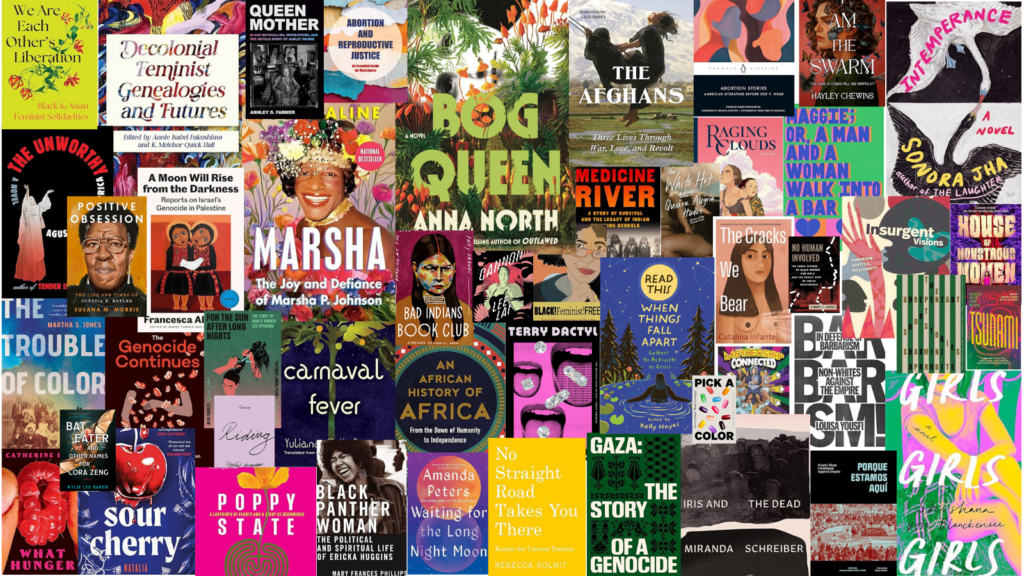
This year, I’m joined by Violet Pandya, of course, and between the two of us, we chose our top 48 titles of 2025.
Because we can’t include all the books, we have been extra selective for the end-of-the-year list. If you’ve read these columns in the past, you know that we focus on books by women and people of the global majority. We also pay extra attention to often underrepresented independent and university presses. This usually means that some very deserving titles that are all over other major lists may not be on ours, and that’s true again this year. Instead, we choose to highlight similarly deserving titles that the other lists have missed.
Thank you so much for your continued readership and support throughout the year. Wishing you a safe, restful, joyful and justice-filled holiday season.
By Marlene Gerber Fried and Loretta J. Ross. University of California Press.
Whether you are new to the concept of reproductive justice (RJ) or have been part of the movement for decades, you will learn a few things from this guide. Written in accessible language, this one is required reading for anyone dedicated to bodily autonomy and sovereignty now and into the future.
*
Edited by Karen Weingarten. Penguin Classics.
Prof. Karen Weingarten and Penguin Classics have collected writings about abortion before Roe v. Wade in 1973. This singular collection includes poems, stories and essays from famous writers, everyday people, providers and more.
*
By Åsne Seierstad. Bloomsbury Publishing.
Through sharing the stories of three Afghan individuals, Åsne Seierstad explores the effects the Soviet occupation, the US “War on Terror” and the Taliban’s return to power in 2021 had on the people of Afghanistan. Deeply researched and empathetically reported, this volume is a monumental modern history of a country about which most Westerners know little.
*
By Zeinab Badawi. Mariner Books.
From Sudan herself, Zeinab Badawi visited over 30 African countries to write this sweeping and accessible new history of the continent. Engaging and enlightening, this volume highlights stories, events, and figures previously misrepresented or neglected, making it this month’s #RequiredReading.
*
By Patty Krawec (Anishinaabe). Broadleaf Books.
Patty Krawec has taken her love of reading, her book club, and her podcast about Indigenous reading and books, and has gifted a guide for anyone looking to better understand Indigenous lives. From history and gender to horror and other fiction, this volume gives you book suggestions but also primes you to reflect on, learn from and talk about those books in new, nuanced and inspiring ways.
*
By Kylie Lee Baker. MIRA.
In this subversive and darkly comical horror, Cora Zeng contends with her sister’s death, hungry ghosts, a serial killer and anti-Asian hate—all during the pandemic. While it speaks to important topics such as systemic racism and police brutality, it also gives you all the gore you’re looking for.
*
By Beverly Guy-Sheftall. Third World Press.
BLACK!Feminist!FREE! gathers the work of the incomparable Beverly Guy-Sheftall in one robust volume. Reflections on Coretta Scott King, bell hooks, Alice Walker and Toni Cade Bambara are among the most powerful, but consider the entire volume required reading.
*
By Mary Frances Phillips. NYU Press.
This groundbreaking volume is more than the first book-length treatment of Ericka Huggins; it is a revelation. While she covers much more, Phillips’ most poignant contribution here focuses on Huggins as a spiritual seeker and leader.
*
By Anna North. Bloomsbury.
The latest novel by Anna North explores questions of environmentalism, tradition and whose stories are told and remembered. Told from several perspectives, we not only hear from present-day Agnes, a forensic anthropologist called upon to identify a body found in a bog, but also from an Iron Age druid and from the bog’s moss itself, as North gives a powerful voice to a sacred witness.
*
By Lee Lai. Drawn and Quarterly.
Cannon is a chef dealing with a sick, formerly abusive grandfather, an avoidant mother, a selfish best friend and a stressful job. As she explores friendship, family and self, Lee Lai’s latest graphic novel is exceptionally well-written, drawn and felt. I loved this one.
*
Written by Yuliana Ortiz Ruano. Translated by Madeleine Arenivar. Soft Skull.
This evocative and captivating novel centers on Ainhoa, a young Afro-Ecuadorian girl growing up in the 1990s. Ainhoa tells her story of contending with hardship, poverty, family secrets and male violence while surrounded by dance, music and aunties who protect and support her.
*
Written by Catalina Infante. Translated by Michelle Mirabella. World Editions.
In her moving English language debut, Chilean writer Catalina Infante deftly explores the hopes and heartaches of new motherhood. Composed of short vignettes, this uniquely envisioned narrative pieces together the struggles that political exile, mental illness and familial loss have on Laura, whose restless newborn brings back haunting memories.
*
Edited by Annie Isabel Fukushima and K. Melchor Quick Hall. University of Illinois Press.
Examining radical resistance to racism and settler colonialism, the contributors to this interdisciplinary anthology include Rachel Afi Quinn, Tricia McGuire-Adams (Anishinaabe), Eun-Jin Keish Kim, Azza Basarudin and more. This is a significant collection that both excavates the past and envisions a more equitable future.
*
By Fatemeh Jamalpour and Nilo Tabrizy. Pantheon.
In this powerful record of witness, two Iranian journalists tell the story of the Woman, Life, Freedom movement. Sparked by the murder of Mahsa Jina Amini by Iran’s morality police for not wearing a hijab, the women-led movement is beautifully and bravely related here through histories, interviews and personal experiences.
*
Edited by Fatima Bhutto and Sonia Faleiro. Verso.
This crucial anthology offers firsthand accounts of the genocide in Gaza and reflects on the importance of storytelling, particularly in life’s most challenging moments. Enraging and heartbreaking to read, it’s imperative we bear witness to the atrocities and act upon the glimmers of hope.
*
By Karen Stote. Fernwood Publishing.
Karen Stote’s latest is a powerful examination of what some have called conspiracy theory. Stote provides evidence that control over land and resources has and continues to drive the forced and coercive sterilization of Indigenous women.
*
By Shoshana von Blanckensee. G.P. Putnam’s Sons.
A breathtaking coming-of-age debut that had me laughing, crying and growing alongside Hannah as she navigates her new life in San Francisco. A story full of highs and lows, Shoshana von Blanckensee deftly depicts ways to be young, queer and Jewish, all while navigating life, death and what it means to be frei.
*
By Daphne Fama. Berkley.
As an uprising brews in 1986 Philippines, Josephine finds herself playing for her life in this haunting gothic horror. Pitted against her brother and best friends in a childhood game turned deadly, her struggle for survival eerily parallels the ongoing events of the People Power Revolution.
*
By Hayley Chewins. Viking Books for Young Readers.
I’m struggling to find the best way to describe this unique coming-of-age novel in verse, mostly because I loved it so much. Read the back of the book and just know that it’s full of emotion, rage, fear, sadness, relief, love and hope all at once. This exquisitely raw masterpiece is not only already one of my favorite reads of 2025 but one of my favorites, period.
*
Written by Louisa Yousfi. Translated by Andy Bliss. Verso.
To say this may be one of those essays that marks a turning point in my life would not be overstating its influence. First published in France as Rester barbare, this powerful piece builds on Algerian writer Kateb Yacine’s call to “retain a certain barbarism” in the face of violent domestication, imperial conditioning and forced assimilation.
*
By Chandra Talpade Mohanty. Duke University Press.
Consisting of individual and co-authored essays, as well as one interview, the latest exceptional work by Chandra Talpade Mohanty focuses on an insurgent feminism that incorporates anticapitalist, antiracist, anti-imperialist, and militant resistances to the status quo. Sharing over two decades of wisdom and experience, Mohanty looks back to move into imaginative and liberatory futures.
*
By Sonora Jha. HarperVia.
Sassy, subversive, and oh-so-scintillating, this one-of-a-kind feminist novel is a meditation on marriage, masculinity, midlife, and everything in between. With a captivating narrator and a cast of loveable characters, Sonora Jha provides the perfect satirical escape.
*
By Miranda Schreiber. Book*hug Press.
In this lyrical and original autofiction debut, Miranda Schreiber explores the coming out process of a young woman contending with depression, intergenerational trauma and an exploitative relationship with the person she looked to for help. Schreiber bravely reckons with themes of power, trust, love, loss and transformation.
*
By Katie Yee. S&S/Summit Books.
Told in small fragments, anecdotes, and reflections, this debut novel tackles grief, heartbreak and coming to terms with the unimaginable with the best medicine out there: laughter. At times joyful and loving, at others solemn and contemplative, Katie Yee deftly utilizes dark humor as a form of defiance in times of personal hardship.
*
By Tourmaline. Tiny Reparations Books.
Written by Tourmaline, this is the first definitive biography of Marsha P. Johnson. This long-overdue biography is one of highs and lows, the activist and the artist, the lover and the fighter. Throughout it all, Tourmaline allows Marsha’s light to shine as bright and colorful as the flowers Queen Marsha wore like a crown.
*
By Mary Annette Pember (Red Cliff Band of Wisconsin Ojibwe). Pantheon.
Journalist Mary Annette Pember has been writing about violence, health and trauma in the Native community for many years, and her expertise is on full display here. There’s no one more equipped to cover the tragedy of boarding schools, their lasting legacy and the survivance of those forced to attend.
*
By Francesca Albanese. Pluto Press.
Since 2022, Francesca Albanese has served as Special Rapporteur on the situation of human rights in the Palestinian Territory. In that time, she has written three major reports and spoken out endlessly about Israel’s egregious violations of Palestinian human rights and the West’s complicity in the genocide. This volume compiles those reports, along with additional information and an introduction written by Albanese.
*
By Seth Neblett. University of Texas Press.
This is the long-overdue story of the women of the legendary funk band Parliament-Funkadelic, including Lynn Mabry, Dawn Silva and the author’s mother and “Queen of Funk” Mallia Franklin. Through fascinating interviews with the women and icons like George Clinton, Sly Stone and Bootsy Collins, Seth Neblett has compiled an unbelievable archive full of strength, humor, tea, shade and yes, funk.
*
By Cheryl L. Neely. Beacon Press.
In this urgent and necessary volume, sociologist Cheryl L. Neely examines the infuriating and terrifying impacts of racial prejudice in policing. Through meticulous research and poignant storytelling, Neely shines a spotlight on the victims of crime and demands we contend with police indifference to violence against Black women and girls.
*
By Rebecca Solnit. Haymarket Books.
This collection comprises previously published essays, brought together in a single memorable volume. From antique violins and fairytales to COVID and climate, Solnit’s reflections remind us that uncertainty is the only thing you can count on and that welcoming the meandering is the only way to go.
*
By Souvankham Thammavongsa. Little, Brown and Company.
Reflective and subversive, this profound novel explores the barrier between customer and worker, as well as the divide between the privileged and the wanting. Following Ning at her nail salon, this one-day snapshot considers what we see on the surface, and what might be hiding underneath.
*
By Myriam Gurba. Timber Press.
The latest by writer and activist Myriam Gurba is a raw yet delightful lesson for our time. Gurba masterfully blends ecofeminism, memoir, humor, candor, plant love and Indigenous knowledge into one of the most unique and captivating books I’ve read this year.
*
Edited by Jessica Nydia Pabón-Colón. The Feminist Press at CUNY.
This triumphant collection examines Puerto Rican feminisms, histories, collectivity and action as necessary antidotes to imperialist white supremacist capitalist patriarchy. Serving as a serious call to action, this volume includes essays, manifestas, poems and reflections by Jessica Nydia Pabón-Colón, Aurora Santiago Ortiz, Iris Morales, Aurora Levins Morales and more.
*
By Susana M. Morris. Amistad.
In her latest phenomenal work, Susan M. Morris situates the indomitable Octavia Butler within the major historical issues of the times and explores the influence they had on Butler’s life and work. Through deep archival research, Morris offers new, nuanced and sensitive insights into Butler’s life.
*
By Ashley D. Farmer. Pantheon.
“Queen Mother” Audley Moore led a remarkable life as one of the country’s foremost Black nationalists and reparations activists, yet most of us have probably never heard of her. Through meticulous research and compelling narrative, Ashley Farmer lovingly explores Moore’s life and lasting legacy.
*
By Yudori. Fantagraphics.
This debut by Korean comic book artist Yudori is the mid-16th-century Sapphic feminist fantasy graphic novel of my dreams. In rich and sensuous illustrations, Yudori tells the story of a woman in a non-consensual marriage and the liberating relationship she develops with her husband’s enslaved mistress.
*
Edited by Kelly Hayes. AK Press.
In their latest, Kelly Hayes and 19 other organizers contribute letters to those of us struggling to stay afloat in our own activism, relationships and daily lives. Not a guide, this volume is a salve for the wounds we incur when doing the work, and its contents are the love and encouragement we need to continue tending the fires of resistance.
*
By Pardis Mahdavi. Duke University Press.
What you get from this slim memoir is so much more than the beauty and empowerment of horseback riding. Lovingly articulated, Mahdavi’s absorbing message to readers centers on balance, freedom, feminism and home, even against a backdrop of tragedy and trauma.
*
By Natalia Theodoridou. Tin House.
Words used to describe Natalia Theodoridou’s debut novel examining gender, abuse and toxic masculinity: subversive, transgressive, hallucinatory, haunting, razor-sharp and “a dark delight.” And after reading it, I can tell you it’s all of those and more. I would add wickedly wonderful.
*
By Mattilda Bernstein Sycamore. Coffee House Press.
In her signature style and kaleidoscopic prose, Mattilda Bernstein Sycamore’s latest novel features club kid Terry, the trans daughter of a lesbian couple who grew up surrounded by queens and queers in the midst of the AIDS crisis. With themes of art, love, loss, friendship, identity and connection, this is a fierce fever dream of a book.
*
By Martha S. Jones. Basic Books.
The latest book by one of my favorite historians, Dr. Martha S. Jones, is a memoir of her family across race, place and generations. Not only did this one scratch my genealogical and research itches, but it is also full of intriguing storytelling, profound candor and collective care.
*
Translated by Heather Cleary, Gabriela Jauregui, Julianna Neuhouser, Gabriela Ramirez-Sanchez and Julia Sanches. The Feminist Press.
From historical essays and theoretical reflections to poetry and experimental pieces, the works included here illustrate the depth and breadth of the feminisms, knowledges, concerns and queries of Mexican and Latin American women.
*
By Sharmini Aphrodite. Gaudy Boy, LLC.
In this debut collection, Sharmini Aphrodite writes stories about a history many of us in the West may be unfamiliar with: the Malayan resistance to colonial violence and the repression of leftist independence movements. Including themes of love, memory, perspective and sacrifice, this collection is as beautiful as it is captivating.
*
Written by Agustina Bazterrica. Translated by Sarah Moses. Scribner.
If you like horror, you’re going to love feminist horror. This one centers on a woman in a secret religious order in the midst of climate crisis, violence and extremism. I was so taken from the first page that I swallowed it down in one gulp.
*
By Amanda Peters (Mi’kmaq). Catapult.
Amanda Peters has written this searing and insightful collection of stories highlighting Indigenous lives and experiences. If you enjoyed Peters’ The Berry Pickers, don’t miss this one.
*
Edited by Rachel Kuo, Jaimee A. Swift and TD Tso. Haymarket Books.
A collaborative project between Black Women Radicals and the Asian American Feminist Collective, this groundbreaking anthology features essays, interviews, poetry, and more from writers, organizers, artists and others. Full of depth and breadth, this volume is one to learn from, sit with and act on.
*
By Catherine Dang. Simon & Schuster.
Full of body horror unlike any other, this tale tackles female rage and generational trauma with a Jennifer’s Body spin. Following Ronny after the death of her older brother, What Hunger ties up mother-daughter relationships, teenage growing pains and a craving for flesh, with a bright red, bloody bow.
*
By Quiara Alegría Hudes. One World.
I just finished reading the latest novel by Pulitzer Prize winner Quiara Alegría Hudes in one sitting. To say I am moved, astonished and gutted would be an understatement. This is a stunning, heart-wrenching and unforgettable story of motherhood, intergenerational trauma and forgiveness like no other.
Great Job Karla J. Strand & the Team @ Ms. Magazine Source link for sharing this story.