

Nelson Locke thinks he might have inspired some of this.
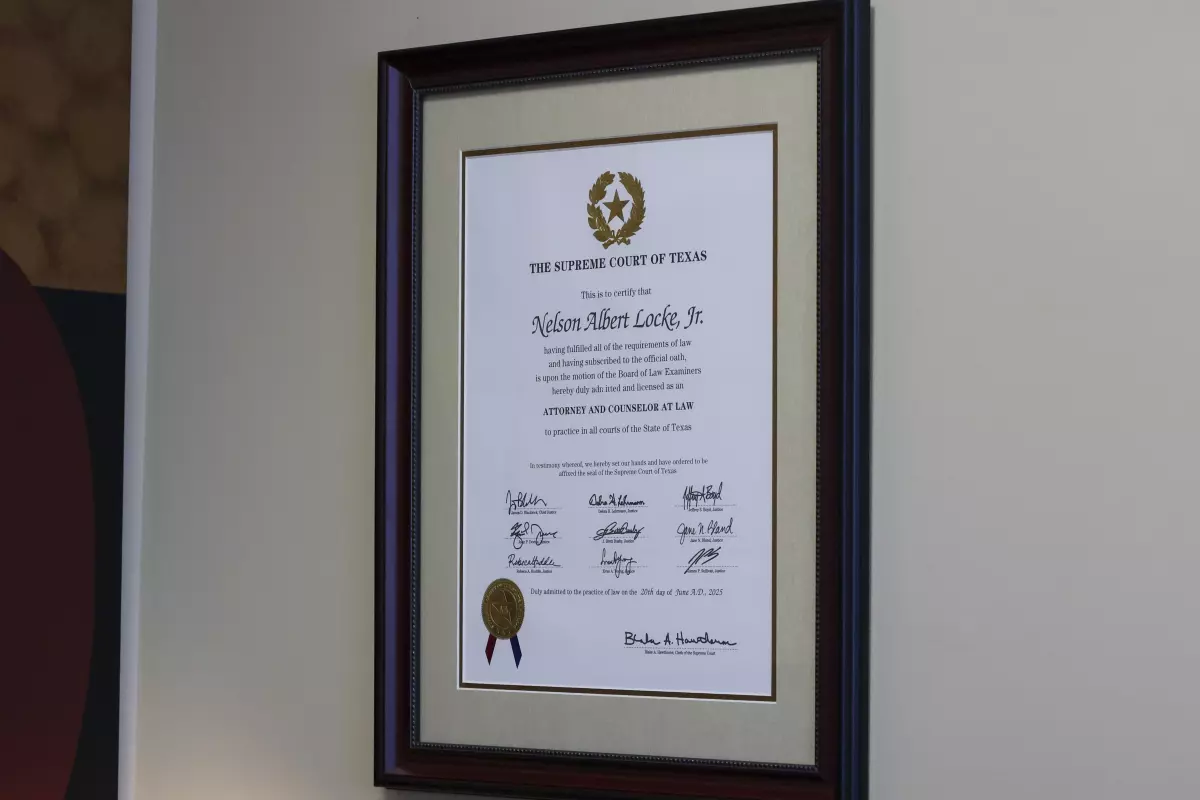
The 75-year-old lawyer spent three years asking the Texas Board of Law Examiners to admit him to the state bar without requiring him to take the bar exam. The Marine Corps veteran had 20-plus-year careers in retail and mortgages before he graduated from Purdue Global Law School at 61.
The board wouldn’t waive his exam requirement because Purdue Global is a fully online law program that wasn’t accredited by the American Bar Association — or any state bar at the time.
“That’s what started this whole thing,” Locke told KERA News in an interview. “Because I realized that — if I can quote from Star Wars — the force was strong here, OK? I was going to achieve my goal, and it was in every fiber of my body.”
Then in April, the Texas Supreme Court announced they’d reconsider whether the ABA should have the final say over which law school graduates can become licensed lawyers. Two months later — after years of Locke’s applications, lawsuits and petitions to the court — justices signed a certificate admitting Locke to the state bar, finding he met the criteria necessary to become licensed without taking the bar exam.
And earlier this month, Texas became the first state to end its reliance on the ABA for law school approval, which could allow graduates of non-ABA-accredited schools to become licensed lawyers in the state.
“Why do we even have the ABA? Can we have non-ABA schools, and how easily should we allow them to come in? And could there be other accreditation models?” Locke said. “All of those things, those are all arguments we made.”
A spokesperson for the Texas Supreme Court denied Locke’s case was connected to the court’s split from the ABA. The Texas Board of Law Examiners declined to comment.
Still, Locke’s not alone in his opinion about the national legal organization.
The court’s decision and a similar move by Florida have exposed divided sentiments about the ABA among lawyers and legal scholars across the country. Some, like Locke, see the ABA as a gatekeeper stifling innovation that could make the profession more accessible.
Others defend the ABA as bringing uniformity and credibility to legal education. They worry about the fragmentation and confusion this change could bring for law students down the line — and the political implications of denouncing the ABA.
What’s the point of the ABA?
The ABA is a voluntary professional association for lawyers. For decades, the association’s stamp of approval has given law schools prestige and imposed nationwide standards.
ABA accreditation mattered a lot when Dallas attorney Bria Riley was applying to law school, she said. The organization also provides resources, scholarships, internships and fellowships for students.
“It was a huge factor, if not one of the lion’s share factors that I considered when I was thinking about what law schools should go to,” Riley said. “Mainly because if the law school was not accredited, I wasn’t sure if the rigors of the legal program would pass muster and if that could somehow deter me from being able to pass the bar exam.”
The Council of the ABA Section on Legal Education and Admissions to the Bar is the independent organization under the ABA umbrella that has officially accredited law schools since 1952. The council is currently proposing changes to its bylaws to further distinguish itself from the larger ABA to avoid confusion.
“The purpose of that when it started was to ensure that there was some quality control at a time when law schools were very, very different, and some just weren’t that good,” said Austen Parrish, dean of the University of California, Irvine School of Law. “Having ABA accreditation is a seal of approval that increases the prestige.”
In many states, only graduates from ABA-accredited schools can take the state bar exam and become a licensed lawyer there. That’s not the case everywhere — in California, for example, aspiring lawyers can also attend law schools accredited only by the state and earn licensure.
The Texas Supreme Court, like other state supreme courts, has long set the rules for who gets admitted to the state bar. The court decided which law schools were approved for licensure until 1983, when it handed that responsibility over to the ABA. The court’s order earlier this month takes that power back.
Daniel Thies, chair of the ABA Section on Legal Education and Admissions to the Bar, said in an interview with KERA News that Texas’ order doesn’t change much in the short term. Texas isn’t the only state to explore alternatives or supplements to ABA accreditation.
“The supreme courts, of course, are entitled to do that,” Thies said. “They are the ones who are in charge of regulating the bar in each of their states, and the council’s role is really to assist them in that job by helping them determine which schools are graduating students who are qualified to sit for the bar in the various states.”
Why the ABA fell from grace — for some
The ABA has been criticized as shifting left for years. Since 2001, presidents have yo-yoed between letting the ABA vet federal judicial nominees and banning them from the process due to conservative criticism that the association showed liberal bias.
President Donald Trump’s second administration has brought that criticism to the forefront again. Trump began last year signing executive orders targeting diversity, equity and inclusion policies in the public and private sectors — initiatives meant to address historical inequities in the workplace and academia.
Then, Attorney General Pam Bondi sent a letter to the ABA in February stating the organization’s requirement that law schools show a commitment to diversity and inclusion — also known as Standard 206 — conflicts with the 2023 U.S. Supreme Court decision ending affirmative action in college admissions, Students for Fair Admissions (SFFA) v. Harvard. The letter also threatened to take away the ABA’s ability to accredit law schools.
The ABA accrediting council voted in May to suspend the standard until August 2026 because of Trump’s executive orders and a letter from the U.S. Department of Education. Thies said the council’s been debating whether it’s appropriate to continue enforcing the rule.
To Parrish, of U.C. Irvine, concerns about the ABA enforcing diversity and inclusion standards could be resolved by the states and the ABA working together instead of doing away with ABA approval altogether. He also said the Trump administration’s view of DEI misconstrues the law.
“I think most people believe — and I think this is true regardless of political leanings — that legal education and higher education should be open for all,” Parrish said. “The Trump administration has interpreted that much more broadly to suggest that this is affirmative action along the lines of what was decided in the (SFFA) case. There’s lots of politics around that, but that’s not really what most of accreditation is about.”

The Texas Supreme Court is no stranger to ABA criticism. During his first State of the Judiciary address last February, a speech the court’s chief justice gives to lawmakers every legislative session, Chief Justice Jimmy Blacklock warned the State Bar to remain politically neutral — unlike the ABA, which he said was “aggressively taking sides” in the fight over the scope of Trump’s executive power.
“The ABA is just a private membership organization that’s entitled to speak its mind,” Blacklock said. “It has a particular point of view, and its views, as far as I’m concerned, ought to carry no more weight than those of the ACLU or the Federalist Society or any other opinionated interest group.”
The high court declined to comment on whether the ABA’s political stances were part of the reason the court chose to dampen its influence in Texas, but the court said in its latest order it would guarantee approval to schools that satisfy “simple, objective and ideologically neutral” criteria.
But criticism of the ABA isn’t strictly conservative or even political. Andrew Morriss, a Texas A&M University law and international affairs professor, ushered the school through the accreditation process when he was dean of the university’s law school from 2014 to 2017.
Every 10 years, the ABA Council conducts sabbatical site reviews at approved law schools to ensure they’re still up to par. Morriss said that required six to nine months of gathering and preparing information ahead of time on finances, syllabi and data — which cost his staff a lot of time and money.
And other times, when Morriss served on ABA teams evaluating other schools, he said he didn’t feel the ABA had the power to do anything meaningful in changing how a school operated.
“I’m not convinced the ABA process — which is cumbersome, time-consuming, and expensive — actually adds any significant quality check to law schools,” Morris said.
Thies with the ABA council, however, said the team has worked on making the process less burdensome, though not every school has seen those changes yet.
“Sometimes when people criticize the process, they’re thinking about the way it was 10 or more years ago,” he said. “We’ve made some changes, we’ve streamlined it, we’ve allowed schools to interact with our staff earlier and more often to address problems so that there are fewer reportbacks and fewer issues.”
Rethinking ‘sacred cows’
By several counts, education has only become more expensive for law students. And low-income Americans who need lawyers often can’t afford the help they need, according to a 2022 report by the Legal Services Corporation.
Martin Pritikin, dean of the fully online Purdue Global Law School, sees a clear tie between the steep costs of going to law school for three years, the resulting student loan debt, the high rates attorneys charge and inaccessibility of those services for low-income Americans.
Pritikin argued the ABA has stifled efforts that could help broaden access to legal education as well as access to lawyers in legal deserts — the ABA won’t accredit law schools that don’t have a brick-and-mortar building. He said states relying less on the association is the first step toward innovation.
“What we are seeing right now is the most dramatic change in licensure and the legal profession that this country has seen in many decades, probably since the Great Depression, almost a century ago,” Pritikin said. “States are finally starting to rethink sacred cows that have been in existence before many people were born.”
In addition to online education, lawyers and scholars have suggested innovation in the form of allowing apprenticeships or work experience instead of law school, letting people go to law school for fewer years.
This doesn’t mean it should be easier for low-quality law schools to earn accreditation, Pritikin said, and he’s not calling for the end of the ABA. He instead points to alternate accreditation systems, like California’s state accreditation process or Connecticut’s model of letting the state board of law examiners approve law schools.
Others say it’s not that simple. Bobby Ahdieh, current dean of the Texas A&M University School of Law, said the ABA could be more flexible with its standards, but the organization isn’t to blame for completely limiting innovation and access to justice in the legal field.
He also points to data that shows California’s accreditation system isn’t always on par with the ABA. Of those who took the California bar exam in July 2022, the pass rate among graduates of ABA-accredited schools was 67%, according to a State Bar of California report. The pass rate for graduates of California-accredited schools was just 21%.
“We want to make sure that whatever system we put in place in Texas — and depending on what flexibility the ABA introduces across the country in other states as well — that it’s in fact going to achieve the results that we want as opposed to it’s just innovation for the sake of innovation,” Ahdieh said.
What it all means for law school graduates
Deans from eight of the 10 ABA-accredited law schools in Texas signed on to a letter to the Texas Supreme Court in June asking justices not to end the reliance on ABA approval. Removing ABA accreditation, they said, could double the compliance burdens, make Texas law schools less competitive and reduce data available to prospective students.
Now, several say nothing much will change.
In emailed statements to KERA News, the University of Houston Law Center, the University of Texas School of Law and St. Mary’s University said they intend to maintain ABA accreditation. The South Texas College of Law will work with both the Texas Supreme Court and the ABA, a spokesperson said.
Dean Leonard M. Baynes of UH said ABA accreditation remains “the gold standard.”
“It remains important for ABA accredited law schools in the state to clearly communicate that 1) the order does not create any immediate substantive effect, and 2) if an applicant enrolls in an ABA accredited Texas law school, their degree remains fully portable allowing them to practice anywhere in the nation,” Baynes wrote.
Baynes acknowledged the ongoing debate over whether state accreditation would make law school cheaper or just lower the quality of law schools, but he didn’t take a clear stance.
The Texas Supreme Court will work with the Texas Board of Law Examiners on how to approach requests from current ABA-accredited law schools who want to be added to Texas’ list, according to the court’s Jan. 6 order. But that list remains the same as it was before, and the court said it doesn’t anticipate immediate changes.
Ahdieh, from Texas A&M, said it probably won’t be long before the court starts reworking school approval standards and potentially adding more schools to its list. What he doesn’t see, however, is the court beginning the sabbatical site review process.
“That’s a bureaucracy,” Ahdieh said. “Do I think that the Texas Supreme Court or others are likely to build out that entire bureaucracy internally? Seems unlikely to me.”
The final order indicates the court will still enforce some ABA standards: a minimum 75% bar passage rate for students, using an admission test like the LSAT and consumer disclosures.
Mortgage lawyer Locke’s advice to anyone concerned about the Texas Supreme Court’s decision signaling negative change: “take a chill pill,” and see what good the future can hold.
“We are changing the shape of the educational delivery system for law schools in the United States,” Locke said. “I’m honored to have been able to help with this. I just wish I had probably a few more years, but it is what it is.”
Toluwani Osibamowo is KERA’s law and justice reporter. Got a tip? Email Toluwani at tosibamowo@kera.org.
KERA News is made possible through the generosity of our members. If you find this reporting valuable, consider making a tax-deductible gift today. Thank you.
Great Job & the Team @ Houston Public Media for sharing this story.