

A stunning video obtained by NBC 5 Investigates highlights concerns about drinking and driving in the era of high-tech vehicles, as more cars offer features that can steer and brake with limited driver input.
Some in law enforcement worry that those technologies may tempt drivers to take more risks, including getting behind the wheel after drinking, while believing their vehicle will help get them home safely.
Police said a video recorded onboard a Tesla driving down a dark Texas highway in 2021 showed the car on autopilot, steering itself, when it suddenly slammed into stopped law enforcement vehicles, injuring five officers and a person they had detained during a traffic stop.
TxDOT
TxDOT Video recorded from a Tesla shows the vehicle slamming into two stopped law enforcement vehicles in Texas.
NBC 5 Investigates obtained the dash camera video from on board the Tesla, which had never been released publicly, from Texas state police who were called in to investigate the crash. The case has become one of the first in Texas to raise questions about drinking, driving and semi-autonomous vehicles.
Doug Murphy is the driver’s attorney. Murphy said police arrested his client and initially charged him with intoxication assault after they said he failed a field sobriety test.
The driver acknowledged having drinks at a business event before heading home, but insisted he was not intoxicated. According to a police report, a blood test taken several hours after the crash showed a blood alcohol level of .06 — below the legal limit of .08.
“His first instinct was, he said, ‘I had a false sense of security, and I relied upon the autopilot,’” Murphy said.

Edward Ayala, NBC 5 Investigates
Edward Ayala, NBC 5 Investigates Doug Murphy, an attorney representing the Tesla driver.
Police later downloaded data and video from the Tesla. According to a TxDPS investigator’s report, the driver “swerved within his lane and almost struck the wall before putting the vehicle on autopilot.”
Once engaged, police said the car recorded 152 instances in which the driver’s hands were not on the steering wheel.
Murphy said his client fell asleep and later woke up stunned to find he had crashed, despite believing the technology would help prevent a collision.
“People are excited about this technology that might bring us into the Jetson era, if you will, but the truth is, we’re not even close to being there yet,” Murphy said.
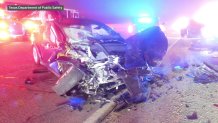
TxDOT
TxDOT A crash scene photo shows a Tesla sedan after it crashed into two stopped law enforcement vehicles.
Murphy also said the driver was not relying on autopilot to compensate for drinking but believed the vehicle would brake in an emergency, if he could not.
Officers injured in the crash are now suing Tesla, claiming the Autopilot system “failed to detect the officers’ cars” and prevent the collision.
Tesla did not respond to questions from NBC 5 Investigates. In court filings, the company’s attorneys said they believe the driver’s blood alcohol level was higher at the time of the crash, arguing he “was legally intoxicated.” They also said the driver was “completely disregarding all instructions and warnings Tesla provides regarding the proper use of Tesla’s Autopilot.”
On its website, Tesla warns that Autopilot is not intended to replace the driver, stating it is the driver’s responsibility “to stay alert, drive safely and be in control of your vehicle at all times.”
So who is responsible when a semi-autonomous car crashes — the driver or the car?
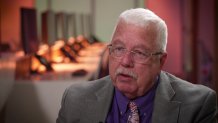
Veteran crash investigator Tim Lovett, a consultant to Texas district attorneys, said responsibility still lies with the person behind the wheel.
“The person in the seat. That’s the end product,” Lovett said.
Lovett was not involved in the Montgomery County case, but said he fears many drivers do not read or follow manufacturer warnings and may not realize that, under Texas law, drivers are still legally responsible even when a car assists with driving.
“There’s no, I got a get out of jail free card because I was on an automated system. It doesn’t work that way,” Lovett said.
Edward Ayala, NBC 5 Investigates
Edward Ayala, NBC 5 Investigates Crash investigator Tim Lovett.
As more automakers add features like adaptive cruise control and steering assistance, Lovett worries more drivers may drink, believing the vehicle will provide a safety boost. He said current systems may not respond to every hazard and can suddenly disengage if drivers fail to touch the steering wheel or follow other prompts.
“If you’re not prepared to take it [the wheel], it’s not a DWI safety tool,” Lovett said.
NBC 5 Investigates also wanted to know how often drivers are drinking and crashing while using some form of vehicle automation. A review of crash records maintained by the Texas Department of Transportation showed it is a difficult question to answer.
Texas crash reports did not require officers to document vehicle automation use until three years ago. Since then, police have recorded more than 17,000 crashes in which a driver was reported to be using some form of automation. However, determining fault would require reading each report individually to know if the driver of the semi-automated vehicle caused the crash.
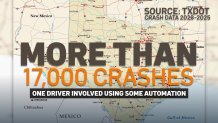
Edward Ayala, NBC 5 Investigates
Edward Ayala, NBC 5 Investigates
NBC 5 Investigates identified six cases in which reports indicated a driver suspected of being under the influence of alcohol caused a crash while using Level Three automation, where the vehicle handles steering and braking. When NBC 5 contacted the investigating departments, most said in hindsight the reports were incorrect and that police officers either made mistakes or lacked enough information to determine whether automation was actually engaged at the time of the crash.
One of those crashes occurred in Frisco, where police said an officer mistakenly marked that a drunken driving suspect was using automation. The department said officers have been gaining experience in recent years in completing that section of the report and often do not have access to onboard vehicle data in less serious crashes.
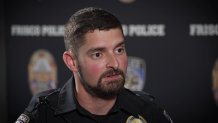
“It can get very confusing because there’s five different levels of automation,” said Sgt. Ryan Thomas with the Frisco Police Department.
Thomas said the department suspects that more drunken driving suspects arrested on traffic stops are using features like advanced cruise control systems, though officers do not routinely access vehicle data to confirm the suspicion. In some cases, he said, they may view the vehicle display or question the driver about the use of those systems.
“It’s definitely a concern, especially with how common the automation in vehicles is becoming,” Thomas said.
Edward Ayala, NBC 5 Investigates
Edward Ayala, NBC 5 Investigates Frisco police Sgt. Ryan Thomas.
In the Montgomery County crash, the intoxication assault charge against the driver was later reduced and ultimately dismissed after he completed probation under a deferred adjudication agreement. Attorneys familiar with the case told NBC 5 Investigates that questions about the role technology may have played in the crash complicated the prosecution and factored into that outcome.
“Don’t get that false sense of security,” Murphy said.
Murphy said the case should serve as a warning to anyone tempted to believe technology can be trusted to get them home after drinking.
“That’s the biggest fallacy around. You’re not safe for drinking and then driving if you’re going to rely upon the auto technology,” Murphy said.

Edward Ayala, NBC 5 Investigates
Edward Ayala, NBC 5 Investigates Doug Murphy, left, talks with NBC 5 senior investigative reporter Scott Friedman.
There is hope that fully autonomous vehicles could one day reduce drunken driving, and in a robo-taxi, a passenger would obviously not be responsible in a crash. Two years ago, Congress also directed the National Highway Traffic Safety Administration to establish rules requiring automakers to install technology that detects and prevents drunken driving in new vehicles, though that effort is still underway.
In the meantime, NBC 5 Investigates found it remains difficult to determine how often drivers are getting into trouble by drinking and relying on vehicle automation. Police said that information on vehicle automation is not widely recorded in DUI arrests where no crash occurs, and crash report data related to automation may not yet be reliable.
Great Job Scott Friedman, Eva Parks, Edward Ayala and Frank Heinz & the Team @ NBC 5 Dallas-Fort Worth for sharing this story.