

I’m not prepared to say goodbye to Rev. Jesse Louis Jackson Sr., and maybe neither should you. He lived by the motto, “never surrender.” He once told me that people drown not because of the water, but because “they stop kicking.”
He died at 84, in the early hours on Feb. 17, in Chicago, a city he loved and to which he devoted his time, care, and exceptional political and economic vision and talent. He was a protégé of Dr. Martin Luther King Jr., the founder and president of the Rainbow PUSH Coalition. He stood tall as one of America’s foremost civil rights, religious and political figures. For over 60 years, he played a pivotal role in virtually every movement for empowerment, peace, civil rights, gender equality, and economic and social justice.
His career was extraordinary. He was a deft and savvy international negotiator, brokering the release of hostages around the world, including Navy pilot Robert Goodman in 1984, hundreds of “human shields” held hostage by Saddam Hussein in Kuwait in 1991, and three U.S. prisoners of war held by Yugoslav President Slobadan Milosevic in 1999.
He was also personable and reachable—he spent time on the popular children’s show Sesame Street, messaging to children, “I am somebody,” teaching the profound value of self-worth and dignity.
Rev. Jackson was an advocate for the poor; he knew what it was to be shut out and shut down by the nature of birth. He was born in the throes of Jim Crow, on Oct. 8, 1941, in Greenville, South Carolina—a state that permitted the brandishing and selling of Black bodies straight off slave ships, and the one with the largest slave auctions and ports of entry in the nation.
As he related his birth at the 1988 Democratic National Convention:
“I understand. I wasn’t born in the hospital … I was born in the bed at [the] house. I really do understand. Born in a three-room house, bathroom in the backyard, slop jar by the bed, no hot and cold running water. I understand. Wallpaper used for decoration? No. For a windbreaker. I understand. I’m a working person’s person. That’s why I understand you whether you’re Black or white.”
He ran for president in 1984 and 1988, providing a vision of hope for many Americans who needed it. He was known as “the Great Unifier,” campaigning boldly and proudly under a rainbow flag, challenging America to be inclusive and to establish just and humane priorities for the benefit of all. As he told the world, “Our flag is red, white and blue, but our nation is a rainbow—red, yellow, brown, black and white—and we’re all precious in God’s sight.”
He was known for bringing people together on common ground across lines of race, culture, class, gender and belief. In his riveting 1984 speech at the DNC, he explained:
“America is not like a blanket: one piece of unbroken cloth, the same color, the same texture, the same size. America is more like a quilt: many patches, many pieces, many colors, many sizes, all woven and held together by a common thread. The white, the Hispanic, the Black, the Arab, the Jew, the woman, the Native American, the small farmer, the businessperson, the environmentalist, the peace activist, the young, the old, the lesbian, the gay and the disabled make up the American quilt.”
His death marks the heartbreaking end of an era, because he was courageous and bold when so many others were silent.
In 1988, concluding his run for president, he told a packed audience at the DNC, “Gays and lesbians, when you fight against discrimination and a cure for AIDS, you are right, but your patch is not big enough”—urging gay and queer rights activists to unite with other marginalized groups to fight for broader social issues, including economic justice, healthcare and education. Rev. Jackson led by example: He gave his voice and a patch from his quilt to fight the cause at a time in which political gay-bashing, violence, stereotyping and stigma was the norm, in both government and America’s courts.
Today, that vision rings prescient, as international support for HIV/AIDS has been stripped away under the Trump administration and attacks on LGBTQIA+ lives are at a fever pitch. Yet, to Rev. Jackson, this was an intimate issue—it was righteous to care about the queer community.
He cautioned, “Don’t despair. Be as wise as my grandmama. Pull the patches and pieces together, bound by a common thread.”
His sense of America as a common thread, consistently centered women. And his clear and coherent advice was that “we must never surrender to inequality.” Long before the use of the word ally as a shorthand for supporting women’s progress, Rev. Jackson was unequivocal and unmistakable. He urged:
“Women cannot compromise ERA or comparable worth. Women are making 60 cents on the dollar to what a man makes. Women cannot buy meat cheaper. Women cannot buy bread cheaper. Women cannot buy milk cheaper. Women deserve to get paid for the work that you do.”
Few male politicians were courageous enough to speak those truths. While many men may not have believed women should be relegated at the back of the bus or plane, they were also not ready for women to lead and pilot.
He called me ‘Doc’ or ‘Doctor Michele.’ I called him ‘Rev.’
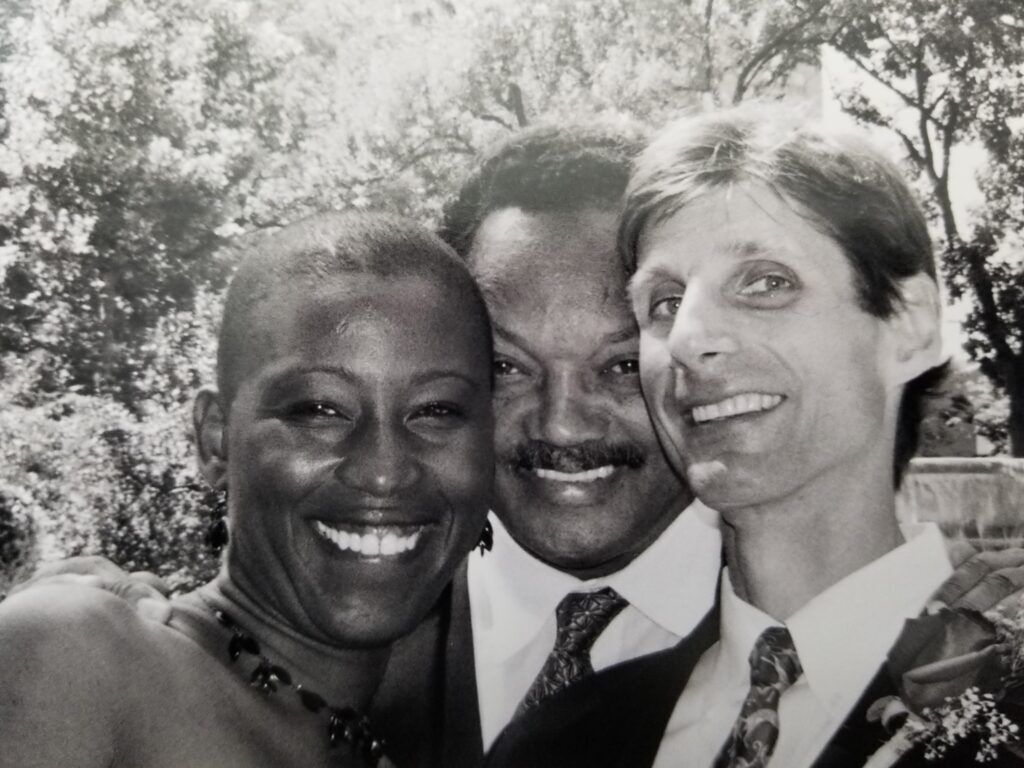
I knew Rev. Jackson beyond the conventions. He married me and my husband, Gregory Shaffer, almost 25 years ago. He always showed up and gave graciously of himself when I called—whether it was to host a convening on HIV/AIDS at Rainbow PUSH in the early 2000s, or to bring together hundreds of working-class residents from the South Side of Chicago to engage on matters of national healthcare, or to meet with (mostly women) academics coming together to figure out the intersections of law, family and reproductive rights at the University of Chicago Club 20 years ago. He called me “Doc” or “Doctor Michele.” I called him “Rev.”
More recently, he responded when I called about the death of Heather Heyer, a civil rights activist who was killed in Charlottesville, Va. It was clear that Americans felt broken and shocked after her death—much like people feel now after the deaths of Alex Pretti and Renee Good.
Heyer’s death marked a critical turning point and rewind of American history. Donald Trump, in his first term, claimed “both sides” were to blame for the violence. However, Charlottesville revealed the contemporary, violent nature of white nationalism—white supremacists abandoning hooded sheets in favor of tiki torches and khaki pants. Flagrant anti-Semitism, racism and deadly violence were on display.

Even with a demanding schedule, Rev. Jackson made time. In a matter of two weeks (or less), he joined me, Rabbi Hillel Cohn, and a packed audience at the Irvine Barclay Theatre, so that we all could process where our nation was heading—the rise of anti-Semitism, the vestiges of racism, and political weakness in addressing both.
I recall walking up a set of stairs together as he shared that he was soon to see a doctor regarding health concerns. Not long after, he was diagnosed with Parkinson’s disease.
A week ago, by his father’s bedside, Rep. Jonathan Jackson (D-Ill.) and I spoke by phone. He had just delivered a speech at the National Prayer Breakfast calling the president to account—to be more humane and just, and to “do what is right.” It was clear that Rev. Jackson’s legacy is already living on.
Listen to Dr. Michele Goodwin read this piece, on a special episode of On the Issues, published on Feb. 17, the day of Rev. Jackson’s death:
Great Job Michele Goodwin & the Team @ Ms. Magazine for sharing this story.