The experts and Ms. contributors assessed the state of the U.S. care crisis and women’s economic inequality in the latest episode of the Ms. podcast Looking Back, Moving Forward—and broke down why investing in women and care workers is good policy.
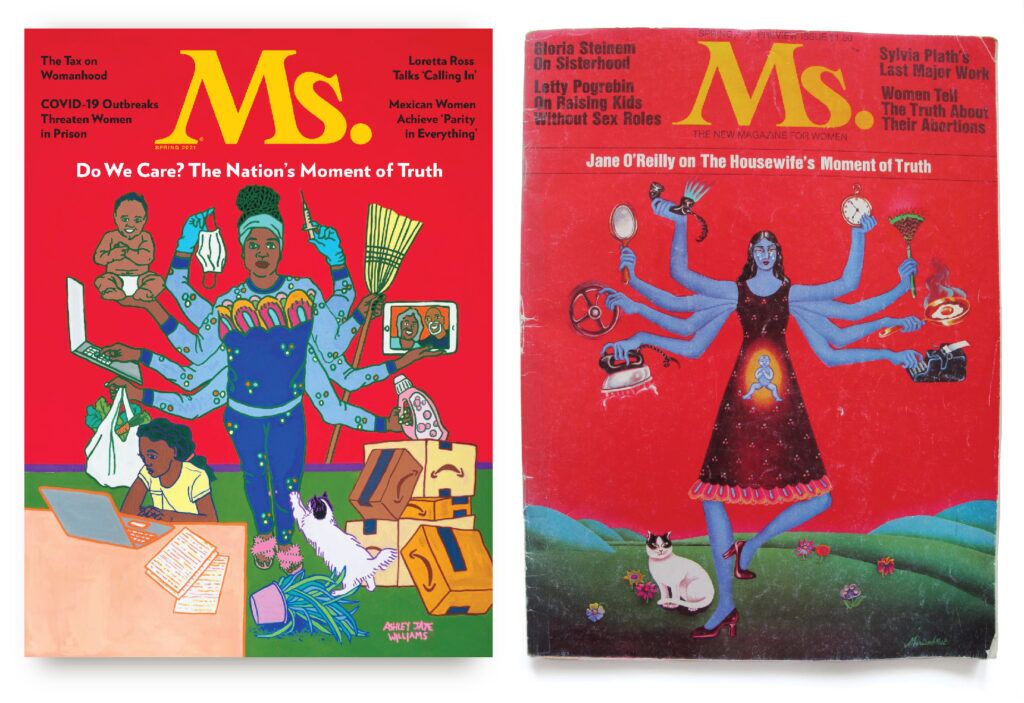
“It’s time for the nation to act on a fundamental truth,” economists Lenore Palladino and Rakeen Mabud wrote in the Spring 2021 issue of Ms. “Our economy and society are stronger when all people can live lives of stability and dignity.”
At the time, the COVID-19 pandemic had exposed the longstanding care crisis in the U.S., and wreaked havoc on women’s economic lives. Unfortunately, the weight of the care crisis has yet to be acknowledged in the way it deserves by the people in power—and women continue to suffer because of it.
Palladino, an assistant professor in the School of Public Policy and the Department of Economics at UMass Amherst, and Mabud, an independent economic consultant, have spent their careers addressing economics at the intersections of gender, race and class. Palladino, before joining UMass, was senior economist and policy counsel at the Roosevelt Institute and vice president for advocacy at Demos; Mabud is the former chief economist and managing director of policy and research at the Groundwork Collaborative and senior director of research and strategy at the TIME’S UP Foundation, and served in the Obama administration Office of Economic Policy at the U.S. Department of the Treasury.
As part of the third episode of the Ms. Studios podcast Looking Back, Moving Forward, I talked to Palladino and Mabud, about the factors that created the care crisis, what has and hasn’t changed since the pandemic, and what we have to do now to advance economic injustice in a time of widespread economic challenges.
Palladino and Mabud are joined in this episode by labor icon Dolores Huerta, Springboard to Opportunities founding CEO Aisha Nyandoro, National Women’s Law Center vice president for education and workplace justice Gaylynn Burroughs, and labor and women’s rights historian Premilla Nadasen. Together, we traced 50-plus years of feminist resistance to workplace discrimination, women’s disproportionate unpaid domestic and care burdens, and the sociopolitical factors that push women, in larger numbers, into poverty—revealing both how the system seeks to devalue all of “women’s work,” and what we can do about it.
Carmen Rios: What led you both to co-authoring the Spring 2021 Ms. cover story on the pandemic care crisis?
Lenore Palladino: At the time, as so many organizing groups and political leaders were talking about how to improve care infrastructure, there was so much conversation about the need to raise wages and increase the quality of care, which are essential, but not as much conversation about how investing in care has a positive impact on the overall economy.
Since Rakeen and I both also spend a lot of time in macroeconomic spaces, where care issues tend to be pretty absent, it felt like a real need, a real gap to bring that part into the conversation, to make it really clear that investing in care strengthens the overall economy. It’s not like, ‘Oh, if we take money away from other things, then maybe children will be better off, but the economy will suffer.’ That’s a total myth. We needed to really puncture that right away.
Rakeen Mabud: When we wrote the piece, we were still deep in the midst of the COVID pandemic. We were still in the midst of a pretty massive policy response to the recession and the pandemic. And, to be honest, crises are opportunities, right? They’re a moment to inject something into the conversation that maybe hasn’t been in the conversation before, and care was suddenly in the spotlight.
Many of us were living off Zoom screens with little children around interrupting us every three seconds, and that brought the caregiving crisis home, quite literally, for people who hadn’t thought about it so much before. All of a sudden, there was a bit of an opening to insert care into this broader economic conversation, to reframe care as infrastructure, as a vital service, vital labor that provides the foundation for all of the rest of our labor, and really advancing the idea that care jobs are job-creating jobs.
When we pay caregivers, when we value that work, it not only ensures that our loved ones are well taken care of—that we’re raising a generation of the future with all the support that they need, or helping people out of this life with all the support that they need—but it has the potential to unleash a lot of productivity that’s pent up, especially for women who, disproportionately, do unpaid care work in particular. That pent-up productivity, when we unleash it, that fuels our economy. That makes our economy stronger and more resilient.
Women actually make most financial decisions in households, but men are the ones who are seen as the experts, and our financial system is shaped around their life cycles.
Lenore Palladino
Palladino: I had a 2- and a 6-year-old at the time. Now I’m remembering writing this piece, in fact, while children, small children were running around.
So much of the conversation among economists and among policymakers about infrastructure has always been about male-dominated infrastructure. It needed to be laid down that we cannot rebuild our economy or build back better, as it were, with male-dominated sectors and not female-dominated sectors—and of course, that’s what ended up happening. It feels pretty tough to reflect on, in many ways, because we didn’t see this work progress.
Rios: What was the reaction to the piece?
Palladino: The analysis specifically about the positive macroeconomic effects of care was cited by the White House. It was something that was utilized by a lot of people who were pushing this agenda within Congress, within the White House. More than anything, the goal was, in the economic analysis piece of it, to be useful to people really trying to push that in the short term. There, of course, we didn’t succeed.
More broadly, within this piece, being part of the way that Ms. is talking about economics, there’s been a lot of hesitancy to talk about macroeconomics among the feminist economics community. I hope that this was a useful intervention in pushing that forward. I should say that’s really within the United States—that’s not the case around the world, it’s really the case here.
Mabud: We, obviously, didn’t come out of the pandemic with universal childcare or huge investments in care, as many of us would have wished, but we saw a reorientation from the Biden administration in seeing care as essential infrastructural labor. That showed up in small places. In conversations I had with colleagues who worked in the administration or who were working closely with them, that was understood—that care is really important. Care is baked into a healthy, functioning economy.
It showed up in the CHIPS and Science Act, which required large manufacturers to plan for providing childcare for their employees. Again—not a panacea, far from the solution many of us were hoping for, but it did have an important effect narratively. That policy intervention made it clear, and provided an anchor in the sand that, without childcare, sectors of the U.S. government that we wanted to support through industrial policies would just never get going. You can’t jumpstart an economy, you can’t jumpstart a sector, you can’t jumpstart green investments if you don’t offer people the basic needs that they need to go to work. It recognized childcare as this essential infrastructural labor.
The other really important conversation that it opened up was that it helped ensure that the industries that we were investing in, precisely because we saw those as the industries of the future, would be open to women—that, all of a sudden, women who disproportionately provide unpaid care would have access to these jobs, would have the supports they needed at work to enter these industries that are rapidly growing and lucrative.
Again: Far from the full-scale solution, the full-scale investments that all of us wanted to see, but this was an important marker of a different way of thinking about care and a different way of approaching care through other channels when we can’t get that big infrastructure investment that we actually want. Those are both things that we discuss in the piece, and it does lay out at least an intermediate step as we work on that bigger universal childcare investment.
When we pay caregivers, when we value that work … that fuels our economy. That makes our economy stronger and more resilient.
Rakeen Mabud
Rios: In the piece, you both talk about the losses that we saw for women, economically, during the height of the pandemic. Five years out from the onset of the pandemic, and four years out from the piece, how are women doing?
Palladino: There were two pieces of this—the investment in the care infrastructure—in terms of childcare and healthcare. The thing, in some ways, that kills me the most, is we had a global pandemic and a deep health crisis that affected every single person in this country, and we don’t have paid sick leave coming out of it. The states that were going to take it on mostly have. Blue states have moved this forward.

I’m scared for the next pandemic. I’m scared for whatever’s going to happen, and the fact that we still don’t have paid leave, we’ve lost reproductive rights, we clearly haven’t moved forward in terms of public support, and in fact, we’ve moved backwards, in terms of everything happening with Medicaid and Medicare right now. It’s pretty bleak.
I do think that, in addition to what Rakeen said, just like a lot of people have a misconception that raising wages will hurt businesses, we were able to make really clear that paid sick leave strengthens a business, as well as giving an employee the actual support they need to get through an illness. That’s another piece where attention on that has, obviously, died down in this political moment, but it’s going to come up again, and we’re going to need to really continue to hammer home these needs that we have, especially at times when we’re affected by society-wide epidemics.
Mabud: I’m really struck right now—who isn’t—by the gutting of Medicaid, by the gutting of Head Start, by the absolutely dystopian stories that you read in the news around reproductive rights.

We’re at a place where we’re back to first principles. We have to protect ourselves in any way possible, because women’s rights, agency, lives, are all under attack. Jobs, too. Tariffs are affecting all of us, and they’re affecting small businesses. We did see a bounceback in women’s employment in the numbers right after the pandemic—that was great—but this is a practice. This is a cultural practice of valuing women and valuing women’s labor and valuing women’s worth and agency and lives, and right now, we’re in a moment where we’re retrenching real fast, and that’s a really scary place to be.
There was this opening, and there was this wellspring of a conversation that happened over the course of the pandemic, where, all of a sudden, women were seen as economic actors and recognized as important, critical economic actors. We’re so far from that conversation, that it feels almost odd to be talking about it right now.
Thinking about this as a multiracial movement is actually essential in terms of understanding that this is not about white, professional-class women employing women of color. This is about care workers from all communities in the United States.
Lenore Palladino
Rios: There is this powerful argument you make in this piece, that caregiving needs to be seen as a shared priority—that, even though we see it packaged up as this individual problem, it’s an individual problem everyone has, so it’s a collective problem. What do you think needs to happen to shift that narrative? What reforms or culture change can we set our sights on to accelerate that?
Palladino: I can offer one. Another piece that I wrote, with Rhiana Gunn-Wright, for the Feminist Green New Deal Network, was making the argument that we’re in this circular problem in which care jobs are low paid and not respected in society, so men won’t take them on—but at the same time, these are the jobs of our economic growth and prosperity going forward. It is the care sector. It is the healthcare sector.
We are moving into what academic Fred Block calls the habitation economy. We don’t live in an industrial economy anymore. We live in an economy that’s about maintaining the infrastructure of our lives. I don’t think we can get men to see themselves as taking on the necessary care jobs without raising their quality as jobs. I also don’t think we will raise their quality as jobs until men start to take them on. That’s a place where we’re stuck, but it’s also a real opening if policymakers can get themselves out of the 20th century.
We are not going back to a post-Fordist manufacturing economy. Tariffs aren’t getting us there, but we’re not getting there no matter what, because that’s not what we need as a society. If we can recognize what we actually need as a society and push forward on making care jobs well-respected jobs that are decently paid and people have dignity and respect at work, that are heavily unionized—that’s why people love manufacturing jobs. It’s not because they’re fun. It’s because they’re heavily unionized, they have a decent quality of life, and more than anything, what a union provides is dignity and respect at work. It’s not just about wages and working conditions.
I’m on my soapbox, but I really think that framing care work not as something that’s about the home, but is about our economy, and the jobs that we have now, and the jobs that we’re going to have in the future, and making them quality jobs so that men will take them, is actually key.
Our economy is so extremely different around the country, and the parts of our country that have been left behind economically—you hear that over and over again—that’s where there are schools, and there are childcare centers, and there are hospitals being shut down right now. Investing in those would be a really important way to move this whole conversation forward.
Mabud: It feels a bit funny to be talking about men so much on a Ms. magazine podcast, but I will add to that. There was this really interesting moment when rail workers called a strike [in 2022] because they did not have any sort of health leave. It wasn’t even paid leave, it was just health leave.
It was a really telling moment where you had these big, burly guys who worked on the rail lines, who had been understaffed because of corporate consolidation and gutting of jobs. This was in the midst of a massive slew of news stories around rail disasters. This was around East Palestine, [Ohio,] and there was another crash, as well, and these guys were saying, ‘Look, you don’t give us time to go to the doctor. You’re making us work these super, super, super long shifts.’
All of a sudden, this conversation about leave—again, not even paid leave, but just health leave—was coming from a completely different place, and it is an example of what you’re highlighting, which is that this is a collective concern. It’s a collective challenge that we all face as a society. The fact that these people don’t have any ability to take time off means that our entire physical infrastructure is more dangerous as a result. It means that we may not get the goods that we need to live our lives.
All of us are intertwined. Our lives are intertwined. Our economic activity is intertwined, and we are the people who keep our economy going. If you don’t give everyday people who keep our economy going the tools they need to function as humans, as workers, as consumers, then how can we possibly have a healthy economy?
This is not a moment to be shy or exclusive. This is a moment to welcome people with open arms … to let folks live their own lives, live their fullest lives, make the choices that are right for themselves, for their families, for their jobs, their bodies.
Rakeen Mabud
Rios: What can we say about the ways that better care infrastructure impacts all women’s economic experiences and the economy at large? We’re sort of circling it, but I’m curious if there’s any particularly potent data or findings that you all have uncovered in your work that point to how critical and how common sense these ideas are.
Mabud: In the paper, we modeled the effect of a $77.5-billion annual public investment in childcare, residential healthcare, and home healthcare, and we found that it would support more than two million new jobs and $220 billion in new academic activity. This, obviously, has spillover effects, because when people are employed, they have more money to spend.
We particularly looked at the impact of this on the food and retail sectors, which had 81,000 and 45,000 jobs, respectively, but obviously, people don’t just spend money on the food and retail sectors. They spend money across the economy.
It’s a really simple analysis in many ways, but it just gives us a baseline understanding of how robust investments in a care infrastructure would unleash economic potential, and it’s a no-brainer.
Rios: It’s also clear, from the data that you all present in your piece, that we can’t solve the care crisis without thinking about racism, and sexism, and issues of class. As we think about not just making these changes, but having to build back from regressive policies that are taking us backwards, how can feminists be really intentional about building an economy in which all women’s labor is valued and appreciated across what kinds of work they do, across lines of race and class? How do we envision a feminist economy, moving forward, that is truly inclusive?
Palladino: One starting place is still, a lot of white women—I’ll speak for myself—generally don’t know the history. They don’t know that domestic workers were carved out of our initial labor laws nearly 100 years ago. They don’t have a sense of how chattel slavery was the foundation of the economy, which leads to the structural racism that we have in our economy still today and leads to the kinds of disparities in respect for different types of employment. White women can’t look away.
The other part is that women of color are, clearly, disproportionately care workers, but the majority of care workers are white women, because that’s the majority of the population. Thinking about this as a multiracial movement is actually essential in terms of understanding that this is not about white, professional-class women employing women of color. This is about care workers from all communities in the United States. Women who do care work also have their own children and family members they are caring for, and also need care. That’s been at the center of the work of the National Domestic Workers Alliance and other organizations that have been doing this organizing across different communities and really strengthening those bonds.

Mabud: We’re at a really pivotal moment and a really complicated moment. We have conservative, pronatalist voices, with more institutional power than they have ever had, at least in modern times. They are advancing an agenda of deep progressive patriarchy, whiteness—and wealth, frankly, is the third prong of that. And they are co-opting progressive policy ideas to do it.
This is a really, really dangerous thing for the future of feminism, frankly. They are advancing things like the MAGA accounts, which sound a lot like baby bonds, although they are not. They’re talking a lot about an expanded child tax credit, but these are in service of deeply regressive and frankly, at times, dystopian aims. We, as the future of the feminist movement, need to have a response to that, and that response needs to be the opposite of what these pronatalist folks are saying.
Should we have an expanded CTC? Absolutely. Is that enough? Absolutely not. Don’t gut Medicaid at the same time if you say that you’re going to care about women and care about families.
We need to make sure that everyone is brought into this movement and that everyone, especially folks who are the most vulnerable, especially folks who have been historically left behind, are front and center in the policies that we’re creating. We need to make sure that our movement is inclusive of non-binary people, of trans people. This is not a moment to be shy or exclusive. This is a moment to welcome people with open arms and make sure that, when we put forward policies, they’re policies that will really support people of all kinds, women, non-binary folks, trans folks, to let folks live their own lives, live their fullest lives, make the choices that are right for themselves, for their families, for their jobs, their bodies. That requires a lot of bravery, it requires a lot of wholesale cultural change—but we need to be really clear-eyed about what we’re fighting against, because they’re pretty savvy, and it really worries me that these policies are being waved around in service of conservative aims instead of progressive aims.
Framing care work not as something that’s about the home, but is about our economy, and the jobs that we have now, and the jobs that we’re going to have in the future, and making them quality jobs so that men will take them, is actually key.
Lenore Palladino
Palladino: Another axis we need to think across is age. I came into my career in a time when I could never imagine that abortion would not be possible. I had an abortion. It didn’t cross my mind that it should be difficult, in the early 2000s, and I was actually reflecting this morning that the end of Roe was three years ago already.
I teach undergraduates. The ones who are coming in as freshmen and sophomores—we’re fortunate to live in Massachusetts where there’s still access, but they don’t live in a world where the expectation of progress for women or for people of color exists. That expectation ended in 2016, and there’s a whole generation of rising leaders in this country who have a very different take on how this country works and how it affects their lives.
Something that happens in all social movements is that the leadership tends to be a little bit older. There become institutions, and people move up in their careers and tend to be in their 40s or 50s when they’re in charge, and really recognizing that the world that those of us in that demographic came up in no longer exists is another really important part. We had this myth that’s been an incredible problem in all kinds of ways, of American exceptionalism. We didn’t think we would go back. We didn’t think that that could happen here. That the only silver lining I see, in some ways, in this moment, is that the myth is broken.
Rios: When we think about why things are unraveling, we often point to one boogeyman, or a few boogeymen. There’s a lot of invisible boogeymen, too There’s a lot of behind-the-scenes actors and forces that have been holding women back. What do we need to be looking at when we’re seeing this problem if we’re going to look at it clear-eyed?
Palladino: Private equity, which is a type of financial institution that takes the assets from pension funds and from working people’s retirement funds and uses it to purchase companies and then extract value from those companies. They understand that the future of this economy is in the care sector. They are buying up all the healthcare facilities they can, including home healthcare, including childcare, because they see that we cannot pull back from our spending on the care services that we need. We are bound to it.
Just in home healthcare, an incredible amount of really scary, consolidation and purchases of these facilities by private equity companies—whose stated intention is to own them only for five to seven years, put lots of debt on them, pull the economic value out of them and pay that value back to their shareholders, and then sell it and keep it moving. They’re not committed to quality of care. They’re certainly not committed to people’s working conditions.
In my state, in Massachusetts, there was a huge scandal where private equity purchased a hospital system. The quality of care went down terrifyingly. The state government, both in Massachusetts and California, have been trying to put forward proposals to at least stop this consolidation by private equity of hospitals, home healthcare, childcare, but it’s happening really fast. The problem is that a lot of people don’t realize that the people who are now in charge of our economy come from this sector of the economy. They are not industrial leaders. They are people who come from hedge funds and private equity who see the economy as a site to extract value for a very small number of people who run these financial institutions.
There is opportunity at the state level, where states do have a lot of power to try to put in place laws and rules and regulations to slow down this consolidation, but we’re certainly not going to see the federal government take that step over the next three and a half years, four years. The care sector is going to be unrecognizable. The NDWA and a lot of workers’ rights organizations are very, very clear on this, but, more broadly, this narrative is not clear enough for a broader audience of people who care about care.
Mabud: Those vampires are bleeding your Medicaid dry and using it to pay for tax cuts for the wealthy and big corporations. That’s what’s happening right now. The tax code is this invisible infrastructure that prioritizes wealth, that prioritizes maleness and funnels money to these folks who are already wealthy, who are primarily white men. There is a deep inequity baked into this invisible architecture that governs so much of the way we do social policy, so much of the way we do economic policy. That’s another place we really need to be keeping our eye on right now, especially this year as we’re entering into a big tax debate.
All of us are intertwined. Our lives are intertwined. Our economic activity is intertwined, and we are the people who keep our economy going.
Rakeen Mabud
Palladino: Within economic policy, there’s such bifurcation. There’s tax policy over here. There’s care over here. It’s still a women’s issue.
Rakeen and I have both spent a lot of time focused on issues of corporate power in the last couple of years, the impact that’s had on our economy, on us as households, what we purchase, what we pay, the impact on workers. But this bifurcation actually is really harming us in terms of understanding how the harms are being perpetuated.
Why are workers in a home care facility suddenly making less money and being far understaffed? It’s not a natural occurrence. It’s because the ownership of that facility changed, because private equity sees that it’s going to have a steady stream of revenue from these types of businesses, and if we don’t have a clear view among the broader economic policy community, we’re not making the right arguments to the broader public. That’s been something that we’ve been working really hard to change over the last couple of years. Not easy.
Rios: A lot of us also just assume that healthcare businesses are resistant to this corporate business, because it feels like it should be sacrosanct. That’s our healthcare. Our hospitals should be regulated or protected in some way. But of course, it’s not, because our government doesn’t take responsibility for them.
Palladino: People have no idea because care facilities are so thought of as mom and pop—and there are lots of those, and they need to be supported by public infrastructure in all kinds of ways. But there’s fewer and fewer, because the large financial institutions see an opportunity, and when they see an opportunity, they’re going to take it, just like they did in the housing sector with the proliferation of subprime mortgages in 2005 to 2007, and then we saw the collapse.
We saw the impact that had on the economy and the impact that had on families, and that the banks got away with it, and so, I’m very worried about the same type of dynamic happening again.
Rios: We’ve talked about a lot—but as we’re thinking about the last 50 years, in particular, of feminism, and everything we’ve seen in those 50 plus years now, what do you hope changes in the next 50?
Mabud: I want women everywhere to have freedom. Freedom and agency and power. Power, really, above all, to control their own lives, their own families, their own bodies, but also to exert power over our economy and our society, because that is actually how we get to a stronger economy. That’s how we get to a stronger society. It’s one where no one, regardless of what their sex or gender, no one, regardless of their immigration status or race, is held back, and a true feminism embraces all of us and gives us all that power that we’ve been missing for so long, and that’s being rapidly eroded at the moment.
Palladino: Economics is still seen as a man’s game. Women actually make most financial decisions in households, but men are the ones who are seen as the experts, and our financial system is shaped around their life cycles. The numbers of women who are professional economists who earn PhDs in economics are atrocious. The number of women of color is far, far worse, who reach the level of PhD and then go on to be academics and policymakers.
We need to really break down, both in a cultural sense, this idea that economics is a man’s game, but then also, on a very nuts and bolts sense, women who are interested in social justice will choose other vocations and other paths because they don’t see being an economist as a space for them. They don’t see it as a place where they can bring their values and work for social justice. That’s something that, for me, is incredibly important to change. Not the big hope, but a small hope is just that, over the next 50 years, we really change who are the leaders in thinking about and doing economic policymaking.
Great Job Carmen Rios & the Team @ Ms. Magazine Source link for sharing this story.