

The Chesapeake Executive Council, the top body responsible for making policy decisions on the watershed’s restoration, on Tuesday adopted a revised Bay Watershed Agreement extending the region’s long-missed pollution cleanup timeline to 2040.
The council, led by Maryland Gov. Wes Moore, assembled at the National Aquarium in Baltimore to approve the updated agreement and reaffirm members’ commitment to its goals and to working cooperatively to restore, conserve and protect the Chesapeake Bay and its watershed.
Members voted Tuesday to name Pennsylvania Gov. Josh Shapiro as the next chair of the body. He will succeed Moore, who chaired the council for the past two years.
In addition to adopting the new agreement, members on Tuesday approved Tribal participation in the Bay partnership and directed staff to work with the seven federally recognized Virginia tribes through the Indigenous Conservation Council of the Chesapeake Bay and recommend pathways for its formal inclusion. Those recommendations, which could include adding tribal signatories to future agreements and establishing an Indigenous guardianship program, are due by July 1.
The move signifies the first step toward formally inviting Indigenous participation in Bay governance, although tribes have not yet been granted equal signatory status.
Evan Isaacson, senior attorney with the nonprofit Chesapeake Legal Alliance, cheered the addition of Indigenous partners. “They will inject a lot of energy, accountability and creativity into the Partnership,” he said, adding that tribes “have proven to be a significant benefit” in estuary restoration elsewhere.
Under the revised framework, partners must “accelerate” water quality planning through 2030, revise nitrogen, phosphorus and sediment targets by the end of that year and develop new or amended Watershed Implementation Plans (WIPs) to implement those updated targets through to a 2040 cleanup timeline.
The new pact also establishes goals for thriving habitats, fisheries and wildlife, healthy landscapes and engaged communities, with multiple outcomes including oyster and freshwater mussel restoration, wetlands protection, fish habitat recovery, land conservation, public access and workforce development. Many of these outcomes carry specific targets through 2040 and, in some cases, earlier interim milestones.
The agreement requires that the partnership update or develop management strategies for each outcome and its targets within 18 months, outlining how goals will be achieved, how progress will be monitored, assessed and reported and how coordination among partner agencies and stakeholders will occur during the implementation period.
As Inside Climate News reported previously, scientists, advocates and citizen groups had criticized the earlier draft agreement for what they feared were attempts to weaken legal accountability under the Clean Water Act and dilute the enforcement of the Bay’s 2010 pollution limits, known as the Total Maximum Daily Load, or TMDL.
However, the version the council approved on Tuesday led some observers to argue that the revised structure signals a shift toward a process approach rather than a push to achieve the pollution-reduction targets now extended to 2040.
In emailed comments, longtime Bay observer and a professor of marine science at the University of Maryland Center for Environmental Science, Don Boesch said the new agreement preserves federal-state cooperation at a time when environmental protections face political pressure. “For the most part, this agreement sets similar goals as the previous agreement but with extended timelines,” he said, noting that areas where progress is already underway, such as protected lands and oyster restoration, now carry broader, forward-looking targets that “will take time to achieve.”
But without firm commitments to science-backed strategies, Boesch said, timelines alone are unlikely to drive results, referencing stream buffer and wetland restoration goals that remain in place without clear plans for expanded funding or policy changes needed to meet them. Of the nutrient pollution reduction goals, Boesch said, “simply extending the deadline out 15 years after 38 years of trying stretches credibility.”
He highlighted recommendations from the Scientific and Technical Advisory Committee, including tying agricultural subsidies to pollution outcomes, focusing investments in the highest-polluting areas and addressing nutrient imbalances driven by concentrated animal production. The adopted framework does not incorporate these suggestions.
Isaacson said the agreement’s strongest potential lies in habitat restoration. He pointed to growing momentum around oyster and freshwater mussel work, noting that “there is some excitement about what has been accomplished with oyster restoration in the past and there is a commitment to keep pushing hard on oyster restoration and to similarly expand efforts with other species, like freshwater mussels.”
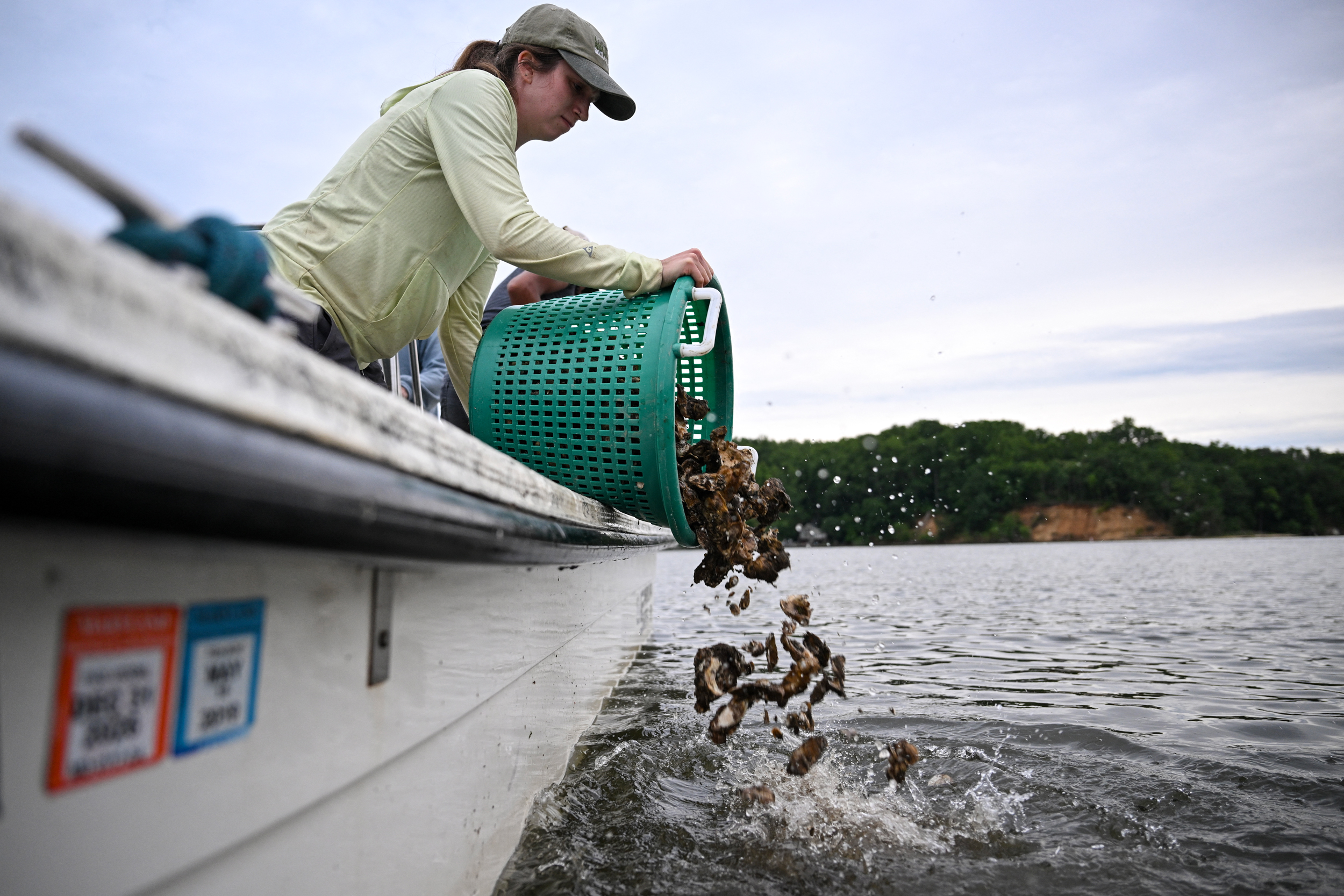
While welcoming the emphasis on habitat restoration, Isaacson cautioned that ecological gains will stall without strict enforcement of pollution controls. “There is a reason that reducing nutrients and sediment was the basis for the TMDL,” he said. “Without reducing these pollutants, it will be impossible to meaningfully restore any of these living resources.”
Jon Mueller, visiting associate professor and environmental law clinic director at the University of Maryland Carey School of Law, said the newly adopted agreement does not change the EPA’s legal authority under the Clean Water Act but fails to strengthen real accountability.
“The revised 2025 agreement is neutral with respect to EPA’s authority under the CWA and the TMDL,” Mueller said. While the Bay TMDL provides “CWA backstop authorities that EPA can use if the bay jurisdictions do not meet Bay TMDL goals on time,” he said, the EPA “has refused to use any of them despite [jurisdictions’] failure to meet the 2025 deadline.”
Asked whether a voluntary partnership model can deliver Clean Water Act standards, Mueller said earlier pacts centered on voluntary commitments had failed to achieve their goals. “These facts show that it is extremely difficult … to meet a goal without accountability,” he said. “Many of us hoped the revised Bay agreement would acknowledge this reality. It does not. Hopefully, the TMDL will deliver.”
This story is funded by readers like you.
Our nonprofit newsroom provides award-winning climate coverage free of charge and advertising. We rely on donations from readers like you to keep going. Please donate now to support our work.
Keisha Sedlacek, senior policy adviser for Chesapeake Bay Foundation, found the delayed deadline frustrating but said she was glad the final agreement included an actual timeline that was missing from the initial draft.
In written remarks, Sedlacek said “the states can and should do more than what’s called for in the agreement” and that it was necessary to robustly implement the new agreement after recurring failures of the previous decades. “Next year, it will be critical that they develop ambitious strategies to implement the goals and outcomes of the new agreement that lay a strong foundation for it to succeed,” she said.
One of those strategies, Sedlacek said, is including Indigenous tribes, especially those not formally recognized by the federal government. Their traditional methods for managing nature and its resources “are valuable knowledge that should be integrated into the restoration effort now, not postponed,” she said.
The partnership is composed of the governors of Maryland, Virginia, Pennsylvania, Delaware, New York and West Virginia; the mayor of the District of Columbia; the U.S. Environmental Protection Agency, representing the federal government, and members of the Chesapeake Bay Commission. A tri-state legislative advisory group, the commission coordinates Bay policy among Maryland, Virginia, and Pennsylvania lawmakers.
The previous Bay agreement was signed in 2014 and linked restoration efforts to the federal TMDL, with a 2025 cleanup deadline. The initial 1987 agreement targeted a 40 percent reduction in nutrient levels by 2000, while the 2000 agreement broadened restoration efforts with a 2010 target.
But none of those deadlines were met. Experts say limited enforcement was one of the main reasons behind stalled progress, pointing to the EPA’s reluctance to use its regulatory authority against lagging states, particularly Pennsylvania, which for years struggled to curb agricultural runoff.
Whether the EPA will take a more hands-off approach with its enforcement responsibilities as the new agreement takes effect and whether EPA Administrator Lee Zeldin will push an anti-regulation agenda, are questions many Bay observers are pondering.
Climate change is also complicating restoration efforts, scientists warn. Extreme weather events such as heavy rainfall, rising sea levels and warming waters are intensifying algal blooms and oxygen-depleted dead zones. Marine scientists caution that these pressures will worsen without aggressive pollution-reductions measures in the near term.
Whether the partnership’s extended timeline will result in such robust action now rests on the delicate balance between states’ collaboration and the EPA’s willingness to use the regulatory tools experts say it has rarely exercised.
About This Story
Perhaps you noticed: This story, like all the news we publish, is free to read. That’s because Inside Climate News is a 501c3 nonprofit organization. We do not charge a subscription fee, lock our news behind a paywall, or clutter our website with ads. We make our news on climate and the environment freely available to you and anyone who wants it.
That’s not all. We also share our news for free with scores of other media organizations around the country. Many of them can’t afford to do environmental journalism of their own. We’ve built bureaus from coast to coast to report local stories, collaborate with local newsrooms and co-publish articles so that this vital work is shared as widely as possible.
Two of us launched ICN in 2007. Six years later we earned a Pulitzer Prize for National Reporting, and now we run the oldest and largest dedicated climate newsroom in the nation. We tell the story in all its complexity. We hold polluters accountable. We expose environmental injustice. We debunk misinformation. We scrutinize solutions and inspire action.
Donations from readers like you fund every aspect of what we do. If you don’t already, will you support our ongoing work, our reporting on the biggest crisis facing our planet, and help us reach even more readers in more places?
Please take a moment to make a tax-deductible donation. Every one of them makes a difference.
Thank you,

Reporter, Washington, D.C.
Aman Azhar is a Washington, D.C.-based journalist who covers environmental justice for Inside Climate News with focus on Baltimore-Maryland area. He has previously worked as a broadcast journalist and multimedia producer for the BBC World Service, VOA News and other international news organizations, reporting from London, Islamabad, the United Arab Emirates and New York. He holds a graduate degree in Anthropology of Media from University of London’s School of Oriental and African Studies (SOAS) and an MA in Political Science from the University of the Punjab, and is the recipient of the Chevening scholarship from the UK government and an academic scholarship for graduate studies from the Australian government.
Great Job By Aman Azhar & the Team @ Inside Climate News Source link for sharing this story.