
A new conversation with Butler biographer Susana M. Morris explores the writer’s meticulous process, expansive imagination and the cautionary lessons she left behind.
Black Feminist in Public is a series of conversations between creative Black women and Janell Hobson, a Ms. scholar whose work focuses on the intersections of history, popular culture and representations of women of African descent.
The Huntington Library, located in San Marino, Calif., launches a new exhibit, Stories from the Library: From Brontë to Butler, on Dec. 13, 2025. This collection is especially renowned for its extensive archive on the personal writings and stories pertaining to science fiction author Octavia Butler, who died too soon at age 58 in 2006 due to a fall outside her home. The prolific writer and MacArthur Grant recipient leaves behind several series of novels and other works of fiction.
Ms.’ Janell Hobson had a chance to speak with Black feminist scholar and Butler biographer Susana M. Morris, who relied on the vast archive available at Huntington for her latest book, Positive Obsession: The Life and Times of Octavia E. Butler, which came out earlier this year.

Janell Hobson: I remember watching A Quiet Place: Day One with Lupita Nyong’o, who’s on a deserted city street in Manhattan when she picks up a copy of Octavia Butler’s Dawn. It reminded me that the writer has now entered pop culture and has become a cultural icon. What do you think she would make of that?
Morris: I think she would’ve been pleased. She was not against recognition. And in that kind of movie, being referenced, recognized, alluded to, I think she would’ve appreciated that very much; that people are paying attention and listening to and understanding her work not simply for its sociological elements. She was a creative writer on purpose.
Hobson: How long have you been working on this biography of Butler?
Morris: I worked on the book for about five years. I started working on it right before the pandemic started. But I’ve been a Butler scholar for about 15 years, and whenever I would be teaching her work, there are any number of interviews and prints. You can go to YouTube and watch videos of her. She was a private person, and I wanted to know more about her, about her craft, about what drove her.
And of course there was the essay, “Positive Obsession,” and there are some other short works. But now with the release of her voluminous archive, I was interested in learning more. That’s how the book came about.
When I didn’t have stories to read, I learned to make them up. Now I was learning to write them down. … I write science fiction and fantasy for a living. As far as I know I’m still the only Black woman who does this.
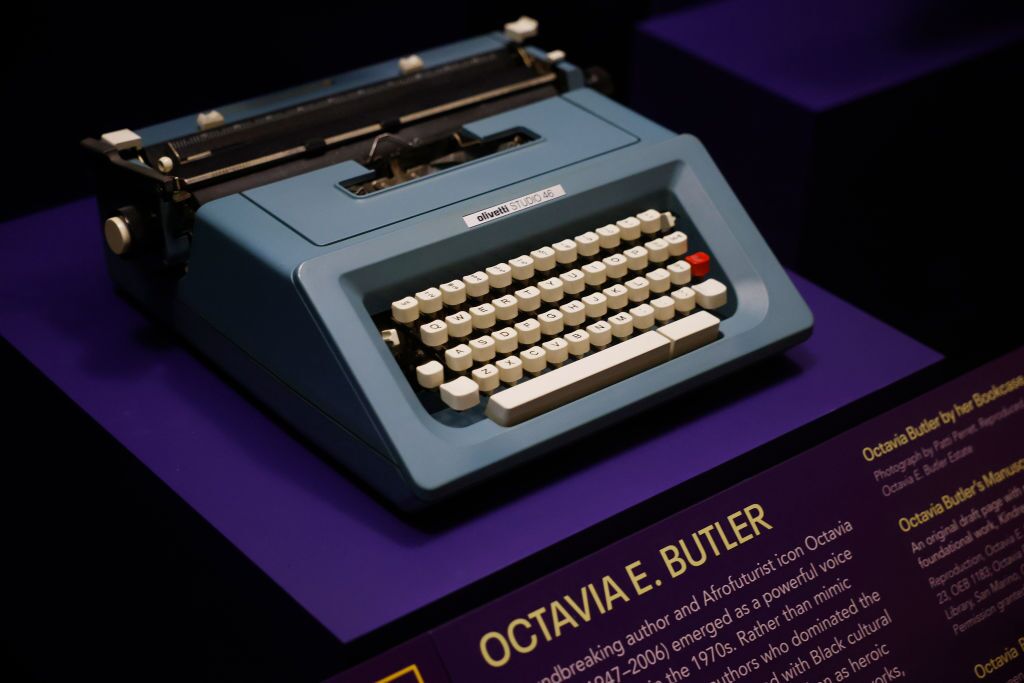
Octavia Butler, “Positive Obsession,” autobiographical article published originally in Essence
Hobson: How helpful did you find this archive?
Morris: The archive is so fascinating, and I encourage anybody who can, to go to the Huntington. It is open. You don’t have to be a professor. You could be a public scholar. You can be a graduate student, an undergraduate student. You can use it in your courses.
Octavia kept everything, every receipt, every to-do list. Her mother’s diary is in her archive. There is so much, but I think maybe some of the most surprising stuff was just her wry observations.
Hobson: What are some examples?
Morris: Octavia was a tall woman. She was stout, and she shopped at the plus-size retailer, Lane Bryant, which is still around.
She would write, “I have to go to this con[ference], so I need to go to Lane Bryant and get my jewelry and my outfit together.” And she was not a fashion girlie, so this was an imposition, like, “I don’t even want to think about these things.” Just the everyday of being a woman, being a writer.
In her commonplace books and journals, she wrote everything down. So, it might be the to-do list of Lane Bryant. And then the page after that, she’d be clearly writing on the bus, and there would be ideas for another story. It was just one of the most enjoyable parts of being in the archive.
Hobson: How much did this archive shape your book?
Morris: This is a deeply researched book. I rely heavily on [Octavia Butler’s] papers. And so, I don’t know that this book could be what it is, such an intimate journey into her interior life as a writer, without access to that work. The archive makes this book, and whatever comes after, possible.
Hobson: In writing your book, did you set out to do a comprehensive biography or a specific focus of her life?
Morris: There is a certain focus. I can imagine someone else writing maybe a thick door-stopper biography, like, “This was the name of the doctor that caught her in the hospital in Pasadena where she’s from.” But that was not necessarily my focus.
I was interested in the politics that shaped her because she was a self-avowed news junkie. She’s someone who spent so much time researching for everything that she wrote. I wanted to know about her process as a writer, what she was listening to, reading, writing, to produce novels like Dawnor Kindredor Fledgling.
Hobson: I remember last year on June 20, 2024, which was the very first diary entry date that opens Parable of the Sower, I was going to reread [the book] that Saturday. And then of course, Sunday, President Biden stepped down from his presidential campaign, endorsed Kamala Harris in his place, and I put that book aside, totally caught up in this new energy.
Morris: Of course!
Hobson: But November happened, and I thought, “I should have been reading Parable of the Sower.”
Morris: Because we’re living it, right?
Hobson: Yes, we’re living it. But it does suggest that Octavia Butler was some kind of prophet. What do you think of that assessment?
Morris: I understand why folks would call her a prophet, although it’s language that she didn’t like for a few reasons.
For one, she was raised in the church, so she was very clear on what a prophet is, and she had moved away from her family’s religion in some ways. But mostly when you call somebody a prophet or an oracle or something like that, it’s imbuing them with a metaphysical power, like, oh, they’re a seer. They’re clairvoyant. And she’s like, “No, I went to the library and I read books. I watched the news and I paid attention. I subscribed to many newspapers, and I read them every day. I took notes. I wrote letters to the editor. I spoke with my friends. I have this voluminous correspondence. I talked with many people on the phone. These are my thoughts about things.”
I understand her being called a prophet, but she’s more than that. And I like to say she’s a prophet if we don’t listen. She was giving us cautionary tales, but it wasn’t with the idea that this has to happen.
Ursula Le Guin says science fiction is descriptive—it’s not prescriptive. It doesn’t have to happen. It is a mirror to our own lives. It’s about us.
So that’s why Parable of the Sower, published in 1993, is set about 30 years into the future, and not 300 years, because she thought, “Well, in 2024, we could have the rise of Christian nationalism,” because it was already happening in 1990, the histories of fascism.
The environmental chaos—she’s from Southern California, so she already saw the wildfires. She’s like, “I’m seeing them. I’m seeing the proliferation of them.” She’s not a prophet, but a researcher.
Hobson: So, because of her meticulous attention, she was able to arrive at this moment?
Morris: Absolutely.
Hobson: Some people would still call that prophecy.
Morris: Yeah, some people would call that prophecy too. But I want to emphasize the work that it takes. Was she a singular mind and genius? Absolutely! But she also had good sense, and the rest of us can at least, as my granny would say, cultivate our senses. Let’s cultivate that. I think she invites us to do that.
Hobson: What was something that you discovered about her while writing this biography that you didn’t know and found fascinating?
Morris: I found that she was extremely hard on herself.
She also described herself as comfortably asocial. When she lived in Los Angeles, the world was swirling around her. She was not going to parties. She was not on the scene in that way. She went places. She watched movies. She went to the library. She hung out with friends, but she really lived a life of the mind. Her life was devoted to reading, writing, thinking, rethinking, engaging, struggling with texts and so on. So, this is not a scandalous biography. That’s not how she lived her life. Her life was very cerebral. She was very much introverted, very much okay with her own company. She described herself as socially awkward, as nerdy.
And this is way before Issa Rae gave us “Awkward Black Girl.” As for my own nerdy self, I could relate in many ways.
Hobson: Some people have tried to claim her as queer. Is that fair?
Morris: I think as a queer person, it would be wonderful to say, “Yes, Octavia identified as queer,” but she did not identify that way. Was she curious about sexuality? She was. She wrote about that. She disclosed that in interviews. She wrote about that in her commonplace books. She even went so far as to go to a meeting where folks were talking about their queer identity. This is in the 1970s, early ’80s, and she’s like, “Maybe I am queer. I don’t know.” And then she goes to this meeting and people are going around a circle talking about their experience, and she’s like, “Yeah, no, I’m not into this, but it’s super interesting so I want to write about it.”
So that’s one of the reasons why we see so much queerness, because though she did not identify as queer herself, she didn’t have any hangups about folks having the whole realm of sexuality. We see polyamory. We see all different kinds of coupling and mating, triads and interspecies love and age gap in her different writings, because she was fascinated by the range of human and inhuman sexuality.
Hobson: What do you think she would say now that we’ve already passed the milestone date of Parable of the Sower?
Morris: I imagine if she were around today, people would be interviewing her a lot, not unlike how folks have been interviewing Margaret Atwood about The Handmaid’s Tale, and I think she would have released stark messages for us: “Again, I’ve laid out possibilities. It’s not this has to happen. This is just one version of the future. We have the power to do something else, so let’s do something else.”
With Octavia Butler, we get cautionary tales. We could have just listened to her.
Great Job Janell Hobson & the Team @ Ms. Magazine Source link for sharing this story.