
On the day bell hooks became an ancestor—four years ago this Monday, Dec. 15—my beloved friend, comrade and co-conspirator Black feminist sociologist Shawn McGuffey and I were consoling one another over text when he wrote, “We should do something.”
Say less, I replied.
I had just begun a new academic appointment, and was confident that I had the capacity and the resources to pull off an event commemorating the prolific Black feminist trailblazer. Especially in light of our program’s commitment to highlighting intersectionality as foundational to Black studies and working locally to recognize Boston’s contributions to Black history, I knew such an event would align well with our vision.
Though we were still in “COVID times,” I approached my dean about the possibility of putting on the symposium, “Talking Back: The Genius of bell hooks,” and thankfully, she quickly agreed and offered her full support.
I remain convinced that works of imagination can save us.
This institutional support came at a time when universities and other institutions were publicly and ceremoniously committing to funding DEI related initiatives in the tidal wave of so-called racial reckoning that occurred in the aftermath of George Floyd’s death.
The first symposium took place two months later on a cold and clear February morning in 2022.
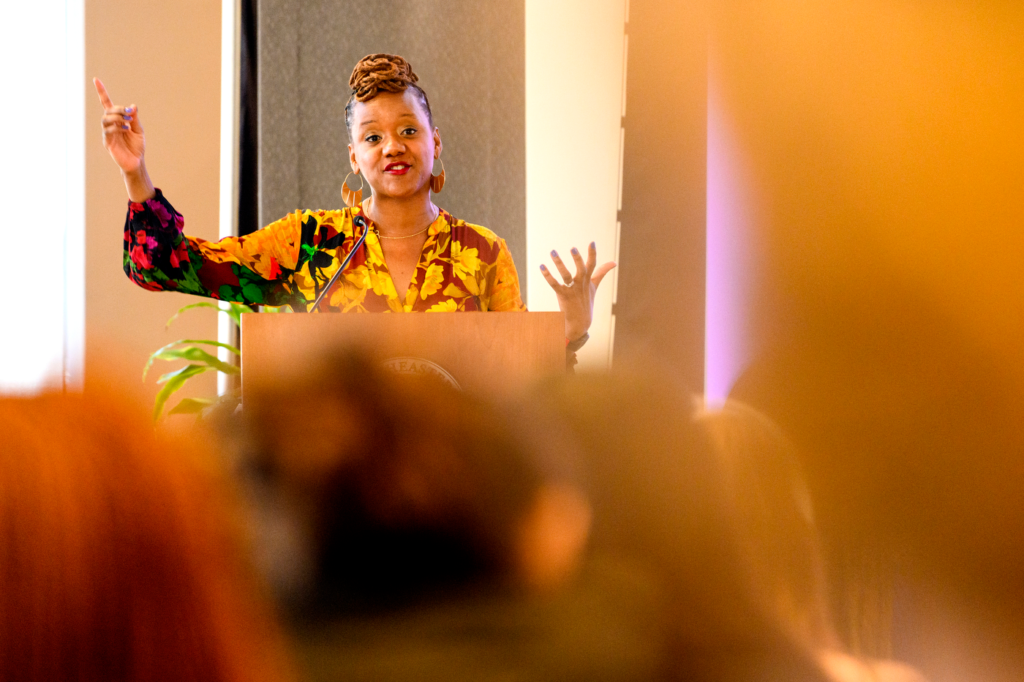
In the spirit of collective mourning and holding space for one another, we hosted an intentional gathering focused on reflection and celebration. Together we took the time, as Black feminist scholars, to reflect on and to share about what the legacy of bell hooks meant to us. Our speakers included Kentucky natives like journalist and scholar Meredith Clark and Boston University sociologist Saida Grundy, along with McGuffey, whose panel, “Belonging: A Culture of Place,” was inspired by their shared Kentucky roots. We also featured historian Kellie Carter Jackson imparting lessons about joy and grief she learned from reading bell hooks, and theologian Amey-Victoria Adkins Jones on a panel focused on the seminal book All About Love.
This annual gathering became an important tradition that we looked forward to each year.
In this climate, Africana studies can be a sanctuary and a site of resistance.
We gathered again in 2023, under different circumstances, but still committed to honoring our Black feminist ancestors and the roads that they paved for us to be here as well as to imagine the futures they might envision. While bell hooks was the catalyst, the work extended far beyond her. That year’s theme, “Black Feminism, Black Freedom,” acknowledged that for the Black feminist, Black freedom has always been one of our main preoccupations. Together with esteemed speakers such as Pulitzer Prize-winning author and activist Salamishah Tillet, Brown University professor Kevin Quashie, Combahee River Collective founding member Demita Frazier and Duke University scholar Annette Joseph-Gabriel, we had another successful and fulfilling symposium.
In 2024, we ventured into a new, and increasingly urgent directions for the times we were living. “Black Feminist Worldmaking” contemplated our futures and visions. Our inaugural Black feminist studies post-doctoral fellow Dr. AK Wright conceptualized the symposium theme and was at the helm of our organizing. Their vision cleared space for scholar like Ashleigh Greene Wade and Tiana Tanksley to share their innovative work that is re-imagining how Black women and girls inhabit digital worlds.
Later that year, we hosted a second symposium in Oakland—“Education as the Practice of Freedom: The Black Feminist Classroom”—focused on the urgency of teaching about racial and gender justice in the 21st century. The title emerged from bell hooks’ book Teaching to Transgress: Education as the Practice of Freedom, in which she explores topics like pedagogy, joy, feminist solidarity and building a teaching community. Our keynote speakers, Angela Davis and Gina Dent, had a lively conversation that was both convicting and inspiring. Author Brandi Summers Thompson also spoke, along with local activists, politicians and organizers from the Oakland community. We concluded with a healing workshop facilitated by Jamaican poet and creative writing professor Pat Powell.
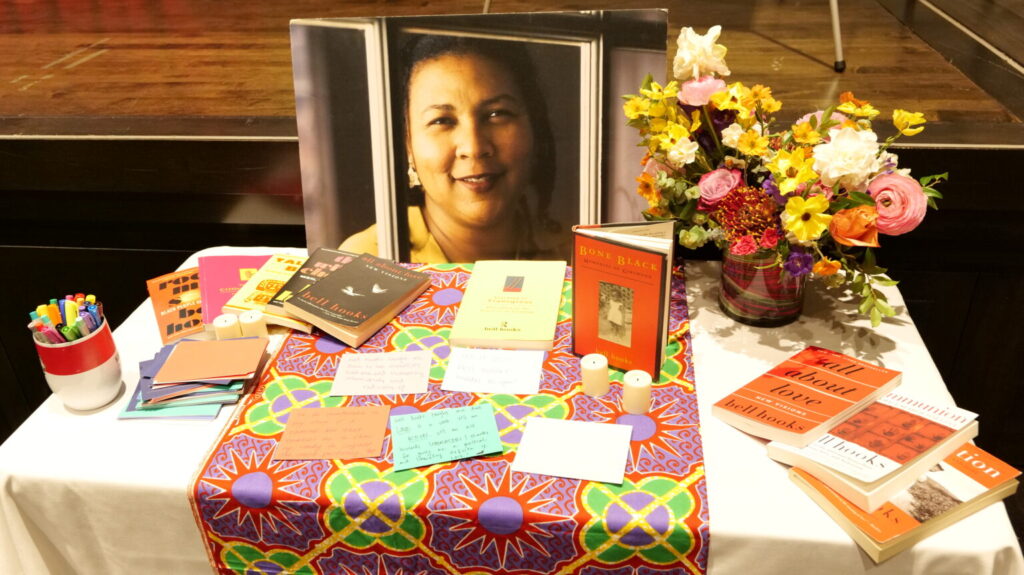
This year was the fifth—and what I fear might have been the final—symposium, “Black Feminism, Black Art,” inspired by her book Art on My Mind: Visual Politics. A series of essays about the intersections of art, aesthetics and identity politics written in 1995, Art on My Mind also features candid interviews with luminaries like the artist Carrie-Mae Weems.

The symposium’s panels titles were drawn directly from hooks’ prolonged meditations—but “Talking Art,” “Art Matters,” “Art on My Mind” and “Art Moves Us” were more than phrases plucked from this text published 30 years ago. They served as our guiding framework for a discussion about the role of art in our lives today. Throughout the day we explored questions like:
- How have Black feminist artists made art that moves us?
- What is the role of art in Black feminist movement making?
- How does talking art and Black feminism together transform the conversation?
- How does critical awareness of race, class, gender and sexuality influence our ways of experiencing art?
- How does art, in all its forms—sonic, visual, embodied, performed, written, etc.—enable us to make the world anew?
- What kinds of art does a Black feminist world make possible?
The book’s subtitle—”Visual Politics”—is defined by hooks as “the way race, gender and class shape art practices.” In the introduction, she identifies art as “a site of possibility” in which “critical awareness of race, gender, and class” does not compromise attention to aesthetics. Similarly, Black feminist artists and critics have been deploying art as a site of possibility that actively imagines and seeks to build other worlds. Our speakers on that day—Grammy-winning musician Terri-Lyne Carrington, visual artist Delita Martin, photographer and activist Scheherazade Tillet and filmmaker Tchaiko Omalwale, among others—are inheritors and practitioners of this tradition, whether through their creation of music, film, photography, visual art, criticism, scholarship or creative writing.
Inspired by what the artist Simone Leigh has identified as “the unstoppable forward movement of Black women” and its impact throughout the world, we faced the difficulty of not being able to include as many artists and art forms as we had originally hoped to. The sonorous notes of Émeline Michel, imposing sculptures by Fern Cunningham, searing poetry by June Jordan, dazzling quilts by Bisa Butler, virtuosic piano playing and singing by Nina Simone all exist as part of our artistic Black feminist imagination.
Due to university wide fiscal austerity, we will not mark the anniversary this year in any official way. … It is a tremendous loss, for our students and for our community locally, nationally and internationally.
As one of our illustrious poets Nikki Giovanni observed, “Art is connection.”
Perhaps, more than anything, our wish was for our audience to experience a soul-stirring sense of connection that inspires and transforms. The success of that event, with a packed room of 300 people and over 800 people online renewed our faith in what is possible when we are unabashed in declaring that Black feminist art matters, just as bell hooks did throughout her life.
This week, we mark four years since the woman born Gloria Jean Watkins, a Black feminist writer, academic, professor and activist became an ancestor. But in 2026, there will be no bell hooks symposium at my university. Due to university wide fiscal austerity, we will not mark the anniversary this year in any official way. It is a tremendous loss, for our students and for our community locally, nationally and internationally.
As I grappled with my own grief over this loss, I had to also reflect deeply about what it means to be a Black feminist scholar in the academy today.
We live in a time when the ideas we champion and the values we espouse—racial justice, gender equity, transgender rights, immigrant rights, human rights for all and the dignity of Black life—are under unremitting attack. In the face of burgeoning authoritarianism, emboldened white nationalism, assaults on academic freedom and the distortion of history for political gain, what are we as Black feminist scholars to do?
More than ever, we must take care of ourselves, gather in community despite the challenges, and nourish the next generation just as our ancestors did. The time is ripe for a time gathering, organizing, creativity and renewed determination to do the work we do. In this climate, Africana studies can be a sanctuary and a site of resistance. Learning from bell hooks means that we affirm the importance of scholarship and activism, that classrooms can be sites of liberation, and that none of our work is possible without communities of struggle and care that are both local and global.
I remain inspired by other Black women writers, like the poet Rita Dove, who said, “… without imagination we can go nowhere. And imagination is not something that’s just related to the arts. Every scientist that I have met who has been a success has had to imagine. You have to imagine it’s possible before you can see something.”
I remain convinced that works of imagination can save us.
With or without institutional support, we must continue to pursue education as the practice of freedom. We must continue to ask difficult questions, to teach with courage, and to create spaces where our students can imagine—and build—a world beyond oppression and erasure.
And so on this fourth anniversary of the day bell hooks transitioned, I am looking for hope. Because indeed, and as the activist Mariame Kaba instructs, “Hope is a discipline.”
And also, as bell hooks reminds us in the epigraph for Teaching Community: A Pedagogy of Hope:
“It is imperative that we maintain hope even when the harshness of reality may suggest the opposite.”
Great Job Régine Jean-Charles & the Team @ Ms. Magazine Source link for sharing this story.