

The Australian Energy Market Operator has just released its annual projections of expected gas supply and demand for Western Australia with claims that shortages are imminent. It’s called the WA Gas Statement of Opportunities (GSOO). No doubt the big gas companies will jump on this crying for more gas supply to plug the energy gap that they created.
How is it that in 2025 after all the warnings from scientists and world leaders, after all the fires, floods, cyclones and heatwaves we are still looking to a fossil fuel as damaging as methane for our energy needs? Especially when a cleaner, cheaper alternative exists.
The reality is that gas does not need to be replaced by gas. The energy landscape is changing rapidly, and with fossil fuels like gas clearly on the decline globally, all investment from here on must be directed to renewable based solutions.
Of course there needs to be a gas phase out period to allow for the transition to renewables but to suggest opening up new fossil fuel developments when we have all the cheaper non-polluting solutions at hand is to run directly against our own interests as a state, not to mention as a species.
Do we forget that last summer every coral ecosystem from north of the Kimberley down to the Ningaloo suffered major bleaching and mortality? Or that our south west forests started dying in the heat the summer prior?
Do we not realise that batteries are already outperforming gas in our electricity grid and that renewable energy backed by batteries is the cheapest option for new energy?
To be blunt; gas is the problem, not the answer.
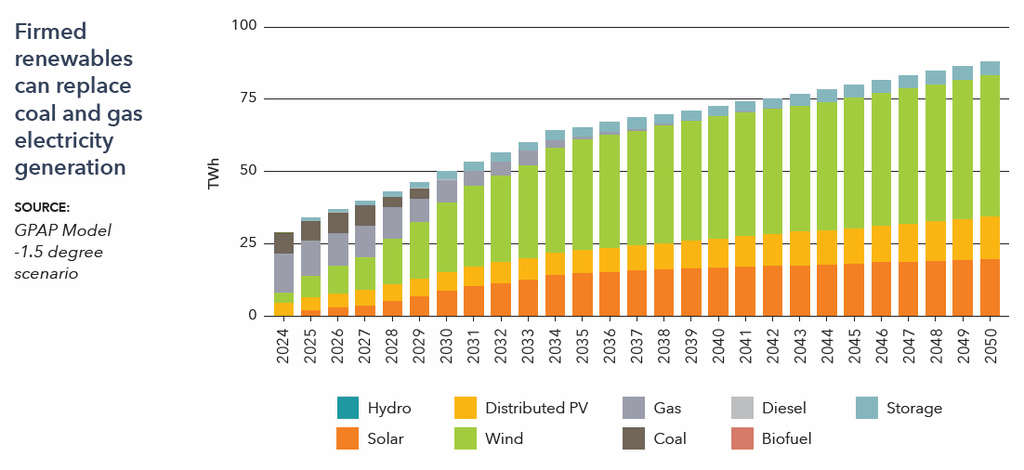
Independent modelling commissioned by Greenpeace Australia Pacific shows that there is no need for more gas to meet WA’s energy needs if the deployment of renewable energy continues to gather pace.
This is not based on fanciful ideals but on detailed modelling of hundreds of data points from energy facilities and emissions reporting across the state, including from AEMO itself.
Given that Australia just signed the Belém Declaration for the Transition Away From Fossil Fuels, and that the WA Premier Roger Cook has repeatedly signalled that we should become a renewable powerhouse, it is preposterous that more polluting gas could possibly be touted as a viable option for WA.
Certainly the transition will take time and our model shows that while gas is not set to disappear from the system instantaneously, it can gradually diminish over the coming decade.
What is absolutely clear right now is that gas use cannot be allowed to expand. The risks are simply too great. Not only the risks to the climate, to our health, and to our pristine environment, but also to the economy.
This week, the Federal Treasurer Jim Chalmers in his mid-year economic update highlighted that natural disaster relief would cost $6.3b more than previously planned. That is the reality of climate pollution coming home to roost. According to IAG, the Australian insurance industry has paid $22.5 billion in insured costs for extreme weather events over the past five years. We know the cost of fossil fuel induced disasters, driven by the extraction and burning of gas, will be added straight onto our insurance premiums.
The cost of letting the fossil fuel industry run rampant is mounting and will only continue to grow.
Furthermore, if we allow the gas industry to delay WA’s transition to renewable energy, we risk missing the opportunity to become a leader in the expanding global markets for green commodities.
The projections from AEMO should not be interpreted as a prescription for more gas, but as a signal to the energy market more broadly. The pressure points emerging in the system exist because we have not moved forward fast enough, and the solutions should not follow the old, polluting script. The reality is that batteries and renewable energy are already outperforming coal, gas and diesel because they are cheaper to run and faster to deploy. There are some impressive examples of this, including the Bellevue Gold mining running off 80% renewable energy but other parts of WA’s mining and heavy industry need to catch up.
One of the other, less heralded statements Australia signed up to in Brazil was the Belém Declaration on Global Green Industrialization which states that “without deep emissions cuts from heavy industry… global carbon emissions reduction goals, in line with the Paris Agreement, cannot be met”.
This is where the rubber hits the road in WA, or perhaps, where the sun hits the solar panel. Western Australia cannot keep approving new industrial developments, like the Perdaman urea plant near Karratha, without clear timetables for renewable energy use to power operations.
What needs to happen is for big gas users like Alcoa, Wesfarmers and Perdaman to follow the lead of some of WA’s miners by putting more investment into electrifying their operations to run off renewable energy, and for the State Government to continue improving the rollout rates of large scale renewable energy and batteries.
Remember – Western Australia in no way has a gas shortage. WA is awash with gas that continues to drive our emissions in the wrong direction.
Western Australia does not need anymore polluting gas. The pathway is clear – renewables and batteries are already proving themselves as winners, we just need to get more winners in the race.
Great Job Geoff Bice & the Team @ Article – Greenpeace Australia Pacific Source link for sharing this story.