

Wired for Profit: Second in a series about Alabama Power’s influence over electric rates, renewable energy, pollution and politics in the Yellowhammer State.
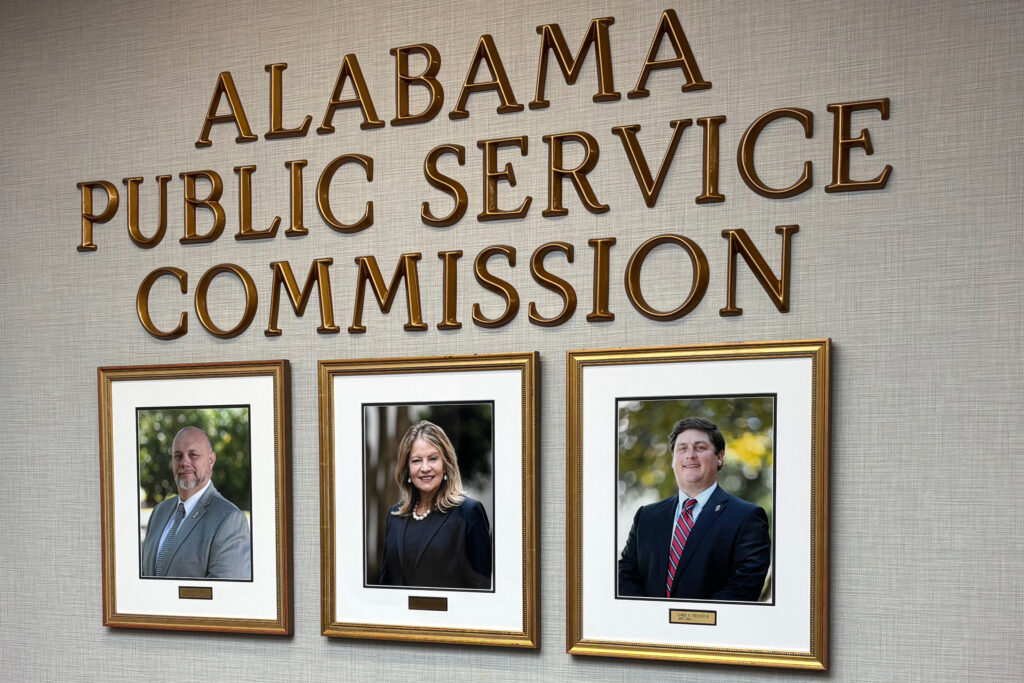
MONTGOMERY, Ala.—There’s a curious sight on the far-left wall of the Alabama Public Service Commission’s main hearing room.
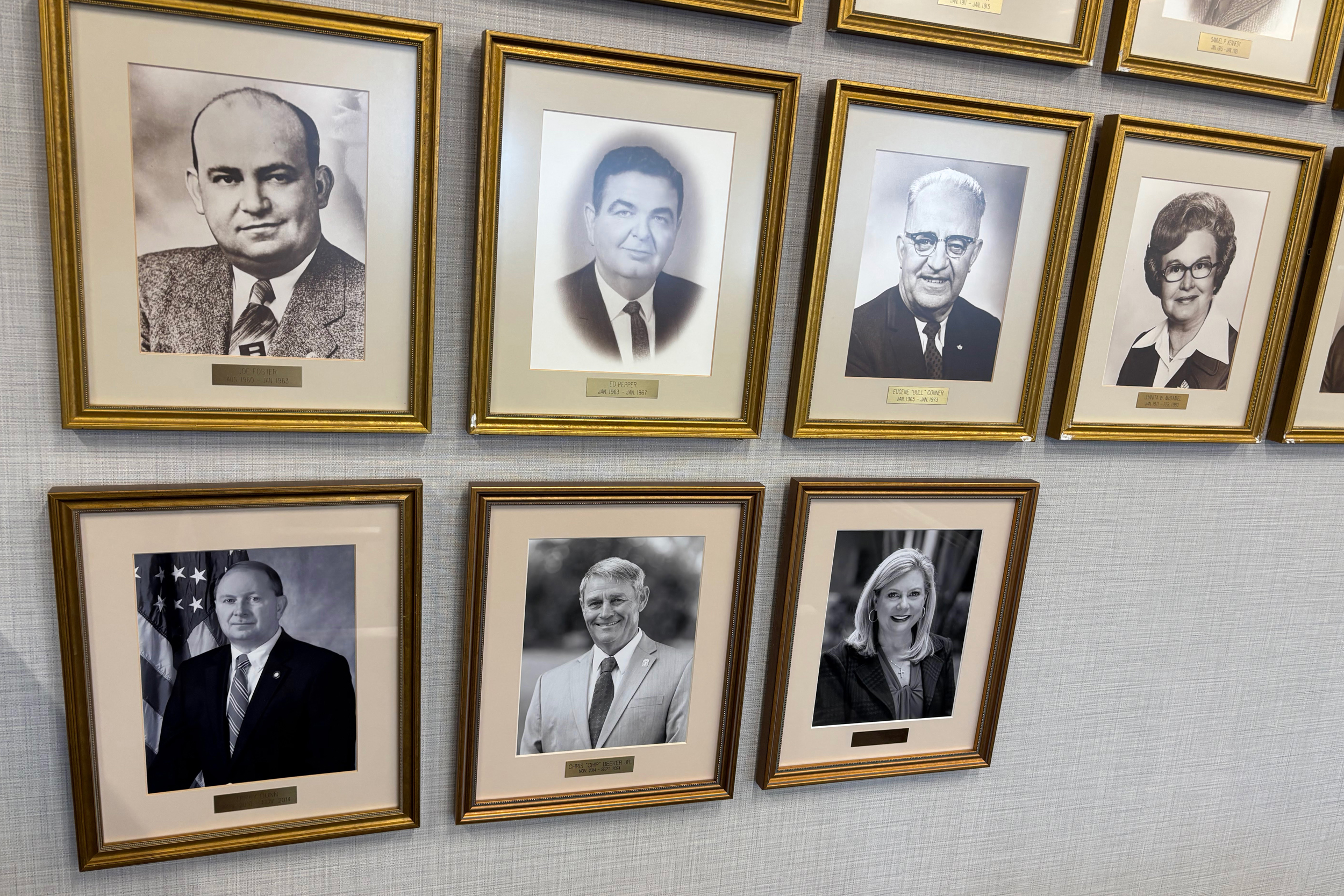
Framed 8-by-10-inch photos of the previous commissioners dating back to 1881 line the wall. The photos are black and white. The commissioners are just white, but that’s not the strange part.
The strange part is that in the bottom left quadrant of the photo wall, directly above the most recent former commissioner, Twinkle Andress Cavanaugh, hangs the smiling mug of one of the most notorious faces in Alabama history.
Eugene “Bull” Connor, the former Birmingham police commissioner whose brutal suppression of civil rights demonstrations with police dogs and firehoses drew worldwide condemnation, stares back at the observer with his slicked-back white hair, horn-rimmed glasses and the slight vestige of a smile.
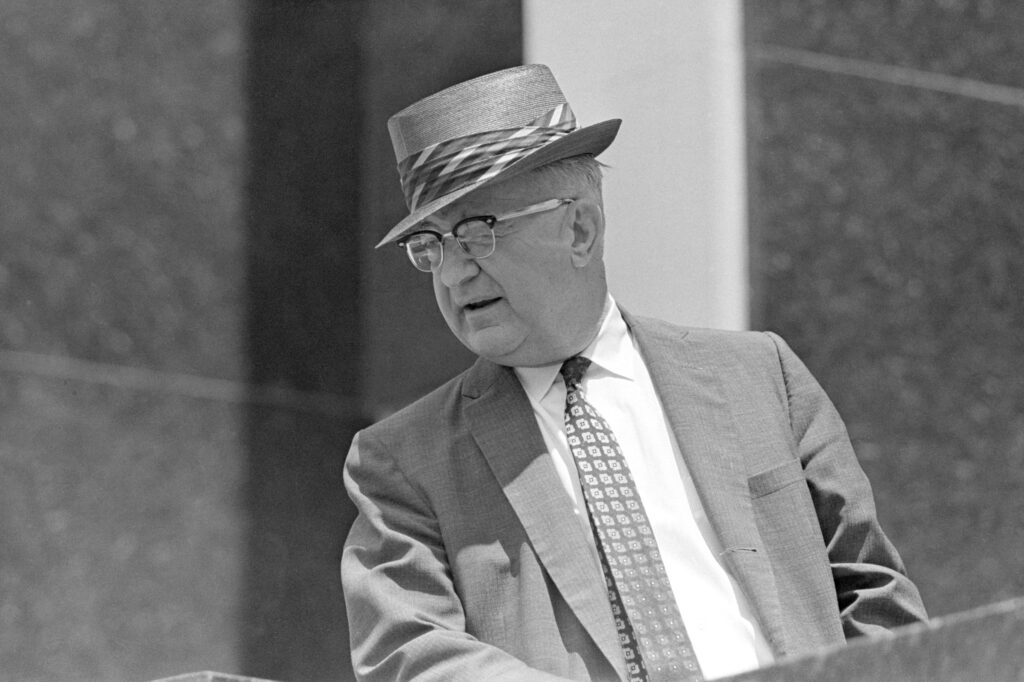
Connor, after his presence became an untenable black eye for the city of Birmingham, was shuffled off to Montgomery and the Alabama Public Service Commission, where he served as PSC president from 1965-1973.
Alabama’s civil rights history is inescapable, even in places most people wouldn’t expect. Their electric bills, for example.
George Wallace, the four-term governor who famously stood in the schoolhouse door in an attempt to prevent Black students from enrolling at the University of Alabama, was never on the commission, but may be as responsible as any single political figure for the state of Alabama’s electric regulation today.
That’s because throughout the 1970s, when crying “segregation forever” was no longer a viable political strategy, Wallace needed a new target for his brand of populist demagoguery. He found it in Alabama Power.
Wallace railed against what he called Alabama Power’s “exorbitant rates” for years, attempting to thwart or delay nearly every rate increase or construction project the company proposed. That campaign turned the state’s regulatory environment into a circus, pushed the state’s largest utility to the verge of bankruptcy and provoked a backlash that still clouds the ratemaking process
David Rountree worked at the PSC for 12 years in the 1990s, 2000s and 2010s, including stints as chief of staff or principal advisor for three different commissioners. Rountree said Wallace’s actions still reverberated through the PSC building decades later. Years before joining the PSC staff, Rountree had actually covered some of the hearings as a reporter for the Montgomery Advertiser newspaper.
“Those rate hearings were just a nightmare,” Rountree told Inside Climate News. “Nobody wanted to get sent over to have to cover a PSC rate hearing. It was like, ‘Can you just pull my fingernails out?’ And they would last for months on end.”
After years of Wallace’s chaotic attacks on the system, the PSC snapped back hard in the other direction. The commissioners attempted to create a system that would take political chaos out of utility ratemaking and prevent another George Wallace from hijacking the regulatory process. Rate increases were put on “autopilot,” Rountree said, going up automatically whenever Alabama Power’s earnings fell below a certain percentage.
The commission voted to approve the new system, called rate stabilization and equalization, or RSE, in 1982. That was the last time Alabama Power held a formal rate case that nearly all other states require. The RSE process did its job of averting contentious and costly rate cases, but there were serious side effects. One, according to environmentalists and public interest lawyers, has been a lack of transparency and almost any meaningful public participation.
The public rate cases that had become so toxic under Wallace had been eliminated, but those hearings served as the best method for the public to gain insight into how their power bills were calculated, and which utility decisions they were paying for. Now the public and advocate groups have to fight and claw for information that is public and easily accessible in other jurisdictions.
In a 2013 white paper titled “Public Utility Regulation without the Public,” the Institute for Energy Economics and Financial Analysis writes that Alabama’s RSE process “allows Alabama Power to adjust its charges each year without any public evidentiary hearings and, indeed, without any participation by ratepaying consumers whatsoever other than off-the-record and after-the-fact comments at an informal hearing that completely lacks public transparency.”
The paper states that only Louisiana and Mississippi have similar processes for utility regulation, but notes that those states have more “meaningful opportunities for public involvement.”
A spokesperson for Alabama Power told Inside Climate News that the RSE process still ensures oversight over the company, even if it differs from other states.
“Alabama’s Rate RSE framework provides continuous, formula-based oversight with monthly filings, annual PSC review, and automatic refunds or adjustments when earnings fall outside the approved range,” Alabama Power said. “Different structure does not equal lack of regulation.”
The Alabama Public Service Commission is in the process of completing its required review of Rate RSE that takes place every six years. It is not clear when the findings of that review will be made public.
“Following the review process engaged in by staff with representatives from Alabama Power and the Alabama Attorney General’s office, staff will consult with the Commission and provide an assessment of the effectiveness of Rate RSE and discuss any potential modifications deemed necessary,” a PSC spokesman said in an email. “The Commission will determine whether any further course or courses of action are necessary based on those consultations with staff. Any determination regarding the need for outside input will not be made until the Commission has made an assessment of the findings compiled by staff.”
Alabama Power went from the precipice of bankruptcy to being one of the most stable and profitable utilities in the country. But its customers shouldered the highest total electric bills in the country last year, according to an Inside Climate News analysis, and pay the highest electric rates in the Southeast.
Advocates who have criticized Alabama Power’s high returns point to the RSE process as a key reason that the company’s profits are so high.
Here’s how it happened.
George Wallace vs. the Power Company
To say Wallace was popular in Alabama through the 1960s and ‘70s is an enormous understatement. He was elected governor of Alabama four times from 1962 to 1982, bouncing in and out of the governorship as term limits allowed. He didn’t leave the governor’s office for good until 1987.
In 1966, the Alabama constitution did not allow governors to serve consecutive terms, blocking Wallace from seeking reelection. So Wallace’s wife, Lurleen Wallace, ran for governor in his stead, explicitly stating that her husband would stay in control. Her name appeared on the ballot as “Mrs. George C. Wallace,” and she won handily, winning the primary without a runoff and garnering 63 percent of the general election vote. Alabama would not elect another female governor until 2018.
Lurleen Wallace died of cancer 16 months into her term, casting the Wallaces temporarily out of the governor’s office. Doctors reportedly told Wallace of his wife’s cancer as early as 1961, but he insisted she not be told, delaying any possible treatment for years. She remained unaware of her condition until 1965, when a different doctor told her directly. Despite her condition, she handled a rigorous campaign schedule throughout 1966, but her health began to deteriorate shortly after taking office.
Lurleen Wallace died in 1968. That same year, Alabama voters approved a constitutional amendment to allow governors to serve two consecutive terms, setting the stage for George Wallace to run and win in 1970, 1974 and 1982.
In 1970, as Wallace campaigned to retake the governor’s office after his first interregnum, he campaigned against “banks and utilities and the rich on Wall Street who don’t pay their taxes,” former Newsweek columnist Stewart Alsop wrote at the time.
Alsop added that Wallace’s “attacks on the big newspapers, the banks, and the utilities account for that electric current in his shirt-sleeved crowds at least as much as the race issue.”
After his reelection, Wallace hired well-known attorney Maurice Bishop to formally intervene in the rate cases at the PSC. A handful of commissioners elected in the next several years had close ties to Wallace or at least shared his views on Alabama Power’s rates.
Meanwhile, Wallace held rallies and gave televised speeches criticizing the power company and called multiple special sessions of the legislature in unsuccessful attempts to give the governor’s office and/or the Alabama Supreme Court the power to directly overrule the PSC on electricity rates. Wallace was unwilling to compromise on any of those issues, which never advanced past the state Senate. He blamed Alabama Power for wielding “undue influence” over senators who balked at his proposals. Some of the senators pushed back.
“George Wallace had made a career out of raising emotional issues and demagoging his way into office,” state Sen. Joe Fine said, according to the Montgomery Advertiser. “First he used the race issue, black against white, but 1766774525 that’s run out.”
In June 1976, the PSC rejected a rate increase request from Alabama Power, which the company’s president Joseph Farley called “shocking and dismaying.” The company appealed the PSC’s decision to the Montgomery County Circuit Court, which ordered the PSC to grant at least a partial increase. Alabama Power appealed that decision to the state Supreme Court.
The pattern would continue for several years, with rate cases bouncing between the PSC and the courts, and with Alabama Power repeatedly filing emergency rate cases before the courts had ruled on its previous rate increases.
People angry over their electric bills were bussed to PSC meetings from across the state. PSC hearings were moved to larger venues to accommodate the crowds.
Financial firm Standard and Poor’s dropped Alabama Power’s credit rating from A- to BBB. The company was forced to rely on high interest, short-term loans to stay afloat due to the long lag between rate increase decisions.
1977: “The Terrible Year”
In the book “Developed for the Service of Alabama,” a company history published by Alabama Power in 2006, historian Leah Rawls Atkins calls 1977 “the terrible year,” though 1978 and 1979 may have even been worse.
Skyrocketing prices caused by inflation and the oil embargo were creating huge costs for the company, and the clashes in Montgomery put the company on its most perilous financial footing since its early days of existence.
In January, an emergency rate case hearing was relocated to Montgomery’s Garrett Coliseum, where huge crowds packed the arena for what was, by most accounts, a circus.
Media reports at the time estimated the crowd ranging from 800 to 2,000 people, more or less evenly split between those who supported Alabama Power’s rate increases—power company employees, steelworkers, construction workers, economic development officials—and those who opposed the increases.
More than 50 witnesses testified, ranging from Alabama Power executives and expert witnesses to everyday Alabamians worried about their ability to pay higher bills in times of economic downturn and inflation.
Stewart B. Clifford, a senior vice president at Citibank, testified as a representative of a nine-bank syndicate that had granted Alabama Power $350 million in short-term loans over two years.
“None of them are willing, under present conditions, to extend any additional credit to Alabama Power,” Clifford said, according to The Birmingham News.
Meanwhile, numerous residents, many elderly, testified that they would not be able to pay their power bills if the increase were approved. So did construction workers who said they would be laid off if Alabama Power were not allowed to build the infrastructure it was planning.
One of the commissioners stated he believed the rate increase to be illegal because a previous rate increase was still awaiting judgment in the Alabama Supreme Court.
At one point in the two-day hearing, officials resorted to playing Simon and Garfunkel’s “Bridge Over Troubled Water” over the PA system to ease the tensions.
In the end, the PSC approved a smaller increase than the company asked for, but the struggles continued for the next two years.
In 1978, after Alabama Power reported a dramatic drop in earnings due to the newly constructed Joseph M. Farley nuclear power plant, the PSC approved an emergency rate increase to steady the ship in November, after that year’s elections. Wallace appealed and got a court to issue an injunction blocking the rate increase.
In December, the company filed a request for an emergency $288.8 million rate increase, saying its return on equity had fallen to a “disastrous” 4.5 percent.
According to Rawls’ book, Alabama Power responded by freezing officer salaries, cutting back construction projects and paying its bills only on an as-needed basis. The company sold five of its buildings with agreements to rent the spaces instead, freeing up cash, but losing out in the long run.
In January 1979, the Alabama Supreme Court denied Alabama Power’s motion to lift the injunction blocking its rate increase. The court found the PSC’s rate increases null and void and dismissed all appeals.
Rawls’ book quotes Alabama Power comptroller Jack Minor as saying the company had $45 million in unpaid bills and was unable to borrow money or sell stocks or bonds to cover them. He reported stacked invoices on his desk, not to be paid “until someone demands payment.”
The company put word out that it would remember which vendors were forgiving of its struggles, and which were not. Rawls says that there were some major suppliers that showed a “lack of support during this critical time,” and that Alabama Power “never did business with them again.”
Alan Martin, who held many executive positions in Alabama Power, including senior vice president, said executives in the company who experienced those times came out stronger for it.
“The enduring effect was positive,” Martin said in Rawls’ book. “Those who lived through those years were like the World War II generation. We were tougher. Our leadership has been real conservative, but when the company is criticized, we are quick to jump like a tiger to defend it.”
A Solution Emerges
By 1982, it was clear that the situation was untenable. Even Wallace and those in his administration conceded that something had to change.
Billy Joe Camp, Wallace’s former advisor and spokesman, had been elected PSC president, and he and the other commissioners implemented the rate stabilization and equalization system.
The goal of the system was to put utility ratemaking on autopilot, removing the possibility of messy rate case battles and political grandstanding that dominated the previous decade.
“At times the rate structure was used as a political football,” Camp said, according to the Associated Press. “I was part of that irresponsibility sometimes. We had to get to a new environment.”
An approved rate of return range was set for Alabama Power at 13 to 14.5 percent of the value of its common equity. Every December, if the company’s earnings for the coming year were projected to fall below that range, rates would go up automatically in January. If the company earned more in the course of the year than its allowed range, some of that money would be refunded to customers the next year.
The new system did not require a vote by the commission to increase rates, nor were there any public rate hearings or formal testimony from the utility on its revenue. In trying to stop political manipulation of the rate system, the PSC nearly removed the public from the process altogether, limiting the opportunities for public engagement or even understanding of the ratemaking process.
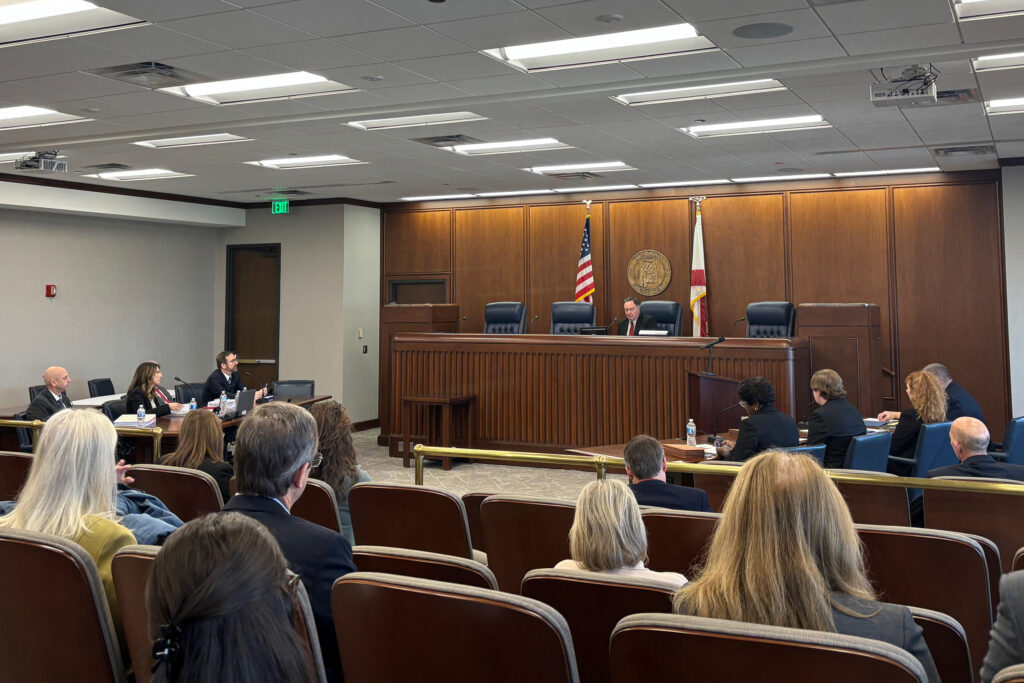
Instead, the PSC hosts informal hearings each year in December. The company presents its latest revenue figures for the year in progress and projections for the coming year, as well details about its environmental compliance plans for the next five years.
Company representatives answer questions from PSC staff, the attorney general’s office or members of the public, but they are not under oath as they would be in a formal rate case. The commissioners, if they attend, sit in the audience with everyone else. Proceedings are not streamed online, as regular PSC meetings are.
Christina Tidwell, a senior attorney for the Southern Environmental Law Center, attends the informal sessions on behalf of SELC clients, asking questions about Alabama Power’s profits, or issues like renewable energy adoption, coal ash cleanup plans, energy efficiency or electric vehicle charging programs offered by the company.
The one-day hearing typically lasts about four hours.
“The informal meetings held in December are the only opportunity for the public to ask Alabama Power questions about its environmental compliance costs or its profits,” Tidwell said in an email. “They are limited in scope—there is no discovery or opportunity to offer expert testimony and Alabama Power’s witnesses are not under oath. There is also no transcript of the meeting.
“It’s unclear to me what role these hearings play in overall utility regulation.”
High Interest Rates Preserved for Decades
One criticism of the RSE process is that utility return rates were locked in at 1982 rates for more than 40 years. And the early 1980s featured the highest interest rates since at least the 1950s thanks to inflation control measures taken by the Federal Reserve.
As Alabama Power demonstrated during its turbulent times in the 1970s, a utility company needs to earn returns higher than benchmark interest rates in order to attract investors to fund its operations and construction projects. If investors can get similar returns on government bonds, there’s little incentive to wade into the slightly riskier waters of utility companies, where politicians could scuttle or delay needed rate increases.
This story is funded by readers like you.
Our nonprofit newsroom provides award-winning climate coverage free of charge and advertising. We rely on donations from readers like you to keep going. Please donate now to support our work.
In 1981, the U.S. average interest rate spiked to 16.38 percent, dropping to 12.26 percent in 1982. But after 1982, interest rates dropped sharply for decades. This year, it is 4.21 percent after spending much of the past 20 years at near-zero levels in the wake of the 2008 economic crash and the COVID pandemic.
Utilities in other jurisdictions had to appear before state regulators periodically to justify their return rates, which dropped as well in many cases. Yet Alabama Power kept earning the same margins.
The only major change to the system occurred in 2013, when the PSC switched from using the industry-standard return on equity metric to evaluate Alabama Power’s profit margins to a novel weighted retail return metric developed for Alabama. The new metric gives Alabama Power additional incentives for having a higher percentage of equity as opposed to debt, a good thing when measuring financial health of the utility, but also made it harder to compare Alabama Power’s returns to other utilities.
By then, the 13 to 14.5 percent returns guaranteed by RSE were among the highest in the nation. After the adoption of the weighted return, Alabama Power’s return on equity remained around 13 percent through 2020, but has since dropped to around 11 percent.
Rountree, the former PSC employee who served as chief of staff to then-Commissioner Terry Dunn when the switch was made in 2013, said the change seemed mostly cosmetic, to deflect criticism over the high allowed returns.
By that time, Rountree said Dunn was being boxed out by the other commissioners, having advocated strongly for formal rate hearings that the other commissioners opposed.
“I crunched a lot of numbers back in the day when they were doing that, because I wanted to make sure that I understood it, and Commissioner Dunn wanted to make sure that we knew what they were doing,” Rountree said. “It looked to me like basically what they were trying to do was refashion the presentation of the numbers so that they look more benign.”
Dunn was the lone PSC commissioner to oppose the change to weighted returns, as he had been the only commissioner criticizing Alabama Power’s high return rates. Dunn lost the Republican primary the next year, after what he called a “smear campaign” linking him to national environmental groups and criticism from other Republicans.
Alabama Power’s return on equity, based on figures included in its federal Securities and Exchange Commission filings, remained above 13 percent through 2020, falling to around 11 percent after that. It is on track to earn about 11.1 percent this year, per filings with the PSC.
Last year’s nationwide average return on equity for an electric utility approved by state regulators was 9.74 percent, according to S&P Global.
Those handful of percentage points can add up. The Energy and Policy Institute, a nonprofit advocacy group, calculated in 2020 that from 2014 through 2018, Alabama Power earned over $1 billion more in profit than it would have if it earned industry-average returns.
The group found that Alabama Power’s profits over those five years totaled $4.26 billion at around a 13 percent return on equity. The group estimates that at industry average rates of return 9.75 percent, Alabama Power would have earned $3.24 billion.
Alabama Power is projected to earn $1.56 billion in profit this year, according to its filings.
The utility agreed to a two-year rate freeze this year with the PSC, intended to avoid increases through 2027, as concerns mount about high rates and the potential need for new generation to accommodate hyperscale data center projects that are currently being planned in Alabama.
U.S. Sen. Katie Britt has, on multiple occasions, said that Alabama Power has the “highest rates in the Southeast,” and called the situation “unacceptable.”
Alabama Power and the PSC have said that any data center customers will pay the “full and fair costs” of their operations, including any new infrastructure that is required. Specific details of those contracts however will likely not be made publicly available.
Rountree said he believes it is vital that utilities be allowed to earn a fair return on their investments.
“In utility regulation, you’re trying to have your public utilities do the job they’re supposed to do as best they can, and as efficiently as they can,” Rountree said. “It’s very important to make sure that you don’t starve them to death, that they have the wherewithal to do it well.”
Rountree credits Alabama Power for being a “first-rate utility” and for helping recruit major industries like Mercedes-Benz and Hyundai to build facilities in Alabama. But he also believes the returns are too much.
“Perhaps in the earlier years, giving Alabama Power that extra boost of return to build itself into a well-operating, good utility, maybe there was some wisdom there,” Rountree said. “But by God, I think it’s unfair, and I think it should be less than it is, the allowed rate of return.”
About This Story
Perhaps you noticed: This story, like all the news we publish, is free to read. That’s because Inside Climate News is a 501c3 nonprofit organization. We do not charge a subscription fee, lock our news behind a paywall, or clutter our website with ads. We make our news on climate and the environment freely available to you and anyone who wants it.
That’s not all. We also share our news for free with scores of other media organizations around the country. Many of them can’t afford to do environmental journalism of their own. We’ve built bureaus from coast to coast to report local stories, collaborate with local newsrooms and co-publish articles so that this vital work is shared as widely as possible.
Two of us launched ICN in 2007. Six years later we earned a Pulitzer Prize for National Reporting, and now we run the oldest and largest dedicated climate newsroom in the nation. We tell the story in all its complexity. We hold polluters accountable. We expose environmental injustice. We debunk misinformation. We scrutinize solutions and inspire action.
Donations from readers like you fund every aspect of what we do. If you don’t already, will you support our ongoing work, our reporting on the biggest crisis facing our planet, and help us reach even more readers in more places?
Please take a moment to make a tax-deductible donation. Every one of them makes a difference.
Thank you,

Reporter, Alabama
Dennis Pillion is a reporter for Inside Climate News based in Alabama. He joined ICN in 2024 after 17 years working for Alabama Media Group, including nine as the statewide natural resources reporter. His work for AL.com and The Birmingham News, won numerous Green Eyeshade and Alabama Press Association awards for his coverage of environmental issues in Alabama. He was born and lives in Birmingham, Ala.
Great Job By Dennis Pillion & the Team @ Inside Climate News Source link for sharing this story.