
By quietly reinstating the harshest abortion restriction in federal healthcare, the Trump administration has taken another deliberate step toward a nationwide ban.
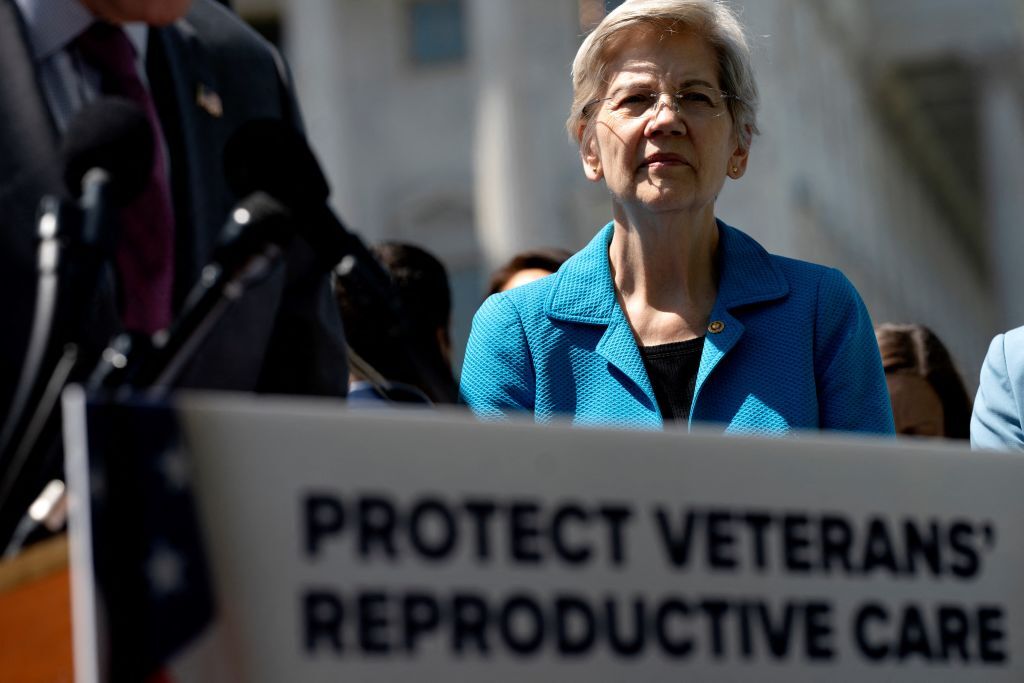
Claiming that abortion care is not an essential medical service, the Trump administration in August proposed a new rule to “reinstate the full exclusion on abortions and abortion counseling from the medical benefits package” for veterans and their dependents. The proposal would undo a 2022 Biden-era policy adopted in the wake of Dobbs that authorized the Department of Veterans Affairs (VA) to provide abortions in cases of rape, incest and threats to the pregnant woman’s health, in addition to the existing life-saving carveout. Once implemented, the rule would once again subject veterans to “the most extreme abortion restriction across federal agencies’ healthcare programs,” according to Democracy Forward.
The proposed rule change drew fierce public opposition from a wide range of groups during the requisite 30-day comment period—including (but far from limited to) Minority Vets of America, the National Women’s Law Center, Physicians for Reproductive Health, a coalition of 21 states and the District of Columbia, as well as Democratic members of the House and Senate Veterans Affairs Committee. The administration’s central claim that abortion is not essential medical care for veterans was denounced as “insulting and ignorant” by the House and Senate Veterans Affairs Committee, and according to the National Women’s Law Center, poses “a dangerous threat to the lives and health of veterans and their beneficiaries.”
The administration failed to follow the formal process required to finalize the proposed rule change, exemplifying its unrelenting attacks on reproductive and sexual rights. Instead, under the cover of the holidays, the full exclusion on abortion and abortion counseling for veterans and their dependents was reinstated through a legal directive issued in a Dec. 18 DOJ memo.
The reaction to this move was fierce and swift.
Slamming the hypocrisy, Democratic Rep. Morgan McCarvey (Ky.), a member of the House Committee on Veteran’s Affairs, forcefully stated:
“You can’t thank a veteran for putting her body on the line for her country, then turn around and take away her right to control it. There is nothing patriotic about denying our nation’s heroes the care they deserve and the ability to determine their own futures.”
Alex McGill Johnson, president and CEO of Planned Parenthood Federation of America, also denounced the sham nature of the move:
“To attack the freedoms of those who have risked their lives defending our own is an egregious assault on fundamental rights. This abortion ban makes it clear that the Trump administration will always choose its dangerous political agenda, even if the cost is veterans and their families’ access to essential care. Everyone deserves the ability to make decisions about their own bodies, lives and futures.”
The high-stakes DOJ memo was authored by Josh Craddock, a deputy assistant attorney general in the Office of Legal Counsel. Fiercely antiabortion, his nomination was red-flagged by the Center for Reproductive Rights for his belief that fetuses are constitutional persons entitled to equal protection of the law, that IVF is wrong due to the personhood status of frozen embryos, and his call for the FDA to withdraw its approval of mifepristone.
Craddock’s memo provides a technical statutory analysis in support of his position that federal law prohibits the provision of abortion care and counseling to veterans—a claim criticized by reporter Cody McDevitt for its overly narrow reading of the law.
Somewhat in passing, the memo suggests that Craddock has at least some awareness, however tenuous and misdirected it might be, of the fact that the contest over the right to abortion is intimately connected to the reality of women’s lives, rather than simply residing in the disembodied land of statutory interpretation.
Relying upon the Supreme Court’s wholly unsubstantiated claim in its 2007 opinion in Gonzalez v. Carhart that “’severe depression and loss of self-esteem can follow’” an abortion, Craddock argues therefore it is reasonable to assume that Congress opted to exclude abortion from the veterans’ medical benefits package because its inclusion would have been “antithetical to the goal of promoting, preserving, or restoring the[ir] health.”
Seeking to buttress his laughable claim that the exclusion was actually for the benefit of the nation’s pregnant veterans, he went on to cite Dobbs for the fantastical proposition that it accordingly advanced the government’s “’legitimate interest in the … protection of maternal health and safety.’”
Women are the now the fastest-growing group of veterans, and of those “who obtain their healthcare through the VA, “half are of childbearing age … with over 43 percent belonging to a racial or ethnic minority group,” according to Minority Veterans of America (MVA). Many of childbearing age live in states with gestational limit or total abortion bans, which means that the VA’s abortion exclusion policy will “shut off what may have been their only path to urgently needed care,” according to a Center for Reproductive Rights press release.
To drill down further into some of the arguments made by opponents that capture the particularly pernicious nature of the abortion exclusion given the multiple and often intersecting lived realities of women and other veterans with the capacity to be pregnant, we turn to the comprehensive public comment letter filed by the MVA, a self-proclaimed “nonpartisan nonprofit that works to create belonging and advance equity and justice for the minority veteran community.”
While the following is far from exhaustive, the quotes capture many of the powerful cross-cutting themes that animated and unite the opponents of this policy change. (Note: Internal endnote references have been omitted.)
Risk of Maternal Mortality and Severe Maternal Morbidity
“Veterans tend to have a constellation of health conditions that put them “at high risk for complications of pregnancy including severe maternal morbidity and pregnancy associated death … Black women are particularly vulnerable.
“Removing access to abortion care will cause tremendous harm in situations where the health of the pregnant veteran would be endangered if the pregnancy were carried to term…—her health may continue deteriorating, causing long-term consequences for her well-being and future fertility, as well as impacting current family. Contrary to the conclusion of the Proposed Rule, these are ‘needed’ medical services.”
Sexual Assault and Rape
“Veterans are at elevated risk of experiencing sexual assault and rape, perhaps more so than any other population. Removing access to abortion care and counseling for veterans who become pregnant as the result of rape or incest risks is cruel and risks compounding acute mental health harms for veterans at a time when VA should be providing needed care.
“For veterans, the mental health consequences of sexual assault are magnified because of the military setting. While still in service, victims are often forced to continue living and working with their assailants, increasing the prospect of revictimization and distress.
“Veterans are at particular risk of experiencing repeat sexual assault following their service, also known as revictimization.
“Abortion access and counseling are necessary to protect the metal health and well-being of veterans who become pregnant in these circumstances… Being forced to carry such a pregnancy to term and give birth may compound the trauma stemming from the sexual assault, as well as compound existing mental conditions or cause new mental health consequences, such as anxiety, depression, or PTSD. That experience can be ‘shatter[ing].’”
Importance of Options Counseling
“Eliminating counseling prevents providers from discussing the full panoply of potential medical care with their patients, meaning patients can’t understand the full range of medical options available to them. This undermines veterans’ confidence in their providers and medical care.“
Socioeconomic Barriers
“Veterans who live in states with abortion restrictions may be forced to travel long distances, and incur significant expenses … on top of lost wages. But for any veteran, the cost of paying for even just healthcare out of pocket may be too much. For the thousands of women veterans experiencing homelessness, the financial barrier is particularly acute.”
And so, bit by bit, we lurch closer to a national abortion ban. As the fight to stop it continues, it is worth keeping the words of Rita Graham—a former U.S. Army artillery officer and research director of the Service Women’s Action Network (SWAN)—firmly in mind:
“We fought for our freedoms and deserve the healthcare that comes with that.”
Great Job Shoshanna Ehrlich & the Team @ Ms. Magazine Source link for sharing this story.