Tesla has discontinued Autopilot, its basic driver-assistance system, as the company tries to boost adoption of a more advanced version of the technology that it calls Full Self-Driving (Supervised).
The decision comes as the company faces a 30-day suspension of its manufacturing and dealer licenses in its largest U.S. market, California. A judge ruled in December that Tesla engaged in deceptive marketing by overstating the capabilities of Autopilot and FSD for years. The California DMV, which originally brought the case and has a say over the licenses, stayed the ruling for 60 days to allow Tesla to comply by dropping the Autopilot name.
Autopilot was a combination of Traffic Aware Cruise Control, which sticks to a designated speed while maintaining distance with cars ahead, and Autosteer, a lane-centering feature that could steer the car around curves.
Tesla’s online configuration site now states new cars now only come standard with Traffic Aware Cruise Control. It’s not clear if current customers are affected.
The decision comes one week after the company said that starting on February 14, it would stop charging a one-time $8,000 fee for the FSD software. After that, customers will only be able to access FSD through a monthly subscription of $99 — though Tesla CEO Elon Musk wrote in a post on Thursday that the subscription price will increase as the software’s capabilities improve.
Musk believes that Tesla’s newer cars will be capable of “unsupervised” driving, saying FSD advances will allow drivers to “be on your phone or sleeping for the entire ride.” In December, he said a new version of FSD allowed the former, though texting while driving is illegal in almost all states.
On Thursday, Tesla rolled out the first robotaxi versions of its Model Y SUVs in Austin, Texas that have no human safety monitoring personnel in the cars. Those vehicles are running a more advanced version of the company’s driving software, and are still followed by the company’s cars for supervision.
Techcrunch event
San Francisco | October 13-15, 2026
Tesla launched the beta version of its Full Self-Driving software in late 2020, but adoption has always lagged behind the expectations of executives like Musk. In October 2025, Tesla’s chief financial officer Vaibhav Taneja said only 12% of all Tesla customers had paid for the software. Hitting “10 million active FSD subscriptions” by 2035 is one of the key “product goals” required for Musk to receive the full payout of his new $1 trillion pay package.
Tesla first introduced Autopilot in the early 2010s after talks broke down between Musk and Google to leverage the tech being developed by the search giant’s then-nascent autonomous driving division (which eventually got spun out into Waymo). Tesla made the driver assistance system standard on all of its vehicles in April 2019.
Across the decade-plus of Autopilot’s existence, Tesla struggled with communicating the software’s capabilities. The company often overpromised and made the tech seem more capable than it was, leading some drivers to become overly confident in its abilities, which in turn led to hundreds of crashes and at least 13 fatalities, according to the National Highway Traffic Safety Administration.
Great Job Sean O’Kane & the Team @ TechCrunch Source link for sharing this story.
DRIZZLE & FOG THIS AM: Damp morning commute, light showers today
COLD FRONT OVERNIGHT: Front arrives around midnight
EARLY SATURDAY: Rain and even a few storms, falling temperatures
SATURDAY AFTERNOON: Cold rain in SA, switchover to ice in Hill Country
6PM SATURDAY-EARLY SUNDAY: Ice possible in San Antonio, travel discouraged
FORECAST
TODAY
Fog and drizzle will slow down the morning commute. The fog should lift later this morning, however, patchy drizzle and shower activity will be possible through the rest of today. Temperatures will peak in the low-70s.
STRONG FRONT TONIGHT
A strong cold front will sweep through the area around midnight. Showers and storms will arrive with the front and a strong storm or two can’t be ruled out. Some localized heavy rainfall is also possible. Gusty winds and a rapid drop in temperatures directly follow the front. By Saturday morning, San Antonio’s temperatures will fall into the 40s, with wind chill values in the 20s.
Strong front around midnight, with a chance for storms (Copyright KSAT-12 2026 – All Rights Reserved)
SATURDAY
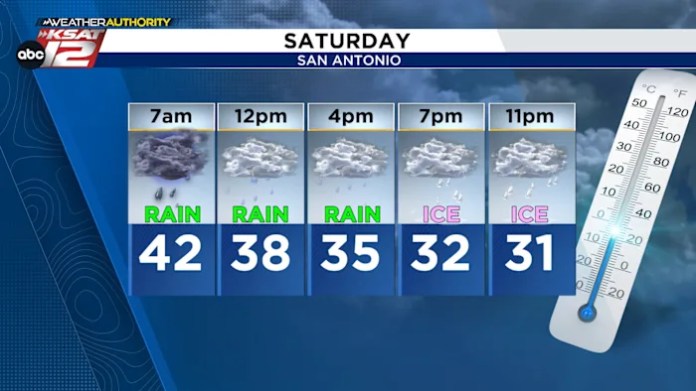
Any heavy rain will push east by early Saturday, but light showers will remain around the area into the afternoon. Meanwhile, temperatures will continue to fall, dropping to freezing in the Hill Country by late afternoon. Light freezing rain will be possible there. For San Antonio, it’ll stay a cold rain until sunset.
Saturday’s Forecast (Copyright KSAT-12 2026 – All Rights Reserved)
ICE POSSIBLE SATURDAY NIGHT & EARLY SUNDAY
Temperatures in San Antonio will drop to or below freezing after sunset Saturday. At this time, a heavier band of precipitation is forecast to move across the area. Freezing rain is expected and some accumulation is possible. Bridges and overpasses will likely become dangerous and should be avoided overnight Saturday and early Sunday. The Hill Country could see heavier amounts of ice, leading to moderate impacts such as isolated power outages.
Ice impacts late Saturday into Sunday (Copyright KSAT-12 2026 – All Rights Reserved)
VERY COLD MONDAY AND TUESDAY MORNINGS
Skies are forecast to clear late on Sunday. This will allow for temperatures to plummet Sunday night and into Monday morning. Currently, we are expecting temperatures in the teens and 20s. Wind chill values may be in the single digits by Monday morning. You’ll want to cover any exposed pipes, drip your faucets, and prepare for bitter cold. Tuesday morning will also see lows in the teens and 20s.
Bitter cold mornings expected Monday and Tuesday. (Copyright KSAT-12 2026 – All Rights Reserved)
Daily Forecast
KSAT meteorologists keep you on top of the ever-changing South Texas weather.
QUICK WEATHER LINKS
Copyright 2026 by KSAT – All rights reserved.
Great Job Justin Horne & the Team @ KSAT San Antonio for sharing this story.
GloRilla is once again trending, and this time, it’s over her looks. The Memphis rapper sparked major conversation on social media after sharing a bare-faced selfie video, prompting mixed reactions from viewers. Glo quickly addressed the chatter, calling out those who are little too invested in her appearance.
GloRilla Sparks Reactions After Dropping NEW Selfie Video
On Wednesday, January 21, GloRilla posted a mirror selfie video to her X account, showing off her natural fresh face. She kept the caption simple, writing, “No lash moment…” The post quickly took off, racking up more than 8.2 million views and sparking a wave of mixed reactions, with users weighing in on the rapper’s look. See the video below.
GloRilla Sends A Message To Critics Commenting On Her Appearance
It didn’t take long for GloRilla to catch wind of the online chatter. On Friday, she returned to X with a direct clapback aimed at critics who made negative comments about her appearance.
“So did any of you h*** get a raise for tryna figure out why a b**** look so beautiful yesterday???? Rent paid? Anything??? Or y’all really just #THAT mad dat a b**** gorgeous for free? Lemme kno ina comments,” she wrote.
One commenter replied, “Nobody mad we just remembered how u looked…”, to which Glo fired back, “Are you getting paid for remembering that? Why does it matter so much to you?”
Social Media Reacts To Glo’s Clap Back
As expected, the internet still continued to sound off with reactions to Glo’s clap back over in The Shade Room Teens comment section. Some social media users were split, with responses ranging from praise to criticism.
Another Instagram user @fijiwhit wrote, “No lie I don’t see nooo changes she literally been looked like this she just look like the older she gets the prettier! Grab a picture from 18 or 19 and put it up with what you look like today and guarantee there is a huge difference!
While Instagram user @paradiseparis wrote, “We know why she looks good. She paid for her pretty”
Instagram user @daniellexoo wrote, “Naa I think people were just shocked at the transformation that’s all ”
Another Instagram user @tanasiabrionne wrote, “idk I like the new face”
While Instagram user @sc0rpiogyal wrote, “Ngl she look the same just richer and softer ”
Instagram user @hoesshatee_jadaa wrote, “why do people act like we just gon forget what you looked like 4 months ago? Like huh”
Another Instagram user @allabouttdriaa wrote, “I miss when she was humble ”
While Instagram user @vibinwithkem wrote, “she look tf good ”
The S&P 500 closed up 0.55% yesterday on good news about U.S. GDP growth and President Trump retracting his threat to impose more tariffs on Europe if he isn’t given Greenland. The S&P is again above 6,900 and within 1% of its all-time high. Gold hit another record yesterday, too.
But futures on the index were down 0.24% prior to the opening bell in New York and markets in Europe sold off slightly this morning after Asia closed mixed, a sign that traders are booking profits after yesterday’s rally.
On the macro front, Wall Street analysts are bullish. It’s a marked change from the fraught mood of the last few days, when investors were anticipating another transatlantic tariff war.
In fact, Trump’s tariffs are turning out to be a much smaller economic deal than “earlier worst-case fears,” JPMorgan Chase says. Companies have adjusted their pricing and supply chains, and the result is “the realized tariff rate has been much lower at ~11% (versus expectations of 15%,”), according to Dubravko Lakos-Bujas and his team. “Only 14% of S&P 500 companies are highly sensitive to tariffs.”
And it could get better if the U.S. Supreme Court rules against the president, the bank says.
“Prediction markets assign >65% odds that the Supreme Court rules against the government, and those odds have consistently been against the government, especially following the November Supreme Court oral arguments,” Lakos-Bujas told clients.
Source: Polymarket
Analysts were also cheered by a new upward revision for Q3 2025 U.S. GDP, at 4.4%.
“The 4.4% real growth rate is much higher than normal and is likely to moderate over the course of the year, but if we can stay above 3% for the entire year it could lead to double-digit returns in the stock market,” Chris Zaccarelli, chief investment officer at Northlight Asset Management said in an email seen by Fortune.
EY-Parthenon Chief Economist Gregory Daco was singing from the same hymnbook. “Momentum was driven by resilient consumer spending, robust equipment and AI-related investment, a sizeable boost from net international trade, and a rebound in federal government outlays. The U.S. economy is neither overheating nor stalling—it is adjusting,” he said in a note.
All of that explains the calm we’re seeing in the markets today.
“For some assets, it was almost like the selloff never happened, with the VIX index of volatility (-1.26pts) back at 15.64pts, which is beneath its levels prior to Saturday’s tariff announcements,” according to Jim Reid and his team at Deutsche Bank.
Here’s a snapshot of the markets ahead of the opening bell in New York this morning:
S&P 500 futures were down 0.24% this morning. The last session closed up 0.55%.
STOXX Europe 600 was down 0.22% in early trading.
The U.K.’s FTSE 100 was down 0.11% in early trading.
Japan’s Nikkei 225 was up 0.29%.
China’s CSI 300 was down 0.55%.
The South Korea KOSPI was up 0.76%.
India’s NIFTY 50 was down 0.95%.
Bitcoin was flat at $89.9K.
Join us at the Fortune Workplace Innovation Summit May 19–20, 2026, in Atlanta. The next era of workplace innovation is here—and the old playbook is being rewritten. At this exclusive, high-energy event, the world’s most innovative leaders will convene to explore how AI, humanity, and strategy converge to redefine, again, the future of work. Register now.
Great Job Jim Edwards & the Team @ Fortune | FORTUNE Source link for sharing this story.
DAYTONA BEACH, Fla. – Four-time IndyCar champion Alex Palou on Friday was ordered to pay McLaren Racing more than $12 million in the breach of contract suit the team filed when the Spaniard backed out of two different deals with the racing team.
The Friday ruling from London’s High Court came after a five-week trial last year. McLaren initially sought almost $30 million in damages, but that number was reduced to $20.7 million as the racing juggernaut sought to reclaim money allegedly lost in sponsorship, driver salaries and performance earnings.
Palou was not ordered to pay anything related to Formula 1 losses McLaren said it suffered when Palou decided to remain with Chip Ganassi Racing rather than move to McLaren’s IndyCar team in 2024. All the damages awarded to McLaren were tied to losses the IndyCar team suffered by Palou’s change of mind.
“The court has dismissed in their entirety McLaren’s Formula 1 claims against me which once stood at almost $15 million,” Palou said in a statement. “The court’s decision shows the claims against me were completely overblown. It’s disappointing that so much time and cost was spent fighting these claims, some of which the Court found had no value, simply because I chose not to drive for McLaren after I learned they wouldn’t be able to give me an F1 drive.
“I’m disappointed that any damages have been awarded to McLaren. They have not suffered any loss because of what they have gained from the driver who replaced me. I am considering my options with my advisors and have no further comments to make at this stage.”
Palou has won three consecutive IndyCar titles and the Indianapolis 500 since this saga began midway through the 2022 season. He has four IndyCar titles in the last five seasons.
IndyCar team owner Chip Ganassi said Palou has his backing.
“Alex has our full support, now and always. We know the character of our driver and the strength of our team, and nothing changes that,” Ganassi said. “While we respect the legal process, our focus is exactly where it should be: on racing, on winning, and on doing what this organization has always done best, competing at the highest level.
“We’re locked in on chasing another championship and defending our 2025 Indianapolis 500 victory. That’s where our energy is, and that’s where Alex’s focus is, on the track, doing what he does best: winning.”
McLaren has won the last two constructor championships in F1 and Lando Norris last season won the driver championship.
Palou first signed with McLaren in 2022 to drive for its IndyCar team in 2023, but Ganassi pushed back and exercised an option on Palou for the 2023 season. The matter was decided through mediation, with McLaren covering Palou’s legal costs. Palou could not join McLaren until 2024 but was permitted to be the reserve and test driver for the F1 team in 2023.
When McLaren signed Oscar Piastri for its F1 team, and Palou’s performance with Ganassi in IndyCar was so dominant, the driver decided he did not want to move to McLaren’s IndyCar team and reneged on his contract.
Palou argued his contracts with McLaren were “based on lies,” and he’d never have a chance to race in F1. His counsel also accused McLaren Racing chief executive Zak Brown of destroying evidence by deleting WhatsApp messages related to the case.
McLaren contended it lost revenue when Palou backed out ahead of the 2024 season and the team had to scramble to find another driver. McLaren wanted Indianapolis 500 winner Marcus Ericsson, who had already committed to Andretti Global, so it instead used four different drivers that season.
Because none were as accomplished as Palou, McLaren argued both NTT Data and General Motors reduced their payouts to the team because McLaren did not field a driver of the caliber it had promised.
Copyright 2026 The Associated Press. All rights reserved. This material may not be published, broadcast, rewritten or redistributed without permission.
Great Job Jenna Fryer, Associated Press & the Team @ KSAT San Antonio Source link for sharing this story.
ProPublica on Friday published never-before-released data connecting generic drugs to the factories that manufactured them. The data powers Rx Inspector, our groundbreaking tool that allows you to find the factories where your generic drugs were made and their Food and Drug Administration inspection track records.
The data, which ProPublica created by linking several FDA datasets, has never been made available by the agency before. It will allow anyone to connect prescriptions to the facilities they were manufactured in by linking National Drug Code numbers to FDA Establishment Identifiers of drug manufacturing facilities.
Academic researchers said the data would contribute significantly to research evaluating the quality and supply of generic drugs.
“This bypasses an incredibly time-consuming barrier for people who want to study drugs and anything to do with manufacturing,” said John Gray, a professor at the Ohio State University.
Gray and his team are working to assign generic drugs quality scores based on risk. The goal is to help government purchasers, including the Centers for Medicare & Medicaid Services, buy medications based on quality, not just cost.
The data also provides some basic information about each facility, like the country it’s in and the name of the company that registered it.
The methods we used to link the FDA’s drug and facility identifiers are complex, and are laid out in our full methodology. To obtain some of the data, ProPublica had to sue the agency.
We know that much of what is represented here is likely incomplete. It is possible the FDA’s information is not up-to-date because, for example, one company acquired another or moved its manufacturing to a different location. However, we believe this is an important first step in shedding light on a process that the agency and drugmakers have sought to keep secret from consumers.
We are releasing this data under a Creative Commons license, meaning you may use it for noncommercial purposes as long as you attribute ProPublica and link back to Rx Inspector.
Great Job Brandon Roberts & the Team @ ProPublica Source link for sharing this story.
Hayes Greenwood is a London-based artist working primarily in painting, alongside sculpture, video and installation. Her deeply charged works draw on lived experience, using landscape and natural motifs to explore life, death, desire and embodiment. She combines the familiar and the otherworldly, translating complex emotional states into heightened visual forms where internal and external fold into one another. Hayes Greenwood combines the familiar and the otherworldly, translating complex emotional states into heightened visual forms where the internal and external worlds collapse and fold into one another.
Hayes Greenwood has exhibited internationally, including solo shows at Castor (London) and GiG (Munich), as well as group exhibitions at Stuart Shave Modern Art (London), Mana Contemporary (USA) and Saatchi Gallery (London). She is currently working on a major commission for Hospital Rooms and has recently undertaken residencies with theCOLAB: Body & Place (2025), Hogchester Arts (2024), and was awarded the Palazzo Monti x ACS Residency Prize (2024). She holds an MA from City & Guilds of London Art School and is the co-founder and former director of Block 336. Her work is held in many public and private collections.
Was there a particular moment when you understood that creating art wasn’t just something you loved, but something you wanted to devote your life to?
It didn’t arrive as a singular moment; it was a slower process than that for me. I’ve always been surrounded by art and creativity in culture both high and low. Making is something I’ve always loved and just never been able to stop doing.
Though she didn’t do it later in life, my mum was a skilled painter, and my stepdad had a deep love of art and literature. He was very involved in Salts Mill in Yorkshire when I was growing up. He was a friend of David Hockney’s, and I always loved Hockney’s drawings and opera sets when I was a child. As a kid, being an artist seemed like a very fun and compelling way of engaging with the world!
I followed a fairly standard path: art A-level, an art foundation, then a BA and MA. After completing my BA, I set up Block 336 in Brixton, a large artist-run gallery and studio space which I ran for over a decade, commissioning major solo projects by other artists with an ambitious public programme. I’ve taught in art schools for the past 15 years and these experiences reinforce that art isn’t just about individual practice but about connection, exchange and deep learning.
I think art will always be a way to orient myself in the world. It continues to be a source of pleasure, a place to time-travel, play, think and process moments that are confusing, painful, unresolved, intense, joyful, wonderful or strange.
You mention that the paintings you created for Weird Weather have all ‘expand[ed] out of a kind of grief logic.’ How did creating this body of work challenge or affirm your previous beliefs about the relationship between art and grief?
Well, artists have always made work to understand their feelings and position in the world. There is a lot of grief in art in one form or another. Edvard Munch is often quoted as saying that “art comes from joy and pain, but mostly pain.” It is said that grief is the price we pay for love, and Bell Hooks writes about this. She talks about it not being simply about loss, but about how it is a testament to the depth of our bonds. She describes it as evidence of our capacity to love deeply and remain open and affected by the world rather than defended against it.
In making Weird Weather, this perspective became tangible through the way the work responded to place and memory. The paintings grew out experiences shaped by transition and change, but also by attachment and connection and to the sense of poignancy and sharp relief that accompanies significant life events. Working urgently and intuitively allowed the work to expand, embracing both intensity and tenderness. Grief is not one-dimensional; it isn’t singularly heavy or painful. It is prismatic, generative, wild, psychedelic and transcendental. It can expose what it is to be alive and present in the world and locates you in a heightened state of awareness and openness.
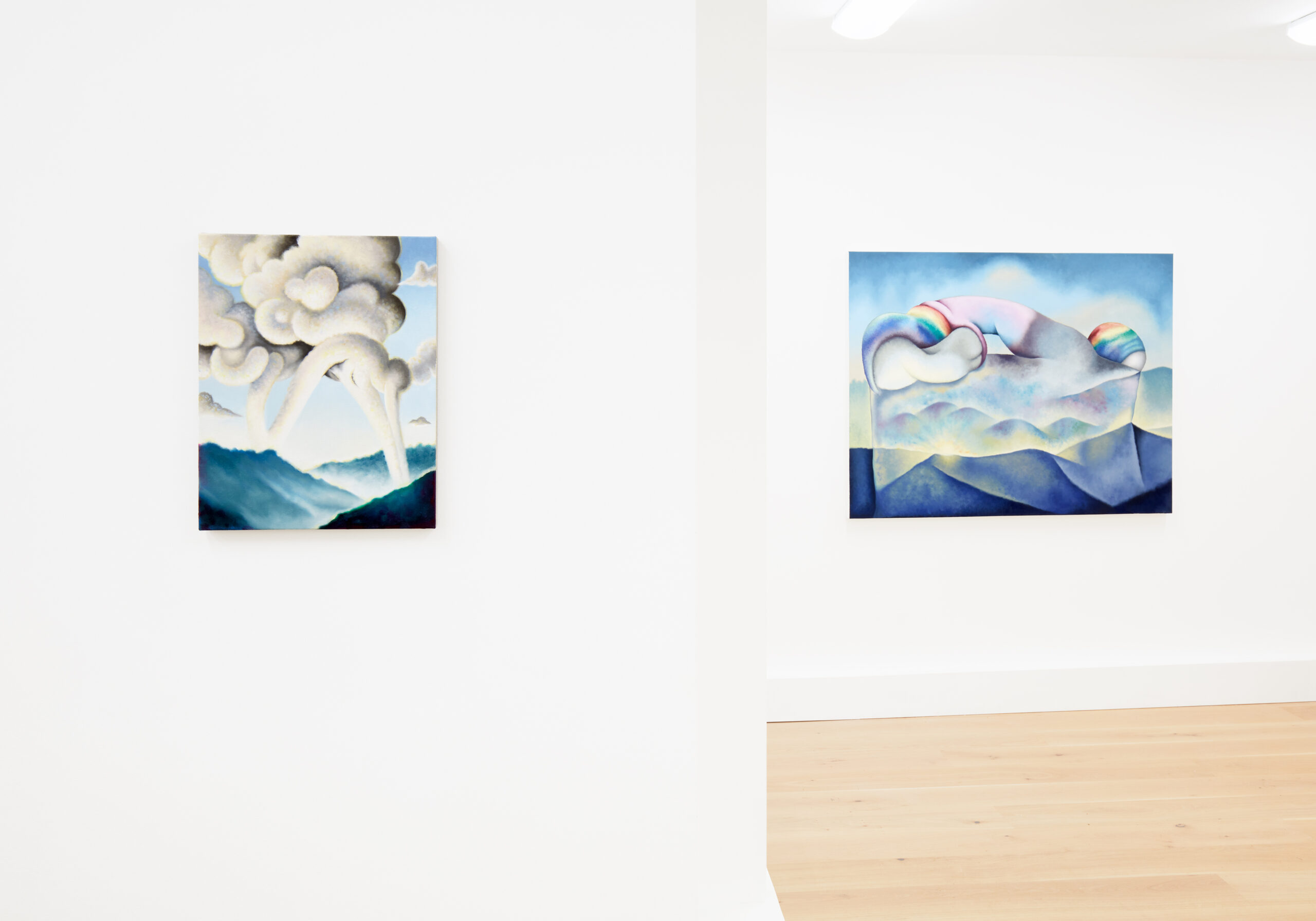
Left: High Pressure, Oil on canvas, 45 x 35 cm, 2025. Right: Held and Holding, Oil on canvas, 110 x 140 cm, 2025. Credit Matt Spour courtesy of IONE & MANN and Castor. Artwork copyright Jane Hayes Greenwood
Reading your description of grief as a prismatic state – where love, pain, gratitude and acceptance can coexist – reminded me of a beloved quote by Rilke: “Death is our friend precisely because it brings us into absolute and passionate presence with all that is here, that is natural, that is love.” When you were working on Weird Weather, did painting become a way of entering that heightened presence? Or did it function more as a space to hold contradiction, where opposing emotional states could sit without needing resolution?
That is a beautiful quote. I would say both, and more. Love and loss really throw you around; they produce a kind of Shakespearean madness, and painting, for me, became a container for all of it – a way to be in a state of heightened presence, to hold emotions that splinter and overlap without needing them to be resolved or in order. At the same time, it was a way to connect with love and beauty, to feel deeply, to process and be grounded, to transform something painful into something creative, to channel, to sublimate, and to experiment and play.
There’s a persistent idea that some of the most beautiful or resonant art is born from life’s most painful experiences, especially profound loss. Do you find that notion reductive, or does it ring true in your own experience?
It can be true. Pain opens you up to depth, intensity and transformation. Equally though, joy, curiosity and wonder are very fertile ground, and they feed and exist in art in ways that are very profound. These things sit on two sides of the same coin and often can’t be separated. For me, creating Weird Weather was motivated by a significant loss, yes, but it was also shaped by a connection to love and so much of what I think is beautiful. When I’m making work, I’m frequently trying to engage with that which I don’t fully understand – the deep, gritty, weird and surprising parts of experience. For me, making is ultimately about embracing all of it and letting it guide the work.
Were there any works in Weird Weather that genuinely surprised you, where you started with one emotional or visual intention but the painting took you somewhere completely different?
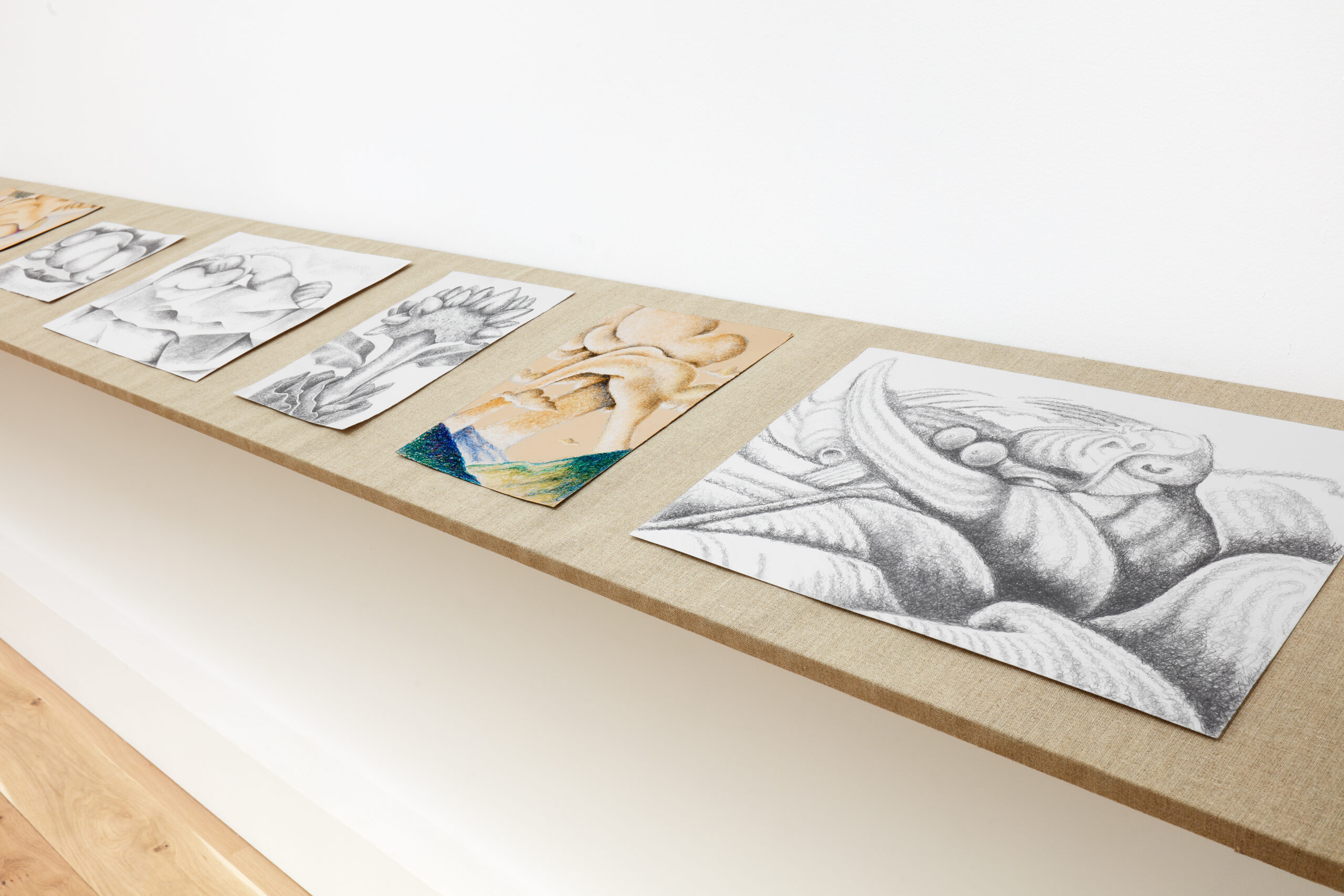
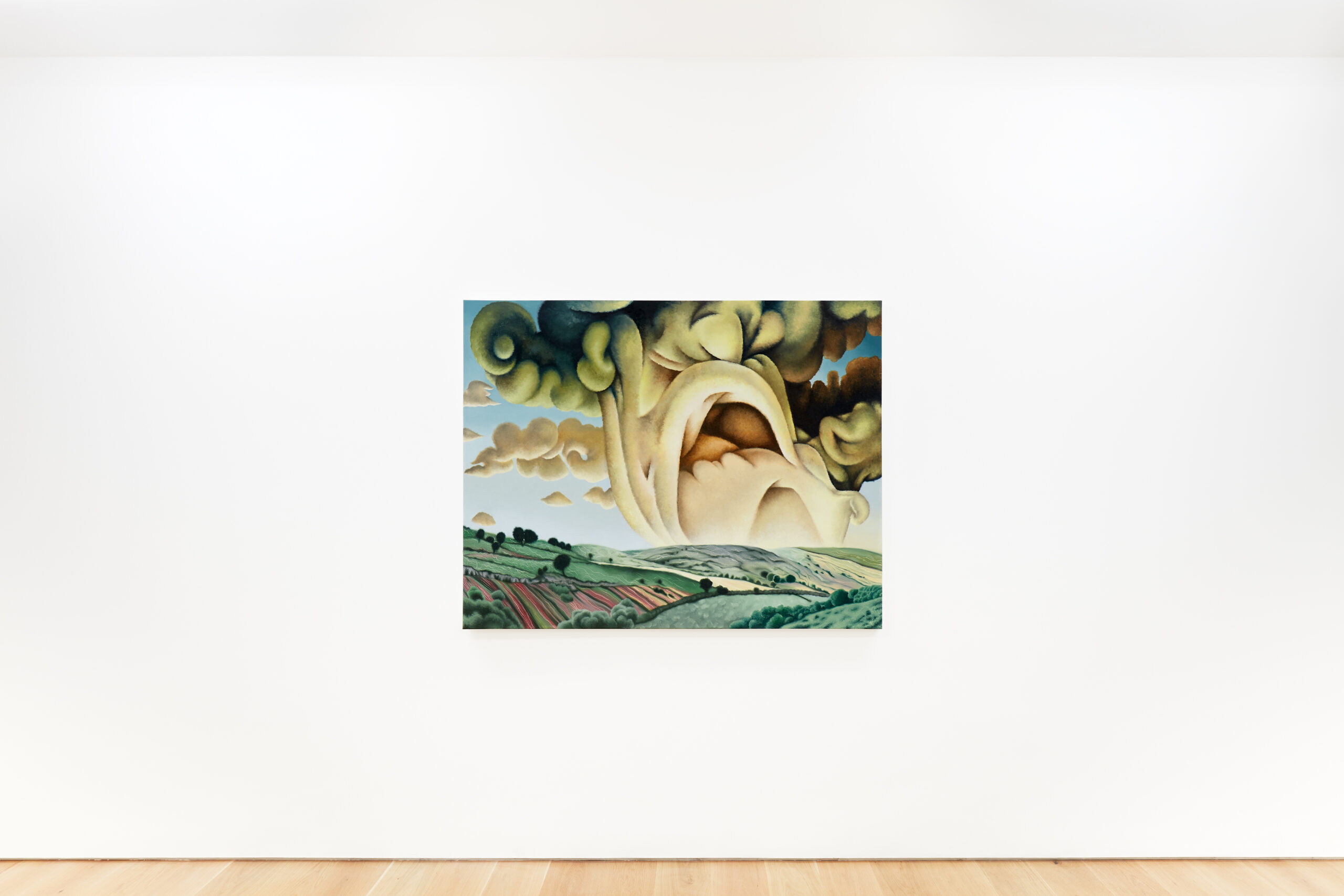
The paintings all start with drawings, but before committing to making the paintings I allowed the drawing stage to be very open – many of them took me in unexpected directions. The logic of the works was shaped in part by my connection to landscape and home. The paintings reference the hills of the Pennines where I grew up. Rather than depicting the landscapes literally, I allowed internal and external states to fold into one another, attempting to push bodily sensation through weather and geography.
The larger paintings are a decent scale, so physically they were quite immersive. There is always a dialogue between intention and discovery in the making that keeps the work alive and unpredictable, pushing colour and touch to carry feeling and sensation. I would try things within the paintings and go off in mad directions, often returning to something closer to what I originally intended. But you have to explore and take these flights of fancy to see what comes of it – and the history and remnants of those journeys remain.
Credit Matt Spour courtesy of IONE & MANN and Castor. Artwork copyright Jane Hayes Greenwood
Thinking back to The Witch’s Garden, which engaged deeply with marginalisation, folk knowledge and gendered authority, I’m curious how earlier bodies of work continue to live inside newer ones. Do processes or emotional strategies ever bleed forward, or does each series demand a complete reorientation?
The core is always the same and earlier bodies of work definitely live inside newer ones, even if the surface concerns might feel different.
The Witch’s Garden was similarly motivated by an autobiographical starting point, tracking my experience of trying for and later having children. It was through researching the origins of the love heart symbol that I came across the history (likely fake news) about a now-extinct plant called silphium, which was apparently an aphrodisiac and contraceptive and was said to have a heart-shaped seed. That set me off into researching plants and their histories, which are of course inextricably entangled with our own. Contextually, the research was so rich and fascinating that I couldn’t stop making the paintings – there are about 60 works in the series. These plants and flowers I was painting became containers for emotion, story and history, but I also always saw them anthropomorphically – as characters in their own right. For Weird Weather that gaze has shifted outward toward landscape –there has been a kind of zooming out.
I have always connected to William Blake’s description of double vision – seeing the world as more than it appears, one thing looking like another, or seeming to express something emotionally. Pareidolia is a familiar phenomenon and my children are always pointing things out, saying, “that looks like X.” It’s quite a trippy or childlike way of seeing the world that has always been with me. I think it’s a useful, generative thing to take note of and what is happening inwardly and outwardly often mirror and inform one’s understanding of experience.
Variable Becoming Cyclonic, Oil on canvas, 110 x 140 cm, 2025. Credit Matt Spour courtesy of IONE & MANN and Castor. Artwork copyright Jane Hayes Greenwood
Finally, what is something you wish more people understood about the experience of being an artist?
Well, I was right as a kid –being an artist is a very fun and compelling way to engage with the world! It’s the best thing in so many ways, but as someone who lives in a semi-permanent state of existential awareness, it can also be intense *laughs*! Art takes you to the craziest places and introduces you to amazing people but there is no road map and the path can be tricky to navigate. Artists are constantly balancing creative exploration with practical realities and right now, with a tough economy and arts funding becoming ever harder to access, it can be challenging. Being an artist is not always easy, but I wouldn’t want to do anything else.
Great Job Gerda Krivaite & the Team @ Our Culture Source link for sharing this story.
From day one of his second term in office, President Trump has unleashed a constant flurry of sweeping changes to immigration enforcement in the United States.
The nonpartisan Migration Policy Institute (MPI) published an analysis of the Trump administration’s immigration actions in the article, “Unleashing Power in New Ways: Immigration in the First Year of Trump 2.0.”
1 of 3 — MPI Trump 2.0 image 1.png
Immigrant encounters at the U.S.-Mexico border over the last 12 years.
Courtesy / Migration Policy Institute
2 of 3 — MPI Trump 2.0 image 2.png
The number of 287(g) agreements per state.
Courtesy / Migration Policy Institute
3 of 3 — MPI Trump 2.0 image 3.png
The number of refugees admitted into the U.S. vs the resettlement ceiling.
Courtesy / Migration Policy Institute
Co-author Muzaffar Chishti, a senior fellow with MPI, said executive orders on immigration have come quickly and show no signs of slowing down.
“It has gone beyond shock and awe,” Chisti said. “We’re not sure what is ultimately more impactful: Is it actually the individual elements of policy or is it the need to create a feeling that every immigrant, especially unauthorized immigrants, should be looking over their shoulders?”
Muzaffar Chishti is a senior fellow at the non-partisan think tank, the Migration Policy Institute.
Chishti said immigration actions have been especially effective this time around with Congress’ passing of the so-called Big Beautiful Bill, which included $170 billion for immigration enforcement over a four-year period.
“If there’s a supply of money, then it also creates a demand for using it,” Chishti said. “This means you have to build detention facilities because money has been allocated. You have to hire more ICE officers because money has been allocated. You have to sign more 287(g) agreements with states and localities because money has been allocated.”
Click here to read the full article and view an MPI briefing on the report below:
Great Job Norma Martinez, Marian Navarro & the Team @ Texas Public Radio for sharing this story.
Cancellations nearly matched factory announcements last year: Firms unveiled a total of $24.1 billion in new cleantech manufacturing projects, but scrapped $22.7 billion worth.
It’s a dramatic reversal. The Biden-era Inflation Reduction Act had spurred well over $100 billion in cleantech manufacturing commitments through incentives for both factories and their customers, be they families in the market for an EV or energy developers building a solar megaproject. The ensuing boom in cleantech factory construction created thousands of jobs and caused overall manufacturing investment to soar. Most of the investment was planned for areas represented by Republicans in Congress.
But last year, the Trump administration put strict stipulations on incentives for factories and repealed many of the tax credits that helped generate demand for American-made cleantech. It also showed an astonishing hostility to clean energy projects — namely offshore wind — and cast a general cloak of uncertainty over the entire economy.
To be fair, other potential factors are at play.
Some of the slowdown in cleantech factory investment could simply be the market maturing. Plenty of projects announced right after the Inflation Reduction Act might already be online, or close to it. Or it could be the result of the gravitational pull of the data center boom, which is attracting gobsmacking amounts of capital that could have otherwise financed more cleantech factories.
But either way, as the new data shows, the Trump administration has weakened the case for investing in expensive projects tied to clean energy. I’m willing to bet that the consequence will be more factory cancellations — and less investment — over this year, too.
{
if ($event.target.classList.contains(‘hs-richtext’)) {
if ($event.target.textContent === ‘+ more options’) {
$event.target.remove();
open = true;
}
}
}”
>
Great Job Dan McCarthy & the Team @ Canary Media Source link for sharing this story.
As the right embraces “AWFUL” as a new slur, outspoken moms are emerging as its most threatening, and targeted, group.
Messages in solidarity with Renee Good are displayed in windows of the Midtown Global Market on Jan. 20, 2026, in Minneapolis. (Brandon Bell / Getty Images)
Last week, my column explored the misogyny directly heaped on Renee Nicole Good—the Minneapolis resident, wife and mother shot and killed by an Immigration and Customs Enforcement (ICE) agent—and highlighted the anti-woman actions taken by immigration enforcement agents over the past year.
Since then, the right wing manosphere has quickly absorbed the lexicon of AWFUL: “Affluent White Female Urban Liberals.” Move over childless cat ladies, there is a new broad in town. The movement hell-bent on extolling the virtues of tradwife life has now set its sights on “organized gangs of wine moms us[ing] Antifa tactics to harass and impede” ICE, according to the talking heads at Fox News.
Sigh, MAGA. There you go again, mangling the plotline. Don’t you know? Motherhood has always been political, embedded in acts of resistance, from Reconstruction to women’s suffrage through the rise of the Civil Rights Movement. In the United States and around the world, mothers have organized, stood their ground and placed their bodies on the line for time immemorial.
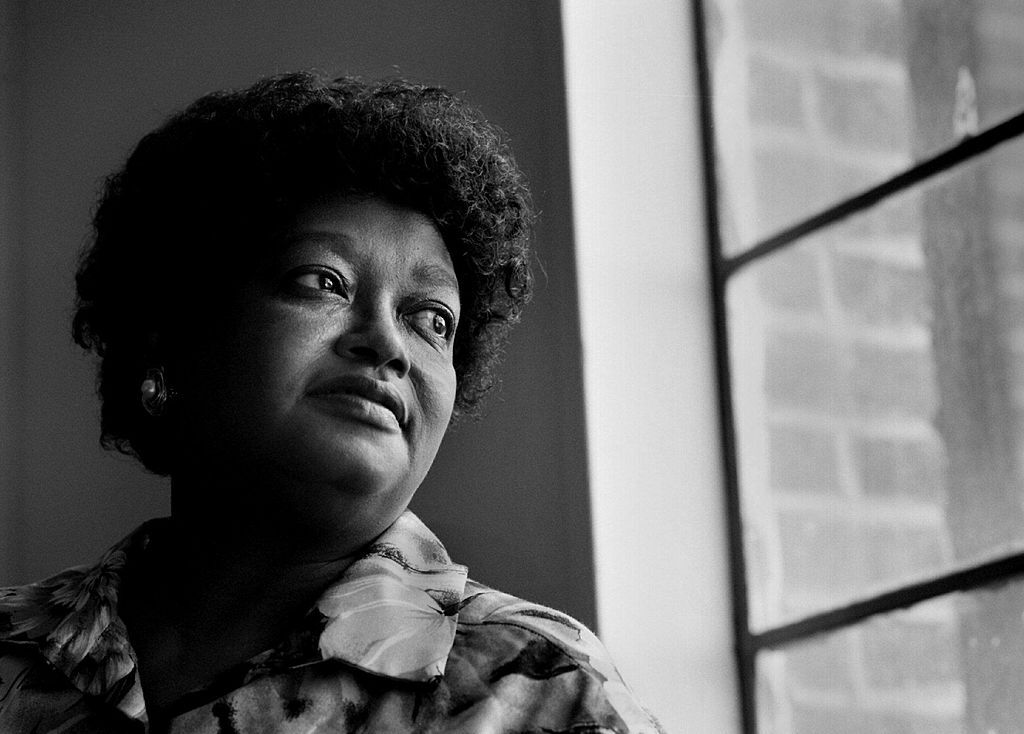
Last week, as the nation debated what kinds of women rise up, civil rights activist Claudette Colvin died at age 86. Arrested in 1955 at age 15 for refusing to give up her seat on a segregated Alabama bus, nine months before Rosa Parks did the same, young Colvin’s public persona was ahead of her time. Reportedly, national leaders had hoped she might be a fresh face for the movement, but ultimately worried she was, well, too wine mom. She had a baby at 16 and, according to the Smithsonian magazine, “words like ‘mouthy,’ ‘emotional’ and ‘feisty’ were used to describe her.”
Claudette Colvin photographed on April 7, 1998. On March 2, 1955, at the age of 15, Colvin was arrested for not giving up her seat to a white person in Montgomery, Ala.—nine months before the arrest of Rosa Parks. (Dudley M. Brooks / The Washington Post via Getty Images)
The century roared on, and so did activist mothers. Girls Who Code and Moms First founder Reshma Saujani recently posted a video highlighting an array of groups that have shaken the status quo with mom-centric organizing—from Mothers Against Drunk Driving, which dominated in the 1980s (ask a suburban Gen X-er about smashed up cars at high school sporting events, talk about scared straight), to Moms Demand Action, the largest nationwide grassroots network formed to take on gun safety in the aftermath of the Sandy Hook school massacre in 2012.
The accusation that some mothers serve the nation (The Contrarianreported last year on the Trump administration’s Nazi-esque consideration of medals for women with at least six children) and others are anathema to its safety and stability is not just inaccurate: It is a deliberate strategy of the authoritarian.
Of course, what Republicans really want is a world in which women—wives, moms, childless cat ladies, even menopausal grandmas—have no public voice at all. They know that women register to vote and cast ballots at higher rates than men, and that Black women show up at the polls and support voter mobilization efforts in even greater numbers.
Just this week, Republicans in the House and the Senate resurrected the notorious Safeguard American Voter Eligibility (SAVE) Act which passed the House in 2025 but stalled in the Senate. Among its provisions, it would make it harder for anyone who changed her name, including many married women, to register to vote. Think that is an oversight? Ask Secretary of Defense Pete Hegseth, who reposted a video of pastors calling for repeal of the 19th Amendment and patriarchal household-style voting.
Moms’ public outrage has every reason to scare Republicans. Empirically, women’s role in protest is a direct avenue to more robust democracy. Harvard Kennedy School Professor Erica Chenoweth wrote a two-part series for Foreign Affairs and Ms. magazine, “The Patriarchs’ War on Women,” making the case that 20th-century mass movements demanding independence and democracy “were more successful at achieving their aims when women participated in larger numbers at the front lines. From the Philippines to Brazil, from Tunisia to Argentina, from Chile to Sudan, ‘people power’ movements were more likely to usher in sustained democratization when at least 25 percent of their participants were women.”
The fate of women’s rights is inextricably tied to the future of democracy. As it turns out, when moms—and all women—mobilize, we are best-suited to help achieve both.
In her recent viral New York Times column, “The Right Is Furious with Liberal White Women,” Michelle Goldberg wrote, “I have more ICE whistles in my house than I can count, because my neighbors are constantly handing them out, most recently at my daughter’s dance recital. Similar bourgeois mobilizations are happening all over the country.”
But what is happening right now appears to be far more palpable.
“Women have always been told the same thing, especially moms. ‘Stay home, be polite, don’t get involved, don’t ask questions, be pretty and don’t pay attention.’… Here’s the problem with that. Mothers do notice. We notice when our neighbors are afraid to leave their homes. We notice when our schools and daycares are asking for ICE protocols. And boy do we notice when real families are being impacted while the rest of the world looks past it.”
Which brings us back to Claudette Colvin. Before her death, she told reporters that her activism and her ability to claim her seat on the bus felt like “Harriet Tubman’s hands pushing me down on one shoulder and Sojourner Truth’s hands pushing me down on the other shoulder—saying, ‘Sit down, girl!’”
Let us all now stand up in her image and honor. Brave women, bold mothers, wine and all, are truly our nation’s institutional spine and moral backbone. We drink at dusk and ride at dawn!
Great Job Jennifer Weiss-Wolf & the Team @ Ms. Magazine Source link for sharing this story.