This guide was originally published on Kornbluh’s Substack, History Teaches …
Looking toward the end of the year, here are a few of the books, plays and museum shows full of vital “history teaches” content—especially on feminism(s), women and gender and sexuality, with a little law and Jewish history, and all of the things this historian teaches about, mixed in. Enjoy!
Liberation, by Bess Wohl, on Broadway through February 2026
Where did 1960s feminism go wrong? Is that even the right question?
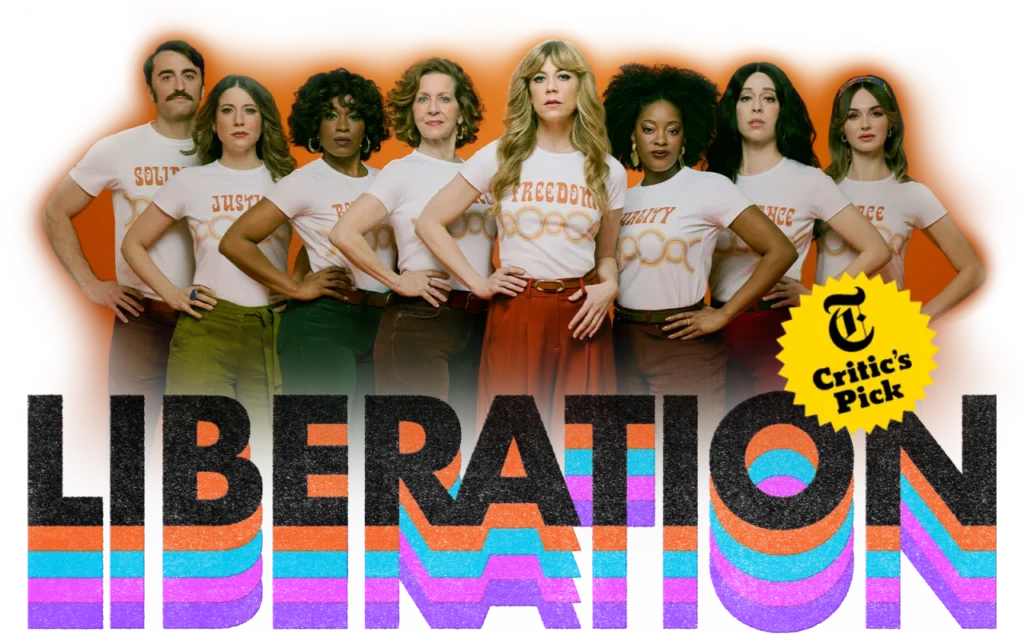
The play is a treatment of a branch of so-called “second-wave” feminism, from the late 1960s and ’70s. Playwright Bess Wohl focuses here on a “consciousness raising” group in Ohio in the early 1970s, the paradigmatic form taken by efforts for “women’s liberation.” While these small discussion groups were only one aspect of the movement from that period, and the play does a poor job of explaining where they fit into the larger movement and the theory behind them, it offers a poignant and thoughtful meditation on some of the key questions facing the movement 50 years ago and the questions facing many women today.
The conceit of the play is that the narrator is a contemporary (white, apparently upper-middle-class, cisgender and heterosexual) woman with young children, who wants to understand her own mother and her mother’s feminist milieu. The animating question of the piece is “Where did they go wrong?”—in other words, how did feminist failures produce the non-feminism and anti-feminism all around us?
Theater is made up of dialogue. Autocracy is a monologue. Theater is about community: We watch a play together. Autocracy seeks to isolate us. … In honoring this play, you honor the role of dialogue, community and questions in creating social change.
Bess Wohl accepts a Global Women’s Rights Award from the publisher of Ms.

The best thing about the play is that it abandons that animating question and confronts anyone who is obsessed with it, near the end of the second act. I don’t have the exact text, but the characters from the ’70s, who are in dialogue with the character from today, insist that the forces were too strong, the factors too many, for a bunch of local, rag-tag feminist discussion groups to defeat. So don’t ask why feminists failed to change the world; ask why the world didn’t change in response to the new understandings feminism offered.
Particularly interesting, too, is a scene in which the one Black woman who participates regularly in the group talks about the strengths and weaknesses of majority-white feminist efforts with a Black woman who chooses not to participate—with no commentary from a white character or from a stand-in for the playwright.
Also important is the play’s repeated return to the questions of human happiness, particularly for heterosexual, cisgender, women who choose to raise children. Although these questions are raised mostly regarding a central character in the play, supposedly the narrator’s mother, they are the most real for audiences today: Given the minuscule progress on government policy to support child-raising families, and continued pressures at work, and the hotly contested issue of changing male behavior, how do people balance their desire for autonomy and equality (“liberation”) with their desire for connection and what our society generally understands as happy family life?
… Don’t ask why feminists failed to change the world; ask why the world didn’t change in response to the new understandings feminism offered.
Editor’s note: At the Feminist Majority Foundation (publisher of Ms.) Global Women’s Rights Awards on Nov. 18 in Los Angeles, FMF honored the team behind the Broadway smash hit Liberation: Wohl, director Whitney White and Lisa Cronin Wohl, an OG Ms. writer from the 1970s. Read Wohl’s powerful acceptance speech, or listen to an excerpt of it below:
How To Lose Your Mother: A Daughter’s Memoir, by Molly Jong-Fast
Maybe fame is to blame.

Journalist and podcaster Molly Jong-Fast this year published a searing, fast-paced work about her relationship with her mother, the feminist writer Erica Jong, whose Fear of Flying (1973) set a standard for mass-market, heterosexual sexual frankness from a young woman’s point of view … and, come to think of it, wrestled with similar questions about (white, well-off, straight) adult women’s happiness to the ones posed in Liberation (albeit with more sex).
I was drawn to the work, and perhaps the one above, in part because I wrote about my own feminist mother (not a women’s liberationist, so much as a “liberal” feminist, more committed to legal change from courtrooms and legislatures than from small-group “consciousness raising”) in my book, A Woman’s Life Is a Human Life.
In fact, I gave an informal talk that I’ve been tinkering with for a couple of years, called “How to Write a Book About Your Mother.” It’s not easy—to be appreciative and fair and critical all at the same time, to be appropriately in love with one’s mother and disappointed by her, to identify enough and not too much.
I thought that the book was better as a chronicle of contemporary caregiving and its challenges than it was as a source of insight into modern feminism. Jong is such a singular figure, and her daughter is still so conflicted about her (despite the epigraph insisting she loves her mother “more than anything”), that the reader is likely left with more critique than appreciation of the movement that launched Erica Jong into the mainstream and helped her find her readers.
(This is also a writerly issue: The book clips along so quickly, and is drawn so tightly, that it works as a “novelistic” quick read, even becoming a bestseller in this non-reading era. But in doing that, it is necessarily short on backstory and context: the world of debate about joy and sex within modern feminisms, the literary ocean in which Fear of Flying became one big fish.)
Jong-Fast focuses on fame as the villain, maybe the main protagonist, of her story, more than she does on feminism. And alcoholism—her own, about which she has been very open (along with her long-term recovery), and her mother’s. These are important themes. They function in the book as the reasons why Jong-Fast and Jong have had a perpetually difficult relationship, and why even now (in the time of the narrative), as Jong experiences dementia and Jong-Fast tries to do the right things in response, there is so much resentment, angst, self-questioning and other junk in the way of making choices and acting on them.
Jong-Fast chooses to take on these other themes and not to sound the feminist or post-/ anti-feminist note clearly. Better that she steered around it, than that she blamed “feminism” for how her and her mother’s lives turned out. But I am still looking forward to her full-on engagement with the subject in a later book—and I won’t be surprised to find it. (In the meantime, don’t miss Jong-Fast’s explainer video about the 2025 elections and the double standards for women running for elected office.)
An extra tip: In the course of getting interested in her book and reflections on later reverberations of feminist literature, I became enamored of Jong-Fast’s constantly-produced (four times per week!) podcast, Fast Politics. Strongly recommended, even if historians appear only rarely.
Without Consent: A Landmark Trial and the Decades-Long Struggle to Make Spousal Rape a Crime, by Sarah Weinman
Slow progress, but progress, nonetheless.
I had a rich, thoughtful conversation with author Sarah Weinman that will appear in a later edition on my Substack. But for now, I want to flag that this fascinating and important book exists—and, for all that it deals with disturbing and all-too-relevant matters of intimate violence and abuse, is a fairly quick and compelling read.
I was drawn to the book and its author because spousal rape is an issue on which I teach almost every semester. It is both a paradigm case of the trouble with how wives were treated, and how the marital relationship itself was understood, in the old legal framework that the U.S. incorporated from England after the American Revolution. This body of law is known as the “common law.”
Although it was transformed in the centuries following 1776, the fact remains that the revolution “our forefathers” waged against the English crown and blood aristocracy did not extend to this fundamental system of law. And under common law, the operating fiction was that “man and wife” were one—if not spiritually or morally, then at law.
And where public matters were concerned, about making contracts, dealing with property and employment, generally speaking, the husband had authority to act, speak, hold the money or property, and the wife did not.
The unity of “man and wife”—which I know all about from legal historian Hendrik Hartog’s foundational Man and Wife in America, and whose racial specificity (applying to white people, that is), I understand from Tera Hunter’s equally foundational Bound in Wedlock—was a unity of reciprocal obligations. The “man” owed the “wife” economic support. The “wife” owed the “man” a bunch of things, including sex; his conjugal right was her conjugal obligation.
But if she owed him sexual access to her body, the fulfillment of his needs and the promise of carrying on his genetic line, then how could any act that involved a husband gaining sexual access to his wife be a crime? How could a crime exist when it was in the understood terms of marriage under common law? If “man” and “wife” were one, how could one part of the unity commit a crime upon itself?
… Under common law, the operating fiction was that ‘man and wife’ were one—if not spiritually or morally, then at law.
This is, as I say, the paradigm case of the problem with the old English, then American, understanding of heterosexual marriage. Students are appropriately shocked. But it is also a paradigm case of a central question in history that almost no one has actually investigated. In teaching, to cover this ground, I use an essay from 1995 by Rebecca Ryan, which is based on her undergraduate thesis at Princeton.
Into this vacuum of literature steps writer Sarah Weinman’s book about the landmark case of Oregon v. Rideout. The book is a tight study of the court case—really, repeated and related cases—that tested one of the first state-level statutes (laws) that criminalized sexual violence by one spouse against another. For journalists, advocates and scholars, there is still plenty to unearth in this history. But Weinman has done something remarkable and important, in chronicling a failed effort from the late 1970s to prosecute marital rape in the state of Oregon—despite a law change—followed decades later by a successful prosecution of the same man for his later acts of sexual violence against his intimate partners.
John Rideout finally received a 25-year sentence in 2022.
One way to understand this story is of progress, slow and fractured. Not steady. But with repeated and dogged efforts … progress nonetheless.
Personhood: The New Civil War Over Reproduction, by Mary Ziegler, Yale University Press
Law professor and reproductive-rights historian Mary Ziegler, an esteemed colleague (and Ms. contributor), has an extraordinary ability to clarify historical debates and to help us understand how these are showing up in debates today and threatening rights tomorrow.
This work is the latest in which she demonstrates this incredible skill, chronicling the history of claims for “fetal personhood” (which is much longer than we regularly imagine, as I learned in researching the aftermath of the change in abortion law in the state of New York, three years before Roe v. Wade, when the first claims were made that fetuses should have all the rights granted persons under the U.S. Constitution) and the journey of this idea through legal and activist circles, through the present day.
John Proctor Is the Villain, by Kimberly Belflower (Broadway production closed Sept. 7)
This was/is an astounding reimagining of the classic play, The Crucible, by Arthur Miller, from the standpoint of girls, or young women, in a public high school in Georgia.
The work draws audiences back to the early modern witch trials that are the ostensible subject of the play, and to the middle-20th-century anti-anti-Communist liberal or left context in which Miller’s play was celebrated for analogizing between the “witch hunts” of yore and the efforts to suppress dissidence by Sen. Joseph McCarthy and his fellows.
It places both of these moments in time in conversation with and tension with a contemporary, #MeToo-influenced generation of teenage students who are learning not to trust received wisdom. And it causes us to wonder why it was ok for generations to think of the character “John Proctor,” as a martyr to the truth and a hero, when he is also presented as a married man who had an affair with a young female servant and then called her a “whore.”
The play gains extra force from both the contemporary efforts by the White House and its allies to suppress dissident thinking, teaching and broadcasting, as in the 1950s, and the protestations of President Trump and others that they are victims of various “witch hunts.” Who’s the real witch? Which is the real hunt?
Making a Way: Lesbians Out Front, by Joan E. Biren (JEB), re-release
Lesbian photographer Joan E. Biren is having a moment—after having practiced her craft for many moments, since she started chronicling the feminist, lesbian-feminist, and gay and lesbian, movements in the 1970s.

This collection of JEB’s photographs first appeared in 1987—the year of the world-changing Second National March on Washington for Lesbian and Gay Rights, about which JEB made an important film. This collection of 105 portraits may once have stood for the proposition that we (lesbians) exist, and that we live diverse and joyous lives. It is now a vital historical record, in addition to still standing for those things.
The Woman Question in Jewish Studies, by Susannah Heschel and Sarah Imhoff (Princeton University Press)
This book is really a collection of important essays by two of the U.S.’s leading Jewish Studies scholars. They address the origins of the field and its content even today, the structures that define it and the treatment of women (and, to a lesser degree, sexual and gender minorities) who work or attempt to work in it.
A Century of ‘The New Yorker’ exhibit, The New York Public Library, Stephen Schwarzman Building (through Feb. 21, 2026)
Finally, a recommendation to see, if you are able, the exhibit I wander through repeatedly while doing research at the New York Public Library in mid-town Manhattan (“the lions” library)—free, no ticket required, and the building itself is a balm to the soul and a salve to the aesthetic sense.
I was especially surprised and delighted to find here the work of two overweeningly great 20th-century Jewish women intellectuals, political theorist Hannah Arendt, whose most accessible and renowned (and controversial!) work, Eichmann in Jerusalem, I knew had started its life as a series of articles in The New Yorker, but which I could hardly imagine in typescript, having been edited and worried over like any old piece for any old publication.
And Cynthia Ozick, fiction writer, essayist and skewer-er of hoary half-truths, a person whose mind and writing I’ve always admired although I doubt that she and I would have much in common beyond a shared sense that women are often smart, and always real people. Here, even more surprisingly than the scrappy typescript of “Eichmann,” is an apologetic ditty from Ozick, penned (typed) when she ran afoul of the magazine’s famous (infamous!) grammatical editing and fact-checking.
Subscribe to History Teaches … to receive new posts and support my work.
Great Job Felicia Kornbluh & the Team @ Ms. Magazine Source link for sharing this story.