

MANVILLE, N.J.—Richard Onderko said he will never forget the terrifying Saturday morning back in 1971 when the water rose so swiftly at his childhood home here that he and his brother had to be rescued by boat as the torrential rain from the remnants of Hurricane Doria swept through the neighborhood.
It wasn’t the first time—or the last—that the town endured horrific downpours. In fact, the working-class town of 11,000, about 25 miles southwest of Newark, has long been known for getting swamped by tropical storms, nor’easters or even just a wicked rain. It was so bad, Onderko recalled, that the constant threat of flooding had strained his parents’ marriage, with his mom wanting to sell and his dad intent on staying.
Eventually, his parents moved to Florida, selling the two-story house on North Second Avenue in 1995. But the new homeowner didn’t do so well either when storms hit, and in 2015, the property was sold one final time: to a state-run program that buys and demolishes houses in flood zones and permanently restores the property to open space.

“It’s pretty traumatic to watch your childhood home be bulldozed,” said Onderko, 64 and now the mayor of this 2.5-square-mile borough, which sits at the confluence of two rivers and a placid-looking brook that turns into a raging river when a storm moves through.
His boyhood property—now just a grass lot—is one of some 1,200 properties that have been acquired across New Jersey by the state’s Blue Acres program, which has used more than $234 million in federal and state funds to pay fair market value to homeowners in flood-prone areas who, like the Onderko family, had grown weary of getting flooded over and over again.
The program, started in 1995, is considered a national model as buyouts are an increasingly important tool for dealing with climate-related flooding. A report this month by Georgetown Climate Center said the program has achieved “significant results” by moving quicker than federal buyout programs, providing a stable source of state funding and shepherding homeowners through the process.
In addition, a report last month by the Natural Resources Defense Council and the Environmental Defense Fund warns that communities may well have to come up with new ways to pay for such initiatives as the Trump Administration continues to downsize government and cut programs.
Already, the NRDC said, billions of dollars in previously approved Federal Emergency Management Agency (FEMA) resilience grants have been cancelled.
“We need to do a lot of things very differently,” said Rob Moore, an NRDC director who worked on the report, which suggests that states and counties consider using revenue from municipal bonds, local fees and taxes, revolving loan funds, and leveraging insurance payouts to offset some of the reductions in federal funding.
But Moore said the problem goes beyond funding uncertainty, as the science is showing that the impacts of climate change are “outpacing our efforts to adapt.”
The report, released Nov. 18, cited the Charlotte-Mecklenburg County Storm Water Services, which has acquired some 500 homes in North Carolina in its buyout program, relying largely on stormwater utility fees to fund the sales. New Jersey’s program, Moore said, is a “wonderful example” of a plan that raised money with three bond issues while building a staff that developed a lot of expertise over the years.
Decades of experience may well come in handy as New Jersey, the nation’s most densely populated state, is likely to experience more significant flooding in the years to come.
Sea level rose about 1.5 feet along the New Jersey coast in the last 100 years—more than twice the global rate—and a new study by the New Jersey Climate Change Resource Center at Rutgers University predicts a likely increase of between 2.2 and 3.8 feet by 2100, if the current level of global carbon emissions continues.
Torrential rain storms also have led to massive flooding in inland towns—like Manville—as rivers and streams overflow, sending waves of water into the homes of stunned owners. The stronger storms are attributed by scientists to the Earth’s changing climate, with warming oceans causing rising sea levels and fueling more intense atmospheric activity.
“Blue Acres has been a pioneering program,” said Robert Kopp, a climate scientist and professor at Rutgers University, calling buyouts a “very important tool” in how the state deals with the flooding repercussions of climate change.
The program, which so far has benefitted mostly inland rather than coastal communities, is funded with federal money as well as a share of the state’s corporate taxes, providing a consistent infusion of money at a time of uncertainty about the future of federal disaster funding.
Courtney Wald-Wittkop, who manages Blue Acres for the state Department of Environmental Protection, said the program is an important solution for homeowners who have grown weary of repeated flooding. But deciding to give up a home and move away from the flood plain, she said, often takes time. “You have to give them space,” she said, to weigh the financial and personal costs of leaving a home with memories.
She said the program is known for its novel approach of assigning a case manager to every applicant to help them sort through the issues. “It’s really important that we walk hand in hand with these homeowners,” said Wald-Wittkop.
The program’s goals, however, go beyond the needs of homeowners. The idea is to help reshape the community by returning properties to permanent open space, which can better absorb rain water than impervious surfaces such as concrete, asphalt and buildings. That open space, in turn, is managed—mostly with lawn cutting and brush clearing—by the municipality.
Wald-Wittkop said the program is evolving, and that she would like to make the process move more quickly, provide sellers with more housing assistance, especially outside of flood-prone areas and encourage more community involvement in what to do with the newly acquired open space.
“We’ve tried to be as innovative as possible,” she said.
With its history of flooding, Manville is one of the towns that has benefitted the most from the state buyout initiative, with some 120 homes in the town sold to the state for about $22 million between 2015 and 2024. Another 53 buyouts are currently underway, according to Wald-Wittkop.
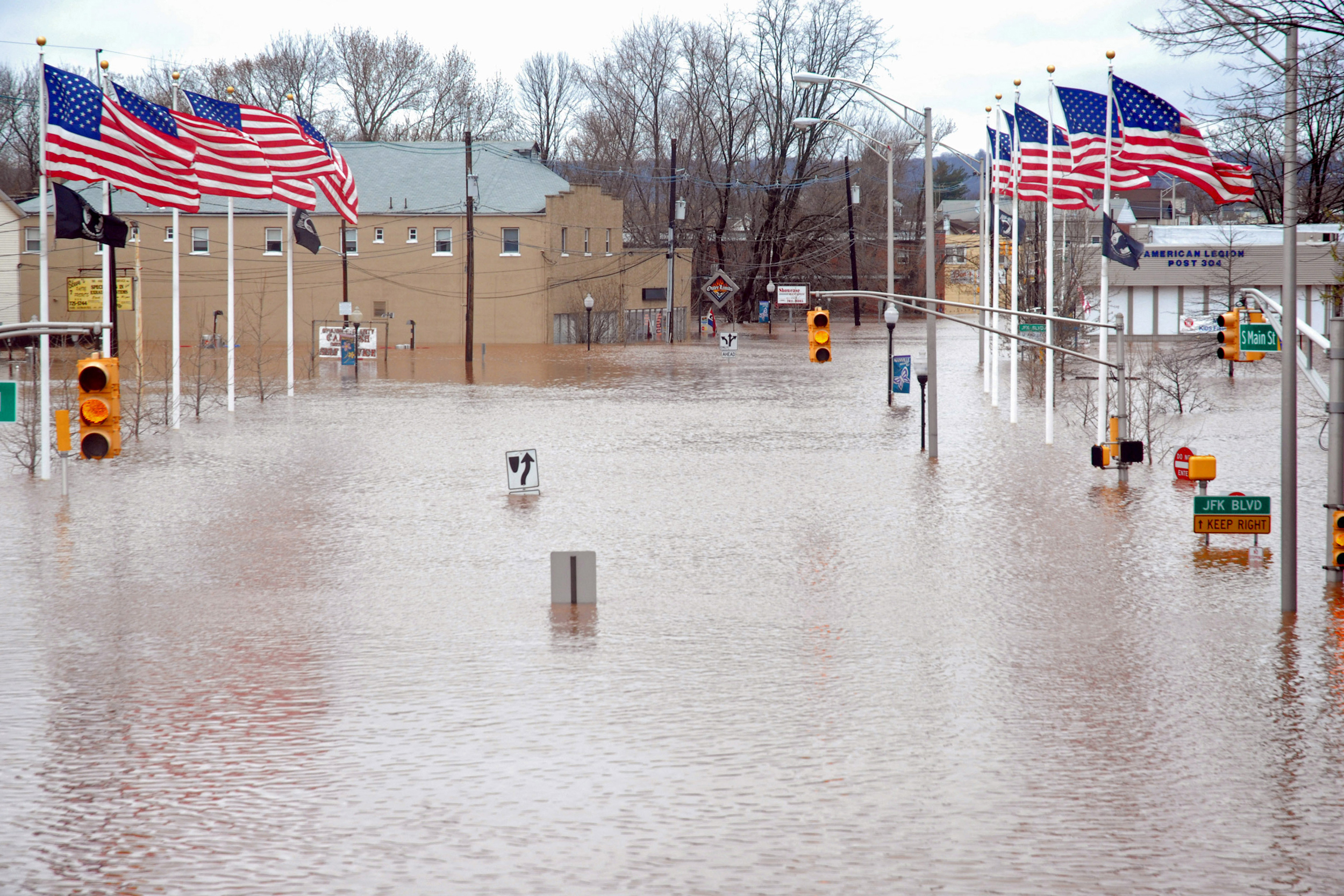
About an hour south, the city of Lambertville was hit hard by Hurricane Ida when a series of creeks overflowed in 2021, stranding residents and business owners in the popular tourist town wherever they happened to be when the massive downpour began. Hours later, residents emerged to stunning destruction.
“The force of the water was just unbelievable,” recalled Mayor Andrew Nowick, who said 130 properties were damaged and about two dozen homeowners ended up submitting applications for Blue Acre buyouts. Three eventually accepted buyout offers, he said.
The program, he said, can be attractive for sellers who are ready to move on but he said there was a lot of real soul-searching about the advantage of selling versus repairing homes that were filled with family memories. “These are all hard choices,” said the mayor.
Incorporated in 1929, Manville was named with a nod to the Johns-Manville Corp., a now-defunct asbestos manufacturer with jobs that transformed the area from a farming community to a factory town. As Manville grew so did the rest of once-rural Somerset County, with more housing, industry and roads. The result was less farmland and open space to absorb the rain and more impervious surfaces that cause substantial water runoff and flash flooding.
“It’s troubling today to see all the development that has gone on unabated,” said Onderko.
And when Manville floods, it is often epic.
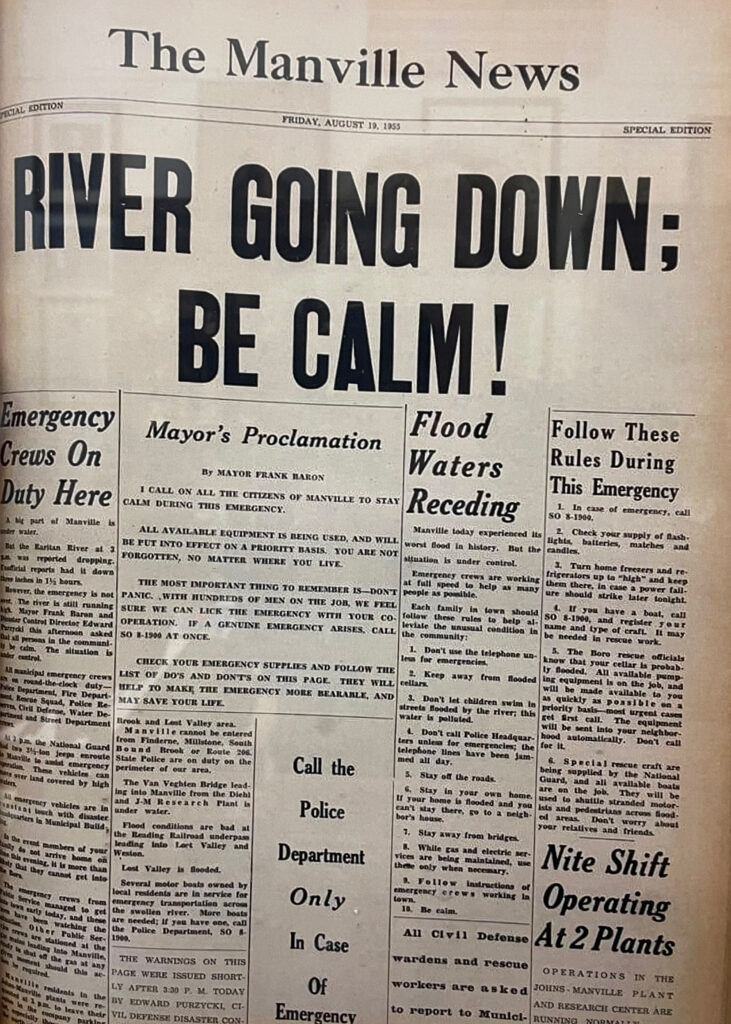
In 1955, Hurricane Diane caused what was called the town’s “worst flood in history,” according to a special edition of the Manville News, which now hangs in Onderko’s office. “RIVER GOING DOWN; BE CALM!” screamed the banner headline. Then-Mayor Frank Baron urged residents not to panic. “You’re not forgotten, no matter where you live,” Baron declared.
Onderko said getting rescued after Hurricane Doria in 1971 was surreal. Their oil tank came loose from all the water, and he recalled seeing the fuel mix in with the water that was flooding the basement as it approached the first floor. “It was something that you will never forget,” he said.
Later, the remains of Hurricane Floyd caused widespread damage in 1999, as did Hurricane Irene in 2011, but the town largely escaped the fury of Superstorm Sandy, which caused catastrophic damage to parts of New Jersey in 2012.
But then came Hurricane Ida in 2021.
Onderko still chokes with emotion when recalling that night in September 2021 when Ida came roaring through. “It was a war zone,” he recalled in an interview at the borough hall, which was inundated with two feet of water in that storm. “The water came so fast. It was a flash flood event. We were just lucky we didn’t have any loss of life.”
For hours, the mayor and rescue personnel went door to door, urging residents to leave. By the next morning, about 10 to 11 feet of water had flooded the central part of town and surrounding neighborhoods. Two homes and a banquet hall exploded from natural gas leaks, and emergency personnel could not even reach them.
“It took a toll on me,” said Onderko, recalling how he had trouble sleeping and felt “kind of powerless” because of the extent of devastation.
This story is funded by readers like you.
Our nonprofit newsroom provides award-winning climate coverage free of charge and advertising. We rely on donations from readers like you to keep going. Please donate now to support our work.
Wendy Byra and her husband, Thomas Kline, had already moved to higher ground.
Their house had flooded twice and they decided to sell their home to the Blue Acres program. The sale was approved in 2015 for a $185,000 buyout. Byra said a number of their neighbors also applied for the buyout, but had mixed feelings about the amount of money they were offered.
“A lot of people weren’t happy,” said Byra, recalling that some neighbors thought they should receive more money for their homes. Byra said she and her husband figured they would have a hard time selling on their own, so they accepted the buyout and moved to a home on higher ground, but still in Manville, where she grew up.
Except when a major flood happens, Onderko said, Manville is a good place to live. So homeowners, even in the two parts of town known for flooding, can go years without having to deal with a water disaster.
Onderko said residents had long relied on a mix of government help in rebuilding after flooding, but two years after Ida hit in 2021, the state said it would use federal funds only for Blue Acres buyouts of flood-prone properties in Manville.
Onderko said he and residents were caught off guard by the change in policy. He also believes that elevation and repair remained viable alternatives for some of the houses. The buyouts take time, he said, and the town loses tax revenue from the properties sold via the Blue Acres program. “It doesn’t help the town to lose [tax] rateables,” said the mayor, who said the town also bears the cost of maintaining the open space.
Now in his third term as mayor, Onderko, who lives in a house on higher ground than his boyhood home, seems more like a property manager than municipal executive as he presides over a town that is a mix of neighborhoods. Some are on higher ground and do not flood, but others are in areas that get caught repeatedly in deluges. There, vacant grass lots left from demolished Blue Acres properties are interspersed with homes that have been elevated, repaired or are still in recovery mode. “It’s very frustrating,” said Onderko.
Looking to the future, the mayor said he believes many more homes will be at risk whenever the next flood happens. And Onderko does not sound especially hopeful about how that will go.
“It’s going to take a miracle to try to save this town,” he said.
About This Story
Perhaps you noticed: This story, like all the news we publish, is free to read. That’s because Inside Climate News is a 501c3 nonprofit organization. We do not charge a subscription fee, lock our news behind a paywall, or clutter our website with ads. We make our news on climate and the environment freely available to you and anyone who wants it.
That’s not all. We also share our news for free with scores of other media organizations around the country. Many of them can’t afford to do environmental journalism of their own. We’ve built bureaus from coast to coast to report local stories, collaborate with local newsrooms and co-publish articles so that this vital work is shared as widely as possible.
Two of us launched ICN in 2007. Six years later we earned a Pulitzer Prize for National Reporting, and now we run the oldest and largest dedicated climate newsroom in the nation. We tell the story in all its complexity. We hold polluters accountable. We expose environmental injustice. We debunk misinformation. We scrutinize solutions and inspire action.
Donations from readers like you fund every aspect of what we do. If you don’t already, will you support our ongoing work, our reporting on the biggest crisis facing our planet, and help us reach even more readers in more places?
Please take a moment to make a tax-deductible donation. Every one of them makes a difference.
Thank you,
Great Job By Emilie Lounsberry & the Team @ Inside Climate News Source link for sharing this story.