

While people look to start fresh in the new year, many residents in California’s Los Angeles County are still living in the burn scars of the past. A year ago this week, a series of deadly wildfires tore through the region, their spread pushed by winds topping 80 miles per hour and parched vegetation that burned rapidly the moment a spark ignited it.
They contributed to at least 440 deaths from Jan. 5 to Feb. 1 in LA County, an August study suggests. The two largest, the Palisades Fire in Pacific Palisades and the Eaton Fire in Altadena, burned more than 50,000 acres and destroyed nearly 16,000 homes and other buildings before they were fully contained. Climate change set up these fire-ripe conditions, making the wildfires about 35 percent more likely to occur, researchers estimate.
Many residents from these hardest-hit neighborhoods are still displaced, either due to permitting and construction delays or concerns over lingering toxic contamination in their homes. Debates have raged for months over the best approach to recovery and how to prevent future blazes, but a few moments of hope have emerged alongside the wreckage.
An Ongoing Disaster: Last January, the 12 destructive wildfires that burned simultaneously through LA County threw much of the country’s second-most populous city into disarray. Confusing evacuation orders and tough-to-navigate neighborhoods created gridlock on the roads as thousands of people tried to flee at the same time. Some stayed behind to try to protect their homes. More than 30 people perished directly in the flames—the additional deaths came later due to fire-related factors, such as lung or heart harm from increased air pollution.
Although firefighters eventually contained the infernos, cascading disasters followed. As I covered at the time, displaced people struggled to find temporary or new housing as landlords hiked rent prices, a mostly illegal—but common—practice in the wake of extreme weather. Meanwhile, homeowners have battled for months to secure payouts from insurers for their losses as the industry reckons with the growing financial impacts of climate change.
Two months after the fires started, I visited Southern California to report on the aftermath. The damage was harrowing. On a helicopter flyover of the scorched area, firefighters from the Orange County Fire Authority recounted the grueling experience of going up against the flames, and pointed out the remains of homes in Altadena and the Pacific Palisades. It resembled a post-apocalyptic scene from a sci-fi movie: entire structures leveled, once-pristine swimming pools blackened by a soup of ash and soot, scorched hillsides devoid of almost all vegetation.
What also struck me were the homes that didn’t burn. Strong gusts made the LA fires unpredictable, with the flames skipping some areas altogether or even sparing just one home on a block.
However, the homes that weren’t destroyed didn’t necessarily escape damage. For an Inside Climate News series called “After the Fires,” Nina Dietz has spent months reporting on health risks following the LA infernos. Dietz followed scientists and homeowners’ efforts to uncover how lead and other toxic substances from the smoke and ash affected the buildings that remained. In some cases, insurance companies have resisted paying for testing and decontamination, which could leave homeowners at risk of serious health problems such as cancer, experts say.
These types of challenges are becoming increasingly common as climate change worsens urban conflagrations, where materials like plastics and tires leave behind harmful chemicals when burned.
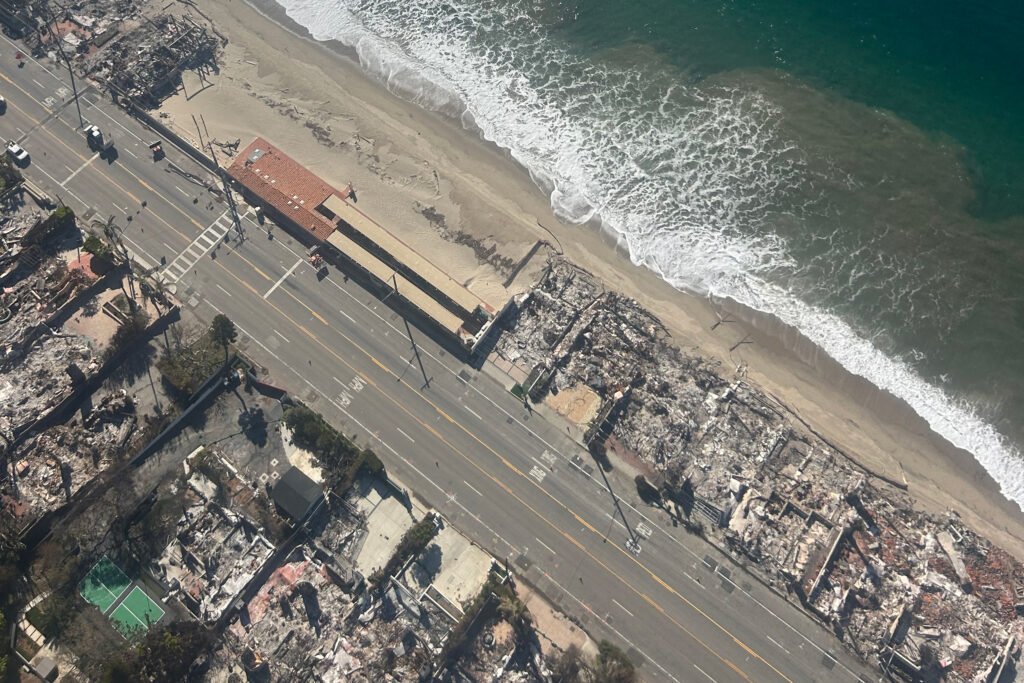
Many homes in Malibu, California, were also destroyed by the fires that swept through LA last January. Credit: Kiley Price/Inside Climate News
Slow Recovery: Rising construction costs, environmental hazard assessments and permitting red tape have made rebuilding a slowgoing process.
To fast-track recovery, the state has suspended certain permitting and review requirements, including those required under the California Environmental Quality Act and the California Coastal Act. But rebuilds are lagging, with just two homes fully rebuilt in and around the Pacific Palisades, according to a new analysis by online real estate marketplace Realtor.com. In Altadena, just four single-family homes, one multifamily property and three accessory dwelling units have been fully rebuilt, the analysis found.
“The rebuilding process has been slower than anyone hoped,” real estate agent Brock Harris, with the firm Brock & Lori, told Realtor.com. “While debris removal moved quickly, the permitting and construction bottlenecks are real. Many families are still in temporary housing a year later, which is heartbreaking.”
As recovery lags, policymakers, fire experts and local residents argue over how to implement new rules to reduce the amount of vegetation that could ignite in the area directly around a home dubbed “Zone Zero.” More broadly, experts are urging governments and the public to reconsider humanity’s relationship with fires as climate change intensifies.
Though fire has always been a natural fixture in the American West, the “Los Angeles fires mark a new phase, and seem to affirm a new consensus among a certain cohort of fire experts, that we have fundamentally misunderstood the nature of the problem and mismanaged fire risk as a result,” journalist David Wallace-Wells wrote in an op-ed for The New York Times.
This “new phase” extends beyond California, with states across the U.S. reckoning with growing fire risks—even in the Northeast, where large blazes may become more common with rising temperatures. The Trump administration is charging forward with a new plan to reorganize federal firefighters, but cuts to climate research and initiatives could inhibit their ability to understand risks associated with global warming, as I reported in December.
However, there have been a few bright spots amid the devastating tragedy of the LA fires. Neighbors leaned on each other to preserve the identity of their communities, salvaging tiles from historic fireplaces in Altadena or starting support groups to coordinate resources and help work through the grieving process of losing homes. One Altadena resident, Missi Dowd-Figueroa, planted sunflowers on her scorched property, turning the spot that once held her four-bedroom home into a garden of hope while she waited to rebuild, The Associated Press reports.
Though most of the flowers are now gone, a new beacon is emerging in their wake: Construction on Dowd-Figueroa’s home is expected to be completed by mid-June.
More Top Climate News
Over the weekend, the United States performed a “large-scale strike” against Venezuela, capturing the country’s president and taking him to New York to face criminal charges. President Donald Trump is now seeking to expand U.S. oil operations in the South American country, stating at a press conference after the capture that the U.S. is going to have its “very large United States oil companies, the biggest anywhere in the world, go in, spend billions of dollars, fix the badly broken infrastructure, the oil infrastructure, and start making money for the country,” Jake Bittle reports for Grist. Venezuela has the largest reported reserves of oil in the world, and most U.S. oil companies were forced out of the country over the last century. Experts are skeptical that U.S. oil operations in Venezuela will scale up at the size and scale Trump has promised any time soon, given the political instability and costs associated with propping up the industry in this area.
According to documents obtained by The Washington Post, the Department of Homeland Security has drafted a plan to slash the Federal Emergency Management Agency workforce in 2026. The agency has been a target of President Donald Trump’s ire—he flirted with eliminating it early in his second term but has since walked that back. Instead, the Post reports, the documents show that the administration may drastically reduce the number of disaster workers under FEMA. An agency spokesperson told the news outlet that “materials referenced from the leaked documentation stem from a routine, pre-decisional workforce planning exercise” and the “email outlining that exercise did not direct staffing cuts or establish reduction targets.”
A new study stresses that microplastics are undermining the ocean’s ability to absorb carbon, which could fuel faster climate change, Liam Gilliver reports for Euronews. After reviewing nearly 90 studies on the links between microplastic and marine health, the authors found that these tiny contaminants can release emissions when they degrade and hurt marine life crucial to carbon sequestration. The researchers assert that tackling the microplastic pollution issue and climate crisis together is key to solving both.
Postcard from … New York

After a brief holiday break, I am so excited to be back with you readers. One of my favorite additions to 2025 for the newsletter was the “Postcards From” series. Kicking off 2026, one of our readers sent in a snowy squirrel shot he took in his backyard in Rochester “during our very cold December.”
I can’t wait to see more of your nature photos this year; please send them to [email protected] to be featured in upcoming newsletters.
About This Story
Perhaps you noticed: This story, like all the news we publish, is free to read. That’s because Inside Climate News is a 501c3 nonprofit organization. We do not charge a subscription fee, lock our news behind a paywall, or clutter our website with ads. We make our news on climate and the environment freely available to you and anyone who wants it.
That’s not all. We also share our news for free with scores of other media organizations around the country. Many of them can’t afford to do environmental journalism of their own. We’ve built bureaus from coast to coast to report local stories, collaborate with local newsrooms and co-publish articles so that this vital work is shared as widely as possible.
Two of us launched ICN in 2007. Six years later we earned a Pulitzer Prize for National Reporting, and now we run the oldest and largest dedicated climate newsroom in the nation. We tell the story in all its complexity. We hold polluters accountable. We expose environmental injustice. We debunk misinformation. We scrutinize solutions and inspire action.
Donations from readers like you fund every aspect of what we do. If you don’t already, will you support our ongoing work, our reporting on the biggest crisis facing our planet, and help us reach even more readers in more places?
Please take a moment to make a tax-deductible donation. Every one of them makes a difference.
Thank you,

Reporter
Kiley Price is a reporter at Inside Climate News, with a particular interest in wildlife, ocean health, food systems and climate change. She writes ICN’s “Today’s Climate” newsletter, which covers the most pressing environmental news each week.
She earned her master’s degree in science journalism at New York University, and her bachelor’s degree in biology at Wake Forest University. Her work has appeared in National Geographic, Time, Scientific American and more. She is a former Pulitzer Reporting Fellow, during which she spent a month in Thailand covering the intersection between Buddhism and the country’s environmental movement.
Great Job By Kiley Price & the Team @ Inside Climate News Source link for sharing this story.