

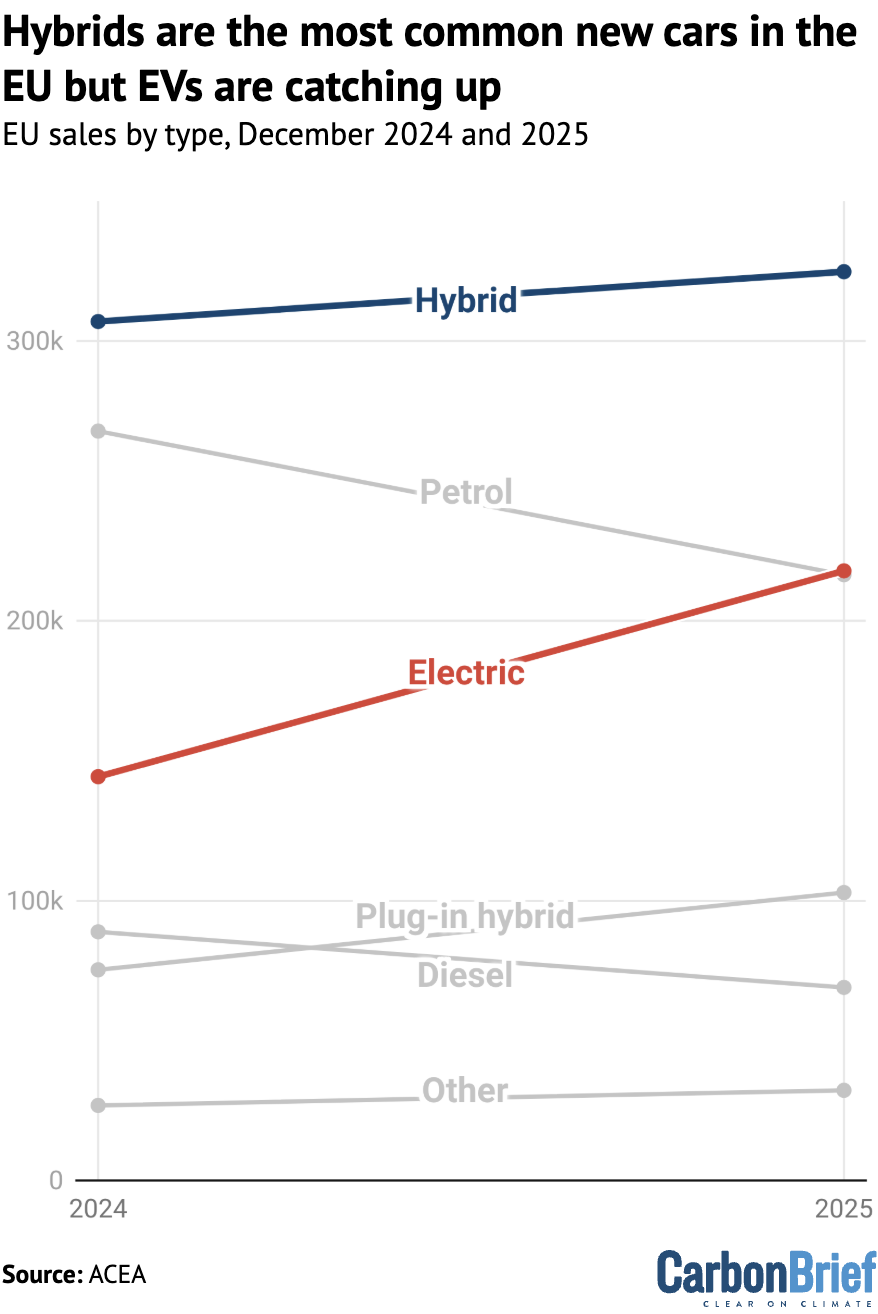
Sales of electric vehicles (EVs) overtook standard petrol cars in the EU for the first time in December 2025, according to new figures released by industry group the European Automobile Manufacturers’ Association (ACEA).
The figures show that registrations of battery EVs – sometimes referred to as BEVs, or “pure EVs” – reached 217,898, up 51% year-on-year from December 2024, as shown in the chart below.
Meanwhile, sales of standard petrol cars in the bloc fell 19% year-on-year, from 267,834 in December 2024 to 216,492 in December 2025. (Note that this definition, from ACEA, excludes “hybrid” cars that only run on petrol, but also have a small battery.)
Overall in 2025, EVs reached 17.4% of the market share in the bloc, up from 13.6% the previous year.
(EVs run purely from a battery that is charged from an external source, plug-in hybrids have both a battery that can be charged and an internal combustion engine, while regular hybrids cannot be plugged in, but have a smaller battery that is charged from the engine or braking.)
According to ACEA, 1,880,370 new battery-electric cars were registered last year, with the four biggest markets – Germany (+43.2%), the Netherlands (+18.1%), Belgium (+12.6%), and France (+12.5%) – accounting for 62% of registrations.
In a release setting out the figures, ACEA described this as “still a level that leaves room for growth to stay on track with the transition”.
Meanwhile, registrations of petrol cars fell by 18.7% across 2025, with all major markets seeing a decrease.
France accounted for the steepest decline in standard petrol registrations at 32% year-on-year, followed by Germany (-21.6%), Italy (-18.2%), and Spain (-16%).
Overall, 2,880,298 new standard petrol cars were registered in 2025, a drop in market share from 33.3% in December 2024 to 26.6%.
Hybrid vehicles, which are still entirely fuelled by petrol or diesel, remain the largest segment of the EU car market, with sales jumping 5.8% from 307,001 in December 2024 to 324,799 a year later, as shown in the chart below.
However, cars that can run on electricity from the grid – battery EVs and plug-in hybrids – are growing even faster, with sales up 51% and 36.7% in December 2025, respectively.
The registration figures follow the EU’s automotive package, released in December to “support the automotive sector’s efforts in the transition to clean mobility”.
It includes a proposed shift from banning the sale of new combustion-engine cars from 2035 to reducing their tailpipe emissions.
Under the proposals, the EU will target a 90% cut in carbon dioxide (CO2) emissions from 2021 levels by 2035, rather than all vehicle sales having to be zero-emissions.
If approved, the package would require that the remaining 10% of emissions be compensated through the use of low-carbon steel made in the EU or from e-fuels and biofuels.
This would allow for plug-in hybrids (PHEVs), “range extenders”, hybrids and pure internal combustion engine vehicles to “still play a role beyond 2035”.
There has been repeated pushback from the automotive sector in Europe against the introduction of “clean car rules”, which has led to targets being shifted more than once.
For example, the head of Stellantis in Europe, one of the continent’s largest car manufacturers, recently claimed that there was no “natural” demand for EVs.
Automakers have argued that EU targets for cleaner cars should be eased in the face of competition from Chinese producers and US tariffs.
ACEA figures show Volkswagen continued to claim the largest market share in the EU, accounting for 26.7% of new registrations in December, up from 25.6% a year earlier.
It was followed by Stellantis, Renault, Hyundai, Toyota and BMW.
EV giant Tesla saw its market share drop from 3.5% in December 2024 to 2.2% in December 2025. Over the course of 2025, the brand saw its market share in the EU fall 37.9% from 2024, following controversy around its owner, Elon Musk.
Meanwhile, Chinese EV brand BYD tripled its market share from 0.7% in December 2024 to 1.9% in December 2025.
Great Job Molly Lempriere & the Team @ Carbon Brief Source link for sharing this story.