

Kris Mayes believes in the lost art of the town hall.
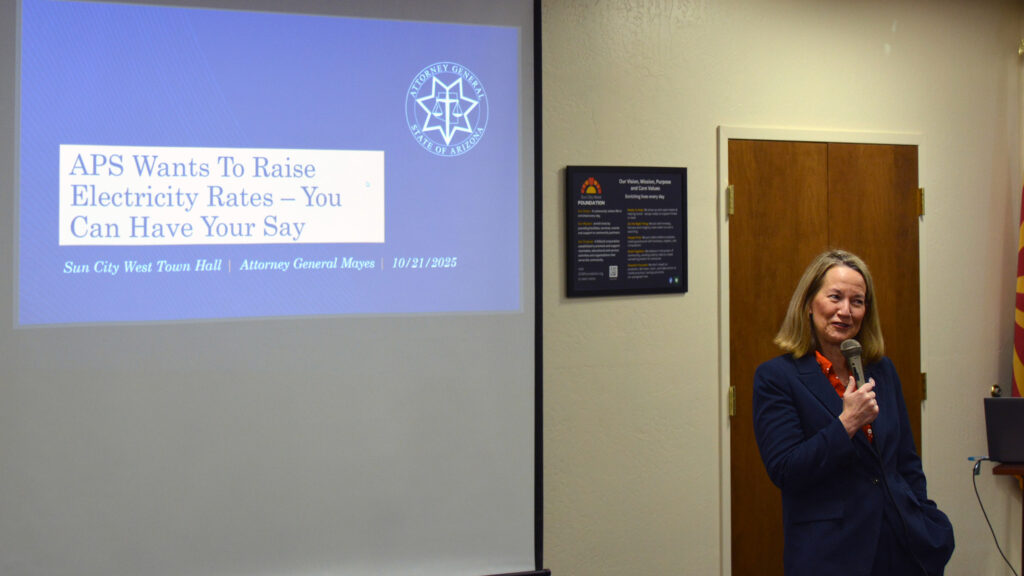
That conviction recently brought the Arizona attorney general before a group of a few dozen residents of Sun City, Arizona, a far-flung suburb for retirees in the Phoenix area’s West Valley, to hear from residents how a proposed rate hike from the state’s largest utility, Arizona Power Service (APS)—its third in four years—would affect them.
Mayes came with a deeper understanding of energy issues than many who serve in her role.
She once served on the Arizona Corporation Commission (ACC)—the utility regulator known as Arizona’s “fourth” branch of government—then became a professor of energy law at Arizona State University and a mom. Then, by a margin of 280 votes, state residents elected her to be the Arizona attorney general (“They don’t call me landslide Mayes for nothing,” she joked).
When she was on the ACC, the commissioners would travel the state to hear from the people affected by issues like rate hikes. Mayes worries they won’t in this case due to the unpopularity of APS’s latest price increase.
If APS’s latest rate increase is approved, its customers’ rates would go up 14 to 16 percent, netting the company another $662 million a year; last year, APS reported a profit of just over $600 million.
PowerPoint presentation behind her, Mayes did what an ex-energy law professor does best: Present a lesson on how a rate case works, and how she believes “this is nothing more than a case of blatant corporate greed.”
That’s why she is intervening in the case, she said, signing up the state’s largest law firm tasked with enforcing Arizona’s laws to argue that the rate case should not go through.
“I believe Arizonans deserve a voice,” she told the audience. “These utilities are greedy. They’re asking for too much, and they’re overreaching.”
It’s the first time in state history that the state attorney general has intervened in a rate case, and the latest example of Mayes using her office to wade into environmental and energy issues to protect Arizonans. At a time when climate issues have faded from the vocabulary of many federal and state politicians across the country, Mayes has continued to prioritize them.
She’s sued a controversial industrial farming operation under Arizona’s nuisance laws for causing water wells in rural areas to go dry, fought a mining company’s plan in Chino Valley and filed 30 lawsuits against the Trump administration, many of which have implications for the climate and environmental work in Arizona and across the country. And now she’s intervening in multiple cases before the ACC, from APS and other utilities’ proposed rate increases to opposing plans to repeal the state’s energy efficiency and renewable energy standards, both of which she helped co-author and pass while serving as a commissioner.
These are not the typical fights of an attorney general, Mayes conceded in an interview with Inside Climate News. But they should be, she said. She believes the Arizona Corporation Commission “is basically controlled by the utilities”—APS and its parent company, Pinnacle West, have spent millions to elect corporation commission members. Mayes doesn’t believe “the people of Arizona have anybody that’s really fighting for them.”
She knows utility law as well as anyone, and it empowers her to take action in the courts against corporations, “so why wouldn’t I do that?”
She believes these water and energy and environmental issues are not just winning ones, but righteous ones, ones that impact everyday Arizonans. Can a family continue to afford their utility bill in the midst of inflation? Will they still have water coming out of their well?
“My north star is standing up for the people against big corporations when they can’t do it themselves,” she said. “We’re living in a time when more and more people are finding themselves harmed by big corporations and by the consolidation of power among a few corporations, and I don’t know, for whatever reason, not very many politicians seem willing to get in there and lead the fight. I don’t have any problem with doing that. I feel like it’s my duty. If that means I lose an election down the road, so be it. I mean, the people of Arizona put me here by 280 votes, and I want to spend every precious minute fighting for them.”
Mayes is up for reelection next year, when voters will decide if a state politician in the political battleground of Arizona focused on rural groundwater issues and fighting utility rate increases can hold on to office.
Deep Roots in the Arizona Environment
Mayes grew up with her hands in the dirt.
Growing up on a tree farm in Prescott, Arizona, her job was watering the garden and the freshly potted ponderosas, honey locusts and willows. Many of the trees in Prescott today are from the nursery owned by her father, a founding member of the Yavapai County chapter of the Sierra Club. For vacations, the family took the “yellow banana”—an “ugly, old” yellow Mazda station wagon, as Mayes describes it—and headed to the Santa Maria River. The ponderosa pine the family selected as its Christmas tree every year was a “scraggly little sucker.”
“I learned at an early age—helping my dad with the tree farm, watering trees, going to the Santa Maria river, going over on the other side of the county to where the headwaters of the Verde River are—about the value of water and the beauty of our state and the need to conserve it,” Mayes said. “I think that was pretty much drilled into me from day one.”
She attended Arizona State University in Phoenix, where she had a dual-major in politics and journalism, graduating in 1994. As a political reporter for the Arizona Republic at the start of her career, she was barred from the late Sen. John McCain’s presidential campaign bus in 2000 for asking inappropriate questions—like why he wasn’t way ahead in the polls in the state where he was a senator.
Mayes was the press secretary for Janet Napolitano’s successful gubernatorial campaign in 2001. In 2003, when a member of the ACC, Jim Earvin, resigned to avoid impeachment after being accused of trying to influence a bidding war for the Southwest Gas Corporation, The law required Napolitano to appoint a Republican replacement. Mayes, who had her own political ambitions, was a Republican.
While she ended up on the commission by chance, the position matched her interests and she ran to keep the seat in 2004 and 2006, serving on the ACC until 2009. Along the way she helped pen Arizona’s energy efficiency and renewable energy standards.
After her time on the commission, she spent a decade at Arizona State University teaching utility and energy law before running for attorney general as a Democrat on a platform to protect Arizonans’ abortion access and address climate change in the state. She’s the only Arizona politician to win statewide office as both a Republican and a Democrat.
“She can go toe-to-toe with anyone on this energy stuff,” said Bill Mundell, a former corporation commissioner who served with Mayes and is now her chief deputy.
“She’s a force of nature,” said Dru Bacon, a retiree who has spent his time advocating for solar energy and has worked with Mayes since her days on the ACC.
Confronting Growth and Diminishing Water Supplies
Arizona is facing an “obvious crisis,” Mayes said.
“We are quickly outstripping our natural resources,” she told Inside Climate News.
The Phoenix area, with its sprawling highways and suburbs, consistently ranks among the country’s worst for air quality. And the water that enabled the nation’s fifth-largest city to rise is rapidly disappearing. From Phoenix to Arizona’s rural stretches, aquifers are vastly overtapped. Planned suburbs on the outskirts of the Phoenix area are on hold asdevelopers search for water. Wells are running dry at churches and homes near industrial farming operations.
This story is funded by readers like you.
Our nonprofit newsroom provides award-winning climate coverage free of charge and advertising. We rely on donations from readers like you to keep going. Please donate now to support our work.
Meanwhile, Arizona’s share of the Colorado River has been cut as the waterway that provides the lifeblood of the Southwest declines due to climate change and vast overconsumption of its water, with the state facing even steeper cuts in tense, ongoing negotiations about how to use less. The Colorado River is split into the Upper Basin states of Wyoming, Colorado, Utah and New Mexico, and the Lower Basin states of Arizona, California and Nevada. The two sides are deadlocked over how cuts should be distributed between the seven states.
“We need an adult, serious conversation about how much and how fast we can grow, and where our water supplies are going to come from,” Mayes said.
That conversation, she said, needs to prioritize rural Arizona, where the impacts of the region’s drought are already playing out.
“I think Phoenix politicians think that we’re going to solve this problem on the backs of rural Arizonans by bringing water in from Western Arizona, in part,” she said, referring to deals buying up rural farms to use their water rights to supply cities. Other schemes pump groundwater from unregulated rural aquifers to transfer to cities. “Phoenix politicians are doing some magical thinking about the Colorado River that is just not reality,” she said. “We have a battle royale brewing with the Upper Basin states who, I can tell you, have no intention of backing down.”
Nature, she said, has a way of telling you when your time is up. “And the Colorado River and our groundwater our screaming at us, and they are telling us: ‘You need to get your act together.’”
There are limits to what can be done, Mayes said, and Arizona politicians have to confront that. And it has to be done in a way that doesn’t sacrifice rural Arizonans for the “explosive growth” in places like Phoenix and Tucson. “We have some hard choices ahead of us,” she said.
Mayes’s comments on Arizona’s water future are remarkably blunt for a state-level politician. Gone are the days when some of the state’s politicians would deny Arizona had a water problem, but even now, after two decades of drought and its fallout, few local leaders will say the region’s growth is unsustainable. In the Phoenix area, its far-flung suburbs like Buckeye are betting on water transfers from rural Arizona to save them. Meanwhile, wells are running dry in rural stretches of La Paz and Cochise counties after decades of overconsumption caused almost exclusively by agriculture.
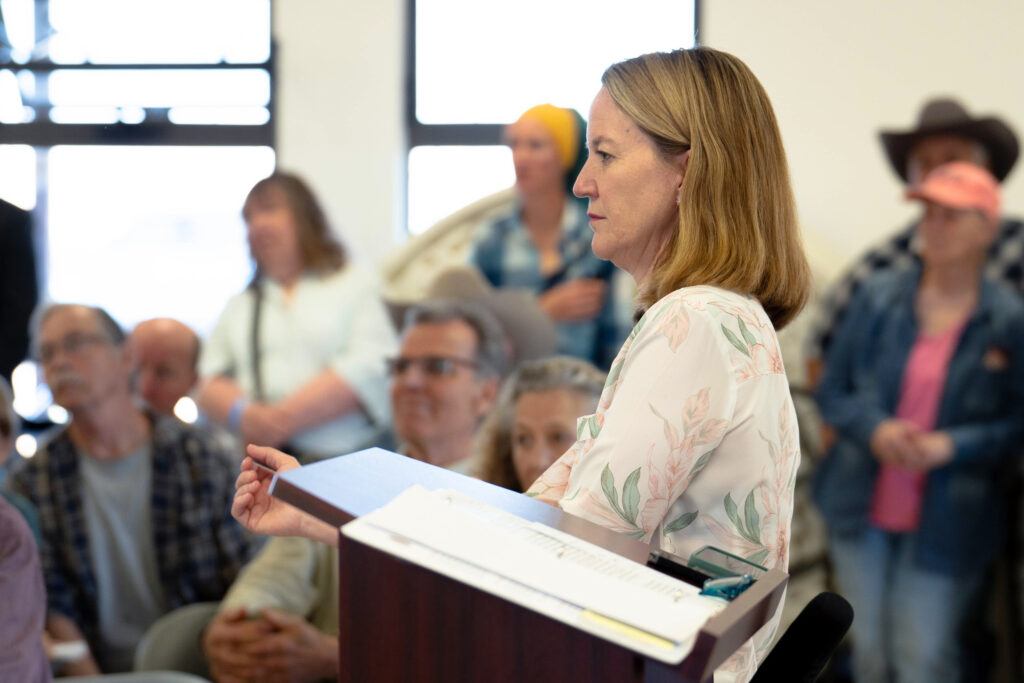
Since taking office, Mayes has held over 40 town halls across the state. There is no substitute, she said, for physically being in person with people affected by an issue, trying to find ways to help. Often, she’s fighting for Arizonans in rural parts of the state who did not vote for her. She’s had members of the Democratic Party tell her she’s wasting her time on them.
“It’s an incredibly offensive question, because these people deserve my time just as much as somebody living down here in one of these high rises,” she said, gesturing towards the apartment complexes surrounding the AG’s downtown Phoenix office.
In Sun City, retirees on fixed incomes spoke about the challenges of keeping up with costs as inflation rises. A 16 percent increase to their electricity bill would only make it worse, and would be done so that APS can build more power plants for the increasing number of data centers in the state, they fear.
For utilities, it used to be industrial use subsidized residential use, Mayes said. The APS rates have flipped that.
“Data centers are the cotton candy of economic development, but to the degree that we want to facilitate data centers, they definitely should be paying for themselves,” Mayes said. “That burden should not be put on residential consumers.”
“I don’t personally think that Arizona wants to be the data center capital of the world,” she said.
It just might be a politically winning position. Across Arizona, local communities are fighting back against proposed data centers. In Tucson, a local coalition’s critique of a proposed data center backed by Amazon Web Services led the city council to reject the proposal and pass new water restrictions for large users; the project’s developers have continued their push to build it on county land outside the city, but recently Amazon pulled out of the project.
Teri Huff and Susan Colvin, retired Sun City residents who attended the town hall there and are both Republicans, said it was refreshing to have an attorney general like this who shows up to listen. They might just have to vote for her—even if she’s a Democrat.
About This Story
Perhaps you noticed: This story, like all the news we publish, is free to read. That’s because Inside Climate News is a 501c3 nonprofit organization. We do not charge a subscription fee, lock our news behind a paywall, or clutter our website with ads. We make our news on climate and the environment freely available to you and anyone who wants it.
That’s not all. We also share our news for free with scores of other media organizations around the country. Many of them can’t afford to do environmental journalism of their own. We’ve built bureaus from coast to coast to report local stories, collaborate with local newsrooms and co-publish articles so that this vital work is shared as widely as possible.
Two of us launched ICN in 2007. Six years later we earned a Pulitzer Prize for National Reporting, and now we run the oldest and largest dedicated climate newsroom in the nation. We tell the story in all its complexity. We hold polluters accountable. We expose environmental injustice. We debunk misinformation. We scrutinize solutions and inspire action.
Donations from readers like you fund every aspect of what we do. If you don’t already, will you support our ongoing work, our reporting on the biggest crisis facing our planet, and help us reach even more readers in more places?
Please take a moment to make a tax-deductible donation. Every one of them makes a difference.
Thank you,

Reporter, Phoenix
Wyatt Myskow covers drought, biodiversity and the renewable energy transition throughout the Western U.S. Based in Phoenix, he previously reported for The Arizona Republic and The Chronicle of Higher Education. Wyatt has lived in the Southwest since birth and graduated from Arizona State University with his bachelor’s degree in journalism.
Great Job By Wyatt Myskow & the Team @ Inside Climate News Source link for sharing this story.