

At a House Judiciary subcommittee hearing on what Republicans called “opportunistic” lawsuits filed against the energy-intensive engineered stone industry by injured workers, the differences between the concerns of America’s political parties could not have been clearer.
Over the past several years, hundreds of U.S. workers have developed silicosis, a debilitating, often fatal but preventable occupational disease caused by inhaling silica dust. There are no effective treatments or cures for silicosis, which leaves workers struggling to breathe, coughing uncontrollably, progressively disabled and choosing between million-dollar lung transplants or death.
Those who work in the artificial stone industry face the greatest risk of exposure to silica dust, particularly when they prepare engineered stone slabs, formed by combining petroleum-based resins with pigments and pulverized crystalline silica, for installation. Twenty-seven artificial stone workers have died of silicosis since 2019 in California alone.
Yet the real victim, in the eyes of industry representatives and their Republican allies, is an industry that views workers’ efforts to recoup lost wages and budget-busting medical costs as an unjust money grab designed to bankrupt companies they say have no responsibility for how their products are cut, shaped and finished before installation.
“Our hearing this morning examines the troubling rise of abusive litigation against the U.S. stone slab industry,” Rep. Darrell Issa, R-Calif., said at the Wednesday hearing.
Issa, who chairs the subcommittee and co-sponsored H.R. 5437, a bill that would shield artificial stone slab manufacturers from lawsuits, blamed “bad actor” firms that buy those products and skirt health and safety regulations as they prepare them for installation. He played a video showing how such “fabrication” shops could keep employees safe. The video was produced by the Cambria Co., the largest domestic manufacturer of artificial stone slabs.
Issa also credited the Occupational Safety and Health Administration, which another bill co-sponsor is trying to abolish, for providing expert advice to companies who could help their workers avoid exposure to silica dust by following OSHA standards.
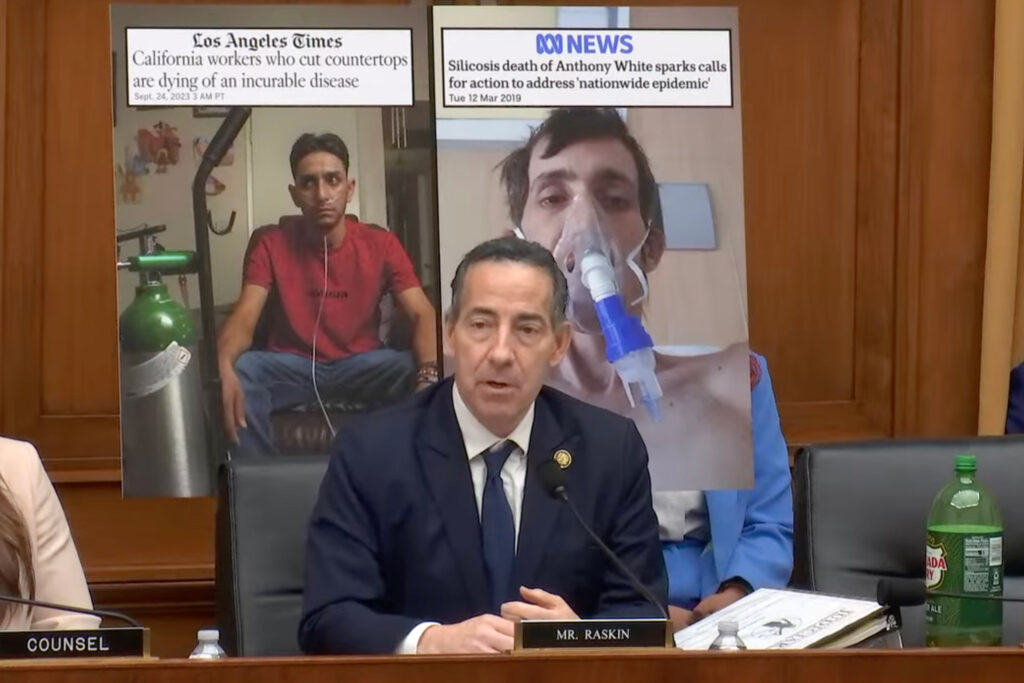
Rep. Jamie Raskin, D-Md., the ranking Democrat on the House Judiciary Committee, said when he learned that his Republican colleagues were “suddenly focused on a severe health crisis afflicting working-class craftsmen across America,” he assumed they were moved by the same headlines and articles he’d been reading about workers with silicosis dying of an incurable disease.
“Alas, I’d fallen victim to magical thinking,” said Raskin, who sat in front of posters of men who were dying or had already died of silicosis. “Our colleagues were getting involved in this rather esoteric matter, not to help the workers, but to help the industry they work in.”
The Republican-controlled subcommittee invited three representatives of the $30-billion artificial stone industry to testify. All praised H.R. 5437, the Protection of Lawful Commerce in Stone Slab Products Act. The bill, sponsored by Rep. Tom McClintock, R-Calif., promised the luxury countertop industry the same immunity from civil lawsuits enjoyed by the gun industry.
At the hearing, Rebecca Shult, Cambria’s chief legal officer, described the legal threat facing the industry and her company, which she described as a family-owned business in a “small rural community.”
“Despite complying with all applicable law, including OSHA regulations, we are under attack from hundreds of lawsuits,” Shult said, acknowledging that workers who file the suits are succumbing to diseases caused by hazardous conditions on the job, but blaming bad actors for those exposures.
Cambria has no control over these third-party businesses that don’t follow OSHA laws, said Shult, who said that rogue fabricators are cutting corners and “putting profits over people.”
Instead of holding these bad actors accountable, she said, “lawsuits are being filed against dozens of innocent stone slab manufacturers.”
Republicans sympathized, agreeing it’s not manufacturers’ fault that workers are getting sick in the shops they sell to.
“Isn’t the only role of your company to sell a safe and legal product to a willing buyer?” McClintock asked Shult, who replied in the affirmative.
McClintock called it an injustice that Cambria and other manufacturers are being sued for the illegal practices of fabrication shops. “It appears that instead of enforcing the law against these illegal practices, the Democrats prefer to drive you out of business.”
Jim Hieb, CEO of the trade group Natural Stone Institute, thanked McClintock for introducing a bill that “brings fairness to the sellers of stone slabs,” while calling for more enforcement from OSHA.
It’s not fair that so many companies are wondering whether they’ll be in business next year, Hieb said.
“Sorry for what you’re going through,” Lance Gooden, R-Texas, told Hieb.
A Clear Chasm
As the minority party, the Democrats exercised their right to call a witness, and chose America’s longest-serving occupational health and safety chief, epidemiologist David Michaels, who ran OSHA from 2009 to 2017.
“There was this very clear chasm between the Republicans, who were primarily interested in protecting corporations, in particular, Cambria, and the Democrats, who
wanted to talk about how they ensure that workers who have silicosis get justice and how to address the silicosis epidemic,” Michaels, now a professor at George Washington University’s Milken Institute School of Public Health, told Inside Climate News.
Michaels, who has testified at dozens of congressional hearings, said he’s never been to one where Republicans heaped so much praise on OSHA and underscored its importance.
They kept saying if only fabricators followed OSHA rules, we wouldn’t have this problem, he said. But the OSHA silica standard is based on economic and technological feasibility as well as health effects, because the law doesn’t allow consideration of health protection alone, Michaels explained. “So just because you’re within the silica standard from OSHA, it doesn’t mean you’re safe.”
Plus, “it’s rich irony” for this Congress to call for stronger OSHA protections, he said, given that the House proposed significant cuts to OSHA’s budget and an H.R. 5437 co-sponsor wants to abolish the agency.
Democrats, in contrast to Republicans, expressed concern that silicosis is making American workers sick faster and younger from an irreversible but preventable disease.
“Doctors are seeing patients in their twenties and thirties,” said Rep. Henry Johnson, D-Georgia, ranking member of the subcommittee. “Men with families and young children so sick that they require double lung transplants, so sick that they can no longer work and no longer provide for their families, so sick that they slowly and painfully suffocate to death.”

Johnson entered into the record a letter from two physician-researchers from the University of California, San Francisco, Jane Fazio and Sheiphali Gandhi, who oppose H.R. 5437 because it rests on a fundamentally flawed premise: that artificial stone slabs are inherently safe and that worker harm arises primarily from noncompliant fabrication shops. That premise, they said, goes against clinical evidence, occupational health research and what they see in their medical practices.
“These products contain extremely high concentrations of crystalline silica—often exceeding 90 percent,” warned Fazio and Gandhi, who treat patients with silicosis. “Even with modern dust controls, cutting, grinding, and polishing artificial stone releases respirable silica at levels that overwhelm existing engineering and personal protective measures.”
“Surely we must be here to talk about how Congress can protect workers from artificial stone silicosis,” Johnson said, teeing up what he saw as the reason his Republican colleagues called the hearing.
“Apparently, it’s to give a handout to a millionaire friend of none other than Donald Trump,” he said, referring to Marty Davis, Cambria’s CEO. Davis has donated more than $800,000 to Republican politicians, including the president, federal filings show, and encouraged Trump to challenge the outcome of the 2020 election, according to The New York Times.
Micah Aberson, who acts as Cambria’s executive vice president for government affairs, declined to comment on Johnson’s conjecture, calling it “in no way germane” to safe workplaces and liability reform.
Widespread Risk
Republicans and the industry representatives cast the problem as one of a few bad actors operating mostly in California. But data from the state Department of Public Health shows that 54 percent of fabrication shops have silicosis cases, Michaels told the committee. California has a good screening system for workers, unlike much of the nation, he said.
“We haven’t seen that many cases around the country because no one’s looked for them,” Michaels told the committee. “We have, no doubt, thousands of cases if there are 500 cases in California.”
There’s every reason to think more cases will be identified, as long as exposure continues, Michaels told Inside Climate News.
This story is funded by readers like you.
Our nonprofit newsroom provides award-winning climate coverage free of charge and advertising. We rely on donations from readers like you to keep going. Please donate now to support our work.
Yet there are many changes manufacturers could institute to keep workers safe. One option is to stop manufacturing the product and switch to safer alternatives, which is the path Australia took after silicosis cases took off.
Alarmed by the rising incidence of silicosis among California stone fabrication workers, the Western Occupational and Environmental Medical Association has petitioned California’s Occupational Safety and Health Standards Board “to prohibit all fabrication and installation tasks on artificial stone that contain more than 1 percent crystalline silica.”
Cambria isn’t considering such changes, Aberson said.
“We don’t believe it solves the core problem, which are bad actor fabricator shops that are taking advantage of their workers and not providing a safe work environment,” he said.
Cambria is doing its part to address the problem through a learning-exchange center to train fabricators on safe processing techniques, Aberson said, though Shult told the committee the company does not require its buyers to complete the training.
As for overseeing its buyers’ operations, Aberson said with 10,ooo fabricators in the country, manufacturers aren’t in a position to monitor the entire industry. “This is specifically why we have OSHA, and we have regulations,” he said, adding that they won’t sell to shops they learn have unsafe conditions.
Many industries have programs that limit or prohibit sales to companies that endanger their workers, though it often takes litigation to trigger such actions.
When workers at microwave popcorn processing plants contracted a devastating respiratory illness after being exposed to diacetyl, a flavoring chemical, the firms did nothing to help their employees, even though manufacturers knew from lab tests that diacetyl could harm lungs, Michaels said in his written testimony.
Cases quickly led to more than $100 million awards or settlements to workers sick with “popcorn” lung, said Michaels, who’s written books on industry tactics to escape regulation. But rather than asking Congress for protection against more litigation, the industry acknowledged the problem and its trade group substituted a safer flavoring chemical.
Other industries have product stewardship programs where they work with companies that buy their product to make sure they’re used safely, he said.
And it’s not just a few bad actors that are making workers sick, Michaels said. The state figures showing that 54 percent of all the fabrication shops in California are reporting silicosis cases are a case in point, Michaels said. “This is across the industry, and this is who Cambria is selling to.”
Litigation is like regulation in that it drives technology, Michaels told the subcommittee. “Companies that don’t want to be involved in litigation find better products, safer products, and they substitute.”
If the industry receives immunity from liability, “all bets are off,” he said. “There’s no stopping the number of silicosis cases we’ll see around the country.”
Passing H.R. 5437, he told Inside Climate News, “would be a death sentence for workers exposed to silica.”
About This Story
Perhaps you noticed: This story, like all the news we publish, is free to read. That’s because Inside Climate News is a 501c3 nonprofit organization. We do not charge a subscription fee, lock our news behind a paywall, or clutter our website with ads. We make our news on climate and the environment freely available to you and anyone who wants it.
That’s not all. We also share our news for free with scores of other media organizations around the country. Many of them can’t afford to do environmental journalism of their own. We’ve built bureaus from coast to coast to report local stories, collaborate with local newsrooms and co-publish articles so that this vital work is shared as widely as possible.
Two of us launched ICN in 2007. Six years later we earned a Pulitzer Prize for National Reporting, and now we run the oldest and largest dedicated climate newsroom in the nation. We tell the story in all its complexity. We hold polluters accountable. We expose environmental injustice. We debunk misinformation. We scrutinize solutions and inspire action.
Donations from readers like you fund every aspect of what we do. If you don’t already, will you support our ongoing work, our reporting on the biggest crisis facing our planet, and help us reach even more readers in more places?
Please take a moment to make a tax-deductible donation. Every one of them makes a difference.
Thank you,

Reporter, California
Liza Gross is a reporter for Inside Climate News based in Northern California. She is the author of The Science Writers’ Investigative Reporting Handbook and a contributor to The Science Writers’ Handbook, both funded by National Association of Science Writers’ Peggy Girshman Idea Grants. She has long covered science, conservation, agriculture, public and environmental health and justice with a focus on the misuse of science for private gain. Prior to joining ICN, she worked as a part-time magazine editor for the open-access journal PLOS Biology, a reporter for the Food & Environment Reporting Network and produced freelance stories for numerous national outlets, including The New York Times, The Washington Post, Discover and Mother Jones. Her work has won awards from the Association of Health Care Journalists, American Society of Journalists and Authors, Society of Professional Journalists NorCal and Association of Food Journalists.
Great Job By Liza Gross & the Team @ Inside Climate News Source link for sharing this story.