
Bringing essential services directly to rural communities, Zimbabwe’s Women at the Centre initiative is repairing a fractured response system and empowering survivors to seek justice.
For years, Tjedza* endured sexual violence at the hands of her father. Clara*, an elderly woman, experienced abuse at the hands of her son. And for most of Tabeth’s* married life, she bore abuse at the hands of her husband.
“He would say hurtful things to me in front of my children,” recalled Tabeth. “He would threaten to kill me, saying he would burn the house with me inside. He would say this all the time and for the longest time I could remember.”
These abuses—and many more like them—went unseen for far too long. Yet in rural Zimbabwe, services to support survivors of gender-based violence are often out of reach. Survivors often must travel long distances to seek help, and when they do, they risk facing stigma and blame from the very responders who are meant to protect them.
But today, for survivors like Tjedza, Clara and Tabeth, the years of fear and silence are over.
An initiative in Zimbabwe’s Bubi District, known as Women at the Centre, is improving access to essential protection and support services—and improving the quality and delivery of these services as well. Now, when one survivor receives respectful care and protection, others are emboldened to speak out too.
“I only got the confidence to report after seeing how other survivors had received care and were in a much better place,” Tjedza shared.
Healing a Fractured Response System
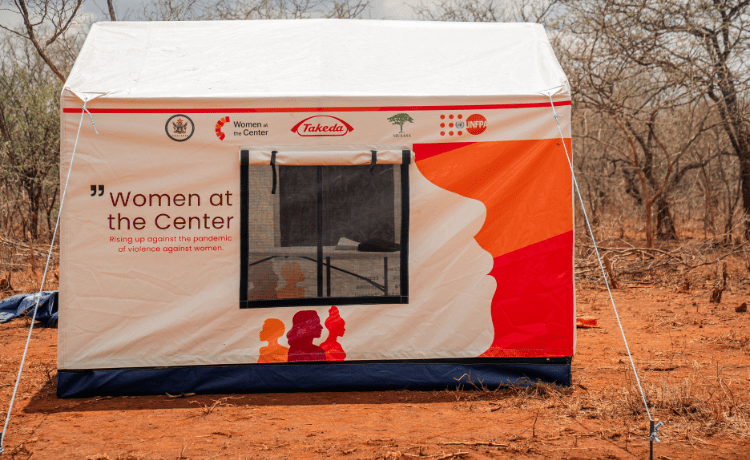
Women at the Centre is implemented by the United Nations Population Fund (UNFPA), the U.N.’s sexual and reproductive health agency, with support from Takeda Pharmaceuticals. This four-year initiative is strengthening gender-based violence case management systems across five countries, placing a particular emphasis on marginalized groups such as women and girls with disabilities, rural communities and adolescent girls.
In Zimbabwe, the project is working with local partners in Bubi District to bring services directly to marginalized and rural communities, including Musasa, a local women’s rights organization, and World Vision Zimbabwe to deploy mobile one-stop centers: roving structures that offer the full range of services survivors need, including case management, psychosocial support, medical care such as post-rape treatment and legal assistance with protection orders and court cases.
Providing these together, under one roof, is critical in a system that is all too often fractured.
Tabeth was able to obtain both counseling and safety.
“After years of abuse I have been assisted to get a protection order and since then my heart feels less heavy,” she said. “The counseling I also received was good. The service providers gave me so much respect.”
Since its launch in 2023, the Women at the Centre program has become a lifeline for marginalized women and girls in Bubi.
“This program didn’t just save my life; it gave me back my dignity,” said Clara.
Training a New Generation of Gender-Based Violence Responders
But reaching survivors is only the first step.
To create lasting change, Zimbabwe needs a stronger, more skilled workforce to manage gender-based violence cases with expertise and empathy for women and girls in all their diversity.
In December 2024, UNFPA began working with the government, the Council of Social Workers and eight academic institutions to develop a gender-based violence case management curriculum, based on international guidelines, for pre- and in-service training of social workers.
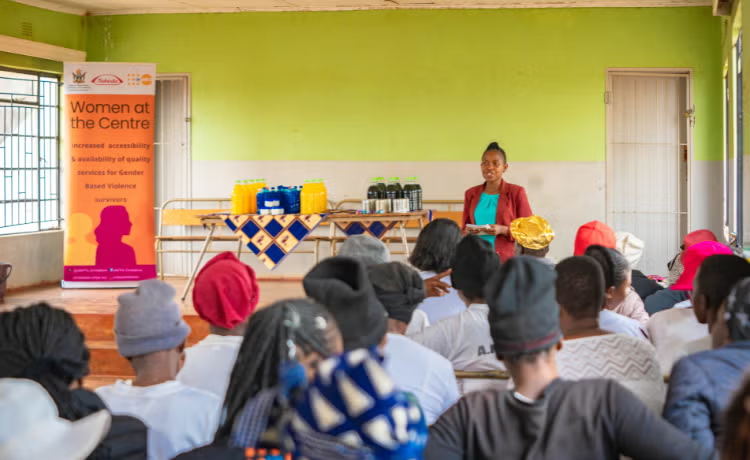
And in June of this year, UNFPA convened a training workshop in Bulawayo, bringing together lecturers from eight Zimbabwean universities, the Ministry of Women Affairs and the Ministry of Social Welfare, as well as social workers and frontline responders.
For five intensive days, they immersed themselves in survivor-centered case management, learning how to identify and respond to gender-based violence, how to coordinate health, legal and psychosocial services and how to teach these skills to the next generation of social workers.
“Before this, many of us only had superficial knowledge of gender-based violence,” said Dr. Abel Matsika, head of social work at Arrupe Jesuit University in the capital Harare. “Now, we are equipped to train students, and that will transform our communities.”
The curriculum, developed with the Zimbabwe Council of Social Workers, is now awaiting accreditation. The next steps are piloting, assessing and updating the curriculum, a process already underway.
Building a Future Without Fear
These efforts are proving that a better future is possible. Survivors are breaking their silence, communities are mobilizing against gender-based violence and Zimbabwe’s institutions are stepping up.
But the work is far from over.
“This is about more than crisis response,” said Janneke Bienert, a UNFPA gender-based violence specialist in Zimbabwe. “It’s about reimagining a society where women and girls live free from violence.”
For survivors like Tjedza, Clara and Tabeth, that dream is more real than ever. “Now I know I’m not alone,” Tabeth said. “And that changes everything.”
*Names changed for privacy and protection.
Originally published by UNFPA.
Great Job United Nations Population Fund (UNFPA) & the Team @ Ms. Magazine Source link for sharing this story.