More than 100 years ago, two women undertook an epic road trip in support of women’s suffrage. In 2026, feminists are determined to follow in their tracks—until women achieve full constitutional equality.
The year was 1916. Woodrow Wilson was president, U.S. troops were hunting Pancho Villa and a world war was raging in Europe, a conflict the U.S. would join a year later.
After a century of relentless efforts for suffrage, the movement was stalled, with only 11 states guaranteeing voting rights for women in statewide elections. Suffrage leaders of 1916 understood the need for more visible activities to energize supporters, attract new members and showcase strong public support. Media attention was crucial in recruiting new activists and conveying apowerful message to elected officials.
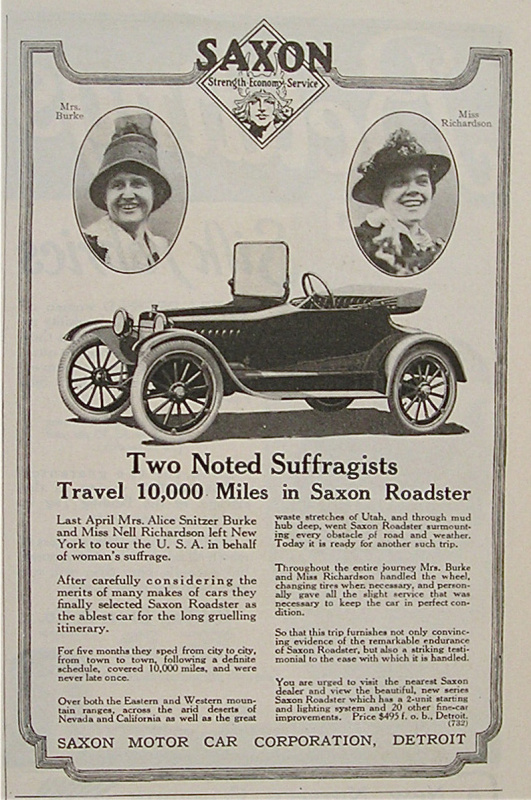
In this atmosphere, two adventurous, gutsy women—Alice Snitjer Burke, 39, and Nell Richardson, 25, both members of the National American Woman’s Suffrage Association—were determined to spread the message about the importance of women’s suffrage. With support from NAWSA, they volunteered to make an epic car trip across the country and back in a small Saxon roadster for “the cause.” At the time, few women drove cars, and automobiles were a big part of a major cultural shift from horses and buggies. Such a trip would be symbolic on many levels.
It has been nearly 110 years since the women made their historic drive. The trip took 26 weeks, covering 10,700 miles and crossing at least 29 states and Washington, D.C. There was no national highway system, only a patchwork of local roads, most of which were unpaved and unmarked.
The suffragists’ determination remained unshaken. The tireless collective efforts of the movement finally paid off, and the 19th Amendment was ratified and recognized in 1920, four years after Alice and Nell’s extraordinary journey.
The state of suffrage in 1916 was not unlike that of the Equal Rights Amendment today, with efforts underway for full recognition by Congress and the courts. During the 250th anniversary of the Declaration of Independence in 2026, ERA supporters are determined to follow in their tracks as the fight to protect voting rights continues, and to ensure women have full constitutional rights.
Votes for Women
The first women’s rights convention, which took place in Seneca Falls, N.Y., in 1848, adopted the “Declaration of Sentiments,” calling for, among many things, “her inalienable right to the elective franchise.” Five decades later, most suffrage organizing involved numerous local and state campaigns, including referendums to persuade male politicians to support women’s voting rights. Suffragists fought and won the right to vote first in Wyoming, followed by Colorado, Utah, Idaho, Washington, California, Kansas and Arizona on the same day, and Oregon.
As NAWSA continued to lobby state legislatures, the National Woman’s Party formed in 1916, with its members picketing the White House, staging hunger strikes and engaging in other civil disobedience. Whatever their preferred tactics, the major suffrage organizations were now united behind the goal of a constitutional amendment.
The Democratic and Republican national conventions were scheduled for June 1916, in St. Louis and Chicago. To pressure both parties to support women’s suffrage, marches and protests were planned. Both parties’ platforms endorsed suffrage but left the decision to the states. President Woodrow Wilson, the Democrats’ incumbent nominee, opposed a federal amendment and maintained that suffrage was a state issue.
The Journey
On April 6, 1916, Alice and Nell packed dresses, water bags, camping gear, a typewriter, camera, sewing machine and cooker into a small Saxon roadster painted bright yellow, the color of the suffrage movement.
Alice was an experienced driver, having completed a two-month trip around New York state. At the time, the Saxon Motor Car Co. was promoting its vehicles as inexpensive, economical and “easy enough for a woman to drive.” The company provided the car and supported the suffrage trip wherever possible, including at local dealerships along the way that kept it clean and provided necessary maintenance, while NAWSA planned the daily routes with overnight stays hosted by local suffrage organizations.
Alice and Nell drove through Manhattan, and at Columbus Circle were met by a crowd of well-wishers. At noon, Carrie Chapman Catt, head of NAWSA, christened the car the Golden Flyer, whacking it with a bottle of gasoline that left a dent.
The pair left Columbus Circle accompanied by an entourage of enthusiastic suffragists. The parade drove to the Weehawken ferry, where Alice and Nell waved goodbye and headed for New Jersey, the first stop on their long adventure.
To increase newspaper coverage and engage people in their travels, Alice wrote daily accounts in the form of a “Diary of the Golden Flyer,” which was published regularly in The Boston Daily Globe and New York Tribune. Their journey often made front-page news due in part to the novelty of seeing a woman drive a car, but Alice and Nell kept the focus on “votes for women.”
Down through New Jersey; Maryland; Washington, D.C; Virginia; North Carolina; and the South they drove. Not all plans worked as well as they had hoped. Newspapers reported stories of snowstorms, mules and mud. The roads were terrible—the Golden Flyer often was hung up on the center ridges created by horse and buggy. Alice’s diary spoke of travel issues, constant vibrations and tires caught in the middle of streams.
Alice and Nell were featured speakers at each stop, distributing literature, engaging with the crowds and actively recruiting supporters. They drafted seven speeches with distinct messages tailored to appeal to different audiences. News reports and their diary entries suggest that their messages likely resonated with committed suffragists, women who felt disenfranchised and men who recognized the importance of supporting their mothers, wives and daughters. Speeches varied for states with or without women’s voting rights.
They spoke to crowds large and small, indoors and out, from a podium or standing on the seat of their car. They collected donations while distributing literature. In Alabama, someone gave them a small black kitten instead of a coin. In Texas, they discovered a bullet hole in the kitten’s basket while navigating through a border skirmish.
At one point they were lost in the desert in Arizona. They had run out of water and resorted to drinking from a well they discovered held a dead chicken. Nell still proclaimed the water “good.” The Los Angeles Times ran a story titled “They’re Not Lost—New York Society Women Campaigning for Suffrage Are Safe in El Centro, Despite Alarming Reports That They Were Astray on the Desert.” The suffrage tour continued north throughout California after making more than 56 stops and with 14 states to go.
Then came Oregon and Washington. The Portland Oregonian quoted Alice highlighting the importance of Western states: “The fate of national suffrage rests with the women of the West,” she said. “In the East, it’s harder. We have labor conditions, politics and corruption to contend with. Yes, the Eastern women must look to the West. There rests the hope of national suffrage.”
Driving out of Seattle they experienced snow in the mountains, which made the roads more treacherous. Alice often said that once women gained the vote, she would begin working for better roads.
In Montana, where women already had the vote, they shared an important message: “The women of Montana and the West must not forget us. … They themselves are limited in their suffrage just as long as there are states in the nation which do not grant suffrage. If they move from Montana into a state which does not grant suffrage they lose the right to vote.”
That year, with the support of women’s votes, Montana Republican Jeannette Rankin was the first woman elected to the U.S. Congress. Rankin campaigned as a progressive with strong support for women’s suffrage and social welfare.

Jan. 21, 1918. (Bettmann Archives / Getty Images)
Alice and Nell spent time in South Dakota campaigning for a ballot measure for women’s suffrage. It was narrowly defeated in November by the state’s male voters (52 to 48 percent), but activists stayed strong—and suffrage was finally approved in the 1918 elections as the “Citizenship Amendment.”
Their tour of the Midwestern states included a visit to Minnesota on day 150 of the trip. The late summer gave them an opportunity to speak at state fairs. A newspaper quoted Alice as saying, “You men should read editorial pages rather than sport columns to vote intelligently.”
In mid-September, they arrived in Detroit, nicknamed the “Motor City”— home to about 125 car companies, including Saxon. Their journey continued from Toledo, Ohio, to Cleveland, then on to Erie and Warren, Pa. While they were driving across upstate New York, the Rochester Democrat and Chronicle ran a long article detailing their travels and noting the friendly receptions from coast to coast from governors, mayors and many others.
As they reached Manhattan, Alice and Nell are believed to have become the first women to drive 10,700 miles cross- country and back. But they did their tour to win the right to vote, not to earn a place in the record books.
The Golden Flyer was looking worn. The early dent was lost among newer ones and a multitude of signatures inscribed on the car by well-wishers. In the back, there were deer antlers and a 2-foot key to the city of San Jose, Calif., along with a car-flattened snakeskin and “Saxon,” now a full-grown cat.
In the two years after this historic 1916 trip, 15 more states passed suffrage bills of varying degrees. After New York joined them in 1917, President Wilson finally changed his position to support a national amendment, and the political landscape began to shift in favor of the right for women to vote.
In 1918, Wilson addressed the U.S. Senate, urging passage of the suffrage amendment as part of the Allies’ mission in World War I to “make the world safe for democracy”—because America needed to show it offered its own citizens “mere justice.”
By June 1919, two-thirds of Congress approved the amendment. Illinois, Wisconsin and Michigan were the first states to ratify it. The final state needed for adoption, Tennessee, ratified the amendment on Aug. 18, 1920, but not without controversy over a quorum vote.
On Aug. 26, suffrage was certified and recognized as the 19th Amendment.
A New Drive
In March of 1776, when the Declaration of Independence was still being written, Abigail Adams urged her husband, John, to “remember the ladies,” warning that a new country built on old exclusions would face a rebellion of its own from women. That warning has echoed through two centuries, most recently in the protests and resistance against U.S. Immigration and Customs Enforcement and the fury stirred by the vote on the Epstein files in Congress.
In 1977, Republican feminist activist Jill Ruckelshaus told the delegates of the National Women’s Political Caucus, “We are in for a very, very long haul.” She predicted that the road ahead would demand everything of feminists.
Later, singer-songwriter Kristin Lems turned the words of Ruckelshaus’ speech into an anthem for the fight for the Equal Rights Amendment with the chorus, “We will never give up, we will never give in”—a promise carried by feminists from the streets to the halls of Congress and back again.
In March, leaders of the national petition drive at Sign4ERA.org are taking that promise on the road—launching a visibility tour, Driving the Vote for Equality, by tracing the tracks of the Golden Flyer.
Amending the Constitution to include women’s suffrage took more than a century, and was accomplished thanks to the dedication of people like Alice and Nell. Yet ratification did not guarantee full enfranchisement—either for voting or equal rights under the law. Before the Voting Rights Act of 1965, women of color faced serious economic, legal and political obstacles that effectively denied them the right to vote.
The ERA is needed now more than ever to ensure full voting rights are not rolled back, to stop the Trump administration from continuing to bulldoze over gender equality, and for new state and federal laws and policies to ensure “equality of rights under the law shallnot be denied … on account of sex.”
Although the ERA has met all requirements to become the 28th Amendment, it’s been held up due to language in the resolving clause from the joint congressional resolution setting a ratification timeline. Top constitutional experts believe this should not keep the ERA from being deemed properly ratified, in part because the arbitrary time limit is in the preamble, not the actual text of the ERA, which is what was approved by Congress and ratified by the states.
To settle these concerns and ensure the courts cannot decide the amending process must start over, a joint resolution is pending in Congress. The House version states: “Notwithstanding any time limit … [the ERA] is valid to all intents and purposes as part of the United States Constitution having been ratified by the legislatures of three-fourths of the several States.” Nearly all House Democrats are cosponsors, along with only one Republican.
Driving the Vote for Equality will work with a wide range of groups, including Mayors for ERA, historical societies and local activists, to commemorate the suffragists’ efforts—and alert voters and politicians to the importance of Congress recognizing the ERA.
For more information or to volunteer for Driving the Vote for Equality when it comes to your state and community, email team@sign4era.org.
This article appears in the Winter 2026 issue of Ms. Join the Ms. community today and you’ll get issues delivered straight to your mailbox.

Great Job Jeryl Schriever & the Team @ Ms. Magazine Source link for sharing this story.