

In January 1929, the novelist and critic Mike Gold published a manifesto in the socialist magazine New Masses titled “Go Left, Young Writers!” In it, Gold argued that the American democratic project suffered from a broad inability to imagine the lives of working-class and poor people. It was necessary to inject proletarian voices into the media so that people could encounter the reality of working people’s lives as they themselves saw it.
One obstacle was that writing had earned a reputation as a somewhat otherworldly endeavor. Opaque and rarified, writing’s secret genius was inaccessible to all but a handful of highly educated and innately talented elites. Many self-important writers promoted this impression themselves, talking about their craft with an air of snobbery and territorial insularity.
Gold, who would become the architect of twentieth-century America’s proletarian literary movement, argued that this was nonsense. Writing was “not any more mystic in its origin than a ham sandwich.”
Peeling back the layers of pretentiousness, Gold argued, one found a media ecosystem controlled from the top down by capitalists for profit and social control, and populated with bourgeois scions and careerist sycophants. To conceal this basic structure, they obfuscated what writing is. For Gold, it was labor like any other. The finished product was composed of time, attention, and skill combined with paper, ink, and glue. Word people weren’t engaged in a process any more otherworldly than what transpired at the factory or the stockyard.
While seeking to demystify the process, Gold’s manifesto nevertheless argued that literature is distinct from other products. The best writing was “the mirror of its age,” showing the reader a true vision of society and the modern individual’s place in it. The working class had a point of view and naturally ought to participate with its own aesthetic sensibility. In contrast to the period’s “ignorant jazzy bourgeois” high modernism, proletarian literature claimed clarity and refreshing common sense.
And so at the end of “Go Left Young Writers!,” Gold called for American workers to send in their confessions, diaries, and fiction written about their daily lives. Steelworkers were to send the New Masses their poetry. “The Great mass of America is not ‘prosperous’ and it is not being represented in the current politics or literature,” Gold wrote. “Upon their shoulders the whole gaudy show-palace rests. When they stir it will and must fall.”
The big crash occurred in October of 1929, a few months after Gold’s manifesto was published. It proved what socialist critics like Gold had argued all throughout the roaring twenties — that industrial and financial elites ran society like a casino and regarded workers as unimportant collateral.
A year after the crash, in 1930, the executive class declared victory over the slump. In 1931, the president of General Motors said the American economy was now entering a new upswing, “with new ideas, new measures, new confidence, new hope.” But every year, hundreds of thousands of jobs evaporated, and whole industries collapsed. The economic foundations of American cities turned to dust, as did the prairie lands of Kansas and Oklahoma; the dust bowl was an environmental apocalypse. But the richest men in American history were soundly in control of American political life, and so they got to decide how to handle the crisis. “The sole function of government is to bring about a condition of affairs favorable to the beneficial development of private enterprise,” declared Herbert Hoover in 1931.
In 1929, the top 1 percent of the US economy owned 59 percent of the wealth. The elite believed that the working class could endure endless abuses, and that their own monopolistic system was the best of all possible ways to organize society. The success of Coca-Cola and Maxwell House sloganeering convinced them that a good catchphrase was the most effective way to intervene. “What this country needs is a good big laugh,” said Hoover. That would raise the spirits of the American people. Maybe then they’d stop whining and start belt-tightening.
Twenty of these lazy, humorless whiners starved to death in New York City that year, and the next year that number shot up to ninety-five. As the historian Nick Taylor notes, “Police in Danbury, Connecticut, found a mother and her sixteen-year-old daughter huddled in a makeshift shelter in the woods, where they had been eating apples and wild berries to survive.”
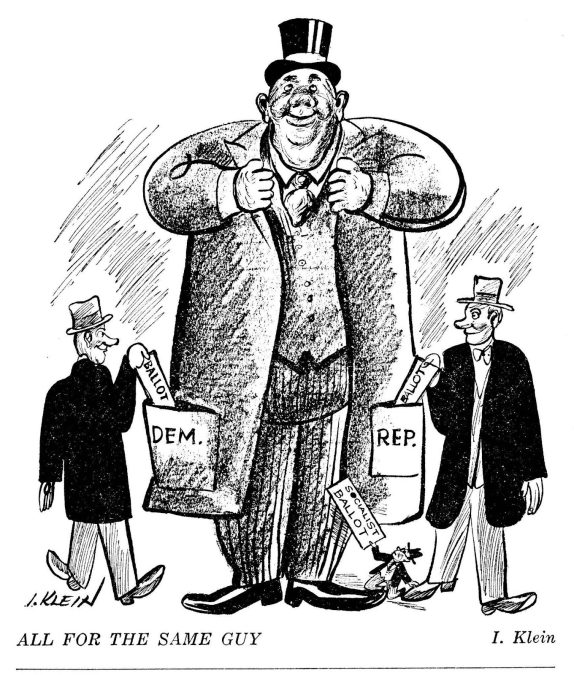
By March of 1931, eight million Americans were out of work, double the number of the year before, and yet the corporate elite controlling Washington enforced a suicidal commitment to laissez-faire economics while preaching the virtues of rugged individualism. Hoover kept saying that the country’s economic woes were “a passing incident in our national life,” and that the number of people “threatened with privation” was actually small.
As Gold wrote before the crash, the rich had spent the decadent 1920s “joyfully” reveling in the fruits of exploitation and reckless speculations. They then turned around and interpreted the crash as an occasion for moral cleansing — but not for themselves. As the millionaire industrialist Andrew Mellon advised Hoover, suggesting he simply let the depression run its course without significant intervention:
Liquidate labor, liquidate stocks, liquidate the farmers, liquidate real estate . . . It will purge the rottenness out of the system. High costs of living and high living will come down. People will work harder, live a more moral life. Values will be adjusted, and enterprising people will pick up the wrecks from less competent people.
Workers couldn’t rely on these cold, punitive elites to see or value them, much less look out for their interests. They would have to take it upon themselves. This was the context in which the proletarian literary movement was born.
When World War I ended, Americans wished to bask in peacetime. But strife at home was only intensifying. Starting in 1917, escalating in tandem with the wealth inequality of the 1920s and ’30s, the second wave of the Ku Klux Klan systematically terrorized black America. White supremacist attacks escalated year after year, with lynchings and vigilante murders that began to rival levels seen during the Redemption era. In response, formations that would eventually yield the Civil Rights Movement began to coalesce in the 1930s, with the proletarian literary movement playing a large role.
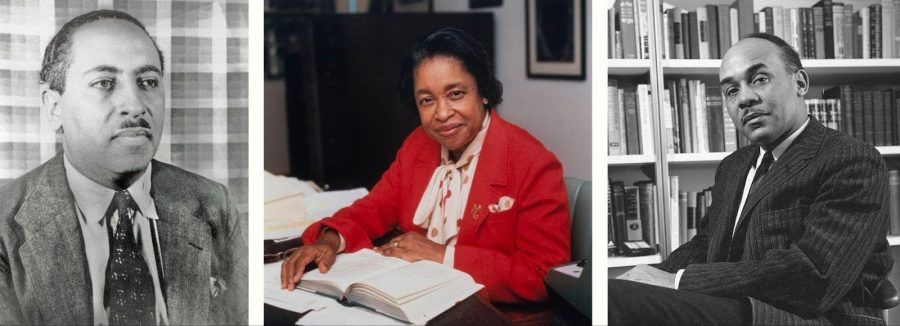
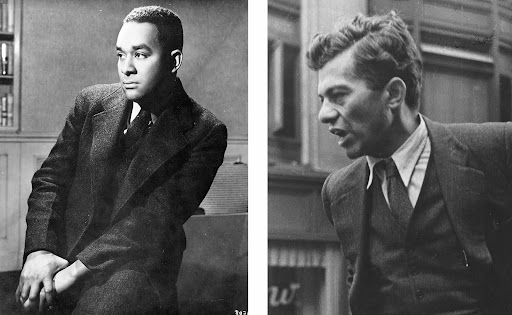
Publications like the New Masses and The Anvil espoused multiracial socialism and published young black writers of the Harlem Renaissance and beyond, including Arna Bontemps, Margaret Walker, and Richard Wright.
As Marc Blanc writes in his history of The Anvil magazine, proletarian writer-editors like Gold and Jack Conroy modeled and fostered a new kind of insurgent, anti-fascist, working-class American writer who, ignoring high-minded theorems, wrote realistic literature with passion and authenticity. Proletarian writers were included in this image regardless of creed or race.
Conroy often said the sight of Karl Marx’s Capital on a bookshelf across the room was enough to give him a headache. This new American writer’s spiritual-political attitude would be informed by firsthand experience as a member of the working class. Proletarian writing would reflect life on the clock, living out of tenement housing, camping in the tent city outside the lumber mill.
The struggles of women, who were often confined to the home where they were charged with caring for hungry kids, were encapsulated by the novels and short stories of Tillie Olsen and Meridel Le Sueur. Le Sueur’s The Girl is an epic proletarian novel of bank robberies, mutual aid, and pregnancy, culminating in a communal birth.
The Anvil’s purpose was to give voice to writers outside the centers of capital, patriarchy, or the racial hierarchy. The New Masses became a megaphone for black left-wing writers, immigrants, poor farmers, and city proletarians who voiced their frustration over pointless work and wasted potential. These writers expressed anger, frustration, and rage at the stupidity of it all; the daily insults and the violence of an economic system that only seemed to benefit the boss.
In novels like Conroy’s A World to Win, Gold’s Jews without Money, or Wright’s Black Boy, workers are scammed by capitalists or feel the misery of the depression, but are still proud of their ability to perform difficult jobs and survive. These writers didn’t grow up reading and writing with private tutors at fancy colleges; they were corralled into debt peonage, posted up in the breadline.
Characters in proletarian literature are often misled into believing that their individual flaws account for their miserable conditions, but then encounter a union organizer or a wise old Wobbly who tells them the truth, setting fictional men and women on the revolutionary path. “Let us be large, heroic and self-confident at our historic task,” wrote Gold in “Go Left Young Writers!”
“The best thing a young writer can now do in America, is to go leftward . . . Do not be passive. Write. Your life in mine, mill, and farm is of deathless significance in the history of the world.”
The proletarian writer movement didn’t last long. Like other left movements, it was subsumed and metabolized by the New Deal, the Popular Front, and eventually World War II. But its reverberations could be felt all the way through the 1960s Civil Rights Movement and beyond.
The same thing that ended the Great Depression and kept thousands of left-wing writers afloat: a massive federal intervention in the US economy. The New Deal’s Works Progress Administration protected public health, created safer cities and roads, built bridges, dammed rivers, and helped conserve and make accessible America’s vast national parks.
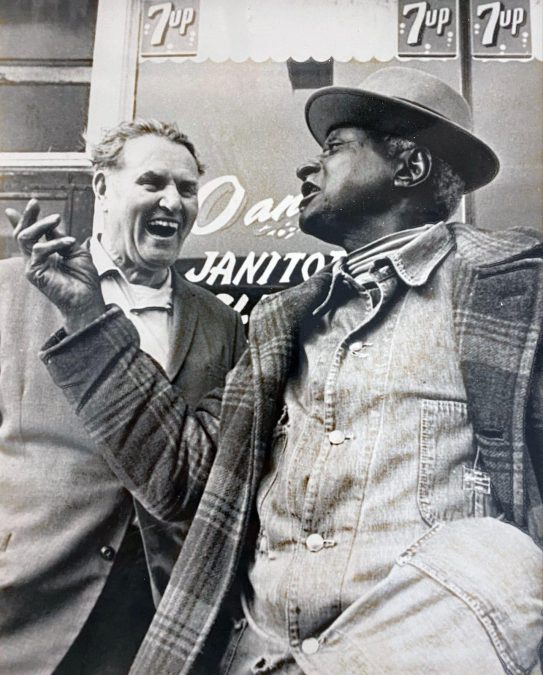
And one of the most impactful aspects of the program was that it also put tens of thousands of artists and writers to work telling the story of the United States itself. They told this story of America through paintings, murals, song, folklore, state guidebooks, plays, and reporting — all for the consumption of regular citizens, not critics. Beyond material support, which was no small thing, the New Deal also restored a sense of purpose to many who felt forgotten and aimless.
The novels of Ralph Ellison, Nelson Algren’s stories of America’s seedy underbelly, and May Swenson’s poems about the magic of the natural world were all supported by the New Deal WPA’s Federal Writers’ Project. Saul Bellow and John Cheever were part of it, too. Meanwhile, the WPA recorded previously ignored music, laying the groundwork for the cultural boom of the postwar era.
The WPA also undertook national healing that should have occurred during Reconstruction, sixty years earlier, specifically through the WPA Slave Narrative Collection, which compiled firsthand accounts of formerly enslaved people while it was still possible. Every era loses contact with the past rapidly, and the WPA slave narratives saved firsthand stories from oblivion. That archive testifies to our incomplete victory over the Southern planter class and remembers the victories of yesterday in an era where fascist domination and Klan violence seemed unstoppable.
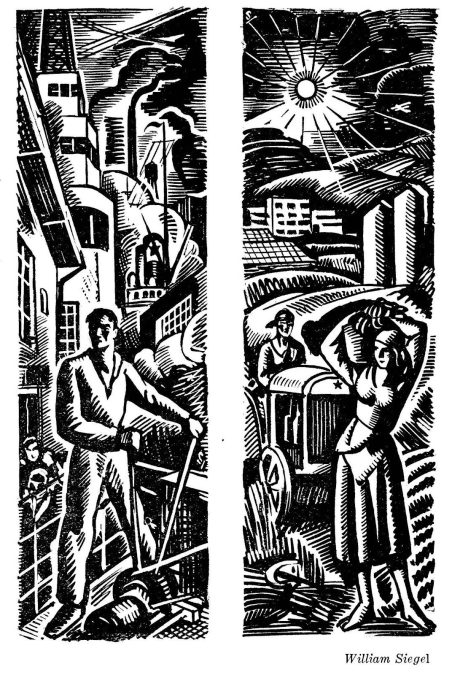
These New Deal–era efforts were a large-scale version of the scrappy proletarian literary movement started by editors like Gold and Conroy, who made a point of publishing the stories of the underclass because the language of the oppressed rings truer than propaganda. And though the movement has faded into distant memory, its most deeply held belief remains true: common people are not stupid. They recognize the truth of their stories when they hear and see them. They feel the anxiety of inflation, de-skilling, rent-seeking, and exploitation. They see the workings of the many systems in place designed to degrade, control, and discourage them. They feel the leathery weight of the boot on their necks. And they have something to say about it.
Working-class people have the same critical task today as they did in the 1930s: grab a blank page and start. Write some stuff down. Do a little every day. Snatch some parts of the world, put it into words, and see how it looks. Write a firsthand account of a day on the job. Go to a protest or a picket and write what happened there. Write a song so good it thrashes the faux-populism of MAGA-glam country music. Meridel Le Sueur based The Girl on the stories she heard from unemployed women at Workers Alliance meetings. Talk to people, listen to how they say things. The novelist William H. Gass used to say he hammered every word against the desk before it was ready to go into the work. Try his nine rules of writing:
- Continue work . . .
- Study the masters . . .
- Do deliberate exercises . . .
- Regularly enter notes . . . sharpen that peculiar and forgetful eye . . .
- Take to sketching . . . details . . . exactitude . . .
- Become steeped in history . . .
- The better word . . . the better word . . . the better word . . .
- Figure it will be five years before any . . .
- Wait . . .
Writing is communal — you can’t write literature for no one (although journaling is good too), so give it to someone to read. Except for the cost of time, it’s one of the cheapest crafts out there. It’s rewarding, though it also might drive you insane. The pay is bad, and something needs to drastically change in the greater media economy to make it lucrative, but that’s largely out of our control. For now, we can practice. It can be horribly dispiriting, too, so watch out. Do it for truth and self-expression, not for flowers and accolades.
The proletarian movement pushed American workers to develop a craft as a bet on the future; seeds sown every day that won’t yield until much later. Many seeds from the 1930s didn’t yield until the Civil Rights Movement or the New Left of the 1960s. As Gold said, let us be large, heroic, and self-confident at our historic task. As the New Masses editor wrote of the poet Ezra Pound, who was on an admiring tour of European fascism in the early 1930s:
You may yet return triumphantly, Ezra, to a Fascist America, and lead a squad that will mystically, rhetorically but effectively bump off your old friends, the artists and writers of the New Masses.
Always ready, but hoping to see you in hell first.
Great Job Devin Thomas O’Shea & the Team @ Jacobin Source link for sharing this story.