

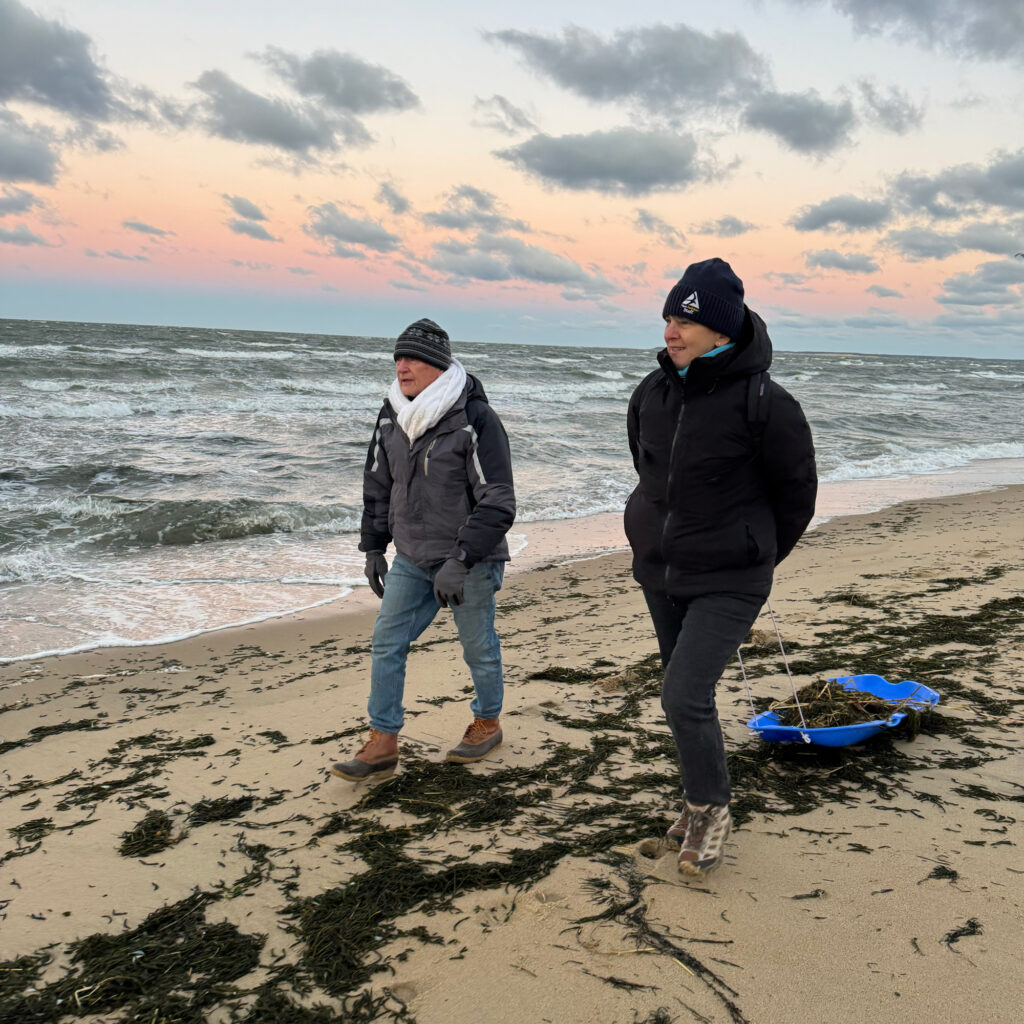
Over the last few weeks, volunteers have braved bitter winds and freezing temperatures to patrol Cape Cod’s bayside beaches at night, sweeping their flashlight beams along the last high-tide line marked with mounds of seaweed, searching for signs of life.
“That’s where you’re most likely to find a turtle,” said Mark Faherty, science coordinator at Mass Audubon’s Wellfleet Bay Wildlife Sanctuary, which runs a sea turtle rescue and research program in Cape Cod.
Every year, from November through early January, hundreds of juvenile sea turtles strand on these beaches when water temperatures drop below 50 degrees Fahrenheit, leaving them cold-stunned—a hypothermic reaction experienced by marine reptiles—and unable to swim.
Disoriented and helpless, the animals drift until the surf deposits them on the beach, covered in algae and barnacles, so still and so camouflaged they often resemble rocks. Kemp’s ridleys—the world’s most endangered sea turtle—make up the majority, along with smaller numbers of green and loggerhead turtles.
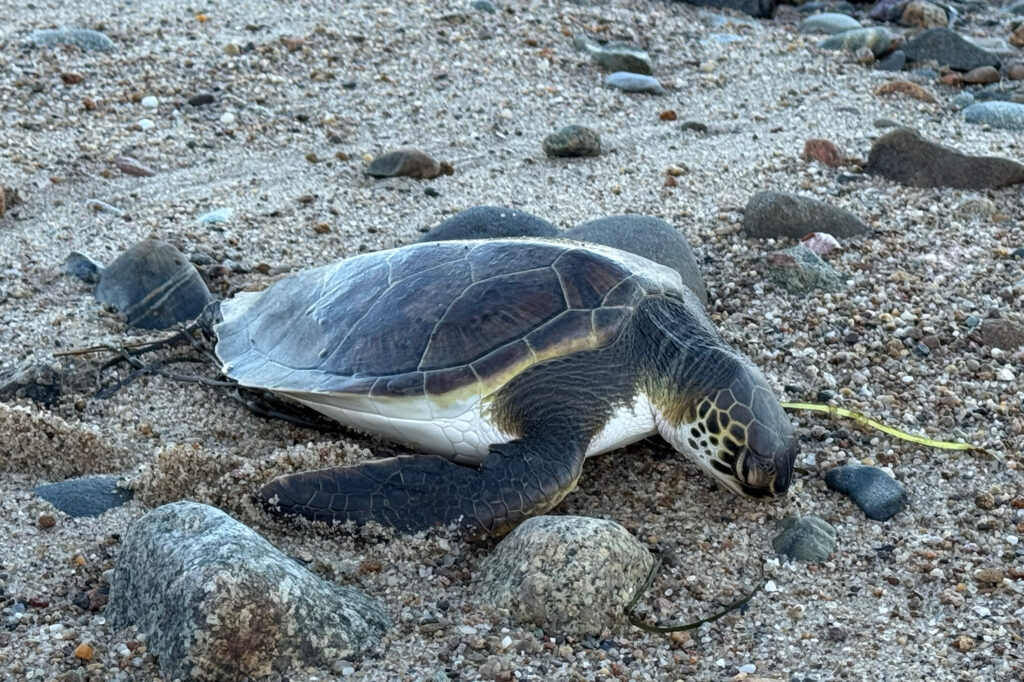
“It’s the biggest annual cold-stunning event of sea turtles in the world,” Faherty said. And it’s expected to get bigger. Thirty years ago, around a hundred turtles would typically strand in a season. Now, Faherty said, “We might see over 100 turtles in a single day.”
So far this winter, more than 500 rescued turtles have been rescued along Cape Cod beaches, including Sandy Neck, Chapin Memorial, Skaket and others in Eastham and Brewster. New ones are found almost daily.
For the rest of the cold-stunning season, volunteers will continue to comb miles of shoreline, day and night, sometimes in storms and subfreezing winds, to search for the stranded animals pushed in by the tides. Each one saved, Faherty said, could help boost the species.
“Some number of those are going to go on to breed and contribute to hopefully continuing to rebuild the population,” he said.
Climate change is largely driving the increase in stranded turtles, which has risen sharply across the northwestern Atlantic since the 1970s, according to a study co-authored by Faherty, published in the scientific journal PLOS One. The researchers found that the largest stranding years occurred when late October and early November sea-surface temperatures in the Gulf of Maine were warmer than normal. If that trend continues—and projections suggest it will—more than 2,300 juvenile Kemp’s ridleys could cold-stun in Cape Cod Bay each year by 2031.
“The Gulf of Maine is warming up faster than about 99 percent of the water bodies in the world,” said Kate Sampson, sea turtle stranding and disentanglement coordinator for NOAA Fisheries.
That rapid warming is driven by shifting ocean currents and the distinct geography of the gulf, which stretches from Nova Scotia to Cape Cod. For decades, cold Arctic water carried south by the Labrador Current helped keep the Gulf of Maine cool. But as human-driven climate change has warmed the planet, that current has weakened. Meanwhile, the Gulf Stream, which originates in the Gulf of America and flows north along the East Coast, has strengthened, pushing warmer tropical waters into the region. With less cold water to counterbalance that influx, the Gulf of Maine is absorbing and retaining more heat. Its basin-like shape, bordered by shallow underwater banks, traps that excess warmth much like a bathtub, according to the Gulf of Maine Research Institute.
These shifts have made the Gulf of Maine a prime summer feeding ground for juvenile sea turtles.
“It’s always been a habitat for turtles in the past, but now it’s becoming, probably more appealing as the water temperature warms in that area,” Sampson said.
Most of the Kemp’s ridley sea turtles that strand on Cape Cod begin life thousands of miles to the south, emerging from nests on the Gulf Coast, either on Padre Island National Seashore in Texas or on the beaches of Tamaulipas, Mexico. As hatchlings, they enter ocean currents that carry them from the Gulf of America into the Atlantic, where, for the first few years of their life, they live and forage amidst large floating fields of sargassum. Eventually, they instinctually move inshore, drifting with the Gulf Stream, which carries them north and disperses them along the Eastern seaboard, where they continue to follow warm water and abundant food.
The PLOS One study found that the increasingly warm waters in the Gulf of Maine act as an “ecological bridge,” drawing juvenile Kemp’s ridleys out of the Gulf Stream and into nearshore New England habitats where they linger well into the fall while foraging on crabs, shrimp and mollusks along the seafloor.
But climate change isn’t the only factor behind the rising number of turtles in Cape Cod. Decades of conservation efforts have also helped rebuild Kemp’s ridley populations, Sampson said.
For decades, their eggs were harvested en masse for sale or consumption. Adult turtles were routinely caught and killed in shrimp trawlers in the Gulf of America. By the 1980s, the species had nearly collapsed. To conserve the turtles, Mexico and the United States began protecting nesting beaches. And in the U.S., shrimp trawlers were required to install turtle excluder devices—trapdoor-like openings in trawl nets that allow turtles to escape. Those protections are widely credited with helping the population make a gradual comeback.
Even with recent gains from conservation efforts, the population has faced major setbacks.
In 2010, the Deepwater Horizon disaster—the largest marine oil spill in history—is estimated to have killed more than 80,000 juvenile Kemp’s ridley turtles in the Gulf of America, according to the New England Aquarium.
Turtle Rescue
For years, the Boston-based aquarium has partnered with Mass Audubon to rescue and rehabilitate cold-stunned turtles in Cape Cod Bay.
As the days shorten and the water cools, their hospitable feeding grounds become perilous. Instinctively, they try to head south toward warmer seas, but their escape is blocked by the peninsula’s famous hook that juts out like a flexed arm and cuts the turtles off. “They’re just sort of drifting around at the mercy of the winds and currents,” Faherty said. “Once it gets to 50 [degrees] and below, they start to get hypothermic.”
Unable to navigate north and east to find their way out, the turtles become effectively penned inside the bay.
“The southern end of the Gulf of Maine is that trap,” Sampson said.
Cape Cod isn’t the only place where sea turtles fall victim to sudden cold snaps. Along North Carolina’s Outer Banks, some animals strand along Cape Hatteras or inside other estuaries where rapidly cooling water can immobilize them before they reach the open ocean. Similar events have happened in Florida’s Indian River Lagoon and St. Joseph Bay. In Texas, some of the most extreme cold-stun episodes on record have occurred. During a severe cold front in February 2021, NOAA’s Sea Turtle Stranding and Salvage Network documented more than 13,000 cold-stunned green turtles—the largest event of its kind in history.
When volunteers encounter stranded turtles, they cover them with seaweed to slow further heat loss as they haul them along the beach on sleds back to their cars, which they’ve been instructed to keep cool at about 55 degrees.
This story is funded by readers like you.
Our nonprofit newsroom provides award-winning climate coverage free of charge and advertising. We rely on donations from readers like you to keep going. Please donate now to support our work.
“You don’t want to warm them up too quickly, because that can be just as dangerous for them as not warming them up at all,” said Adam Kennedy, director of the New England Aquarium’s sea turtle hospital located in Quincy, Massachusetts.
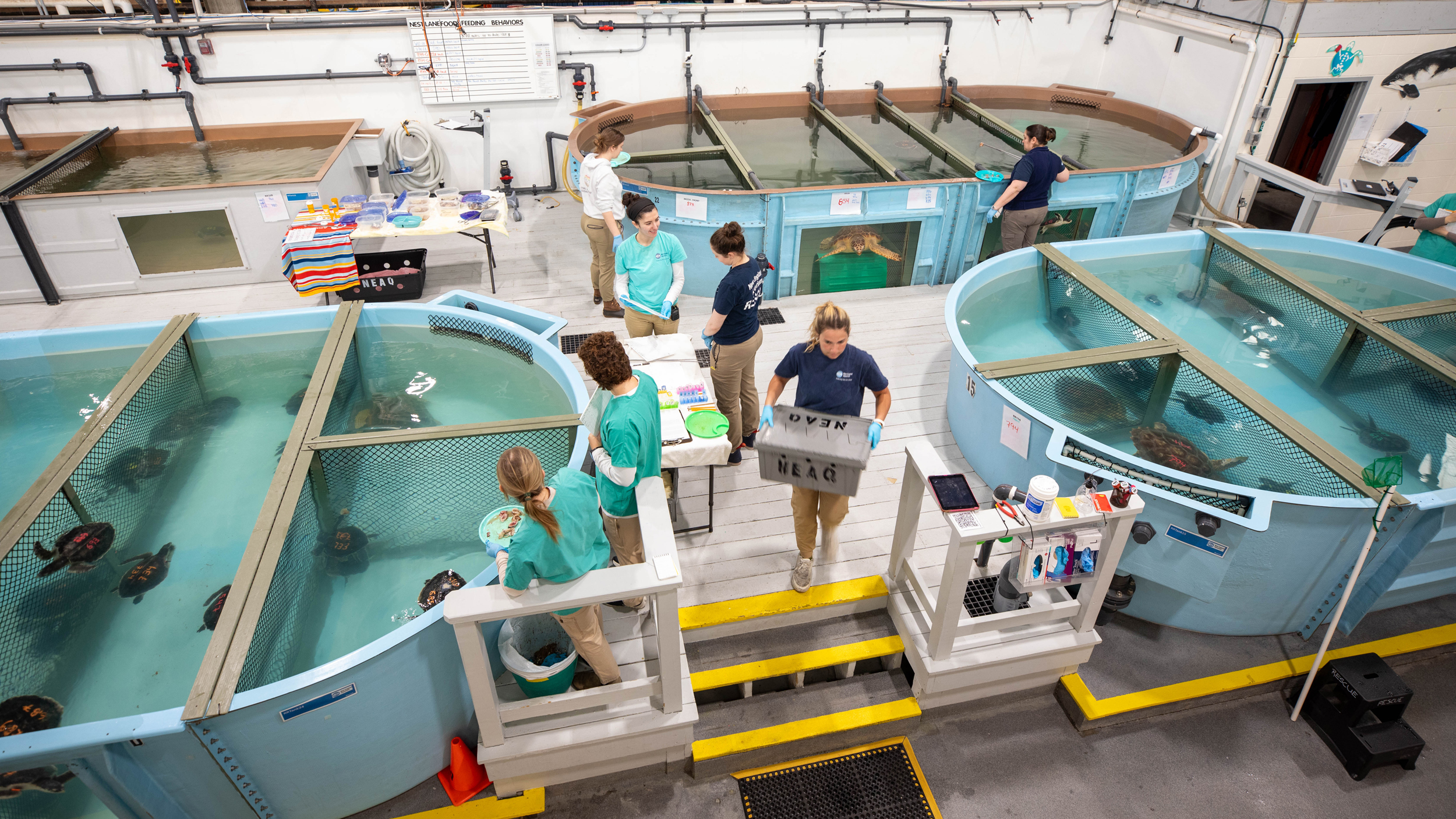
From the beach, the volunteers drive the rescued turtles to the Wellfleet Bay Wildlife Sanctuary, where staff weigh, measure and assess each animal’s overall condition. It’s not always obvious if a turtle is alive. Often, they appear dead until they’ve had time to defrost, Faherty said. Those turtles are placed in what he dubs the “questionable corner,” where they’re monitored closely to see if they begin to revive as they warm. Once they show signs of life and are stable enough for transport, they’re sent on to the New England Aquarium’s sea turtle hospital for further care.
Turtle Rehab
At the Quincy hospital, each turtle is assigned a number, painted on its shell, for identification before beginning a carefully timed warming regimen. On the first day, the animal is submerged in a shallow tub kept at about 55 degrees. On day two, the water temperature is raised to 65 degrees, and by day three they are in 75-degree water—warm enough for them to “graduate” into deeper rehabilitation tanks.
Many of the turtles arrive at the hospital in critical condition, severely compromised by the cold-stunning, said Melissa Joblon, a sea turtle veterinarian and director of animal health at the New England Aquarium. While struggling in the surf, they often aspirate water. “You can imagine they’re not breathing very well,” she said. This often leads to pneumonia. They’re also immunocompromised, she said. As they freeze, blood stops circulating to their flippers and other extremities, resulting in frostbite or bone infections.
Each turtle that enters the New England Aquarium sea turtle hospital has a number painted on its shell for identification purposes. Credit: Vanessa Kahn/New England Aquarium
During the first days of care, veterinarians conduct exams, take X-rays and perform blood work to assess dehydration, respiratory issues and other ailments, including eye infections, abnormal buoyancy caused by gas buildup, and sometimes the occasional fracture or bites from predators. Some are missing entire flippers. One turtle found this season showed signs of shark bites. Each turtle receives a tailored treatment plan that may include antibiotics, fluids enriched with sugar or electrolytes and medications to address their needs.
One of the hardest battles in the first weeks of rehabilitation is getting the turtles to eat to “get those calories on board, to help with that fight against infections and just gaining that muscle back,” Kennedy said.
Many arrive severely emaciated, their bodies depleted after days unable to move or feed in frigid water. Their shoulders and plastrons—the hard, protective underside of the shell—are often so sunken that the animals’ ribs beneath become visible. Some have hollow eyes or hang limply in the water, their flippers drooping from exhaustion.
Staff spend hours each day coaxing them toward food, knowing that most won’t take their first bite for a week or two. In extreme cases, Kennedy said, staff may tube feed turtles a “delicious smoothie” of blended herring and squid until they can eat on their own.
Despite their precarious condition, many cold-stunned turtles prove remarkably resilient. Earlier this week, one rescued turtle slowly paddled inside its tank, its shell marked with the number 599. “599, yesterday had no detectable heartbeat,” Kennedy said. “It would move a little bit so we knew it was alive, but it wouldn’t even breathe, even when we tried to stimulate it.” After emergency medications and fluids, the turtle rallied overnight. By the next morning, it had significantly improved.
Complete recovery from cold-stunning can take 4 to 8 months. But the hospital doesn’t always have capacity to provide that amount of time and care to the hundreds of turtles that come through its doors. A maximum of 80 turtles may be rehabilitated there at any one time. To free up space, many turtles, once stabilized in Quincy, are transported by car, or even flown by volunteer pilots to other rehabilitation centers around the country.
This past week, around 80 turtles were flown to Florida where they will receive further care at various rehabilitation centers including The Turtle Hospital in Marathon and the Loggerhead Marinelife Center in Juno Beach. Ultimately, Kennedy said, the goal for each animal is the same: help them become healthy enough to return to warmer waters. “We want every turtle to make it back to the ocean.”
About This Story
Perhaps you noticed: This story, like all the news we publish, is free to read. That’s because Inside Climate News is a 501c3 nonprofit organization. We do not charge a subscription fee, lock our news behind a paywall, or clutter our website with ads. We make our news on climate and the environment freely available to you and anyone who wants it.
That’s not all. We also share our news for free with scores of other media organizations around the country. Many of them can’t afford to do environmental journalism of their own. We’ve built bureaus from coast to coast to report local stories, collaborate with local newsrooms and co-publish articles so that this vital work is shared as widely as possible.
Two of us launched ICN in 2007. Six years later we earned a Pulitzer Prize for National Reporting, and now we run the oldest and largest dedicated climate newsroom in the nation. We tell the story in all its complexity. We hold polluters accountable. We expose environmental injustice. We debunk misinformation. We scrutinize solutions and inspire action.
Donations from readers like you fund every aspect of what we do. If you don’t already, will you support our ongoing work, our reporting on the biggest crisis facing our planet, and help us reach even more readers in more places?
Please take a moment to make a tax-deductible donation. Every one of them makes a difference.
Thank you,

Oceans Correspondent
Teresa Tomassoni is an environmental journalist covering the intersections between oceans, climate change, coastal communities and wildlife for Inside Climate News. Her previous work has appeared in The Washington Post, NPR, NBC Latino and the Smithsonian American Indian Magazine. Teresa holds a master’s degree in Journalism from the Craig Newmark Graduate School of Journalism. She is also a recipient of the Stone & Holt Weeks Social Justice Reporting Fellowship. She has taught journalism for Long Island University and the School of the New York Times. She is an avid scuba diver and spends much of her free time underwater.
Great Job By Teresa Tomassoni & the Team @ Inside Climate News Source link for sharing this story.