

The U.S. ranks as the 19th most dangerous country for women, 11th in maternal mortality, 30th in closing the gender pay gap, 75th in women’s political representation, and painfully lacks paid family leave and equal access to health care. But Ms. has always understood: Feminist movements around the world hold answers to some of the U.S.’s most intractable problems. Ms. Global is taking note of feminists worldwide.
Nigeria
+ Mass school kidnappings escalate as schoolchildren are taken in consecutive attacks
On Friday, November 21, armed men kidnapped more than 300 schoolchildren and teachers from the Catholic Saint Mary’s boarding school in Niger state, though state officials report that the number may be exaggerated. School officials say that 50 of the children have since escaped and reunited with their families. The attack is being described as one of the worst in the country’s history and marks Nigeria’s second major abduction in the same week.
Just days earlier, on Monday, Nov.17, 25 Muslim schoolgirls were abducted from their boarding school in the northern Kebbi state, 106 miles away from Friday’s attack. One girl managed to escape soon after, and all the girls were later released under unclear circumstances. Following the attacks, schools in the area have been closed.
Mass kidnappings from schools have become increasingly common in Nigeria in the past decade. Some victims are released with ransoms, but many remain missing. Since the 2014 Chibok abduction of nearly 300 girls, more than 1,500 children have been taken from Nigerian schools.
So far, no group has claimed responsibility. Security agencies are conducting full-scale investigations and search-and-rescue operations for the remaining missing students from Friday’s attack.
Afghanistan
+ New Taliban rule denies healthcare for women who do not wear burqas
On November 5, the Taliban imposed yet another new law in Herat requiring women to wear a burqa–a full-body covering with only a small mesh screen over the eyes–before entering any public hospital or healthcare facility. If they fail to do so, they will not be allowed in.
The mandate is the latest in a string of restrictions limiting Afghan women’s access to healthcare, which is already constrained by bans, clinic closures, and other restrictive policies. Afghan women, many already confined to their homes due to oppressive laws like workplace and university bans along with strict public dress codes, now face additional barriers to seeking even basic medical care. Since the burqa requirement, urgent care admissions for women have dropped 28 percent, and overall female use of healthcare facilities have drastically dropped.
“This is suffocating for us,” a woman in Herat, who asked to remain anonymous for security, told RFE/RL’s Radio Azadi. Sarah Chateau, the program manager for Doctors Without Borders, said that “Each restriction placed on women as patients translates into delayed or denied medical care. We know this will have severe consequences for children and mothers who already face enormous barriers to accessing health services in Afghanistan.”
Brazil
+ Indigenous women’s organizations demand access to UN climate funds at summit
This year, COP30—the United Nations Climate Change Conference—hosted a record number of Indigenous representatives in Brazil. The conference was held this year near the Amazon, on Indigenous land. However, only 14 percent of Indigenous attendees at COP30 were invited to the “Blue Zone,” where official negotiations were held. Indigenous groups protested and held counter-events, such as the Parallel People’s Summit, in addition to holding a COP30 fringe event, the Global Summit of Indigenous Women and Youth to advocate for Indigenous women’s organizations receiving access to the UN’s climate funds.
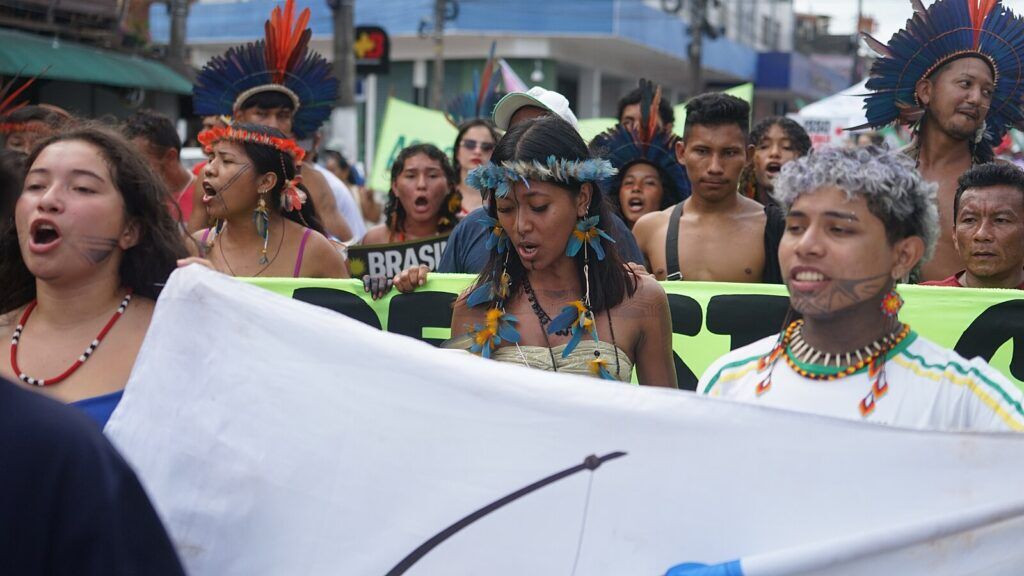
Over 200 delegates met at the Global Summit between Nov. 12 and 14, to call on governmental organizations to “end discrimination, respect self-determination and provide direct access to climate finance.” At the Summit, Indigenous women leaders demanded access to UN climate funding and to be a part of the governing bodies. Their declaration, which was obtained and reported by OpenDemocracy, states, “The climate crisis is fundamentally a crisis of rights, justice and life, rooted in colonialism, exploitation and structural inequality… Climate finance is a right, not a favour.”
Mexico
+ Mexican president groped, asks: “If this is done to the president, what is going to happen to all of the young women in our country?”
Mexico’s president, Claudia Sheinbaum, was groped by a man on the street in early November. In her daily press briefing, she demanded Mexican states reassess the procedures for reporting assaults, said she had pressed charges, and said, “If this is done to the president, what is going to happen to all of the young women in our country?”
Some political opponents have claimed that she had staged the assault, further emphasizing the downplaying women often face in cases of assault—in Mexico and beyond.
Sheinbaum stated she would review nationwide harassment laws, and allied herself with Mexican women: “I say this not as president, but as a woman and on behalf of Mexican women.”. She then called for a national campaign to reach “beyond politics… defending the integrity of Mexican women.”

Italy
+ Unanimous vote in Italy’s Parliament recognizes femicide in criminal codes, honors victims of gender-based violence
On November 25, International Day for the Elimination of Violence Against Women, Italy’s Lower Chamber of Parliament unanimously voted to ratify a law recognizing femicide in Italy’s criminal codes and making it punishable with life in prison. In a rare moment of unity from Italian lawmakers, it passed with bipartisan support and was backed by conservative Premier Giorgia Meloni. In Italy, it is estimated that a woman is murdered by a current or former partner every three days.
The law recognizes that the murders of women for misogynistic reasons are now defined as femicide, and also includes other measures against gender-based crimes. Stalking, revenge porn, and murder among other gender-based acts of harm are included. The new law declares any murders of misogynist intent as femicide. It specifically refers to cases of women who are murdered due wishing to leave a relationship, limiting freedoms, an “act of hatred or discrimination,” or “an act of control or possession or domination.”
Between January and September of 2025, more than 36 women were killed by a former or current partner in Italy. Giulia Cecchettin’s murder put a spotlight on Italy’s femicides and the gender-based violence in the country. Cecchettin, the 105th female murder victim of 2023, was a 22-year-old student brutally stabbed by her ex-boyfriend, and her case gripped the country. In the year after her death, over 106 women were killed, including a 13-year-old murdered by her boyfriend.
As the Lower Chamber counted the votes, members of the opposition party jangled house keys to honor Cecchettin, as house keys have become a symbol of those fighting domestic violence in Italy.
Japan
+ Is Japan’s first women Prime Minister a win for women?
On October 21, Sanae Takaichi became Japan’s first woman Prime Minister after winning leadership of the ruling Liberal Democratic Party (LDP) on October 4. As Takaichi finishes her first month in office, many in the country are questioning whether her election will help to advance women’s rights: Takaichi is a hard-line conservative who champions traditional family structures, and has faced criticism for supporting policies that limit women’s rights, such as opposing laws allowing couples to have different surnames.
Though critics worry she may continue endorsing policies that have long constrained Japanese women, many celebrate Takaichi as a trailblazer with firsthand experience navigating Japan’s male-dominated political culture. “I want Takaichi to make it easier for women to become politicians and representatives. Stepping confidently into the political world for women — I think she’ll be able to achieve that,” 19 year-old freshman at Otsuma Women’s University Hikari Minagawa told the New York Times.

Women hold just 16 percent of lower house seats in Japan’s parliament, though they won a record 33.6 percent of seats in the upper house this August, and the country still consistently ranks low in gender equality. Takaichi nearly won the party leadership last year but was considered too conservative for the mainstream electorate. “It’s almost like she’s popular despite her gender, rather than because of it,” said political expert Tina Burrett, from Sophia University.
As Takaichi announced she would focus solely on work, ignoring her own work-life balance, Professor Burrett noted, “The tone she’s setting is basically: suck it up and work harder.” In Japan’s rigid work culture, over half of mothers leave the workforce after having children, and many who stay fear taking maternity leave. Whether Takaichi’s leadership marks progress for women remains uncertain, and advancing gender equality will require the additional support of male colleagues in the LDP..
India
+ Women bear the brunt of working in life-threatening heat
A November New York Times article reports that over the past few decades, summers in India have grown hotter and longer, with temperatures averaging around 105 degrees Fahrenheit in the hottest months. Each year, more than a billion Indians, many of whom work in the informal sector, face heat waves that cause them to spend long hours outdoors as temperatures climb higher for longer stretches.
Like other global climate change impacts, it is women who are hit the hardest. Over 90 percent of working women in India are employed in the informal sector—working for unregistered private enterprises run by individuals or families. During extreme heat, many must reduce their hours or abandon work altogether, losing up to 60 percent of their income just to survive. Scientists and public health experts warn that prolonged heat exposure causes physiological stress, leading to chronic illness and higher risk of premature death.
Women working in the heat also face higher rates of U.T.I.s, often due to dehydration and synthetic clothing that traps heat. Kantben Kishen Parmar, a 45-year-old vegetable seller, collapsed from severe dehydration on a particularly hot day three years ago. When interviewed in November by the Times, she said, “Where are we poor folks going to go? We have no option but to sit here.”
England
+ Increase in women seeking suicide intervention services due to “burnout”
An English suicide support charity, The Martin Gallier Project, reported a 59 percent increase in people seeking intervention compared to last year. The founder and CEO, Jessica Gallier-Booth, told the BBC that an increasing amount of women were seeking suicide intervention services.
Although men are more than three times more likely than women to be victims of suicide in England, Gallier-Booth told the BBC that data is more complex than those statistics, as women are likely to reach out for support before suicide. She also noted that many of those currently being supported by the project were mothers, young women, caretakers, and professionals who had no diagnoses and were unfamiliar with the system. Instead, they were a new group facing “burnout” who “have been carrying too much for too long.”
Great Job Maya Olson & the Team @ Ms. Magazine Source link for sharing this story.