

A scenario that meets the “net-zero by 2050” goal would be the “cheapest” option for the UK, according to modelling by the National Energy System Operator (NESO).
In a new report, the organisation that manages the UK’s energy infrastructure says its “holistic transition” scenario would have the lowest cost over the next 25 years, saving £36bn a year – some 1% of GDP – compared to an alternative scenario that slows climate action.
These savings are from lower fuel costs and reduced climate damages, relative to a scenario where the UK fails to meet its climate goals, known as “falling behind”.
The UK will need to make significant investments to reach net-zero, NESO says, but this would cut fossil-fuel imports, support jobs and boost health, as well as contributing to a safer climate.
Slowing down these efforts would reduce the scale of investments needed, but overall costs would be higher unless the damages from worsening climate change are “ignored”, the report says.
In an illusory world where climate damages do not exist, slowing the UK’s efforts to cut emissions would generate “savings” of £14bn per year on average – some 0.4% of GDP.
NESO says that much of this £14bn could be avoided by reaching net-zero more cheaply and that it includes costs unrelated to climate action, such as a faster rollout of data centres.
Notably, the report appears to include efforts to avoid the widespread misreporting of a previous edition, including in the election manifesto of the hard-right, climate-sceptic Reform UK party.
Overall, NESO warns that, as well as ignoring climate damages, the £14bn figure “does not represent the cost of achieving net-zero” and cannot be compared with comprehensive estimates of this, such as the 0.2% of GDP total from the UK’s Climate Change Committee (CCC).
Net-zero is the ‘cheapest option’
Every year, NESO publishes its “future energy scenarios”, a set of four pathways designed to explore how the nation’s energy system might change over the coming decades.
(Technically the scenarios apply to the island of Great Britain, rather than the whole UK, as Northern Ireland’s electricity system is part of a separate network covering the island of Ireland.)
Published in July, the scenarios test a series of questions, such as what it would mean for the UK to meet its climate goals, whether it is possible to do so while relying heavily on hydrogen and what would happen if the nation was to slow down its efforts to cut emissions.
The scenarios have a broad focus and do not only consider the UK’s climate goals. In addition, they also explore the implications of a rapid growth in electricity demand from data centres, the potential for autonomous driving and many other issues.
With so many questions to explore, the scenarios are not designed to keep costs to a minimum. In fact, NESO does not publish related cost estimates in most years.
This year, however, NESO has published an “economics annex” to the future energy scenarios. It last published a similar exercise in 2020, with the results being widely misreported.
In the new annex, NESO says that the UK currently spends around 10% of GDP on its energy system. This includes investments in new infrastructure and equipment – such as cars, boilers or power plants – as well as fuel, running and maintenance costs.
This figure is expected to decline to around 5% of GDP by 2050 under all four scenarios, NESO says, whether they meet the UK’s net-zero target or not.
For each scenario, the annex adds up the total of all investments and ongoing costs in every year out to 2050. It then adds an estimate of the economic damages from the greenhouse gas emissions that primarily come from burning fossil fuels, using the Treasury’s “green book”.
When all of these costs are taken into account, NESO says that the “cheapest” option is a pathway that meets the UK’s climate goals, including all of the targets on the way to net-zero by 2050.
It says this pathway, known as “holistic transition”, would bring average savings of £36bn per year out to 2050, relative to a pathway where the UK slows its efforts on climate change.
The overall savings, illustrated by the dashed line in the figure below, stem primarily from lower fuel costs (orange bars) and reduced climate damages (white bars).
Note that the carbon pricing that is already applied to power plants and other heavy industry under the UK’s emissions trading system (ETS) is excluded from running costs in the annex, appearing instead within the wider “carbon costs” category.
This makes the running costs of fossil-fuel energy sources seem cheaper than they really are, when including the ETS price.
Net-zero requires significant investment
While NESO says that its net-zero compliant “holistic transition” pathway is the cheapest option for the UK, it does require significant upfront investments.
The scale of the additional investments needed to stay on track for the UK’s climate goals, beyond a pathway where those targets are not met, is illustrated in the figure below.
This shows that the largest extra investments would need to be made in the power sector, such as by building new windfarms (shown by the dark yellow bars). This is followed by investment needs for homes, such as to install electric heat pumps instead of gas boilers (dark red bars).
These additional investments would amount to around £30bn per year out to 2050, but with a peak of as much as £60bn over the next decade.
These investments would be offset by lower fuel bills, including reduced gas use in homes (pale red) and lower oil use in transport (mid green).
Notably, NESO says it expects EVs to be cheaper to buy than petrol cars from 2027, meaning there are also significant savings in transport capital expenditure (“CapEx”, dark green).

Again, the biggest savings in “holistic transition” relative to “falling behind” would come from avoided climate damages – described by NESO as “carbon costs”.
Net-zero cuts fossil-fuel imports
In addition to avoided climate damages, NESO says that reaching the UK’s net-zero target would bring wider benefits to the economy, including lower fuel imports.
Specifically, it says that climate efforts would “materially reduce” the UK’s dependency on overseas gas, with imports falling to 78% below current levels by 2050 in “holistic transition”. Under the “falling behind” scenario, imports rise by 35%”, despite higher domestic production.
This finding, shown in the figure below, is the opposite of what has been argued by many of those that oppose the UK’s net-zero target.

NESO goes on to argue that the shift to net-zero would have wider economic benefits. These include a shift from buying imported fossil fuels to investing money domestically instead, which “could bring local economic benefits and support future employment”.
The operator says that there is the “potential for more jobs to be created than lost in the transition to net-zero” and that there would be risks to UK trade if it fails to cut emissions, given exports to the EU – the UK’s main trading partner – would be subject to the bloc’s new carbon border tax.
Beyond the economy, NESO points to studies finding that the transition to net-zero would have other benefits, including for human health and the environment.
It does not attempt to quantify these benefits, but points to analysis from the CCC finding that health benefits alone could be worth £2.4-8.2bn per year by 2050.
Investment is higher for net-zero than for ‘not-zero’
It is clear from the NESO annex that its net-zero compliant “holistic transition” pathway would entail significantly more upfront investment than if climate action is slowed under “falling behind”.
This idea, in effect, is the launchpad for politicians arguing that the UK should walk away from its climate commitments and stop building new low-carbon infrastructure.
As already noted, the NESO analysis shows that this would increase costs to the UK overall.
Still, NESO’s new report adds that “falling behind” would “save” £14bn a year – relative to meeting the UK’s net-zero target – as long as carbon costs are “ignored”.
Specifically, it says that ignoring carbon costs, “holistic transition” would cost an average of £14bn a year more out to 2050 than “falling behind”, which misses the net-zero target. This is equivalent to 0.4% of the UK’s GDP and is illustrated by the solid pink line in the figure below.
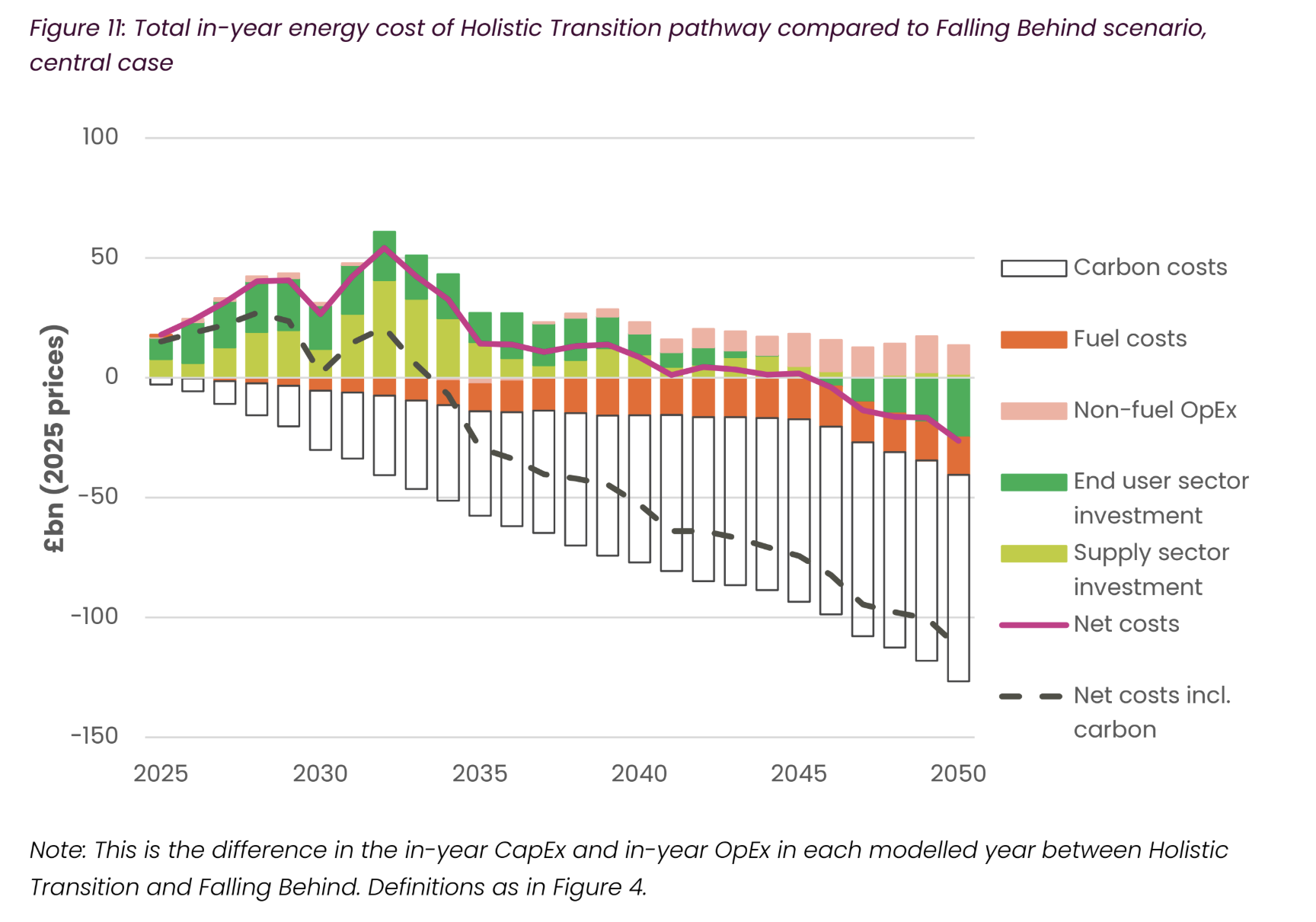
Some politicians are indeed now willing to ignore the problem of climate change and the damages caused by ongoing greenhouse gas emissions. These politicians may therefore be tempted to argue that the UK could “save” £14bn a year by scrapping net-zero.
However, NESO’s report cautions against this, stating explicitly that the “costs discussed here do not represent the cost of achieving net-zero emissions”. It says:
“Our pathways cannot provide firm conclusions over the relative costs attached to the choices between pathways…We reiterate that the costs discussed here do not represent the cost of achieving net-zero emissions.”
It says that the scenarios have not been designed to minimise costs and that it would be possible to reach net-zero more cheaply, for example by focusing more heavily on EVs and renewables instead of hydrogen and nuclear.
Moreover, it says that some of the difference in costs between “holistic transitions” and “falling behind” is unrelated to climate action. Specifically, it says that electricity demand from data centres is around twice as high in “holistic transitions”, adding some £5bn a year in costs in 2050.
In addition, NESO says that most of the “saving” in “falling behind” would be wiped out if fossil fuel prices are higher than expected – falling from £14bn per year to just £5bn a year – even before considering climate damages and wider benefits, such as for health.
Finally, NESO says that failing to make the transition to net-zero would leave the UK more exposed to fossil-fuel price shocks, such as the global energy crisis that added 1.8% to the nation’s energy costs in 2022. It says a similar shock would only cost 0.3% of GDP in 2050 if the country has reached net-zero – as in “holistic transition” – whereas costs would remain high in “falling behind”.
Great Job Simon Evans & the Team @ Carbon Brief Source link for sharing this story.