

By Keva Hoffmann Boardman —
“There was a little custom that, I think, has completely died out. It’s called New Year’s Callers.” So began a story told by local New Braunfels resident, Kola Albrecht Zipp. She was born in 1899 and remembered her older sisters participating in New Year’s Day Calling in the early 1900s.
Like me, you may wonder just what New Year’s Day Calling is. “Calling”, an old custom, was when one paid an informal visit to family friends and acquaintances. Its purpose was to renew old friendship ties or settle family differences. It required a calling card which announced the visitor’s name. It was rather restrained and elegant. Think about the young heroines meeting men in Jane Austen’s novels.
In the mid-1800s, it seems that the “Dutch” population in New York began a new custom which combined this old one of “calling” with what can only be described as the equivalent of a 19th-century dating app. Let me explain.
It became a New Year’s Day tradition for young single men to “call” on young single women during the afternoon. Often, a group of two to four men would visit a home where two or more women had gathered in anticipation. The men were welcomed into the best room of the house and served refreshments. The visit only lasted 10 to 15 minutes because there were a lot of “calls” to make. And that meant, there were more eligible young women with whom you made acquaintances. Yes, the guys were checking out the girls and vice versa. The calling cards made perfect tour tickets into the ladies’ homes. They would be left at the home and remind the women who had made the visit.
By the late 1800s, the New York New Year’s Calling scene began to look a lot like “speed dating.” It became a competition between the men as to who could visit the most houses and between the women as to see who would collect the most calling cards.
So, back to Kola Zipp and the New Braunfels rendition of New Year’s Callers. “The young men would hire a carriage from the livery stable and they’d go out on New Year’s afternoon and they’d go calling. The girls would stay home to welcome them and they just made the rounds of their girlfriends … the girls sort of expected them, you know?”
As for refreshments, “The girls would offer the boys wine. Mother always bought a gallon of wine for Christmas and a case of ginger ale. Oh, that was a treat, you know! And the New Year’s Callers would come in, and oh, they were a happy lot. Of course, by the time they’d get all around, they had a lot to be happy about!” (Wink wink!)
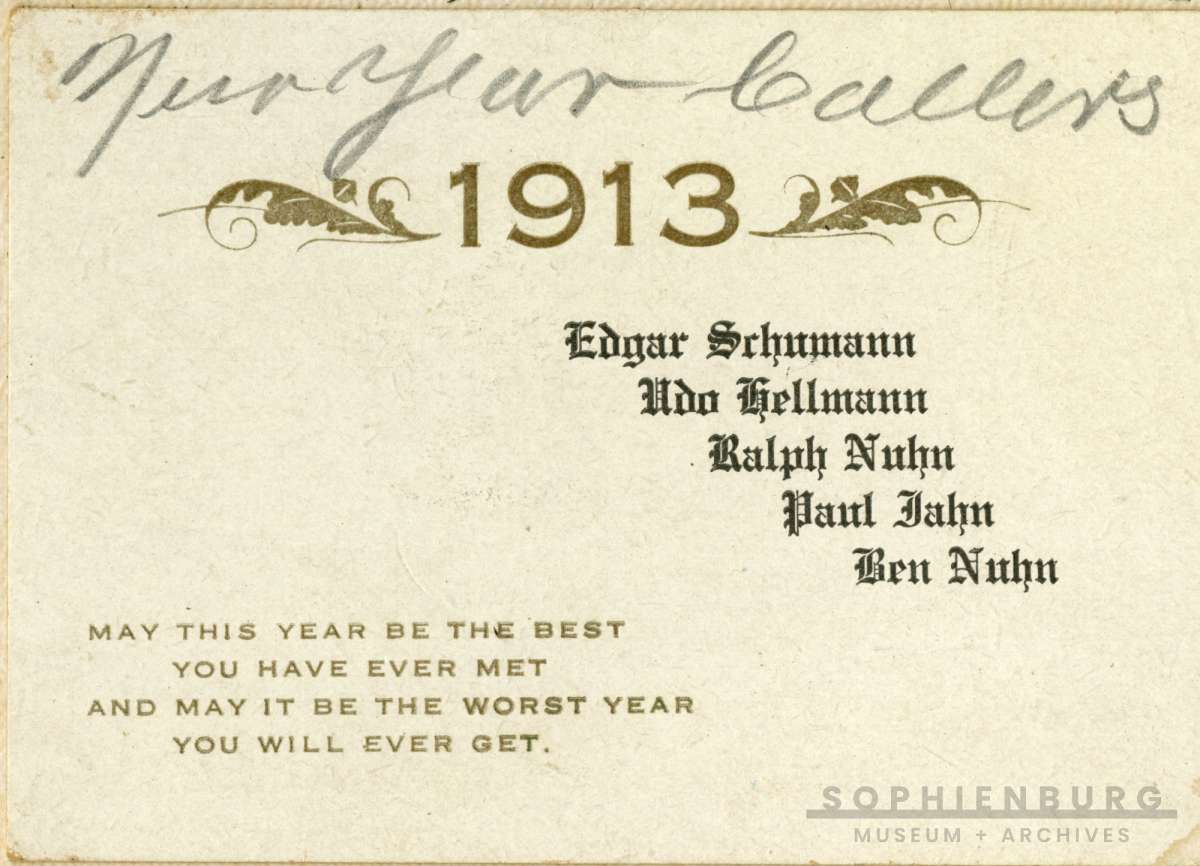
“This was from the time of my very oldest sisters … and some of their friends that came were Udo Hellmann, Herbert Voss, Ben Nuhn and Paul Jahn.” Check out the photo of the card to see their names.
Erna Heidemeyer Rhode, born in 1896, was also a local lady who remembered this interesting custom. “I was thinking back on an activity which happened on New Year’s afternoon. A boyfriend, of course — by that time we were teenagers and we each had a boyfriend — would rent a buggy or surrey from the livery stable. There were no cars at that time; maybe one or two boys had them. They would bunch up in fours or fives or whatever amount they could get into the rental buggy and they would come to the different houses and call on the girls. Usually, two or three girls would go together and be at somebody’s house. [The boys] would stay for maybe an hour or so, and if the house had a piano and one of the girls could play the piano, then we’d sing and we’d have refreshments for the boys. They’d stay for about an hour and then they’d go back … I mean, they’d leave and would go back to somebody else’s house where they got the same courtesy and entertainment.”
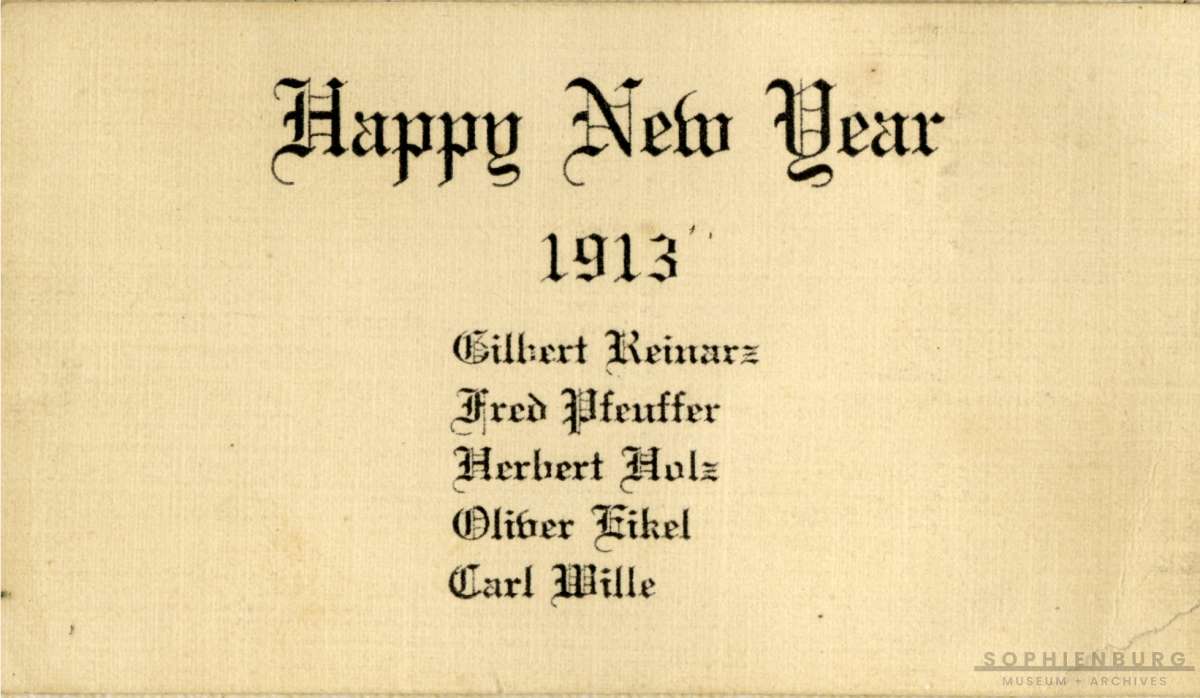
“I have pictures of two or three of these boys who used to come: Julius Voelcker, Erwin Shaw, Herbert Haus, Paul Young and Oliver Eikel. We’d dress up in long dresses, evening dresses, because it was a very special occasion. The house was decorated, flowers and everything, and it was quite an event.” If you look at the photo of the card with young men, you will find Julius Voelcker on the far right.
I wondered if these were chaperoned events for the young ones. It was a time when stricter conventions were in place for the interactions of men and women. Erna Rhode answered my question. “They might come in and shake hands and say hello … maybe bring in the refreshments, but it was all very permissible. This was the New Year’s custom.”
New Year’s customs sure have changed.
This year, while munching on snacks and watching football games, think back on those gentle times when young men and women set their sights on new relationships in the new year. Not a bad idea.
FYI: These memories and others have been collected and recorded at the Sophienburg Museum & Archives through the “Reflections” oral history program and can be accessed at the Sophienburg or the New Braunfels Public Library.
Sources: Sophienburg Museum’s “Reflections” programs #8 and #202; https://friendsppm.wordpress.com/2019/12/09/the-long-lost-custom-of-new-years-day-calling/; https://nycpast.org/2016/12/29/calling-in-new-york-a-new-years-day-tradition/.
“Around the Sophienburg” is published every other weekend in the New Braunfels Herald-Zeitung.
Great Job Alan King & the Team @ Sophienburg Museum and Archives for sharing this story.