

“The labyrinth is a metaphor for life. It takes time. You may think that you’re lost, but if you trust, you’ll get there.”
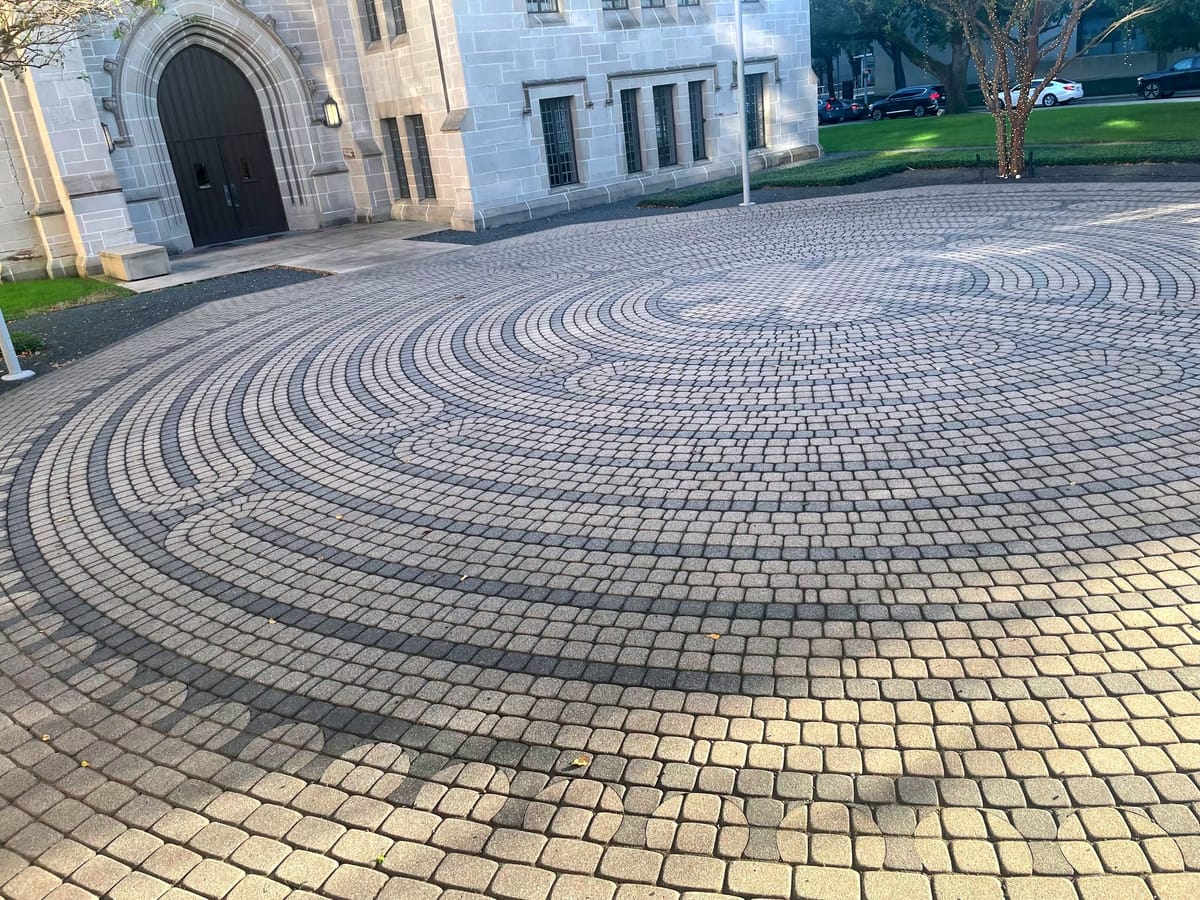
I wasn’t really in a meditative mood when I visited the labyrinth outside of St. Paul’s United Methodist Church in Houston. Located just north of the Texas Medical Center, one of the busiest places in the city, it was loud and smelled of car exhaust. Thanksgiving was days away, and I had a million things to do that seemed more important than following a stone pathway.
Still, I put on the suggested playlist of Christian hymns and started from the small statue of Jesus as instructed. It was weird how soon the sounds of the world fell away, leaving only the choir coming from my phone. The path meandered strangely, and I was constantly wondering if I was close to the center or had even gotten turned around despite the linear path. By the time I reached the middle, I felt like I had walked for miles despite maybe covering a few dozen feet. The sun was setting and evening rush hour loomed, but instead of simply stepping across the path, I chose to walk out the same way I walked in. My heart was calmer, my mind clearer, and I didn’t really understand what the hell happed.
Houston is a city of labyrinths. The one at St. Paul’s is among 20 others in the city, with more being built all the time. Sarah Gish, owner and operator of Ignite Your Life, has been walking the paths for more than a decade and even used to publish a regular guide to them and created the Labyrinth Walkers of Houston Facebook group. For her, they have become a centerpiece of her spirituality.
“I have a mantra,” she said in a phone interview. “Release as you go in. Receive when you reach the center. Rejoice as you walk out. The labyrinth is a metaphor for life. It takes time. You may think that you’re lost, but if you trust, you’ll get there.”
The labyrinth at St. Paul’s was built in 2012 by Marty Kermeen of Labyrinths of Stone. Former priest of St. Paul’s, Gail Williford, had fallen in love with similar labyrinths in Europe and San Francisco. She quickly found that there was a hunger for labyrinths in Houston and commissioned one.
Kermeen is a venerable old man now who has had a lot of time to think about what the labyrinth means to humanity. It’s one of our oldest symbols. The one at St. Paul’s is practically a teenager in terms of history, but is based on a 13th-century design at Chartres Cathedral. However, the labyrinth as a concept is ancient when the New Testament was written, and predates many books of the Old.
“There is a historic pattern we can prove is 3,200 years old, but there’s some that are probably 4,000 or more, but we can’t prove it,” said Kermeen in a phone interview. “There’s been a rise and fall of labyrinth enthusiasm many times throughout history. And they last about 100 years, 150 years, and they send a fall off and then come back again a few hundred years later.”
Kermeen says that new, defining labyrinth designs generally happen in times of great uncertainty, which seemingly describes the way of the world today. It’s a spiritual or magical practice that transcends religious divisions. Churches and mosques often have labyrinths, and similar walking paths have been used by Buddhist monks for hundreds of years. There is something inherently mystical about walking a winding path with intent.
One person I reached out to was Houston’s chief witch, Jessican Anderson of Thorn and Moon. She’s walked the labyrinth at St. Paul’s as well as others in the city. Her fascination with labyrinths began with the Jim Henson film of the same name, but has stayed strong thanks to the power she feels flowing as she follows the twists and turns.
“Labyrinth walking, to me, is a practice for spiritual meditation or contemplation, as you walk along the winding path,” she said in a phone interview. “I like to take full moon Labyrinth walks, alone or with others, and use the quiet time to focus my intentions, to let go of ill-serving energies, and to release what no longer serves my highest good. For me it represents a liminal space for transformation.”
It’s remarkably similar to the mantra used by Gish. In fact, much of Gish’s labyrinth walking also sounds like spell work. When an anti-LGBT shooter attacked the Pulse nightclub in Orlando in 2016, she organized a group walk that directed healing and comfort to the survivors. She’s organized similar ones after the shooting in Uvalde and anybody else affected by the policies of this current time. Though she does walk alone, sometimes with her own hand-crafted cloth labyrinths, she prefers the energy of a group.
“People are looking for a way to center,” she said. “Technology has cost us a lot of ways to be centered. When they were burying Heather Heyer, I was walking a labyrinth in Charlottesville. I love to activate labyrinths with prompts. Think of who you want to receive compassion, then start walking.”
When I left the labyrinth at St. Paul’s, I felt lighter. The grim grit of the bustling Houston streets seemed more ethereal under the memorial oaks decked out in Christmas lights. Maybe Gish’s mantra is right. Something negative followed me but didn’t follow me out. Strange as it seems, the labyrinths of Houston have a power in them.
Great Job Jef Rouner & the Team @ The Texas Signal for sharing this story.