

After Zohran Mamdani cruised to victory in New York City’s mayoral election last November, Republican politicians and right-wing pundits rapidly coalesced around a shared narrative to make sense of the candidate’s historic ascent. Unwilling to concede that Mamdani’s left-wing politics might command genuine populist appeal among American voters, right-wing critics instead reached for their favorite scapegoat: immigrants.
Across the MAGAsphere politicians and pundits sought to delegitimize Mamdani’s victory as the result of a foreign “invasion.” “Legal immigrants who hate America elected a Communist Muslim Jihadist,” proclaimed the ultrazionist congressman Randy Fine, who warned that America was next “if we don’t stop it” (by it, of course, he meant non-white immigration). Others insisted that this was simply all part of the plan to destroy America. As the podcaster and self-proclaimed “theocratic fascist” Matt Walsh explained to his four million followers on X: a “third-world communist won in New York because New York is a third-world city now,” which was “mass migration working exactly as intended.”
The country’s most inveterate xenophobe, Stephen Miller, affirmed this script by simply posting a screenshot from a 2023 report showing that half of New York households contain at least one immigrant. After Mamdani won the Democratic primary in June, the White House official blamed “unchecked migration” for “fundamentally [remaking] the NYC electorate,” hence enabling the rise of a democratic socialist in the city. “Import communists, become communists,” declared Miller.
This nativist reading of Mamdani’s election has several advantages for Republicans. First, it downplays the national relevance of his victory and the broader appeal of left-wing populism outside of New York and other deep blue enclaves. More importantly, however, it provides additional ideological justification for the Trump administration’s racist immigration crackdown, which has not only targeted the undocumented population but all fifty-two million immigrants in America, including naturalized citizens like Mamdani.
By pinning the election of an alleged “communist” on a scary horde of anti-American foreigners, reactionaries like Miller and Walsh linked the two things they hate most — immigrants and the Left — while encouraging the further crackdown on both.
In policy terms, the right-wing response to Mamdani’s electoral triumph has been to call for the deportation of legal immigrants as well as undocumented ones, starting with the mayor-elect himself, who has been a US citizen since 2018. These pleas have not only come from far-right pundits but from House Republicans like Andy Ogles, who implored the Department of Justice (DOJ) to strip Mamdani of his citizenship and deport him to his birth country of Uganda. Ogle’s colleague Representative Fine went even further in calling for the federal government to “review every naturalization of the past thirty years,” citing the danger of “people who have come to this country to become citizens, to destroy it.” While Republicans have long called for the mass deportation of “illegal” immigrants, Fine and other prominent GOP figures have pushed this nativist project to its logical end point, broadening it to encompass legal immigrants and naturalized citizens as well (or roughly 15 percent of the US population).
Last June the Trump administration already indicated its plans to pursue aggressive denaturalization efforts when the DOJ issued a memo urging its attorneys to “prioritize and maximally pursue denaturalization proceedings.” More recently, a leaked guidance document for the U.S. Citizenship and Immigration Services field offices showed administration officials asking for 100–200 new denaturalization cases per month, which would represent a huge spike from the grand total of 120 cases filed since 2017.
In the months ahead, top officials will likely grow even more brazen in pursuing their nativist project. After an Afghani national shot two National Guard members in Washington, DC, the day before Thanksgiving, White House officials quickly jumped on the tragedy as a pretext to sidestep legal limitations and trample on the constitutional rights of immigrants and naturalized citizens.
“Democrats have spent the last year demanding that every invader have a multi-year trial prior to removal, unlimited access to appeals, endless defenses against removal, and automatic habeas release from ICE detention,” Miller posted on X. “The only process invaders are due is deportation.”
In his own Thanksgiving day screed, the president promised to “remove anyone” who is “incapable of loving our Country” and to denaturalize those who “undermine domestic tranquility,” signaling that the administration is entering a new phase in its crusade against immigrants and political opponents.
The Right’s newfound obsession with using deportation as a political weapon reflects a broader embrace of the kind of repressive tactics that were periodically employed throughout the twentieth century to silence dissent and crush political opposition. Yet to find a comparable moment when nativism and political persecution were so openly fused into a single project, one must look more than a century back to the First Red Scare.
Emerging at the close of the Progressive Era and near the end of the nation’s second great wave of mass immigration, the First Red Scare was part of a larger reaction to sweeping social and political change and those believed to be driving it. As one historian later remarked, it was a “massive act of political surgery which tried to cut out the disruptive elements” in American society, with the implicit aim of restoring an imagined “golden age.” For the leading nativists and white supremacists of the time, this meant immediately shutting off the flow of immigrants who had been coming into the country since the late nineteenth century, mostly from Eastern and Southern Europe. It also meant arresting and deporting every “enemy alien” that espoused “subversive” and “seditious” ideas.
Deportation first came to be seen by nationalists as a political tool to be wielded against disloyal foreigners and troublemakers on the left during World War I. “In deportation the nation grasped its absolute weapon against the foreign-born radical,” observes historian John Higham in his seminal book on nativism, Strangers in the Land. This was a novel development in the country’s history.
According to Higham, deportation had been a strictly “instrumental function” used to enforce immigration laws for most of the country’s history, yet it assumed a “wholly new significance” after the country entered the war. As the country prepared for deployment in 1917, a patriotic fervor swept the nation and all opposition to the war effort was denounced as seditious and anti-American. That year, Congress passed the Espionage Act, enabling the Wilson administration to aggressively crack down on critics of the war, most of them on the left.
Additionally, the nation’s lawmakers passed the Immigration Act of 1917 over Woodrow Wilson’s veto, enacting an immigrant literacy test, barring almost all immigration from Asia, and expanding a 1903 provision that excluded “anarchists” and other political undesirables from entering the country. Both of these laws would be expanded and strengthened the following year to empower federal officials in their crackdown on dissent. The 1918 immigration act not only blocked entry to anyone discovered to have affiliations with subversive organizations but authorized the government to deport any noncitizen for “radicalism” at any point after they entered the country.
This crusade against radicals intensified after the war ended in late 1918. As the national mood shifted from fears of German militarism to the specter of Russian Bolshevism, the country plunged into one of its most tumultuous years on record.
In 1919, ruling-class hysteria was set off by a series of political bombings carried out by lone anarchists. It was further inflamed by widespread labor unrest, with some four million workers or roughly 20 percent of the US workforce participating in strikes that year. Native and foreign-born workers alike participated in labor actions across the country, which were driven largely by the soaring costs of living over the previous five years. Worker demands were often modest, such as wage increases, shorter hours, and the protection of gains that had been made during the war like the basic right to organize.
In response to these labor actions, capital hit back with brute force, employing strikebreakers and recruiting state militias and federal troops to help crush worker revolts. In Gary, Indiana, where thirty-five thousand steel workers had joined the picket line, four thousand troops led by Major General (and aspiring Republican presidential candidate) Leonard Wood arrived to restore order after violence erupted between workers and the state militia. In a speech made a few days after taking over the city, Wood blamed the disorder wholly on the “alien, unassimilated group among the strikers” and took the opportunity to make a push for mass deportation and immigration restriction. “The great need is keeping this kind of cattle out of the country and getting those who are here out of it . . . Every man of this type ought to be summarily deported.”
Calls for mass deportation reached a fever pitch that year as nativists and red-hunters looked to the policy as a “means of purifying American society,” both ideologically and ethnically. “Deportation is the answer,” said the mayor of Gary, Indiana, when asked about a remedy for the recent unrest. “Deportation of these leaders who talk treason in America and deportation of those who agree with them and work with them.”
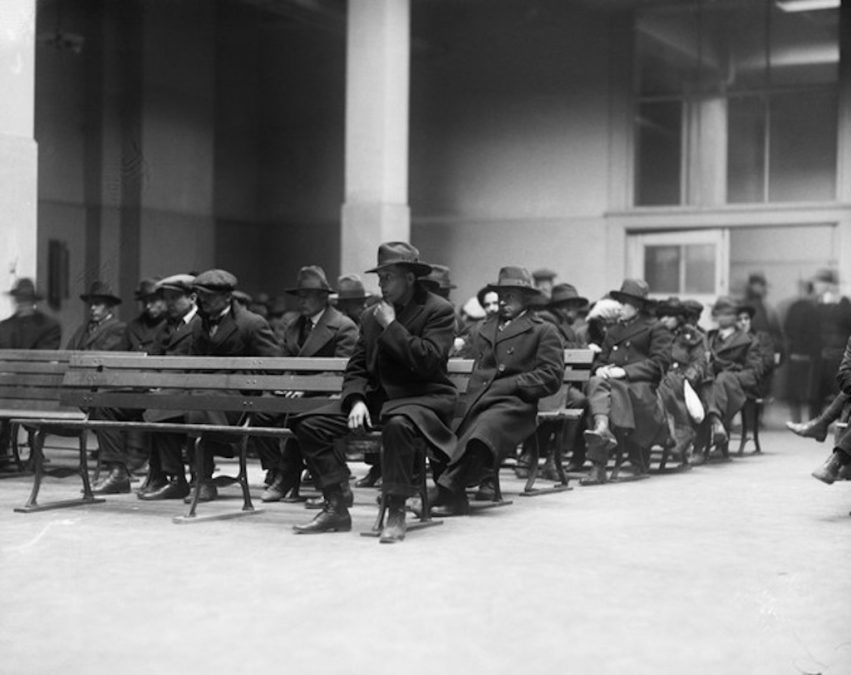
Federal officials like Attorney General Mitchell Palmer and the young head of the DOJ’s General Intelligence Division, J. Edgar Hoover, were eager to oblige. The notorious Palmer Raids that Hoover spearheaded in the winter of 1919–20 — intentionally launched on the second anniversary of the Bolshevik Revolution — rounded up ten thousand alleged alien radicals for deportation, though most of the dangerous “radicals” were no such thing and had simply been in the wrong place at the wrong time.
In New York City, where so many of the “enemy aliens” allegedly roamed, seven hundred city police officers and private vigilantes joined federal agents in raiding over seventy branches of the newly formed Communist Party along with the offices of other radical groups and publications. Hundreds of accused radicals were interned at Ellis Island to await deportation. Less than two months later 249 noncitizen detainees were boarded on an old army vessel — later dubbed the “Soviet Ark” in the press — and shipped away in the dead of night.
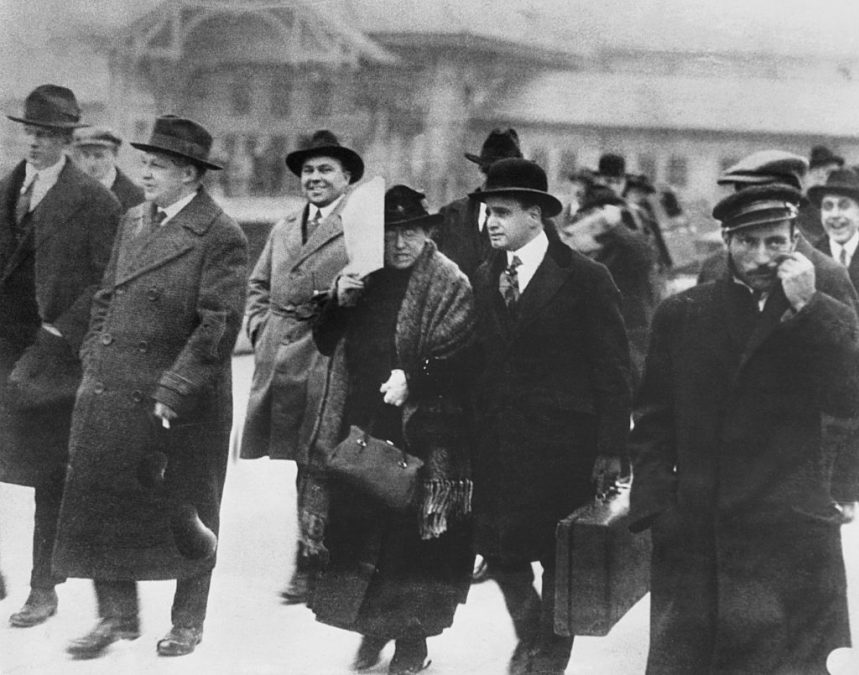
In a pamphlet published shortly afterward, the ship’s most notable passenger, anarchist writer Emma Goldman, condemned the “Czarification of America” and warned that the “naturalized American” would soon become the next target of political repression. “Henceforth the naturalized citizen may be disfranchized [sic], on one pretext or another, and deported because of his or her social views and opinions.” Goldman would have known — she herself had had her citizenship revoked after living in the country for three decades.
The First Red Scare disproportionately targeted immigrants because they were easy targets who lacked the same legal protections and rights afforded to citizens. They were also convenient scapegoats for business elites who sought to divide workers and undermine the growing labor and socialist movements. By linking all challenges to the economic status quo with “radical aliens” and foreign plots, business leaders could denounce even modest efforts at reform as “un-American” or worse. For economic conservatives, then, nativism offered a ready-made way to discredit radicals and progressive reformers trying to rein in corporate capitalism.
Yet for the truly committed nativists, radicalism was only the most immediate threat posed by foreigners — and the deportation of “subversives” only a temporary fix. “Racial nativism” was the corollary of the antiradical variant, and long after the worst fears of a red invasion had subsided by the early 1920s the more committed xenophobes would successfully push for a more comprehensive fix in the immigration restriction laws of that decade.
Like today, the most fervent nativists of the early twentieth century were consumed by visions of civilizational decline and “race suicide.” For these racial nativists, the true danger of unchecked immigration was not socialism or anarchism but the “mongrelization” of America and the erasure of its dominant Anglo-Protestant culture (and, of course, the displacement of its blue-blooded elites). For the patrician leaders of the immigration restriction movement, left-wing radicalism was simply a front for the real goal of destroying Western civilization and supplanting the “Nordic” race. As Madison Grant, the New York lawyer and racist pseudoscholar, explained in 1920, Bolshevism in Russia represented the “elimination of the Nordic aristocracy and the dominance of the half-Asiatic Slavic peasantry” — a fate that awaited America if the hordes of Slavs, Jews, and Italian peasants were allowed to keep flooding in. The “inrush of lower races is threatening the very blood of our country,” read the text of a promotional piece for Grant’s influential book on scientific racism, The Passing of the Great Race, which Adolf Hitler would later claim as his “bible.”
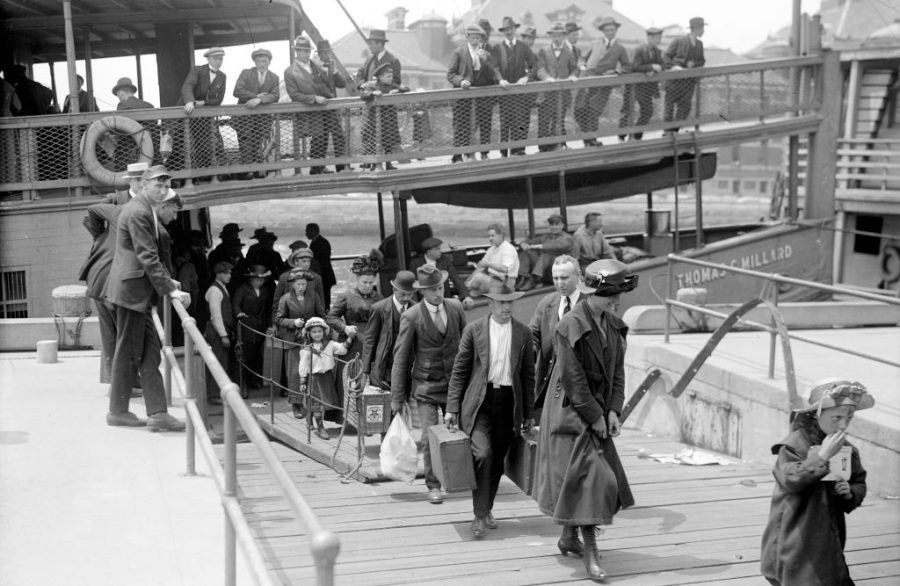
The efforts of restrictionists like Grant ultimately produced the national origins law of 1924, which dramatically curtailed arrivals from Southern and Eastern Europe by linking immigration quotas to the ethnic makeup of America in 1890. As Daniel Okrent documents in his excellent book on the subject, some 189,198 immigrants arrived to the United States from the countries that formerly made up the Russian Empire in 1921, yet four years later — one year after the National Origins Act was signed by Calvin Coolidge — that number had fallen to just 7,346. The drop-off was even steeper for Italian immigrants — plummeting from 222,260 arrivals in 1921 to a mere 2,662 in 1925.
Few figures embodied the reactionary nativism of the era more fully than the national origin law’s chief architect, John B. Trevor, who Slovene-American journalist Louis Adamic would later describe as “America’s alien-baiter No. 1.” A blue-blooded Wall Street attorney who traced his lineage back to the city’s first mayor, Trevor was an avid red-hunter who called New York a “foreign city” about a century before today’s Republicans made the same allegation.
Before coming up with the national origins concept for immigration restriction, Trevor’s main contribution to the cause of purifying America was the creation of a color-coded “ethnic map” of New York City during his brief tenure as head of the New York intelligence division for the US military. In addition to mapping out the ethnic makeup of New York, Trevor’s map identified over one hundred locations where radicals congregated, from meeting sites to the offices of leftist and liberal publications. In his later years, Trevor would use his remaining influence in Washington to help kill a proposed 1939 law that would have relaxed the national origins quota to allow twenty thousand German Jewish children into the country as refugees, citing the danger of a “foreign invasion.”
“If a man’s love for his country is measurable by his detestation of all who had the bad taste to be born elsewhere,” Adamic observed caustically of Trevor, “there probably is no greater patriot in America to-day.”
After the calamitous rise of the Nazis, the red-baiting nativists and race scientists who dominated America’s political scene in the 1920s were largely condemned by posterity. Upon signing the Immigration and Nationality Act of 1965, which abolished the national quota system, President Lyndon Johnson denounced the “harsh injustice” of the system that had been in place for over four decades. Johnson spoke for the overwhelming majority of lawmakers who backed the repeal when he said that it corrected a “cruel and enduring wrong in the conduct of the American nation.” As with racialized immigration restriction, the Red Scare and its Cold War sequel would come to be viewed by future generations as shameful periods of mass hysteria and political repression that most would rather forget.
Yet this historical consensus was never fully accepted on the right. Just as many conservatives continued to privately praise Joseph McCarthy long after his name had become a pejorative in mainstream culture, the Right’s historical assessment of the nativism and red-baiting of the early twentieth century was at best ambivalent. In more recent years that ambivalence has turned into unqualified approval. Indeed, the Right’s open embrace of nativism and red-baiting is a chilling reminder of the illiberal and authoritarian impulses that have always lurked just beneath the surface of American politics.
For all their public chest-thumping, however, today’s nativists are coming from a position of profound insecurity rather than strength. Just as their predecessors could never reverse the decline of the country’s Anglo-Protestant majority, today’s nativists will fail to reverse the country’s shifting demographics. Indeed, even if the current administration were to miraculously deport every undocumented immigrant in the country — driving the economy into a tailspin in the process — the “browning of America” would continue. This explains why Republicans have increasingly turned against all immigrants regardless of their legal status.
The weakness of the nativist right was laid bare by the rise of Zohran Mamdani, who not only withstood vicious xenophobic and Islamophobic attacks as a foreign-born Muslim man but the red-baiting smears painting him as a seditious “alien” who secretly hates America. Despite this torrent of bile, the democratic socialist was elected with the greatest number of votes in half a century, signaling the broad appeal of his populist message and the overall ineffectiveness of red-baiting in the twenty-first century. Since his victory, Mamdani’s approval with New Yorkers statewide has improved markedly, with strong majorities supporting key pieces of his agenda.
In an account of John Trevor and his nativist allies in the 1930s, Louis Adamic memorably described them as a coalition of “nervous patriots who are determined to save the country from Communism and protect its liberties if they have to register, index and cross-index, fingerprint, gag, blindfold, and handcuff every man, woman, and child in the United States, to do it.” Today a similar mentality has manifested itself once again as “nervous patriots” in the White House trample on constitutional liberties in the name of defending America from the “enemies within.” It’s vital today to recall both the long history and racist roots of nativist red-baiting — and the enduring radical democratic and socialist traditions that have consistently stood against it.
Great Job Conor Lynch & the Team @ Jacobin Source link for sharing this story.