The White House’s refusal to acknowledge World AIDS Day taps into an older pattern of stigma and state-sanctioned neglect that devastated a generation.
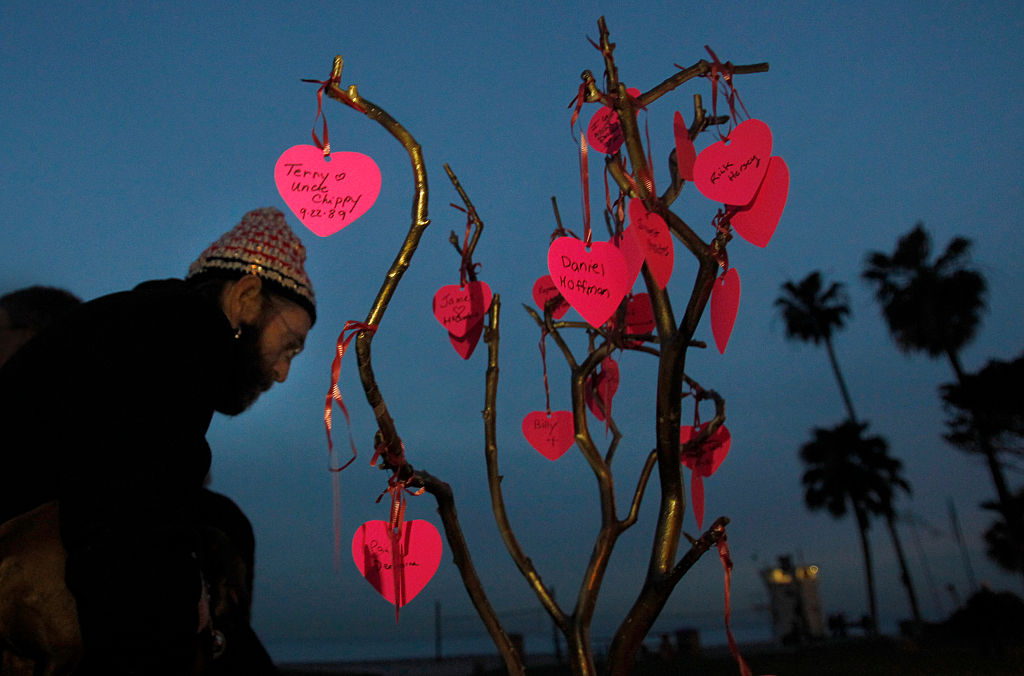
Last month, the State Department warned employees not to commemorate World AIDS Day through official work accounts, including social media, nor should they use government funds to mark Tuesday, Dec. 2, as World AIDS Day. The day came and went in a quiet, cold Washington, D.C., without the president marking what it represented—the more than 700,000 Americans who died from HIV/AIDS-related causes in the United States since 1981.
Trump’s silence was compounded by that of Secretary of Health and Human Services Robert F. Kennedy Jr. who has cast skepticism surrounding vaccines as effective and safe methods of preventing the spread and deadliness of infectious diseases.
If his intentions were unclear, Trump’s budget proposed ending all CDC HIV prevention programs this past June, and Congress continues to negotiate next year’s budget, proposing massive cuts to HIV programs.
While Republicans’ decision to discontinue vital HIV prevention programs is not unexpected, Trump’s choice not to mark World AIDS Day was a slap in the face to Americans who have lost loved ones, and reflects a growing government campaign against queer and trans federal workers.
For many young people who never lost friends or family, there may be the misconception that the HIV/AIDS crisis of the 1980s was localized and small, but nearly 300,000 men who have sex with men have died from AIDS-related complications, with over 6,000 deaths in 2019 alone. To put this in perspective, this would be as if over half of Wyoming’s population disappeared, or if everyone in Pittsburgh, Penn., vanished overnight.
Even Madonna criticized Trump’s move, posting on Instagram, “It’s one thing to order federal agents to refrain from commemorating this day, but to ask the general public to pretend it never happened is ridiculous, it’s absurd, it’s unthinkable. I bet he’s never watched his best friend die of AIDS, held their hand, and watched the blood drain from their face as they took their last breath at the age of 23.”
A Crisis the U.S. Government Chose to Ignore
From the publication of the first report on a rare lung infection in five gay men in Los Angeles on June 5, 1981, fear surrounded the virus … to the point where people with HIV/AIDS were denied housing, refused healthcare, segregated and stigmatized. Hospitals isolated the sick and some medical institutions treated the dead with little to no dignity, placing the bodies of AIDS victims in black trash bags. Funeral homes refused to prepare the bodies of AIDS victims for burial or to even hold memorial services.
As thousands of people died from AIDS-related complications, the government refused to publicly acknowledge the virus until 1985—four years after President Ronald Reagan cut budgets for the Centers for Disease Control and the National Institutes of Health, denying the funding necessary to develop treatments and spread awareness of the disease. By 1987, the Senate restricted the CDC from educating the public about AIDS prevention, arguing that it would encourage risky behaviors. In 1983, after more than 1,000 cases of the virus were diagnosed, an epidemiologist at the CDC wrote in a contemporaneous memo that the government’s response was inadequate.
“I went to 43 funerals that year [1994]—that was what our life was like back then,” actor Tilda Swinton said in a recent BBC radio program raising awareness about the virus. “It bears repeating because I know there’s a younger generation that has somehow missed out on somehow knowing enough about it.”

As many people now acknowledge, the government had the capacity and responsibility to prevent a number of these deaths through immediate awareness and education campaigns and by allocating adequate funding for medical research and community-based care programs.
World AIDS Day was first developed by James W. Bunn and Thomas Netter, employees at the World Health Organization, in 1987. A decade later, the Joint United Nations Programme on HIV/AIDS took over World AIDS Day, creating the World AIDS Campaign to focus on a long-term collective commitment to educating people about and preventing the spread of AIDS. By 2004, the World AIDS Campaign was its own organization.
By 2007, the White House marked the holiday by displaying a 28-foot AIDS ribbon on the north portico. The move was monumental: the first banner or symbol hung from the White House since the 19th century. Ever since 1993, the president has issued a proclamation on World AIDS Day, including President Trump on Nov. 30, 2017.
Silence Is Compliance
Trump’s refusal to recognize World AIDS Day during his second term sent shockwaves through affected communities, compounding on escalating homophobic and transphobic violence against federal workers—just like Reagan, whose legacy is forever tainted by his inaction that contributed to the deaths of thousands of people from HIV/AIDS.
Trump’s silence also has real-world consequences. Stigma and discrimination still exist, including in healthcare settings, despite solid medical understanding of how the disease is transmitted. Refusing to publicly acknowledge not just members of the LGBTQ+ community who died from AIDS-related conditions but all people contributes to stigma and misinformation that discourages testing and treatment, harms physical and mental health, and contributes to the very social isolation that led to a public health crisis almost 50 years ago.
Trump’s budget, revealed this summer, slashed funding for HIV education and awareness programs.
Carl Schmid, executive director of the HIV+Hepatitis Policy Institute, called “the obliteration of CDC HIV prevention and surveillance programs … an absurd proposal that will just increase HIV infectious and health costs down the road. … HIV … is still a serious infectious disease and results in about 32,000 new cases each year.”
A New Lavender Scare
The Lavender Scare refers to the mass dismissal of gay men and lesbian women from government service during the 1950s and ’60s, overlapping with McCarthyism and its effort to weed out communists from federal employment.
Although Reagan did not sign Executive Order 10450 banning LGBTQ+ individuals from government employment—that was President Dwight D. Eisenhower in 1953—he continued the exclusion of gay and lesbian employees from federal service, cementing a 50-year legacy of the Lavender Scare.
Many people fired from the federal government remain alive today, and some federal institutions have yet to apologize for their dismissals.
In June, the Rainbow History Project, a local LGBTQ+ history initiative in Washington, D.C., reenacted a protest against these discriminatory practices, featuring the last surviving member of the 10 activists who once included Frank Kameny and Barbara Gittings.
By 1975, a federal bill to outlaw discrimination on the basis of sexual orientation was introduced in Congress but never brought to a vote. Discrimination and termination remained widespread through the 1980s—compounded by stigma surrounding HIV/AIDS.
It wasn’t until June 15, 2020, that the Supreme Court ruled in Bostock v. Clayton County that Title VII of the Civil Rights Act of 1964 also bars discrimination on the basis of sexual orientation and gender identity.
*
Despite this, one of Trump’s first executive orders openly declared that the U.S. government does not recognize the existence of trans, nonbinary and intersex people—including LGBTQ+ federal workers. Since then, he has fired federal employees whose responsibilities involve DEI commitments and has mandated that agencies disband their LGBTQ+ employee resource groups or any use of federal funds promoting “gender ideology.”
FBI director Kash Patel is now facing a lawsuit from a longtime bureau employee who alleges he was fired for displaying a Pride flag at his work station.
The National Park Service has erased trans histories from the Stonewall National Memorial and from DuPont Circle in Washington, D.C. And in May, the Interior Department’s Civil Rights Office revoked guidance from former Interior Secretary Deb Haaland that allowed park rangers to wear their uniforms to Pride parades and events.
It’s not difficult to see how intentionally refusing to recognize World AIDS Day—and mandating that federal workers do the same—risks the spread of a dangerous virus, while also reviving a 21st-century Lavender Scare.
Like the original Lavender Scare of the 1950s and Reagan’s policies in the ’80s, Trump’s move doesn’t just harm LGBTQ+ employees. HIV/AIDS does not impact only the queer community; the infection can and does affect anyone who contracts it, including federal workers who are not trans or queer. And homophobic violence also targets people with HIV/AIDS, even if they are straight.
World AIDS Day isn’t just about raising awareness for testing and treatment—it’s about fighting the stigma that still surrounds the infection today. Trump’s efforts targeting queer and trans federal employees ultimately harm all federal employees in the process.
Great Job Emma Cieslik & the Team @ Ms. Magazine Source link for sharing this story.