
A state-by-state look at where menopause policy stands heading into 2026—and where advocates can expect the next breakthroughs.
Originally published by Katie Couric Media.
Throughout 2025, Katie Couric Media kept a running tally of legislative and policy advances for menopause, one of the very few women’s health issues that’s managed to have teeth in the current political environment. To date, an unprecedented 19 states have introduced upward of three dozen bills to improve menopause care and treatment; eight of those bills are now law.
Among them:
- Four states now mandate insurance coverage for menopause treatments for all (Illinois, Louisiana) or some (Oregon, Washington) patients. A fifth state—New Jersey—will join their ranks this Friday.
- California enables providers to earn professional licensing credits for menopause education (more below on the latest version of related legislation); Maine requires its state Department of Health and Human Services to provide menopause informational materials.
- Rhode Island will ensure workplace protection to employees on the basis of menopause (and the city of Philadelphia passed an ordinance to do the same, which goes into effect in January 2027).
- Illinois created a permanent statewide Menopause Awareness Week.
At the federal level, the U.S. Food and Drug Administration finally removed the “black box warning” on estrogen products, ushering in a new era for menopause care whereby women and their doctors can make decisions without the unnecessary fear the prior label engendered.

And so, we kick off the new year with a mighty impressive track record. Can we expect more of the same in 2026? My prediction is a resounding yes. This is only the beginning of a long overdue and much deeper series of demands.
Here’s my forecast for what to expect in the weeks and months ahead.
1. All Eyes on California…
Menopause has been front and center on the Golden State’s agenda, including the passage of a 2025 bill that would both require health insurance policies to provide coverage for evaluation and treatment for perimenopause and menopause symptoms, as well as improve menopause education opportunities for medical professionals. Despite bipartisan support and major media attention, Gov. Gavin Newsom vetoed the bill—not once, but twice!
As of December, he indicated his intention to include all or some of its provisions into the state budget, which will be proposed this month. We should be ready to get loud if Newsom pares back the bill in response to the insurance industry, which opposed it. And remember: Whatever reforms are included will only last the life of the budget, which means more advocacy will be needed to permanently codify menopause care into law.
2. … And Everywhere Else.
In every state legislature, red and blue alike, there is no excuse but to step up. Same for city councils and community boards. There is now a trove of legislative language and fiscal analyses, which the next round of lawmakers can pick and choose and adapt—from improving patient and professional education, to ensuring treatment affordability, to countering workplace discrimination.
Which states am I betting on in 2026?
Michigan—where legislators and Gov. Gretchen Whitmer made menopause the topic of a statewide listening tour—has four live bipartisan bills that support initiatives like a statewide medical school curriculum and a public education campaign.
New Jersey also has multiple proposals on the table: Bills that would mandate insurance coverage of menopause treatments, enable menopause credits for physicians seeking license renewal, establish an inter-agency council on menopause tasked to direct research, disseminate evidence-based knowledge and develop state-supported treatment services. Gov. Phil Murphy is set to sign A5278, the Menopause Insurance Coverage Act, into law this week, ensuring insurance coverage for perimenopause and menopause care for women statewide. (Mikie Sherrill takes over for Murphy on Jan. 20.)
So does New York, and I’ve got my eye on Florida, Georgia and Virginia as well.
This is an unusually ripe moment for state and local advances, one in which all of us can make menopause reforms feel inevitable.
3. Congress Needs to Stay in the Game.
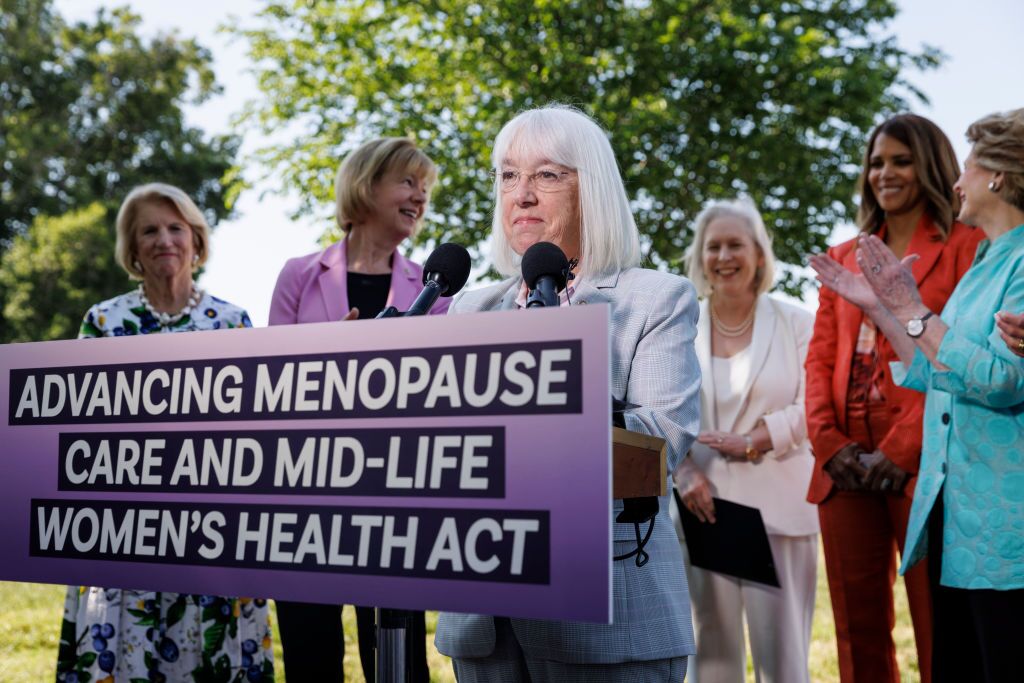
There is no substitute for federal engagement, particularly when it comes to the foundational medical research that women are owed. Several bills introduced over the past two years—most recently the Improving Menopause Care for Veterans Act, along with the Biden-era Advancing Menopause Care and Mid-Life Women’s Health Act, Menopause Research and Equity Act, and We’re Addressing the Realities of Menopause (WARM) Act—focus on investment in science and education.
No doubt, getting these passed will be an uphill climb given the state of play on Capitol Hill. But that cannot be a reason to write off the potential for even incremental progress. Quite the opposite: The FDA’s removal of the “black box warning” on estrogen necessitates exactly the kind of reinforcement that Congress can provide.
4. We Can Demand More From the FDA.
Here, the immediate next chapter entails helping the public and clinicians understand what the estrogen labeling status change does (and doesn’t) mean—and ensuring that accurate, nuanced engagement takes its place.
There are other treatments the FDA should address as well. Testosterone treatments have increasingly become part of menopause care—there have been more than a few viral articles lately about women’s commitment to their T—yet regulatory barriers limit its usage. The FDA only approves it for men.
An FDA-approved women’s formulation, backed by research, is an important next step.
5. Private Sector Leaders: It’s Your Turn.
Last year saw CEOs offering menopause-friendly workplaces; 2026 demands more. Executives must leverage their support to fund research and education.
Follow the lead of the Gates Foundation’s $2.5 billion investment in women’s health—an overt commitment to tackling the longstanding societal neglect of menstrual health and menopause—and of Melinda French Gates, whose rise as a leading advocate for girls and women includes expansive and creative funding for women’s health, equality and political representation. This includes a recent $100 million investment to accelerate research for menopause, women’s cardiovascular and brain health, and chronic illnesses.
Menopause Care Must Reach Everyone
I also predict 2026 will be a year that the burgeoning menopause movement takes stock and further prioritizes people at the margins—those suffering health inequities and societal injustice, people facing dire circumstances like domestic violence or addiction, locked in jails and prisons and otherwise likely to be left behind. If menopause care is substandard for resourced people on a good day, behind bars and inside shelters it is exponentially worse. One lawmaker in the U.K. took notice and advanced simple steps, designing a card with information about symptoms and arranging for a specialist to meet with incarcerated women and staff—gestures that made a tangible difference. We can all do better.
As for me, I am betting menopause will continue to transcend political gridlock—and I look forward to keeping track of progress together.
Great Job Jennifer Weiss-Wolf & the Team @ Ms. Magazine Source link for sharing this story.