

The United States is poised to lose its measles-free status next year. If that happens, the country will enter an era in which outbreaks are common again.
More children would be hospitalized because of this preventable disease. Some would lose their hearing. Some would die. Measles is also expensive. A new study — not yet published in a scientific journal — estimates that the public health response to outbreaks with only a couple of cases costs about $244,000. When a patient requires hospital care, costs average $58,600 per case. The study’s estimates suggest that an outbreak the size of the one in West Texas earlier this year, with 762 cases and 99 hospitalizations, costs about $12.6 million.
America’s status hinges on whether the country’s main outbreaks this year stemmed from the big one in West Texas that officially began Jan. 20. If these outbreaks are linked, and go on through Jan. 20 of next year, the U.S. will no longer be among nations that have banished the disease.
“A lot of people worked very hard for a very long time to achieve elimination — years of figuring out how to make vaccines available, get good vaccine coverage, and have a rapid response to outbreaks to limit their spread,” said Paul Rota, a microbiologist who recently retired from a nearly 40-year career at the Centers for Disease Control and Prevention.
Instead of acting fast to prevent a measles comeback, Robert F. Kennedy Jr., a lawyer who founded an anti-vaccine organization before taking the helm at the Department of Health and Human Services, has undermined the ability of public health officials to prevent and contain outbreaks by eroding trust in vaccines. The measles vaccine is safe and effective: Only 4% of nearly 1,800 confirmed U.S. cases of measles this year have been in people who had received two doses.
Kennedy has fired experts on the vaccine advisory committee to the CDC and has said, without evidence, that vaccines may cause autism, brain swelling, and death. On Nov. 19, scientific information on a CDC webpage about vaccines and autism was replaced with false claims. Kennedy told The New York Times that he ordered the change.
“Do we want to go back into a prevaccine era where 500 kids die of measles each year?” asked Demetre Daskalakis, a former director of the CDC’s national immunization center, who resigned in protest of Kennedy’s actions in August. He and other scientists said the Trump administration appears to be occupied more with downplaying the resurgence of measles than with curbing the disease.
HHS spokesperson Andrew Nixon said in a statement that vaccination remains the most effective tool for preventing measles and that the “CDC and state and local health agencies continue to work together to assess transmission patterns and ensure an effective public health response.”
Looking for Links
CDC scientists are indeed tracking measles, alongside researchers at health departments and universities. To learn whether outbreaks are linked, they’re looking at the genomes of measles viruses, which contain all their genetic information. Genomic analyses could help reveal the origin of outbreaks and their true size, and alert officials to undetected spread.
Scientists have conducted genomic analyses of HIV, the flu, and covid for years, but it’s new for measles because the virus hasn’t been much of a problem in the U.S. for decades, said Samuel Scarpino, a public health specialist at Northeastern University in Boston. “It’s important to get a surveillance network into place so that we could scale up rapidly if and when we need it,” he said.
“We are working with the CDC and other states to determine whether what we’re seeing is one large outbreak with continued spread from state to state,” said Kelly Oakeson, a genomics researcher at the Utah Department of Health and Human Services.
At first glance, the ongoing outbreak in Utah and Arizona, with 258 cases as of Dec. 1, seems linked to the one in Texas because they’re caused by the same strain of measles, D8-9171. But this strain is also spreading throughout Canada and Mexico, which means the outbreaks could have been sparked separately from people infected abroad. If that happened, this technicality could spare the U.S. from losing its status, Rota said. Being measles-free means the virus isn’t circulating in a country continuously year-round.
Canada lost its measles-elimination status in November because authorities couldn’t prove that various outbreaks from the D8-9171 strain were unrelated, said Daniel Salas, executive manager of the comprehensive immunization program at the Pan American Health Organization. The group, which works with the World Health Organization, includes health officials from countries in North, South, and Central America, and the Caribbean. It makes a call on measles elimination based on reports from scientists in the countries it represents.
Early next year, PAHO will hear from U.S. scientists. If their analyses suggest that measles has spread continuously for a year within the U.S., the organization’s director may revoke the country’s status as measles-free.
“We expect countries to be transparent about the information they have,” Salas said. “We will ask questions, like, ‘How did you determine your findings, and did you consider other angles?’”

In anticipation of PAHO’s assessment, Oakeson and other researchers are studying how closely the D8-9171 strains in Utah match others. Instead of looking at only a short snippet of genes that mark the strain, they’re analyzing the entire genome of the measles virus, about 16,000 genetic letters long. Genetic mutations occur naturally over time, and the accumulation of small changes can act like a clock, revealing how much time has ticked by between outbreaks. “This tells us the evolutionary history of samples,” Oakeson said.
For example, if one child directly infects another, the kids will have matching measles viruses. But measles viruses infecting people at the start of a large outbreak would be slightly different than those infecting people months later.
Although the Texas and Utah outbreaks are caused by the same strain, Oakeson said, “more fine-grained details are leading us to believe they aren’t super closely related.” To learn just how different they are from each other, scientists are comparing them with measles virus genomes from other states and countries.
Ideally scientists could pair genetic studies with shoe-leather investigations into how each outbreak started. However, many investigations have come up dry because the first people infected haven’t sought care or contacted health departments. As in West Texas, the outbreak in Utah and Arizona is concentrated in close-knit, undervaccinated communities that are leery of government authorities and mainstream medicine.
Researchers are also trying to learn how many measles cases have gone undetected. “Confirmed cases require testing, and in some communities, there’s a cost to going to the hospital to get tested: a tank of gas, finding a babysitter, missing work,” Andrew Pavia, an infectious disease doctor at the University of Utah, said. “If your kid has a measles rash but isn’t very sick, why would you bother?”
Subtle Surveillance
Pavia is part of a nationwide outbreak surveillance network led by the CDC. A straightforward way to figure out how large an outbreak is would be through surveys, but that’s complicated when communities don’t trust public health workers.
“In a collaborative setting, we could administer questionnaires asking if anyone in a household had a rash and other measles symptoms,” Pavia said, “but the same issues that make it difficult to get people to quarantine and vaccinate make this hard.”
Instead, Pavia and other researchers are analyzing genomes. A lot of variation suggests an outbreak spread for weeks or months before it was detected, infecting many more people than known.
A less intrusive mode of surveillance is through wastewater. This year, the CDC and state health departments have launched efforts to test sewage from households and buildings for measles viruses that infected people shed. A study in Texas found that this could function as an early warning system, alerting public health authorities to an outbreak before people show up in hospitals.
The quiet research of CDC scientists stands in stark contrast to its dearth of public-facing actions. The CDC hasn’t held a single press briefing on measles since President Donald Trump took office, and its last publication on measles in the agency’s Morbidity and Mortality Weekly Report was in April.
Rather than act fast to limit the size of the Texas outbreak, the Trump administration impeded the CDC’s ability to communicate quickly with Texas officials and slowed the release of federal emergency funds, according to investigations by KFF Health News. Meanwhile Kennedy broadcast mixed messages on vaccines and touted unproven treatments.
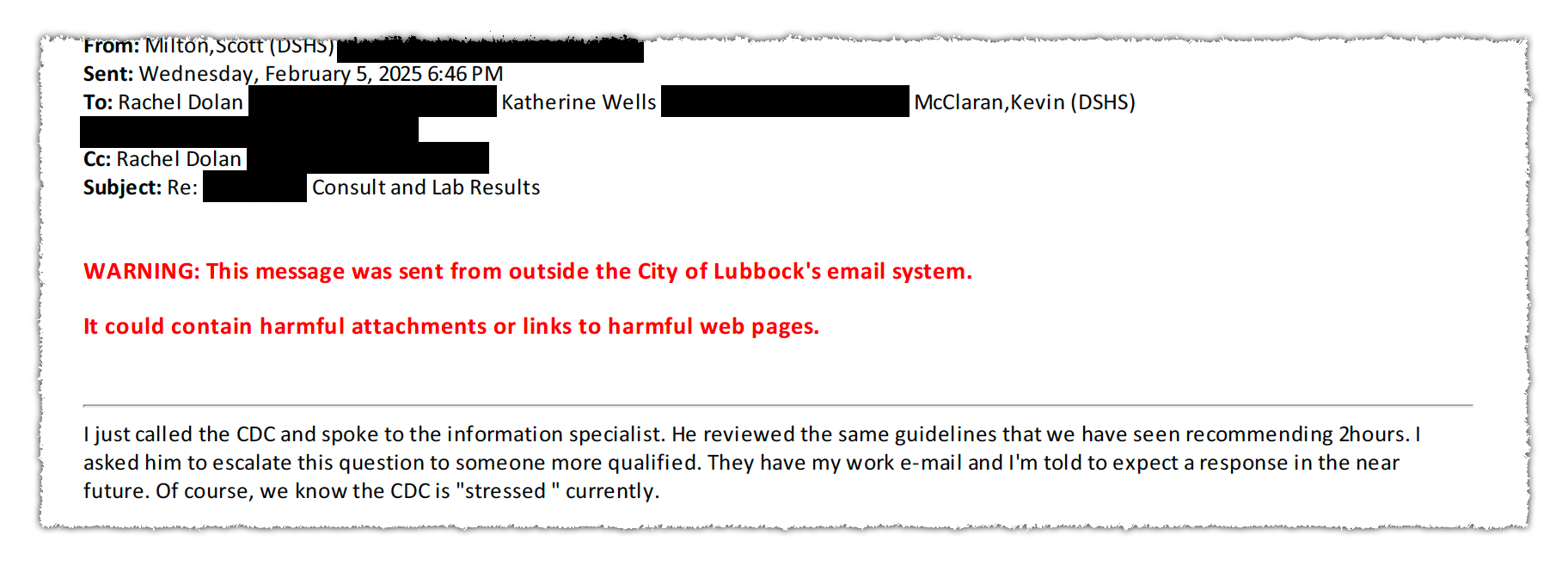
Daskalakis said that as the outbreak in Texas worsened, his CDC team was met by silence when they asked to brief Kennedy and other HHS officials.
“Objectively they weren’t helping with the Texas outbreak, so if we lose elimination, maybe they’ll say, ‘Who cares,’” Daskalakis said.
Nixon, the HHS spokesperson, said Kennedy responded strongly to the Texas outbreak by directing the CDC to help provide measles vaccines and medications to communities, expediting measles testing, and advising doctors and health officials. The U.S. retains its elimination status because there’s no evidence of continuous transmission for 12 months, he added.
“Preliminary genomic analysis suggests the Utah and Arizona cases are not directly linked to Texas,” the CDC’s acting director, Deputy HHS Secretary Jim O’Neill, wrote on the social platform X.
Given Kennedy’s distortions of data on vitamin A, Tylenol, and autism, Daskalakis said the Trump administration may insist that outbreaks aren’t linked or that PAHO is wrong.
“It will be quite a stain on the Kennedy regime if he is the health secretary in the year we lose elimination status,” he said. “I think they will do everything they can to cast doubt on the scientific findings, even if it means throwing scientists under the bus.”
Great Job Amy Maxmen & the Team @ Public Health Archives – KFF Health News Source link for sharing this story.