Home News Page 123

Texans warned not to plant unmarked seed packets from unknown senders

Texans warned not to plant unmarked seed packets from unknown senders

Commissioner Miller Warns Texas as China Mystery Seed Package Deliveries Continue (1/5/2026)

The Texas Department of Agriculture is warning residents not to plant seeds that are mysteriously appearing in the mail from unknown sources. 

In the past year, over 1,000 such packages have been collected by the department, the first originating from China. 

Mysterious Texas seed packets

The first unsolicited seed packet came to the TDA’s attention in February 2025, when a resident of Clute was mailed a package from China they didn’t ask for. Along with the unidentified seeds, the package contained an unknown liquid. 

Immediately, the TDA warned Texans to be extremely careful if they get unsolicited packages like these in the mail. They’ve since collected 1,101 packages of seeds from 109 locations.

The TDA said in their Monday release that they’ve since found that the issue isn’t limited to Texas. Reports from Ohio, New Mexico and Alabama have shown a widespread area of effect in the apparently coordinated effort to spread mysterious seeds. 

Risk to national biosecurity

Why you should care:

While small, the TDA says, these packets could pose a huge risk if not handled properly. They say the effort could be a serious and ongoing threat to the nation’s agricultural biosecurity.

What they’re saying:

“At a glance, this might seem like a small problem, but this is serious business,” said Texas Agriculture Commissioner Sid Miller. “The possible introduction of an invasive species to the state via these seeds poses real risks to Texas families and the agriculture industry. We need everyone to report these packages when they arrive so the contents may be gathered and disposed of properly.”

The TDA and federal partners are working to collect, test, and safely dispose of the foreign seeds. 

“Whether it’s part of an ongoing scam or something more sinister, we are determined to protect Texans,” said Miller. “Unsolicited seeds coming into our country are a risk to American agriculture, our environment, and public safety. Texas isn’t going to take chances when it comes to protecting our people and our food supply.”

What you can do:

If you receive an unsolicited package, do not open its contents; instead, keep them sealed in their original packaging and contact the Texas Department of Agriculture immediately at 1-(800) TELL-TDA for guidance and safe collection.

The Source: Information in this article comes from the Texas Department of Agriculture.

Texas

Great Job & the Team @ Latest & Breaking News | FOX 7 Austin for sharing this story.

How one rancher beat drought, debt, and low cotton prices » Yale Climate Connections

How one rancher beat drought, debt, and low cotton prices » Yale Climate Connections

Transcript:

In 2008, Texan Chad Raines took over his family’s cotton farm, which had been worked by his father and grandfather before him. But he struggled to stay afloat.

Raines: “It just kept getting harder and harder. The prices of everything that we bought to manage the farm kept going up.”

So he started raising sheep. That was more lucrative. But in drought years, he struggled to grow crops to feed his flock, so he had to either buy feed or lease additional land.

Raines: “Raising sheep was still more profitable than cotton, but we were just barely getting by.”

Then Raines heard that farmers could get paid to keep their sheep at solar farms.

The sheep graze around the solar panels, keeping weeds from shading them. And the farmers can still harvest meat, milk, and wool.

So now Raines raises sheep on nine solar farms. He says he’s finally making a profit and building a business he can pass on to his sons.

Raines: “We were out at one of our sites … and it just dawned on me. I stepped back and realized that I was out there along with my dad and both of my boys. Just to think that there were three generations of us all working together … you know, it’s meant a lot to our family to be able to keep it going.”

Reporting credit: Ethan Freedman / ChavoBart Digital Media

Great Job YCC Team & the Team @ Yale Climate Connections Source link for sharing this story.

What’s Next for Menopause Legislation in Your State?

What’s Next for Menopause Legislation in Your State?

A state-by-state look at where menopause policy stands heading into 2026—and where advocates can expect the next breakthroughs.

(Catherine Ivill / Getty Images)

Originally published by Katie Couric Media.

Throughout 2025, Katie Couric Media kept a running tally of legislative and policy advances for menopause, one of the very few women’s health issues that’s managed to have teeth in the current political environment. To date, an unprecedented 19 states have introduced upward of three dozen bills to improve menopause care and treatment; eight of those bills are now law.

Among them:

  • Four states now mandate insurance coverage for menopause treatments for all (IllinoisLouisiana) or some (OregonWashington) patients. A fifth state—New Jersey—will join their ranks this Friday.
  • California enables providers to earn professional licensing credits for menopause education (more below on the latest version of related legislation); Maine requires its state Department of Health and Human Services to provide menopause informational materials.
  • Rhode Island will ensure workplace protection to employees on the basis of menopause (and the city of Philadelphia passed an ordinance to do the same, which goes into effect in January 2027).
  • Illinois created a permanent statewide Menopause Awareness Week.

At the federal level, the U.S. Food and Drug Administration finally removed the “black box warning” on estrogen products, ushering in a new era for menopause care whereby women and their doctors can make decisions without the unnecessary fear the prior label engendered.

The U.S. Food and Drug Administration in Silver Spring, Md. (Ting Shen / Xinhua via Getty Images)

And so, we kick off the new year with a mighty impressive track record. Can we expect more of the same in 2026? My prediction is a resounding yes. This is only the beginning of a long overdue and much deeper series of demands.

Here’s my forecast for what to expect in the weeks and months ahead.

1. All Eyes on California…

Menopause has been front and center on the Golden State’s agenda, including the passage of a 2025 bill that would both require health insurance policies to provide coverage for evaluation and treatment for perimenopause and menopause symptoms, as well as improve menopause education opportunities for medical professionals. Despite bipartisan support and major media attention, Gov. Gavin Newsom vetoed the bill—not once, but twice!

As of December, he indicated his intention to include all or some of its provisions into the state budget, which will be proposed this month. We should be ready to get loud if Newsom pares back the bill in response to the insurance industry, which opposed it. And remember: Whatever reforms are included will only last the life of the budget, which means more advocacy will be needed to permanently codify menopause care into law.

2. … And Everywhere Else.

In every state legislature, red and blue alike, there is no excuse but to step up. Same for city councils and community boards. There is now a trove of legislative language and fiscal analyses, which the next round of lawmakers can pick and choose and adapt—from improving patient and professional education, to ensuring treatment affordability, to countering workplace discrimination.

Which states am I betting on in 2026?

Michigan—where legislators and Gov. Gretchen Whitmer made menopause the topic of a statewide listening tour—has four live bipartisan bills that support initiatives like a statewide medical school curriculum and a public education campaign.

New Jersey also has multiple proposals on the table: Bills that would mandate insurance coverage of menopause treatments, enable menopause credits for physicians seeking license renewal, establish an inter-agency council on menopause tasked to direct research, disseminate evidence-based knowledge and develop state-supported treatment services. Gov. Phil Murphy is set to sign A5278, the Menopause Insurance Coverage Act, into law this week, ensuring insurance coverage for perimenopause and menopause care for women statewide. (Mikie Sherrill takes over for Murphy on Jan. 20.)

So does New York, and I’ve got my eye on Florida, Georgia and Virginia as well.

This is an unusually ripe moment for state and local advances, one in which all of us can make menopause reforms feel inevitable.

3. Congress Needs to Stay in the Game.

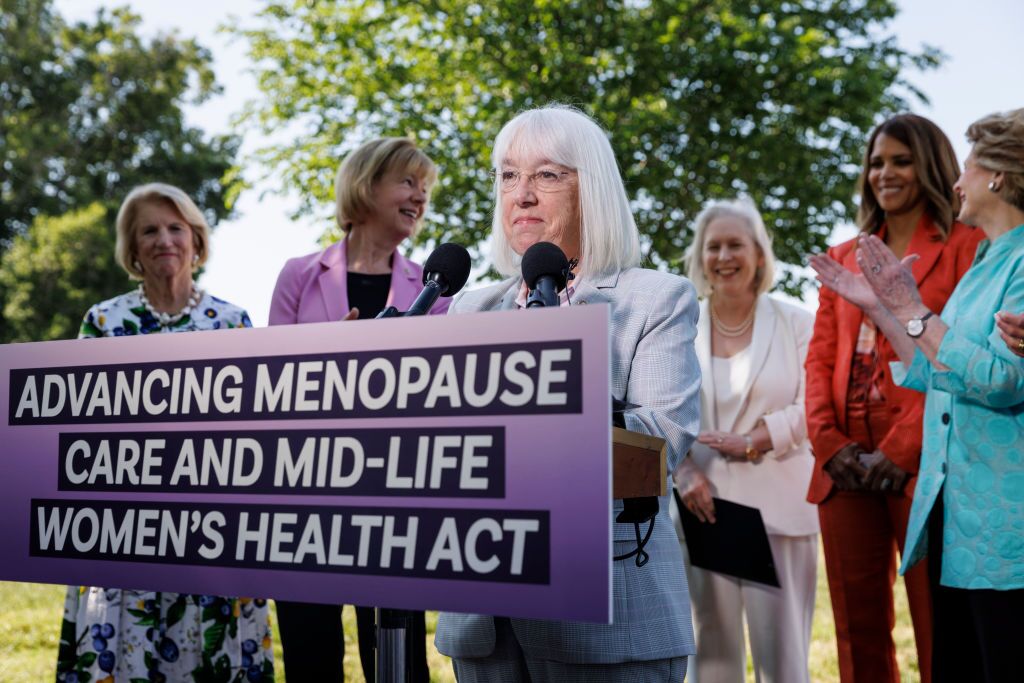
There is no substitute for federal engagement, particularly when it comes to the foundational medical research that women are owed. Several bills introduced over the past two years—most recently the Improving Menopause Care for Veterans Act, along with the Biden-era Advancing Menopause Care and Mid-Life Women’s Health ActMenopause Research and Equity Act, and We’re Addressing the Realities of Menopause (WARM) Act—focus on investment in science and education.

Sen. Patty Murray (D-Wash.) with Halle Berry (second from right) and other senators at the Capitol to introduce a new bipartisan Senate bill to boost research on menopause on May 2, 2024. (Moriah Ratner / The Washington Post via Getty Images)

No doubt, getting these passed will be an uphill climb given the state of play on Capitol Hill. But that cannot be a reason to write off the potential for even incremental progress. Quite the opposite: The FDA’s removal of the “black box warning” on estrogen necessitates exactly the kind of reinforcement that Congress can provide.

4. We Can Demand More From the FDA.

Here, the immediate next chapter entails helping the public and clinicians understand what the estrogen labeling status change does (and doesn’t) mean—and ensuring that accurate, nuanced engagement takes its place.

There are other treatments the FDA should address as well. Testosterone treatments have increasingly become part of menopause care—there have been more than a few viral articles lately about women’s commitment to their T—yet regulatory barriers limit its usage. The FDA only approves it for men.

An FDA-approved women’s formulation, backed by research, is an important next step.

5. Private Sector Leaders: It’s Your Turn.

Last year saw CEOs offering menopause-friendly workplaces; 2026 demands more. Executives must leverage their support to fund research and education.

Follow the lead of the Gates Foundation’s $2.5 billion investment in women’s health—an overt commitment to tackling the longstanding societal neglect of menstrual health and menopause—and of Melinda French Gates, whose rise as a leading advocate for girls and women includes expansive and creative funding for women’s health, equality and political representation. This includes a recent $100 million investment to accelerate research for menopause, women’s cardiovascular and brain health, and chronic illnesses.

Menopause Care Must Reach Everyone

I also predict 2026 will be a year that the burgeoning menopause movement takes stock and further prioritizes people at the margins—those suffering health inequities and societal injustice, people facing dire circumstances like domestic violence or addiction, locked in jails and prisons and otherwise likely to be left behind. If menopause care is substandard for resourced people on a good day, behind bars and inside shelters it is exponentially worse. One lawmaker in the U.K. took notice and advanced simple steps, designing a card with information about symptoms and arranging for a specialist to meet with incarcerated women and staff—gestures that made a tangible difference. We can all do better.

As for me, I am betting menopause will continue to transcend political gridlock—and I look forward to keeping track of progress together.

Great Job Jennifer Weiss-Wolf & the Team @ Ms. Magazine Source link for sharing this story.

Session 445: Eliminating Your Digital Footprint — Therapy for Black Girls

Session 445: Eliminating Your Digital Footprint — Therapy for Black Girls

Whether you’re chronically online, or only log on to post a quarterly dump, it’s important that you know where and how the data you’re sharing on the internet is being used. Oftentimes, we accept, we say yes, and we check a box on the screen just to get to what we were looking for, but exercising choice in those moments is a crucial way to protect your identity and take control of your digital footprint.

Here to talk with us today is Camille Stewart Gloster, an attorney and strategist working at the intersection of technology, cybersecurity, national security, and foreign policy. Camille has advised top leaders in both government and policy and major companies like Google in cybersecurity practices, and I’m excited to have her on today to talk about how we can begin to protect ourselves from the risks that come with existing in digital spaces.

About the Podcast

The Therapy for Black Girls Podcast is a weekly conversation with Dr. Joy Harden Bradford, a licensed Psychologist in Atlanta, Georgia, about all things mental health, personal development, and all the small decisions we can make to become the best possible versions of ourselves.

Resources & Announcements

If you’d like to take the info from this episode a step further, we invite you to join us on Patreon for the 5-Day Digital Declutter Challenge! We’re hosting the 5-Day Digital Declutter Challenge to help you clean up, reset, and redefine your digital life.

When you join, you’ll get:

  • A free Digital Identity Audit Worksheet
  • Daily declutter prompts to reduce digital overwhelm
  • Community conversation and support
  • A Live Sunday Night Check-In where we’ll work through the worksheet together and reflect in community

If you’re ready to start the year feeling lighter, clearer, and more intentional online, this is your next step. Join us on Patreon
Starts January ,7th 2026


Where to Find Our Guest

Website:  https://camillestewartgloster.com/ 

Stay Connected

Is there a topic you’d like covered on the podcast? Submit it at therapyforblackgirls.com/mailbox.

If you’re looking for a therapist in your area, check out the directory at https://www.therapyforblackgirls.com/directory.

Grab your copy of our guided affirmation and other TBG Merch at therapyforblackgirls.com/shop.

The hashtag for the podcast is #TBGinSession.


Make sure to follow us on social media:

Instagram: @therapyforblackgirls

Facebook: @therapyforblackgirls


Our Production Team

Executive Producers: Dennison Bradford & Gabrielle Collins

Director of Podcast & Digital Content: Ellice Ellis

Producers: Tyree Rush & Ndeye Thioubou 

See omnystudio.com/listener for privacy information.

Great Job Dr. Joy Harden Bradford & the Team @ Therapy for Black Girls Source link for sharing this story.

CES Live Blog, Day 3: Even More of the Coolest Tech We’ve Seen

CES Live Blog, Day 3: Even More of the Coolest Tech We’ve Seen

Clicks Power Keyboard.

Photograph: Julian Chokkattu

Accessory company Clicks makes cases with integrated physical keyboards for select phones, but they’re almost comically long and tough to fit in a pocket. The new Clicks Power Keyboard solves this problem and offers wider compatibility. It’s a magnetic physical keyboard you can snap to MagSafe iPhones or any Qi2 Android device, turning them into old-school BlackBerries of sorts. When you don’t need the keyboard, just take it off. It connects via Bluetooth, and that means you can also use it with other smart devices, like TVs, when you want to enter a password. You can pair it with up to three devices.

The keyboard can extend to various lengths to accommodate small or big phones, and you can rotate the Power Keyboard sideways and shorten the length to use the keyboard with your phone in landscape mode. Since it’s not integrated into a phone case, the Power Keyboard has bigger keys and a dedicated number row, which makes typing on it a little easier. It can also work as a power bank in a pinch, but the capacity is low, and it charges the phone very slowly at 5 watts, so it’s best to just save that juice for the keyboard itself. It costs $109 and goes on sale in the spring, but you can preorder it now.

Image may contain Electronics Mobile Phone and Phone

Clicks Power Keyboard.

Photograph: Julian Chokkattu

Image may contain Electronics Phone and Mobile Phone

Clicks Power Keyboard.

Photograph: Julian Chokkattu

That wasn’t the only exciting thing from Clicks at CES. Clicks is now a phone company, too. The Clicks Communicator is a proper Android phone, one that’s designed to be a second phone that specifically focuses on communication. (I was only able to play around with a dummy prototype model.) Load it up with your favorite messaging apps and type away—you can even use the selfie or rear cameras for video calls. The company partnered with Niagara Launcher to make the home screen look more unique than the typical spread of app icons.

Image may contain Electronics Phone and Mobile Phone

The Clicks Communicator.

Photograph: Julian Chokkattu

The Communicator supports a physical SIM or eSIM, has a headphone jack, 256 GB of storage plus a microSD card slot, Qi2 wireless charging, and NFC for contactless payments. It even uses silicon-carbon battery tech for the 4,000-mAh cell inside. Since it does have the Google Play Store, you can install anything you want on it—even TikTok, assuming it doesn’t look strange on the square-ish OLED screen. There’s a customizable killswitch on one side that turns on airplane mode by default, and the “Prompt Key” on the other side for voice dictation—a press and hold will enable voice memos.

Image may contain Electronics Phone and Mobile Phone

The Clicks Communicator.

Photograph: Julian Chokkattu

Clicks doesn’t want to force you to limit your screen time with this secondary device, unlike similarly sized pocket devices like the Light Phone III or Minimal Phone. Instead, you’re in control and can customize what you want to use it for; nothing is stopping you from making it your primary phone. It’ll get two Android OS upgrades and 5 years of security updates, though the company is exploring other chip options to widen the OS update window. It costs $499, and you can reserve it now, with an expected launch date later this year.

Great Job & the Team @ WIRED Source link for sharing this story.

Glowin’! Taraji P. Henson Turns Heads With Makeup-Free Photos

Glowin’! Taraji P. Henson Turns Heads With Makeup-Free Photos

Taraji P. Henson is turnin’ heads with her makeup-free photos.

RELATED: They’re Back! Tyler Perry Reunites Cast For ‘Why Did I Get Married Again’ With Surprise Addition! (EXCLUSIVE PHOTOS)

Taraji P. Henson Shares Makeup-Free Photos

Earlier this week, Taraji P. Henson took to Instagram to share a carousel of photos and videos with her more than 22.1 million followers. Furthermore, included in the post was footage of one of Henson’s fits, alongside photos of the ensemble. Additionally, also capped off the carousel with three photos showing her makeup-free, rocking a separate ‘fit.

In those photos, Henson donned braids, a green, bedazzled cap, a brown fur coat, a green sweatsuit, and tan boots, alongside her Louis Vuitton luggage.

Peep her carousel and her makeup-free flicks below.

Social Media Users Are Turnin’ Heads

Social media users gathered in TSR’s comment section to react to Taraji P. Henson’s makeup-free shots.

Instagram user @therealucyk wrote, She look different and pretty ”

While Instagram user @muvachinkk__ added, She look so good ! Ain’t age at all. ”

Instagram user @miyonikamaiya wrote,Literally a beauty YES!”

While Instagram user @miyonikamaiya added, always been that girl ”

Instagram user @onlyabouthers_ wrote, Her style eats ”

While Instagram user @thesuaveprince added, She’s pretty af! Its like she’s aging backwards”

Instagram user @emeraldjadeforever wrote, 55 WHERE? Jeez. Taraji is gonna be fine her whole life.”

While Instagram user @prettyopp__ added, Idk what it is but she looks different”

Instagram user @dimedivadee wrote,Why every time someone looks good yall start with the theories that they must’ve had work done? Just say she look good and move on”

While Instagram user @beautyislovelyb added, Aunt aging backwards ”

This Isn’t The First Time Taraji P. Henson’s Posts Have Turned Heads

This isn’t the first time Taraji P. Henson has turned heads with her posts. As The Shade Room previously reported, in July, Henson shared a few bikini shots, which left social media users hyping her up.

Click here to see the photos.

Then, in August, Henson sparked reactions after droppin’ footage of some of her recent ‘fit checks.

RELATED: Pop Out, Then! Taraji P. Henson Turns Heads After Droppin’ Footage Of Her Recent ‘Fit Checks Online (WATCH)

What Do You Think Roomies?

Great Job Jadriena Solomon & the Team @ The Shade Room Source link for sharing this story.

Get ahead of the hiring nightmare in 2026: These are the interview questions execs are currently asking job seekers: “Design a car for a deaf person.” | Fortune

Get ahead of the hiring nightmare in 2026: These are the interview questions execs are currently asking job seekers: “Design a car for a deaf person.” | Fortune

It’s no secret that getting a new job is hard, with candidates constantly complaining about the endless hoops that recruiters are making them jump through to prove they’re the perfect match, from endless rounds of interviews to 90-minute tests and presentations. 

But for young people in particular, the challenge is even steeper. About a fifth of Gen Zers worldwide are classified as “NEETs” and are currently locked out of the job market. Last year in the U.K. alone, more than 1.2 million applications were submitted for fewer than 17,000 graduate roles. 

Even Goldman economists have admitted Gen Z’s hiring nightmare is real—and it isn’t going away anytime soon. 

As millions of Gen Zers face unemployment and entry-level office roles becoming scarcer, hiring managers are being forced to get creative to find the very best candidates. So Fortune has rounded up the curveball make-or-break interview questions now shaping hiring decisions.

Do you think we are in an AI bubble?

Do you think we’re in an AI bubble? Even the experts who’ve predicted past crashes can’t seem to agree. But if you’re looking for a job right now, your opinion on all this could decide whether you get the job. Dave McCann, IBM’s managing partner for EMEA, says he now throws the curveball question in interviews as a make-or-break test.

There’s no right or wrong answer, but actually knowing where you stand could give you an edge and pique the exec’s interest. McCann doesn’t care which side you pick—he cares whether you’ve thought it through.

Can you design a car for a deaf person?

Lyft CEO David Risher likes to ask candidates: “Design a car for a deaf person.” The curveball question may sound unusual, but for Risher, it’s a quick way to “suss out” whether a candidate can put themselves in the shoes of a customer—and he got the idea from his time working with Jeff Bezos. 

“I want to see the candidate close their eyes and ears and imagine what that feels like, then be able to describe the experience to me in detail, including what someone in that position might need,” Risher said. “That’s how I know I’ve got someone who can build great customer-obsessed experiences.”

Do you have any questions for me?

The question that turns its head on the interviewee and enables them to put the hiring manager in the hot seat isn’t an unusual one. But for Twilio’s CEO Khozema Shipchandler, it’s what comes next that matters most. 

If your answer is a blank stare or “Nope, I’m fine,” consider yourself on thin ice. 

“The number one red flag for me is when someone doesn’t ask questions towards the end of an interview,” Shipchandler exclusively told Fortune. “That’s a pretty significant mark against them being curious about what they’re interviewing, the company, the way we might work together, chemistry, culture, all of those things.”

And Denny’s CEO Kelli Valade echoed that it doesn’t really matter what you ask employers at the end of the interview—the fact that you do ask something shows you did your homework, are seriously interested and is a big green flag.

Can you start right away?

Picture this: You’ve spent hours applying for the dream job and sitting through multiple interviews. Finally, you think you’ve won over the hiring manager when they ask, “when can you start?” 

You’d be forgiven for thinking the right answer, is “straight away.” After all, you want to seem eager. But Gary Shapiro, the chief executive of U.S. trade association Consumer Technology Association, revealed that he turns candidates down who say they’re available within two weeks. “They don’t get the job, because they’ll treat us the way they treat that former employer.”

Other things to look out for: Coffee cup tests, pricey menu items and wait staff

It’s not just what you say in the interview that could cost you the job. Hiring managers are also watching what you do—as early as when you walk through the revolving doors and great reception. They’re looking at how you treat staff before and after your interview, as well as, what you do with the coffee (or tea) cup you were drinking from. Hint: offering to clean it up will go down will.

Other hiring managers take their prospective new hires out for a lunch interview and watch for whether they season their food before taking a bite. Why? Because putting salt (or anything) on your food before tasting it is the equivalent of judging a book by its cover and apparently, highlights a lack of patience.

That’s not all. They’re also testing you for how quickly you order, whether you wait for others to sit before sitting down to eat, the price of the items you order, and how you treat wait staff.

One consultant even revealed on X that he knows a CEO who goes as far as taking candidates for breakfast and secretly asking the servers to mess up their order “to see how they’d react.”

Great Job Orianna Rosa Royle & the Team @ Fortune | FORTUNE Source link for sharing this story.

Tatiana Schlossberg’s funeral held at same church as grandmother Jackie Kennedy Onassis’ memorial

Tatiana Schlossberg’s funeral held at same church as grandmother Jackie Kennedy Onassis’ memorial

Tatiana Schlossberg was remembered at a private funeral on Jan. 5 at St. Ignatius of Loyola, the same New York City church that hosted the memorial service for her grandmother, Jacqueline Kennedy Onassis.

The funeral for Schlossberg, who died Dec. 30 after being diagnosed with a rare form of leukemia, was attended by a collection of dignitaries and celebrities, including former President Joe Biden, House Speaker Emerita Nancy Pelosi, David Letterman and several of Schlossberg’s cousins, including Maria Shriver.

A source who attended said Schlossberg’s brother, Jack Schlossberg, welcomed mourners, while her husband, George Moran, with whom she had two young kids, delivered the eulogy. Her sister, Rose Schlossberg, gave a reading.

Tatiana Schlossberg was the daughter of Caroline Kennedy and Edwin Schlossberg and one of three grandchildren of John F. Kennedy. Caroline Kennedy could be seen carrying Tatiana’s daughter, Josephine, 1, out of the church. Moran was also seen holding their son, Edwin, born in 2022.

In November — on the 62nd anniversary of the day her grandfather was assassinated — Schlossberg revealed in an essay for The New Yorker that, shortly after the 2024 birth of her daughter, she had been diagnosed with acute myeloid leukemia, which she described as “terminal.”

“My parents and my brother and sister, too, have been raising my children and sitting in my various hospital rooms almost every day for the last year and a half. They have held my hand unflinchingly while I have suffered, trying not to show their pain and sadness in order to protect me from it” she wrote.

“For my whole life, I have tried to be good, to be a good student and a good sister and a good daughter, and to protect my mother and never make her upset or angry,” she added. “Now I have added a new tragedy to her life, to our family’s life, and there’s nothing I can do to stop it.”

Jackie Kennedy Onassis was laid to rest in May 1994 after her death at 64 from non-Hodgkin’s lymphoma, a type of cancer that affects the lymphatic system, per Mayo Clinic. After the funeral at the Church of St. Ignatius Loyola, she was buried at Arlington National Cemetery beside her first husband.

Schlossberg was a Yale and Oxford graduate who worked as a science reporter for The New York Times. She also wrote the 2019 book “Inconspicuous Consumption: The Environmental Impact You Don’t Know You Have.”

Throughout the service, Schlossberg was remembered for her passion for reporting on climate change.

In 2019, she spoke with TODAY about her work.

“I think climate change is the biggest story in the world,” she said at the time. “It’s a story about everything. It’s about science and nature, but it’s also about politics and health and business. To me, looking at this as a journalist, it felt like a really important story to tell, and if I could help communicate about it that might inspire other people to get involved and work on the issue.”

On the day of her funeral, Schlossberg was also remembered in public tributes. The Instagram account for the JFK Library Foundation shared a photo of Schlossberg with her husband and two children taken in the months before her death.

Jack Schlossberg also posted a quote from her book that read, in part: “It’s up to us to create a country that takes seriously its obligations to the planet, to each other, and to the people who will be born into a world that looks different than ours has for the last 10,000 years or so.” 

Tatiana Schlossberg, the journalist and author who was a granddaughter of John F. Kennedy, has died after revealing she had been diagnosed with cancer, her family announced Tuesday.

This story first appeared on TODAY.com. More from TODAY:

Great Job Drew Weisholtz l TODAY & the Team @ NBC 5 Dallas-Fort Worth for sharing this story.

Ex-Longhorns star, NFL receiver Jordan Shipley hospitalized with severe burns from accident on his Central Texas ranch

Ex-Longhorns star, NFL receiver Jordan Shipley hospitalized with severe burns from accident on his Central Texas ranch

He was eventually taken to Austin via a medical transport flight

FILE -Texas wide receiver Jordan Shipley (8) during an NCAA college football Big 12 Conference championship game against Nebraska, Dec. 5, 2009, in Arlington, Texas. (AP Photo/Tony Gutierrez, File) (Tony Gutierrez, AP2009)

Former Texas star and NFL receiver Jordan Shipley was in an accident Tuesday on his ranch near his hometown of Burnet, Texas, that left him hospitalized with severe burns.

Shipley was operating a machine that caught on fire. He was driven to a local hospital and later was taken to Austin on a medical transport flight. He is in critical, but stable condition, according to a statement from his family.

The 40-year-old Shipley earned Associated Press All-America honors with the Longhorns in 2009. He had 248 career catches in college for 3,191 yards and 33 touchdowns.

Shipley was drafted in the third round in 2010 by Cincinnati and had 79 receptions for 858 yards and four touchdowns over three seasons with the Bengals, Jacksonville Jaguars and Tampa Bay Buccaneers.

___

Get poll alerts and updates on the AP Top 25 throughout the season. Sign up here and here (AP News mobile app). AP college football: https://apnews.com/hub/ap-top-25-college-football-poll and https://apnews.com/hub/college-football


Great Job Associated Press & the Team @ KSAT San Antonio Source link for sharing this story.

Trump’s EPA Could Limit Its Own Ability to Use New Science to Strengthen Air Pollution Rules

Trump’s EPA Could Limit Its Own Ability to Use New Science to Strengthen Air Pollution Rules

Ethylene oxide was once considered an unremarkable pollutant. The colorless gas seeped from relatively few industrial facilities and commanded little public attention. 

All that changed in 2016, when the Environmental Protection Agency completed a study that found the chemical is 30 times more carcinogenic than previously thought.

The agency then spent years updating regulations that protect millions of people who are most exposed to the compound. In 2024, the EPA approved stricter rules that require commercial sterilizers for medical equipment and large chemical plants to slash emissions of ethylene oxide, which causes lymphoma and breast cancer.

It was doing what the EPA has done countless times: revising rules based on new scientific knowledge.

Now, its ability to do that for many air pollutants is under threat. 

In government records that have flown under the radar, President Donald Trump’s EPA said it is reconsidering whether the agency had the legal authority to update those rules. 

Chemical companies and their trade organizations have argued that the EPA cannot reevaluate hazardous air pollution rules to account for newly discovered harms if it has revised them once already.

It doesn’t matter if decades have passed or new information has emerged. 

If the EPA agrees, environmentalists fear that the decision could have wide implications, significantly curbing the EPA’s ability to limit nearly 200 pollutants from thousands of industrial plants. The next time new science reveals that a chemical is much more toxic, or that the amount of pollution released from a factory had been underestimated and would cause legally unacceptable health risks, the agency would not be able to react.

“It’s a poor reflection on this administration’s claim that they are actually interested in clean air,” said Ana Baptista, a professor of environmental policy and sustainability management at The New School. “By saying we’re no longer going to consider science, it’s abdicating your mission.”

The EPA didn’t address ProPublica’s questions about the ethylene oxide reevaluation or its broader implications. Instead, the agency pointed to a March press release about how it was reconsidering multiple air pollution rules issued by President Joe Biden’s administration, including the ones for chemical plants and commercial sterilizers. “EPA is committed to using the gold standard of science during these reviews,” a spokesperson said in an email. “Since day one, EPA has been clear that providing clean air, water, and land for all Americans is a top priority.” 

The EPA’s reconsideration focuses on the Clean Air Act, the country’s most powerful air quality law, which regulates hazardous air pollutants for different types of industrial operations. There’s a specific rule for oil refineries, for instance, and another for steel mills. Within eight years after each rule is published, the EPA is required to conduct an assessment, called a residual risk review, to decide if an update is necessary. 

These assessments use detailed data on the quantity of emissions coming from each facility, the toxicity of each chemical and other information on how the chemicals are released and dispersed in the air. The combined data reveals how the emissions put local residents at risk of cancer, respiratory diseases, reproductive harm and other health problems. 

If the EPA determines the overall risks exceed what’s allowed under the law, the agency must tighten the rules.

The Clean Air Act doesn’t say whether the EPA is required to conduct additional residual risk reviews after the first one. Nor does it specifically prohibit the agency from doing so.

As far back as 2006, the EPA under President George W. Bush asserted that the agency had the right to revisit and revise the rules based on risk. 

The issue became newly relevant in 2021, when the EPA’s Office of Inspector General cited the new conclusions about the toxicity of ethylene oxide. The office estimated that nearly half a million Americans were exposed to unacceptable cancer risks from industrial emissions by chemical plants, commercial sterilizers and other facilities pumping out ethylene oxide.

In its report, the inspector general’s office advised the agency to “exercise its discretionary authority to conduct new residual risk reviews” as needed when “new data or information indicates an air pollutant is more toxic than previously determined.” (The inspector general was a Trump appointee.)

The EPA had already conducted the first, mandatory risk reviews for large chemical plants and commercial sterilizers in the early 2000s. In response to the inspector general report, the agency launched additional reviews using the updated science on ethylene oxide. Ultimately, the EPA determined the health risks were unacceptable and revised the rules to lower them. The agency asserted that the Clean Air Act “does not limit our discretion or authority to conduct another risk review should we consider that such review is warranted.” 

According to the EPA’s estimates, the new regulations for chemical plants under the 2024 revised rule would cut the number of nearby residents who are exposed to unacceptable cancer risks from 90,000 to 3,000. 

But the chemical industry opposed the stricter rules. Industry representatives disagreed with the EPA’s new assessment of ethylene oxide, contending that it overestimated the risk the chemical posed, and argued the agency didn’t have the authority to conduct those risk reviews. In a 2023 letter, the American Chemistry Council said “the Agency has erred in conducting a new risk review,” as “the plain text” of the Clean Air Act “indicates that EPA actually lacks this authority.”

Similarly, the Louisiana Chemical Association submitted public comments on the chemical plant rule stating the “EPA has no statutory authority to conduct a second risk review” and that doing so was “arbitrary and capricious.”

David Cresson, president and CEO of the association, told ProPublica that the trade group supports “protecting the public’s health through regulatory frameworks that are lawful, while remaining based in sound science.” 

Brendan Bradley, a spokesperson for the American Chemistry Council, said the organization had no further comment on the issue.

After Trump was inaugurated, one of his appointees to the EPA let the industry know the agency was conducting a “reconsideration” of the two rules focused on ethylene oxide emissions. Last spring, Principal Deputy Assistant Administrator Abigale Tardif, a former oil and gas lobbyist, hinted at how the EPA might challenge those rules.

In letters addressed to trade groups representing commercial sterilizers and chemical plants, Tardif said the agency was reconsidering multiple issues related to the rules, including the “EPA’s authority and decision to undertake a second residual risk review” under the Clean Air Act, as well as “the analysis and determinations made in that review, and the resulting risk standards.”

Tardif didn’t respond to requests for comment. 

The agency also filed a regulatory notice about its plans to revise the 2024 chemical plant rule. Citing the part of the Clean Air Act that deals with the updated rule assessments, the notice said the EPA had “identified items for reconsideration around its CAA section 112(f)(2) residual risk review authority.” 

While the stricter ethylene oxide rules are technically still in effect, the Trump administration has exempted dozens of large chemical plants and sterilizer facilities from following them as the agency works through a formal process that is widely expected to result in watered-down standards.

If the Trump EPA does decide it lacks the legal authority to conduct multiple risk reviews, the agency might still have the authority to strengthen hazardous air pollution rules by using a separate part of the Clean Air Act, said Abel Russ, a senior attorney at the Environmental Integrity Project, an advocacy group. That section of the act allows the EPA to update a rule if agency scientists conclude that better pollution-control technology is affordable and available. But limiting the agency’s ability to conduct residual risk reviews would be a serious blow to the act, Russ said, “kneecapping” the agency’s authority over these toxic pollutants. 

Environmental groups will almost certainly sue if the EPA concludes it does not have the legal authority to revise hazardous air pollution rules more than once based on risk. Russ called industry’s comments absurd and said they don’t account for the reality that our knowledge of industrial pollution is changing all the time. 

As ProPublica reported in October, the agency recently received clear evidence that many industrial facilities are leaking far more pollution than the companies that own them previously reported. In 2023, researchers who conducted their own air monitoring in the industrial corridor of Louisiana known as Cancer Alley found much higher concentrations of ethylene oxide than expected. For more than half the areas they sampled, the local cancer risk from ethylene oxide would be unacceptable if residents were exposed to these concentrations over a lifetime.

If the EPA decides it lacks the legal authority to conduct multiple risk reviews, it would find itself in the position of not being able to take action even if the agency confirmed similar results.

“The whole premise of risk assessment is that it’s based on the best available science,” said Kimberly Terrell, a research scientist at the Environmental Integrity Project. As our knowledge grows, researchers tend to find that chemicals are linked to additional health effects, she added, so blocking these updates “pretty much ensures” the EPA is underestimating the risks.


Great Job Lisa Song & the Team @ ProPublica Source link for sharing this story.

Secret Link