
In a step toward heading off a government shutdown when a temporary funding agreement expires at the end of January, appropriators in both the Senate and House of Representatives released a bipartisan spending package Monday morning that kept the budget of the Environmental Protection Agency largely intact.
The spending package would fund several federal agencies and scientific bodies, including the EPA, departments of Interior and Energy and the National Science Foundation through Sept. 30, the end of the fiscal year.
The “minibus” bills, which will likely move to the House floor for a vote this week, allocated more than $38 billion to Interior, Environment and related agencies, or $9.5 billion more than the Trump administration’s budget request.
“This legislation is a forceful rejection of draconian cuts to public services proposed by the Trump administration and Republicans in Congress,” said Rep. Rosa DeLauro, D-Conn., the ranking member of the House Appropriations Committee, in a statement.
“The bill prioritizes unleashing American energy, ensuring access to public lands, promoting the reversal of harmful Biden-era rulemakings that have hamstrung farmers and industries and rightsizing agency funding levels, including a $320 million reduction to the Environmental Protection Agency,” said Rep. Tom Cole, R-Okla., chair of the House Appropriations Committee, in a statement outlining key provisions of the package.
The package allocated $8.8 billion for the EPA, roughly 4 percent less than last year’s $9 billion budget for the agency, a far less drastic reduction than environmental advocates had feared.
Both DeLauro and Cole noted the lack of “poison pills” in the package, referring to policy provisions added by opponents of a bill designed to sabotage its passage.
“This bill blocks the worst cuts and policy riders to EPA and shows Congress getting back to its job by passing bipartisan bills rather than relying on short-term stopgaps,” said Marc Boom, senior director of public affairs for the nonprofit Environmental Protection Network (EPN), in a statement. The group is made up of more than 700 former EPA employees.
Before Congress adjourned for the holiday recess in December, former EPA staffers led by EPN urged legislators to adopt the Senate’s bipartisan approach to funding the nation’s environmental regulators to halt what they called the dismantling of protections for Americans’ health.
The bipartisan Senate bill had negotiated a 5 percent budget reduction. The House, by contrast, had originally proposed a 23 percent cut, which was less severe than the Trump administration’s proposed 55 percent reduction but deep enough to hobble the agency’s core enforcement and research duties, warned experts with EPN.
Democratic members of the Senate Appropriations Committee said the package of funding bills rejects “draconian” cuts and policies pushed by President Trump and House Republicans, and reasserts congressional control over key funding decisions, in a statement Monday.
The bill is a notable step in the right direction, said Boom, “but it doesn’t yet undo the damage to EPA’s capacity to protect public health or prevent further destructive actions by Administrator [Lee] Zeldin.”
In July, the EPA announced staff cuts and “organizational improvements” affecting the Office of Research and Development (ORD) it said would save $748.8 million. The agency had already cut more than 3,700 EPA employees in the first seven months of Trump’s second term.
“Science is really foundational to EPA in its ability to achieve its mission, and now it’s at risk,” said Jennifer Orme-Zavaleta, a former principal deputy assistant administrator with ORD, at an EPN briefing last month. “Dismantling EPA’s Office of Research and Development would devastate the agency’s ability to protect us from legacy pollution and emerging threats,” said Orme-Zavaleta, who spent 40 years at the agency.
The administration already dismantled the Board of Scientific Counselors for ORD, Orme-Zavaleta told Inside Climate News, referring to the independent federal advisory committee established in 1996 to support the office’s research.
ORD once had more than 1,5o0 employees but now just 140 are left, she said. “There remains a lot of uncertainty about whether the agency is going to take the final step and dismantle the whole thing, or are they waiting to see how the budget plays out?”
It’s also unclear whether Colorado’s Democratic senators will support the package, after the Trump administration threatened to close the National Center for Atmospheric Research, a global leader in climate and earth science based in Boulder, and then vetoed a bill to fund a drinking water pipeline in the state.
Boom credits the “sustained advocacy” of the many environmental experts at EPN who urged Congress to adopt the bipartisan Senate approach and halt the relentless assault on the EPA. But the EPA’s budget remains historically low when adjusted for inflation, continuing a decade-long erosion of the agency’s capacity as its responsibilities have grown, he said.
“EPN volunteers will continue to press Congress to finish the job of ensuring EPA is fully resourced, accountable and able to carry out its proper mission of protecting the American people,” Boom said.
About This Story
Perhaps you noticed: This story, like all the news we publish, is free to read. That’s because Inside Climate News is a 501c3 nonprofit organization. We do not charge a subscription fee, lock our news behind a paywall, or clutter our website with ads. We make our news on climate and the environment freely available to you and anyone who wants it.
That’s not all. We also share our news for free with scores of other media organizations around the country. Many of them can’t afford to do environmental journalism of their own. We’ve built bureaus from coast to coast to report local stories, collaborate with local newsrooms and co-publish articles so that this vital work is shared as widely as possible.
Two of us launched ICN in 2007. Six years later we earned a Pulitzer Prize for National Reporting, and now we run the oldest and largest dedicated climate newsroom in the nation. We tell the story in all its complexity. We hold polluters accountable. We expose environmental injustice. We debunk misinformation. We scrutinize solutions and inspire action.
Donations from readers like you fund every aspect of what we do. If you don’t already, will you support our ongoing work, our reporting on the biggest crisis facing our planet, and help us reach even more readers in more places?
Please take a moment to make a tax-deductible donation. Every one of them makes a difference.
Liza Gross is a reporter for Inside Climate News based in Northern California. She is the author of The Science Writers’ Investigative Reporting Handbook and a contributor to The Science Writers’ Handbook, both funded by National Association of Science Writers’ Peggy Girshman Idea Grants. She has long covered science, conservation, agriculture, public and environmental health and justice with a focus on the misuse of science for private gain. Prior to joining ICN, she worked as a part-time magazine editor for the open-access journal PLOS Biology, a reporter for the Food & Environment Reporting Network and produced freelance stories for numerous national outlets, including The New York Times, The Washington Post, Discover and Mother Jones. Her work has won awards from the Association of Health Care Journalists, American Society of Journalists and Authors, Society of Professional Journalists NorCal and Association of Food Journalists.
Great Job By Liza Gross & the Team @ Inside Climate News Source link for sharing this story.
Zohran Mamdani became the 112thmayor of New York City on New Year’s Day. He followed custom by being legally sworn in at midnight and holding a big public ceremony in the afternoon.
Anyone who expected the mayor to back off his previous commitment to socialism was sorely disappointed. Mamdani was sworn in by Senator Bernie Sanders, whom he praised in his inaugural address as “the man whose leadership I seek most to emulate.” He said, “I was elected as a democratic socialist, and I will govern as a democratic socialist.” And in the line that most infuriated the American right, he rejected “rugged individualism” in favor of “collectivism.”
In the lead-up to that line, Mamdani talked about the “voters from Hillside Avenue or Fordham Road who supported President Trump a year before they voted for me, tired of being failed by their party’s establishment.” He said:
Many of these people have been betrayed by the established order. But in our administration, their needs will be met. Their hopes and dreams and interests will be reflected transparently in government. They will shape our future.
And if for too long these communities have existed as distinct from one another, we will draw this city closer together. We will replace the frigidity of rugged individualism with the warmth of collectivism.
In response, journalist Matt Taibbi compared New York’s new mayor to Joseph Stalin, describing “collectivism” as “an infamous Stalinist term.” Wealthy tech CEO David Sacks joined Taibbi in fretting about the allegedly innate bloodthirstiness of “collectivist political experiments.” The official X account of the House Republicans posted that rugged individualism is what “made America great” and declared that “communism has to be defeated before there’s nothing left to save.”
New York City has officially fallen to a radical communist agenda. Zohran Mamdani is openly declaring war on the self-reliance and grit that made our country great. If “rugged individualism” is the enemy, then freedom is dead.
Even Sohrab Ahmari, one of the most thoughtful writers on the contemporary Right, rejected Mamdani’s statement on the basis that “collectivism” supposedly means “destroying individuality.” He counterposed both collectivism and individualism to a Catholic-inflected notion of “the common good.”
Many right-wing outlets simply posted the clip without commentary, apparently taking it for granted that everyone would share in their horror. Former Fox News personality Megyn Kelly made the assumption explicit, posting, “No, actually, we are Americans and we don’t believe in that sh-t.”
Judging by the double-digit defeat Mamdani handed Andrew Cuomo on election day, not to mention the fact that Bernie Sanders consistently polls as one of the most popular politicians in the country, it seems that quite a few Americans do, in fact, believe in that sh-t.
More importantly, though, Mamdani is correct on the merits of the issue. The phrasing was provocative — likely deliberately so — but it’s a fight that makes sense to provoke, on terrain where the Left can and should prevail. Socialists often emphasize democracy and equality, but community is also an essential socialist value, and one that the mayor is right to highlight.
The term “collectivism” has had many uses and connotations over the centuries. Its original use comes from nineteenth-century anarchists, for whom it meant a stateless egalitarian order based on shared ownership of the means of production. When referencing the Soviet Union, “collectivization” connotes Stalin horrifically forcing Russian peasants to live on so-called collective farms — quite the opposite of anything an anarchist would endorse. Later in the twentieth century, Ayn Rand used “collectivist” as an all-purpose catchall for socialists, communists, nationalists, religious people, and anyone else who questioned her right to be maximally selfish, again a totally different definition.
In truth, most Americans are not historians of the nineteenth century left, nor students of Stalinist state policy, nor devotees of Ayn Rand. For them, “collectivism” likely means something like “pursuing left-wing economic policies” (such as collective ownership of resources or collective efforts to meet people’s needs).
Even some left-wing commentators expressed concern that, in contrasting collectivism with individualism, Mamdani was conceding important ideological territory to the anti-socialist Right. But the key word this critique misses is “rugged.” Given Mamdani’s past fondness for invoking the democratic socialism of Martin Luther King Jr, it’s likely that part of his intention here was to reference King’s classic observation that in America we “all too often have socialism for the rich and rugged free enterprise capitalism for the poor.”
If “individualism” connotes individual rights like freedom of speech or freedom of religion, or the ability of individuals to live their own lives in whatever way seems best to them within reasonable limits set by everyone else being given the same freedom of action, then democratic socialists are ardent individualists. (Indeed, Oscar Wilde argued precisely that in his famous essay “The Soul of Man Under Socialism.”)
But individual striving playing out over “rugged” terrain means leaving everyone to their own devices. In this conception, obstacles to flourishing are always your problem alone, and you should pull yourself up by your own individual bootstraps instead of expecting help from the rest of society. That’s the type of individualism Mamdani is rightly contrasting with what he calls the warmth of collectivism.
On the talk show Breaking Points, producer Griffin Davis joked that Mamdani sounded like an “Ayn Rand villain.” He’s not wrong. The villains in Ayn Rand’s novels tend to talk about society coming together to collectively care for one another. And this, in turn, gives us a clue about what the mayor may have been up to.
While we can’t know his intentions for certain, someone as rhetorically savvy as Mamdani probably wouldn’t have included a line this likely to reduce conservatives and libertarians to spasms of fury without knowing exactly what he was doing. In contrasting collectivism with rugged individualism, he ensured that his remark would be the subject of intense scrutiny.
That would make a lot of sense if his calculation was that most normal, persuadable working-class Americans find the morality of Ayn Rand novels repulsive. They believe that we should live in a society that cares for all its members, and hearing right-wingers respond to that suggestion by ranting about Stalin will only make the Right look unpleasant and unhinged.
In the society we live in right now, some city dwellers learn not to make eye contact with homeless people in order to psychologically function around the results of extreme inequality. People who don’t have health insurance and those who’ve exhausted what their insurance will pay for are often left to beg for donations on GoFundMe. The escalating spiral of social cruelty has reached the point where Republicans in Congress voted last year to impose work requirements for Medicaid at the national level.
In other words, the rotten fruit of “rugged” individualism is hanging all around us. Don’t be surprised if more and more Americans like the sound of collectivism by contrast.
Great Job Ben Burgis & the Team @ Jacobin Source link for sharing this story.
Welcome to Day 2 of the Brain Health Challenge. Today, we’re talking about food.
Your brain is an energy hog. Despite comprising about 2 percent of the average person’s body mass, it consumes roughly 20 percent of the body’s energy. In other words, what you use to fuel yourself matters for brain health.
So what foods are best for your brain?
In a nine-year study of nearly 1,000 older adults, researchers at Rush University in Chicago found that people who ate more of nine particular types of food — berries, leafy greens, other vegetables, whole grains, beans, nuts, fish, poultry and olive oil — and who ate less red meat, butter and margarine, cheese, sweet treats and fried food had slower cognitive decline.
Based on these findings, the researchers developed the MIND diet.
Experts think the foods included in the MIND diet are especially good for the brain because they contain certain macro and micronutrients.
Berries and leafy greens, for example, are rich in polyphenols and other antioxidants, said Jennifer Ventrelle, a dietitian at Rush and a co-author of “The Official Mind Diet.” Many of these compounds can cross the blood-brain barrier and help to fight inflammation and oxidative stress, both of which can damage cells and are linked to dementia.
Nuts and fatty fishes, like salmon and sardines, contain omega-3 fatty acids, which are important for building the insulating sheaths that surround the nerve fibers that carry information from one brain cell to another.
Whole grains and beans both contain a hefty dose of fiber, which feeds the good microbes in the gut. Those microbes produce byproducts called short-chain fatty acids that experts think can influence brain health via the gut-brain axis.
You don’t have to revamp your whole diet to get these nutrients. Instead, think about “MIND-ifying” whatever you already tend to eat, said Dr. Joel Salinas, a neurologist at NYU Langone Health and the founder and chief medical officer of the telehealth platform Isaac Health. For instance, add a handful of nuts or berries to your breakfast.
Today’s activity will help you MIND-ify your own meals. Share your choices with your accountability partner and in the comments, and I’ll discuss the ways I’m adjusting my diet, too. For added inspiration, check out these MIND-approved recipes from New York Times Cooking.
Great Job Dana G. Smith & the Team @ NYT > Well Source link for sharing this story.
Kate Lowry, a former vice president at Insight Partners, is suing the firm, alleging disability discrimination, gender discrimination, and wrongful termination, according to a suit filed on December 30 in San Mateo County, California, and seen by TechCrunch.
Insight Partners did not immediately respond to TechCrunch’s request for comment.
Lowry told TechCrunch she filed the suit because she believes “too many powerful, wealthy people in venture act like it’s OK to break the law and systemically underpay and abuse their employees.”
“It’s an oppressive system that reflect[s] broader trends in society that use fear, intimidation, and power to silence and isolate truth. I’m trying to change that.”
Lowry began working at Insight Partners in 2022, after previously working for Meta, McKinsey & Company, and an early-stage startup. The suit alleges that, upon being hired, she was assigned to a different supervisor than the person mentioned during her interview.
She alleges in the suit that she was told by her new supervisor, who was a woman, to be “online all the time, including PTO, holidays, and weekends,” and to respond between “6 a.m. and 11 p.m. daily.”
Lowry says in the suit that this first supervisor “berated, hazed, and antagonized” her, spoke openly about a hazing that would be “longer and more intense” than what she put other male reports through.
Some comments the supervisor allegedly made, according to the suit, include “you are incompetent, shut up and take notes” and “you need to obey me like a dog; do whatever I say whenever I say it, without speaking.” Lowry also alleges that her supervisor assigned her “redundant tasks” and restricted her ability to participate in calls, while allowing less experienced male colleagues to do so. Lowry, instead, she alleges, was relegated to “administrative tasks such as note-taking and cataloging.”
Techcrunch event
San Francisco | October 13-15, 2026
Lowry said she became “increasingly ill” because of the work environment and that her physician advised a medical leave of absence, which she was granted and took from February to July 2023.
When she returned to work, she was placed on a new team and, the suit alleges, was told by the head of human resources that “if the new team did not like her, she would be fired.”
In September 2023, Lowry said she got a concussion and took another medical leave and returned to work near the end of 2024. Due to some departures, she was placed under the supervision of a new person, where Lowry said her poor treatment continued. She also alleges that in 2024, her compensation was about 30% below the market.
By April 2025, she alleges she was told her compensation would be cut. In May of 2025, through her attorneys, Lowry sent a letter to Insight regarding her alleged treatment by the company. A week later, the firm terminated her employment, the suit states.
The lawsuit is reminiscent of Ellen Pao’s suit against Kleiner Perkins back in 2012, in which she alleged discrimination and retaliation. That suit offered what was, at the time, a rare glimpse into how women partners felt they were treated in venture capital. Though Pao lost that suit, it sent waves through the industry, and other women went on to sue major tech companies.
Great Job Dominic-Madori Davis & the Team @ TechCrunch Source link for sharing this story.
Carnes Funeral Home director Mario Gutierrez aids in a procession for the victims of a Galveston plane crash alongside executive director Tim Baker on Jan. 2, 2026.
The Rev. Mario Gutierrez said he always wanted to be a funeral director.
“I know some people think, ‘Oh, that’s weird, that’s creepy.’ It’s not. It’s serving people, it’s helping people … it’s not for everybody,” Gutierrez said.
The minister, who works as a Carnes Funeral Home director in Texas City, is very familiar with loss. When he was young, his family gathered for three to four years straight for somebody’s funeral. Those hardships inspired him to help others through loss and ultimately led him to an early morning procession in Texas City on Jan. 2 for the victims who died in a plane crash in Galveston.
Sign up for the Hello, Houston! daily newsletter to get local reports like this delivered directly to your inbox.
The plane had eight passengers on board when it crashed into the Galveston Bay on Dec. 22. It was on a medical support mission with Fundación Michou y Mau, a nonprofit that helps transfer pediatric burn patients in Mexico to Shriners Children’s Texas hospital in Galveston.
Two passengers survived, but the other six people aboard the small Mexican Navy plane died in the crash, including the young patient.
Gutierrez was heading to his birthday dinner with his family when he heard about the tragedy that occurred during a foggy afternoon in Galveston. In that moment, he knew he had to do everything he could to help honor the victims.
“Four words started everything. ‘How can we help?’ Simple as that,” Gutierrez said. “And that ‘How can we help’ turned into ‘Let’s see how quickly we can get this done.'”
Throughout it all, Gutierrez also wanted to honor the culture of the victims.
“We need to do this as if they were ours, as if they were our heroes,” he said. “If it was our sons and daughters in another country, what would we hope that they would do? So, they’re going to go out in a casket, they’re going to go out in style. We’re going to get their flags, we’re going to put it over their casket.”
Gutierrez said in Mexican culture, when someone passes away, the process moves very quickly. He said it’s common to have a cremation go to disposition within 24-48 hours, whereas the system in the United States tends to take longer than that.
So, Gutierrez, alongside other officials, got to work.
“I’m talking permits, translating permits, death certificates, American death certificates, consulate interaction,” Gutierrez said.
Gutierrez said certain paperwork needed to be completed before the victims could be returned to their hometowns and families. He said it was compassion that fueled everyone from the Carnes Funeral Home team, law enforcement and the Galveston County Medical Examiner, among others, to get everything done right.
Gutierrez led everyone in prayer before taking off from Texas City to Galveston Scholes Field Airport with multiple law enforcement vehicles leading the way and following behind.
“I know that as we were passing people, they knew what those five caskets were about. Immediately it came to their head, ‘Wow. There they go. They’re going home,'” Gutierrez said.
Five of the six passengers who died in the crash were transported back home on Jan. 2. The remains of the young child who died in the crash are in Galveston with his parents for the time being, while his mother, who survived the crash, recovers from her injuries. Gutierrez said they are working on arrangements to get the family home to Mexico this week.
Great Job & the Team @ Houston Public Media for sharing this story.
CARACAS, Venezuela — The Venezuelan government on Monday sought to show its people and the world that the country is being run independently and not controlled by the United States following its stunning weekend arrest of Nicolás Maduro, the authoritarian leader who had ruled for almost 13 years.
Lawmakers aligned with the ruling party, including Maduro’s son, gathered in the capital, Caracas, to follow through with a scheduled swearing-in ceremony of the National Assembly for a term that will last until 2031.
Delcy Rodríguez, who served as vice president to Maduro and has vowed to work with the Trump administration, was sworn in as interim president. She was sworn in by her brother, Jorge Rodríguez, who was reelected as speaker.
“I come with sorrow for the suffering inflicted upon the Venezuelan people following an illegitimate military aggression against our homeland,” she said with her right hand up.
Venezuelan lawmakers gave speeches focused on condemning Maduro’s capture Saturday by U.S. forces.
“If we normalize the kidnapping of a head of state, no country is safe. Today, it’s Venezuela. Tomorrow, it could be any nation that refuses to submit,” Maduro’s son, Nicolás Maduro Guerra, said at the legislative palace in his first public appearance since Saturday. “This is not a regional problem. It is a direct threat to global political stability.”
Maduro Guerra, also known as “Nicolasito,” demanded that his father and stepmother, Cilia Flores, be returned to the South American country and called on international support. Maduro Guerra, the deposed leader’s only son, also denounced being named as a co-conspirator in the federal indictment charging his father and Flores.
While Venezuelan lawmakers met, Maduro made his first court appearance in a U.S. courtroom on the narco-terrorism charges the Trump administration used to justify capturing him and taking him to New York. Maduro declared himself “innocent” and a “decent man” as he pleaded not guilty to federal drug-trafficking charges.
The U.S. seized Maduro and Flores in a military operation Saturday, capturing them in their home on a military base. President Donald Trump said the U.S. would “run” Venezuela temporarily, but Secretary of State Marco Rubio said Sunday that it would not govern the country day-to-day other than enforcing an existing ” oil quarantine.”
Rubio said the U.S. was using pressure on Venezuela’s oil industry as a way to push for policy changes. “We expect to see that there will be changes, not just in the way the oil industry is run for the benefit of the people, but also so that they stop the drug trafficking,” Rubio said on CBS’ “Face the Nation.”
On Sunday, Rodríguez said Venezuela is seeking “respectful relations” with the U.S., a shift from a more defiant tone she struck in the immediate aftermath of Maduro’s capture.
“We invite the US government to collaborate with us on an agenda of cooperation oriented towards shared development within the framework of international law to strengthen lasting community coexistence,” Rodríguez said in a statement. Her conciliatory message came after Trump threatened that she could “pay a very big price” if she did not fall in line with U.S. demands.
Venezuela’s Supreme Court appointed Rodriguez as interim president on Saturday. The country’s constitution requires an election within 30 days whenever the president becomes “permanently unavailable” to serve. However, the Supreme Court declared Maduro’s absence a “temporary” one.
In such a scenario, the vice president, an unelected position, takes over for up to 90 days — a period that can be extended to six months with a vote of the National Assembly.
The Supreme Court made no mention of a time limit, though, leading some to speculate she could try to remain in power even longer. Rodríguez is also backed by Venezuela’s military, long the arbiter of power struggles in the South American nation.
Before taking the oath of office, Venezuelan lawmaker Grecia Colmenares said she would “take every giant step to bring back (to Venezuela) the bravest of the brave, Nicolás Maduro Moreno, and our first lady, Cilia Flores.”
“I swear by the shared destiny we deserve,” she said.
A State Department official said Monday that the Trump administration is making preliminary plans to reopen the U.S. embassy in Venezuela.
The official, who spoke on condition of anonymity to discuss internal administration deliberations, said early preparations “to allow for a reopening” of the embassy in Caracas had begun in the event Trump decides to return American diplomats to the country.
Copyright 2026 NPR
Great Job The Associated Press & the Team @ Texas Public Radio for sharing this story.
Electricity prices in the U.S. are rising sharply, but the burden of rising bills isn’t evenly distributed.
A Yale Climate Connections analysis of electricity prices has found that data centers and other commercial electricity users are consuming more kilowatts than ever, but the price they pay for that electricity has risen only a little. And industrial users of electricity are actually paying lower prices, on average, than they were two years ago.
But between 2020 and 2024, residential electricity prices in the U.S. increased by 25%. In other words, people using their toasters, laptops, and electric heating and cooking at home are paying ever-increasing prices, while the data centers that are driving rapid growth in electricity demand are scoring handsome discounts.
A word of warning: this analysis might make you mad, but hopefully in a productive way.
Since 2008, residential bills have been rising more than in other sectors
Electricity customers are sorted into use types: residential for homes, commercial for businesses and data centers, and industrial for facilities like factories or refineries. The graph below shows how the prices paid by these three sectors have shifted over time.
From 1997 through 2007, electricity prices for all three categories of users rose and fell at a similar pace.
In 2008, that trend stopped. That year, electricity prices went up for residences but down for businesses and industries.
Over the next decade, home uses of electricity became more expensive, while electricity prices for businesses stayed nearly flat.
In 2021, the trend shifted again. Electricity prices for all three sectors began to rise steeply, but unequally. The gap between home energy use and business/industrial energy use became even larger. In the last two years, these differences became especially stark, as shown in the chart below.
In just two years, starting in 2022, residential electricity prices rose by 10%, while commercial prices increased by only 3%, and industrial electricity prices fell by 2%.
This is an example of the “K-shaped economy,” where things improve for some groups while getting worse for others. The lines on a K-shaped graph head off in different directions, illustrating an ever-larger gap between those benefiting and those left out.
Recent increases in electricity demand are mostly due to the commercial sector, which includes data centers
If any one sector is driving the growth in electricity usage, it would make sense for that sector to foot the bill for the power plants and power lines needed to serve their demand. So let’s look at how electricity use is growing in each sector.
The chart below shows how the amount of electricity used by each sector has changed since 1997. Industrial use has stayed relatively flat, while commercial and residential use both grew at fairly similar rates and are now consuming about 40% more power than they were in 1997.
But a new pattern emerged in the last three years, as seen in the chart below. Commercial demand for electricity rose sharply and steadily, using 9% more power over just a three-year span.
Glenn McGrath, an electricity data analyst at the U.S. Energy Information Administration, wrote in an email that the growing energy needs of data centers “are likely a significant factor” behind increasing electricity use in the commercial sector.
To sum up the situation in recent years, household electricity use has grown the least of the three sectors, but that’s where prices have gone up the most.
The data illustrates how residential users are subsidizing the energy bills of A.I. and data centers, a perspective backed up by other recent analyses. A report by the Harvard Law School Environmental and Energy Law Program, Extracting Profits from the Public, lays out some of the reasons why Big Tech is able to off-load its costs onto the public and outlines specific steps policymakers can take to restore balance.
A big part of the problem is that the three sectors of electricity users are far from equal when it comes to their leverage. The report explains that companies that use large amounts of electricity can often negotiate lower pricing with energy suppliers, and in some cases, these contracts are secret. Complex rules and rate structures make it hard for the public – as well as regulators – to follow or engage with the process. Furthermore, policymakers have an incentive to attract new economic development in their state as technology companies shop around for the best pricing.
But for individual consumers, the situation is the opposite. In many states, people have no choice in their energy provider or their energy prices, and they can’t look elsewhere for a better deal. In the parlance of the energy industry, everyday people are often called “captive ratepayers” because we have little choice but to be the ever-faithful customers of a monopoly utility.
Expensive electricity can make life harder
Rising electricity bills can trigger a host of negative consequences. High energy costs may prevent people from adequately heating or cooling their homes, which can contribute to both physical and mental health problems. Expensive energy can also lead people to forego necessities in other areas of their lives in order to keep up with rising bills and avoid having their service shut off. These burdens fall disproportionately on low-income, Black, Hispanic, and disadvantaged households, who spend a large portion of their income on energy bills.
Higher electricity prices could also slow the adoption of modern, climate-friendly technology such as electric vehicles, heat pumps, and induction stoves that rely on electricity. That said, electric cars and appliances are more efficient than their fossil-fuel counterparts, so the trade-off is often still worth it.
And in some cases, expensive electricity can spur faster adoption of climate solutions. Home solar panels pay for themselves more quickly, and energy conservation measures make even more financial sense than before.
A stressed system that’s become fundamentally unfair
The electricity system in the U.S. is undergoing multiple stresses at once. Data centers seem to have an unquenchable thirst for energy, as extreme weather – often made worse by our warming climate – destabilizes the grid and causes spikes in electricity demand. At the same time, electricity generation is slowly transitioning from large, centralized power plants to numerous, distributed forms of electricity generation.
But at the root of it all, the data suggests that everyday people are footing the bill while companies that consume ever more power are paying less. At a time when corporations seem to enjoy many structural advantages over consumers, from lower tax rates to relaxed pollution requirements, the burden of rising energy bills can make one feel powerless. And yes, the pun was intentional.
Ratepayers do have a voice
Decisions about electricity rates are made by public utility commissions, which don’t usually get much attention – but that may be changing. In the November 2025 elections in Georgia, two incumbent public utility commissioners were resoundingly defeated after residential electricity prices climbed by 41% in just four years. Commissions are increasingly criticized for rubber-stamping price hikes and not protecting ratepayers who are caught inside a monopolistic system.
If you’re interested in learning more about the electricity decision-making process near you, here’s a directory of public utility commissions in every state, and Canary Media wrote a user-friendly guide to engaging with your electricity regulators. The deck may feel stacked against the common person, but that might just be all the more reason to get involved.
GREG GUTFELD (CO-HOST): Jesse, does Trump kind of treat the news like a laser pointer, you know, and drives all the cats crazy? It’s like he throws out Greenland and the Democrats and the media —
JESSE WATTERS (CO-HOST): Perhaps. But there’s another military doctrine I’d like to say: if you don’t use it, you lose it. And that goes for Greenland and it also goes for all the oil that Venezuela has. And Denmark better wise up. They should sell it to us, lease it to us. We could run it together. Who cares? But we need it more than they do. The same with the oil.
Harold, I don’t know if you missed the press conference on Saturday morning. I did, I didn’t have internet, but I’ve read about it and he was very clear about what’s going on here. We’re kicking the Chinese out of the hemisphere. That goes for the Arctic and it goes for Latin America. Didn’t want to do research for this segment, had to.
Do you know how many right-wing, pro-American governments have just seized power in Latin America? Argentina, Chile — Chile, whatever — Ecuador, El Salvador, Peru, Honduras. Pro-American governments are sweeping this hemisphere, and the Chinese Belt and Road initiative is collapsing. Leftist governments are collapsing one at a time. And I’m sorry, but Cuba could be next. They get all their energy from Venezuela, and we are going to see the mafia running casinos again in Havana.
Great Job Media Matters for America & the Team @ Media Matters for America Source link for sharing this story.
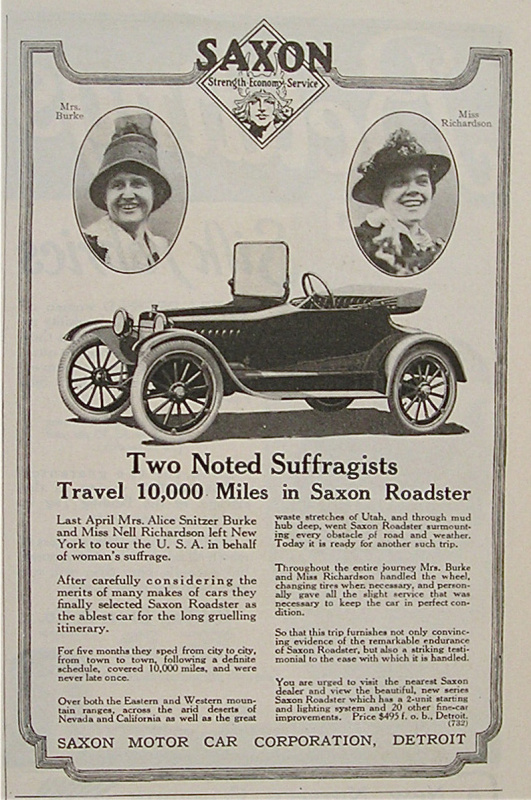
More than 100 years ago, two women undertook an epic road trip in support of women’s suffrage. In 2026, feminists are determined to follow in their tracks—until women achieve full constitutional equality.
Suffragists Alice Snitzer Burke and Nell Richardson seated in their “Golden Saxon” car during a cross-country tour for the suffrage movement in 1916. (Ken Florey Suffrage Collection / Gado / Getty Images)
The year was 1916. Woodrow Wilson was president, U.S. troops were hunting Pancho Villa and a world war was raging in Europe, a conflict the U.S. would join a year later.
After a century of relentless efforts for suffrage, the movement was stalled, with only 11 states guaranteeing voting rights for women in statewide elections. Suffrage leaders of 1916 understood the need for more visible activities to energize supporters, attract new members and showcase strong public support. Media attention was crucial in recruiting new activists and conveying apowerful message to elected officials.
In this atmosphere, two adventurous, gutsy women—Alice Snitjer Burke, 39, and Nell Richardson, 25, both members of the National American Woman’s Suffrage Association—were determined to spread the message about the importance of women’s suffrage. With support from NAWSA, they volunteered to make an epic car trip across the country and back in a small Saxon roadster for “the cause.” At the time, few women drove cars, and automobiles were a big part of a major cultural shift from horses and buggies. Such a trip would be symbolic on many levels.
It has been nearly 110 years since the women made their historic drive. The trip took 26 weeks, covering 10,700 miles and crossing at least 29 states and Washington, D.C. There was no national highway system, only a patchwork of local roads, most of which were unpaved and unmarked.
The suffragists’ determination remained unshaken. The tireless collective efforts of the movement finally paid off, and the 19th Amendment was ratified and recognized in 1920, four years after Alice and Nell’s extraordinary journey.
The state of suffrage in 1916 was not unlike that of the Equal Rights Amendment today, with efforts underway for full recognition by Congress and the courts. During the 250th anniversary of the Declaration of Independence in 2026, ERA supporters are determined to follow in their tracks as the fight to protect voting rights continues, and to ensure women have full constitutional rights.
Votes for Women
The first women’s rights convention, which took place in Seneca Falls, N.Y., in 1848, adopted the “Declaration of Sentiments,” calling for, among many things, “her inalienable right to the elective franchise.” Five decades later, most suffrage organizing involved numerous local and state campaigns, including referendums to persuade male politicians to support women’s voting rights. Suffragists fought and won the right to vote first in Wyoming, followed by Colorado, Utah, Idaho, Washington, California, Kansas and Arizona on the same day, and Oregon.
As NAWSA continued to lobby state legislatures, the National Woman’s Party formed in 1916, with its members picketing the White House, staging hunger strikes and engaging in other civil disobedience. Whatever their preferred tactics, the major suffrage organizations were now united behind the goal of a constitutional amendment.
The Democratic and Republican national conventions were scheduled for June 1916, in St. Louis and Chicago. To pressure both parties to support women’s suffrage, marches and protests were planned. Both parties’ platforms endorsed suffrage but left the decision to the states. President Woodrow Wilson, the Democrats’ incumbent nominee, opposed a federal amendment and maintained that suffrage was a state issue.
The Journey
On April 6, 1916, Alice and Nell packed dresses, water bags, camping gear, a typewriter, camera, sewing machine and cooker into a small Saxon roadster painted bright yellow, the color of the suffrage movement.
Alice was an experienced driver, having completed a two-month trip around New York state. At the time, the Saxon Motor Car Co. was promoting its vehicles as inexpensive, economical and “easy enough for a woman to drive.” The company provided the car and supported the suffrage trip wherever possible, including at local dealerships along the way that kept it clean and provided necessary maintenance, while NAWSA planned the daily routes with overnight stays hosted by local suffrage organizations.
Alice and Nell drove through Manhattan, and at Columbus Circle were met by a crowd of well-wishers. At noon, Carrie Chapman Catt, head of NAWSA, christened the car the Golden Flyer, whacking it with a bottle of gasoline that left a dent.
The pair left Columbus Circle accompanied by an entourage of enthusiastic suffragists. The parade drove to the Weehawken ferry, where Alice and Nell waved goodbye and headed for New Jersey, the first stop on their long adventure.
To increase newspaper coverage and engage people in their travels, Alice wrote daily accounts in the form of a “Diary of the Golden Flyer,” which was published regularly in The Boston Daily Globe and New York Tribune. Their journey often made front-page news due in part to the novelty of seeing a woman drive a car, but Alice and Nell kept the focus on “votes for women.”
Down through New Jersey; Maryland; Washington, D.C; Virginia; North Carolina; and the South they drove. Not all plans worked as well as they had hoped. Newspapers reported stories of snowstorms, mules and mud. The roads were terrible—the Golden Flyer often was hung up on the center ridges created by horse and buggy. Alice’s diary spoke of travel issues, constant vibrations and tires caught in the middle of streams.
Alice and Nell were featured speakers at each stop, distributing literature, engaging with the crowds and actively recruiting supporters. They drafted seven speeches with distinct messages tailored to appeal to different audiences. News reports and their diary entries suggest that their messages likely resonated with committed suffragists, women who felt disenfranchised and men who recognized the importance of supporting their mothers, wives and daughters. Speeches varied for states with or without women’s voting rights.
They spoke to crowds large and small, indoors and out, from a podium or standing on the seat of their car. They collected donations while distributing literature. In Alabama, someone gave them a small black kitten instead of a coin. In Texas, they discovered a bullet hole in the kitten’s basket while navigating through a border skirmish.
At one point they were lost in the desert in Arizona. They had run out of water and resorted to drinking from a well they discovered held a dead chicken. Nell still proclaimed the water “good.” The Los Angeles Times ran a story titled “They’re Not Lost—New York Society Women Campaigning for Suffrage Are Safe in El Centro, Despite Alarming Reports That They Were Astray on the Desert.” The suffrage tour continued north throughout California after making more than 56 stops and with 14 states to go.
Then came Oregon and Washington. The Portland Oregonian quoted Alice highlighting the importance of Western states: “The fate of national suffrage rests with the women of the West,” she said. “In the East, it’s harder. We have labor conditions, politics and corruption to contend with. Yes, the Eastern women must look to the West. There rests the hope of national suffrage.”
Driving out of Seattle they experienced snow in the mountains, which made the roads more treacherous. Alice often said that once women gained the vote, she would begin working for better roads.
In Montana, where women already had the vote, they shared an important message: “The women of Montana and the West must not forget us. … They themselves are limited in their suffrage just as long as there are states in the nation which do not grant suffrage. If they move from Montana into a state which does not grant suffrage they lose the right to vote.”
That year, with the support of women’s votes, Montana Republican Jeannette Rankin was the first woman elected to the U.S. Congress. Rankin campaigned as a progressive with strong support for women’s suffrage and social welfare.
Rep. Jeannette Rankin is presented with the flag that flew at the House of Representatives during the passage of the suffrage amendment, on Jan. 21, 1918. (Bettmann Archives / Getty Images)
Alice and Nell spent time in South Dakota campaigning for a ballot measure for women’s suffrage. It was narrowly defeated in November by the state’s male voters (52 to 48 percent), but activists stayed strong—and suffrage was finally approved in the 1918 elections as the “Citizenship Amendment.”
Their tour of the Midwestern states included a visit to Minnesota on day 150 of the trip. The late summer gave them an opportunity to speak at state fairs. A newspaper quoted Alice as saying, “You men should read editorial pages rather than sport columns to vote intelligently.”
In mid-September, they arrived in Detroit, nicknamed the “Motor City”— home to about 125 car companies, including Saxon. Their journey continued from Toledo, Ohio, to Cleveland, then on to Erie and Warren, Pa. While they were driving across upstate New York, the Rochester Democrat and Chronicle ran a long article detailing their travels and noting the friendly receptions from coast to coast from governors, mayors and many others.
As they reached Manhattan, Alice and Nell are believed to have become the first women to drive 10,700 miles cross- country and back. But they did their tour to win the right to vote, not to earn a place in the record books.
The Golden Flyer was looking worn. The early dent was lost among newer ones and a multitude of signatures inscribed on the car by well-wishers. In the back, there were deer antlers and a 2-foot key to the city of San Jose, Calif., along with a car-flattened snakeskin and “Saxon,” now a full-grown cat.
In the two years after this historic 1916 trip, 15 more states passed suffrage bills of varying degrees. After New York joined them in 1917, President Wilson finally changed his position to support a national amendment, and the political landscape began to shift in favor of the right for women to vote.
In 1918, Wilson addressed the U.S. Senate, urging passage of the suffrage amendment as part of the Allies’ mission in World War I to “make the world safe for democracy”—because America needed to show it offered its own citizens “mere justice.”
By June 1919, two-thirds of Congress approved the amendment. Illinois, Wisconsin and Michigan were the first states to ratify it. The final state needed for adoption, Tennessee, ratified the amendment on Aug. 18, 1920, but not without controversy over a quorum vote.
On Aug. 26, suffrage was certified and recognized as the 19th Amendment.
A New Drive
In March of 1776, when the Declaration of Independence was still being written, Abigail Adams urged her husband, John, to “remember the ladies,” warning that a new country built on old exclusions would face a rebellion of its own from women. That warning has echoed through two centuries, most recently in the protests and resistance against U.S. Immigration and Customs Enforcement and the fury stirred by the vote on the Epstein files in Congress.
In 1977, Republican feminist activist Jill Ruckelshaus told the delegates of the National Women’s Political Caucus, “We are in for a very, very long haul.” She predicted that the road ahead would demand everything of feminists.
Later, singer-songwriter Kristin Lems turned the words of Ruckelshaus’ speech into an anthem for the fight for the Equal Rights Amendment with the chorus, “We will never give up, we will never give in”—a promise carried by feminists from the streets to the halls of Congress and back again.
In March, leaders of the national petition drive at Sign4ERA.org are taking that promise on the road—launching a visibility tour, Driving the Vote for Equality, by tracing the tracks of the Golden Flyer.
Amending the Constitution to include women’s suffrage took more than a century, and was accomplished thanks to the dedication of people like Alice and Nell. Yet ratification did not guarantee full enfranchisement—either for voting or equal rights under the law. Before the Voting Rights Act of 1965, women of color faced serious economic, legal and political obstacles that effectively denied them the right to vote.
The ERA is needed now more than ever to ensure full voting rights are not rolled back, to stop the Trump administration from continuing to bulldoze over gender equality, and for new state and federal laws and policies to ensure “equality of rights under the law shallnot be denied … on account of sex.”
Although the ERA has met all requirements to become the 28th Amendment, it’s been held up due to language in the resolving clause from the joint congressional resolution setting a ratification timeline. Top constitutional experts believe this should not keep the ERA from being deemed properly ratified, in part because the arbitrary time limit is in the preamble, not the actual text of the ERA, which is what was approved by Congress and ratified by the states.
To settle these concerns and ensure the courts cannot decide the amending process must start over, a joint resolution is pending in Congress. The House version states: “Notwithstanding any time limit … [the ERA] is valid to all intents and purposes as part of the United States Constitution having been ratified by the legislatures of three-fourths of the several States.” Nearly all House Democrats are cosponsors, along with only one Republican.
Driving the Vote for Equality will work with a wide range of groups, including Mayors for ERA, historical societies and local activists, to commemorate the suffragists’ efforts—and alert voters and politicians to the importance of Congress recognizing the ERA.
For more information or to volunteer for Driving the Vote for Equality when it comes to your state and community, email team@sign4era.org.
A couple of weeks after Merriam-Webster named “slop” as its word of the year, Microsoft CEO Satya Nadella weighed in on what to expect from AI in 2026.
In his classic, intellectual style, Nadella wrote on his personal blog that he wants us to stop thinking of AI as “slop” and start thinking of it as “bicycles for the mind.”
He wrote, “A new concept that evolves ‘bicycles for the mind’ such that we always think of AI as a scaffolding for human potential vs a substitute.”
He continued: “We need to get beyond the arguments of slop vs sophistication and develop a new equilibrium in terms of our ‘theory of the mind’ that accounts for humans being equipped with these new cognitive amplifier tools as we relate to each other.”
If you parse through those syllables, you may see that he’s not only urging everyone to stop thinking of AI-generated content as slop, but also wants the tech industry to stop talking about AI as a replacement for humans. He hopes the industry will start talking about it as a human-helper productivity tool instead.
Here’s the problem with that framing, though: Much of AI agent marketing uses the idea of replacing human labor as a way to price it, and justify its expense.
Meanwhile, some of the biggest names in AI have been sounding the alarm that that the tech will soon cause very high levels of human unemployment. For instance, in May Anthropic CEO Dario Amodei warned that AI could take away half of all entry-level white-collar jobs, raising unemployment to 10-20% over the next five years, and he doubled down on that last month in an interview on 60 Minutes.
Techcrunch event
San Francisco | October 13-15, 2026
Yet we currently don’t know how true such doomsday stats are. As Nadella implies, most AI tools today don’t replace workers, they are used by them (as long as the human doesn’t mind checking the AI’s work for accuracy).
One oft-cited research study is MIT’s ongoing Project Iceberg, which seeks to measure the economic impact on jobs as AI enters the workforce. Project Iceberg estimates that AI is currently capable of performing about 11.7% of human paid labor.
While this has been widely reported as AI being capable of replacing nearly 12% of jobs, the Project says what it’s actually estimating is how much of a job can be offloaded to AI. It then calculates wages attached to that offloaded work. Interestingly, the tasks it cites as examples include automated paperwork for nurses and AI-written computer code.
That’s not to say there are no jobs being heavily impacted by AI. Corporate graphic artists and marketing bloggers are two examples, according to a Substack called Blood in the Machine. Then there are the high unemployment rates among new grad junior coders.
But it’s also true that highly skilled artists, writers and programmers produce better work with AI tools than those without the skills. AI can’t replace human creativity, yet.
So it’s perhaps no surprise that as we slide into 2026, some data is emerging that shows the jobs where AI has made the most progress are actually flourishing. Vanguard’s 2026 economic forecast report found that “the approximately 100 occupations most exposed to AI automation are actually outperforming the rest of the labor market in terms of job growth and real wage increases.”
The Vanguard report concludes that those who are masterfully using AI are making themselves more valuable, not replaceable.
The irony is that Microsoft’s own actions last year helped give rise to the AI-is-coming-for-our-jobs narrative. The company laid off over 15,000 people in 2025, even as it recorded record revenues and profits for its last fiscal year, which closed in June — citing success with AI as a reason. Nadella even wrote a public memo about the layoffs after these results.
Notably, he didn’t say that internal AI efficiency led to cuts. But he did say that Microsoft had to “reimagine our mission for a new era” and named “AI transformation” as one of the company’s three business objectives in this era (the other two being security and quality).
The truth about job loss attributed to AI during 2025 AI is more nuanced. As the Vanguard report points out, this had less to do with internal AI efficiency and more to do with ordinary business practices that are less exciting to investors, like ending investment in slowing areas to pile in to growing ones.
To be fair, Microsoft wasn’t alone in laying off workers while pursuing AI. The technology was said to be responsible for almost 55,000 layoffs in the U.S. in 2025, according to research from firm Challenger, Gray & Christmas, CNBC reported. That report cited the large cuts last year at Amazon, Salesforce, Microsoft and other tech companies chasing AI.
And to be fair to slop, those of us who spend more time than we should on social media laughing at memes and AI-generated short-form videos might argue that slop is one of AI’s most entertaining (if not best) uses, too.
Great Job Julie Bort & the Team @ TechCrunch Source link for sharing this story.