
Home News Page 15

Getting Critical Minerals Certification and Due Diligence Right In the DRC-Rwanda Accord and Beyond (With a Lesson from a Punk Band?)

Getting Critical Minerals Certification and Due Diligence Right In the DRC-Rwanda Accord and Beyond (With a Lesson from a Punk Band?)

So much is being written these days, understandably, to advise governments and companies on critical minerals and rare earths policy issues, especially as the Trump administration and leaders around the world prioritize minerals access as a key foreign policy and national security goal.

Most current analysis focuses on the core challenge of how critical minerals can be extracted in a smooth and efficient manner, on the one hand, and how supply chain certification and due diligence mechanisms can promote responsible practices, on the other. That’s especially the case because so much sourcing occurs in conflict-affected and high-risk countries, such as Ukraine, Central Asia, and beyond. The Regional Economic and Integration Framework that the Trump administration helped craft between the Democratic Republic of the Congo and Rwanda (known as the REIF) is just the latest of the U.S. president’s foreign policy priorities to be rooted in minerals access for the United States and, purportedly, in responsible economic development for the two countries. (It is to be seen, of course, whether Venezuela goes in this direction, but it could, given that they also have a range of minerals in addition to oil.)

Having worked on these topics for more than 15 years in government, civil society, and the private sector, and co-teaching a graduate school class this semester at Georgetown University on critical minerals policy, I have learned that the most important reference point is not a government strategy, a report from the World Bank, a trade association white paper, an in-region nonprofit, or a think tank’s analysis.

No. It’s legendary D.C. hardcore punk band Fugazi. In perhaps their greatest song, they advise their audience to not “make the same mistakes” and to always remember that “function is the key.” In the song, frontman Ian MacKaye expresses the frustration of late 1980s youth, who desperately wanted to change the world left them by their parents; MacKaye implores them not to just take expedient or superficial action or just do something for the sake of doing something, but rather to be patient to identify an action that would have impact. The world of expanding investment in critical minerals, too, must move past measures that are simply “quick wins” or that result in superficial action on responsible sourcing that can negatively affect both mining operations and the local communities in the long term.

For agreements like the REIF to bear meaningful fruit in high-risk areas, the focus should be less on replicating past generalized models of broad-based certification and due diligence and more on “function.” That is, policymakers and implementers — the latter being, most immediately, mining companies and their financial backers — should look more toward investing in the specific affected communities and working to resolve underlying rights and development issues in a given context. As such investments are made and reported on, then traders, smelters/refineries, and downstream companies can themselves be held accountable when they shun local engagement and fail to respect those investments.

The Shortcomings of Current Approaches to Certification and Due Diligence

The push for critical minerals is now at a seeming fever pitch and certainly unlike anything in the United States in recent times, though arguably still well behind the push undertaken by China beginning in the early 2000s). The international community has taken certain standard approaches to respond to the risks to communities of commodities development and supply chains in the 21st century, particularly where these types of investments can contribute to conflict, human rights violations, and corruption. (Though gold technically isn’t a critical mineral, it should also be ; for ease of reference, this article will refer just to “critical minerals” but the analysis relates to gold, too, as the DRC-Rwanda case illustrates just how economically “critical” it is.)

In far too many cases, the desire for commodities leads to initial investments that do not live up to their expected promise of smooth operations and windfall profits. When projects fail, they may descend into a downward spiral; the companies face frustratingly low production levels and financial results, while the communities are left trying to pick up the pieces, which in turn leaves the companies’ reputation in tatters. Amid the inevitable, downstream companies then face pressure not to source minerals from these projects, and various stakeholders often disagree on whether they should disengage or persist. In Peru, for example, years of protests by mine workers and mining communities have led to deeper questions about whether it is “responsible” to source copper from Peru, one of the world’s major producers of the mineral. These types of quandaries should prompt caution among those in government who developed the DRC-Rwanda REIF, and those in industry who hope to benefit from it.

For the most part, the international community’s responses to the ethical issues related to minerals sourcing have boiled down to, on the one hand, due diligence certification overseen by governments, most notably the Kimberley Process (KP) for rough diamonds, and on the other hand, due diligence undertaken by companies that tends to be rooted in the due diligence guidance first issued by the Organisation for Economic Co-operation and Development (OECD) in 2011. In many cases, that due diligence is overseen or facilitated by multi-stakeholder leadership, such as the Initiative for Responsible Mining Assurance focused on the mining sector, or by industry-run certification bodies, such as the Responsible Minerals Initiative, which companies downstream use to evaluate midstream processors and smelters. Myriad other initiatives exist, with some governments like the United Arab Emirates (for gold) or the United States or European Union (for conflict minerals) at least nominally requiring companies to perform due diligence.

In sum, an enormous amount of work and investment has been applied in the last 25 years, and the overall results are, at best, mixed. Yet the DRC-Rwanda REIF appears to be heading down the same roads, with vague references to “export certification,” “due diligence,” and related processes, but lacking any specifics. Leaving aside the current (and much graver) questions for the Trump administration related to the DRC-Rwanda peace agreement in the M23 advances and escalating violence, a few lessons on minerals due diligence should inform a commitment to not making the same mistakes:

  • The Kimberley Process and certification systems like it have proven that governments cannot be responsible for qualitative decision-making about what minerals should be allowed, or not allowed, to enter global supply chains. Governments are simply unwilling to say to companies “it is too risky to allow cobalt from country X to enter supply chains because of ongoing human rights or labor rights abuses.” There may be too much uncertainty about how exactly such a determination would apply (i.e., would a ban apply to all exports, exports from a certain region, made during a certain timeframe, etc.). There also may be too many complicated geopolitical interests that have nothing to do with minerals (see, for example, the unwillingness of the United States or others to take meaningful action against the UAE for its role in the gold trade fueling genocide in Sudan), and too little ability to follow any determination with meaningful implementation, enforcement, and accountability for violations. At most, individual countries can make these decisions through sanctions or import bans, but expecting that global standards bodies can play a role is unrealistic. Even a regional certification mechanism in Central Africa, overseen by the International Conference of the Great Lakes Region, has struggled to implement a consistent system, in part because of capacity constraints and competing interests from countries within the region, especially Uganda and its “partner” in the REIF Rwanda, benefiting from illicit minerals smuggled out of the DRC.
  • Similarly, due diligence led by companies on their own, or through the rubric of industry-led certification systems, has also generally failed to proactively exclude minerals from conflict-affected and high-risk areas in a consistent and demonstrable manner. Minerals-related due diligence, and human rights due diligence more broadly, has often evolved into a set of paper processes that companies can put on their books (and thus be audited against). This is, of course, a necessary step, but the concentration on due diligence has come at the expense of scrutinizing supply chain decision-making, where companies can point to how and why they made specific decisions to make a purchase of a particular mineral, knowing that it could be sourced from such an area of risk. While that may be an oversimplification of expectations of how complex minerals supply chains work, at the end of the day, minerals from complex environments like the DRC and Rwanda reach downstream companies every day despite the existence of extensive due diligence systems. The fact that many tons of gold from Sudan continue to move through the global supply chain without meaningful interruption is a testament to the limitation. Until the focus evolves from due diligence processes to ensuring those due diligence standards underlie specific decision-making about transactions, those minerals will continue to flow, including from eastern Congo. In sum, responsible sourcing can and should be a key component of broader due diligence (financial crime, money laundering, etc.), but too often it is not.

At a recent minerals industry discussion, a senior executive bemoaned that “despite our best efforts, illicit minerals somehow make it into supply chains.” There should be no somehow to it; people and companies choose to make these purchases, and the key mistake of the first 25 years of supply chain interventions is not focusing sufficiently at that level of individual responsibility/investment and related accountability.

Why the Debate Matters: Human vs. Business Costs

Balancing minerals certification and due diligence with business efficiency and costs is not a new conundrum, and reflecting on one of the more challenging debates from the recent past can help bring key recommendations into focus. In the early 2010s, Tim Worstall, then a contributing writer for Forbes, and Mike Davis, the now-executive director of one of the leading NGOs focused on minerals issues in the DRC, Global Witness, engaged in a quasi-debate about whether the cost of minerals due diligence for companies could be justified in light of the potential lives saved.

Worstall argued, in sum, that the prospect of billions of dollars spent on due diligence by companies, as required by Section 1502 of the Dodd-Frank Act, could not be justified in light of the likely return on investment and would actually make things worse. Davis replied by suggesting that Worstall was essentially trying to come to a number beyond which an investment in due diligence processes is not justified to save lives:

“Is he implying, as it appears, that there is a cost barrier beyond which it ceases to be worthwhile for companies to make sure they are not funding rape and war through their purchases? What is the maximum a company should spend on its supply chain controls to avoid sponsoring a mass-rapist or murderer? How about putting some dollar signs against the suffering of victims of the armed groups that finance themselves through the global minerals trade?”

Impossible ethical questions — but ever more essential in 2026. This debate matters today as much as in 2013 because the DRC-Rwanda REIF focuses on the exact same region as the due diligence over conflict minerals in this early 2010s debate. And undoubtedly the same questions will emerge as minerals produced under the REIF’s auspices begin to flow. Myriad articles and Government Accountability Office reports have been written debating whether the due diligence required by Dodd-Frank was indeed worth it. To be sure, even if the international community has learned that due diligence is an important tool for companies seeking to understand their supply chains, it is clear that these kinds of interventions alone cannot stop conflicts or prevent minerals from such regions flowing, even when the push for mineral wealth is a key factor in why the fighting is happening.

So with all this time and money spent on certification and due diligence, even with many positives resulting from both, alongside the mistakes, the core issue remains: is there any way to ensure meaningful decision-making by governments and companies on whether or not to source critical minerals from regions such as the DRC/Rwanda?

Cue: Fugazi

Maybe, if we go back to Fugazi’s reminder to ensure “function is the key.”

In sum, both minerals certification models like the Kimberley Process and broader due diligence programs have allowed companies to generalize their approach to risk, such that they can avoid both direct engagement in difficult areas and consequences for downstream purchases that may involve minerals from those same areas. Having this broad-based infrastructure in place is useful, even essential, as a starting point, but it is ultimately insufficient, especially for governments seeking to ensure that deals like the REIF deliver on their potential.

The past mistakes have occurred as policymakers try to make these broad approaches capable of addressing more pinpointed needs and concerns. Going forward, the United States and other governments should build on these models and complement generalized approaches like those set forth in the REIF with specific and functional tools, such as:

  • Investment in local community-based solutions, from both governments and the private sector, that ensure new projects, as well as broader supply chains, are directly connected to and informed by the expected local beneficiaries. Such investment, especially when done in conjunction with nonprofit implementers with deep experience in the specific community, can also inform approaches that don’t criminalize or marginalize artisanal and small-scale miners but instead find ways to include them while mitigating potential concerns.
  • Imposition of sanctions and other punitive mechanisms on companies engaged in illicit activity that undermines the REIF. Ideally, these would not just be actors in the DRC and Rwanda but networks further downstream in refining/smelting, trading, and even in the manufacturing and retail sectors. Although it is often presumed that use of sanctions against mining companies or investors will drive all companies out of a specific sector, this tool can be used instead both to drive out negative actors and also demonstrate to the industry as a whole what practices will be acted against.
  • Intelligence-sharing, through public-private partnerships, that can enable companies to take more proactive approaches to due diligence, both in terms of identifying problematic actors and those that are connected to positive investments.
  • Issuance of business risk advisories and other statements that are based on shared intelligence and disseminated directly to certification and auditing bodies.
  • Revision of certification and sustainability standards that rely on third-party auditing to ensure that (i) auditors truly understand the core risk issues and geographies in the supply chains of the companies they are testing, and (ii) that audits then test not just whether a paper-based process is in place but how those processes applied to specific sourcing decisions. Downstream jewelry or tech companies, for example, should be facing auditor questions and examinations that interrogate how they have made specific decisions on sourcing with DRC, Sudan, or other high-risk areas in mind.

Finally, these improvements can be individualized efforts at national levels or achieved through the panoply of standard-setting certification bodies. A recent United Nations Environment Program report assessing sustainability standards for the mining sector made clear that there is a rubric for assessing when mining-related standards work. Regardless of whether any of these specific standards are integrated into the REIF, a few key needs echo the recommendations above:

  • Establish clear expectations for what standards will be followed and how they will be evaluated over time.
  • Allow local communities to have direct voices in these processes.
  • Ensure direct repercussions and meaningful accountability at every stage of the process.

Shifting public and private approaches from broad-based certification and due diligence to a more specific concentration on decision-making, investment, and accountability will not only make Fugazi proud by showing that “function is the key,” they can also augur a new level of impact for agreements like the DRC-Rwanda REIF.

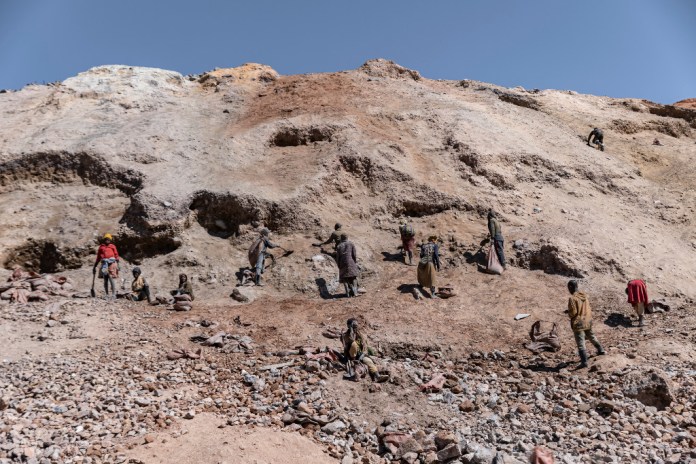
FEATURED IMAGE: Miners work along unstable slopes of a ridge where there is a significant risk of falling rocks and landslides on May 26, 2025 in Kolwezi, Democratic Republic of Congo. (Photo by Michel Lunanga/Getty Images)

Great Job Brad Brooks-Rubin & the Team @ Just Security Source link for sharing this story.

Minnesota Police: ICE Is Racially Profiling Off-Duty Cops Of Color

Minnesota Police: ICE Is Racially Profiling Off-Duty Cops Of Color

Source: Anadolu / Getty

Here’s a simple truth: ICE and Border Patrol are engaging in racial profiling.

The Trump administration, specifically the Department of Homeland Security, continues to deny that immigration cops are stopping and detaining people based on their skin color and accent, and DHS Secretary Kristi Noem has even scolded reporters for suggesting that they do, despite the fact that the Trump administration has taken legal battles all the way to the U.S. Supreme Court in order to give its agents the legal right to racially profile civilians. Noem also recently told immigrants to keep proof of citizenship on their person at all times, indicating that they might be subject to the profiling she claims is not happening. ICE Director Tom Homan said himself that “ICE officers and Border Patrol don’t need probable cause to walk up to somebody, briefly detain them, and question them,” and that “they just go through the observation…based on the location, the occupation, their physical appearance, their actions.” 

According to an ICE agent, White House Chief of Staff Stephen Miller once demanded an increase in immigration arrests, asking, “Why aren’t you at Home Depot? Why aren’t you at 7-Eleven?” — a clear indication that he expected agents to go where Hispanic migrants typically work, and to identify people to detain based on their race, their occupation or the language they speak.

There’s also video footage of agents approaching people at their own homes and at random businesses, telling them flat-out that they need to see proof of citizenship just “because of your accent.” Countless lawsuits have been filed against DHS, accusing agents of targeting brown people who they catch speaking anything other than English, or speaking English in a foreign accent.

But fine, if bootlicker America still doesn’t believe the many plaintiffs filing many lawsuits, or the federal judges who have ruled the feds are racially profiling, or what agents say out of their own mouths, or what Trump administration officials are saying out of their own mouths, or the Supreme Court — maybe they’ll believe it if local cops say it’s true.

As the Washington Post reports, local law enforcement leaders in Minneapolis and St. Paul are publicly accusing federal immigration agents of violating U.S. citizens’ civil rights, citing incidents in which they have pulled guns on off-duty police officers of color, demanding that they show proof of citizenship.

From the Post:

Mark Bruley, police chief of the Minneapolis suburb Brooklyn Park, said at a Tuesday news conference that an off-duty police officer had been “boxed … in” by vehicles driven by ICE agents, who demanded with guns drawn to see paperwork proving the officer hada right to be in the United States. “She’s a U.S. citizen, and clearly would not have any paperwork,” he said.

The officer attempted to begin filming the interaction and her phone was knocked out of her hand, Bruley said. When she identified herself as a police officer, the federal agents “immediately left,” he said.

All of the off-duty police officers who had been targeted by ICE in his city were people of color, Bruley said.

“I wish I could tell you that this was an isolated incident,” he said, adding, “if it is happening to our officers, it pains me to think how many of our community members are falling victim to this every day.”

Dawanna Witt, sheriff of Hennepin County, which includes Minneapolis, said that people were being “stopped, questioned and harassed solely because of the color of their skin” and that the behavior of federal agents was eroding trust in law enforcement.

“We demand lawful policing that respects human dignity,” she said, adding that the surge of ICE agents in Minneapolis was impacting local officers as well as the community. “We will all continue to show up, even though times are hard, even though our law enforcement is exhausted.”

St. Paul Police Chief Axel Henry said that city employees had been subject to “traffic stops that were clearly outside the bounds of what federal agents are allowed to do.”

These are the highest-ranking officers in multiple police departments, saying explicitly that the racial profiling is happening and it’s happening routinely.

Granted, one could argue that local cops are just salty because the feds are jacking their steez — like, “If anyone is going to racially profile my citizens, it’s going to be me” — but that’s another story for another day.

At this point, it’s not even clear why the Trump administration still denies that its agents are racially profiling, or that racism is at the heart of President Donald Trump’s mass deportation agenda, for that matter. As I wrote previously, “The president is outright casting aspersions on entire ethnic groups while making it explicitly clear he only wants white immigrants in the U.S.”

If this administration is going to continue to make it so painfully obvious that it is a white supremacist organization, why continue to be in denial when it’s being accused of doing white supremacist things?

Just be the loud and proud white nationalists that you demonstrably are. MAGA, amirite?

SEE ALSO:

ICYMI: ICE Agents Force Elderly US Citizen Outside In His Underwear

MAGA Supporters Defend White Nationalist Jake Lang


Minnesota Police: ICE Is Racially Profiling Civilians And Off-Duty Cops Of Color
was originally published on
newsone.com

Great Job Zack Linly & the Team @ Black America Web Source link for sharing this story.

WINTER WEATHER TIMELINE: What to expect this weekend in San Antonio and the Hill Country

WINTER WEATHER TIMELINE: What to expect this weekend in San Antonio and the Hill Country

FORECAST TIMELINE

  • FRIDAY EVENING: Cold front arrives, temperatures plummet

  • FRIDAY NIGHT: Cold rain

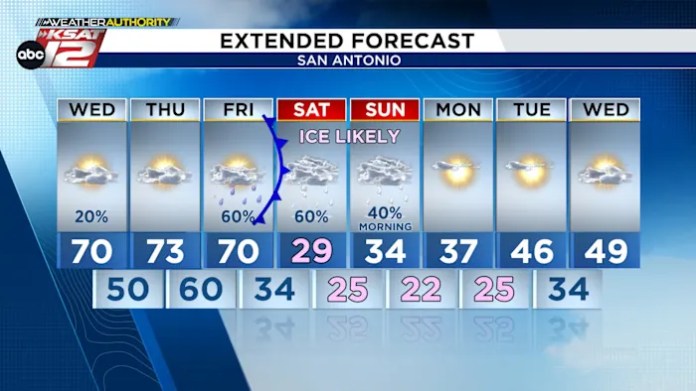
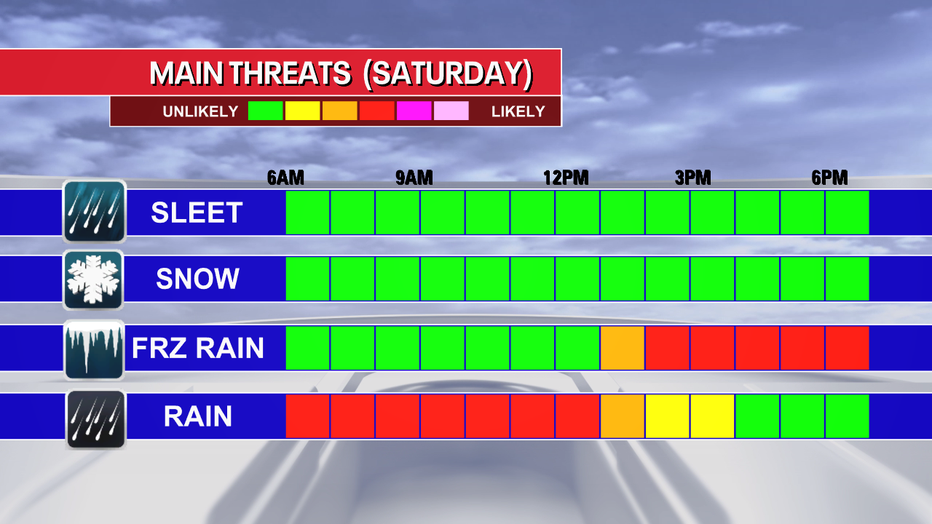
  • SATURDAY MORNING THROUGH MIDDAY: Ice in Hill Country, Cold rain for San Antonio

  • SATURDAY NIGHT THROUGH SUNDAY MORNING: Ice for Hill Country AND San Antonio

  • SUNDAY AFTERNOON: Precipitation ends

  • MONDAY MORNING: Very cold. 20s.

  • MONDAY AFTERNOON: Chilly, but likely above freezing

IMPACTS

SATURDAY

If you live in the Hill Country, ice will begin Saturday morning, meaning driving could be hazardous for those north of the Alamo City. In San Antonio, however, just a cold rain is expected for most of the day Saturday.

Expect ice in the Hill Country Saturday, with a cold rain for most of the day around San Antonio (Copyright 2026 by KSAT – All rights reserved.)

Temperatures will be falling throughout the day Saturday, so that by the evening, it’ll be freezing in San Antonio. That means any precipitation will likely turn to freezing rain, potentially glazing surfaces and bridges/overpasses Saturday night into Sunday morning. It’s best to stay home Saturday night and Sunday morning.

By Saturday night & Sunday morning, we’ll all likely see some ice (Copyright 2026 by KSAT – All rights reserved.)

SUNDAY

Lingering ice is possible Sunday morning. This is when it could be most hazardous to travel around the Alamo City.

By midday, all precipitation will end. We may even briefly rise above freezing. However, the cold will still stick around for a few days.

IMPACTS FROM ICE

Potential Ice impacts (Copyright 2026 by KSAT – All rights reserved.)

Because more ice accumulation is expected in the Hill Country, this is where impacts will be greatest. Accumulations of up to 0.25″ to 0.50″ are possible north of San Antonio. This kind of ice can cause tree limbs to break and power lines to sag, leading to the risk of power outages.

Generally less accumulation is expected in San Antonio — a glazing to 0.10″. This can still be dangerous, though, and cause slick spots on bridges and overpasses. But concern for widespread power outages around the Alamo City is much lower than the Hill Country.

IMPACTS FROM COLD

Expect be be below freezing for at least 24 hours and perhaps even longer, depending on temperatures Sunday afternoon. Sunday, Monday, and Tuesday mornings will be well below freezing.

Now is the time to prepare your home for extended cold: insulate exposed pipes, cover outdoor faucets, make sure your pets will be inside with you this weekend and early next week.

The latest extended forecast from Your Weather Authority (Copyright 2026 by KSAT – All rights reserved.)

QUICK WEATHER LINKS

Copyright 2026 by KSAT – All rights reserved.

Great Job Justin Horne, Sarah Spivey & the Team @ KSAT San Antonio for sharing this story.

Many right-wing media figures fell in line after Trump renewed threat to acquire Greenland

Many right-wing media figures fell in line after Trump renewed threat to acquire Greenland

Many right-wing media figures backed President Donald Trump’s vow to take control of Greenland, a move that threatened the NATO alliance formed after World War II, telling Denmark to “just sell us Greenland” and arguing that it’s “worth talking about” taking Greenland by force because “that’s the only way that America exists in the first place.” Some in conservative print media outlets came out against Trump’s threats, suggesting that some of his tactics were “dangerous,” calling it “Trump’s lesson in how to turn U.S. allies into China’s friends,” and asserting that his “foreign policy needs to distinguish between friend and foe.”

Great Job Media Matters for America & the Team @ Media Matters for America Source link for sharing this story.

To survive warming winters, the Olympics will need to change

To survive warming winters, the Olympics will need to change

Winter weather is now less dependable in many cities that have historically hosted the games.

The post To survive warming winters, the Olympics will need to change appeared first on Yale Climate Connections.

Great Job Bob Henson & the Team @ Yale Climate Connections Source link for sharing this story.
Exercise Variety Matters When It Comes to Longevity

Exercise Variety Matters When It Comes to Longevity

Becoming a jack of all trades in the gym might be one of the keys to living a longer, healthier life, a new study suggests.

Participants who exercised more had a lower risk of early death compared with those who exercised less — but those who varied their movement routines the most had a 19 percent lower risk of premature death compared with people who got the same amount of exercise but with little variety.

“The takeaway is refreshingly practical: Don’t put all your movement eggs in one basket,” says Mark Kovacs, PhD, an exercise physiologist based in Atlanta who has researched longevity and athletic performance, but wasn’t involved in the study. “You don’t need extreme workouts or complex programming. Simple variety goes a long way.”

What the Study Found

Researchers looked at data from more than 111,000 healthcare professionals, women and men, who were involved in the Nurses’ Health Study and the Health Professionals Follow-Up Study over the course of more than 30 years.

Great Job Cristina Mutchler & the Team @ google-discover Source link for sharing this story.

Apps for boycotting American products surge to the top of the Danish App Store | TechCrunch

Apps for boycotting American products surge to the top of the Danish App Store | TechCrunch

European consumers are fighting back against the U.S. following Trump’s threats to take control of Greenland, a Danish territory. As a result, two mobile apps that offer a way to determine if products are made in America, then suggest local alternatives, have surged to the top of the Danish App Store in recent days.

The Danish App Store serves users in both Greenland and Denmark, and the same is true for Google Play.

The boost in downloads comes as Danish consumers have been organizing a grassroots boycott of American-made products, which also included canceling their U.S. vacations and ditching their subscriptions to U.S.-based streaming services, like Netflix.

Across both iOS and Android, two apps, NonUSA and Made O’Meter, have entered the top 10 this month, according to new data from market intelligence provider Appfigures.

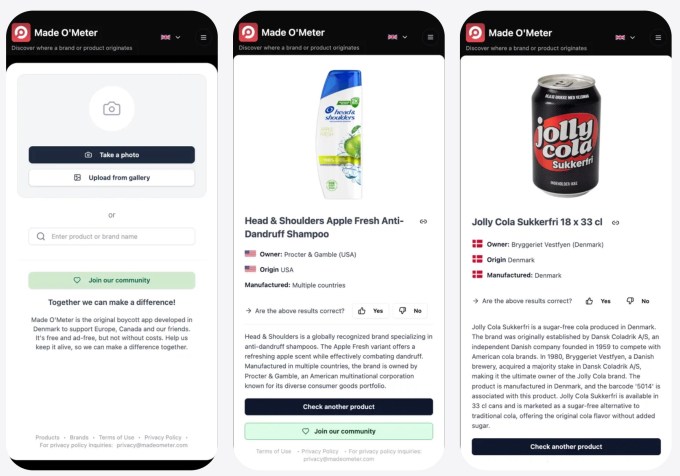
NonUSA became the No. 1 app on Wednesday, after earlier jumping from No. 6 on Tuesday, up from No. 441 on January 9. This app is specifically designed to allow users to boycott American products in their everyday lives. To use the app, users scan product barcodes, then view the product’s origin information on their iPhone. It also suggests local Danish alternatives that users can purchase instead.

Currently, the app’s top five markets are Denmark, Norway, Sweden, and Iceland, demonstrating a Nordic alliance in boycotting American products.

Image Credits:Appfigures

Made O’Meter, which is available on both iOS and Android, has a smaller footprint but is now the No. 5 app on the App Store.

Combined, the average daily downloads for NonUSA for iOS, Made O’Meter for iOS, and Made O’Meter for Google Play have increased 867% (or about 9.7x) over the past seven days, versus the week prior.

Apps for boycotting American products surge to the top of the Danish App Store | TechCrunch
Image Credits:Made O’Meter (opens in a new window)

Of course, the number of downloads the Danish App Store sees daily is quite small, compared to larger markets like the U.S. In Denmark, it could only take a few thousand downloads in a single day to reach the top of the App Store. In total, Denmark’s iOS App Store sees around 200,000 downloads per day in total across all apps, Appfigures notes.

Other apps currently in the Danish App Store’s top 10 include travel app Rejsekort (perhaps helpful for those rescheduling travel plans!), and other local services. Other U.S.-based apps in the top chart include Shop, ChatGPT, and Microsoft Authenticator.

Great Job Sarah Perez & the Team @ TechCrunch Source link for sharing this story.
Austin weather: Winter Storm Watch issued as Arctic blast set to arrive

Austin weather: Winter Storm Watch issued as Arctic blast set to arrive

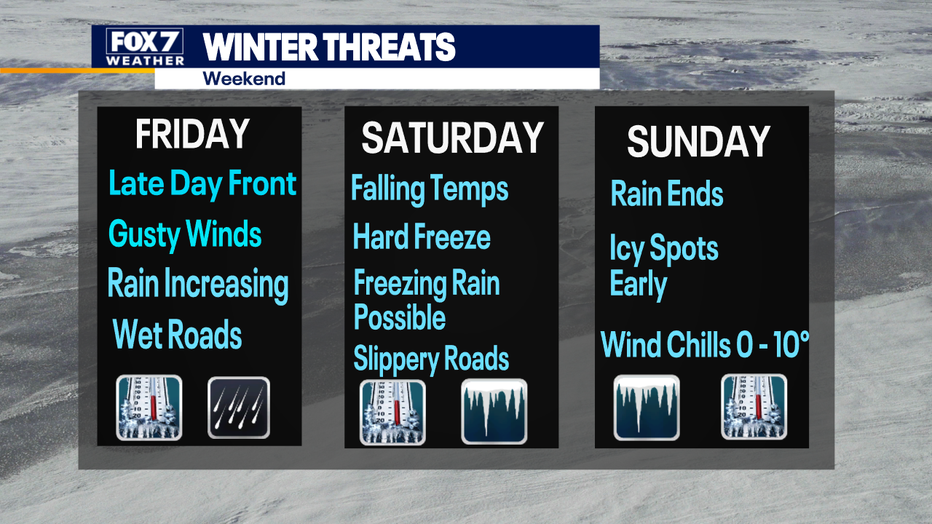
It’s looking very like that Central Texas will see a very hard freeze this weekend along with a wintry mix.

Timeline:

Winter Storm Watch for Central Texas

The National Weather Service has issued a Winter Storm Watch for counties in Central Texas beginning Jan. 24 at 12 a.m. and lasting through Jan. 26 at 12 p.m.

The following counties are included:

  • Gillespie
  • Hays
  • Caldwell
  • Bastrop
  • Blanco
  • Lee
  • Travis
  • Llano
  • Burnet
  • Williamson
  • Fayette

Austin weather: Winter Storm Watch issued as Arctic blast set to arrive

Areas just to our north are under a Winter Storm Watch already starting Friday night and lasting through Saturday night. 

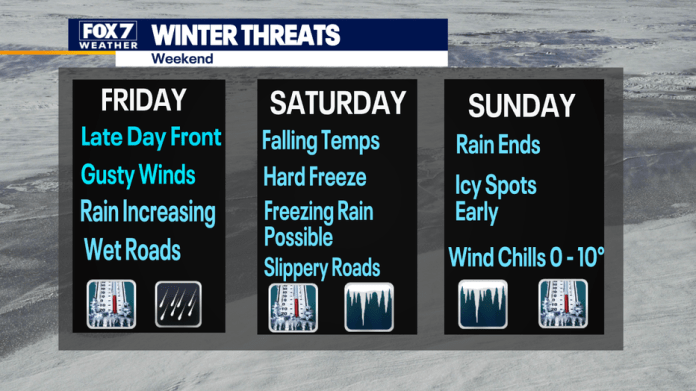
The Arctic air is still scheduled to push through starting late Friday night. 

We will be freezing from Saturday afternoon to Monday morning. 

Wind chills will drop into single digit territory by Sunday morning.

Dig deeper:

A potent upper low will glide over the frigid air to enhance the cloud cover and turn on the precipitation. The kind of precipitation depends on the temperature profile. 

For now, it looks like the freezing layer of air will be close to the ground.

This would support rain changing over to freezing rain. 

Then some sleet and snow flurries mixed in late Saturday night before drying out on Sunday. 

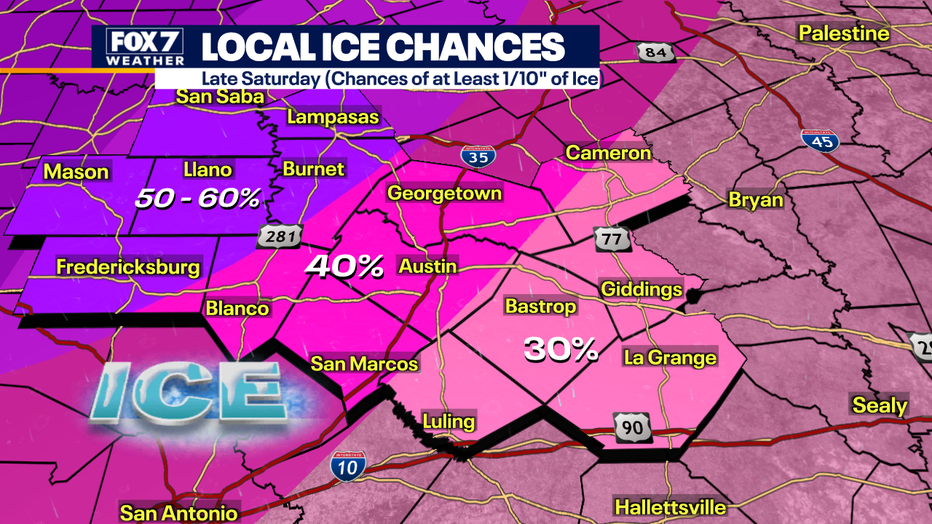
The highest chances of a tenth of an inch of ice will be north and west of Austin. 

It will be just cold rain Friday and Friday night and then rain freezing on contact late Saturday.

Why you should care:

Elevated roads will be the main concern for icing, along with isolated power outages with minor ice build up on the lines.

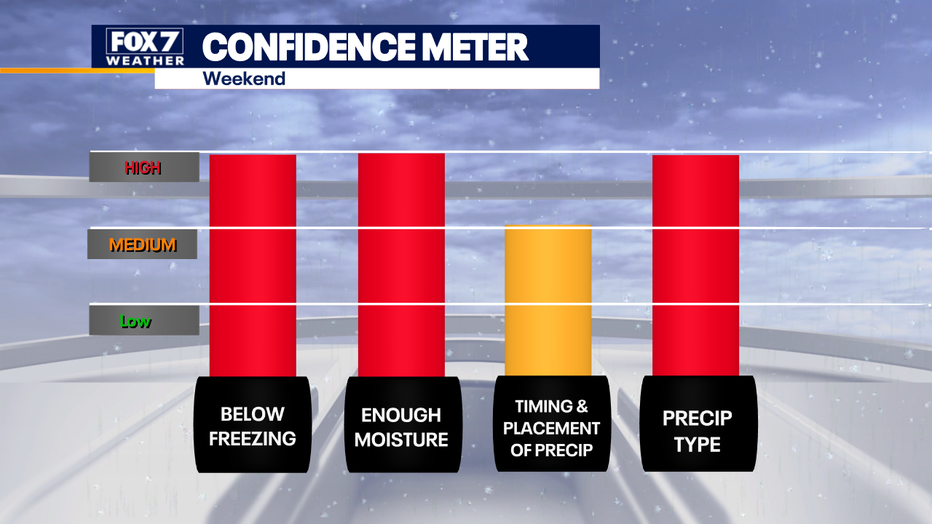
For now, the computer weather models keep the crippling and damaging ice storm just to our north.

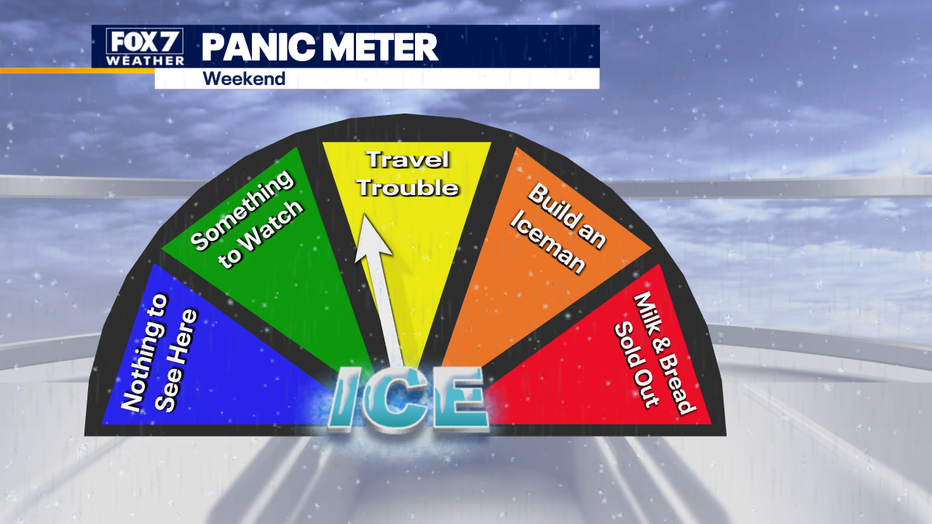
We are at a LEVEL 3 out of 5 concern with this Winter Storm greatly impacting the area.

What you can do:

Pay close attention to the forecast as it could still change as we head closer to the weekend.

Track your local forecast for the Austin area quickly with the free FOX 7 WAPP

The design gives you radar, hourly, and 7-day weather information just by scrolling. 

Our weather alerts will warn you early and help you stay safe.

The Source: Information from meteorlogist Zack Shields.

WeatherWinter WeatherAustin

Great Job & the Team @ Latest & Breaking News | FOX 7 Austin for sharing this story.

Gov. Abbott endorses Nate Sheets over Sid Miller for agriculture commissioner

Gov. Abbott endorses Nate Sheets over Sid Miller for agriculture commissioner

In a stunning blow to Texas Agriculture Commissioner Sid Miller, Gov. Greg Abbott endorsed Miller’s Republican primary challenger for agriculture commissioner, putting his support behind first-time political candidate Nate Sheets.

“Texans deserve an Agriculture Commissioner who is focused on promoting Texas Agriculture, with zero tolerance for criminality,” Abbott wrote Wednesday on social media. “Nate Sheets is the true conservative champion for the job and is the leader we need to keep Texas the global powerhouse in agriculture.”

Last year, Miller turned heads when he hired his political consultant Todd Smith as the agency’s chief of staff just a few months after Smith pleaded guilty to commercial bribery after he was criminally charged for selling hemp licenses that are regulated by Miller’s office. The move sparked outrage among agency employees who told Texas Rangers they had warned Miller about Smith.

Miller did not immediately respond to a request for comment.

In a statement, Sheets said: “I’m honored to have Governor Abbott’s support and I look forward to working together to fight for Texas agriculture and for farmers’ and ranchers’ future economic success, restore trust in our food system, and ensure Texas remains strong, healthy, and secure for generations to come.”

Sheets is the founder of Nature Nate’s Honey company. A native Texan business and ranch owner, he served for six years in the U.S. Naval Reserve before graduating from Texas State University. Sheets sold Nature Nate’s in 2021 and resigned as CEO in 2024 to run for agriculture commissioner. He also previously worked as communications director for E3 Partners, an evangelist ministry that establishes new Christian congregations around the world.

In a statement, Kim Snyder, Abbott’s campaign manager, said Abbott endorsed Sheets because of Miller’s “history of corruption” and pointed to his vote in favor of in-state tuition for undocumented students when Miller served in the Texas House. At the time, the measure had broad bipartisan support, but as the Republican Party has shifted further to the right, it has become a political sticking point among hardline anti-immigrant politicians.

“Nate Sheets is the only candidate in the race who has the integrity to lead the Texas Department of Agriculture,” Snyder added.

First elected agriculture commissioner in 2014, Miller came under fire in 2016 for using state funds to travel to Oklahoma to receive what he called a “Jesus shot,” an injection that an Oklahoma City doctor claimed could take away all pain for life.

Miller later reimbursed the state for the trip, and Travis County prosecutors did not pursue charges.

In 2017, the Texas Ethics Commission fined Miller $2,750 for sloppy campaign accounting. The next year, the commission fined Miller $500 for using state funds to travel to a rodeo in Mississippi after an investigation found the primary purpose of the trip to Jackson was personal.

Miller toyed with challenging Abbott in the 2022 Republican primary before running for reelection for agriculture commissioner. Miller was one of several Republican leaders who sued Abbott after he extended the early voting period during the 2020 pandemic.

Earlier this week, Miller criticized Abbott and Lt. Gov. Dan Patrick at a Wood County forum where he said “there is nobody that understands rural Texas anymore,” according to audio obtained by The Texas Bullpen. “Our governor, for 10 years I’ve been trying to get him on the farm. Hadn’t got him there yet. Our lieutenant governor is from New England. He’d have never been on a farm that I know of,” Miller said.

Patrick is from Maryland.

Sheets already has endorsements from multiple Republican state senators, including Sens. Charles Perry of Lubbock, Angela Paxton of McKinney and Kevin Sparks of Midland.

Great Job Texas Tribune, Kate Mcgee & the Team @ KSAT San Antonio for sharing this story.

‘Doesn’t Even Look Like Herself Anymore’: Hilary Duff’s Unrecognizable Look Has Fans Struggling to See the ‘Lizzie McGuire’ Star They Remember

‘Doesn’t Even Look Like Herself Anymore’: Hilary Duff’s Unrecognizable Look Has Fans Struggling to See the ‘Lizzie McGuire’ Star They Remember

Former Disney star Hilary Duff has been off the music scene for over a decade and hasn’t performed onstage for nearly twice as long. But now she’s back full throttle. 

In the years since Duff’s last tour in 2008, she’s gotten married twice. During these marriages, she welcomed four kids: Luca Comrie, 13, Banks Bair, 7, Mae James Bair, 4, with her first husband, Mike Comrie, and her youngest, 1-year-old Townes Meadow Bair, with her current husband, Matthew Koma.

A lot more has evolved in the 38-year-old’s world, and fans say that includes her looks. 

‘Doesn’t Even Look Like Herself Anymore’: Hilary Duff’s Unrecognizable Look Has Fans Struggling to See the ‘Lizzie McGuire’ Star They Remember
Hilary Duff has fans debating her looks after her grand return to the stage. (Photo by Phillip Faraone/Getty Images)

‘She Looks Uncomfortable’: ‘Fifty Shades of Grey’ Fans Cover Their Eyes as Dakota Johnson Pushes Limit In See-Through Look

On Monday, Jan. 19, the former “Lizzie McGuire” star made her return to stage with the opener of her “Small Rooms, Big Nerves” tour. Duff posted a video of herself using the intro to rapper Diamond Dondada’s song “She’s Back” during her preparation for her first performance at London’s O2 Shepherd’s Bush Empire that evening.

The video begins with her in a yellow shirt sitting in a chair as her glam team pretends to apply makeup and do her hair. During this shot, Duff glares at the camera and confidently lip-syncs along with the audio.

“I took over a year off and gave you b-tches some slack,” she mouthed. 

The video then cut to a stage-ready Duff, who now had her hair lightly wand curled as she rocked a two-piece blue outfit.

As the audio continued, “Tell a friend to tell a friend she’s back,” she pushed up her top and shook her hips to the beat. She received a lot of supportive comments from excited fans under the post that reached over 1.2 million likes and counting.

But there were a few fans who could not get over the former child actress’s changed appearance. One person expressed these thoughts under a Lizzie McGuire fan account that reposted the video on X. They wrote, “She doesn’t even look like herself anymore.”

Another person who seemed taken aback typed, “Is this a clone?”

Not every fan felt the same, as some of Duff’s longtime followers thought she didn’t look that different at all. 

One person complimenting her appearance said, “So gorgeous and literally looks the same from 20 years ago, natural beauty so rare these days.”

Another person reflecting on Duff’s notable Disney role as Lizzie McGuire commented, “And she still has that the Lizzie grin/smile DOWN pat.”

Following her performance, Duff shared a collection of images and a video from the night’s event. The 16-slide post featured photos of Duff interacting with her bandmates, singing, and connecting with the audience. The last slide was a clip of Duff performing the last few seconds of her 2009 song “Wake Up.” The video ends with her closing her eyes and smiling in relief, as the audience gives her an ovation. 

Reflecting on the night, she wrote a message in the caption that reads, “18 years later, and I still can’t quite make sense of it all. I’ve imagined what it might feel like to return to the stage, but last night was something else entirely. The love, the community, the energy…it met me in a way I wasn’t prepared for.”

She then showed her gratitude to fans by thanking them for sticking by her side over the years. 

Even though she took a break from singing, Duff didn’t completely leave show business. She was a cast member in a TV Land show called “Younger” for six seasons until it ended in 2021. In 2022 and 2023 she was the star of the sitcom “How I Met Your Father.”

She announced her return to music last fall, and by November, she released a single called “Mature,” her first in years.

She recently dropped the second single from her upcoming album, “Roommates,” a racy tune in which she sings about her ardor for a partner who has seemingly grown disinterested in her. 

Duff’s album, “Luck… or Something” will be released on Feb. 20.

Great Job J. Jones & the Team @ Atlanta Black Star Source link for sharing this story.
Secret Link