Monday, January 19, 2026, I had the honor and privilege of celebrating the life and legacy of Dr. Martin Luther King Jr. right here in New Braunfels.
We gathered at Solms Park and began walking together toward the Civic Center. With every step, the crowd grew. People joined in along the route. Families, elders, children, neighbors. What started as a march became a moving expression of shared purpose.
There was no anger. No violence. No fear. Just people. Singing. Praying. Walking together in peace.
I am deeply grateful to the New Braunfels Martin Luther King Association for continuing this tradition and creating a space that honors Dr. King’s legacy with dignity, intention, and love. What you organized was powerful, and it mattered.
I also want to thank our Indivisible Comal County volunteers who marched with us. Your presence means more than you know. You show up, again and again, with courage and heart. When the work feels heavy, you remind me why it matters. You give me fuel to keep going.
One of the most meaningful moments of the day was deeply personal. My mother traveled from Dallas to be part of the celebration. She is 77 years old, and I learned that day that she had never marched in an MLK event before. This was on her bucket list. Watching her walk alongside me and my husband, surrounded by community, was something I will carry with me forever. I am so grateful she chose to share that moment with us.
Serenity Cole pasó las fiestas del pasado diciembre descansando con su familia cerca de su casa en St. Louis, haciendo manualidades y visitando amigos.
Fue muy diferente a la temporada navideña de 2024, cuando estuvo hospitalizada, algo frecuente debido a la anemia falciforme, una enfermedad genética que daña los glóbulos rojos encargados de transportar oxígeno, y que durante años le causó un dolor incapacitante en brazos y piernas. Las crisis solían obligarla a cancelar planes o faltar a clases.
“Con la anemia falciforme te duele todos los días”, dijo. “Hay días que se tolera más, pero siempre está presente”.
En mayo, Cole completó un tratamiento de terapia génica que duró varios meses y que reprograma las células madre del cuerpo para que produzcan glóbulos rojos saludables.
Fue una de las primeras personas inscritas en Medicaid en todo el país en beneficiarse de un nuevo modelo de pago en el que el gobierno federal negocia con las farmacéuticas el costo de una terapia celular o génica en nombre de los programas estatales de Medicaid, y luego las hace responsables del éxito del tratamiento.
Según los Centros de Servicios de Medicare y Medicaid (CMS, por sus siglas en inglés), los estados participantes recibirán “descuentos y reembolsos” por parte de los fabricantes si los tratamientos no funcionan como se prometió.
Eso representa un cambio importante con respecto a cómo Medicaid y otros planes de salud suelen pagar los medicamentos y terapias: normalmente se paga la factura sin importar si el tratamiento beneficia o no al paciente.
Sin embargo, los CMS no han revelado los términos completos del contrato, incluyendo cuánto dinero deberán devolver las farmacéuticas si la terapia no resulta efectiva.
El tratamiento que recibió Cole ofrece una posible cura para muchas de las 100.000 personas —en su mayoría negras no hispanas— que viven con anemia falciforme en Estados Unidos, una enfermedad que se estima que acorta la esperanza de vida en más de dos décadas.
Pero su alto costo supone un gran reto financiero para Medicaid, el programa gerenciado por los gobiernos estatales y el federal que ofrece seguro médico a personas con bajos ingresos o discapacidades. Medicaid cubre aproximadamente a la mitad de quienes viven con esta enfermedad en el país.
Actualmente hay dos terapias génicas aprobadas por la Administración de Alimentos y Medicamentos (FDA, por sus siglas en inglés), con costos de $2,2 millones por paciente en un caso y $3,1 millones en el otro, sin incluir el gasto de la hospitalización prolongada que requieren.
Este programa de los CMS es una de las pocas iniciativas de salud que comenzaron durante la administración del presidente Joe Biden y continuaron bajo el gobierno del presidente Donald Trump. La administración Biden firmó el acuerdo con los dos fabricantes, Vertex Pharmaceuticals y Bluebird Bio, en diciembre de 2024, abriendo la puerta para que los estados se unieran voluntariamente.
“Este modelo cambia las reglas del juego”, dijo Mehmet Oz, administrador de los CMS, en un comunicado emitido en julio al anunciar que 33 estados, Washington, D.C., y Puerto Rico se habían sumado a la iniciativa.
Consultada por más detalles sobre los contratos, Catherine Howden, vocera de los CMS, dijo en un comunicado que los términos de los acuerdos son “confidenciales y solo se han compartido con las agencias estatales de Medicaid”.
“Enfrentar el alto costo de los medicamentos en Estados Unidos es una prioridad de la actual administración”, agregó.
Debido a esa confidencialidad, tanto dos directores estatales de Medicaid como las farmacéuticas se negaron a divulgar los términos financieros de los acuerdos.
Serenity Cole toma varios medicamentos después de someterse a una terapia génica para la anemia falciforme. La terapia fue cubierta por un nuevo programa de Medicaid que permite al gobierno exigir responsabilidades a las compañías farmacéuticas por el éxito del tratamiento. “Este modelo lo cambia todo”, afirma Mehmet Oz, administrador de los Centros de Servicios de Medicare y Medicaid.(Judd Demaline for KFF Health News)
Nuevas terapias
Las terapias génicas, aprobadas en diciembre de 2023 para personas de 12 años o más con anemia falciforme, ofrecen la posibilidad de vivir sin dolor ni complicaciones como derrames cerebrales o daño a órganos, y sin necesidad de hospitalizaciones, visitas a salas de emergencia u otros cuidados costosos. La administración Biden estimó que la atención médica de esta enfermedad ya cuesta al sistema de salud casi $3.000 millones al año.
Con muchas otras terapias génicas caras en camino, el costo de las terapias para la anemia falciforme anticipa los desafíos financieros que enfrentará Medicaid. Hay cientos de terapias celulares y génicas en ensayos clínicos, y decenas podrían recibir aprobación federal en los próximos años.
Si este modelo de pago para la anemia falciforme funciona, probablemente se adoptarán acuerdos similares para otras terapias costosas, especialmente las dirigidas a enfermedades raras, dijo Sarah Emond, presidenta y directora ejecutiva del Instituto para la Revisión Clínica y Económica (ICER, por sus siglas en inglés), una organización de investigación independiente que evalúa nuevos tratamientos médicos. “Este es un experimento valioso”, señaló.
Establecer un modelo de pago basado en resultados tiene sentido cuando se trata de tratamientos costosos y aún no se conocen bien sus beneficios a largo plazo, explicó Emond.
“El beneficio tiene que justificar el enorme esfuerzo”, dijo.
Los ensayos clínicos para estas terapias incluyeron a menos de 100 pacientes, a los que siguieron por solo dos años, lo que deja a algunos funcionarios estatales de Medicaid buscando garantías de que están haciendo una buena inversión.
“Nos importa si los servicios realmente mejoran la salud”, dijo Djinge Lindsay, directora médica del Departamento de Salud de Maryland, que administra el programa estatal de Medicaid. Se espera que Maryland comience a aceptar pacientes para el nuevo programa este mes.
Medicaid ya está obligado a cubrir casi todos los medicamentos y terapias aprobados por la FDA, pero los estados tienen cierto margen para limitar el acceso al establecer criterios sobre quién es elegible, requerir procesos de autorización previa extensos o exigir que los beneficiarios prueben primero otros tratamientos.
Aunque las terapias génicas solo están disponibles en ciertos hospitales del país, funcionarios estatales afirman que el modelo federal permitirá que más personas inscritas en Medicaid accedan al tratamiento sin otras restricciones.
Serenity Cole, que vive en St. Louis con su abuela, Theresa Cole, espera graduarse de la escuela secundaria esta primavera. Antes de someterse al tratamiento para la anemia falciforme, los episodios agudos a menudo la obligaban a cancelar sus planes o faltar a la escuela. “Estoy muy agradecida de haber podido recibirlo”, dice.(Judd Demaline for KFF Health News)
Los fabricantes también cubren los costos de preservar la fertilidad, como congelar células reproductivas, que pueden verse afectadas por la quimioterapia durante el tratamiento. Por lo general, Medicaid no cubre ese costo, explicó Margaret Scott, asesora principal de la firma de consultoría Avalere Health.
Emond dijo que las farmacéuticas están interesadas en el acuerdo federal porque podría agilizar la aceptación del tratamiento por parte de Medicaid, en comparación con negociar contratos individuales con cada estado.
Los estados se sienten atraídos por el programa federal porque también ofrece apoyo para monitorear a los pacientes, además de negociar el costo, agregó. A pesar del secretismo que rodea el nuevo modelo, Emond espera que se realice una evaluación financiada por el gobierno federal para hacer seguimiento a cuántos pacientes ingresan al programa y cuáles son sus resultados, permitiendo a los estados solicitar reembolsos si el tratamiento no funciona.
El programa podría extenderse por hasta 11 años, según los CMS.
“Esta terapia puede beneficiar a muchas personas con anemia falciforme”, dijo Edward Donnell Ivy, director médico de la Asociación Estadounidense de la Anemia Falciforme (Sickle Cell Disease Association of America).
Dijo que el modelo federal ayudará a que más pacientes accedan al tratamiento, aunque señaló que su uso también dependerá del número limitado de hospitales que ofrecen esta terapia de varios meses de duración.
Esperanza para los pacientes
Antes de la terapia génica, la única posible cura para la anemia falciforme era el trasplante de médula ósea, una opción disponible solo para quienes podían encontrar un donante compatible, lo que ocurre en aproximadamente el 25% de los casos, explicó Ivy. Para el resto, el manejo de por vida incluye medicamentos para reducir los efectos de la enfermedad y controlar el dolor, además de transfusiones de sangre.
Unas 30 de las 1.000 personas inscritas en Medicaid con anemia falciforme en Missouri recibirán la terapia en los primeros tres años, dijo Josh Moore, director del programa estatal de Medicaid. Hasta ahora, menos de 10 pacientes la han recibido desde que el estado comenzó a ofrecerla en 2025, explicó.
A menos de un año de iniciado el programa federal, Moore señaló que aún es pronto para conocer su efectividad —definida como la ausencia de crisis dolorosas que requieran hospitalización—, pero espera que se acerque al 90% observado en los ensayos clínicos tras un par de años.
Moore dijo que el programa federal, basado en la efectividad del tratamiento, era preferible a reducir los pagos por una terapia nueva y prometedora, lo cual podría poner en riesgo la capacidad de las farmacéuticas para desarrollar nuevos medicamentos. “Queremos administrar bien el dinero de los contribuyentes”, señaló.
No quiso comentar cuánto podría ahorrar el estado con este modelo ni dar detalles sobre cuánto tendrían que devolver las empresas si el tratamiento no funciona, argumentando la confidencialidad de los contratos.
Hasta ahora, buenos resultados
Últimamente, Cole, quien recibió la terapia en el Hospital Infantil de St. Louis ha podido concentrarse en sus pasatiempos —jugar videojuegos, dibujar y pintar— y en graduarse de la secundaria.
Dijo que se alegra de haber recibido el tratamiento. Lo peor fue la quimioterapia, explicó, que le impidió hablar o comer y requirió múltiples inyecciones.
Aseguró que su condición está “mucho mejor” y que no ha tenido episodios dolorosos por los que tuviera que internarse desde que completó la terapia en la primavera pasada. “Estoy muy agradecida de haber podido recibirla”.
Meta on Wednesday announced it’s expanding ads on Threads to all users globally. The expansion, which starts next week, will be gradual, the company says, noting it may take months for the full rollout to complete.
Meta CEO Mark Zuckerberg has repeatedly praised the social app and X rival, which has now grown to over 400 million monthly active users, as the company’s next big hit. Shortly after the app’s debut, the exec told investors that Threads had a good chance of reaching 1 billion users in a few years’ time.
The company has made it easy for existing advertisers to expand their reach to include Threads by allowing them to automatically place ads through both Meta’s Advantage+ program and via manual campaigns. Supported formats include image and video, ads, including the newer additions of the 4:5 aspect ratio format and carousel ads. Advertisers can manage their Threads ads alongside those for Facebook, Instagram, and WhatsApp in their Business Settings, which simplifies cross-posting.
In addition, Meta expanded the third-party verification already available on Facebook and Instagram (including feed and Reels) to the Threads feed through Meta Business Partners. This provides advertisers with independent brand safety and suitability verification for Threads — a useful feature when Threads’ nearest rival is dealing with a scourge of illegal deepfakes.
The company didn’t share how often users would see ads in their feed, but noted that ad delivery initially would remain “low” as the feature scaled to global users.
Great Job Sarah Perez & the Team @ TechCrunch Source link for sharing this story.
MINNEAPOLIS – Former NFL sideline reporter Michele Tafoya launched her campaign for the U.S. Senate on Wednesday, hoping to win the Republican nomination for the Minnesota seat being vacated by retiring Democratic Sen. Tina Smith.
“For years, I covered the biggest football games in America,” Tafoya said in a video posted on social media, in which she stands on a snowy football field. “I walked the sidelines when the pressure was mounting and the stakes were the highest. That job taught me about more than football. It taught me about how leadership really works. When leaders are prepared and accountable, teams succeed. When they aren’t, people pay the price.”
Tafoya alluded to the turmoil over the ongoing immigration crackdown in Minnesota, making clear that she stands with federal law enforcement. The video includes brief clips of federal officers clashing with protesters.
“As Minnesota’s senator, I will clean up the system, fighting corruption, ending the fraud and protecting your tax dollars,” she said. “I will protect what’s fair and safe, standing with our law enforcement officers, deporting dangerous criminals, and keeping female sports for female athletes.”
Tafoya, who’s long been active in Minnesota Republican politics, is best known for her work from 2011-2022 as a sideline reporter for NBC’s Sunday Night Football. She currently hosts a frequently political podcast. Other Republicans in the race include former NBA player Royce White, who lost to U.S. Sen. Amy Klobuchar in 2024, military veterans Adam Schwarze and Tom Weiler, and former Minnesota GOP Chair David Hann.
Top Republicans had long urged Tafoya to run. U.S. Sen. Tim Scott, of South Carolina, chairman of the National Republican Senatorial Committee, quickly endorsed her, posting on social media: “Change is coming, and Michele Tafoya will lead the way.”
But she also faces potential hurdles among some Republican voters. She supported then-Sen. Marco Rubio, of Florida, for president in 2016 and in 2022 urged Trump not to run again. She has also supported abortion rights, with some exceptions.
On the Democratic side, U.S. Rep. Angie Craig and Lt. Gov. Peggy Flanagan are competing for their party’s nomination to succeed Smith, who announced last February that she wouldn’t seek another term.
“Trump’s hand-picked candidate just jumped in the race for US Senate,” Craig said in a social media post. “Minnesota needs a Senator who will stand up and fight for our state — and we know it won’t be MAGA Michele.”
Tafoya is hoping to break a long losing streak for Republicans at the top of Minnesota’s ballot. No GOP candidate was won statewide office in Minnesota since 2006, and the last Republican to win a Minnesota U.S. Senate seat was Norm Coleman, who was elected to a single term in 2002.
Copyright 2026 The Associated Press. All rights reserved. This material may not be published, broadcast, rewritten or redistributed without permission.
Great Job Steve Karnowski, Associated Press & the Team @ KSAT San Antonio for sharing this story.
CORPUS CHRISTI, Texas – Both sides are expected to present closing arguments on Wednesday in the trial of Uvalde CISD officer Adrian Gonzales, after resting their cases on Tuesday.
Jurors are expected to begin deliberations after the judge reads Gonzales’ charges.
Prosecutors took nine days and three dozen witnesses to try and prove to the jury that Adrian Gonzales failed to follow his training at Robb Elementary School, endangering the 19 students who died and an additional 10 surviving students.
Gonzales is charged with 29 counts of abandoning or endangering a child.
The high-profile trial is expected to begin at 8:30 a.m.
Before both sides rested…
On Tuesday, Jan. 20, the defense called two witnesses to the stand to testify as the prosecution contended that Gonzales crossed paths with the gunman at some point before he entered Robb Elementary School.
Officer’s pathway prior to school entry
The first witness was Claudia Rodiguez. Rodriguez worked at the funeral home across the street from where the gunman crashed his truck, prior to entering the school. Rodriguez’s testimony, along with grainy surveillance video, seemed to refute the prosecution’s argument that Gonzales crossed paths with the gunman prior to entering the school.
The defense pointed to the path in which Gonzales drove by the shooter (marked in red) while he was ducking and reloading.
The start of Gonzales’ drive past the shooter
Police officer on how to properly respond
Following her testimony, retired San Antonio police officer, Willie Cantu, took the stand. Cantu testified about the training that officers undergo and what the proper way is to respond to situations like this.
“It depends on what they were seeing at the time. I think that’s what I mean about the context missing. But what he was observing in other places. That’s just to be fair, sir,” said Cantu.
Gonzales’ defense team is trying to argue he is being unfairly blamed for a broader law enforcement failure that day.
After Cantu’s testimony, the defense rested.
Last week’s coverage
The backstory:
On Friday, the trial continued with the testimony of a Texas Ranger. That ranger remained on the stand for around half an hour, answering questions about what he saw at the scene after the shooting.
The next witness was a Texas DPS Homeland Security officer, who was working as a Texas Ranger at the time. He told the court he was called to the scene after the shooting as a photographer, and he documented the evidence and spoke with representatives at a funeral home while working on the case.
A Texas DPS officer in the Homeland Security division spoke Friday in the trial for Adrian Gonzales, a former officer for Uvalde CISD, where he’s accused of abandoning the victims of the Robb Elementary School mass shooting.
The second witness remained on the stand for questioning until the court adjourned for the day.
Thursday, Jan. 15, trial proceedings
Proceedings began per usual on Thursday, but court was adjourned at 2 p.m. due to an emergency situation involving a family member of the jurors.
Prior to the juror leaving, only one witness gave testimony in the morning’s proceedings. A retired Uvalde Police Department sergeant took the stand at the start of the day, and remained for questioning until the court broke for lunch around 1 p.m.
A former Uvalde Police Department sergeant gave his testimony Thursday in the trial of former CISD officer Adrian Gonzales, who is accused of abandoning the victims of the Robb Elementary School massacre.
During his testimony, the former officer described the response that day, answering questions about how and when officers arrived at the scene and what he saw while he was there. He also reviewed his bodycam footage from that day.
The former sergeant was still on the stand when the court went to lunch, but was unable to continue due to the unexpected recess for the rest of the day.
Wednesday, Jan. 14, trial proceedings
Employee testifies warning Gonzales of shooter
On Wednesday, Jan. 14, the court heard from multiple witnesses, including a former Uvalde CISD employee who first told Gonzales to confront the gunman. Melodye Flores testified about the moments leading up to the deadly shooting at Robb Elementary.
Flores, a teacher’s aide at the school, told the court she learned about the shooter over her school radio hearing the gunman had jumped the fence and was firing a weapon. Her first thought was to run outside to protect the children at recess.
The defense questioned Flores’ perception of the day. They pointed out that her description of the white vehicle did not match Gonzales. They have maintained the entire trial that Gonzales did the best he could with what he knew at the time.
Doctor testifies treating students following incident
Dr. Cherie Hauptmeier testified on Wednesday, as well. She joined nearly 10 other doctors in treating around 15 patients. She described the medical injuries of each victim from the day. One of those injured was a 10-year-old 4th grader.
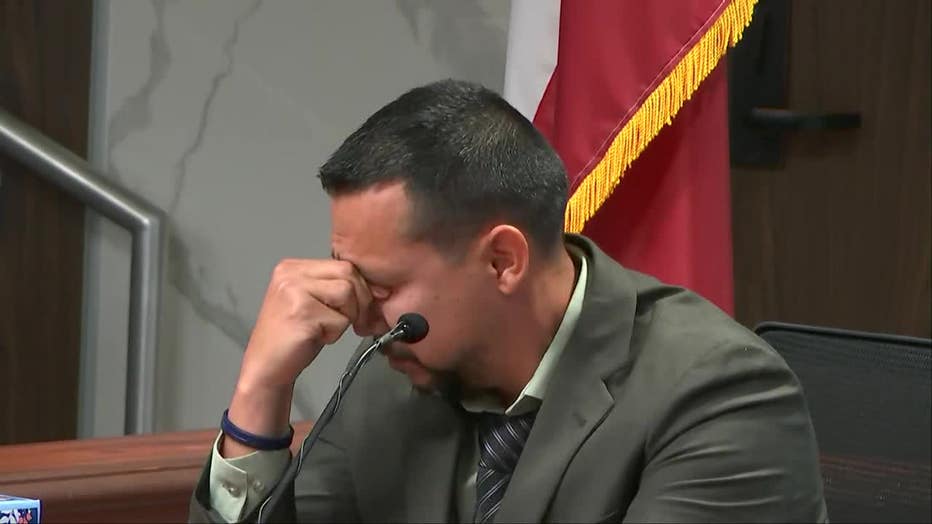
Wednesday was also the first day on which Gonzales appeared to become emotional during the trial. In previous days of proceedings, a stoic Gonzales rarely altered his facial expressions, remaining calm and even-tempered as witnesses delivered their testimonies.
During the medical examiner’s time at the witness stand, however, Gonzales appeared to wipe away tears as the expert recalled the wounds sustained by some of the children that day.
The officer who trained Gonzales gives testimony
The prosecution argues Gonzales ignored his active shooter training that day.
Retired Dallas police officer, Michael Witzgall, helped train Gonzales on active shooter response. He testified about the active shooter response, saying the main goal is to keep the gunman moving away from soft targets, which are places like schools, churches or hospitals.
The defense argued if Gonzales went in alone, it would have put Gonzales and other officers at a higher risk of being killed.
Tuesday, Jan. 13, trial proceedings
Robb elementary’s 4th grade teacher, Elsa Avila, testified on Tuesday, Jan. 13, recounting when her class noticed students running and screaming to getting classrooms before recognizing her gunshot wound upon the lockdown. When she noticed the wound, she says her fourth grade students tried to comfort her while staying quiet and hugging each other.
Off-duty officer testimony
On Jan. 13, testimony was also given by off-duty Zavala County Sheriff’s Deputy Sgt. Joe Vazquez. Vazquez rushed to the scene when he heard on the radio that there was an active shooter at the school. Vazquez’s daughter goes to that school so he sped to the school in his shorts, threw on his vest, grabbed his rifle and asked how he could help. Vazquez’s daughter was unharmed.
Courtroom outburst
Just as Vasquez was getting off the witness stand, there was a loud outburst from the galley. The sister of a victim made an emotional outburst in court, causing a disturbance in which she was escorted from the building.
The judge then spoke to those in the courtroom, saying, “I want this case to go to verdict. Any further outbursts will just echo the attempt for another motion for mistrial. So please think about that. We’re trying to get this case to the jury, and these are not helping and, soon enough, if it continues, I will have no choice but to grant a mistrial. So please think about that. OK, we’re in recess until 1:30.”
Monday, Jan. 12, trial proceedings
Teacher testifies being shot and playing dead to stay alive
Arnulfo Reyes was a teacher working inside classroom 111 when the gunman walked in and opened fire. Reyes survived by playing dead. None of his students survived. Reyes goes on to describe that the shooter shot at him, striking him in the arm.
Jurors heard emotional testimony on Monday in the trial for a former Uvalde police officer accused of failing to protect students. Arnulfo Reyes was a teacher working inside Classroom 111 when the gunman walked in and opened fire at Robb Elementary School in Uvalde. He told jurors he survived by playing dead. None of his students survived.
Reyes said the gunman then went into a neighboring classroom and continued shooting.
That gunman then came back into his classroom and taunted Reyes, before shooting him again in the back.
During the first week of trial
Last week, powerful images of the destruction of Robb Elementary School were shown to the juror depicting the day of the May 2022 shooting.
Prosecutors presented dozens of photos of new evidence throughout the school, documenting the damage left behind. During the presentation of evidence, some photos that were presented, the judge warned the audience, were “gruesome” and “shocking.”
The images depicted areas of the school struck by gunfire, such as classroom walls, windows with shattered glass and doorways with bullet fragments. Some of the photos also showed students’ school work and belongings left behind.
The state argued the images show the intensity of the attack and says Gonzales ignored his active shooter training and failed to act. The defense says Gonzales is not responsible for the bullet destruction in the classroom, stating that he previously said he radioed for help and helped evacuate students.
Mother of victim gives emotional testimony
The mother of one shooting victim, 9-year-old Eliana Garcia, gave her recollection of the day of the shooting. Jennifer Garcia said Eliana had asked to come home early that day, but Jennifer told her to stay to participate in an end-of-year pizza party with her class. Eliana would have turned 10 on June 4, just a week after the shooting.
The backstory:
Nearly 400 officers responded to the school on May 24, 2022. More than 70 minutes passed before a tactical team entered, killing the shooter.
Read more:
The Source: Information in this article comes from live coverage of the Uvalde school shooting trial in Corpus Christi, Texas.
The United States is saber-rattling over Greenland once again. The vast island’s natural resources are back on the agenda, a year after then–US national security advisor Michael Waltz announced: “This is about critical minerals. This is about natural resources.”
Greenland is endowed with both fossil fuels and critical raw materials. It possesses at least twenty-five of the thirty-four raw materials considered critical by the European Union.
The EU’s 2024 Critical Raw Materials Act seeks to improve European supply security of these, and both US President Donald Trump and the EU want to weaken Chinese dominance in the trade. Meanwhile, vast amounts of oil are found offshore across eastern and western Greenland.
The value of these resources is hard to estimate as the prices of oil and critical raw materials fluctuate wildly. Like with Venezuela’s oil, it will take an enormous amount of money to build the infrastructure needed to mine the natural resources in Greenland. Mining and fossil fuel projects are capital-intensive, requiring large upfront investments with long lead times before projects yield profits.
Outside its capital, Nuuk, there is almost no road infrastructure in Greenland and limited deepwater ports for large tankers and container ships.
Around the world, private mining and fossil fuel corporations can exploit public infrastructure such as roads, ports, power generation, housing, and specialist workers to make their operations profitable. In Greenland, huge capital investment would be required to extract the first truckload of minerals and the first barrel of oil.
As such, the government faces a classic dilemma. Let private multinationals extract but lose the lion’s share of revenues? Or insist on state ownership but struggle to find the capital and state capacity to enable extraction.
Greenland’s mineral riches have been known about for some time. In April 2025, Danish state broadcaster DR aired a documentary about how Denmark had historically siphoned off profits from a cryolite mine in Greenland.
The program led to a major political and media crisis, with some believing it challenged perceptions of Greenland being financially dependent on Denmark. Minerals are a prominent but sensitive topic in Greenland’s relationship to the rest of the world.
Foreign companies have tried to set up viable mining industries in Greenland for decades, with little to show for it. Indeed, contrary to Trump’s assertions, American corporations have long had the opportunity to enter Greenland’s mining sector. The capital intensity twinned with extremely harsh climactic conditions mean that, so far, no firm has begun commercial mining activities.
Greenland’s natural resources minister, Naaja Nathanielsen, said in 2025 that she wanted mining to become a “very good, stable supplement” to the country’s overwhelming dependence on the fisheries industry.
Yet in 2021, Greenland’s new socialist Inuit Ataqatigiit government banned uranium mining on pollution grounds. Australian company Energy Transitions Minerals (ETM) sued Greenland and Denmark in 2023 for seventy-six billion kroner (£8.9 billion), equivalent to almost four times Greenland’s GDP.
The mining company claimed to have been robbed of future profits after its uranium project at Kuannersuit/Kvanefjeld was terminated.
Danish courts have struck down most of ETM’s claims as baseless and there has been a report of concerns ETM could declare bankruptcy and thereby potentially avoid paying the large legal fees. In a statement, ETM said its subsidiary GM “worked in good faith for over a decade, in close cooperation with the Greenlandic and Danish governments.” It added that both governments had used GM to promote Greenland as a safe destination for mining investors.
But research in 2025 labelled similar behavior “feigned victimization.” Generally, this is where corporations perceive or position themselves victims of unfair processes rather than powerful participants concerned with profits.
Drilling in the Greenlandic crust would reverberate in Copenhagen as Greenland has a mining profit-sharing agreement with Denmark. As part of the gradual transfer of autonomy from Denmark, Greenland now retains ownership over its natural resources.
However, Denmark provides an annual block grant of 3.9 billion kroner (around half of Greenland’s state budget) to support the domestic economy, which is overwhelmingly comprised of fisheries. Denmark will cut its block grant by 50 percent of mining profits, meaning essentially mining profits are shared fifty-fifty between the two up to the value of the block grant.
Recently, the Australian American corporation Critical Metals received construction approval for a permanent office for its Tanbreez project to supply rare earth minerals, including heavy rare earth elements, in southern Greenland.
The following day, mining company Amaroq declared that the United States is considering investing in its mining projects in southern Greenland through EXIM, the US Export-Import Bank. If the state loan is approved, it will be Trump’s first to an overseas mining project.
A recent executive order from Trump earmarked US$5 billion (£3.7 billion) to support mining projects critical for national security. This demonstrates the close relationship between the extractive industries and military activity.
Fossil fuel production is less likely to happen any time soon. In 2021, Greenland’s government banned fossil fuel exploration and extraction for environmental reasons. A parliamentary majority still favors the ban.
With volatile oil and gas prices and the same climactic and infrastructural challenges as for other natural resources, fossil fuel production in Greenland is implausible even in the event of a full US takeover.
There are many reasons why the Trump administration might want to dominate the Arctic, not least to gain relative power over Russia and China. But natural resource extraction is unlikely to feature centrally.
What’s more, the United States already has military bases in Greenland, following a defense agreement with Denmark. As such, it’s more likely that recent US moves are yet another chapter in the return of the country’s imperialist ambitions.
Great Job Lukas Slothuus & the Team @ Jacobin Source link for sharing this story.
Genetic testing differs from screening, but it can be a valuable tool for some families in which HCM is prevalent.
Genetic testing offers the opportunity for you to find out which of your genes is involved in your HCM. Once you have that information, your family members can undergo genetic testing to see if they also carry that specific gene.
An HCM gene doesn’t automatically cause HCM, but it does mean the carrier is at risk. “Unlike imaging tests, genetic testing can clarify which relatives are truly at risk and need ongoing heart evaluations, and which relatives are unlikely to develop the condition,” says Steitieh. If a person finds out they’re a carrier, they should see a cardiologist for HCM screening to determine whether they have the condition. If someone isn’t a carrier, they may be less likely to develop HCM.
If you or others opt into genetic testing, you’ll first meet with a genetic counselor to weigh the benefits and drawbacks of testing and what to expect when your results come in. If you decide to proceed with testing, you’ll give a blood or saliva sample that’s then sent to a lab. The lab will analyze the sample for HCM variants. From there, you’ll be notified about the results and discuss next steps with your genetic counselor.
The decision to undergo genetic testing is a personal one. Family members don’t need to have genetic testing in order to be screened for HCM. What’s more, not being a carrier doesn’t guarantee a person is safe from HCM.
“We have to understand its limitations, which is mainly that we don’t know every HCM disease-causing gene,” says Steitieh.
Great Job Marygrace Taylor & the Team @ google-discover Source link for sharing this story.
Deepinder Goyal, the co-founder and CEO of food delivery service Zomato and its parent Eternal, is stepping down from his role and handing the top job to Albinder Dhindsa, the CEO of its quick-commerce division Blinkit.
Goyal on Wednesday said he would remain on Eternal’s board as vice chairman as he shifts focus to “higher-risk exploration and experimentation,” which he says may be harder to pursue within the constraints of a listed company.
“This is a change in title, not in commitment toward outcomes,” Goyal said in a letter to Eternal’s shareholders. “Eternal remains my life’s work.”
Goyal co-founded Zomato with Pankaj Chaddah in 2008 as a restaurant discovery and reviews platform called FoodieBay while both were working at Bain & Company. In 2009, they quit to focus on the business full-time, and rebranded it as Zomato in 2010 amid a naming conflict with eBay, before expanding into food delivery in 2015.
Chaddah left the company in 2018, and Zomato later consolidated its position by acquiring Uber Eats’ India business in 2020, and Blinkit (formerly Grofers) for $568 million in 2022.
The leadership change comes as Eternal reported (PDF) strong momentum in its third quarter, with profit rising about 73% to ₹1.02 billion (around $11.13 million) from a year earlier, on adjusted revenue ₹166.92 billion (about $1.8 billion), up 190% from a year ago.
Blinkit remained the company’s fastest-growing business, with net order value jumping 121% to ₹133.0 billion (roughly $1.45 billion) in the last quarter.
Techcrunch event
San Francisco | October 13-15, 2026
Outside Eternal, Goyal has been working on other projects for the last few months, including a longevity-focused initiative called Continue Research, and an experimental brain-health wearable dubbed “Temple”. He is a co-founder of the aviation startup LAT Aerospace, and also is an angel investor.
The handover could be an indicator of Blinkit’s rising influence inside Eternal, as the company’s growth skews toward quick commerce and away from its mainstay, food delivery.
Quick commerce in India is booming even as the sector faces rising scrutiny over working conditions for the thousands of gig workers employed in the industry. The country’s labour ministry recently asked platforms to drop their “10-minute delivery” marketing, and put in place measures to improve conditions for their delivery personnel.
Great Job Jagmeet Singh & the Team @ TechCrunch Source link for sharing this story.
WASHINGTON – House Republicans are starting a push Wednesday to hold former President Bill Clinton and former Secretary of State Hillary Clinton in contempt of Congress over the Jeffrey Epstein investigation, opening the prospect of the House using one of its most powerful punishments against a former president for the first time.
The contempt proceedings are an initial step toward a criminal prosecution by the Department of Justice that, if successful, could send the Clintons to prison.
Still, ahead of a meeting Wednesday by the House Oversight Committee to prepare the charges, there were signs of a thaw. The Clintons, both Democrats, appeared to be searching for an off-ramp to testify, and passage of contempt charges through the full House was far from guaranteed, requiring a majority vote — something Republicans increasingly struggle to achieve.
The repercussions of contempt charges loomed large, given the possibility of a substantial fine and even incarceration. While the charges have historically been used only as a last resort, lawmakers in recent years have been more willing to reach for the option. The Oversight Committee chair, Rep, James Comer of Kentucky, initiated the contempt proceedings after the Clintons refused for months to fulfill a House Oversight Committee subpoena for their testimony in the panel’s Epstein probe.
The clash was the latest turn in the unpredictable Epstein saga, as Congress investigates how he was able to sexually abuse dozens of teenage girls for years. Epstein killed himself in 2019 in a New York jail cell while awaiting trial. The public release of case files has shown details of the connections between Epstein and both Bill Clinton and Donald Trump, among many other high-powered men.
Clinton, Trump and many others connected to Epstein have not been accused of wrongdoing. Yet lawmakers are wrestling over who receives the most scrutiny.
“They’re not above the law. We’ve issued subpoenas in good faith,” Comer told The Associated Press on the eve of the contempt proceedings. “For five months we’ve worked with them. And time’s up.”
Comer rejected an offer Tuesday from an attorney for the Clintons to have Comer and the ranking Democrat on the committee, Rep. Robert Garcia, interview Bill Clinton in New York, along with staff.
How the Clintons have responded
The Clintons released a scathing letter last week criticizing Comer for seeking their testimony at a time when the Department of Justice is running a month behind a congressionally mandated deadline to release its complete case files on Epstein.
Behind the scenes, however, a longtime attorney for the Clintons, David Kendall, has tried to negotiate an agreement. Kendall raised the prospect of having the Clintons testify last Christmas and Christmas Eve, according to the committee’s account of the negotiations.
The Clintons have also argued that the subpoenas are invalid because they don’t serve any legislative purpose and say that they did not know about Epstein’s abuse. They have offered the committee written declarations about their interactions with Epstein.
“We have tried to give you the little information we have. We’ve done so because Mr. Epstein’s crimes were horrific,” the Clintons wrote in a letter to Comer last week.
How contempt proceedings have been used
Contempt of Congress proceedings are rare, used when lawmakers are trying to force testimony for high-profile investigations, such as the infamous inquiry during the 1940s into alleged Communist sympathizers in Hollywood or the impeachment proceedings of President Richard Nixon.
The Jan. 6 committee also subpoenaed Trump in its inquiry, but Trump’s lawyers resisted the subpoena, citing decades of legal precedent they said shielded ex-presidents from being ordered to appear before Congress. The committee ultimately withdrew its subpoena.
No former president has ever been successfully forced to appear before Congress, although some have voluntarily appeared.
The Democrats’ response
Democrats have largely been focused on advancing the investigation into Epstein rather than mounting an all-out defense of the Clintons, who led their party for decades. They’ve said Bill Clinton should inform the committee if he has any pertinent information about Epstein’s abuses.
A wealthy financier, Epstein donated to Bill Clinton’s 1992 presidential campaign and Hillary Clinton’s joint fundraising committee ahead of her 2000 Senate campaign in New York.
Democrats embraced the call for full transparency on Epstein after Trump’s return to the White House, particularly after Attorney General Pam Bondi stumbled on her promise to release the entirety of the unredacted Epstein files to the public. The backlash scrambled traditional ideological lines, leading Republicans to side with Democrats demanding further investigation.
The pressure eventually resulted in a bipartisan subpoena from the committee that ordered the Justice Department and Epstein estate to release files related to Epstein. Republicans quickly moved to include the Clintons in the subpoena.
Comer indicated Tuesday that he would insist that the subpoena be fulfilled by a transcribed deposition of Bill Clinton.
“You have to have a transcript in an investigation,” he said. “So no transcript, no deal.”
Copyright 2026 The Associated Press. All rights reserved. This material may not be published, broadcast, rewritten or redistributed without permission.
Great Job Stephen Groves And Matt Brown, Associated Press & the Team @ KSAT San Antonio for sharing this story.