Cardi B is snapping back after online rumors about her relationships gone too far.
In a lengthy rant, the Bronx rapper addressed the invasion of privacy (no pun) from fans and internet trolls who began stirring up fake breakup rumors. The speculation surfaces despite Cardi being spotted at several of her boo, Stefon Diggs’ football games. After the NFL star’s most recent game on Dec.28, Diggs was seen scanning the stands for Cardi before an affiliate put the two on FaceTime.
During the call, Diggs asked where she was, and Cardi explained she was inside the stadium and making her way down to the field to congratulate him on his team’s win.
Earlier in the week, the internet detectives claimed the couple spent the holidays apart, which quickly fueled breakup chatter. The AM I DRAMA rapper took to social media to shut the rumors down:
Love News? Get more! Join the Black America Web Newsletter
“Y’all been dragging me for three or four days, and y’all been a little too mean. I can’t change sh*t. I can’t go back in time, I already had a baby. Y’all want me to put the baby back in my pu**y? I don’t know what y’all want me to do. Y’all want me to leave my man and f*ck yours?”
Captioning the video, “We need a reset,” so you know the Bodak Yellow rapper is sick and tired of being sick and tired.
Cardi also added that she’s been in grind mode for her first headlining tour, which will prevent her from being around her family, “I’m gonna be away from my babies, away from my personal life, away from home. I have to rehearse for 10-12 hours a day for tour. There are so many elements of production that I’m missing for the tour. I’m already super stressed out. I need my support system to love me, and I need my fans to come to my tour. Don’t be dragging me.”
As Cardi gears up for a new chapter in her career, she’s making it clear that support, not speculation, is what she needs from her fans right now.
BEXAR COUNTY, Texas – The Bexar County Sheriff’s Office is intensifying search operations this week as investigators seek the public’s help in locating three teenagers reported missing in separate incidents across the county.
Sheriff’s officials have established a mobile command post and are utilizing drones, K-9 units, and mounted patrols to search for 19-year-old Camila Mendoza Olmos, 17-year-old Angelique Johnson, and 14-year-old Sofia Gabriela Peters-Cobos.
While the cases are not currently linked, authorities are urging residents to check home surveillance and dash camera footage for any signs of the missing youths.
What you can do:
Anyone with information on any of the following individuals is asked to contact the BCSO at 210-335-6000 or email missingpersons@bexar.org.
Camila Mendoza Olmos, 19
What we know:
Investigators are particularly focused on the northwest side of the county following the disappearance of 19-year-old Camila Mendoza Olmos. Olmos was last seen leaving her residence in the 11000 block of Caspian Spring at 6:58 a.m. on Christmas Eve.
According to family, Olmos typically went for morning walks, but concern grew when she failed to return. Initial surveillance footage from her home showed an individual believed to be Olmos searching inside her vehicle before walking away on foot. Her vehicle remained at the residence.
Camila Mendoza Olmos (19) (Source: Bexar County Sheriff’s Office)
On Monday, officials released new dashcam footage provided by a passing motorist. The video, captured around 7 a.m. on Dec. 24, shows a person matching Olmos’ description walking northbound on Wildhorse Parkway between Shetland Wind and Caspian Spring.
“We’re asking anybody with any information to please give us a call,” a BCSO spokesperson said during a Monday news conference. “Even if you don’t live in this immediate neighborhood… look through your surveillance camera videos from later that day and let us be the judge of whether it’s something usable or not.”
The FBI and Homeland Security are assisting in the case by analyzing digital evidence and monitoring outbound flights and border crossings as a precaution.
Last Seen Wearing: A baby blue and black hoodie, baby blue pajama bottoms, and white shoes.
Angelique Johnson, 17
What we know:
The Sheriff’s Office is also searching for 17-year-old Angelique Johnson, who was reported missing from the 130 block of Exeter Place, located near Potranco Road on the city’s northwest side.
Angelique Johnson, 17 (Source: Bexar County Sheriff’s Office)
Investigators believe Johnson still has her cell phone in her possession, but her current location and intended destination remain unknown.
Description: Female, 5 feet 10 inches tall, 198 pounds, with brown hair and brown eyes.
Sofia Gabriela Peters-Cobos, 14
What we know:
The most recent disappearance involves 14-year-old Sofia Gabriela Peters-Cobos. Sofia was last seen leaving her home near the intersection of Landon Ridge and Potranco Road at approximately 7:00 p.m. on Monday, Dec. 29.
SOFIA GABRIELA PETERS-COBOS (14) (Source: Bexar County Sheriff’s Office)
Description: Female, 5 feet 4 inches tall, 132 pounds, with brown hair and green eyes.
Last Seen Wearing: A black flannel shirt and black shorts.
Authorities reminded the public that anyone found harboring or hiding a reported missing person could face criminal charges. Information leading to the recovery of the teens can be reported anonymously.
The Source: Information in this article is from the Bexar County Sheriff’s Office.
Chris Warner has been harvesting seafood in coastal Maine since he was a teenager. It’s never been easy, but he’s never let the obstacles stand in his way. Sometimes, he says, it feels like he’s spent 34 years in an endless state of adaptation.
Warner was on a boat the last day before the regional shrimp moratorium went into effect in 2013. He saw the sea urchin industry rise and fall. He was out there the day limits were put on haddock. Still, he and his fellow harvesters found ways to pivot and keep themselves afloat, fighting to preserve one of the region’s few reliable industries and their place in shaping Maine’s identity.
Today, Warner farms oysters and digs softshell clams for half his income and makes the rest as a real estate agent. But even what remains is now threatened, he said, by an uptick in harvest closures driven by increased pollution along Maine’s booming coastline and heavier and more frequent rains washing it into waterways.
Commercial shellfisheries in Maine and beyond are regulated by the National Shellfish Sanitation Program, an interstate compact developed in 1925 and administered at the state level to protect the public from unsafe seafood. In Maine, two inches of rain within a 24-hour period automatically triggers an emergency closure of shellfish growing areas under the NSSP; harvesters can’t get back to work until the state’s water-quality testing shows the risk of shellfish polluted by fecal coliform has subsided. Many of the state’s growing areas are on stricter limits, closing for as many as 14 days after rainfall totals as low as three-quarters of an inch—closures that can be extended for weeks by intervening storms.
Each of those closures deals a blow to the community of shellfish harvesters whose work helps sustain Maine’s seafood economy. As climate change coincides with a post-pandemic rush of residents and tourists to the state’s serene seaside towns, overtaxing septic systems and bringing a surge of new pollution, those working on the water describe being pushed to the brink. Warner and others like him are tangling with the reality that they may need to pivot once again—only this time, they’re running out of options.
“It’s horrifying,” Warner said. “Every time it rains, you’re done.”
“An Onslaught of Issues”
Maine’s iconic lobster remains the undisputed heavyweight of the state’s commercial fisheries, but clams and oysters rank second and third, respectively, bringing in about $15 million each in 2024. Because both are filter feeders, their safety for consumers relies on water quality that’s become harder to maintain.
Since 1970, Maine’s annual rainfall has increased by four inches, according to a Climate Central report, powered by higher temperatures that trap more moisture in the air. Across the Northeast, the heaviest rain events now bring 60 percent more precipitation. And Maine faced more 2-inch rainfall events in the 2010s than any previous decade, while anticipating overall precipitation to rise annually by 5 to 14 percent in the decades to come. All that rain carries polluted runoff into the mudflats and estuaries where shellfish grow.
Maine’s shellfish industry has faced “an onslaught of issues in the past couple decades,” said Marissa McMahan, senior director of fisheries at the nonprofit Manomet Conservation Sciences, where she works to build resilience in fishing communities and marine ecosystems. The Gulf of Maine is warming faster than 99 percent of the world’s oceans, and those warmer waters have contributed to an influx of invasive green crabs and other predators, as well as algal blooms and other biotoxins that lead to separate harvest closures under the NSSP. Ocean acidification adds another layer of concern. By reducing the amount of calcium carbonate in the water, it makes it harder for clams and oysters to grow their protective shells. Conditions could drop below critical levels for shellfish health by 2050.
“There are still places that are thriving and viable,” McMahan said. “But now those places are being closed because of water quality. It’s just compounding the issue.”
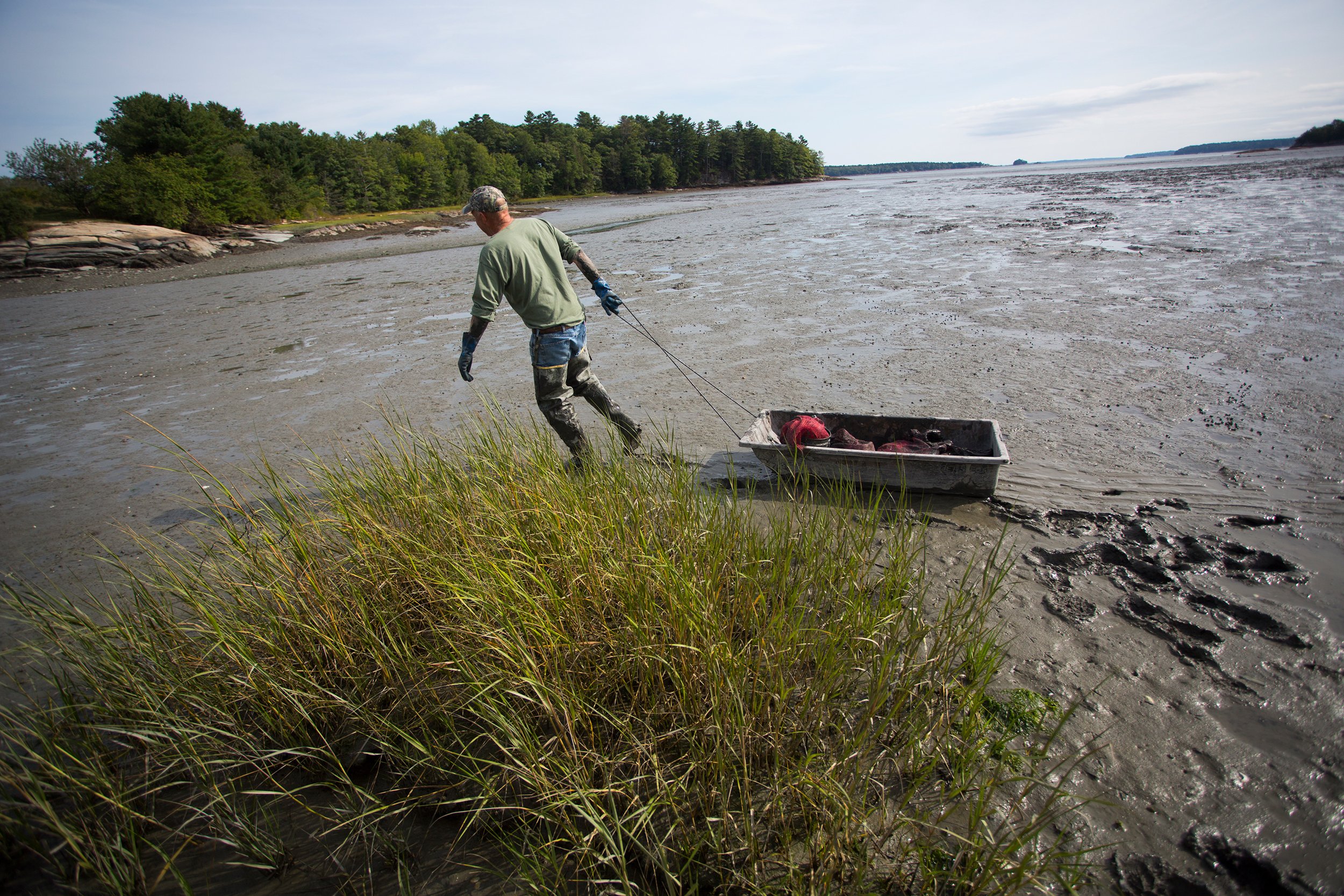
A clammer hauls his harvest after digging in the flats near Wolfe’s Neck Center in Freeport, Maine. Credit: Derek Davis/Portland Press Herald via Getty Images
To make matters worse, climate change is bringing more people to Maine, sending housing prices through the roof and making it harder for shellfish harvesters to stay in the towns where they live. Because harvesting licenses are tied to residency, some are faced with an unenviable choice: keep working in increasingly unaffordable coastal towns or move and give up their license. In the midst of what Warner calls a “perfect storm,” commercial shellfish licenses fell from 1,510 in 2022 to 1,207 in 2024, a 20 percent decline, according to the state’s Department of Marine Resources.
Even before Maine’s coastal towns were inundated with people “from away,” the economic toll of rainfall-related closures was putting a pinch on shellfish harvesters. A 2016 study from the University of Maine found that temporary closures sapped more than one-quarter of total shellfish revenue from Machias Bay in the state’s Downeast region.
The confluence of factors is also affecting an even more vulnerable group, McMahan said. The low cost of a recreational license—often between $10 and $20—opens the door to sustenance fishing. Digging a pack of clams a day provides more than enough food to feed a family and requires little more than a sturdy pair of boots and a clam hoe for raking the catch out of the mud. Rainfall-related closures, which limit commercial and recreational clamming, are likely taking food directly off of dinner tables, McMahan said. “There’s a real danger that we’re overlooking how important it is for food security for people.”
Strain on the System
Unable to stop the rain, many harvesters have turned their ire on the Department of Marine Resources, which implements the NSSP in Maine. The agency is tasked with monitoring 47 growing areas, each of which comprises numerous coves that are assigned a different status depending on their historic water quality and monitored via 1,179 sampling stations. In some areas, harvesting is fully approved or fully prohibited; in others, harvesting is conditional upon weather patterns, closing down seasonally or following heavy rains. Still others are restricted, meaning shellfish can’t be taken to market until they’ve gone through depuration, a process in which they spend time in clean water to purge low-level contamination.
The DMR always aims for the least-restrictive classification, which often leads to conditional designations that allow areas to be kept open in good weather, according to Bryant Lewis, one of the agency’s two growing-area supervisors.
Half the department’s role is classifying and monitoring growing areas; the other half is promoting the shellfish industry. But it isn’t responsible for or capable of addressing pollution sources that lead to classification downgrades and harvest closures. Around a dozen DMR employees conduct shoreline surveys along the state’s nearly 3,500 miles of coastline, rotating through growing areas across a 12-year cycle. They search for failing or overwhelmed septic systems, dog parks and other sources leeching fecal coliform—bacteria found in the intestines of warm-blooded animals that indicate a heightened risk of dangerous pathogens—into rivers and bays. The agency informs towns of any concerns, at which point remediation is up to municipalities.
Garnering support for the remediation and any necessary changes to prevent future contamination, though, is often an uphill battle. There’s a “societal trade-off” being made in small communities bearing the brunt of harvest closures, said Bob Rheault, executive director of the East Coast Shellfish Growers Association. In budget conversations, sewer improvements are up against schools and policing and often fall to the end of the line, he said.
“What are your priorities as a community? Do you want to have open growing areas that you can harvest freely from on a regular basis?” Rheault said. “If you do, then you need to invest in your wastewater treatment infrastructure where your population centers exist.”
The DMR does what it can in Maine, Lewis said, but lacks the authority to compel individuals to replace failing septic systems or to make towns reduce combined sewer overflows.
Unfortunately, McMahan said, there’s a “mismatch in the pace at which we’re seeing more and more sources of pollution versus what the DMR is capable of doing and what that ultimately means for the industry and impact to harvesters.”
In Brunswick, a Midcoast town with about 22,000 residents and 61 miles of coastline, a section of Maquoit Bay that has been harvested for generations—and once fed the Wabanaki and Micmac tribes—was recently reclassified to be closed for two weeks every time it rains an inch, said Dan Devereaux, the town’s coastal resource manager. Based on last year’s particularly rainy weather patterns, he calculated that the area could now be closed for up to half the year, removing around 400 productive acres—25 percent of the town’s total—from harvest.
“You close down these areas, you better make damn sure you’ve done everything you can to keep them open,” he said. “And I don’t think that’s necessarily happening here.”
Devereaux and others have lamented the collision of a rigid regulatory structure with a water quality testing regime that hasn’t kept up with the increased pressure on Maine’s coastline, even while acknowledging the DMR lacks the staffing and resources necessary to meet the challenge. Faced with a complicated set of circumstances, the state and its municipalities need to do more—both in terms of testing and addressing pollution—to avoid unnecessary closures, he said.
“The most conservative way to do it for public health is just to keep everything closed, but because of our heritage and our rich history, we can’t sit around and let that happen to our community,” Devereaux said. “We have 100 years of people making a living off the clam flats in this region and across the state and a municipal responsibility as part of the management partnership.”
Rainfall closures and growing area reclassifications have a pernicious effect on Maine’s 150 or so oyster farmers, too. Eric Oransky, whose Maine Ocean Farms is situated in the town of Freeport in Casco Bay, said he and his partner studied years of water quality data before choosing their location but have lost tens of thousands of dollars because of harvest closures in the past two years.
Shellfish farmers don’t have the ability to simply harvest in another location if theirs is temporarily closed, and unexpected breaks can disrupt relationships with wholesalers or restaurants that require consistency from their suppliers. Unlike wild harvesters, farmers can keep their shellfish in the water until harvesting is allowed and recoup any losses, although doing so takes a level of financial flexibility that not everyone can muster.
“We want to protect public health more than anyone,” Oransky said. He and his colleagues believe more diligent testing and shoreline surveying can balance the needs of consumers and producers. He wants to see “better science, more data and people who are asking questions with an eye on how this affects people’s ability to earn a living along the water.”
Rainfall and Remediation
Despite the challenges, some towns have found ways to successfully navigate the increase in harvest closures as rainfall rises.
In Biddeford, a town of around 22,000 people south of Portland, residents just approved a $20 million overhaul of the municipal sewer system. Brunswick, meanwhile, has given grants to individuals to update their septic systems, said Carissa Maurin, the aquaculture program manager at the Gulf of Maine Research Institute. Harvesters along the Medomak River in the Midcoast region formed a working group that identified and remediated pollution from a kelp processor.
“There are towns and communities working toward that goal because they see how important it is to the livelihood of people in their communities,” Maurin said.
This story is funded by readers like you.
Our nonprofit newsroom provides award-winning climate coverage free of charge and advertising. We rely on donations from readers like you to keep going. Please donate now to support our work.
Changes to the state’s sampling regime could also make a meaningful difference, McMahan said. Monthly sampling—as opposed to the current six annual tests—could balance the state’s busier summer months with calmer winter months to lower scores and keep growing areas in less-restrictive classifications. Harvest peaks between May and October but takes place year-round.
If the state conducted hydrodynamic modeling, it could get a better idea of how effluent moves through its waterways when it rains, perhaps making clear that shellfish in certain areas are unaffected, McMahan said. “Most towns don’t have the capacity to do that,” McMahan said. “And the state says they don’t have the capacity. So who’s going to do it?”
David Taylor has been doing his part since 2019. A former harvester who started digging when he was 13, he’s now 71 and put down his clam hoe a few years ago. Taylor collects water samples along the Georges River and sends them to a professor at the University of New Hampshire for DNA testing that reveals the source of fecal coliform, rather than just its presence, as DMR tests indicate. (The agency won’t use his data, he said.)
With that information, Taylor has helped ameliorate pollution and informed the reopening of multiple growing areas, he said. In all the testing he’s seen, he’s never come across a sample that doesn’t include dog waste, so he carries a straightforward message with him when he speaks with towns and residents about the connection between their land use and the shellfish they love to eat: Pick up after your pets.
“Please work with us,” he said. “You’re talking about people’s livelihoods.”
Keeping Tradition Alive
Even after more than three decades fishing, Chris Warner still loves it. Some nights he’s so excited to wake up and get to work he has to take Benadryl to sleep. But it’s getting harder to stay with it as the rains fall more intensely and more often. The longest harvest closure he’s faced while working the Kennebec River was 78 days.
For 30 years, he said, “I’ve lived and died on water quality.”
Closures, for Warner, are about more than a day’s pay. He’s seen the tangible impact on the lives of his fellow harvesters—lost income, sure, but foreclosures and divorces that followed, too. “People don’t get to do what they enjoy, what they do best, what they’ve been brought up to do,” he said.
As he’s watched precarity edge its way into shellfish harvesting, he’s started to question whether he made a mistake passing on the tradition to his son, rather than steering him toward another career. He encourages young people to get as much education as they can and diversify their options, rather than rely solely on clamming.
He’s not ready to give it up himself, even though he’s taken his own advice by becoming a real estate agent to supplement his income. A prospective buyer recently remarked on the constant reinvention required by his fellow fishermen. “You’re more resilient than anybody,” they told him.
“We believe in fighting for that,” Warner said.
About This Story
Perhaps you noticed: This story, like all the news we publish, is free to read. That’s because Inside Climate News is a 501c3 nonprofit organization. We do not charge a subscription fee, lock our news behind a paywall, or clutter our website with ads. We make our news on climate and the environment freely available to you and anyone who wants it.
That’s not all. We also share our news for free with scores of other media organizations around the country. Many of them can’t afford to do environmental journalism of their own. We’ve built bureaus from coast to coast to report local stories, collaborate with local newsrooms and co-publish articles so that this vital work is shared as widely as possible.
Two of us launched ICN in 2007. Six years later we earned a Pulitzer Prize for National Reporting, and now we run the oldest and largest dedicated climate newsroom in the nation. We tell the story in all its complexity. We hold polluters accountable. We expose environmental injustice. We debunk misinformation. We scrutinize solutions and inspire action.
Donations from readers like you fund every aspect of what we do. If you don’t already, will you support our ongoing work, our reporting on the biggest crisis facing our planet, and help us reach even more readers in more places?
Please take a moment to make a tax-deductible donation. Every one of them makes a difference.
Thank you,
Great Job By Ben Seal & the Team @ Inside Climate News Source link for sharing this story.
Donald Trump’s obsessive hatred of wind energy has reared its ugly head again. On Monday, December 22, Interior Secretary Doug Burgum announced that all construction on offshore wind projects would be halted due to “national security concerns.” This will affect five offshore wind projects on the East Coast, some of which are already mostly completed. In an X post, Burgum called these projects “expensive, unreliable, heavily subsidized offshore wind farms.”
Due to national security concerns identified by @DeptofWar, @Interior is PAUSING leases for 5 expensive, unreliable, heavily subsidized offshore wind farms!
ONE natural gas pipeline supplies as much energy as these 5 projects COMBINED. @POTUS is bringing common sense back to…
The move rests on supposed classified claims from the Department of War that these projects interfere with radar systems, but no solid evidence has been presented publicly. Just three days before this announcement, the Army Corps of Engineers had approved continued construction on Vineyard Wind, one of the projects that will now be paused. A few months ago, the Trump administration’s attempt to derail the Revolution Wind project in the name of national security was defeated in the courts. A coalition of anti-offshore-wind groups has been coordinating this offensive and supplying the administration with a slew of draft executive orders to use.
While Trump has gone on the attack, building trades unions have been rallying behind offshore wind development and have already experienced substantial job growth from it. This latest salvo has added to growing tensions between the administration and construction unions.
A statement from North America’s Building Trades Unions (NABTU) said this move “kills thousands of good-paying jobs on projects that were legally permitted, fully vetted, fully funded, and already underway. These aren’t hypothetical jobs. They are real paychecks and billions in investment.”
The International Brotherhood of Electrical Workers (IBEW) also spoke out and called the order “a direct attack on American workers. . . . Offshore wind projects represent thousands of good, union jobs for IBEW members who have spent years training to build and maintain this infrastructure.”
The Laborers’ International Union of North America (LIUNA) highlighted the disruptive nature of these stop-work orders, saying, “LIUNA members plan their life around this work. Pulling the plug now — during the holidays and after years of negotiations and extensive reviews — is reckless and unfair to the men and women who build this country.” They demanded that the administration “let us work — and stop playing politics with our jobs.”
All five of the paused projects are on the East Coast, an ideal location for offshore wind development. The North Atlantic Coast in particular has the best conditions for the industry in the entire country. The National Renewable Energy Laboratory estimates that there is capacity to build 264 gigawatts (GW) of offshore wind that could produce up to 27 percent of the United States’ annual electricity consumption by 2030.
This is why the building trades in New England have been especially proactive and supportive of the industry. Back in October 2023, these unions pushed a unique multistate procurement agreement for offshore wind that was signed by Rhode Island, Connecticut, and Massachusetts. This procurement was meant to help coordinate its development across the region and reduce costs in implementation. Unions worked with the Climate Jobs National Resource Center to craft a vision for building out the entire domestic supply chain including components, specialized ships, and transmission networks.
In October, Rhode Island AFL-CIO president Patrick Crowley announced that building trades unions in Rhode Island and Massachusetts signed a labor peace agreement with SouthCoast Wind to ensure union work on a massive 2.4 GW offshore wind project they have planned.
States throughout southern New England have already begun making substantial investments in port infrastructure directly tied to offshore wind development. New Bedford Marine Commerce Terminal, the first offshore wind port in the country, and the heavy-lift deepwater port New London State Pier are signs that offshore wind is becoming a key driver of industrial development. Rhode Island’s Block Island Wind Farm has increased the demand for skilled workers at the Port of Providence and Quonset. This represents some of the few real examples of successful reindustrialization in the last decade.
More recently, building trades unions on the East Coast participated in a national “Yes to Wind” week of action. In Baltimore, IBEW Local 24 hosted a press conference at their union hall. The local’s political director, Rico Albacarys, says, “Offshore wind is a big deal for us locally.” Earlier this year, the local had the largest class for its training facility on record, and they see offshore wind as a prime growth sector for the future. Energy developer US Wind had plans to build a huge offshore wind hub off Maryland’s Eastern Shore that could power about 700,000 homes.
United Steelworkers union (USW) members would also get work retrofitting the Bethlehem Steel plant, once the largest steel production facility in the world. Jim Strong, a USW “offshore wind sector assistant,” spoke of the symbolic meaning of having workers back at the plant: “We had history and now we have a future with the return of steel workers here. So, this is a big deal for our union.”
But in August, the Trump administration pulled the $47 million federal grant for the US Wind project and is trying to revoke the federal permits. Now it lies in limbo as the dispute works its way through the courts.
In Maine, Iron Workers Local 7 member Chad Ward stressed the potential for local job creation:
A job in the offshore wind industry in Maine would mean I could see my kids grow up, and my kids could have the option of going into an industry that keeps them employed in Maine while also helping to do something good for the environment.
Trump’s attacks on offshore wind and other unionized clean energy projects have opened up political cleavages that building trades unions could creatively leverage beyond statements of opposition and press conferences. The administration would likely have a difficult time dealing with rowdy demonstrations from sympathetic construction workers and media appearances that give them an opportunity to present a compelling case for why these projects must stay. This is a time to emphasize the contradiction between the president’s pro-blue-collar rhetoric and his policies.
We should listen to the building trades: offshore wind is both a critical energy source and job creator for the future. Trump’s repeated attempts to block it are just another front in his war on workers.
Great Job Paul Prescod & the Team @ Jacobin Source link for sharing this story.
Three more dog breeds joined the American Kennel Club’s roster of recognized breeds on Tuesday, making them eligible for many U.S. dog shows and likely increasing their visibility to the pet-loving public.
One of the newcomers is a terrier named for a U.S. president. Another is a toy dog from Cold War-era Russia. The third is a centuries-old French hunting hound. Here’s a closer look:
The basset fauve de Bretagne
The stats: 12.5 to 15.5 inches (32 to 40 centimeters) at the base of the neck; 23 to 39 pounds (10.5 to 17.5 kilograms)
chrisuk1 / Getty Images
chrisuk1 / Getty Images
Basset Fauve de Bretagne.
The topline: A hardy, sociable, compact hound that can hunt all day — and needs mental and physical activity.
The pronunciation: bah-SAY’ fove deh breh-TAHN’-yeh
The translation: Fawn-colored, low-set dog from Brittany
The history: Versions of these coarse-coated, tan-hued hounds go back at least as far as 16th-century French aristocratic circles. The breed has been championed in the U.S. in recent years by Cindy Hartman, a South Carolina service dog trainer who brought a pair of fauve puppies back from France in 2001. She has since trained and placed about 20 fauves as medical alert dogs for people with diabetes, she said.
The quote: “They’re wicked smart, and so if you’re wanting a dog that’s just going to lay around all day long, a fauve is not for you,” Hartman said. “But yet, when challenged mentally and physically, they’re happy to come in with you and curl up on the sofa for the evening.”
The Teddy Roosevelt terrier
The stats: 8 to 14 inches (20 to 36 centimeters) at the base of the neck; 8 to 25 pounds (3.5 to 11 kilograms)
The topline: A solid, energetic small canine that will rid your barn of rodents, alert you to strangers, do dog sports — or just entertain you with its antics.
The history: Originally seen as a short-legged variant of the rat terrier, these dogs were deemed a breed of their own in 1999. The breed was named for President Theodore Roosevelt because of his fondness for dogs, including terriers.
The quote: “They know how to get you to laugh,” says Cindy Rickey of Waynesville, North Carolina, the secretary of the American Teddy Roosevelt Terrier Club. While many terrier breeds are known for being independent-minded, her Teddy competes in obedience. “They’re terriers, no doubt about it, but they also have this tremendous desire to please,” she explains.
The Russian tsvetnaya bolonka
The stats: Up to 10¼ inches (26 centimeters) at the base of the neck; 7 to 9 pounds (3 to 4 kilograms)
Wirestock / Getty Images
Wirestock / Getty Images
Russian Tsvetnaya Bolonka.
The topline: A sweet but clever little companion that wants playful interaction, not just snuggling (though it likes that, too).
The pronunciation: zvit-NEYE’-ah boh-LON’-kah
The translation: Russian colored lapdog
The history: The breed was developed in Soviet-era Leningrad (now St. Petersburg) after World War II as a pet for apartment dwellers. American fans have been working to establish bolonki (the proper plural) in the U.S. since the early 2000s.
The quote: “Having a bolonka is like having a 3-year-old kid running around your house. … They can enjoy their time lying on the couch with you, but you’ve got to be prepared to play with them and keep them entertained,” says Denise Dang of Oklahoma City, the secretary of the Russian Tsvetnaya Bolonka Club of America. Owners also need to care for a thick, wavy coat that’s low-shedding but can get matted. Even if it’s cut fairly short, a bath every couple of weeks is wise, Dang says.
The big picture
The AKC recognizes 205 breeds, including these three newcomers. Fanciers of many others — though, as yet, no “doodles” or other popular poodle hybrids — have voluntarily entered a pipeline that takes years of breeding, documentation and consensus-building.
The club doesn’t limit the number of breeds it might eventually recognize. Spokesperson Brandi Hunter Munden says it’s not “adding dogs indiscriminately,” but rather providing “an established framework for growth, breed standards, competition and education in the U.S.”
The controversy
Animal-rights activists have long deplored dog breeding and the AKC for supporting it, and the criticism hardened this year into a lawsuit over the health of French bulldogs, pugs, dachshunds and Chinese shar-peis. The group People for the Ethical Treatment of Animals is seeking a court order to stop the AKC from continuing to promulgate the current “standards,” or ideal characteristics, for those breeds.
The AKC denies the allegations and has asked a court to dismiss the case, calling the suit frivolous. The club said it “has been — and remains — firmly committed to the health, well-being and proper treatment of all dogs.”
Ahead of the 2026 Winter Games, Team USA athletes reveal the voices they use when talking to their pets.
Great Job Jennifer Peltz | The Associated Press & the Team @ NBC 5 Dallas-Fort Worth for sharing this story.
Universities and research labs have long been Europe’s deep tech treasure trove. Now, academic spinouts have consolidated into a solid startup funnel worth $398 billion — and VC money is following.
According to Dealroom’s European Spinout Report 2025, 76 of these deep tech and life sciences companies have either reached $1 billion valuations, $100 million in revenue, or both. These include unicorns like Iceye, IQM, Isar Aerospace, Synthesia, and Tekever, which are now inspiring more funds to back university spinouts.
Just this month, two new funds emerged that will bring more funding to talent emerging out of European tech universities, while adding breadth to a pipeline currently topped by Cambridge, Oxford, and ETH Zurich.
PSV Hafnium, out of Denmark, recently closed its inaugural fund at an oversubscribed €60 million (approximately $71 million), with a focus on Nordic deep tech. With offices in Berlin and London, but also in Aachen, U2V (University2Ventures) is targeting the same amount for its first fund, of which it recently completed the first closing.
These two newcomers join the growing ranks of European venture firms that have university spinouts as a core part of their investment thesis. Pioneered by the likes of Cambridge Innovation Capital and Oxford Science Enterprises, which have now fully matured, this category has also diversified.
While it still mostly consists of funds backed by one or several universities and institutes, it now includes independent firms that simply see spinouts as potential fund returners — and rightly so. Oxford Ionics, acquired by U.S.-based IonQ, was one of the six spinouts out of Switzerland, the U.K., and Germany that delivered exits of more than $1 billion to their investors in 2025.
These exits come alongside increased amounts of funding. According to Dealroom, European university spinouts in deep tech and life sciences are on track to raise a near all-time-high $9.1 billion in 2025. This contrasts with overall VC funding in Europe, which is down nearly 50% from its 2021 peak.
Techcrunch event
San Francisco | October 13-15, 2026
Large rounds closed in 2025 also reflect appetite for spinouts in sectors as varied as nuclear energy — Proxima Fusion — and dual-use drones — Quantum Systems, now valued above $3 billion. In many cases, these startups leverage research from specialized labs, which also explains why there is a long tail of European locations capable of producing spinouts.
Building relationships with hubs outside of Oxbridge and leading countries can also be a way for newcomers to differentiate themselves and find deals. “The Nordic’s research institutions hold extraordinary, untapped potential,” PSV Hafnium’s partners stated in a press release.
PSV Hafnium itself is a spinout from the Technical University of Denmark (DTU), but is also making early-stage investments in other Nordic countries. One of its nine checks to date went to SisuSemi, a Finnish startup leveraging a decade of research at the University of Turku to bring new surface cleaning tech to the semiconductor industry.
It is good news for teams like SisuSemi that there is more funding available to them. It also comes in addition to grants, commercialization support, and improved deal terms that contribute to an encouraging environment for Europe’s spinouts. However, one pain point remains: growth capital.
As the report’s authors note, this gap “is not a unique trend to spinouts, but something impacting the entire startup ecosystem in Europe.” Still, it is quite striking that nearly 50% of late-stage funding for European deep tech and life sciences spinouts comes from outside Europe, mainly from the U.S.
While this share has decreased over the years, Europe won’t be fully reaping the benefits of its investments in talent and research unless this changes more substantially — but that’s a broader issue to be solved.
Great Job Anna Heim & the Team @ TechCrunch Source link for sharing this story.
More artists have canceled scheduled performances at the Kennedy Center following the addition of President Donald Trump’s name to the facility, with jazz supergroup The Cookers pulling out of a planned New Year’s Eve concert, and the institution’s president saying the cancellations belie the artists’ unwillingness to see their music as crossing lines of political disparity.
The fresh round of cancellations after Trump put his name of the building follows an earlier artist backlash in spring. After Trump ousted the Kennedy Center board and named himself the institution’s chairman in February, performer Issa Rae and the producers of “Hamilton” cancelled scheduled engagements while musicians Ben Folds and Renee Flaming stepped down from advisory roles.
The Cookers, a jazz supergroup performing together for nearly two decades, announced their withdrawal from “A Jazz New Year’s Eve” on their website, saying the “decision has come together very quickly” and acknowledging frustration from those who may have planned to attend.
The group didn’t mention the building’s renaming or the Trump administration but did say that, when they return to performing, they wanted to ensure that “the room is able to celebrate the full presence of the music and everyone in it,” reiterating a commitment “to playing music that reaches across divisions rather than deepening them.”
The group may not have addressed the Kennedy Center situation directly, but one of its members has. On Saturday, saxophone player Billy Harper said in comments posted on the Jazz Stage Facebook page that he “would never even consider performing in a venue bearing a name (and being controlled by the kind of board) that represents overt racism and deliberate destruction of African American music and culture. The same music I devoted my life to creating and advancing.”
According to the White House, Trump’s handpicked board approved the renaming. Harper said both the board, “as well as the name displayed on the building itself represents a mentality and practices I always stood against. And still do, today more than ever.”
Richard Grenell, a Trump ally whom the president chose to head the Kennedy Center after he forced out the previous leadership, posted Monday night on X that “The artists who are now canceling shows were booked by the previous far left leadership,” intimating the bookings were made under the Biden administration.
In a statement to The Associated Press, Grenell said Tuesday the ”last minute cancellations prove that they were always unwilling to perform for everyone — even those they disagree with politically,” adding that the Kennedy Center had been “flooded with inquiries from real artists willing to perform for everyone and who reject political statements in their artistry.”
There was no immediate word from Kennedy Center officials if the entity would pursue legal action against the group, as Grenell said it would after musician Chuck Redd canceled a Christmas Eve performance. Following that withdrawal, in which Redd cited the Kennedy Center renaming, Grenell said he would seek $1 million in damages for what he called a “political stunt.”
President John F. Kennedy was assassinated in 1963, and Congress passed a law the following year naming the center as a living memorial to him. Scholars have said any changes to the building’s name would need congressional approval; the law explicitly prohibits the board of trustees from making the center into a memorial to anyone else, and from putting another person’s name on the building’s exterior.
___
Associated Press writers Steven Sloan and Hillel Italie contributed to this report.
Copyright 2025 The Associated Press. All rights reserved. This material may not be published, broadcast, rewritten or redistributed without permission.
Great Job Meg Kinnard, Associated Press & the Team @ KSAT San Antonio for sharing this story.
Former first lady Michelle Obama had a little too much fun on her podcast while chatting with actor Henry Winkler, and it didn’t take long for their conversation to drift into flirtatiously nostalgic territory.
Winkler is best known for playing Arthur “Fonzie” Fonzarelli on the hit sitcom “Happy Days” — the leather-jacket-wearing, motorcycle-riding greaser whose effortless cool turned him into a pop-culture fixture and a crush for countless viewers.
But it was Obama’s cheeky confession about Winkler that has fans issuing playful warnings to her husband, Barack Obama — especially after a year of unconfirmed separation rumors.
Michelle Obama has fans warning Barack Obama to watch his back after she interviews “The Fonz” Henry Winkler on her podcast. (Photo by COREY SIPKIN/AFP via Getty Images)
On “Happy Days,” nearly every woman seemed to swoon over “The Fonz,” and the former first lady admitted she was no exception, confessing she, too, had a crush on Winkler’s leather-jacket-clad character during the Dec. 24 episode of her podcast, “IMO with Michelle Obama & Craig Robinson.”
The 61-year-old podcast host admitted that his character on the show was one of her first crushes as a young girl.
“Let me tell you who The Fonz was, at least to me,” Michelle began. “First of all, sexy. Now, what did I know about sexy?”
Winkler interjected to say, “I’m sitting differently in my chair right now,” as he adjusted to Obama’s admission.
“What did I — at the age, I can’t do the math, but I was young. I was under 10, right?” she continued as she and Robinson confirmed that she was a “pre-teen” at the time the show was on the air.
“I saw on the screen the coolest, you did — you read tall. You read 6’3″, yeah,” Michelle added.
Winkler, who is 5 feet 6, added that people often thought he was much taller than he is because of the show. The actor said, “People would say, “Oh my God, I thought you were taller.”
“Think, um, an even cooler version of John Travolta,” Obama continued. “Thick, black, luscious, Italian hair. Who knew? Right?”
“I had it imported from Milan,” joked Winkler about his character’s hair.
After fans saw a clip of the podcast, several fans agreed with Obama, writing, “I am right there with you, Michelle! I am the same age as you…he was ‘sexy” even though we weren’t quite sure what it was all about!! Love this interview so much!”
“If Michelle called me sexy I’d also be sitting in my chair differently! You wouldn’t be able to tell me anything moving forward lol,” noted about Winkler’s reaction. A third fan added, “Yes to all this. And the leather coat!”
The leather jacket Michelle mentioned was one of Fonzie’s most iconic looks — so iconic that Henry Winkler donated it to the Smithsonian National Museum of American History in 1980, where it’s preserved as a symbol of “Happy Days” pop-culture cool, though not always on display.
Some fans leaned into the jokes, suggesting Barack Obama might need to check Winkler — or at least borrow a page from Fonzie’s playbook. “Barack needs to bust out a leather jacket now for his lady!” one fan quipped.
Others piled on with playful warnings, with one writing, “Barack better watch out. Great interview,” while another joked, “Does Mr. Obama have to step to the Fonz?… lol jk.” One commenter took the humor even further, joking that “Barack should file for divorce ASAP.”
Obama also recalled that Winkler’s character also wore a khaki jacket, and the actor revealed why he changed his look.
Obama also recalled that Fonzie originally wore a khaki jacket, prompting Winkler to explain why the leather eventually took over. He said series creator Gary Marshall convinced ABC that it was hard to look cool — and safe — riding a motorcycle in “cloth,” leading to the iconic switch.
The change clearly stuck with Obama, who laughed as she revisited her crush, admitting, “I remember that change… it did something to me. I was like, ‘Woo!’”
In the end, the exchange played out as pure, cheeky nostalgia, with Barack’s wife openly gushing over a show character like a school girl. And while fans jokingly sounded the alarm for her husband, the moment felt less like trouble at home and more like proof that even former first ladies aren’t immune to the lasting power of a leather jacket and a well-timed “woo.”
Great Job Niko Mann & the Team @ Atlanta Black Star Source link for sharing this story.
The modern internet is less interested in demanding attention than in simply occupying it.
Adavia Davis understands that better than perhaps anyone else. Since dropping out of Mississippi State University in 2020, the 22-year-old has built a thriving content-creation business out of what has come to be called “slop”— the high-volume, AI-generated background noise that thrives in the gaps of the attention economy. Davis’ most successful videos aren’t meant to be watched, shared, or even remembered. Often, Davis told Fortune, his viewers are asleep.
Since dropping out of Mississippi State University in 2020, the 22-year-old has assembled a sprawling network of YouTube channels that operates as a near-autonomous revenue engine, requiring only about two hours of his oversight a day. He currently runs five active channels, but his broader portfolio includes multiple Minecraft channels aimed at children as well as channels devoted to funny-animal compilations, prank videos, anime edits, Bollywood clips, and celebrity gossip. Most lucrative is a “Boring History” channel built around six-hour “history to sleep to” documentaries, narrated by what sounds like a languid David Attenborough.
The channels belong to a genre that has come to dominate YouTube, known as “faceless” content–-videos designed to be scalable, easily replicated. Nearly all of Davis’ videos are generated with artificial intelligence, anchored by TubeGen, a proprietary software pipeline built by his partner, fellow 22-year-old Eddie Eizner, that automates nearly every step of production. Scripts and visuals are generated with Claude, the silky British narration from ElevenLabs, then assembled into long-form videos. The results can run as long as six hours, costing as little as $60 to produce from start to finish.
Davis told Fortune that his network of videos generates roughly $40,000 to $60,000 a month in revenue. His operating costs—primarily small salaried teams overseeing the different niches—run at about $6,500 per month he said. The margins are 85%-89%, extraordinary by tech standards.
Fortune reviewed screenshots from Davis’ social media analytics dashboards, as well as recent AdSense payout records, which show tens to hundreds of thousands of dollars in monthly earnings from individual channels, equating to annual gross revenue of roughly $700,000. He talked to Fortune more about what is turning into his career, how it got started, and why college wasn’t part of the equation for him.
How Davis hacks the attention economy
Growing up on YouTube, Davis was a product of the platform’s golden era. When he was 10 years old in 2014, he said, he would spend six hours a day scripting and editing Minecraft and Fortnite playthroughs. He said he mourns the passing of this era, a time when creators were driven by “a love of the game, not necessarily to sell something.”
But by 2022, the launch of ChatGPT shifted the internet’s market logic. Davis said he saw the writing on the wall early: the era of the personal brand was being eclipsed by the large-scale-content farm.
“I didn’t start YouTube to make AI videos,” he said. “I started YouTube for fun at first. Then I started to make money with all the kids channels and the compilation channels, and then, if all my competitors are uploading more than me, and I’m waiting on my scriptwriter to get done, then I’m just falling behind.”
Davis was a 19-year-old college student when he felt the internet world shifting under his feet. He sold his first YouTube channel to a brand, which converted the account into a marketing feed for its product (the kind of deal Davis said he routinely accepts, even if it rarely pays off for the buyer: “they don’t know what they’re doing). To celebrate, he spent what he describes as the last of his savings on a Tesla Model 3, at the time retailing at $55,000. This didn’t leave any funds for tuition. He had enrolled largely for the experience, he said, but quickly realized he couldn’t juggle classes and content creation without killing both. “If I stayed in school, I was going to be broke and distracted,” he said. “That was just a setback for no reason.”
Davis turned fully to making YouTube channels with the new AI tools at his disposal, with the internet that he grew up with now gone forever, in his opinion.
“The ethics of have gotten really, really bad from these higher up companies that have their number one goal as attention,” Davis said. “Because attention is the number one currency. Whoever has the most influence controls the most.”
Today’s platforms are no longer marketplaces of ideas so much as engines of extraction, he said, designed to capture attention by any means necessary. He described the system that he’s monetized as very “psychological,” even destructive—“trying to destroy minds to make them easier to sell to.”
Davis explained his understanding of the business model as YouTube needing to cater to advertisers, “the puppet masters” of the platform, in order to stay alive. The only way to survive the system, he argued, is to understand it, or even teach it. (In fact, Davis said that he offers an online course for people looking to supplement their income, including his belief that “social media is a social science.”)
Recent data suggests that so-called “AI slop” has rapidly expanded across YouTube. Researchers at the video-editing company Kapwing found that more than 20% of the videos shown to new users fall into that category, and that channels posting nothing but that AI low-quality content have collectively amassed over 63 billion views, 221 million subscribers, and an estimated $117 million a year in advertising revenue. Against that backdrop, Davis remains a comparatively small fish: he has built and sold faceless AI-driven channels ranging from roughly 400,000 subscribers to just over one million. Yet, he said his network of videos now averages about two million views per day.
“When you understand psychology, everything else just falls into place,” he said.
Over the past several years running channels on YouTube as well as shows on TikTok, Instagram, and Snapchat, Davis said that he’s learned to optimize for social media’s most unforgiving metric: watch time. Some tactics are straightforward. Davis obsessively engineers the opening seconds, or the “hook,” of a video—the bright contrast of colors on screen, the first facial expression or vocal inflection you hear—because that initial moment determines whether a viewer stays or clicks away.
Others are more mischievous. In compilation videos, Davis sometimes turns to shock tactics such as a sudden flash of a spiders on screen for a split second at the beginning, just long enough to make viewers rewind and check whether they actually saw what they think they saw. In short-form clips, he has intentionally misspelled words on screen to bait viewers to pause, comment and correct him, stretching watch time in the process.
“I do everything in my power to trick watch time,” he said. “Because that’s the metric that’s going to pay you at the end of the day.”
The 2027 deadline
So far, Davis has had something of a first-mover advantage, given how early he was to spot the arbitrage opportunity and also his long-developed intuition for the sort of video that performs well.
But now, with AI advancing beyond scripts into video production and further collapsing barriers to entry, competition has grown fiercer. He said the biggest career mistake he ever made was posting a promotional video for TubeGen showing how he made his long-form Boring History sleep videos using AI. Within days, Davis said that he saw scores of copycats posting similar videos, crowding out the niche that he had built and monopolized, until then.
But more threatening than the individual imitators, he said, are the companies with capital. Davis describes himself as “kind of a doomer” about the future of the space, estimating that individual creators have until around 2027 to meaningfully profit from AI-generated long-form YouTube content.
After that, he predicted the “sharks” will arrive: large media companies with the capital to industrialize any format the moment it proves lucrative. “At that point,” he said, “you’re just competing against the big fish.”
Davis pointed to a World War II history channel that he admired, full of thoughtfully produced videos that seemed to come from a student, posting every other day. Once an unnamed media company noticed the niche, it began uploading three times a day. Those sorts of videos cost roughly $110 to produce, he estimated, whereas posting at the media company’s speed would cost over $300. “You can’t compete unless you have the budget,” he said.
Still, he said he was optimistic that he’ll find a way to “seep through the cracks,” as he has for three years now. Rather than inventing new genres, Davis said he looks for small edges inside formats that already work. Most recently, he has been experimenting with a twist on a familiar setup: pairing narrated Reddit posts with looping Minecraft footage—but instead of a classic Reddit story, swapping in narrated horror stories for the “psychopaths,” as he put it, who like to fall asleep to them.
“The proof of concept is there,” Davis said.
But Davis hopes that one day, soon, none of his content will be much in demand at all. As AI content floods the internet and trust erodes, he believes authenticity itself will become scarce,and therefore valuable. He already sees a growing audience for creators who reject heavy editing and algorithmic tricks.
“It’ll get worse before it gets better,” he said, but eventually, “True longevity,” he said, “is going to come within brands and real influencers with real faces.”
Great Job Eva Roytburg & the Team @ Fortune | FORTUNE Source link for sharing this story.
LAGOS – Tributes have been paid after the crash that injured British former heavyweight champion Anthony Joshua and killed two close associates on Monday, amid growing concern over Nigeria’s roads following the deadly incident near Lagos.
Joshua, a two-time heavyweight champion and an Olympic gold medalist, was under “observation” while recovering from minor injuries, his promoter said Monday.
Nigeria’s Federal Road Safety Corps said the accident along a major highway connecting Lagos, the country’s economic hub, and Ogun state was a result of “excessive speed and wrongful overtaking,” which had caused the car to collide with a stationary truck by the roadside. Eyewitnesses say the vehicle’s tire had burst at high speed.
Joshua had recently won a bout against Youtuber-turned-boxer Jake Paul on Dec. 19, a fight he used to improve fitness in a bid to contest future top-flight boxing titles.
The former world heavyweight champion, who also holds Nigerian nationality, is in “stable condition” and would remain in hospital for further “observation” according to his promoter, Matchroom Boxing. Joshua’s long-term friends and team members, Sina Ghami and Latif Ayodele, were killed in the crash, the promoter said in a statement posted on X.
Ghami was Joshua’s strength and conditioning coach while Ayodele was a trainer. Just hours before the crash, Joshua and Ayodele posted clips on social media playing table tennis together.
Mustafa Briggs, a friend of Ayodele, described him as pure-hearted and sincere. “He had not a bad intention or a bad bone in his body,” Briggs told U.K. broadcaster Sky News. “He loved life, he enjoyed life,” he said.
Outside a gym owned by Ghami in London, bouquets of flowers have been left at the entrance. Evolve Gyms was temporarily closed on Tuesday to mourn the loss of its “beloved owner,” according to a statement posted on the building.
Concerns over frequent road crashes in Nigeria
The high-profile accident has prompted serious concerns about road safety on Nigerian highways, where accidents are common.
The West African nation recorded 5,421 deaths in 9,570 road accidents in 2024, according to data by the country’s Federal Road Safety Corps. Its data showed 340 more people were killed in road accidents last year compared to 2023.
Experts say a combination of factors including a network of dilapidated roads, lax enforcement of traffic laws, and indiscipline by drivers, produces the grim statistics.
The stationary truck that Joshua’s vehicle hit is a fixture of Nigeria’s thoroughfares, often causing massive gridlocks. Goods and food are transported across Nigeria’s vast geographical reach via these trucks, which experts say tend to be in poor condition and are responsible for many accidents.
“The prevalence of accidents in Nigeria is a serious issue,” Ache Ogu, the CEO of the Road Accident Prevention Network Centre, an Abuja-based nongovernmental organization, told The Associated Press. “Most of the trucks are not in order, and the law enforcement agency needs to step up its efforts.”
Monisola Abosede, a 27-year-old marketer who lives in Lagos and commutes several kilometers every weekday for work, has been involved in two accidents in December alone.
“In Lagos, everyone is in a rush to get somewhere; people are always on the move,” she told The AP, blaming crashes on the city’s heavy traffic combined with the bad state of its road network.
The boxing world reacts
British heavyweight star Tyson Fury has led the tributes from the boxing community in the aftermath of the crash. “This is so sad. May god give them a good bed in heaven,” he posted on Instagram.
Boxer Chris Eubank Jr, who last month fought a high-profile middleweight bout, expressed his support and condolences. “Thank god our heavyweight champ survived that horrible car crash. And pray for the two fallen soldiers Latz & Sina & their families,” Eubank Jr posted on X. “I knew both … they were genuinely good men. Rest in Peace boys.” British boxer Shannon Courtenay, a women’s bantamweight fighter who fought earlier this month in the build-up to the Joshua-Paul fight in Miami, Florida, posted a photo of her with Joshua on Instagram. “As well as Sina and Latz please keep the big man (Joshua) in your prayers,” she wrote, adding. “No man should have to go through and witness what he went through today losing his two best friends.”
Former world champion Wladimir Klitschko, who was stopped in the 11th round by Joshua at Wembley Stadium in 2017, wrote on X: “I’m deeply saddened to hear about AJ and his close-knit group of friends.
“Having had the pleasure of engaging in an unforgettable battle with AJ, I’ve always regarded him as a true class act who commands my utmost respect.
“My heart goes out to him, and I wish him and his loved ones all the best during this difficult time.”
Copyright 2025 The Associated Press. All rights reserved. This material may not be published, broadcast, rewritten or redistributed without permission.
Great Job Ope Adetayo, Associated Press & the Team @ KSAT San Antonio Source link for sharing this story.