Home News Page 2520

‘I’m not going to make it’ | Man dies saving family from Texas Hill Country floodwaters | FROUSA Media | FROUSA Media

‘I’m not going to make it’ | Man dies saving family from Texas Hill Country floodwaters | FROUSA Media | FROUSA Media

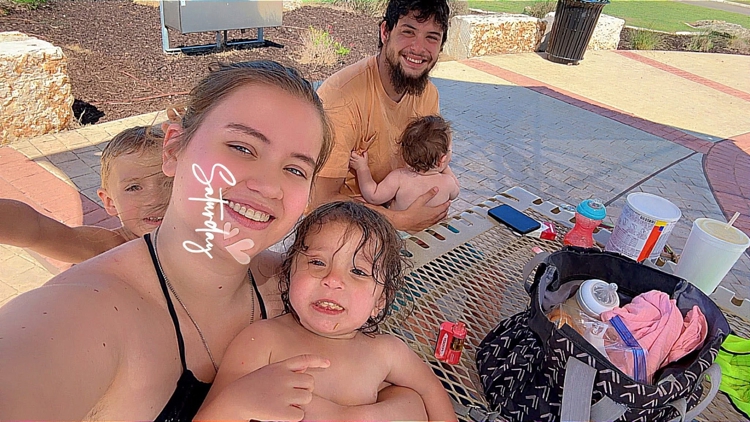
Through tears and shock, 27-year-old Julian Ryan’s family members said the father, brother, and fiancé died a hero.

INGRAM, Texas — Christinia Wilson and her fiancé, Julian Ryan, were at home in Ingram when the devastating floodwaters started to rise along the Guadalupe River in the early morning hours on Friday.

They lived at their house near the river with their children and Ryan’s mother.

Everything happened fast. Trees were thrown like toothpicks, and water quickly rose, leaving families with little time to comprehend what was happening.
RELATED: Several families, children missing after devastating flooding hits Texas Hill Country
When the water started to rise, Ryan sprang into action — those actions ended up being the last of his life.
Through tears and shock, the 27-year-old’s family members said the father, brother, and fiancé died a hero.

“He died a hero, and that will never go unnoticed,” Ryan’s sister, Connie Salas, said.

Wilson said that within 20 minutes, the water was up to their knees in the house.

“It just started pouring in, and we had to fight the door to get it closed to make sure not too much got in. We went back to the room and started calling 911,” Wilson said.

That’s when Wilson said her fiancé punched out a window to try to get her, their children, and his mother to safety.
“It severed his artery in his arm and almost cut it clean off,” she said.
Wilson said they kept calling 911, but no one could get to them in time to save him.
“By 6 (a.m.), he looked at me and the kids and my mother-in-law and said, ‘I’m sorry, I’m not going to make it. I love y’all,” Wilson said.
She said his body wasn’t recovered until hours later — when the water receded.
Now, loved ones are left with only memories of the man they call a hero.

“He is the hero in this story,” Salas said.

They’re now left questioning the preparations and response to the catastrophic flooding.

“When they said my brother was dying, they should have went to him first. That’s how I see it,” Joseph Rounsley said.

Ryan’s best friend remembered his buddy as a gentle soul.

“He’s the kindest person I’ve ever met in my life, and I’ll forever love him no matter what,” Kris Roberts said.

Now, Wilson, Salas, Rounsley and Roberts stand together, saying more needs to be implemented to avoid anything like this from ever happening again. They believe flood sirens could have saved lives.

“Everybody would’ve been worried — what’s that noise?” Wilson said. “We would have left. We would have gone anywhere else. We had so many places that were safe.”

The family has asked for help to get through the tragedy. Click here to donate to their GoFundMe account.


Great Job Felicia Ray Owens & the Team @ FROUSA Media Source link for sharing this story.

#FeliciaRayOwens #TheFeliciaFiles #FROUSA #LocalVoices #IndependentMedia #HerSheSquad

Great Job Felicia Ray Owens & the Team @ Felicia Ray Owens Source link for sharing this story.

#FROUSA #HillCountryNews #NewBraunfels #ComalCounty #LocalVoices #IndependentMedia

Great Job Felicia Ray Owens & the Team @ FROUSA Media Source link for sharing this story.

#FeliciaRayOwens #TheFeliciaFiles #FROUSA #LocalVoices #IndependentMedia #HerSheSquad

Great Job Felicia Ray Owens & the Team @ Felicia Ray Owens Source link for sharing this story.

ECB’s Makhlouf says euro not ready to challenge dollar’s role

ECB’s Makhlouf says euro not ready to challenge dollar’s role

The euro cannot quickly supplant the dollar as the anchor of the world’s financial system as countries using it still have far to go in their financial and economic integration, European Central Bank Governing Council member Gabriel Makhlouf said.

The Central Bank of Ireland Governor said dollar dominance will decline over the long-term, but for now Europe lacks a single fiscal capacity of a safe asset like Treasuries that would mirror the US system.

“Frankly, Europe’s economic system is still not formed,” Makhlouf said at an economic conference in Aix-en-Provence, France. 

Currency movements in recent months, which have seen the euro appreciate against the dollar, are more attributable to investor concerns about the rule of law in the US, he added.

“It’s a bit far to say that’s suddenly going to lead to the euro replacing the dollar because the euro is not ready to do that,” Makhlouf said. 

Still, he echoed the calls of his colleagues at the ECB for Europe to use the current environment of global uncertainty as an opportunity to bolster its own security, lift barriers within its single market and increase joint-financing for shared objectives. 

“These opportunities to actually increase the standing of the EU, to strengthen its sovereignty and autonomy matter, and they need to be taken,” Makhlouf said. 

Introducing the 2025 Fortune 500, the definitive ranking of the biggest companies in America. Explore this year’s list.

Great Job William Horobin, Bloomberg & the Team @ Fortune | FORTUNE Source link for sharing this story.

‘I’m not going to make it’ | Man dies saving family from Texas Hill Country floodwaters | FROUSA Media

‘I’m not going to make it’ | Man dies saving family from Texas Hill Country floodwaters | FROUSA Media | FROUSA Media

Through tears and shock, 27-year-old Julian Ryan’s family members said the father, brother, and fiancé died a hero.

INGRAM, Texas — Christinia Wilson and her fiancé, Julian Ryan, were at home in Ingram when the devastating floodwaters started to rise along the Guadalupe River in the early morning hours on Friday.

They lived at their house near the river with their children and Ryan’s mother.

Everything happened fast. Trees were thrown like toothpicks, and water quickly rose, leaving families with little time to comprehend what was happening.
RELATED: Several families, children missing after devastating flooding hits Texas Hill Country
When the water started to rise, Ryan sprang into action — those actions ended up being the last of his life.
Through tears and shock, the 27-year-old’s family members said the father, brother, and fiancé died a hero.

“He died a hero, and that will never go unnoticed,” Ryan’s sister, Connie Salas, said.

Wilson said that within 20 minutes, the water was up to their knees in the house.

“It just started pouring in, and we had to fight the door to get it closed to make sure not too much got in. We went back to the room and started calling 911,” Wilson said.

That’s when Wilson said her fiancé punched out a window to try to get her, their children, and his mother to safety.
“It severed his artery in his arm and almost cut it clean off,” she said.
Wilson said they kept calling 911, but no one could get to them in time to save him.
“By 6 (a.m.), he looked at me and the kids and my mother-in-law and said, ‘I’m sorry, I’m not going to make it. I love y’all,” Wilson said.
She said his body wasn’t recovered until hours later — when the water receded.
Now, loved ones are left with only memories of the man they call a hero.

“He is the hero in this story,” Salas said.

They’re now left questioning the preparations and response to the catastrophic flooding.

“When they said my brother was dying, they should have went to him first. That’s how I see it,” Joseph Rounsley said.

Ryan’s best friend remembered his buddy as a gentle soul.

“He’s the kindest person I’ve ever met in my life, and I’ll forever love him no matter what,” Kris Roberts said.

Now, Wilson, Salas, Rounsley and Roberts stand together, saying more needs to be implemented to avoid anything like this from ever happening again. They believe flood sirens could have saved lives.

“Everybody would’ve been worried — what’s that noise?” Wilson said. “We would have left. We would have gone anywhere else. We had so many places that were safe.”

The family has asked for help to get through the tragedy. Click here to donate to their GoFundMe account.


#FROUSA #HillCountryNews #NewBraunfels #ComalCounty #LocalVoices #IndependentMedia

Great Job Felicia Ray Owens & the Team @ FROUSA Media Source link for sharing this story.

#FeliciaRayOwens #TheFeliciaFiles #FROUSA #LocalVoices #IndependentMedia #HerSheSquad

Great Job Felicia Ray Owens & the Team @ Felicia Ray Owens Source link for sharing this story.

‘What Would You Do?’: Black Man Says He’s Facing Racist Hate After Punching Passenger Who Allegedly Choked Him on Frontier Flight

‘What Would You Do?’: Black Man Says He’s Facing Racist Hate After Punching Passenger Who Allegedly Choked Him on Frontier Flight

A man who was taunted and then choked by a stranger sitting behind him on a Frontier Airlines flight is speaking out about the terrible ordeal, an experience he said “changed everything in my life overnight.”

The fight was caught on video from multiple angles by fellow passengers, and several edited clips made headline news. But victim Keanu Evans said the initial reporting has been misleading, and despite the police stating the attack was “unprovoked,” he is still facing an onslaught of “racist comments and hate speech.”

‘What Would You Do?’: Black Man Says He’s Facing Racist Hate After Punching Passenger Who Allegedly Choked Him on Frontier Flight
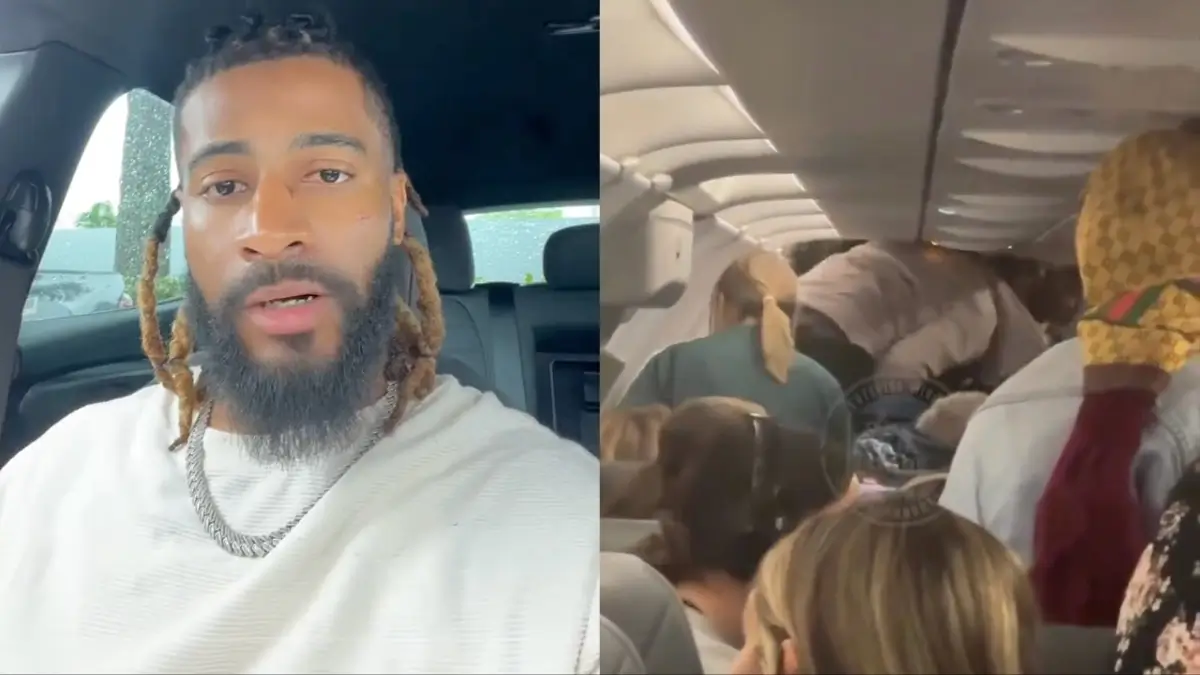
Keanu Evans speaks about a viral fight he was involved in on July 3, 2025. (Photos: TikTok/Keanu Evans, X/OnlyInDade)

Among the critics are some who called out Evans for defending himself. “People are saying if I’m a man of God, why didn’t I use my words?” he revealed in a July 3 video posted on his TikTok account to set the record straight. “What would you do if you were in a confined space in an aircraft and another stranger you don’t know stands up and starts to choke you? I defended myself. I did what any rational person would do.”

He continued, “The only thing that upsets me is that these news outlets are reporting false narratives, and everybody is starting to run with it and believe it.”

Events unfolded on July 1 as the flight was coming into Miami International Airport.

Evans was relaxing in his seat with his headphones on when he heard “villainous laughter” that was loud enough to cut through his music. After his seatmates shot him several concerned looks, he turned to ask the man, “Are you good?” That’s when alleged attacker Ishaan Sharma, a 21-year-old from New Jersey, lit into him, calling him “puny” and “weak,” and making death threats, stated Evans.

Shocked, Evans went to the restroom and informed the flight attendants, who told him they were aware of the situation and instructed him to press the call button if things escalated. As soon as Evans returned to his seat, Sharma started back up with the “disturbed” comments and threats, Evans claimed. After pressing the call button, he turned to ask Sharma, “Yo, what’s your problem?”

“He immediately put his forehead on my forehead, face to face, and he grabs me with both of his hands and he starts to choke me,” he recounted.  

Sharma was arrested and charged with battery. He is facing a $500 bond, according to jail records, and suffered a black eye and multiple cuts to his face. As the saying goes, you reap what you sow, but Evans expressed that he is “genuinely concerned” for Sharma’s mental state. “I pray that that man gets the help that he needs because that is not OK.”

Evan’s retelling of the incident has garnered more than 6,000 comments, with the vast majority of them supporting his decision to defend himself.

“The aggressor was arrested. Why is there any other narrative at all?” asked one person. “I guess people are judging you because you kicked the other guys a**,” wrote another.

“Good that’s what he gets for instigating,” wrote a supporter on the official Instagram account of the New York Post. But some question how things could have spun out of control so quickly in the first place. “Remember just after 9/11 when you were afraid to even fart in a plane for fear of an air marshal snapping your spine?”

Today, only 6 percent of U.S. flights have air marshals on board, per The New York Times. Meanwhile, there has been a spike in threatening or violent behavior during passenger flights since 2021, according to data from the FAA. Unruly passengers can now face fines up to $37,000 and be prosecuted on criminal charges.

Great Job Grace Jidoun & the Team @ Atlanta Black Star Source link for sharing this story.

Scientists just found a major flaw in a key COVID drug study

Scientists just found a major flaw in a key COVID drug study

The COVID pandemic illustrated how urgently we need antiviral medications capable of treating coronavirus infections. To aid this effort, researchers quickly homed in on part of SARS-Cov-2’s molecular structure known as the NiRAN domain — an enzyme region essential to viral replication that’s common to many coronaviruses. A drug targeting the NiRAN domain would likely work broadly to shut down a range of these pathogens, potentially treating known diseases like COVID as well as helping to head off future pandemics caused by related viruses,

In 2022, scientists in China (Yan et al.) published a structural model describing exactly how this domain works. It should have been a tremendous boon for drug developers.

But the model was wrong.

“Their work contains critical errors,” says Gabriel Small, a graduate fellow in the laboratories of Seth A. Darst and Elizabeth Campbell at Rockefeller. “The data does not support their conclusions.”

Now, in a new study published in Cell, Small and colleagues demonstrate exactly why scientists still don’t know how the NiRAN domain works. The findings could have sweeping implications for drug developers already working to design antivirals based on flawed assumptions, and underscore the importance of rigorous validation.

“It is absolutely important that structures be accurate for medicinal chemistry, especially when we’re talking about a critical target for antivirals that is the subject of such intense interest in industry,” says Campbell, head of the Laboratory of Molecular Pathogenesis. “We hope that our work will prevent developers from futilely trying to optimize a drug around an incorrect structure.”

A promising lead

By the time the original paper was published in Cell, the Campbell and Darst labs were already quite familiar with the NiRAN domain and its importance as a therapeutic target. Both laboratories study gene expression in pathogens, and their work on SARS-CoV-2 focuses in part on characterizing the molecular interactions that coordinate viral replication.

The NiRAN domain is essential for helping SARS-CoV-2 and other coronaviruses cap their RNA, a step that allows these viruses to replicate and survive. In one version of this process, the NiRAN domain uses a molecule called GDP to attach a protective cap to the beginning of the virus’s RNA. Small previously described that process in detail, and its structure is considered solved. But the NiRAN domain can also use a related molecule, GTP, to form a protective cap. Determined to develop antivirals that comprehensively shut down the NiRAN domain, scientists were keen to discover the particulars of the latter GTP-related mechanism.

In the 2022 paper, researchers described a chain of chemical steps, beginning with a water molecule breaking a bond to release the RNA’s 5′ phosphate end. That end then attaches to the beta-phosphate end of the GTP molecule, which removes another phosphate and, with the help of a magnesium ion, transfers the remaining portion of the GTP molecule to the RNA, forming a protective cap that allows the virus to replicate and thrive.

The team’s evidence? A cryo-electron microscopy image that showed the process caught in action. To freeze this catalytic intermediate, the team used a GTP mimic called GMPPNP.

Small read the paper with interest. “As soon as they published, I went to download their data,” he says. It wasn’t there. This raised a red flag — data is generally available upon release of a structural biology paper. Months later, however, when Small was finally able to access the data, he began to uncover significant flaws. “I tried to make a figure using their data, and realized that there were serious issues,” he says. Small brought his concerns to Campbell and Darst.

They agreed. “Something was clearly wrong,” Campbell says. “But we decided to give the other team the benefit of the doubt, and reprocess all of their data ourselves.”

An uphill battle

It was painstaking work, with Small leading the charge. Working frame by frame, he compared the published atomic model to the actual cryo-EM map and found something striking: the key molecules that Yan and colleagues claimed to have seen — specifically, the GTP mimic GMPPNP and a magnesium ion in the NiRAN domain’s active site — simply were not there.

Not only was there no supporting image data, but the placement of these molecules in the original model also violated basic rules of chemistry, causing severe atomic clashes and unrealistic charge interactions. Small ran additional tests, but even advanced methods designed to pick out rare particles turned up empty. He could find no evidence to support the model previously produced by Yan and colleagues.

Once the Rockefeller researchers validated their results, they submitted their findings to Cell. “It was very important that we publish our corrective manuscript in the same journal that published the original model,” Campbell says, noting that corrections to high-profile papers are often overlooked when published in lower tier journals.

Otherwise, this confusion in the field could cause problems that reach far beyond the lab bench, Campbell adds — a costly reminder that rigorous basic biomedical research is not just academic, but essential to real-world progress. “Companies keep their cards close to their chests, but we know that several industry groups are studying this,” she says. “Efforts based on a flawed structural model could result in years of wasted time and resources.”

Great Job & the Team @ Public Health News — ScienceDaily Source link for sharing this story.

PVL: Akari edges ZUS Coffee, gives Tina Salak a winning welcome

PVL: Akari edges ZUS Coffee, gives Tina Salak a winning welcome

PVL: Akari edges ZUS Coffee, gives Tina Salak a winning welcome

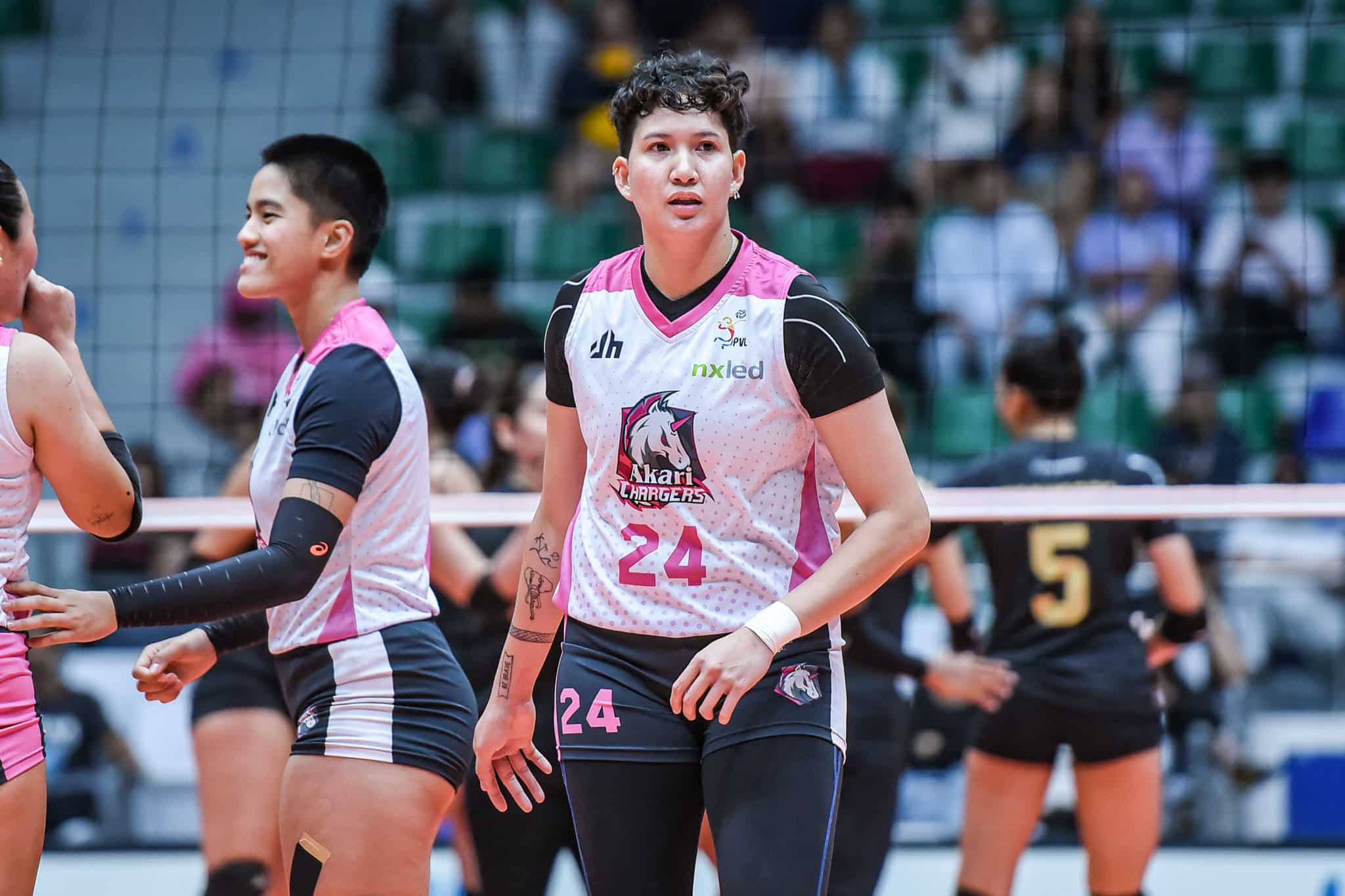
Akari Chargers during a PVL on Tour game against ZUS Coffee Thunderbelles. –PVL PHOTO

MONTALBAN, Rizal — Akari snapped a two-game skid and gave new coach Tina Salak a winning debut, surviving ZUS Coffee, 26-24, 25-21, 17-25, 17-25, 17-15,  in the PVL on Tour Saturday evening at Ynares Center Montalban.

After a winless two-game stop in Vigan, Ilocos Sur–which Salak missed due to personal matters–the Chargers finally entered the win column with old reliables Eli Soyud and Grethcel Soltones leading the way for a 1-2 record in Pool B.

Article continues after this advertisement

READ: PVL: Chenie Tagaod excited to work with Tina Salak anew

Soltones finished with 23 points and 11 digs, while Soyud, the Most Improved Player of the previous PVL season, scored seven of her 19 points in the fifth set.

“Since everything’s new—the system, everything—we really need to pick up Coach Tina’s system quickly so we won’t struggle in the next games. We’re also very happy because even with how things went, we were able to recover in the end thanks to the reminders from the coaches, especially Coach Tina,” said Soltones in Filipino.

Akari Chargers' Eli SoyudAkari Chargers during a PVL on Tour game against ZUS Coffee Thunderbelles.Akari Chargers' Eli SoyudAkari Chargers during a PVL on Tour game against ZUS Coffee Thunderbelles.

Akari Chargers’ Eli Soyud
Akari Chargers during a PVL on Tour game against ZUS Coffee Thunderbelles. –PVL PHOTO

Soyud sent the Chargers to match point, 14-13, but rookie AC Miner forced a deuce. Both squads exchanged errors before Ced Domingo brought them back on top with a 16-15 lead. A costly attack error by Kate Santiago allowed Akari to escape with a win.

Article continues after this advertisement

“Coach told us, ‘It would be such a waste if we worked so hard in the first two sets only to end up losing.’ That really pushed me, and I thought, ‘Yeah, it would be a waste if we didn’t get anything out of all our effort,’” said Soyud. “So I just pushed myself to score in the fifth set, especially since we were all tired already, but we needed to keep going.”

READ: PVL: Bea Bonafe embraces growth in new chapter with Akari

Domingo delivered 12 points. Ivy Lacsina had nine points. Chenie Tagaod and Ezra Madrigal chipped in six points. Setter Kamille Cal had 15 excellent sets on top of six points, while libero Dani Ravena protected the floor with 22 digs and 13 excellent receptions.

Article continues after this advertisement

“I was surprised with how the team performed, especially since I just got back from vacation. We didn’t have super high expectations, but I really saw the team’s resiliency, and that’s a big factor for us, especially at this point. Instead of dwelling on the injuries, we chose to focus on winning,” said Salak in Filipino.

“The good thing is, hopefully, we can recover quickly since we have another game tomorrow. We’re also thankful to ZUS. That game really tested the team’s character These two right here, (Soyud and Soltones) were key factors. They really held on to what they wanted to happen.”

Soltones had a clutch showing in the first two sets. She drilled the last two points for Akari in the opening set and capped a 6-1 turnaround in the second set.

But the Chargers, who were bogged down with 32 errors, lost steam in the ensuing sets to allow ZUS Coffee to pull level.

Akari hopes to carry the momentum against Chery Tiggo, which fended off Capital1 in four sets earlier, on Sunday at 4 p.m.

Jov Gonzaga played through cramps in the final set and finished with 23 points, 12 receptions, and 11 digs in a losing effort. Chinnie Arroyo had 17 points, while rookie Miner debuted with 12 points.


Your subscription could not be saved. Please try again.


Your subscription has been successful.

ZUS Coffee hopes to bounce back against the winless Capital1 also on Sunday at 6:30 p.m.

Great Job & the Team @ INQUIRER.net Source link for sharing this story.

Congress Won't Block State AI Regulations. Here's What That Means for Consumers

Congress Won't Block State AI Regulations. Here's What That Means for Consumers

After months of debate, a plan in Congress to block states from regulating artificial intelligence was pulled from the big federal budget bill this week. The proposed 10-year moratorium would have prevented states from enforcing rules and laws on AI if the state accepted federal funding for broadband access.

The issue exposed divides among technology experts and politicians, with some Senate Republicans joining Democrats in opposing the move. The Senate eventually voted 99-1 to remove the proposal from the bill, which also includes the extension of the 2017 federal tax cuts and cuts to services like Medicaid and SNAP. Congressional Republican leaders have said they want to have the measure on President Donald Trump’s desk by July 4.

AI Atlas

Tech companies and many Congressional Republicans supported the moratorium, saying it would prevent a “patchwork” of rules and regulations across states and local governments that could hinder the development of AI — especially in the context of competition with China. Critics, including consumer advocates, said states should have a free hand to protect people from potential issues with the fast-growing technology. 

“The Senate came together tonight to say that we can’t just run over good state consumer protection laws,” Sen. Maria Cantwell, a Washington Democrat, said in a statement. “States can fight robocalls, deepfakes and provide safe autonomous vehicle laws. This also allows us to work together nationally to provide a new federal framework on artificial intelligence that accelerates US leadership in AI while still protecting consumers.”

Despite the moratorium being pulled from this bill, the debate over how the government can appropriately balance consumer protection and supporting technology innovation will likely continue. “There have been a lot of discussions at the state level, and I would think that it’s important for us to approach this problem at multiple levels,” said Anjana Susarla, a professor at Michigan State University who studies AI. “We could approach it at the national level. We can approach it at the state level, too. I think we need both.”

Several states have already started regulating AI

The proposed moratorium would have barred states from enforcing any regulation, including those already on the books. The exceptions are rules and laws that make things easier for AI development and those that apply the same standards to non-AI models and systems that do similar things. These kinds of regulations are already starting to pop up. The biggest focus is not in the US, but in Europe, where the European Union has already implemented standards for AI. But states are starting to get in on the action.

Colorado passed a set of consumer protections last year, set to go into effect in 2026. California adopted more than a dozen AI-related laws last year. Other states have laws and regulations that often deal with specific issues such as deepfakes or require AI developers to publish information about their training data. At the local level, some regulations also address potential employment discrimination if AI systems are used in hiring.

“States are all over the map when it comes to what they want to regulate in AI,” said Arsen Kourinian, a partner at the law firm Mayer Brown. So far in 2025, state lawmakers have introduced at least 550 proposals around AI, according to the National Conference of State Legislatures. In the House committee hearing last month, Rep. Jay Obernolte, a Republican from California, signaled a desire to get ahead of more state-level regulation. “We have a limited amount of legislative runway to be able to get that problem solved before the states get too far ahead,” he said.

Read more: AI Essentials: 29 Ways to Make Gen AI Work for You, According to Our Experts

While some states have laws on the books, not all of them have gone into effect or seen any enforcement. That limits the potential short-term impact of a moratorium, said Cobun Zweifel-Keegan, managing director in Washington for IAPP. “There isn’t really any enforcement yet.” 

A moratorium would likely deter state legislators and policymakers from developing and proposing new regulations, Zweifel-Keegan said. “The federal government would become the primary and potentially sole regulator around AI systems,” he said.

What a moratorium on state AI regulation would mean

AI developers have asked for any guardrails placed on their work to be consistent and streamlined. 

“We need, as an industry and as a country, one clear federal standard, whatever it may be,” Alexandr Wang, founder and CEO of the data company Scale AI, told lawmakers during an April hearing. “But we need one, we need clarity as to one federal standard and have preemption to prevent this outcome where you have 50 different standards.”

During a Senate Commerce Committee hearing in May, OpenAI CEO Sam Altman told Sen. Ted Cruz, a Republican from Texas, that an EU-style regulatory system “would be disastrous” for the industry. Altman suggested instead that the industry develop its own standards.

Asked by Sen. Brian Schatz, a Democrat from Hawaii, if industry self-regulation is enough at the moment, Altman said he thought some guardrails would be good, but, “It’s easy for it to go too far. As I have learned more about how the world works, I am more afraid that it could go too far and have really bad consequences.” (Disclosure: Ziff Davis, parent company of CNET, in April filed a lawsuit against OpenAI, alleging it infringed Ziff Davis copyrights in training and operating its AI systems.)

Not all AI companies are backing a moratorium, however. In a New York Times op-ed, Anthropic CEO Dario Amodei called it “far too blunt an instrument,” saying the federal government should create transparency standards for AI companies instead. “Having this national transparency standard would help not only the public but also Congress understand how the technology is developing, so that lawmakers can decide whether further government action is needed.”

Sen. Ted Cruz and Sen. Maria Cantwell sit at a dais during a congressional hearing. Cantwell (right) is pointing and Cruz (left) has his hand on his chin.

A proposed 10-year moratorium on state AI laws is now in the hands of the US Senate, where its Committee on Commerce, Science and Transportation has already held hearings on artificial intelligence. 

Nathan Howard/Bloomberg via Getty Images

Concerns from companies, both the developers that create AI systems and the “deployers” who use them in interactions with consumers, often stem from fears that states will mandate significant work such as impact assessments or transparency notices before a product is released, Kourinian said. Consumer advocates have said more regulations are needed and hampering the ability of states could hurt the privacy and safety of users.

A moratorium on specific state rules and laws could result in more consumer protection issues being dealt with in court or by state attorneys general, Kourinian said. Existing laws around unfair and deceptive practices that are not specific to AI would still apply. “Time will tell how judges will interpret those issues,” he said.

Susarla said the pervasiveness of AI across industries means states might be able to regulate issues such as privacy and transparency more broadly, without focusing on the technology. But a moratorium on AI regulation could lead to such policies being tied up in lawsuits. “It has to be some kind of balance between ‘we don’t want to stop innovation,’ but on the other hand, we also need to recognize that there can be real consequences,” she said.

Much policy around the governance of AI systems does happen because of those so-called technology-agnostic rules and laws, Zweifel-Keegan said. “It’s worth also remembering that there are a lot of existing laws and there is a potential to make new laws that don’t trigger the moratorium but do apply to AI systems as long as they apply to other systems,” he said.

What’s next for federal AI regulation?

One of the key lawmakers pushing for the removal of the moratorium from the bill was Sen. Marsha Blackburn, a Tennessee Republican. Blackburn said she wanted to make sure states were able to protect children and creators, like the country musicians her state is famous for. “Until Congress passes federally preemptive legislation like the Kids Online Safety Act and an online privacy framework, we can’t block states from standing in the gap to protect vulnerable Americans from harm — including Tennessee creators and precious children,” she said in a statement.

Groups that opposed the preemption of state laws said they hope the next move for Congress is to take steps toward actual regulation of AI, which could make state laws unnecessary. If tech companies “are going to seek federal preemption, they should seek federal preemption along with a federal law that provides rules of the road,” Jason Van Beek, chief government affairs officer at the Future of Life Institute, told me. 

Ben Winters, director of AI and data privacy at the Consumer Federation of America, said Congress could take up the idea of pre-empting state laws again in separate legislation. “Fundamentally, it’s just a bad idea,” he told me. “It doesn’t really necessarily matter if it’s done in the budget process.”

Great Job Jon Reed & the Team @ CNET Source link for sharing this story.

‘I’m not going to make it’ | Man dies saving family from Texas Hill Country floodwaters

‘I’m not going to make it’ | Man dies saving family from Texas Hill Country floodwaters

Through tears and shock, 27-year-old Julian Ryan’s family members said the father, brother, and fiancé died a hero.

INGRAM, Texas — Christinia Wilson and her fiancé, Julian Ryan, were at home in Ingram when the devastating floodwaters started to rise along the Guadalupe River in the early morning hours on Friday.

They lived at their house near the river with their children and Ryan’s mother.

Everything happened fast. Trees were thrown like toothpicks, and water quickly rose, leaving families with little time to comprehend what was happening.

RELATED: Several families, children missing after devastating flooding hits Texas Hill Country

When the water started to rise, Ryan sprang into action — those actions ended up being the last of his life.

Through tears and shock, the 27-year-old’s family members said the father, brother, and fiancé died a hero.

“He died a hero, and that will never go unnoticed,” Ryan’s sister, Connie Salas, said.

Wilson said that within 20 minutes, the water was up to their knees in the house.

“It just started pouring in, and we had to fight the door to get it closed to make sure not too much got in. We went back to the room and started calling 911,” Wilson said.

That’s when Wilson said her fiancé punched out a window to try to get her, their children, and his mother to safety.

“It severed his artery in his arm and almost cut it clean off,” she said.

Wilson said they kept calling 911, but no one could get to them in time to save him.

“By 6 (a.m.), he looked at me and the kids and my mother-in-law and said, ‘I’m sorry, I’m not going to make it. I love y’all,” Wilson said.

She said his body wasn’t recovered until hours later — when the water receded.

Now, loved ones are left with only memories of the man they call a hero.

“He is the hero in this story,” Salas said.

They’re now left questioning the preparations and response to the catastrophic flooding.

“When they said my brother was dying, they should have went to him first. That’s how I see it,” Joseph Rounsley said.

Ryan’s best friend remembered his buddy as a gentle soul.

“He’s the kindest person I’ve ever met in my life, and I’ll forever love him no matter what,” Kris Roberts said.

Now, Wilson, Salas, Rounsley and Roberts stand together, saying more needs to be implemented to avoid anything like this from ever happening again. They believe flood sirens could have saved lives.

“Everybody would’ve been worried — what’s that noise?” Wilson said. “We would have left. We would have gone anywhere else. We had so many places that were safe.”

The family has asked for help to get through the tragedy. Click here to donate to their GoFundMe account.


Great Job & the Team @ WFAA RSS Feed: news Source link for sharing this story.

A fragile ceasefire in the Israel-Iran war tests the harmony of Los Angeles’ huge Iranian community

A fragile ceasefire in the Israel-Iran war tests the harmony of Los Angeles’ huge Iranian community

LOS ANGELES – “Tehrangeles” in West Los Angeles is home to the largest Iranian community outside Iran.

This cultural enclave, also known as Little Persia, is where Iranian Muslims, Jews, Christians, Zoroastrians and Bahai have peacefully coexisted for decades.

But the recent war between Israel and Iran — a bloody, 12-day conflict paused by a fragile ceasefire — has brought up religious tensions and political debates that rarely surface in this culturally harmonious environment. To complicate matters, the U.S. — an ally of Israel — bombed Iran during the war.

Many Iranian Jews in the diaspora have viewed the onset of the war with “anxious glee,” said Daniel Bral, a West Los Angeles resident whose grandfather, Moossa Bral, was the sole Jewish member of parliament in prerevolutionary Iran. He sees family members and others in the community rejoicing at the possibility of their “tormentor” being vanquished.

But Bral feels differently.

“I’m just nervous and am completely rattled by everything that is happening,” he said. “I understand and sympathize with people’s hope for regime change. But I worry about the safety of civilians and the efficacy of the operation removing Iran as a nuclear threat.”

But Bral doesn’t see the war itself as a divisive issue in the diaspora because antagonism for the current regime is common across religious groups.

“This hatred for the regime actually unifies Muslims and Jews,” he said.

Cultural enclave offers a sense of grounding

Kamran Afary, a professor of communication at California State University, Los Angeles, who emigrated from Iran in the 1970s and cowrote a book about identities in Iranian diaspora, said the community, for the most part, has nursed a spirit of tolerance and respect, much like his interfaith family. While Afary is spiritual but not religious, other members of his family practice Judaism, Islam and the Bahai faith.

“Interfaith marriage used to be fraught, but even that is common now,” he said.

Afary says for him, Tehrangeles, with its row of grocery stores, ice cream and kebab shops, restaurants, bakeries and bookstores, offers solace and a sense of grounding in his culture and roots. There are about half a million Iranian Americans in the Greater Los Angeles region.

The largest wave of Iranians migrated to the area after Shah Mohammad Reza Pahlavi was overthrown in 1979 and Ayatollah Khomeini assumed control, establishing the Islamic Republic of Iran. West Los Angeles, in particular, has the largest concentration of Iranian Jews outside Iran.

A test for long-held bonds

Diane Winston, professor of media and religion at the University of Southern California, said Israel’s recent fight against the regime in Iran could test relationships between Iranian Jews and Muslims.

“Muslims, who otherwise would be happy to see regime change, might have felt a little differently about it because their antipathy for Zionism is strong,” she said.

Winston also observed that in the diaspora, which is concentrated in wealthy cities like Beverly Hills and Westwood, it is not just religion or culture that brings people together, but also their elevated social status.

“They go to the same schools, parties and cultural events,” she said. “In general, Iranian Muslims and Jews are not quite as religious as their counterparts back home. Los Angeles is a city where there is room to be orthodox, but also being less religious is not a problem. The less religious Jews and Muslims are, the less antipathy they may have toward each other.”

A time of fear and uncertainty

Tanaz Golshan was 2 when her family left Iran in 1986. She serves as the senior vice president of Caring for Jews in Need, the Jewish Federation Los Angeles’ service arm. She is also the organization’s liaison to the Iranian Jewish community.

Judaism for Iranians is “more cultural and familial,” Golshan said. Getting together Friday for Shabbat means having Persian Jewish dishes like “gondi,” which are dumplings served in soup.

“In my family, we didn’t grow up too religious,” she said. “We don’t think about religion when we go to a restaurant or market. You’ll find people in both communities that are extreme and don’t want anything to do with the other. But in general, we have a lot of love and respect for each other.”

And yet this is proving to be a tense and scary time for Iranian Jews in the diaspora, she said.

“What happens globally can affect security locally,” Golshan said, adding the federation’s helpline has received calls asking if there are any threats to local Jewish institutions, she said. “There is real fear that temples and community centers could become targets.”

On Monday, Golshan’s organization and others hosted more than 350 community members for a virtual event titled, L.A. United: Iranian and Israeli Communities in Solidarity.

A call for regime change in Iran

Reactions to the war have been nuanced, regardless of religious affiliations. Arezo Rashidian, whose family is Muslim, is a Southern California political activist who favors regime change in Iran. She supports the return of Reza Pahlavi, the exiled son of the shah, who has declared he is ready to lead the country’s transition to a democratic government.

Rashidian said she has never been able to visit Iran because of her activism. The only hope for her return would be for the current regime to fall. This is why the ceasefire has stirred mixed feelings for her and many others in the community, she said.

“It’s been an emotional roller coaster. No one wants a war, but we were on the brink of seeing this regime collapse. We were so close,” she said.

Lior Sternfeld, professor of history and Jewish studies at Penn State University, said Iranian Jews in the diaspora identify with Iran, Israel and the U.S., and that these identities are “often not in harmony.”

“They don’t see the Islamic Republic as Iran any more, but an entity to be demolished,” he said. “They see Israel more as a religious homeland.”

President Donald Trump enjoyed strong support in the diaspora and has now upset his backers in the community because he has stated he is not interested in regime change, Sternfeld said.

Desire for unity and common ground

There is a push, particularly in the younger generation, for peace and understanding among religious groups in the diaspora.

Bral says he is engaged in peacebuilding work through his writing and advocacy. “We are cousins at the end of the day, as clichéd and corny as that sounds,” he said.

Bral’s friend Rachel Sumekh, whose parents emigrated from Iran, grew up Jewish in the San Fernando Valley. Sumekh hosts dinner parties with her diverse group of friends as a way of widening her circle across religious lines.

In December, she hosted a gathering for Yalda, an ancient Persian festival with Zoroastrian roots, which is observed on the winter solstice as celebrants look forward to brighter days. Last year, Yalda, which also marks the victory of light over darkness, coincided with Hanukkah, the Jewish festival of lights.

“We created a new tradition bringing people of both traditions together to emphasize how much we have in common,” Sumekh said. “This war is just a reminder that as much as our day-to-day lives may be separate, there is still a lot we share in terms of culture and as a people.”

___

Associated Press religion coverage receives support through the AP’s collaboration with The Conversation US, with funding from Lilly Endowment Inc. The AP is solely responsible for this content.

Copyright 2025 The Associated Press. All rights reserved. This material may not be published, broadcast, rewritten or redistributed without permission.


Great Job Deepa Bharath, Associated Press & the Team @ KSAT San Antonio Source link for sharing this story.

Saturday Sessions: Billianne performs “Jessie’s Comet”

Saturday Sessions: Billianne performs “Jessie’s Comet”


Saturday Sessions: Billianne performs “Jessie’s Comet” – CBS News


Watch CBS News


Rising Canadian singer-songwriter Billianne grew up in a musical family. She went viral on TikTok for her cover of Tina Turner’s “The Best,” earning praise from stars like Taylor Swift, Joe Jonas, and P!NK. The 22-year-old has now toured across North America and Europe. Here is Billianne with “Jessie’s Comet.”

Be the first to know

Get browser notifications for breaking news, live events, and exclusive reporting.


Great Job & the Team @ Home – CBSNews.com Source link for sharing this story.

Secret Link