Professional gamblers say a tax change tucked into the One Big Beautiful Bill could wipe out their profits and drive them toward offshore betting sites — threatening an industry that reportedly raked in nearly $115 billion last year.
Great Job Emma Ayers & the Team @ The Washington Times stories: News Source link for sharing this story.
America is facing an energy imperative: Grow power from all sources or face potential failure.
That’s failure in the race against China for AI supremacy; failure to provide ample affordable power for its citizens; and failure to make energy as clean as possible as climate change woes mount with each passing year.
As President Donald Trump has touted American energy dominance, he has leaned on executive orders to expedite natural gas-fired power and new nuclear plants. But regulatory and supply-chain bottlenecks still put those projects several years out.
Meanwhile, Trump’s “One Big, Beautiful Bill” is intentionally handicapping more easily and faster-built wind, solar and battery storage projects that would help satiate the massive data center power demands of the large-scale cloud service providers known as hyperscalers. The final legislation approved by Congress on July 3 (the House concurred on a 218-214 vote) agrees to quickly unwind the clean energy tax credits that could have helped strengthen an already stretched electric grid.
The GOP is leaning on clean energy cuts to support fossil fuels, while channeling the president’s own anti-renewables sentiments: He has often decried the intermittent nature of wind and solar—even if that unpredictability is increasingly offset by the growth of battery storage for renewable energy. And of course cutting tax credits helps offset federal spending elsewhere in the bill.
Unsurprisingly, the clean energy industry is up in arms about the BBB legislation. Abigail Ross Hopper, president and CEO of the Solar Energy Industries Association, said it will increase electricity bills, shut down manufacturing facilities, cost many thousands of U.S. construction jobs, and weaken the grid.
“This legislation [will] set back America’s global competitiveness, destabilize our energy future, and weaken the very industries that power our economy and strengthen our national security—while surrendering the 21st-century tech race to China,” she said.
On the other hand, with money flowing from fossil fuel interests to support Trump and Republicans last year, oil and gas lobbyists—who frequently decry clean energy tax credits as unfair—praised the final bill.
Melissa Simpson, president of the oil and gas industry’s Western Energy Alliance, hailed the “monumental bill that’ll unleash the energy we need.” She specifically touted “provisions promoting oil and natural gas production on public lands” and the halting of the emissions-related “excessive tax on natural gas.”
“Energy dominance” or “energy abundance”?
The final legislation rapidly phases out tax credits for all clean energy projects not online by the end of 2027—exempting those that break ground by June 2026. The Senate’s original, less draconian language required starting construction by the end of 2027—a subtle but massive timeline difference for those scrambling to get projects up and running.
This isn’t just a problem for clean energy developers or environmental advocates; it could dramatically slow the country’s planned and much-needed rapid increases in power generation. In simple terms, that means less power for increasingly electricity-hungry tech and manufacturing sectors, and a growing population—meaning higher power bills for everyone, and possible shortfalls and brownouts.
“The bill doesn’t just burden families, it undermines our country,” said Ari Matusiak, CEO of the Rewiring America nonprofit. “We need low-cost, abundant energy to compete globally. We will become collectively poorer, less resilient, and less equipped to lead in a rapidly changing world.” After all, renewables accounted for almost 90% of new power generation installed in the U.S. last year, according to the Department of Energy.
A wind power turbine near Constellation Energy’s LaSalle Clean Energy Center nuclear power plant, in Illinois.
Scott Olson—Getty Images
Cutting deadlines back to 2027 for completing most projects will result in about 20% fewer clean energy projects being built in the U.S. over the next 10 years, according to S&P Global Commodity Insights projections.
“That’s extremely meaningful,” said Roman Kramarchuk, head of climate market and policy analysis for S&P Global. “This isn’t 20% of a small share; this is 20% of the strong majority of the new deployments.
“That’s rough,” he added. “What it will do is increase costs for power.”
Instead of so-called energy dominance, there’s a growing plea from tech, utilities, and political moderates for scaled-up “energy abundance”—a stance that embraces all forms of power to more rapidly build capacity and help push down prices. But both political parties have been tripped up by ideology, failing to support a strategy that includes clean energy and natural gas—with the GOP targeting renewables and Democrats fighting fossil fuels.
That’s despite the urging of the Edison Electric Institute (EEI), an organization representing investor-owned electric utilities nationwide, and many others. “We’re in unprecedented times for our industry; we haven’t seen this type of load growth since the advent of air conditioning,” EEI chairman and Exelon CEO Calvin Butler told Fortune. “We have to get new power generation built. It’s going to take the all-of-the-above portfolio approach—nuclear, gas, wind, solar, and new technologies like battery storage.”
Butler said he would have supported the legislation if it allowed clean energy projects to break ground by 2027, although later was preferred. “We believe the tax credits are key,” he said. “We don’t believe we can get to the energy dominance without having renewables as part of the solution.”
Why do we need so much power?
After U.S. power demand has remained relatively stagnant for a couple of decades, domestic electricity consumption is expected to spike by 25% from 2023 to 2035 and roughly 60% from 2023 to 2050, according to the International Energy Agency.
A big part of that increase comes from the hyperscalers: Amazon, Google, and Microsoft are investing anywhere from $75 billion to $100 billion each into building data centers for 2025 alone.
To put those dollars in context, the entire market cap of Big Oil giant BP is $80 billion. A planned, super-sized Meta data center in Louisiana, for instance, would require twice the power used by the whole city of New Orleans.
John Ketchum, CEO of NextEra Energy (173 on the Fortune 500)—a massive utility and power developer—estimates that anticipated gas-fired generation cannot even meet 20% of the data center needs from now until 2030. Despite record volumes of shale gas produced domestically in recent years, the turbines required to turn that gas into electricity are getting more costly and there aren’t enough being manufactured because of supply chain challenges.
“If it’s not renewables, what is it going to be?” Ketchum said of the remaining 80% of data center power needs, while speaking at the Politico Energy Summit in June.
While the legislation does not cripple clean energy—a lot of utility-scale wind and solar will still be built—it does substantially weaken its access to tax breaks and increase costs.
A prior version of the bill didn’t just phase out the tax credits; it also placed a brand-new excise tax on clean energy projects—one that even renewable energy opponents bristled at. Some projections estimated the tax easily could have killed most pending clean energy projects, making them economically not viable. That tax was removed just before final Senate voting.
Another last-minute change exempted clean energy projects from losing the tax credit if they break ground by June 2026, even if they exceed the 2027 completion deadline—although these are still very tight timelines.
Likewise, the legislation keeps the “transferability” of tax credits—the removal of which was considered a backdoor “poison pill” meant to cripple the program. Transferability allows smaller developers to raise capital by transferring tax credits at a discount to larger buyers that can immediately take advantage of the tax benefits. The original House version of the bill had eliminated transferability.
The legislation also places new “foreign entity of concern” (FEOC) provisions on renewable energy projects. The FEOC rules, which only applied to electric vehicle tax credits in the Inflation Reduction Act, would now apply to all clean energy tax credits, essentially limiting needed supply-chain materials from China. The House bill placed arduous FEOC provisions on projects, but the final version takes a more measured, phased-in approach.
No matter how much new manufacturing is built in the U.S., many of the materials still only come from China and any delays or missteps cede more ground to China in the middle of a brawl for AI dominance as China rapidly builds more power from coal to wind and solar.
While China is currently more reliant on coal than the U.S., China now sources about one-third of its power from renewables—compared to about 22% in the U.S.—and China is currently installing more solar power, for instance, than the rest of the world combined. As China continues to rapidly build more generation, U.S. slowdowns in any forms of new electricity infrastructure will give China more of a power boost in the AI race to supremacy.
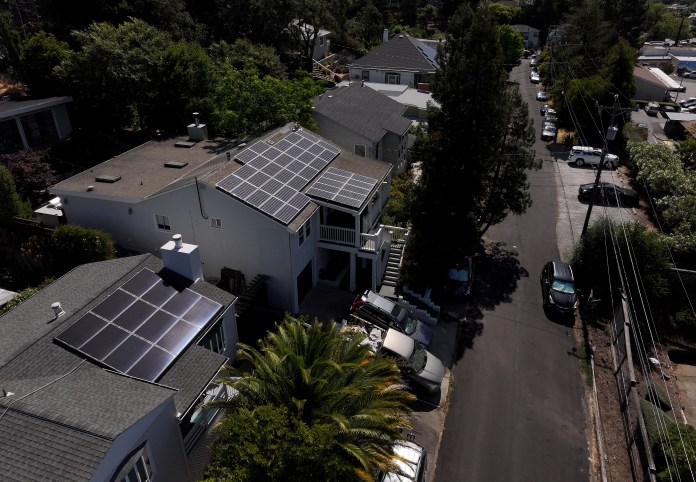
The credit for residential solar projects will be axed as part of the megabill passed by Congress July 3.
Justin Sullivan—Getty Images
The legislation also undoes a bevy of other clean energy and efficiency efforts. The electric vehicle tax credit is axed, as is the credit for residential solar projects and for other home energy efficiency efforts. The megabill also comes as the Trump administration aims to roll back energy efficiency standards for home appliances and more.
“Families will face rising electricity costs with fewer tools to do anything about it,” said Matusiak of Rewiring America. “As energy demand from AI, data centers, and manufacturing explodes, households are boxed in, expected to pay more while getting less.”
Residential electricity costs in the U.S. already have risen by 13% on average from 2022 until now, according to the Department of Energy. And they are projected to keep increasing with demand growth from data centers and higher natural gas prices as a wave of liquefied natural gas export projects come online between now and 2030.
What happens next?
Next up in the renewables sector is the continuation of a rabid race to break ground on clean energy projects to beat the tax credit deadlines. In a way, the more stringent the timelines, the bigger and faster the mad dash is to qualify for tax breaks—even if fewer will be built overall.
“This sector has done this before,” Kramarchuk said. “There’s always the rush to hit the deadlines.”
In the push for more fossil fuel-sourced power, new gas-fired turbines that aren’t already contracted will take five years or so to be built. In the meantime, that means increasing the utilization of existing gas-fired power plants and working to keep more coal plants open for longer. “It means running your existing gas or coal units harder,” Kramarchuk said. Not coincidentally, a tax break for coal exports was a late add to the legislation.
By 2028, 50 gigawatts of existing coal capacity are scheduled to be retired. Some of those plants must stay online for longer to bridge the gap, but how much longer is even possible is unclear. “A lot of those plants are very old and require significant capital investments to keep them going,” he said.
To be clear, the end of tax credits does not mean the death of renewables. The GOP-aligned super PAC ClearPath Action, which supports efforts to combat climate change, called the bill a much better draft than some earlier versions that would have imposed additional taxes on renewables and “devasted” the clean energy industry. “Senate Republicans and House allies rejected that approach and preserved some financial tools to accelerate American innovation and invest in American manufacturing,” said ClearPath CEO Jeremy Harrell.
It does mean, however, that wind and solar projects will become more expensive. A lot of regional utilities and smaller developers may kill the clean energy projects on their drawing boards. But the hyperscalers, of course, have bigger budgets.
“New wind and solar that would’ve been built, can be built. It’s just going to cost a lot more,” Kramarchuk said. “If you’re a hyperscaler, then you probably have more latitude to pay more.”
As for the rest of us? Our electricity and heating bills will likely rise too.
Great Job Jordan Blum & the Team @ Fortune | FORTUNE Source link for sharing this story.
Supreme Court to consider reviving lawsuit restricting evangelizing in small Mississippi town
July 3, 2025
The suspect is expected to be transported to Bexar County Jail at 1:30 p.m. Wednesday
BCSO Perp Walk (KSAT)
SAN ANTONIO – The Bexar County Sheriff’s Office arrested a suspect Wednesday in connection to a January homicide investigation, according to a news release.
The office said it is interviewing the suspect.
Following the interview, the suspect will be transported to Bexar County Jail. KSAT will stream the perp walk in this article.
Christian Riley joined KSAT 12 in June 2025. Riley returned to the Lone Star State after serving as the senior digital producer at the NBC affiliate in mid-Missouri and earning two Missouri Broadcasters Association awards.
Felicia Ray Owens is a media founder, cultural strategist, and civic advocate who creates platforms where power meets lived truth. As the voice behind C4: Coffee. Cocktails. Culture. Conversation and the founder of FROUSA Media, she uses storytelling, public dialogue, and organizing to spotlight the issues that matter most—locally and nationally.
A longtime advocate for community wellness and political engagement, Felicia brings experience as a former Precinct Chair and former Chief Communications Officer of Indivisible Hill Country. Her work bridges culture, activism, and healing through curated spaces designed to inspire real change.
The EPA is placing 144 officials on leave effective immediately after they signed on to a public letter excoriating the agency’s energy dominance agenda and direction under the Trump administration. [emphasis, links added]
EPA administrator Lee Zeldin said the action was part of a zero-tolerance policy for employees who seek to undermine the agency’s policies.
Zeldin emphasized that the majority of EPA employees are dedicated to implementing the Trump EPA’s agenda and that the letter represented the views of a small minority.
The officials will remain on leave pending further investigation, according to the EPA.
Zeldin’s drastic action Thursday sends a clear message to EPA staffers that the administration will not be pressured by such public letters and that it will pursue its agenda regardless of such dissent.
The sprawling agency employs more than 15,000 officials across the country, and it has historically proven difficult for Republican administrations to keep its left-leaning staff in line.
The will of the American public will not be ignored at our agency. -EPA chief Lee Zeldin
“We have a ZERO tolerance policy for agency bureaucrats unlawfully undermining, sabotaging, and undercutting the agenda of this administration as voted for by the great people of this country last November,” Zeldin said in a statement.
“The will of the American public will not be ignored at our agency.”
“Unfortunately, a small number of employees signed onto a public letter, written as agency employees, using their official work title, that was riddled with misinformation regarding agency business,” he added.
“Our ZERO tolerance policy is in full force and effect and will be unapologetically implemented unconditionally.”
The officials sent the letter to Zeldin earlier this week, outlining their dissent with his actions and accusing him of unraveling environmental protections.
The letter listed five primary concerns with the Trump EPA.
It seems like Kathy Griffin likes to keep it natural when she is going for her walks in Southern California.
She was spotted on Tuesday, July 1, on a stroll with a male counterpart in her Malibu neighborhood. For fans who are used to seeing the comedian in her glammed up looks on red carpets and at events, Griffin looked nothing like herself.
Kathy Griffin’s appearance has fans comparing her to the fake severed head that resembled Trump’s.(Photo by Rich Fury/Invision/AP, File)
Paparazzi captured the 64-year-old wearing a gray T-shirt emblazoned with the logo from her Laugh Your Head Off tour, black pants and gray sneakers. Her signature fiery red hair was not in its usual curled style but instead trailed wildly behind her head as she wore no makeup.
This isn’t the first time Griffin has been captured in her natural state. Back in May paparazzi found the “Shrek Forever After” voice actor with no makeup on and “bedhead” hair as she walked with a female friend.
Despite Griffin’s latest look being similar to the candid shots from May, fans still had the same judgmental and startling reaction to her appearance.
Kathy Griffin was photographed showing off her wild, natural hair and brand merch as she stepped out for a walk on Tuesday. : BACKGRID pic.twitter.com/fAaOxwj90X
One person in the Daily Mail’s comments said, “Do she and Carrot Top go to same stylist?” referring to Carrot Top the comedian. Carrot Top, who was born Scott Thompson, also has distinctive curly red hair.
Another person comparing her to a historic redhead figure wrote, “When did she start morphing into Queen Elizabeth the First?” Queen Elizabeth ruled England and Ireland from 1558 to 1603 and is depicted in paintings with short curly red hair.
A third fan, who seems to be holding a grudge against Griffin over what some considered to be a distasteful jab at President Donald Trump, referenced that incident in their comment. They said, “She looks like that fake head she once carried around. Maybe we all should apologize to her for claiming she was carrying Trump’s head when it actually was her own….”
Remember the comedian Kathy Griffin posing with a mock-up of President Trump’s severed head? They’ve wanted him dead forever and now they’re talking about “political violence”. pic.twitter.com/W1f0rqHk7r
Griffin’s career in entertainment tanked after she shared a photo in May 2017 of her holding a fake severed head that resembled Trump’s. The intense backlash led to her tour being canceled and she was under investigation for conspiracy to assassinate Trump, who was then in his first term as president of the United States.
The actress initially apologized for the photo and claimed it was supposed to be political satire. But later that same year she retracted her apology.
“I am no longer sorry. The whole outrage was B.S. The whole thing got so blown out of proportion, and I lost everybody. Like, I had Chelsea Clinton tweeting against me. I had friends, Debra Messing from ‘Will and Grace,’ tweeting against me. I mean, I lost everybody,” she said three months later in an interview with Australian morning TV show called “Sunrise.”
When asked by an anchor if she accepts that she crossed the line, Griffin added, “No. You’re full of crap. Stop this. You know this. Stop acting like my little picture is more important than talking about the actual atrocities that the president of the United States is committing.”
If it wasn’t clear that she has no regrets in that interview, it should be clear now.
On May 31, she stitched a TikTok video of a creator who makes rugs. The rugs that the person posted were the decapitated heads of billionaires like Trump, his on-again, off-again friend and Tesla CEO Elon Musk, Amazon founder Jeff Bezos, and Facebook founder Mark Zuckerberg. At the end of the stitch, Griffin’s video comes in and she smiles and tilts her head at the camera before nodding. Before the video ends, the words “That’s all” pop up above her head.
Great Job J. Jones & the Team @ Atlanta Black Star Source link for sharing this story.
2. Swap Out Corn on the Cob for a Baked Potato Without the Skin
Corn on the cob is a summer BBQ staple, but for those with UC, whole-kernel corn can worsen GI symptoms. Corn is high in insoluble fiber, a type of fiber that is not fully broken down by the body and has a rough texture, which may irritate an inflamed gut.
Insoluble fiber also speeds up GI transit time, meaning it causes food to move through the GI tract more quickly. People who are experiencing a UC flare-up tend to already have reduced GI transit time, so adding extra insoluble fiber to the mix can provoke an already overactive gut. Further, those with an ostomy or J-pouch are often advised to avoid or limit whole-kernel corn because it may increase the risk of an intestinal blockage.
Baked potatoes without the skin can serve as a tasty alternative to corn on the cob. They are less likely to aggravate GI symptoms, and they may even help improve certain symptoms associated with active UC. Potatoes are rich in soluble fiber, a type of fiber that is broken down by the body and slows GI transit time, helping your body absorb more fluid and nutrients from the foods and beverages you consume. This type of fiber also has prebiotic properties, meaning it helps feed beneficial gut microbes, research has found.
By removing the skins of baked potatoes, you’ll eliminate excess insoluble fiber while still reaping the benefits of soluble fiber found in the potato flesh.
Aside from their soluble fiber content, baked potatoes are a good source of potassium, a mineral that serves as an electrolyte, promoting fluid balance. Potassium is commonly depleted in those experiencing a particularly severe flare-up, so it’s important to incorporate plenty of potassium-rich foods into your diet to avoid deficiency.
3. Swap Out Raw Salads for Grilled Yellow Summer Squash, Zucchini, and Eggplant
Raw, fibrous salads can be hard to tolerate when your intestines are inflamed, but peeled and cooked vegetables are another story. Vegetables like yellow summer squash, zucchini, and eggplant are all excellent UC-friendly choices, as they’re in season during the summer and become soft and easy to break down after grilling. For those experiencing a flare-up, it can be helpful to eat only the soft, fleshy parts of the vegetables, leaving the insoluble fiber–rich skins on your plate.
Aside from being rich sources of soluble fiber, zucchini and yellow summer squash contain beta-carotene, a precursor to vitamin A. Vitamin A plays a role in proper immune function and maintaining healthy body tissues, including the gut lining. Studies have found people with inflammatory bowel disease (IBD) are more likely to have low levels of vitamin A as compared with those in healthy control groups, so consuming more dietary sources of beta-carotene and vitamin A can help reduce your risk of not getting enough of this essential nutrient.
Eggplant flesh is packed with phenolic acids, which are antioxidant compounds that help fight inflammation. Because UC is an inflammatory condition, incorporating more antioxidant-rich foods into your diet may be especially beneficial, some research suggests.
4. Swap Out Berries for Seedless Watermelon, Cantaloupe, and Honeydew
Berries can be hard to digest due to their seeds and skin, but other summer fruits like melons are soft and easy to break down (just be sure to remove the seeds).
In addition to beta-carotene, melons are rich in potassium and are a good source of vitamin C, an antioxidant that helps lower inflammation by neutralizing free radicals (unstable molecules that play a role in various diseases) in the body. According to research, people with IBD have a greater risk of vitamin C deficiency, likely due to a combination of their avoidance of fresh fruits and vegetables, reduced absorption capability, and increased nutrient needs.
Aside from providing you with vitamins and minerals, adding more servings of soft, seedless melon to your diet is an easy way to increase your prebiotic fiber intake, which helps support a healthy gut microbiome.
5. Swap Out Beer for Kombucha
Alcoholic beverages, such as beer, hard cider, and spiked seltzer, are often featured at summer BBQs. And although they’re festive, you may want to consider limiting them or avoiding them altogether if you have UC, particularly if you’re experiencing a flare-up. Unfortunately, alcohol can worsen UC symptoms, increase inflammation, and may also negatively interact with certain commonly prescribed UC medications.
Whether you choose to drink alcohol in moderation or avoid it altogether is entirely a personal choice. But if you decide to avoid or limit alcohol, kombucha can serve as a tasty and refreshing gut-friendly alternative. Kombucha is a fermented beverage made from tea and various flavorings, such as fruit juice, spices, and sugar. Due to the fermentation process, it’s slightly effervescent, giving it a similar feel to beer. It also contains probiotics and can help populate the gut with beneficial microbes.
It is important to note that kombucha does contain very small quantities of alcohol as a natural end product of fermentation. However, the amount is negligible, and most kombucha varieties are considered nonalcoholic beverages.
If you’re trying kombucha for the first time, try a small amount first so you can monitor whether or not it affects your symptoms.
The Takeaway
While many typical BBQ foods can be tough to digest with UC, there are plenty of easy swaps you can make so you can still enjoy the summer outdoor eating season without exacerbating IBD symptoms.
Opt for turkey or veggie burgers over hamburgers, a baked potato without skin over corn on the cob, and grilled veggies over a raw salad to help keep UC symptoms at bay.
Talk to your doctor or a registered dietitian nutritionist for more help constructing a UC eating plan that’s tailored to your needs.
Great Job Rachel Dyckman, RDN & the Team @ google-discover Source link for sharing this story.
The 2025 CONCACAF Gold Cup is nearing its conclusion, as the tournament has reached the final.
The U.S. men’s national team is fresh off a 2-1 victory over Guatemala, following a thrilling penalty shootout win against Costa Rica in the quarterfinals.
In the other semifinal, Mexico defeated Honduras 1-0 on Wednesday.
Now, the USMNT and Mexico will face each other in the championship match on Sunday, July 6, at 7 p.m. ET on FS1.
The U.S. has claimed seven Gold Cup titles, with its most recent championship coming in 2021.
Meanwhile, Mexico recently found its stride, having won the Nations League Finals this past spring and claiming the Gold Cup title in 2023.
The only time the tournament was won by a country other than the U.S. or Mexico was in 2000, with Canada taking home the title that year.
Will Mexico, the favorite to win a record-setting 10th title, be able to claim the trophy?
Let’s dive into the odds as of July 3 at DraftKings Sportsbook.
CONCACAF Gold Cup winner
Mexico: -135 (bet $10 to win $17.41 total) USA: +100 (bet $10 to win $20 total)
The U.S. men’s national team defeated Guatemala after Diego Luna dominated early.
Luna scored two goals in the first 15 minutes, with his second being his third-ever international goal.
“He is absolutely lighting up the Gold Cup,” Landon Donovan said on the FOX Sports broadcast during the first half. “Fantastic quality and work rate. This man has become an absolute star.”
Recently, Mexico has been impressive defensively, not allowing a goal since their group-stage opener against the Dominican Republic. Meanwhile, the U.S. men’s national team has conceded one goal in each of its last three matches.
The last time these two teams met was in October, during Pochettino’s second match as the USMNT manager, where Mexico secured a 2-0 victory.
This Sunday’s Gold Cup final will be the eighth time these North American rivals have clashed in the championship match.
Want great stories delivered right to your inbox? Create or log in to your FOX Sports account and follow leagues, teams and players to receive a personalized newsletter daily!
Get more from Gold CupFollow your favorites to get information about games, news and more
Great Job & the Team @ FOX Sports Digital Source link for sharing this story.
Officers were called to the Fort Worth Central Station at 1001 Jones St. shortly after 11 a.m. to respond to the shooting.
FORT WORTH, Texas — A wheelchair-bound man allegedly shot another man on a TRE train in Fort Worth Thursday after an argument, police tell WFAA. Both men were taken to a hospital, according to police.
Officers were called to the Fort Worth Central Station at 1001 Jones St. shortly after 11 a.m. after TRE dispatch reported a “man with a firearm causing a disturbance on a train due to the station within several minutes,” police say.
One man who was found with a gunshot wound to the leg was taken to an area hospital in “stable but potentially life-threatening condition,” police said.
The suspected shooter, who police say had fired several shots in the train, was taken into custody and also transported to an area hospital at his request. Neither the suspected shooter nor the man who was shot have been identified.
Police tell WFAA the incident started when a wheelchair-bound man got into an argument with another man on the train. The wheelchair-bound man was punched at one point and surprised the other man with a gun, shooting him in the leg, according to police. The wheelchair-bound man claimed the shooting was in self-defense and that he was also feeling hurt, so paramedics took both men to the hospital, police say.
As crews responded to the incident, TRE warned passengers to expect delays and said trains were running only between Trinity Lakes and EBJ Union Stations as of 11:30 a.m.
TRE said a bus shuttle was available to help passengers travel between Trinity Lakes and Fort Worth T&P stations.
Due to an incident near Fort Worth Central Station, TRE passengers may experience delays. Trains are currently running only between Trinity Lakes and EBJ Union stations. A bus shuttle is available to help passengers travel between Trinity Lakes and Fort Worth T&P stations. We…
CHARLOTTE, N.C. – Lifelong soccer fan Victor Dumois expressed concern about the United States co-hosting the 2026 World Cup after attending a recent Club World Cup match in Miami.
“I think after the Copa America, a weird phenomenon has occurred here,” said Dumois, who is from Spain. “There’s people that don’t like the World Cup being in the United States.”
The Copa America championship game last year in Miami was a security nightmare, with overheated and ticketless fans breaking down the barriers at Hard Rock Stadium to get inside. Eventually the game was played, although some paying customers never were able to get to their seats because they were occupied. Some cited the debacle as one example of how unprepared the United States is to host soccer’s biggest tournament.
Fast-forward to this summer and the 32-team Club World Cup hosted solely in the United States.
Dumois said security was tight this time around — almost to a fault.
“In Spain, it is different, you can just have an Uber or taxi take you right up to the stadium,” Dumois said, sharing his thoughts on the Round 16 match between Real Madrid and Juventus. “Here in Miami, they have to leave you outside and far away. There’s so many layers of security, it’s too much.”
The Club World Cup, which is entering the quarterfinals this weekend, has served as a tune-up for the United States which, along with Canada and Mexico, will host the 2026 World Cup in cities like Miami, Atlanta, Boston, Dallas, Houston, Kansas City, Los Angeles, Philadelphia, San Francisco and Seattle.
A Round of 16 knockout match at Charlotte’s 75,000-seat Bank of America Stadium between Fluminense and Inter Milan drew just 20,030 fans. Stadium officials allowed fans who’d purchased upper deck tickets to move down to the lower bowl. Even then, lower bowl looked half full.
Empty seats have been a common sight across the country.
There are variety of reasons why.
First, the club tournament simply isn’t as popular as the World Cup, where players are competing for their countries rather than a club team.
Benjamin Cabral lives in Boston, but his family is from Azoras, an autonomous region of Portugal.
He said if FIFA hopes to grow the game in America, a scheduling change is necessary. Due to soccer’s popularity in Europe, many club matches have been played in the middle of the day so fans overseas can watch games on television or livestream in real time at night.
The downside is players have been forced to play with temperatures above 90 degrees Fahrenheit (32 Celsius) while a major heat wave gripped the States.
“If they’re trying to grow their game in the US, they need to make the games later,” Cabral said. “It’s too hot out here for the players.”
It hasn’t been easy on fans, either.
“There’s no roof, no screens, not much,” said Carlos Olguin, who made the trek from Mexico to Charlotte to watch Pachuca play Real Madrid.
Next year’s World Cup will be played during a similar time frame, beginning in mid-June and concluding in mid-July.
Excitement surrounding the current event also remains a concern.
“The other thing in the city is that it should be more prepared for the event, because there are people who don’t even know there’s an event and so you go to a restaurant with the idea that there are flags, fans, more football things and there’s nothing,” Olguin added of the Club World Cup. “The city should be more prepared for the event, because there are people who don’t even know there’s an event.”
As for the venues, spectators attending Club World Cup matches offered differing reviews of American stadiums and host cities leading up to the country hosting the World Cup for the first since 1994.
“I’ll be honest, the U.S. is not ready to host the World Cup,” said Jeremy Zuniga from South Carolina. “There’s too many people coming from South America, Europe, everybody.”
Others, like Rogerio Bajos from Peru, feel differently.
“I think it’s been good, we haven’t had any problems,” said Bajos, who also attended a CWC game in Miami. “The parking is no problem, the security has been good. Overall, a stupendous spectacle.”
Humberto Contasta from Miami said the Club World Cup should help the American co-hosts iron out some issues before next summer.
Daniel Marques, who made the trek from Portugal to Charlotte for the sole purpose of watching Benfica battle Chelsea in a group play match, said he was impressed overall with how the tournament was run.
Guilherme Altoe agreed.
Altoe, who grew up watching World Cup matches in Brazil before moving to the United States nearly a decade ago, said he thinks the United States will put on a good event next summer.
“I think the United States has everything, all the infrastructure to host a World Cup,” he said. “So we are excited to have them see all the fans from different places and have family come around and it will be a great time.”
___
Freelancers Andrew Jaime-Mendez and Max Feliu Merce contributed to this report.
Copyright 2025 The Associated Press. All rights reserved. This material may not be published, broadcast, rewritten or redistributed without permission.
Great Job Steve Reed, Associated Press & the Team @ KSAT San Antonio Source link for sharing this story.
WASHINGTON – The Supreme Court said Thursday it will consider whether to revive a lawsuit from a man barred from evangelizing outside a small-town Mississippi amphitheater after authorities say he shouted insults at people over a loudspeaker.
Gabriel Olivier, an evangelical Christian, says restricting him from public property violated his religious and free speech rights, but a legal Catch-22 has barred him from challenging the law in court.
Lower courts found he couldn’t file a civil-rights lawsuit because he’d been arrested, and instead needed to file under habeas corpus, a legal remedy open to prisoners. But because he was ticketed rather than imprisoned, his lawyers say that option wasn’t open either, effectively denying him a day in court.
The city of Brandon, Mississippi, on the other hand, says the restrictions aren’t about religious speech, but rather about limiting disturbances caused when he and his group yelled insults like “Jezebel,” “nasty,” and “drunkards” at people passing by.
The ordinance restricts demonstrations near the amphitheater but does allow him to preach from a designated “protest zone,” and has already survived another lawsuit, the city said. The city says the case is about Olivier and his group’s “desire to have their preferred method of protest, without regard for the rights or interests of anyone else.”
Olivier’s attorneys say he was engaging in respectful and protected speech at the time of his arrest, and the case centers on a key legal issue affecting free speech across the political spectrum.
“Every American has First Amendment rights to free speech; and every American has a right to their day in court,” said Kelly Shackelford, president and CEO for First Liberty Institute, which is representing him along with attorney Allyson Ho of the firm Gibson Dunn. “Both of these rights were violated for Gabe Olivier. The Supreme Court will now decide whether those rights will be protected for all Americans.”
The court is expected to hear arguments in the fall.
Copyright 2025 The Associated Press. All rights reserved. This material may not be published, broadcast, rewritten or redistributed without permission.
Great Job Lindsay Whitehurst, Associated Press & the Team @ KSAT San Antonio Source link for sharing this story.