

Home News Page 2581

Families detained in Dilley immigrant center allege inhumane conditions in new lawsuit

DILLEY, Texas – A new lawsuit alleges families living in cramped metal trailers while struggling to get food, water and adequate medical care at a Dilley immigrant detention center.

Their testimony was shared in documents filed by advocates earlier this month to prevent the Trump administration from terminating the Flores Settlement Agreement, a policy requiring immigrant children detained in federal custody to be held in safe and sanitary conditions.

The South Texas Family Residential Center in Dilley opened in 2015. It is the largest immigrant family detention center in the country.

According to the National Immigration Forum, the facility can detain up to 2,400 people. That amount is nearly four times as many beds as the only other family residential center, the Karnes County Civil Detention Center, approximately 95 miles away.

These two facilities are used to hold individuals while their immigration status is being processed or are awaiting deportation, according to the U.S. Immigration Customs and Enforcement.

The Biden administration closed the facility last summer, citing high costs of operations, but the Trump administration resumed operations in March under private prison operator CoreCivic.

Multiple families claim to be living in metal trailers

In the lawsuit, several people gave their accounts of the conditions at the Dilley facility.

One person, in Exhibit 11 of the lawsuit, said they lived with multiple families in one trailer.

“We live in a trailer — it’s like a metal container — with six bunk beds,” the person said. “There are three families in my room — and I have all four of my kids.”

“It is so hot here (that) my kids cry and get dizzy,” the person continued. “We only have one pair of shorts each for the boys, and it’s too hot for the tracksuits they gave us.”

In family detention centers, fathers are also largely separated from the mothers and children.

In the court documents, the person said their spouse was only allowed to see their children from 8 to 11 a.m. and then again from 4 to 8 p.m.

According to the lawsuit, the person also testified that the children are not allowed to leave their side.

Families allege they were denied medical care

The same parent from Exhibit 11 of the lawsuit said their 8-year-old son broke his arm while the parent was in the bathroom because he had to wait alone outside the facility.

After the son was rushed to the medical area of the detention center, the doctor allegedly told the family they did not believe the child needed to go to the emergency room because “he was not crying.”

“The medical staff debated whether to take him to the ER for two hours as my son’s arm was getting more and more swollen,” the parent said, according to testimony in the lawsuit.

While at the ER, the parent said a doctor determined that the 8-year-old son’s arm “was definitely broken.”

Another parent, in Exhibit 8 of the lawsuit, described the detainment of their 6-year-old with leukemia.

“My son was supposed to have an appointment with the doctor today to see when he needs his next cancer treatment,” the parent testified. “He started treatment two years ago and is supposed to get about three more treatments.”

The parent said their son was receiving treatment approximately every three weeks but had not been since arriving in Dilley.

“I am worried that my son needs his next cancer treatment urgently,” the parent continued.

Multiple people also described poor mental health support while detained.

One 13-year-old, who testified in Exhibit 10 of the lawsuit, said they started to blame themselves for their family’s failure to pass the interview with ICE officials.

After having multiple nightmares, the teenager was told to use a breathing exercise and to drink warm milk.

“(The counselor) did not ask much about why I was feeling so bad or having nightmares,” the 13-year-old said, according to the lawsuit. “She never asked me if I had any thoughts about hurting myself.”

One parent said they had heard adults and children who attempted to take their own lives.

Another parent, who testified in Exhibit 7 of the lawsuit, said their 3-year-old son began purposely injuring himself due to conditions.

Parents say the food provided is not ‘kid-friendly’

Many parents in the lawsuit described the food provided in the facility as inadequate for children.

“The kids are hungry a lot because they don’t really eat the food,” one parent said, according to the Exhibit 11 portion of the lawsuit. “I have told them the food is horrible. They need more kid-friendly food.”

The mother said that some other options are available at the commissary, but she described the selection as unhealthy.

“My son has only eaten two days out of the 19 days,” one parent, in Exhibit 7 of the lawsuit, said.

Parent alleges tap water makes people ‘sick’

Multiple people testified that the water in living areas is known to be unsafe.

“We have been told that the water in the cafeteria is filtered and okay, but the staff told us water in the living areas is not good,” one person said, according to Exhibit 5 of the lawsuit.

One parent, in Exhibit 11 of the lawsuit, described their daughter experiencing diarrhea after being told to use tap water for her baby’s formula.

“They told me using tap water was fine, but now my baby is having horrible diarrhea,” the parent said, according to the lawsuit. “It has been going on for three days, and it is so bad it leaks out of her clothes.”

Allegations of limited legal resources to detainees

People testified in the documents that legal assistance is difficult to attain and maintain, if they can obtain a list of resources.

“There are numbers for lawyers on a list on the wall here, but none of the numbers work,” one person testified, according to the lawsuit. “I told one staff that the numbers don’t work and she said, ‘I don’t know if we are offering free lawyers anymore.’”

Others said that there is no legal counsel offered at all.

“My son has never been given a list of free legal counsel,” another person said. “I have not seen a list of legal counsel on the wall, but I got a number for lawyers from another resident.”

Many concluded their testimony by sharing their hopes for the future.

“My biggest goal is to have a home for me and my son, and give him everything I was not able to have,” another person said in the lawsuit.

Read more reporting on the KSAT Investigates page.

More coverage of this story on KSAT:

Copyright 2025 by KSAT – All rights reserved.

Great Job Christian Riley, Daniela Ibarra, Alexis Montalbo & the Team @ KSAT San Antonio Source link for sharing this story.


Elon Musk Issues Huge Threat to Republicans Who Back Trump Budget

Donald Trump’s border czar Tom Homan couldn’t care less that people are dying in ICE custody.

A reporter asked Homan Monday to respond to reports that Isidro Perez, a 75-year-old Cuban man who’d been living in the United States for nearly 60 years, died last week in ICE custody.

“I’m unaware of that, I’m not aware of that. I mean people die in ICE custody, people die in county jail, people die in state prisons,” Homan replied, brushing off that a man had just died on his watch.

“The question should be how many lives does ICE save? Because when they go in detention, we find many with diseases and stuff that we deal with right away to prevent that,” Homan said. Perez is at least the twelfth person to die in ICE custody so far this year, a notable uptick from previous years in line with the Trump administration’s directive to increase the rates of ICE arrests.

“People can argue with me all they want, but the facts are the facts. I think the politicians in New Jersey found this out, that we have the highest detention standards in the industry,” Homan said. He was referring to a group of three lawmakers the Department of Homeland Security previously claimed had stormed Delaney Hall in Newark, New Jersey, last month.

Homan claimed that the lawmakers had found the standards of the 1,000-bed ICE detention facility to be “outstanding” and added that it was “probably the cleanest facility in that entire state.”

But crucially, the lawmakers who visited Delaney Hall last month never completed their inspection of the newly reopened ICE facility. A court filing in Newark Mayor Ras Baraka’s lawsuit against Alina Habba, New Jersey’s acting U.S. attorney, stated that lawmakers were kept in a waiting room inside the facility for over an hour before they departed to join Baraka outside, where a wild confrontation ensued, resulting in Baraka’s arrest and landing Representative LaMonica McIver with assault charges, to which she pleaded not guilty last week.

New guidelines released by ICE this month asserted that lawmakers are not permitted to inspect ICE field offices and must give three days’ notice before arriving to inspect another facility, in violation of federal law. ICE claimed that lawmakers have no right to inspect field offices, because they are not detention centers, though the agency routinely holds immigrants at field offices and does not distinguish between those offices and larger detention centers, according to Democracy Docket.

Great Job Edith Olmsted & the Team @ The New Republic Source link for sharing this story.

SeaWorld to host two nights of firework shows for the Fourth of July

The shows are included with general admission tickets to the park

fireworks at SeaWorld over the lake ((Seaworld San Antonio), Seaworld)

SAN ANTONIO – SeaWorld is welcoming guests to celebrate this year’s Fourth of July with two nights of firework shows.

The Independence Day shows will happen at 9:45 p.m. on July 4 and 5.

The shows are included with general admission tickets to the park that start at $44.99 per person.

The park is also offering a VIP Fireworks Package that includes a private viewing space, entry to the Las Tortuga area and a glow sword.

Package tickets start at $39.99 for kids, ages 3 to 9, and $79.00 for adults. Children under 3 years old do not need a ticket.

For more information or to purchase tickets, click here.


Read also:


Great Job Maria Wence & the Team @ KSAT San Antonio Source link for sharing this story.
Golden Knights get Mitch Marner in a sign-and-trade from the Maple Leafs, AP source says

LAS VEGAS – The Vegas Golden Knights acquired Mitch Marner in a sign-and-trade with Toronto on Monday, according to a person familiar with the move.

The person spoke to The Associated Press on condition of anonymity because the deal had not been announced. It’s reportedly worth $96 million over eight years after Vegas sent center Nicolas Roy to the Maple Leafs to jump the line on Marner, who would have been the most sought-after player beginning at noon EDT Tuesday.

Marner, 28, will count $12 million annually against the salary cap through the 2032-33 season. He is coming off setting career highs with 75 assists and 102 points.

The deal came together as the team announced veteran defenseman Alex Pietrangelo was stepping away from hockey because his hip injury would require bilateral femur reconstruction that general manager Kelly McCrimmon said had “no guarantee of success.” Pietrangelo going on long-term injured reserve in part paves the way for the Golden Knights to fit Marner in under the salary cap.

“After exploring options with doctors as well as my family, it’s been advised to remove the intensity of hockey to see if my body can improve so that I can return to a normal quality of life,” Pietrangelo said. “This decision has been difficult to come to terms with after the last 17 years of competition and the camaraderie with my teammates and coaches. The likelihood is low that my body will recover to the standard required to play, but I know this is the right decision for me and my family.”

___

AP NHL: https://apnews.com/hub/nhl

Copyright 2025 The Associated Press. All rights reserved. This material may not be published, broadcast, rewritten or redistributed without permission.

Great Job Associated Press & the Team @ KSAT San Antonio Source link for sharing this story.

Trump Insults America—Again

Trump Insults America—Again

This is an edition of The Atlantic Daily, a newsletter that guides you through the biggest stories of the day, helps you discover new ideas, and recommends the best in culture. Sign up for it here.

Oops, he did it again.

On Sunday, President Donald Trump had a rambling conversation with the Fox Business host Maria Bartiromo. It was a typical Trump performance: He leaned into his trademark edge-of-the-chair crouch and spooled off long strings of words that were only sometimes on topic or related to one another. (“They call it ‘magnets,’” he helpfully informed Bartimoro at one point when she asked about rare-earth minerals.) But when it came to China, Trump returned to one of his favorite themes: moral equivalence between the United States and authoritarian regimes.

Bartiromo noted that authorities recently arrested some Chinese nationals accused of smuggling in biological materials that could threaten the U.S. food supply. “We don’t know where that came from,” Trump said, waving away the arrests as possibly nothing more than the apprehension of a few “whackos.” Bartiromo pressed on: The Chinese have hacked “into our telecom system; they’ve been stealing intellectual property; fentanyl, COVID, I mean, you know, all of this stuff, so how do you negotiate with obviously a bad actor and trust them on economics?”

And then Trump went for it. “You don’t think we do that to them?” he said with a smirk. “You don’t think we do that to them?” he repeated as Bartiromo struggled during a few seconds of silence. “We do,” the president said. “We do a lot of things.”

“So,” Bartiromo asked, “that’s the way the world works?” Trump shrugged. “That’s the way the world works. It’s a nasty world.”

As a card-carrying expert who taught international relations for more than three decades, I can affirm the president’s assertion that we do, in fact, live in a nasty world. But as a patriotic American, I have a bit more trouble with the idea that the United States of America and the People’s Republic of China are just two bad kids on the playground.

In my many travels to university campuses over the years, I have often heard that America is only one of many horrendous regimes in the world. Usually these pronouncements came from students trying out new intellectual clothes in the safety of an American classroom, or from radicals on the faculty for whom anti-Americanism was a central part of their academic credo. And I know, especially from studying the Cold War, that presidents in my lifetime did a lot of shady, immoral, and illegal things. But I have never heard a president of the United States sound like a graduate student who’s woozy from imbibing too much Noam Chomsky or Howard Zinn.

This isn’t the first time that Trump has resorted to this kind of embarrassing equivocation. In early 2017, then–Fox host Bill O’Reilly asked Trump about U.S. relations with Russia and how he might get along with Russian President Vladimir Putin. “He’s a killer,” O’Reilly said. “Putin’s a killer.”

Trump bristled—and rose to Putin’s defense. “There are a lot of killers,” Trump said, with the same kind of half-smiling smirk he deployed at Bartiromo. “We’ve got a lot of killers. What do you think? Our country’s so innocent?”

Of course, Trump’s only consistent foreign-policy principle during the past 10 years has been to side with Russia whenever possible. But leaving aside his obsession with Putin, the president’s smears on his own country are not the result of a deeply considered moral position, or even some kind of strategic big-think. Principles are inconvenient, and if they get in the way of winning the moment—the news cycle, a trade negotiation, an argument with a reporter—then they are of no use.

Indeed, Trump has shown, over and over, that he has no real ability to make moral distinctions about anything. Perhaps nothing illustrates this vacuousness more than Bob Woodward’s report that when Trump decided to run for president, an aide told him that his previous pro-choice stances and donations to Democrats would be a problem. “That can be fixed,” Trump said. “I’m—what do you call it? Pro-life.” As Groucho Marx is rumored to have said: “Those are my principles, and if you don’t like them … well, I have others.”

But there is also a laziness in Trump’s casual slanders against America. If Trump admits that the United States is a far better nation than Russia or China, with a heritage of liberty and democracy that imposes unique responsibilities on America as the leader of the free world, then he would have to do something. He would have to take a stand against Russia’s military aggression and China’s economic predations. He’d have to take the hard path of working with a national-security team to forge policies that are in the long-term interests of the United States rather than the short-term interests of Donald Trump.

Likewise, when Trump depicts America as an unending nightmare of crime and carnage, he’s not only trying to trigger a cortisol rush among his followers; he’s also creating a narrative of despair. It’s a clever approach. He tells Americans that because the world is nasty, all that “shining city on a hill” talk is just stupid and all that matters is making some deals to get them stuff they need. Meanwhile, he paints America as something out of a medieval woodcut of hell, implicitly warning that he can’t really extinguish the lava and the fires but promising to at least put on a show of punishing some of the demons.

This nihilism and helplessness is poisonous to a democracy, a system that only works when citizens take responsibility for their government. It is a narrative that encourages citizens to think of themselves as both scoundrels and victims, crabs in life’s giant bucket who must claw their way up over the backs of their fellow Americans. The modern global order itself—a system of peace, trade, and security built by the genius of American diplomacy and the sacrifices of the American armed forces—is, in Trump’s view, one big criminal struggle among countries that are no better than mob families. In his world, the United States isn’t a leader or an example; it’s just another mook throwing dice against the wall in a back alley.

Some people support Trump because they want certain policies on immigration or taxes or judges. Others enjoy his reality-TV approach to politics. Some of his critics reject his plans; others reject everything about the man and his character. But none of us, as Americans, have to accept Trump’s calumnies about the United States. We are a nation better than the dictatorships in Moscow and Beijing; we enjoy peace and prosperity that predated Trump and will remain when he is gone.

We live in an America governed by Trump. But we do not have to accept that we live in Trump’s America.

Related:


Here are four new stories from The Atlantic:


Today’s News

  1. A suspect, found dead, is believed to have set a brush fire and ambushed firefighters, killing two in Idaho yesterday.
  2. The Senate is in the midst of an extended vote-a-rama session on amendments for President Donald Trump’s sweeping policy bill.
  3. An Israeli strike on a popular waterfront café in Gaza killed at least 41 people and injured dozens, according to a hospital official.

Dispatches

Explore all of our newsletters here.


Evening Read

Illustration by The Atlantic.

The Conservative Attack on Empathy

By Elizabeth Bruenig

Five years ago, Elon Musk told Joe Rogan during a podcast taping that “the fundamental weakness of Western civilization is empathy, the empathy exploit.” By that time, the idea that people in the West are too concerned with the pain of others to adequately advocate for their own best interests was already a well-established conservative idea. Instead of thinking and acting rationally, the theory goes, they’re moved to make emotional decisions that compromise their well-being and that of their home country. In this line of thought, empathetic approaches to politics favor liberal beliefs …

But the current ascendancy of this anti-empathy worldview, now a regular topic in right-wing social-media posts, articles, and books, might be less a reasonable point of argumentation and more a sort of coping mechanism.

Read the full article.

More From The Atlantic


Culture Break

Trump Insults America—Again
Illustration by The Atlantic. Source: Getty.

Extending lifespans. America has more great-grandparents than ever. It also has a new caretaking challenge, Faith Hill writes.

Express yourself. What are emoji? Megan Garber unpacks the , the , and the .

Play our daily crossword.


Stephanie Bai contributed to this newsletter.

When you buy a book using a link in this newsletter, we receive a commission. Thank you for supporting The Atlantic.

Great Job Tom Nichols & the Team @ The Atlantic Source link for sharing this story.

Bexar County Sheriff’s Office identifies deputy who fired weapon at fleeing suspect 7 times

BEXAR COUNTY, Texas – The Bexar County Sheriff’s Office has identified the deputy who shot at a stolen vehicle suspect seven times more than one week ago.

According to a sheriff’s office spokesperson’s statement to KSAT on Monday night, Angel Ornelas was the deputy who attempted a traffic stop on a suspected stolen vehicle and later shot at them on June 21 in southeast Bexar County.

Two days later, on June 23, KSAT obtained home camera video of the wild sequence of events before Ornelas shot at the suspect.

The 47-second video showed a maroon BMW convertible traveling on pavement before it began driving on dirt ground at approximately 8:30 p.m. around the home in the 7600 block of Dove Drive.

A marked BCSO vehicle was also seen chasing after the convertible in the video.

According to the video, the BCSO vehicle was seen coming to a stop before the man, later identified as Ornelas, emerged with his weapon drawn.

Later on in the video, the maroon BMW convertible attempted to speed by Ornelas, but it appeared he fired his weapon multiple times from close range at the convertible.

The alleged stolen vehicle then spun out away from Ornelas and came to a stop in a grassy area near the home, the video shows.

During a June 21 news conference, Bexar County Sheriff Javier Salazar told reporters that the convertible came to a stop and appeared to back up toward Ornelas before the deputy opened fire.

In a statement sent to KSAT on June 23, a BCSO spokesperson identified the suspect as Joshua Ryan Garcia.

According to Bexar County Sheriff Javier Salazar, Joshua Ryan Garcia has a “lengthy” criminal history with multiple outstanding arrest warrants. (Bexar County Sheriff’s Office)

In all, Salazar said Ornelas shot at the vehicle seven times. Garcia was hit at least three times. He was transported to a local hospital with non-life-threatening injuries.

According to Salazar, Garcia, 34, has a “lengthy” criminal history with multiple outstanding arrest warrants.

The sheriff said a female passenger in the convertible suffered minor injuries during the pursuit, but she was not shot.

The pursuit was initially a traffic stop, but the convertible sped away from Ornelas and the scene, BCSO said.

Garcia has since been discharged from the hospital and is facing two charges stemming from the June 21 incident, according to Bexar County jail records: unauthorized use of a motor vehicle and evading arrest with a motor vehicle.

The sheriff’s office spokesperson said Monday night that Ornelas was officially hired in December 2023 and began patrolling in January 2024.

BCSO said Ornelas has since been placed on administrative leave, per the sheriff’s office deputy shooting investigation protocols.

More coverage of this story on KSAT:

Copyright 2025 by KSAT – All rights reserved.

Great Job Nate Kotisso, Alejandro Sanchez, Rebecca Salinas, Dillon Collier & the Team @ KSAT San Antonio Source link for sharing this story.

Spurs add frontcourt help in reported signing of ex-Boston Celtic Luke Kornet

SAN ANTONIO – The San Antonio Spurs just became bigger. A lot bigger.

According to a report from ESPN NBA insider Shams Charania, the Silver and Black have agreed on a free agent contract with 7-footer Luke Kornet.

The reported deal is for four years and is worth approximately $41 million.

Charania reported the deal on X, formerly Twitter, just before 6:30 p.m.

NBA free agency officially tipped off at 5 p.m. on Monday.

The signing of Kornet, who is listed a 7-foot-2, appears to be a low-cost, low-post presence for a team with its own 7-foot-3 matchup problem in Victor Wembanyama, who would ideally play on or around the perimeter.

Kornet went undrafted in 2017, but he has already amassed an eight-year NBA career with five different teams. Most notably, he started in seven of 63 regular seasons in 2023-24 with the Boston Celtics, who went on to win the NBA title that year.

During the 2024-25 season, Kornet started in 16 of 73 regular-season games, averaging 6.0 points on 66.8% shooting from the field to go along with 5.3 rebounds, 1.6 assists and 1.0 blocks.

Kornet, who grew up approximately 35 miles from Dallas in Lantana, will turn 30 years old in July.

More recent Spurs coverage on KSAT:

Copyright 2025 by KSAT – All rights reserved.

Great Job Nate Kotisso & the Team @ KSAT San Antonio Source link for sharing this story.

Out of space: Picturing the big, crowded business of satellite internet

Out of space: Picturing the big, crowded business of satellite internet

The idea of a space-based internet is almost as old as the internet itself.

In 1993, the Hughes Aircraft Company filed for a license with the U.S. Federal Communications Commission to develop Spaceway, a high-speed global satellite internet service — the first of its kind. But for decades, widespread success in the industry was fleeting. By the early 2000s, several companies attempting to develop such a service had either declared bankruptcy or given up. Mobile internet was just too cheap and easy to compete with.

But thanks to a rush in technological advancements in the past decade, satellite internet has exploded in popularity, reaching areas where traditional land-based internet infrastructure is sparse or nonexistent, at increasingly reasonable prices. 

Starlink, the most dominant satellite internet provider in the world, is practically synonymous with the industry. The Elon Musk-owned company has over 5 million customers, and is available in 125 countries and regions, covering about half of all the countries and territories in the world. In some countries, a Starlink subscription is even cheaper than the leading fixed internet service provider. Now, private companies and governments around the world are scrambling to bring their own alternatives online. 

Eutelsat OneWeb, based in the U.K., is considered Starlink’s main global commercial competitor. The company delivers services through partnerships with governments, traditional ISPs, and other enterprises. Globalstar, based in the U.S., has dozens of satellites, and partners with Apple to provide texting services to newer iPhones. Amazon’s Project Kuiper launched the first phase of its fleet in April, and Orbit Connect India, a partnership between Jio Platforms and the Luxembourg-based SES, is currently developing a satellite internet service for India. 

Governments and multinational unions around the world are increasingly leery of relying on Starlink, and building their own alternatives. The EU is financing its satellite internet service, IRIS2, through a mix of government agencies and private companies, with plans to launch satellites by 2029. China is developing multiple state-backed satellite internet providers with a global reach. QianFan, or Space Sail, is reportedly in talks with over 30 countries and has signed deals in countries where Starlink has faced regulatory issues, legal proceedings, or backlash, including Kazakhstan, Brazil, and Malaysia.

Despite the billions of dollars of investment, and the thousands of satellites zipping around our planet, it’s still hard to really picture the satellite internet industry. So Rest of World pulled together data to help visualize the industry, and bring it down to earth.

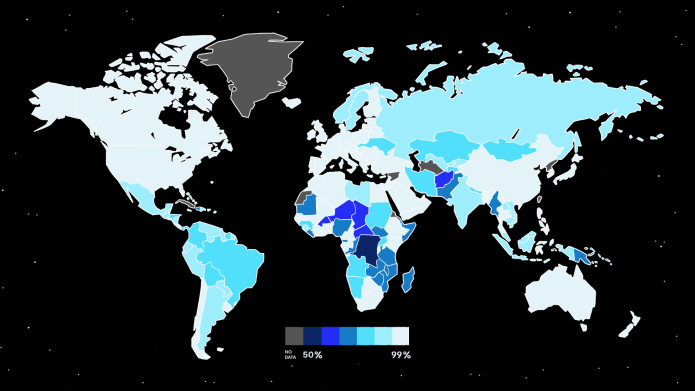
Around 350 million people around the world don’t have access to high-speed mobile internet: 3G or better.

Out of space: Picturing the big, crowded business of satellite internet

Global access to high-speed internet is uneven. While 99% of people in the U.S. have high-speed broadband access, only about 50% of people in Congo do.

Starlink is currently available in 125 countries and regions, including 70 outside the West.

Eutelsat OneWeb says its satellites cover most of the world, and it is entering into more partnerships to bring its services online. It recently announced agreements in parts of the Middle East and Africa.

Amazon’s Project Kuiper and China’s QianFan claim they will eventually cover the globe, but it’s too soon to tell when their services will go online and where they will get full approval to operate.


Over the past five years, putting internet satellites into space has become big business, with millions of customers, billions in revenue, and scores of rockets. The vast majority of these rockets are operated by SpaceX, and fly out of California and Florida. It’s estimated that in 2025 alone, a SpaceX rocket has carried Starlink satellites into space every three days, on average. Although the price of putting anything into space has dropped precipitously over the past 60 years, it can still cost roughly $60 million per launch for satellites. A SpaceX Falcon 9 rocket is able to ferry 23 satellites into space on each journey.

To launch a megaconstellation of satellites, it’s estimated that a company would need at least $10 billion.

For that much money, you could buy a telescope …

for all 9 million residents of Seoul.

Sputnik, the first satellite ever launched in space, weighed just 84 kilograms (184 pounds). Today’s internet satellites vary widely in size and weight.

Two stylized satellites are floating in space against a starry black background. One satellite is rectangular with blue panels and a small green detail, while the other is boxy with an orange outline, a blue solar panel, and antennas on top.


Studio Muti for Rest of World
OneWeb’s satellites weigh around the same as a 150-kilogram (331-pound) fridge.

A stylized blue motorcycle with orange accents floating in space next to a blue satellite with solar panels, set against a black background filled with small stars.


Studio Muti for Rest of World
QianFan’s satellites are a bit heavier, weighing about the same as a motorcycle, around 300 kilograms (660 pounds).

A blue grand piano floating in space with musical notes and a satellite equipped with solar panels nearby against a starry black background.


Studio Muti for Rest of World
A Project Kuiper satellite clocks in at about the same weight as a baby grand piano, around 544 kilograms (1,200 pounds).


Studio Muti for Rest of World
Starlink’s V2 mini satellite is comparable to a cow, around 575 kilograms (1,268 pounds).

A cartoon-style illustration depicting a blue and white car floating in space near a blue satellite with solar panels, against a black starry background.


Studio Muti for Rest of World
A Starlink V3 satellite is significantly heavier at roughly 1,500 kilograms (3,307 pounds), about as much as a small EV hatchback.

Starlink is sending more satellites into space every year. In the first five months of 2025 alone, the company launched 51 rockets. On average, that’s one satellite launch every three days.


Internet satellites orbit Earth at a relatively low elevation — galactically speaking. They live in low Earth orbit, an area of space with an altitude of up to 2,000 kilometers (1,243 miles). In theory, LEO is a vast three-dimensional territory that could contain many millions of satellites — more than we would ever need.

Some researchers have created a model for how many satellites could fit in LEO, taking into account how far apart they should be spaced to reduce the risk of collisions. They estimate that LEO could theoretically hold up to 12.6 million satellites.

But others have warned that even 1 million satellites in LEO — the number of satellites that were filed for approval with the International Telecommunication Union, a U.N. agency, between 2017 and 2022 — pose a risk because of a greater chance for collisions and debris surviving reentry and falling out of the sky.

Most of the active satellites currently orbiting Earth are used for communications. Starlink operates the vast majority of them.

There are currently 11,600 satellites in space.

Of those, 7,500 belong to Starlink.

The U.N. has approved 1 million satellites to go into space. That would make LEO pretty crowded.


For users in remote or previously underserved regions, satellite internet has the potential to be revolutionary, providing faster service, at a cheaper price point, more consistently. 

In at least five countries in Africa, Starlink is already cheaper than the leading fixed internet service providers.

Price of Starlink vs. leading ISP, per month


The lifespan of an internet satellite is short, and predestined. Because of atmospheric drag and the debris that accumulates on a low-altitude satellite, the average lifespan of a single LEO satellite is approximately five years, after which it reenters Earth’s atmosphere and burns up into oblivion.

In order to maintain service, companies like Starlink will have to continuously replenish the constellation of internet satellites orbiting our planet indefinitely.

A grid of small blue dots against a black background, representing launched satellites, with a legend indicating blue for 'Launched', yellow for 'Returned To Atmosphere', and green for 'Deorbiting Underway'. No yellow or green dots are visible in this visual.


Studio Muti for Rest of World
Starlink has launched 4,714 first-generation satellites into space, each with an average lifespan of about five years.

A graphic showing a grid of dots against a black background, with the left section in orange representing 'Returned to Atmosphere' and the right section mostly in blue representing 'Launched'. There are a few green dots in the bottom right indicating 'Deorbiting Underway'. The overall image illustrates the status of objects in space.


Studio Muti for Rest of World
Of those, 1,049 have reentered the atmosphere due to malfunctions and failures, or because they’re being replaced with newer and better satellites.

A graphic displaying a grid of dots on a black background, representing different statuses of objects in space: blue dots for 'Launched', orange dots for 'Returned To Atmosphere', and green dots for 'Deorbiting Underway', with most of the grid occupied by blue dots.


Studio Muti for Rest of World
Another 170 satellites are in the process of returning to the Earth’s atmosphere, where they will burn up.

SpaceX began deorbiting one satellite, for instance, in early February 2025 in an effort to replace its first-generation satellites with newer ones that have better capabilities. The satellite was shut down and left to deorbit on its own in March, and it burned up in the atmosphere in April.

Some small parts of a satellite might not fully burn up, causing them to fall to Earth. SpaceX has said that debris from its newest satellites is designed to land on Earth with less than 3 joules of energy, which is well below industry standards. But last year, debris from a SpaceX satellite — about the size of a laptop — fell to the ground in Canada.

Great Job Khadija Alam & the Team @ Rest of World – Source link for sharing this story.

5 children, wife of Boulder terror suspect held in South Texas detention facility, court records show

DILLEY, Texas – The wife of the Boulder, Colorado, terrorism attack suspect says she and her five children have been unlawfully held at a Dilley detention facility for more than three weeks, according to court records obtained by KSAT Investigates.

Hayal El Gamal and her five children — ages 18, 15, 7 and two four-year-olds — are being held at the South Texas Family Residential Center in Dilley, 73 miles southwest of San Antonio.

El Gamal and her children were detained by Immigration and Customs Enforcement (ICE) in early June 2025, two days after her husband, Mohamad Soliman, was arrested after being accused of firebombing an event in Colorado in support of Israeli hostages.

The family members, all Egyptian citizens, have not been charged in the attack. Mohamed Soliman, the alleged attacker, told authorities that no one, including his family, knew about his plan, according to court documents. Authorities are investigating whether that’s true.

According to a federal lawsuit seeking their release and due process in asylum proceedings, El Gamal and her children’s experience at the facility “has been traumatic.” The suit states El Gamal has had trouble sleeping and issues preserving her modesty in observance of her faith.

The family overstayed their 2022 B-1 visas and were seeking asylum, the El Gamal’s attorney Eric Lee told KSAT. At the time of their detention, Lee said they had pending asylum applications that had not yet been adjudicated.

The Dilley facility is among the largest immigrant detainment centers in the country with capacity to detain up to 2,400 people.

Immigration Processing Centers are facilities where people are held while their immigration status is being processed or are awaiting deportation.

The South Texas Family Residential Center is one of only two active facilities housing families, according to the National Immigration Forum.

The Biden administration closed the facility last summer, citing high costs of operations, but Trump resumed operations last March under private prison operator CoreCivic.

An ICE spokesperson told KSAT Investigates they do not comment on pending litigation when asked for a statement.

Lawsuit alleges family being held as ‘punishment’

According to a lawsuit, El Gamal and her five children were detained as “punishment” for Soliman’s actions. They allege their detention violates the Fifth Amendment because detention is only allowed if it prevents a flight risk or poses a danger to the community.

El Gamal is asking for the court to:

  • Prohibit ICE from deporting her family while the case is pending

  • Preventing the family from being transferred outside the Western District of Texas

  • Release the family from ICE custody

  • Declare their detention as illegal

  • Request reimbursement for attorney and legal fees

El Gamal and the children stayed at a hotel in Colorado Springs for two nights while law enforcement searched their home, records state.

On June 3, court records state Homeland Security agents told El Gamal the family would be moved because “the one at which they were staying was unsafe.”

El Gamal believed the agents were trying to help and went with them, records show.

Outside the hotel, El Gamal saw several plain-clothed law enforcement officers, who court records state are believed to be ICE officers from Denver.

When El Gamal tried to get more information, court records say an officer told her, “You have to pay for the consequences of what you did.”

Soon after, El Gamal and her children were taken to an immigration facility in Colorado, and records show they were flown to San Antonio on the evening of June 3 to be transported to Dilley.

That same night, the White House posted on X that the family was in ICE custody for “expedited removal.”

Family entered the US on visitor visas, sought asylum

Mohamed Soliman, El Gamal and their five children entered the United States in 2022 with B-1 visitor visas and have lived in the country for more than two years, which, according to the lawsuit, means they are not eligible for fast-track deportation.

Soliman’s tourist visa expired in February 2023, according to Department of Homeland Security Assistant Secretary Tricia McLaughlin. He filed for asylum and was granted a work authorization in March 2023, but that also expired before the alleged attack.

It isn’t clear if El Gamal and the children’s visas expired at the same time, or whether she was given a work authorization.

Soliman, his wife and children were living in Colorado Springs. A federal judge issued an order earlier this month to halt the deportation of El Gamal and the children.

In response to the attack, U.S. Secretary of Homeland Security Kristi Noem said that federal authorities will crack down on people who overstay their visas.

The Associated Press contributed to this report.

Read more reporting on the KSAT Investigates page.

Copyright 2025 by KSAT – All rights reserved.

Great Job Daniela Ibarra, Christian Riley, Alexis Montalbo & the Team @ KSAT San Antonio Source link for sharing this story.

Experts warn of food safety hazards ahead of July 4 barbecues and cookouts

SAN ANTONIO – Millions of families will be taking part in Fourth of July celebrations this weekend, and the U.S. Department of Agriculture wants to make sure food remains safe.

When handling frozen foods, experts say frozen beef, poultry and fish should be thawed out in either the fridge, cold water or a microwave.

Once thawed, the department said to cook the meat immediately and thoroughly.

Experts say meat should never be marinated at room temperature. Instead, marinate in the fridge.

To prevent bacterial growth, marinade that has been in contact with raw meat should not be reused, unless boiled.

When cooking meat, experts said to cook all food completely the first time as opposed to partially cooking ahead and finishing later.

Meat is considered safe when it reaches the following safe internal temperatures, as read by a thermometer:

  • Beef, pork, lamb, and veal steaks, chops and roasts: 145 degrees

  • Seafood, including fish and shellfish: 145 degrees

  • Ground beef, pork, lamb and veal: 160 degrees

  • Poultry: 165 degrees

The Bacteria that causes foodborne illnesses to grow live between 40 degrees and 140 degrees.

Hot food should be kept at or above 140 F in slow cookers or preheated grills, while cold foods must be kept at or below 40 F in bowls of ice or inside a cooler.

Copyright 2025 by KSAT – All rights reserved.

Great Job Maria Wence & the Team @ KSAT San Antonio Source link for sharing this story.

Secret Link