A recent Pew Research Center survey shows that about seven-in-ten Americans identify with a religion. Seven-in-ten Americans also believe in an afterlife. And about half of Americans say that parts of nature – such as mountains, rivers or trees – can have spirits or spiritual energies.
But how does the United States compare with other countries when it comes to spirituality and religion?
This interactive narrative walks through data from the U.S. and 35 other countries we surveyed in 2023 and 2024. Together, these three dozen countries are home to about 4 billion people – roughly half of the world’s population.
Although we were not able to conduct surveys in China or many Muslim-majority nations, we have findings on spirituality and religion from all inhabited continents, places with many different religious traditions, and countries with various income levels.
At the end of this brief interactive narrative, you’ll find a sortable table to explore several questions we asked around the world about respondents’ spiritual and religious beliefs and practices.
More than two-thirds of U.S. adults identify with a religion – whether Christianity, Judaism, Buddhism, Hinduism, Islam or something else.
That’s a high number compared with some other wealthy (i.e., economically advanced) countries. For example, just 46% of adults in the Netherlands and 44% in Japan claim any religious identity.
But when we look at all three dozen countries, quite a few have large percentages of people who say they have a religion. This includes places like Indonesia and Israel, where almost all adults identify with a religion.
In many countries – even places where nearly all adults say they have a religion – not everyone believes in life after death. In Israel, one of the countries with near-universal religious affiliation, just 61% say there is “definitely” or “probably” life after death.
In the U.S., seven-in-ten adults think there is definitely or probably an afterlife, which puts the U.S. in the top third of countries surveyed on this question.
Across Europe, people are far less likely to believe in life after death. For example, 38% of Swedish adults express belief in an afterlife.
Nearly half of U.S. adults, meanwhile, say they believe that parts of nature – such as mountains, rivers or trees – can have their own spirits or spiritual energies.
Solid majorities in India and Peru also hold this view.
But only about three-in-ten people surveyed in Poland say parts of nature can have spirits.
When it comes to rates of daily prayer, the U.S. is roughly in the middle of the 35 countries surveyed.
Yet the U.S. stands out among high-income countries on this question. Generally speaking, relatively few adults in wealthy countries – such as Japan and France – say they pray daily.
Countries where most people pray daily tend to be middle-income countries, such as Nigeria and the Philippines.
We also asked about some kinds of spirituality that are less common around the world. In most places surveyed – including the U.S. – about two-in-ten or fewer adults say they consult a fortune teller, horoscope or other way to see the future.
Even in India, where using various means to see the future is relatively common, just under half of adults say they do this.
Great Job Jcoleman & the Team @ Pew Research Center Source link for sharing this story.
ProPublica is a nonprofit newsroom that investigates abuses of power. Sign up to receive our biggest stories as soon as they’re published.
The Trump administration has launched a major reorganization of the U.S. fight against drug traffickers and other transnational criminal groups, setting out a strategy that would give new authority to the Department of Homeland Security and deepen the influence of the White House.
The administration’s plans, described in internal documents and by government officials, would reduce federal prosecutors’ control over investigations, shifting key decisions to a network of task forces jointly led by the FBI and Homeland Security Investigations, the primary investigative arm of DHS.
Officials said the plan to bring law enforcement agencies together in the new Homeland Security Task Forces has been driven primarily by President Donald Trump’s homeland security adviser, Stephen Miller, who is closely overseeing the project’s implementation.
Current and former officials said the proposed reorganization would make it easier for senior officials like Miller to disregard norms that have long walled off the White House from active criminal investigations.
“To the administration’s credit, they are trying to break down barriers that are hard to break down,” said Adam W. Cohen, a career Justice Department attorney who was fired in March as head of the office that coordinates organized crime investigations involving often-competing federal agencies. “But you won’t have neutral prosecutors weighing the facts and making decisions about who to investigate,” he added of the task force plan. “The White House will be able to decide.”
The proposed reorganization would elevate the stature and influence of Homeland Security Investigations and Immigration and Customs Enforcement among law enforcement agencies, while continuing to push other agencies to pursue immigration-related crimes.
The task forces would at least formally subordinate the Drug Enforcement Administration to HSI and the FBI after half a century in which the DEA has been the government’s lead agency for narcotics enforcement.
The new task forces will seek “to end the presence of criminal cartels, foreign gangs and transnational criminal organizations throughout the United States,” the order states. They will also aim to “end the scourge of human smuggling and trafficking, with a particular focus on such offenses involving children.”
Since that order was issued, the administration has proceeded with considerable secrecy. Some Justice Department officials who work on organized crime have been excluded from planning meetings, as have leaders of the DEA, people familiar with the process said.
A White House spokesperson, Abigail Jackson, did not comment on Miller’s role in directing the task force project or the secrecy of the process. “While the Biden Administration opened the border and looked the other way while Americans were put at risk,” she said, “the Trump Administration is taking action to dismantle cross-border human smuggling and trafficking and ensure the use of all available law enforcement tools to faithfully execute immigration laws and to Make America Safe Again.”
The task force project was described in interviews with current and former officials who have been briefed on it. ProPublica also reviewed documents about the implementation of the task forces, including a briefing paper prepared for Cabinet-level officials on the president’s Homeland Security Council.
The Homeland Security Task Forces will take a “coordinated, whole-of-government approach” to combatting transnational criminal groups, the paper states. They will also draw support from state and local police forces and U.S. intelligence agencies.
Until now, the government has coordinated that same work through a Justice Department program established by President Ronald Reagan, the Organized Crime Drug Enforcement Task Forces — which the Trump administration is shutting down.
Known by the ungainly acronym OCDETF (pronounced “oh-suh-def”), the $550-million program is above all an incentive system: To receive funding, different agencies (including the DEA, the FBI and HSI) must come together to propose investigations, which are then vetted and approved by prosecutor-led OCDETF teams.
The agents are required to include a financial investigation of the criminal activity, typically with help from the Treasury Department, and they often recruit support from state and local police. The OCDETF intelligence center, located in the northern Virginia suburbs, manages the only federal database in which different law-enforcement agencies share their raw investigative files.
While officials describe OCDETF as an imperfect structure, they also say it has become a crucial means of law enforcement cooperation. Its mandate was expanded under the Biden and first Trump administrations to encompass all types of organized crime, not just drug trafficking.
As recently as a few months ago, the deputy attorney general, Todd Blanche, declared that OCDETF would play a central role in stopping illegal immigration, drug trafficking and street gangs. He even suggested that it investigate the governments of so-called sanctuary cities for obstructing immigration enforcement.
But just weeks after Blanche’s announcement, the administration informed OCDETF officials their operations would be shut down by the end of the fiscal year in September. In a letter to Democratic senators on June 23, the Justice Department confirmed that the Homeland Security Task Forces would absorb OCDETF’s “mission and resources” but did not explain how the new structure would take charge of the roughly 5,000 investigations OCDETF now oversees.
“These were not broken programs,” said a former Homeland Security official who, like others, would only discuss the administration’s plans on condition of anonymity. “If you wanted to build them out and make sure that the immigration side of things got more importance, you could have done that. You did not have to build a new wheel.”
Officials also cited other concerns about the administration’s plan, including whether the new task force system will incorporate some version of the elaborate safeguards OCDETF has used to persuade law enforcement agencies to share their case files in its intelligence database. Under those rules, OCDETF analysts must obtain permission from the agency that provided the records before sharing them with others.
Many officials said they worried that the new task forces seem to be abandoning OCDETF’s incentive structure. OCDETF funds are conditioned on multiple agencies working together on important cases; officials said the monies will now be distributed to law enforcement agencies directly and without the requirement that they collaborate.
“They are taking away a lot of the organization that the government uses to attack organized crime,” a Justice Department official said. “If you want to improve something, great, but they don’t even seem to have a vision for how this is going to work. There are no specifics.”
The Homeland Security Task Forces will try to enforce interagency cooperation by a “supremacy clause,” that gives task force leaders the right to pursue the cases they want and shut down others that might overlap.
An excerpt from a planning document drafted for the president’s Homeland Security Council describes how the new Homeland Security Task Forces would take charge of major organized crime investigations.
Credit:
Text reproduced from a document obtained by ProPublica.
The clause will require “that any new or existing investigative and/or intelligence initiatives” targeting transnational criminal organizations “must be presented to the HSTF with a right of first refusal,” according to the briefing paper reviewed by ProPublica.
“Further,” it adds, “the supremacy clause prohibits parallel or competitive activities by member agencies, effectively eliminating duplicative structures such as stand-alone task forces or specialized units, to include narcotics, financial, or others.”
Several senior law enforcement officials said that approach would curtail the independence that investigators need to follow good leads when they see them; newer and less-visible criminal organizations would be more likely to escape scrutiny.
In recent years, those officials noted, both Democratic and Republican administrations have tried at times to short-circuit competition for big cases among law enforcement agencies and judicial districts. But that has often led to as many problems as it has solved, they said.
One notable example, several officials said, was a move by the Biden administration’s DEA administrator, Anne Milgram, to limit her agency’s cooperation with FBI and HSI investigations into fentanyl smuggling by Los Chapitos, the mafia led by sons of the Mexican drug boss Joaquín Guzmán Loera, known as “El Chapo.”
Although the DEA eventually indicted the Chapitos’ leaders in New York, officials from other agencies complained that Milgram’s approach wasted months of work and delayed the indictments of some traffickers. Later, when the FBI secretly arranged the surrender of one of the sons, Joaquín Guzmán López, DEA officials were not told about the operation until it was underway, officials said. (Guzmán López initially pleaded not guilty but is believed to be negotiating with the government. Milgram did not respond to messages asking for comment.)
As to the benefits of competition, prosecutors and agents cite the case of El Chapo himself. Before he was extradited to the United States in January 2017, Guzmán Loera had been indicted by seven U.S. attorneys’ offices, reflecting yearslong investigations by the DEA, the FBI and HSI, among others. In the agreement that the Obama Justice Department brokered, three offices led the prosecution, which used the best evidence gathered by the others.
Under the new structure of the Homeland Security Task Forces, several officials said, federal prosecutors will still generally decide whether to bring charges against criminal groups, but they will have less of a role in determining which criminals to investigate.
Regional and national task forces will be overseen by “executive committees” that are expected to include political appointees, officials said. The committees will guide broader decisions about which criminal groups to target, they said.
“The HSTF model unleashes the full might of our federal law enforcement agencies and federal prosecutors to deliver justice for the American people, whose plight Biden and Garland ignored for four years,” a Justice Department spokesperson said, referring to former Attorney General Merrick Garland. “Any suggestion that the Department is abandoning its mission of cracking down on violent organized crime is unequivocally false.”
During Trump’s first term, veteran officials of the FBI, DEA and HSI all complained that the administration’s overarching focus on immigration diverted agents from more urgent national security threats, including the fentanyl epidemic. Now, as hundreds more agents have been dispatched to immigration enforcement, those officials worry that the new task forces will focus on rounding up undocumented immigrants who have any sort of criminal record at the cost of more significant organized crime investigations.
The first task forces to begin operating under the new model have not assuaged such concerns. In late May, Attorney General Pam Bondi and Virginia Gov. Glenn Youngkin announced that the Virginia Homeland Security Task Force had arrested more than 1,000 “criminal illegal aliens” in just two months, but the authorities have provided almost no details connecting those suspects to transnational criminal organizations.
Agents of Homeland Security Investigations and the FBI, part of the new Gulf of America Homeland Security Task Force, arrested dozens of undocumented immigrants in connection with a cockfighting ring in northern Alabama in mid-June.
Credit:
Via HSI Atlanta’s X profile
On June 16, the Gulf of America Homeland Security Task Force, a new unit based in Alabama and Georgia, announced the arrests of 60 people, nearly all of them undocumented immigrants, at a cockfighting event in northern Alabama. Although cockfighting is typically subject to a maximum fine of $50 in the state, a senior HSI official claimed the suspects were “tied to a broader network of serious crimes, including illegal gambling, drug trafficking and violent offenses.” Once again, however, no details were provided.
It is unclear how widely the new task force rules might be applied. While OCDETF funds the salaries of more than a thousand federal agents and hundreds of prosecutors, thousands more DEA, FBI and HSI agents work on other narcotics and organized crime cases.
In early June, five Democratic senators wrote to Bondi questioning the decision to dismantle OCDETF. That decision was first reported by Bloomberg News.
“As the Department’s website notes, OCDETF ‘is the centerpiece of the Attorney General’s strategy to combat transnational-organized crime and to reduce the availability of illicit narcotics in the nation,’” the senators wrote.
In a June 23 response, a Justice Department official, Daniel Boatright, wrote that OCDETF’s operations would be taken over by the new task forces and managed by the office of the Deputy Attorney General. But Boatright did not clarify what role federal prosecutors would play in the new system.
“A lot of good, smart people are trying to make this work,” said one former senior official. “But without having prosecutors drive the process, it is going to completely fracture how we do things.”
Veteran officials at the DEA — who appear to have had almost no say in the creation of the new task forces— are said to be even more concerned. Already the DEA has been fighting pressure to provide access to investigative files without assurances that the safeguards of the OCDETF intelligence center will remain in place, officials said.
“DEA has not even been invited to any of the task force meetings,” one former senior official said. “It is mind-boggling. They’re just getting orders saying, ‘This is what Stephen Miller wants and you’ve got to give it to us.’”
Great Job by Tim Golden & the Team @ ProPublica Source link for sharing this story.
This article was produced for ProPublica’s Local Reporting Network in partnership with New York Focus, an investigative news outlet reporting on New York. Sign up for Dispatches to get our stories in your inbox every week, and sign up for New York Focus’ newsletter here.
Reporting Highlights
Growing Reliance: New York’s social services agencies placed just under half of the individuals and families receiving emergency shelter outside the city in fiscal year 2024 in hotels.
Lack of Services: State regulations exempt hotels from providing the services families receive in shelters, such as food, help finding housing and sometimes child care.
Expensive Solution: County social services offices regularly pay the hotels rates that are more than fair market rent for two-bedroom apartments in their areas.
These highlights were written by the reporters and editors who worked on this story.
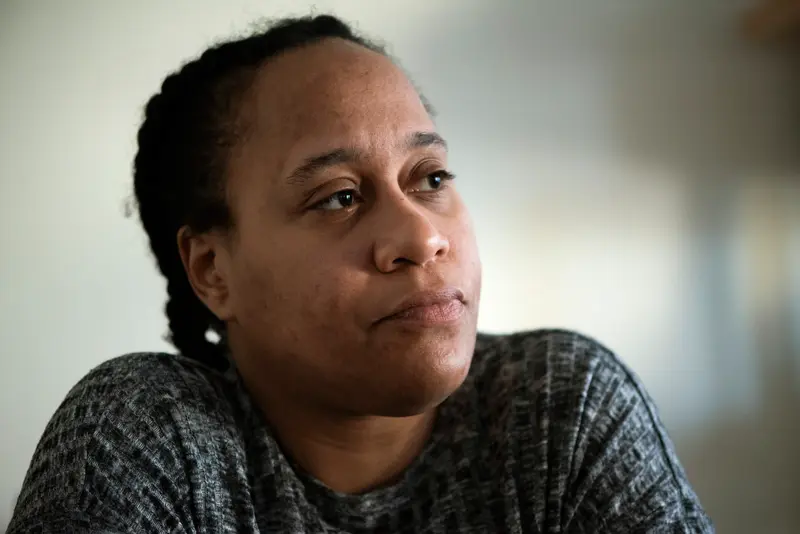
Jasmine Stradford sat on her porch near Binghamton, New York, with toys, furniture, garbage bags full of clothing and other possessions piled up around her. She and her partner were being evicted after falling behind on rent.
So last June, they and their children — then ages 3, 12 and 15 — turned to New York’s emergency shelter system for help. It was built to provide homeless residents not only beds, but also food, help finding permanent housing and sometimes child care so parents can find work, attend school or look for apartments.
Stradford and her family received almost none of that. Instead of placing them in a shelter, the Broome County Department of Social Services cycled them through four roadside hotels over three months, where they mostly had to fend for themselves.
“I remember staring at my kids, thinking that I’d failed them,” Stradford said. “Then I remember going to DSS and being completely dehumanized.”
Stradford’s family was part of a growing trend: In the past few years, hotels have quietly become the state’s predominant response to homelessness outside New York City. New York Focus and ProPublica found that the state’s social services agencies placed just under half the 34,000 individuals and families receiving emergency shelter outside the city in fiscal year 2024 in hotels — up from 29% in 2018. The change was most pronounced in Broome County, where hotel cases more than quintupled.
Statewide spending on hotels more than tripled over that period to $110 million, according to an analysis of state temporary housing data by the news organizations. In total, hotels outside New York City were paid about $420 million to shelter unhoused people from April 2017 to September 2024.
Statewide Spending on Hotels More Than Tripled From 2018 to 2024
Data source: Analysis of Office of Temporary and Disability Assistance data on emergency shelter payments. Years are fiscal years.
Credit:
Lucas Waldron/ProPublica
It’s a makeshift arrangement that provides people a roof over their head but little else. State regulations exempt hotels from providing the same services that families are supposed to receive in the shelter system.
The hotels are “less supportive, less conducive for good health outcomes, good education outcomes,” said Adam Bosch, CEO of Hudson Valley Pattern for Progress, a policy research nonprofit. “If our ultimate goal is to get people moving back toward independence, sticking them in a hotel on a hillside away from services, away from schools, away from transportation networks is not a great strategy.”
Homelessness in New York City received intense media coverage as the migrant crisis became fodder in the presidential election. But far less attention has been paid to the homeless population throughout the rest of New York, which far surpasses most other states on its own.
Few of the migrants were relocated to hotels outside the city. Instead, the spike in hotel housing stems from a combination of soaring rent, dozens of shelter closures and what housing advocates and industry representatives said was a botched response to the end of the state’s pandemic-related eviction moratorium in 2022. After the moratorium ended, landlords began evicting tenants at rates exceeding previous years. With fewer shelters and more people in need, the number of individuals and families placed in hotels shot up.
An unhoused family living at the Knights Inn in Endwell, New York. It was one of the hotels where the Broome County Department of Social Services placed the Stradford-Moses family.
Credit:
Michelle Gabel for ProPublica
Barbara Guinn, the commissioner of the state Office of Temporary and Disability Assistance, said in an interview that her agency hadn’t studied the growth in hotel use for emergency shelter. The trend has been scarcely mentioned at legislative hearings in Albany.
But OTDA, which supervises the county social services offices, has long known about the problems the hotels present. In early 2020, state auditors warned the agency that it wasn’t adequately overseeing shelters, including hotels used as temporary housing. OTDA acknowledged that hotels present challenges because they don’t have on-site support services or the same level of supervision as shelters.
Samir, Moses and Stradford’s 3-year-old son, tries to pass the time in one of the hotel rooms the family stayed in after its eviction.
Credit:
Courtesy of Jasmine Stradford
Rules clarifying the requirement that temporary housing recipients in hotels receive shelter-like services have been on OTDA’s regulatory agenda for at least four years. But the agency, and lawmakers who oversee it, stood by as hotel housing increased. Guinn said she couldn’t “provide insight” on why the agency never formally proposed the rules, but she committed to advancing them this year. The Broome County Department of Social Services did not make its commissioner, Nancy Williams, available for an interview and did not respond to a detailed list of questions.
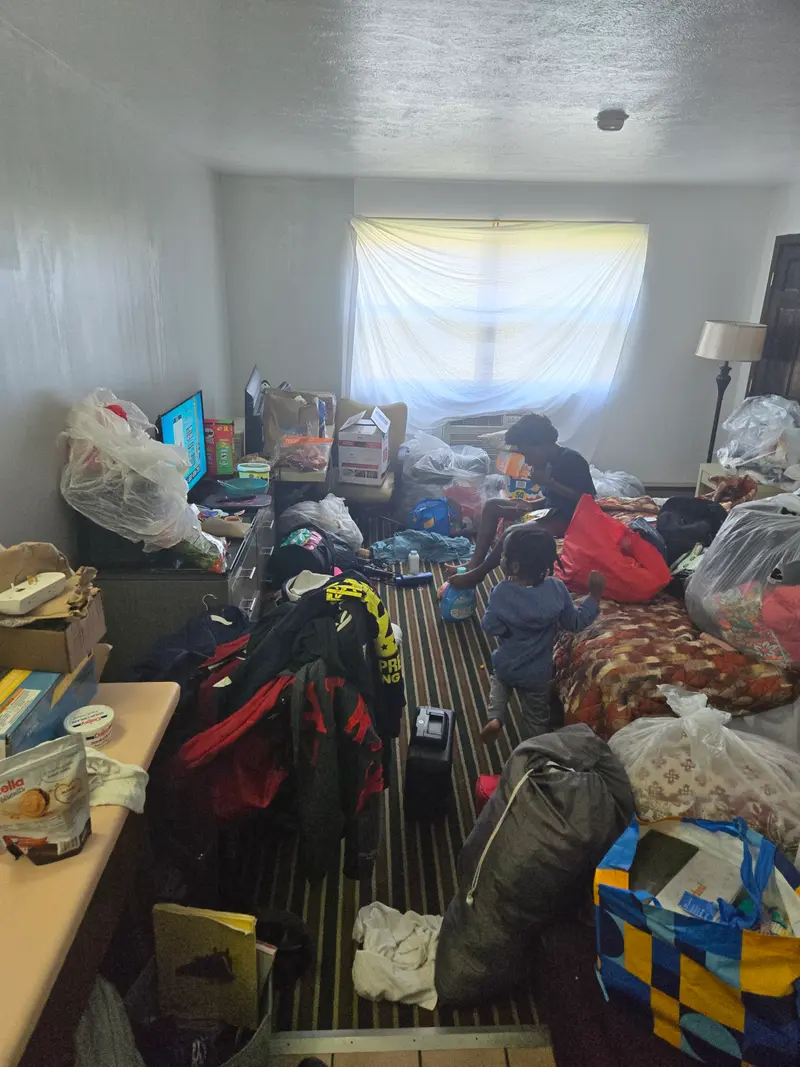
Reporting across the state, the news organizations found people living for months and sometimes years in hotels, doing what they can to get by. Families share beds while their belongings fill the corners of their rooms. Without kitchens and barred from using most appliances, they trek down shoulderless highways to grocery stores or scour food pantries for anything they can cook in a microwave. They squish cockroaches skittering in dressers. And hotels often force them to move out every few weeks, keeping stability out of reach.
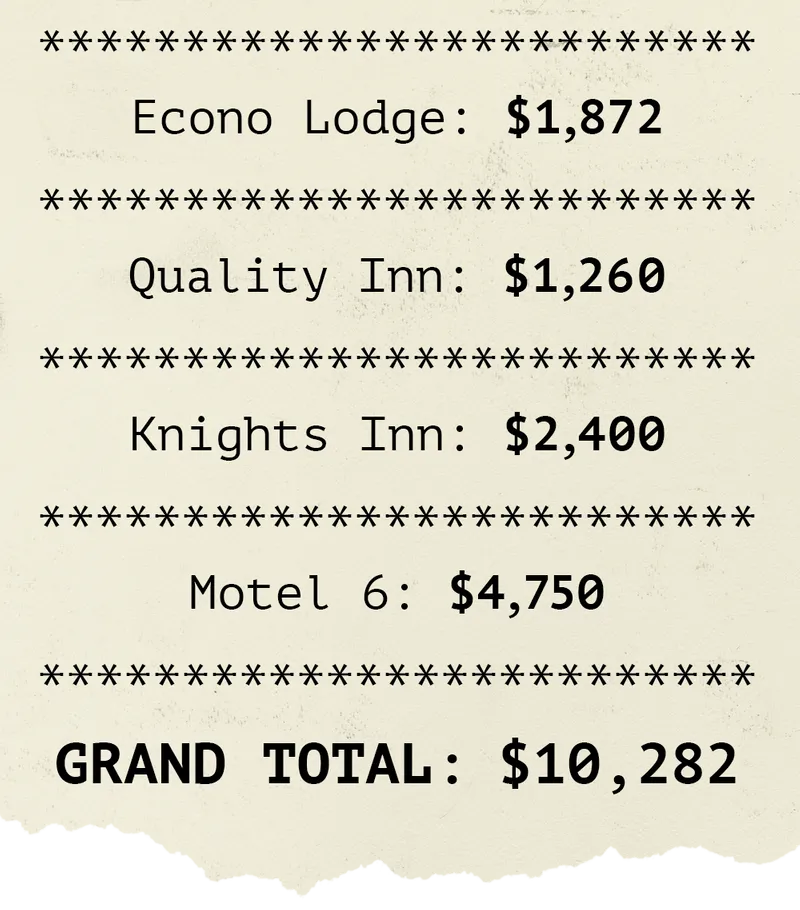
The four hotels that Stradford’s family was placed in last summer collectively made about $10,000 sheltering it over three months — more than what the family owed in back rent. That works out to more than twice the monthly fair market rent for a four-bedroom apartment in Binghamton at the time.
New York Social Services Agencies Frequently Paid Hotels Over Fair Market Rent for a Two-Bedroom Apartment
Nearly half of all payments to hotels were for more than twice the counties’ FMR.
86% of payments to hotels were above FMR
86% of payments to hotels were above FMR
Data Source: Analysis of Office of Temporary and Disability Assistance data on emergency shelter payments; HUD Fair Market Rent data for two-bedroom apartments in each county for federal fiscal year 2024.
Credit:
Lucas Waldron/ProPublica
This isn’t unusual. County social services offices regularly pay the hotels rates that are worth many times fair market rent for permanent housing in their areas, according to the analysis of OTDA’s housing payment data. One motel in Rome, outside Utica, that was the scene of a shooting last fall charged the county $250 a night for a room at times, according to invoices submitted to the county’s Department of Social Services.
Over three months, Stradford’s family struggled to maintain some semblance of its old life while bouncing from hotel to hotel. The family would lose countless possessions. The kids’ educations would be disrupted, as the school bus failed to keep up with their moves. Their experiences would show the importance of the services they weren’t receiving and what happens to New York’s homeless families when they can’t access them.
“It’s Like Malpractice”
Stradford and her partner, Tiberious Moses, had been evicted after she missed work at a children’s group home while recovering from surgery and Moses struggled to support the family with temporary jobs. At first, Stradford was relieved when the Department of Social Services informed her that it would place them in a hotel instead of a shelter.
“Going to the hotel, I originally thought, ‘OK, this gives a little bit more leeway, a little bit more comfort, hospitality, all of that,’ only to find out that it’s not that at all,” she said. “If you are a DSS recipient, you’re nothing. You are the bottom of the pit.”
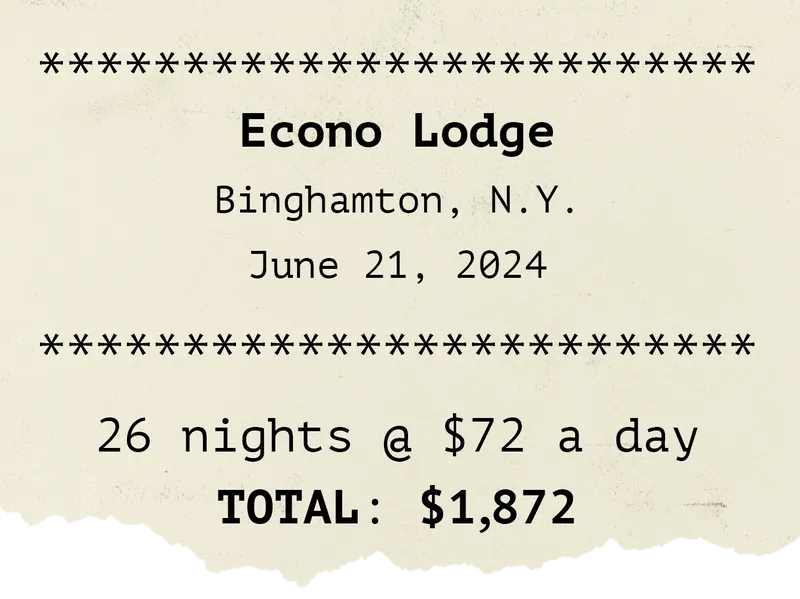
Stradford’s family — two adults, three children and four dogs — was packed into a room with two beds at an Econo Lodge sandwiched between a gas station and another budget hotel. Stradford said she found cockroaches and had trouble getting the hotel to clean their room. She said she often saw drug use at the hotel and felt unsafe. Law enforcement and emergency services were called to the hotel 116 times in the first half of that year, dispatch logs show.
Despite those conditions, the Econo Lodge received more money to house temporary assistance recipients than any other known hotel outside New York City, according to the OTDA payments data for the 2024 fiscal year. The hotel, now called Hillside Inn & Suites, served more than 900 individuals and families placed by the Department of Social Services for at least 30,000 total nights, earning over $2.3 million.
The Hillside Inn & Suites, formerly an Econo Lodge, in Binghamton, New York. The Stradford-Moses family spent 26 nights here.
Credit:
Michelle Gabel for ProPublica
“We’re forced to rent hotel rooms across the state, and the operators of these places understand that,” said state Sen. Roxanne Persaud, chair of the chamber’s Social Services Committee. “The municipalities’ backs are against the wall. And so they must place the unhoused person or persons somewhere. And so that’s why you see the cost is skyrocketing, because people understand that it’s an easy way to make money off the government.”
OTDA’s regulations say hotels should be considered shelters and provide services if they are used “primarily” as temporary housing for homeless welfare recipients. At least 16 hotels appear to house mostly welfare recipients, the analysis showed.
OTDA spokesperson Anthony Farmer said the agency interprets “primarily” to mean hotels that “house recipients exclusively, or almost exclusively, throughout the year.” He said that hotels aren’t required to deliver services but that county social services agencies “are responsible for some level of service provision.” The state, however, doesn’t regularly collect information on how counties provide services. Guinn said OTDA plans to create a formal process for counties to submit it under new regulations.
Credit:
Illustration by ProPublica
The Econo Lodge’s contract with Broome County doesn’t call for the services offered by shelters, like food and assistance finding housing. It requires the hotel to provide little more than a room with housekeeping, linens and toiletries. The hotel’s CEO, Paresh Patel, declined to comment.
In contrast, traditional shelters often put a significant amount of their funding toward social services. Shelter budgets obtained from OTDA show that they frequently retain at least part-time employees to prepare food and help people find jobs and housing. Local social services offices try to offset the lack of on-site services by hiring caseworkers but have struggled to retain them.
Instead, hotel residents like Stradford’s family are caught in a web of conflicts between the way those services are provided, the strings attached to benefits and the rules and limitations of living in hotels. Social services departments might provide them food stamps to buy groceries, but hotel residents usually don’t have kitchens and are often not allowed to have appliances like hot plates. To keep their lodging, they’re generally required to seek housing and to work or look for jobs, but they often don’t receive child care. They have to regularly meet with caseworkers at social services offices but must rely on spotty public transportation.
“To me, it’s like malpractice as a homeless services provider to place people without support services” in hotels, said Deborah Padgett, a professor of social work at New York University. “It’s good in the sense that they get more privacy, but for them to get a life and not be dependent on the government, they need to be close to services and not be punished for making mistakes.”
Guinn said that her agency would prefer counties use regulated shelters in housing emergencies but that there aren’t enough beds to accommodate everyone. Social services offices must rely on hotels when shelters don’t have space or don’t exist in a particular county, Farmer said in an email.
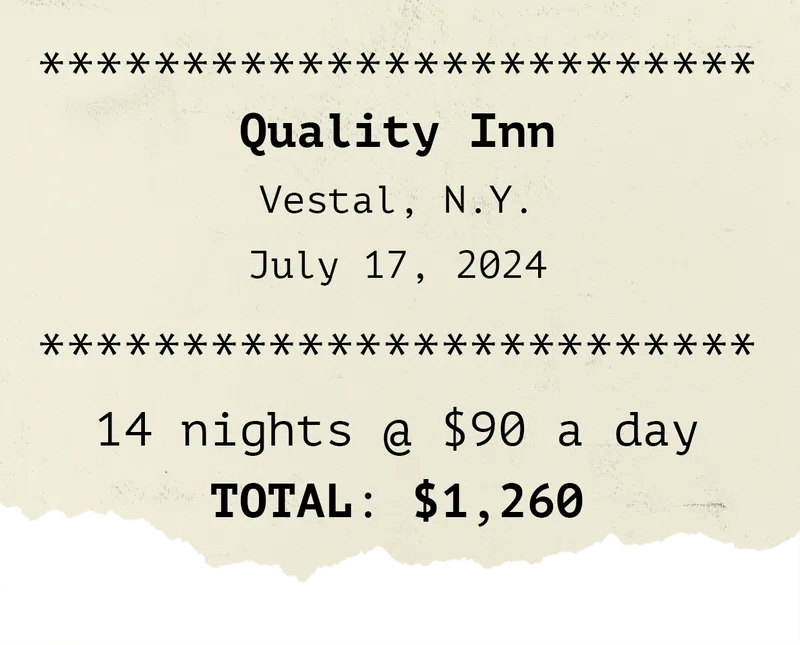
After 26 nights, Broome County relocated Stradford’s family to the Quality Inn & Suites in Vestal, a Binghamton suburb down the Susquehanna River that’s home to Binghamton University. Stradford’s car had been repossessed, so they stuffed a suitcase and the kids’ book bags with as many clothes as they could and hopped on the bus.
Credit:
Illustration by ProPublica
At the Quality Inn, the family struggled to eat. They had applied for food stamps, but Stradford said she couldn’t get wage records from her former employer proving she was eligible. Instead, the county provided them a restaurant allowance worth about $15 a day to cover all five of them. To get by, they took the bus to food pantries like Catholic Charities, which had started creating “hotel bags” stuffed with canned food, oatmeal, crackers, macaroni and cheese and snacks for the kids — anything that could be eaten cold or prepared with a microwave.
While many shelters provide food on site, contracts between the hotels and Broome County forbid emergency housing recipients from eating the hotels’ food. Stradford said her family was threatened with removal from the Quality Inn after her 12-year-old daughter, Taylor, tried to eat the continental breakfast.
“When we first started taking families on, we did allow breakfast, and unfortunately there was too much being carried away, so we chose to change that,” the hotel’s general manager, Bernadine Morris, said. The Quality Inn has since closed and could not be reached for follow-up questions.
People can get kicked out of hotels and lose their housing assistance for repeatedly violating hotels’ policies, including by using their own cooking appliances. One woman who previously lived at the Motel 6 in Binghamton said she avoided sanctions by throwing an extension cord from the window of her second-story room to use a pressure cooker on the sidewalk.
Stradford’s nonstop juggling act left her on edge. She was grieving her mother’s death, feeding five people and four dogs, apartment-hunting and hustling to culinary classes and social services appointments. She said her children started feeling the stress too: Her 3-year-old, Samir, was wetting the bed frequently, and the older kids missed classes for their summer courses.
The family began butting heads with Quality Inn managers, who accused them of being disruptive and terminated their stay, according to Stradford’s social services case file.
“I’m not totally surprised that they run into problems with the hotel supervisors and the staff just because they’re trying to find some way to get their needs attended to, and it’s not really fair to expect the hotel to do what those people are not trained to do,” Padgett said.
During the three months her family lived in hotels, Stradford’s nonstop juggling act left her on edge.
Credit:
Michelle Gabel for ProPublica
Shelters are required to have enough qualified staff to meet residents’ needs. The staff members generally have at least some training in how to handle populations with complex needs, said Elizabeth Bowen, an associate professor at the University at Buffalo School of Social Work.
After Stradford and her family lost their room at the Quality Inn, the county sanctioned them and declined to find them a new place to stay. Moses, who had just gotten a job at Dave & Buster’s, paid out of his own pocket for a room at the Red Roof Inn in Johnson City. When they arrived, the woman at the front desk saw their belongings and dogs and told them the motel wouldn’t honor the reservation. They had used what little money was left on Ubers and the room deposit. The motel did not return requests for comment.
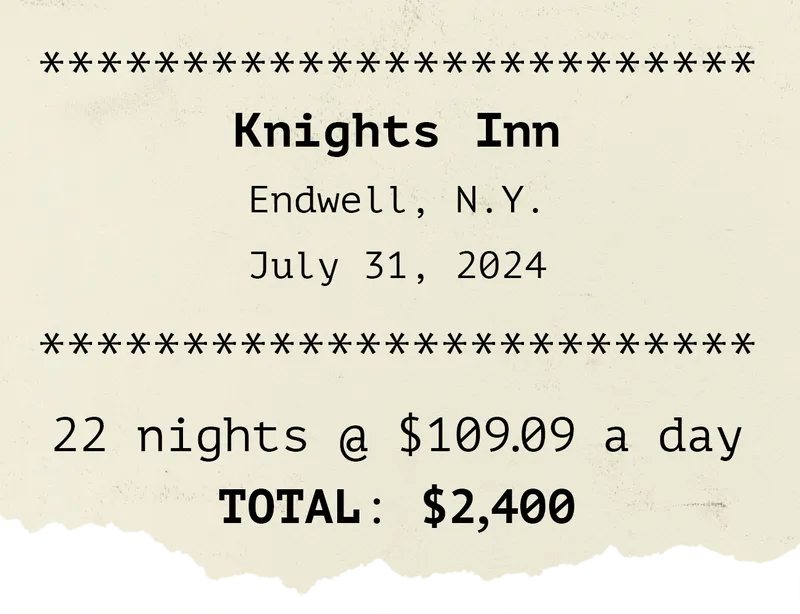
As it rained, Stradford got ahold of the Department of Social Services and pleaded their case. The county decided to continue housing her family until her sanction could be appealed. It booked them at the Knights Inn, another 10 minutes down the road in a town called Endwell.
“I Got Into Protection Mode”
Stradford’s family became skilled at sleeping on a single bed at the Knights Inn. Stradford, Moses, Samir and 15-year-old De’Vante would sleep side by side while Taylor slept horizontally at their feet.
The rest of the facility was in chaos, Stradford said. She saw hypodermic needles and other drug paraphernalia lying in the grass and underneath the stairwell and people slumped over while standing beside the dumpster. Over about six years that the county used it for temporary housing, law enforcement and emergency services were summoned to the motel for 789 incidents, including assaults, overdoses, robberies, domestic disputes and mental health crises.
Note: Knights Inn charged $109.09 per day for two rooms for at least part of their stay.
Credit:
Illustration by ProPublica
The Knights Inn had a litany of issues that prevented it from passing Broome County Social Services’ inspections from 2018 to 2021. According to inspection reports, the rooms were dimly lit due to missing light bulbs and broken lamps. The walls were stained and punched through, and the wallpaper peeled off. Some rooms’ doors didn’t lock. Windows didn’t either or were broken. Carpets were torn, and inspectors found cockroaches in dressers.
Health and safety issues plague hotels used as emergency shelters across the state. A 2020 state comptroller audit found that 60% of the hotels they reviewed outside New York City were in “unsatisfactory” condition — about the same as the percentage of shelters.
One woman, who was living with her children in a motel south of Albany, showed paint flaking off their walls and mattresses covered in black mold. Two other parents placed in the motel said they felt that if the Department of Social Services caught them in private housing that resembled their living conditions, their kid could be taken away by Child Protective Services.
OTDA requires social services agencies to inspect hotels housing families every six months. But an analysis of OTDA compliance data showed that social services districts often fail to keep up with hotel inspections: About 40% of the 351 hotels used to house homeless people outside New York City were out of date on their social services inspections as of mid-October or didn’t have an inspection date listed.
Farmer, the OTDA spokesperson, said that most hotels had been inspected within a year and that some others had stopped housing people.
Even when social services agencies do inspections, records show they sometimes fail to take action. Hotels have to correct problems within 30 days, unless it’s a safety problem. If they don’t, counties are supposed to stop placing people there, according to a directive from OTDA.
Records show that the Knights Inn fixed some of the issues as it went but continued to get written up in every inspection for two and a half years. Despite this, Broome County placed hundreds of social services cases there, earning the motel over $750,000.
A Knights Inn manager, Aizaz Siddiqui, said that the motel moved people out of rooms that needed the most work until they were renovated.
In January 2021, the county said it would stop placing people at the Knights Inn until the violations were corrected. The motel received a clean inspection in July 2022. But Stradford said the Knights Inn wouldn’t give them toilet paper or fresh sheets, which are required in shelters. A bedsheet was used as a curtain for their rear window.
Taylor and Samir watch TV in the Knights Inn room.
Credit:
Courtesy of Jasmine Stradford
The family stayed for three weeks, but tensions with management boiled over when the family failed to get rid of their dogs by the deadline set by the motel. Eventually, the Knights Inn told them to leave. After giving them a few extra days to find other accommodations, Siddiqui called the police to remove them.
Siddiqui said the families placed at the inn by the Department of Social Services deserve sympathy, but he still has to maintain order. “It’s a tough situation to be in, and we try to work with them as much as we can,” he said. “But again, we do have to fulfill our policies, and we have to stand by them.” The motel declined to respond to additional questions about the conditions.
Stradford’s family didn’t have anywhere else to go. As the State Police arrived, she planted herself on a red cooler in front of their room and refused to leave until the county found them somewhere to stay.
Some community activists she met through local charity work showed up to support her and livestreamed the incident on Facebook.
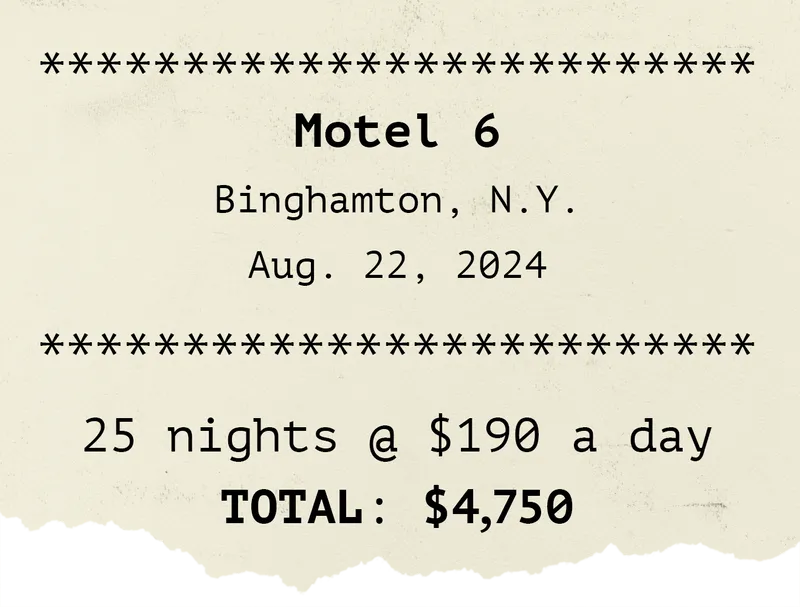
Note: Motel 6 charged $190 per day for two rooms.
Credit:
Illustration by ProPublica
After a three-hour standoff, management relented and allowed the family to stay two more nights. One of the activists arrived with a U-Haul and drove their stuff to the Motel 6, a 15-minute drive back up the river, past the Econo Lodge on the outskirts of Binghamton.
Things were initially calm at the Motel 6. But about three weeks into their stay, the Motel 6 complained to the county that Stradford had left the children alone, which they were told violated the motel’s guest policy. Stradford said she was doing charity work at the time but complained that she couldn’t attend school or meet the state’s requirements to look for housing if she had to constantly supervise her children.
The motel gave the family the weekend to leave. When they missed their checkout time, the Sheriff’s Office came to remove them.
Moses called Stradford, who was at school, to tell her what was happening. She headed to the Department of Social Services to plead their case.
“I got into protection mode,” Stradford said. “I wasn’t going to leave there and just put myself in a seriously homeless situation. So I told them I wasn’t leaving until I knew that we had a secure spot to go to.”
But her attempts failed. The agency said it would no longer help her family due to the complaints. The clerk used a special tool to unlock the room for the deputies.
Community members once again showed up to livestream the encounter and pressure the county. The Sheriff’s Office helped the family find a motel, where it stayed for two more nights.
In the end, it wasn’t New York’s social services system that found stable housing for Stradford’s family; it was a local landlord who heard about the case and offered an apartment at a rate the family could afford on Moses’ wages and temporary assistance from the county.
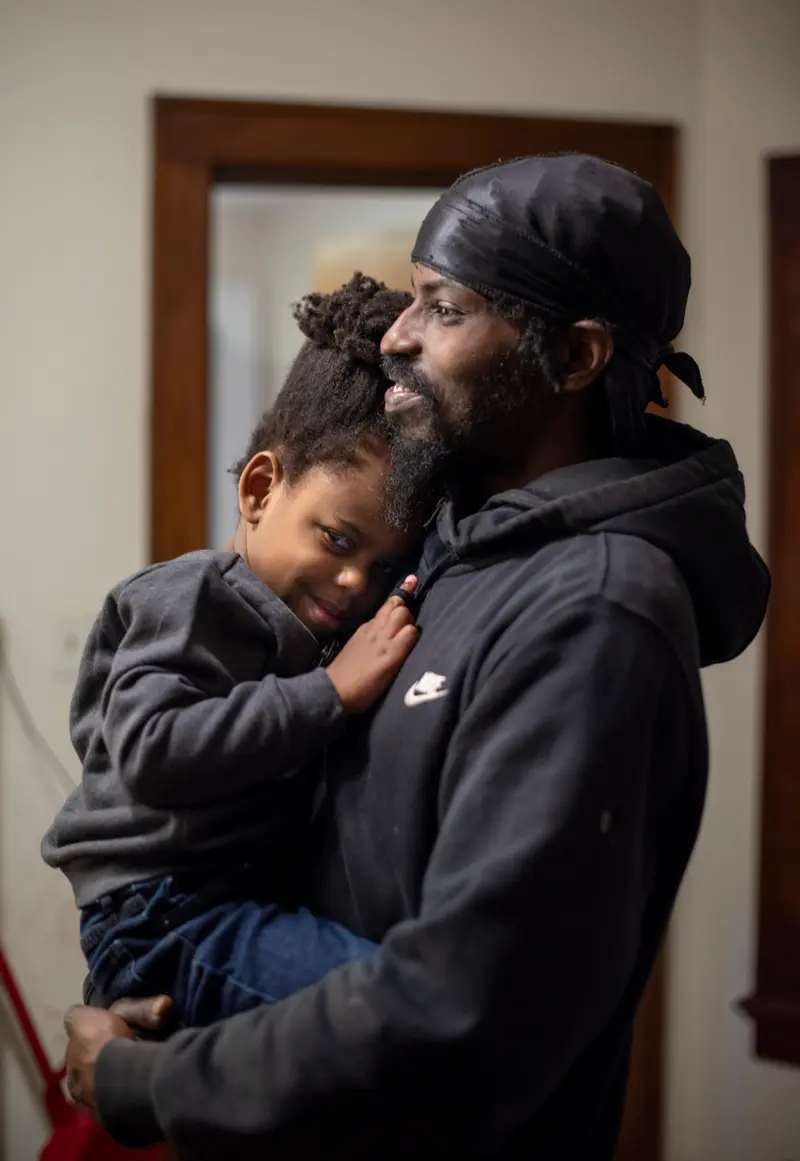
Moses holds Samir in the family’s new apartment.
Credit:
Michelle Gabel for ProPublica
Stradford’s family was placed in hotels for 89 days, about the average for a social services case. Many stay far longer. More than 1,500 individuals and families spent six months or more in hotels, according to payment data from the 2024 fiscal year.
“Some of us really get into a hard time and we really do need the help. We don’t just rely on the system,” Stradford said. “I pay my hard-earned tax dollars. I worked multiple jobs. I’m the one that tried to keep afloat and stuff like that. But things happen in life.”
Between their six moves, the family lost most of its possessions: furniture, Social Security cards, birth certificates, tax documents, family photos, laptops, coats, a painting from someone Jasmine was taking care of, Samir’s toy box, Taylor’s art projects and a blanket covered in motivational quotes that Stradford’s mom had given her before she passed. They had to give up two of their dogs.
When they arrived at their new home, they had only a couple of suitcases and garbage bags full of clothes.
If you have been placed in a hotel or have information about the use of hotels as emergency housing in New York, contact New York Focus reporter Spencer Norris at 570-690-3469 or [email protected].
Your trusted source for contextualizing the news. Sign up for our daily newsletter.
In an upset, Assemblymember Zohran Mamdani will be the Democratic nominee for mayor of New York City, defeating candidates including Andrew Cuomo, who was seeking a political comeback nearly four years after he resigned as governor of New York amid sexual misconduct allegations.
Cuomo conceded the race Tuesday night, before the final results of ranked-choice voting were clear.
“Tonight was not our night,” Cuomo told a crowd of supporters. “Tonight was Assemblyman Mamdani’s night. He put together a great campaign, and he touched young people and inspired them and got them to come out and vote. And he really ran a highly impactful campaign. I called him, I congratulated him, I applaud him sincerely for his effort.”
Mamdani, a 33-year-old self-described Democratic socialist, ran a campaign centered on making New York City more affordable. He proposed offering free universal child care, creating city-run grocery stores, rolling out free bus service and freezing rents on rent-stabilized units.
One year ago, Republican primary voters renominated President Donald Trump, who was found liable for sexually abusing and defaming the writer and advice columnist E. Jean Carroll between his first term and his return to office in January. Trump’s reelection was seen as marking a political and cultural backlash to the #MeToo movement.
Read Next:
Read Next:
Trump’s first term ignited #MeToo. Will his second extinguish it?
But in New York, Democratic voters rejected a former governor who left office following a bombshell 165-page report overseen by the New York attorney general’s office that found he had sexually harassed 11 women, including some state employees.
Those findings were echoed by similar investigations conducted by the Department of Justice and the New York State Assembly. At the time, Cuomo apologized while denying the most serious allegations against him. In the years since, Cuomo and his allies have cast doubt on his accusers’ credibility and painted him as the victim of politically motivated investigations.
While New York City is overwhelmingly Democratic, Mamdani isn’t guaranteed a victory in the general election in November. Mayor Eric Adams, the embattled incumbent, is running as an independent. Cuomo also has indicated he could run as an independent on a “Fight and Deliver” ballot line. Unlike the primary, the general election won’t be held with ranked-choice voting, under which voters can rank up to five candidates in order of preference. If no candidates reach a majority on the first round of ranked-choice voting, votes are redistributed until a candidate gets to above 50 percent.
If elected, Mamdani would be the city’s first South Asian and Muslim mayor.
Cuomo came into the race leading with name recognition and with allies pouring millions of dollars into an allied super PAC. Mamdani, by contrast, built up an energized and passionate grassroots of volunteers. In a crowded field, ranked-choice voting also lent itself to coalition building — Mamdani cross-endorsed fellow progressives Michael Blake and Brad Lander, the New York City comptroller.
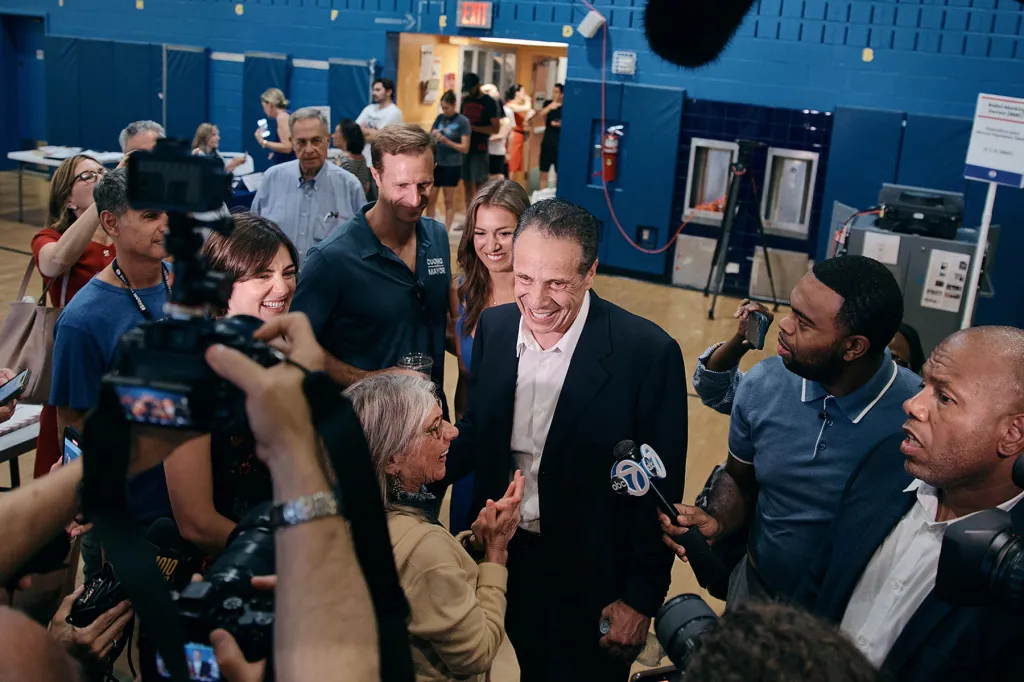
New York mayoral candidate, Andrew Cuomo, speaks to the media as he arrives to vote in the Democratic primary at the High School of Art and Design on June 24, 2025 in New York City.
(Andres Kudacki/Getty Images)
Issues like public safety and affordability, and not Cuomo’s scandals, took center stage in the mayoral campaign. But Mamdani still hammered Cuomo on his record in response to Cuomo criticizing him as inexperienced.
“Mr. Cuomo, I have never had to resign in disgrace,” Mamdani said in a June 12 mayoral debate. “I have never cut Medicaid. I have never stolen millions of dollars from the MTA. I have never hounded the 13 women who credibly accused me of sexual harassment. I have never sued for their gynecological records. And I have never done those things because I am not you, Mr. Cuomo.”
Great Job Grace Panetta & the Team @ The 19th Source link for sharing this story.
Welcome back to World Brief, where we’re looking at Iran retaliating against U.S. strikes, the two-day NATO leaders’ summit, and a terrorist attack in Syria.
Sign up to receive World Brief in your inbox every weekday.
Sign up to receive World Brief in your inbox every weekday.
By submitting your email, you agree to the Privacy Policy and Terms of Use and to receive email correspondence from us. You may opt out at any time.
‘The Era of Hit-and-Run Is Over’
Iran launched several short- and medium-range ballistic missiles at a major U.S. base in Qatar on Monday in retaliation for U.S. President Donald Trump ordering strikes on three key Iranian nuclear sites over the weekend. Tehran “neither initiated this war nor wanted it,” Iranian President Masoud Pezeshkian said on Monday. “But we will never leave any aggression against Iran unanswered.”
Conflict first erupted on June 13, when Israel launched a massive bombardment against Iran’s nuclear and military infrastructure—igniting a slew of back-and-forth attacks as well as threats of U.S. involvement. With its strikes over the weekend, the United States officially joined the fray, with Trump warning Tehran afterward that “there will be either peace, or there will be tragedy for Iran far greater than we have witnessed over the last eight days.” Foreign leaders were quick to demand a return to diplomacy.
Negotiations remain elusive, though, following Monday’s strikes targeting Al Udeid Air Base in Qatar, which houses around 10,000 American troops as well as some members of the British Royal Air Force and Qatari military. Built in the mid-1990s, Al Udeid is the largest U.S. military installation in the Middle East and serves as forward headquarters for U.S. Central Command.
No casualties were reported from Monday’s strikes, with Qatar saying that it had “successfully” intercepted the missiles. A U.S. defense official told Reuters that no other bases besides Al Udeid had been attacked. And the White House is reportedly monitoring the conflict from the Situation Room.
According to Iranian officials, Tehran gave Qatari authorities advance warning of Operation Basharat al-Fath (or “Annunciation of Victory”) to minimize casualties. Experts say that such coordination suggests that although Iran symbolically needed to retaliate against the United States—the secretariat of Iran’s Supreme National Security Council said the number of missiles that Iran used to strike Al Udeid was the same number of bombs that Washington deployed against Iran—it wanted to allow all sides an off-ramp to prevent further escalation.
A similar strategy was used in 2020, when Iran gave Iraq notice before firing ballistic missiles at U.S. forces stationed there following Washington’s assassination of Iranian commander Qassem Suleimani.
The Iranians had “gotten it all out of their ‘system,’ and there will, hopefully, be no further HATE,” Trump wrote on Truth Social on Monday. “I want to thank Iran for giving us early notice, which made it possible for no lives to be lost, and nobody to be injured. Perhaps Iran can now proceed to Peace and Harmony in the Region, and I will enthusiastically encourage Israel to do the same.”
Still, a spokesperson for Iran’s armed forces warned on Monday before Trump’s post that “the era of hit-and-run is over.”
The Qatari Foreign Ministry, which has often helped mediate tensions between Tehran and Washington, called the attack “a flagrant violation of Qatar’s sovereignty and airspace,” adding that Doha “reserves the right to respond directly, proportionate to the nature and scale of this blatant aggression and in accordance with international law.” Saudi Arabia echoed Qatar’s language, condemning Iran’s strikes “in the strongest terms.” And French President Emmanuel Macron called on all parties to “exercise maximum restraint, de-escalate, and return to the negotiating table.”
Meanwhile, the region remains on high alert. Less than an hour before Iran’s attack, Qatari authorities closed the country’s airspace, and the U.S. and U.K. embassies advised their citizens to shelter in place. Bahrain, Iraq, Kuwait, and the United Arab Emirates have since also closed their airspaces; Egypt has canceled all flights to the Gulf states; and Bahrain’s Interior Ministry has ordered its residents to “remain calm and head to the nearest safe place.”
Today’s Most Read
The World This Week
Tuesday, June 24: The 2025 NATO leaders’ summit kicks off in The Hague.
French President Emmanuel Macron concludes a two-day trip to Norway.
China’s National People’s Congress begins a four-day session.
Wednesday, June 25: The three-day annual assembly of the Organization of American States begins in Antigua and Barbuda.
Thursday, June 26: The European Council holds a two-day leaders’ summit in Brussels.
Friday, June 27: German Chancellor Friedrich Merz hosts Austrian Chancellor Christian Stocker in Berlin.
What We’re Following
What to expect at NATO. In less than 24 hours, NATO will kick off its annual two-day leaders’ summit in The Hague, where the alliance’s 32 members and their allies will address the biggest security threats facing the world today.
The top agenda item will be the push to increase NATO’s minimum defense spending requirement, which currently sits at 2 percent of each nation’s GDP. The United States has largely led that charge, with Trump demanding a 5 percent baseline to encourage greater burden-sharing. Despite many NATO members as well as NATO chief Mark Rutte backing the proposal, Spain rejected the target last week, calling it “unreasonable.”
Eight countries are failing to meet the 2 percent baseline, Spain being one of them. If all 32 states were to meet the 2 percent target over the next five years, then the alliance would bring in an extra $156 billion. If all members were to meet the 5 percent target over that same timeline, then an estimated extra $4.26 trillion would be added to NATO’s wallet.
The bloc is also expected to discuss Russia’s war in Ukraine—though it is still unclear if Ukrainian President Volodymyr Zelensky will have a seat at the table—as well as the escalating conflict between the United States and Iran.
Want more NATO summit coverage? Check out Situation Report’s special editions, to be published Monday through Thursday, as well as FP’s roundup of NATO experts.
Suicide bombing in Syria. An armed assailant opened fire on congregants at the Mar Elias Greek Orthodox church in Syria on Sunday before detonating an explosive vest, killing at least 25 people and injuring more than 60 others. Governments in the Middle East, the United States, and the European Union have all denounced the incident as a terrorist attack.
No group has claimed responsibility thus far, but the Syrian Interior Ministry has blamed the Islamic State, which once controlled large swaths of the country. The attack comes as Syrian President Ahmed al-Sharaa is struggling to win the support of the country’s minority groups after toppling dictator Bashar al-Assad in December and establishing a new government.
“These terrible acts of cowardice have no place in the new tapestry of integrated tolerance and inclusion that Syrians are weaving,” U.S. special envoy for Syria Tom Barrack wrote on X. “We continue to support the Syrian government as it fights against those who are seeking to create instability and fear in their country and the broader region.”
Breaking with tradition. South Korean President Lee Jae-myung named Democratic Party lawmaker Ahn Gyu-back on Monday to become the country’s first civilian defense minister in 64 years. Ahn is considered one of the foremost experts on defense policy in the ruling party, and his nomination makes good on Lee’s campaign promise to appoint nonmilitary personnel to the position following the country’s short-lived martial law order last December.
Among Ahn’s past responsibilities, he led the Democratic Party’s emergency task force and chaired the special parliamentary committee in charge of investigating then-President Yoon Suk-yeol’s martial law declaration. Yoon’s defense minister, Kim Yong-hyun, also played a leading role in planning the order and is currently in jail facing insurrection charges.
Lee named 10 other individuals to his cabinet on Monday, including former U.N. ambassador Cho Hyun to be the foreign minister and North Korea diplomacy advocate Chung Dong-young to be the unification minister.
Odds and Ends
Rome’s Spanish Steps are a popular tourist destination and a centuries-old symbol of Italy’s rich history. What they are not, however, is a shortcut for vehicles. That’s an important reminder for one 80-year-old driver, who wound up steering his compact luxury Mercedes-Benz A Class sedan onto the steps last Tuesday before getting stuck part way down. The man tested negative for alcohol, and he maintains that he is unsure how he ended up driving through the historic site. Lesson learned: Trust GPS.
It was to eliminate the way in which colonialism interacted with global political economy. This is the key. Freedoms were a secondary affair. What do I mean by the way it interacted? The US was absolutely convinced, and I think it was probably right, that a big push for the war came from economic rivalries between blocks of capital that were closed off from each other. And that created a kind of antagonism between them to open up markets that were otherwise inaccessible.
The British didn’t have access to French colonies and their markets. The French didn’t have good access to the British colonies. And the Americans had access to none of them. So the first thing to do is to break down these colonial barriers so that capital and labor can move freely. And the US thought that this will reduce the animosities. Now, because it reduces economic animosities, it should also reduce geopolitical rivalries.
As it happens, the second pillar of this was that American capital should be given special access to all these markets, of course, because it benefits the United States. But also because they thought the United States will be best positioned to superintend — to kind of be a referee for economic and political affairs everywhere. And if it has access to all these markets, American states will have an interest in an open playing field.
This should not be surprising because England also was pushing for the same policies in the 1840s and ’50s, a hundred years prior. Why both countries? England in the 1840s and ’50s, the United States in the 1940s and ’50s were the most economically efficient and productive economies in the world. They had nothing to fear from a globalized economy.
Both countries also had some degree of interest in opening up their economies to the others. I won’t go into why the British did — that was primarily because they were the biggest lenders in the world — but in the United States, the reason they wanted to have their borders open was that they knew that after the war, the entire world would need dollars for global trade and imports and exports.
Well, how are they going to get dollars? They can only get dollars if the US is buying goods from them and paying in dollars. So if the US wanted a global economy to thrive, it had to open up its markets to importers from the rest of the world. That meant as early as 1943 to 1944, the US had an agenda for expanding into the global economy before it knew if the Soviets would even survive.
Now, what happens in 1945 is the Soviets not only survive, but they have the largest army in Europe. And that means then that communism is now a real threat inside Europe as well. So now what this does is it adds an inflection to American global ambitions. Those global ambitions were always in place. The US intended to expand its influence over the entire world, but now it has to deal with the fact that there is a potential rival, at least in one part of that world, which is in Eastern Europe. That was a problem. It had to deal with it.
The initial signs after 1944–45 were not that the US would simply start up a deep antagonism with the Soviet Union. That took about eight, ten months to develop. The reason it developed so intensely, the reason anti-communism became such an issue, was that when [Harry] Truman and his people realized that in order to be the new police for the whole world, they would have to massively ramp up their military budgets and their military resources, Congress wasn’t willing to do it. So the one way in which they could get Congress to back this was to raise this specter of Communism.
Every time Congress resists him, he raises the bogey of the communist threat in Europe. This is how the Marshall Plan is passed. This is how the funding for NATO is passed. This is how the militarization of Asia and Europe is passed. So the US starts generating this ideology — the rhetoric of a global communist threat.
Great Job Vivek Chibber & the Team @ Jacobin Source link for sharing this story.
ProPublica is a nonprofit newsroom that investigates abuses of power. Sign up to receive our biggest stories as soon as they’re published.
In 2022, three Food and Drug Administration inspectors headed to India to investigate a massive Sun Pharma plant that produces dozens of generic drugs for Americans. Over two weeks, they found dangerous breakdowns in the way critical medications were made, and the FDA ultimately placed the factory on an import ban — prohibiting the company from shipping drugs to the United States.
The agency, however, quietly gave the global manufacturer a special pass to continue sending more than a dozen drugs to Americans even though they were made at the same substandard factory that was officially banned from the U.S. market.
It wasn’t the first time. Here are the key takeaways from ProPublica’s 14-month investigation into the FDA’s oversight of foreign drugmakers:
Over a dozen years, the agency entrusted to protect America’s drug supply gave similar exemptions to some of the most troubled foreign drugmakers in India, allowing factories banned from the U.S. market to continue shipping medications to an unsuspecting American public.
A secretive group inside the FDA exempted the medications from import bans, ostensibly to prevent drug shortages. With each pass, the agency dismissed warnings from its own inspectors about dangerous breaches in drug quality on factory floors. All told, the FDA allowed into the United States at least 150 drugs or their ingredients from banned factories found to have mold, foul water, dirty labs or fraudulent testing protocols. Nearly all came from factories in India.
The FDA did not regularly test the drugs exempted from import bans to see if they were safe or actively monitor reports about potential harm among patients. And as the drugs circulated in the United States, the agency kept the practice largely hidden from the public. The FDA said it put protective measures in place, such as requiring third-party oversight of factories to ensure the exempted drugs were safe.
Some of the exempted drugs were recalled — just before or just after they were exempted — because of contaminants or other defects that could cause health problems. And a ProPublica analysis identified more than 600 complaints in the FDA’s files about the exempted drugs at three factories alone, each flagging concerns in the months or years after the medications were excluded from import bans. The reports cite about 70 hospitalizations and nine deaths.
Janet Woodcock, who for more than two decades led the FDA’s Center for Drug Evaluation and Research, said she didn’t see a need to inform the public about the drugs from banned factories because the agency believed they were safe and that such information would create “some kind of frenzy” among consumers who might seek to change their prescriptions. “We had to kind of deal with the hand we were dealt,” she said, noting she supported the exemptions to deal with chronic drug shortages.
Decisions made by the FDA decades ago gave rise to the use of exemptions. In the 2000s, as the cost of brand-name drugs soared, the FDA approved hundreds of generic drug applications for foreign manufacturers that had been in trouble before, companies well-known to the inspectors working to stamp out safety and quality breakdowns.
The exempted drugs that have come to the United States include antibiotics, chemotherapy treatment, antidepressants, sedatives and epilepsy medication.
Sun Pharma did not respond to multiple requests for comment. When the FDA imposed the ban, the company said it would “undertake all necessary steps to resolve these issues and to ensure that the regulator is completely satisfied with the company’s remedial action. Sun Pharma remains committed to being … compliant and in supplying high-quality products to its customers and patients globally.”
Patricia Callahan and Vidya Krishnan contributed reporting. Alice Crites contributed research.
Great Job by Debbie Cenziper, Megan Rose, Brandon Roberts and Irena Hwang & the Team @ ProPublica Source link for sharing this story.
Ignited by a single arrest and fueled by decades of poverty and police brutality, the Watts Uprising of 1965 turned the Los Angeles neighborhood into a national symbol of Black struggle and resilience. Thousands of Black residents like Ted Watkins Sr. rose up in anger and desperation. They were fighting for resources to maintain their neighborhood.
In the aftermath of the rebellion, Watkins founded the Watts Labor Community Action Committee to fight for continued investment in Black residents. Today, his son, Tim Watkins, is stuck in the same battles as president of the organization.
Watkins remembers jazz and gospel spilled from street corners, and murals of Black icons watched over bustling sidewalks. With his friends and family, he grew up listening to the melodic lines bellowing out of Central Avenue jazz clubs and the many Black flea markets that would pop up along the streets on weekends. But by the mid 1980s, those same streets started to tell a different story. Today, the murals of Black heroes have faded from walls, and Spanish-language signs now match the number of those in English. Sounds of cumbia ring louder than horn-laced jazz notes.
Often, these changes are framed as progress, yet for Black communities across America, erasure feels closer to the truth. Over the past 50 years, gentrification has swept through hundreds of majority-Black neighborhoods, propelled by policies and practices that favor developers and newcomers while longtime residents lose their footing. Once thriving centers of Black culture, business, and political power have been hollowed out as rents climb and home values surge.
A new nationwide study has put it into perspective.
No racial or ethnic group has experienced more negative impacts from gentrification than Black people, according to researchers from the National Community Reinvestment Coalition, a coalition of 700 nonprofit organizations focused on directing resources to America’s most vulnerable communities.
As hundreds of Black communities across the country have been gentrified since 1980, more than 500,000 Black people have been pushed from their homes. Those same neighborhoods have seen more than 3 million new Latino, Asian, and white residents, with cities like Atlanta, Washington, New York, and San Francisco witnessing entire neighborhoods transform within a single generation.
Perhaps no one has seen this more intimately than Tim Watkins. His Watts neighborhood, which was two-thirds Black at the onset of the 1980s, is now nearly 80% Latino. Over that same period, 92% of Los Angeles’ majority Black neighborhoods that experienced gentrification are no longer majority Black. That is a greater percentage of Black neighborhood loss than any other metro area in the nation. Washington is at a close second, losing 84% of its 55 majority Black areas since 1980.
“Sixty years later, we’re in the rearview mirror,” said Watkins, whose organization works to combat Black displacement through several housing, employment, and environmental initiatives.
“The war on poverty was implemented in a way that it became a war against poverty-stricken.”
And now, decades after first experiencing the mass displacement of Black residents, his neighborhood is changing again. Over the past decade, more than $1 billion of private and public money has flowed into properties in Watts. Luxury condos and trendy cafés have replaced longtime family businesses, while rent prices soar beyond what existing residents can afford. This transformation is driven by developers capitalizing on Watts’ prime location and cheap land values — turning what was once California’s most neglected neighborhood into a profitable investment opportunity that pushes out the very community it claims to help.
When gentrification enters a neighborhood, he said, “that typically means the powers [that] be are going to object to everything that currently makes a community colorful, including us.”
The study found that more than 500 majority-Black neighborhoods have been affected by gentrification over the past 50 years. Today, half of these neighborhoods are no longer Black. In comparison, roughly 80% of white neighborhoods that experienced gentrification remained white after the process.
In total, roughly 15% of urban U.S. neighborhoods have gentrified over the past 50 years. Gentrification most often has taken place near downtown areas, the study found, with the downtown areas in Washington, New York, Philadelphia, New Orleans, Atlanta, and the San Francisco Bay Area topping the list.
Washington witnessed the erasure of its legendary Sunday African drumming circles in Malcolm X Park, as the city’s transformation from “Chocolate City” into upscale cafés and restaurants catering to white newcomers displaced the artists and cultural keepers who had made the nation’s capital a hub of Black creativity and political power.
Atlanta’s Old Fourth Ward experienced such dramatic racial upheaval that it flipped from majority-Black to majority-white after the Eastside Trail of the Beltline opened in 2012, with gleaming apartment complexes rising on formerly vacant industrial land. More than 20,000 Black residents were displaced from neighborhoods that had anchored generations of families.
In New York’s gentrifying neighborhoods like Harlem and Brooklyn, the informal networks of community connection where neighbors once acknowledged each other on the street and gathered for impromptu block parties with music have been fractured as newcomers who don’t understand existing cultural norms increasingly call 311 to complain about the expressions of Black and Afro-Latino culture that defined these spaces for decades
In Watts, as described by Watkins, gentrification has had a profound impact on both the social fabric and the levels of violence within the community. The influx of new residents and redevelopment projects has brought improvements in infrastructure and resources, but these benefits are not equitably distributed. It has shown him that violence in Watts, which has one of LA’s highest rates of gun violence and homelessness, is not simply a product of individual choices or family structures, but is deeply rooted in systemic neglect, environmental injustices, and the failure of government to enforce protections that would keep residents safe.
As funding for affordable housing and environmental protections is cut, the community, which was once home to the city’s largest concentration of public housing, has become more vulnerable to both physical and social displacement.
“All of the playing fields have been rigged,” Watkins said. “And now it seems, with the changes at the federal level, there is no more focus on addressing the playing field.”
However, the fight against gentrification is not passive, he said. The Watts Labor Community Action Committee is leading a community-driven strategic planning process, insisting that only those with a Watts area ZIP code can participate. By documenting the community’s history, forming homeowner associations, and controlling land ownership, the organization is working to ensure that the community retains agency over its future.
This resistance is grounded in self-determination, collective memory, and a refusal to let outsiders dictate the future of their neighborhood. The committee is currently procuring grants to build 2,000 units for unhoused people in Watts.
New buildings are seen under construction next to the historically Black Jordan Downs public housing complex in 2021. (Adam Mahoney/Capital B)
How does gentrification work, and who does it benefit?
The term “gentrification” was coined by sociologist Ruth Glass in 1964, and it began to take hold in the United States during the mid-1960s, especially as deindustrialization left urban neighborhoods, where Black people settled during the Great Migration from the South, economically vulnerable and ripe for reinvestment by wealthier newcomers.
Black Americans are disproportionately and negatively impacted by gentrification due to a legacy of discriminatory housing policies like redlining, exclusionary zoning, and unequal access to credit, which historically confined Black residents to specific neighborhoods and limited their ability to build generational wealth. As gentrification unfolds, it further deepens racial inequalities in housing, education, and economic opportunity.
To complete the study, researchers looked beyond the usual statistics connected to gentrification — income, home values, and college degrees. They tracked the rise of professionals and managers, observed shifts in the racial and ethnic makeup of blocks, and followed the flow of mortgage dollars into once-overlooked streets.
The research also expanded beyond the traditional vision of gentrification that is focused on house flippers to look at how urban planners and developers arrive to remake entire communities.
Bruce Mitchell, the lead researcher, explained that revitalization, on paper, brings hope to communities with new services, fresh amenities, and infrastructure where neglect has long taken root. For longtime residents, these changes can ring hollow. The benefits, such as better parks, safer streets, and new businesses, rarely flow to those who endured years of disinvestment. Instead, newcomers, often higher-income and white, settle into the improved landscape, able to shoulder the rising costs.
As the national housing shortage pushes gentrification into new corners, researchers urge urban planners and policymakers to act with urgency, particularly by including community members early and often in the process of directing money into neglected communities.
When “Chocolate City” loses its flavor
Civil rights lawyer Ari Theresa, photographed in 2018 in Washington, has filed an anti-gentrification lawsuit alleging a “pattern and practice of discrimination and disparate treatment against African American residents living in predominantly African American neighborhoods.” (Salwan Georges/The Washington Post via Getty Images)
Ari Theresa is a fourth-generation Washington resident whose family has witnessed the city’s transformation through segregation, civil rights, and now gentrification. As an adult, seeing the corner stores, churches, and community centers that shaped his childhood disappear, he began to connect the dots on how the city “systematically engineered” the displacement of Black families through policy initiatives designed to attract wealthy professionals. Beginning with rezoning appeals that targeted public housing around 2014, Theresa discovered that D.C.’s rapid development was intrinsically linked to displacement.
The city’s strategy became clear through policy documents that explicitly targeted what officials called “creative class professionals” — highly educated individuals ages 24 to 38 with dual incomes and no children. The motivation was purely economic, he said. Large, poor families were seen as “a drain on social services,” while wealthy professionals would provide “less need for social services, more tax base.”
Theresa has filed a federal lawsuit against the administration of Mayor Muriel Bowser and multiple D.C. government agencies, alleging a “pattern and practice of discrimination and disparate treatment against African American residents living in predominantly African American neighborhoods” through the systematic mishandling of development appeals in Black communities while providing preferential treatment to wealthier white neighborhoods.
However, Theresa observed a striking reversal during the COVID pandemic, as the same wealthy residents who had been courted began leaving the city, prompting D.C. to protect landlords and commercial real estate interests while continuing to burden struggling homeowners.
“It’s interesting that the city has chosen to bail them out in various ways, whereas when regular folks fall on hard times, the tack is to let them fail,” he noted, highlighting the persistent double standard in how the city treats different economic classes during times of crisis.
The disappearance of Black Los Angeles
In LA, the displacement of Black residents from historically Black neighborhoods was a process that was orchestrated to then make room for gentrification, argued Marne Campbell, an African American studies professor at Loyola Marymount University in Los Angeles. She explained how the convergence of multiple factors in the 1980s and 1990s — including deindustrialization, the crack cocaine epidemic, mass incarceration, and the 1984 Olympics — created conditions for what she describes as the “systematic targeting of working-class black neighborhoods.”
Often, gentrification and displacement go hand in hand, but Los Angeles is a unique outlier, explained Campbell.
What then made Los Angeles especially unique compared to other heavily gentrified American cities is that when Black families left these neighborhoods, they were primarily replaced by Latino families rather than white residents, creating a distinctive demographic shift.
“In LA, displacement of Black folks predates gentrification, but it was still a coordinated attack to erase us,” she explained.
Latino families often shared similar economic circumstances with the Black families who had previously lived there, keeping these neighborhoods within reach for working-class residents while remaining less attractive to white buyers initially. It delayed the process of gentrification, but still led to an erasure of much of Black Los Angeles. In recent years, it laid the foundation for political battles between Black and Latino residents, while these same neighborhoods are becoming gentrified and increasingly whiter.
Campbell, the author of Making Black Los Angeles, also drew connections between this historical pattern and current concerns about homelessness and displacement as Los Angeles prepares to host the Olympics again in 2028, suggesting that similar forces of systematic removal are now targeting the city’s unhoused population, many of whom are also Black.
Without targeted intervention and making sure Black voices are maintained and heard in redevelopment plans, “Black people will always be pushed out,” she said.
Looking at present-day gentrification trends, she warns that the displacement cycle is accelerating because of that lack of commitment to Black residents.
“Black people are still here and looking for houses. Even in South Central, they’re being outbid by white families who can bring cash,” she said. “We’re in a crunch for affordable housing.”
To view the entire database and accompanying map that outlines gentrification and displacement nationwide, click here.
Great Job Adam Mahoney & the Team @ Capital B News Source link for sharing this story.
A sprawling network of antiabortion activists, judges and dark money groups is working in lockstep to erode access to abortion pills—and mifepristone is their top target.
Abortion-rights activists in front of the U.S. Supreme Court on June 24, 2024, mark the second anniversary of the Dobbs v. Jackson Women’s Health Organization ruling. (Aashish Kiphayet / Middle East Images via AFP and Getty Images)
It’s been three years since the MAGA contingent of the U.S. Supreme Court reversed Roe v. Wade, overturning federal abortion protections. Shortly after, antiabortion groups, law firms, judges and politicians shifted gears, expanding their focus on state-level efforts to ban abortion, along with a multi-layered and relentless national assault on mifepristone—one of two drugs used in medication abortions.
Medication abortion has become the most popular form of abortion in the U.S. post-Dobbs, providing potentially lifesaving access to women residing in states with abortion bans in place. Because of this, the antiabortion right-wing machine’s dogged attacks on mifepristone should be seen for what they are—an attempt at a backdoor national abortion ban.
It may have taken the antiabortion machine nearly 50 years to overturn Roe, but that network has since redoubled its efforts and has tallied up additional wins under a second Trump presidency. As such, the future of mifepristone access is uncertain as ever.
Three years post-Dobbs, the majority of Americans who support reproductive justice deserve to know where this threat to their rights is coming from and how dire it is to ensure the antiabortion machine’s attacks against mifepristone don’t culminate in another Dobbs-level victory.
2022-2023: The Antiabortion Machine’s Early Attacks Against Mifepristone
At the end of 2022, a newly formed antiabortion front group called the Alliance for Hippocratic Medicine (AHM) filed a lawsuit against the FDA and the Biden administration’s Department of Health and Human Services (HHS) challenging the FDA’s initial approval of mifepristone. AHM is composed of five antiabortion groups, including the American Association of Pro-Life Obstetricians and Gynecologists (AAPLOG), a Project 2025 advisory board member notorious for peddling reproductive disinformation. AHM has ties to Leonard Leo—the antiabortion powerbroker and judicial kingmaker who engineered the MAGA faction of the Supreme Court which overturned Roe.
AHM was incorporated in Amarillo, Texas, even though the organization has a Tennessee mailing address and none of its member organizations are based in Texas. This was by design. Incorporating and filing in Amarillo, Texas, guaranteed the group would appear before the only judge assigned there, Matthew Kacsmaryk, a controversial Trump-appointed judge who failed to disclose his most recent antiabortion zealotry prior to his confirmation. Kacsmaryk overturned the FDA’s decision on the safety of mifepristone, relying heavily on two studies from researchers affiliated with the antiabortion groups Charlotte Lozier Institute (an arm of Susan B. Anthony Pro-Life America) and AAPLOG. These pseudo-studies were later retracted for their lack of “scientific rigor” and failure to disclose any conflicts of interest.
Alliance Defending Freedom (ADF), the Southern Poverty Law Center-designated hate group that orchestrated the legal strategy to challenge and successfully overturn Roe and represented the plaintiff in Alliance for Hippocratic Medicine v. FDA. More specifically, ADF’s Erin Hawley, who is married to far-right U.S. Sen. Josh Hawley (R-Mo.), coordinated the Dobbs case for ADF and helped litigate the case at every turn, including when the case made it before the Supreme Court in March 2024.
Students for Life of America (SFLA), where Leonard Leo was co-chairman in 2023, also bolstered the legal fight against the abortion pill by attempting to shape public opinion. SFLA’s tactics included polling and disinformation campaigns.
For example, these campaigns featured a docuseries attacking the medication in collaboration with ADF and APPLOG, plus a scientifically unfounded campaign that mifepristone was contaminating drinking water. The latter served as a springboard for SFLA-crafted legislation that has been introduced in multiple states, seeking to further erode access to the medication.
Texas legislators recently introduced a version of the bill baselessly arguing that birth control is also contaminating ground water.
Despite asserting that abortion medicine is affecting water, these campaigns are silent on Viagra and other pharmaceutical residues being flushed down toilets and into municipal water purification systems. Incidentally, SFLA’s head, Kristan Hawkins, also wants access to birth control pills and other birth control devices to be illegal.
2024: Attacks on Mifepristone Make It to the Supreme Court, States Get Involved, and Project 2025
The U.S. Supreme Court added Alliance for Hippocratic Medicine v. FDA to its 2023-2024 docket, after Kascmaryk ordered the medication off the market and the Fifth Circuit on appeal reversed this ruling in part. The Roberts Court heard the case in March of 2024, ultimately ruling against the plaintiffs, not because mifepristone is safe (safer than Tylenol, Viagra and penicillin) but instead on the grounds that AHM lacked standing.
The Court’s arguably most corrupt justices—Thomas and Alito—dissented. In their dissent, Thomas and Alito suggested that the Comstock Act, a discredited 1873 law that initially targeted access to contraception, abortion information and pornography, could be used to keep abortion pills from being mailed to patients. Antiabortion groups have called for the enforcement of the Comstock Act to prohibit the mailing of abortion medication. If enforced, the law could be used to derail access to abortion medication and other reproductive health supplies nationwide.
Polish abortion-rights activist Justyna Wydrzynska holds a pack of mifepristone and misoprostol tablets in Warsaw on Jan. 30, 2025. (Sergei Gapon / AFP via Getty Images)
In an anticipatory move, in January 2024, two months before the Supreme Court was set to hear the case, antiabortion attorneys general from Missouri, Idaho and Kansas sought to intervene in the case should the Court determine AHM lacked standing—as critics observed that AHM obviously had insufficient grounds. AHM’s claim of abortion medication causing harm was the possibility of a small fraction of doctors possibly needing to perform a surgical abortion if a patient took mifepristone and the medication failed to terminate the pregnancy. The states filed with Judge Kacsmaryk in January and amended their complaint in October 2024, breathing life back into the case, which could again reach the far-right supermajority on the Supreme Court that Leo’s antiabortion network helped install.
The suit seeks to roll back access to mifepristone by requiring in-person prescriptions, reducing access from 10 weeks gestation to seven (before many know they are pregnant) and banning access for young people. The almost 200-page complaint was co-authored by Missouri Solicitor General Josh Divine. Divine was recently nominated by Trump as a federal judge, but during his confirmation, the committee did little to interrogate his antiabortion extremism, which is on display in the complaint he helped co-author. For example:
The complaint falsely claims that mifepristone “starves the baby to death” in the womb, when really the pill blocks progesterone, a pregnancy-sustaining hormone.
The authors invoked the antiquated Comstock Act of 1873 to falsely argue that the FDA “unlawfully removed its prohibition against mailing abortion drugs.”
The complaint focuses on banning access to mifepristone for anyone under 18, despite the pervasiveness of sexual assault of minors. And while this argument is made under the guise of concern for girls and their “developing reproductive systems,” the authors fail to acknowledge the considerable adverse risks of pregnancy in minors.
Some of the “scientific evidence” that Divine and others used comes from Charlotte Lozier Institute staffers James Studnicki and Tessa Longbons—the same “researchers” who had their 2021 and 2022 mifepristone studies retracted due to a lack of scientific rigor, problematic methodology and undisclosed bias.
The complaint also details “reporting requirements” around mifepristone, at one point suggesting the FDA could require what are called “Elements to Assure Safe Use (ETSU)” rules. Among the ones they specify are that “each patient be subject to ‘certain monitoring’” and “each patient be enrolled in a ‘registry.’” These intrusive demands fit in with the abortion surveillance pushed in Project 2025.
Roger Severino, who served as the director of the Office of Civil Rights within the Department of Health and Human Services during Trump’s first administration, wrote the Project 2025 chapter on HHS’ radical transformation under Trump 2.0, including his vision for the FDA withdrawing approval for mifepristone and for the Department of Justice (DOJ) initiating prosecutions under the Comstock Act.
Severino formerly worked for the Leo-tied Ethics and Public Policy Center (EPPC)—the group that released a pseudo-study that served as a catalyst for the ramped up attacks against the abortion pill in 2025. His spouse is Carrie Severino, a long-time leader in groups at the forefront of Leo’s campaign to capture the Supreme Court, namely the group called the Judicial Crisis Network, which now goes by the alias JCN.
2025: Attacks Against Mifepristone Ramp Up
In May 2025, the Trump administration’s DOJ asked a federal judge to dismiss the lawsuit challenging the FDA’s regulation of the abortion medication mifepristone. What on the surface might seem like a move in support of abortion access is more likely part of a legal strategy aimed at eliminating FDA approval of the medicine nationwide through executive fiat.
Just one week before the DOJ filed that request, Trump’s new FDA chief Marty Makary said he’d consider restricting abortion pill access if “new data” showed it was dangerous. As if this were orchestrated, a few days later, antiabortion groups released a pseudo-study riddled with junk science. That new report was produced by the Ethics and Public Policy Center (EPPC), an antiabortion group that Leo helps steer. An additional pseudo-scientific study utilizing the same (secret) data set was issued by another antiabortion group called the Foundation for the Restoration of America, which is tied to Dick Uihlein, an antiabortion billionaire whose non-profit vehicles are the primary funder of “Women Speak Out,” an arm of Susan B. Anthony Pro-Life America.
Reporting by Politico documented this as part of a coordinated effort by the nation’s most influential antiabortion groups to attack mifepristone. SBA-PLA, EPPC, Americans United for Life, Students for Life and Live Action discussed on Zoom how they could leverage those documents to compel potentially sympathetic members in the Trump administration and Congress to eliminate access to the abortion pill.
Sen. Josh Hawley (R-Mo.), a staunch antiabortionist and Josh Divine’s former boss, used the EPPC report as the basis for introducing legislation that could help further eliminate abortion access for Americans, whether they live in an antiabortion state or not. He also used the paper to successfully obtain public commitments from Trump’s administration, including leveraging the junk science to get RFK Jr., head of HHS, to consider limiting mifepristone access. RFK Jr. has since ordered a review of the drug, even though it has been around since the 1980s, was approved by the FDA in 2000 and has been the subject of over 100 scientific studies.
… likely part of a legal strategy aimed at eliminating FDA approval of the medicine nationwide through executive fiat.
In mid-February, a new antiabortion coalition calling itself the Life Leadership Conference (LLC) was infused with $30 million through its “Pro-Life Venture Fund.” The network of Leonard Leo is financially backing this new venture. The spokesperson for the Conference, long-time antiabortionist David Bereit, said the $30 million is meant to “incentivize” antiabortion groups to “work together” to produce results. Following the announcement of this “conference,” we have seen antiabortion groups come together in messaging and focusing on efforts around Trump’s IVF executive order plus the administration’s efforts to defund Planned Parenthood. This is a joint effort to lift up this paper to try and attain their ultimate goal of eliminating access to mifepristone.
The legal future of abortion pills remains uncertain, but what is clear is that revoking access to mifepristone is key in the antiabortion machine’s fight to maintain control over pregnant Americans’ bodies and lives. As abortion opponents have gained and wielded their power, created right wing echo-chambers filled with disinformation, and supported policies that have resulted in cruel and devastating outcomes, access to mifepristone has become more than just a means of healthcare—it is a vital lifeline and crucial tool of resistance against efforts to limit our reproductive rights and control our future livelihoods.