Elon Musk isn’t very pleased with the “big, beautiful” budget the House passed before leaving town at the end of last week. He’s admitted to being disappointed with the legislation and has warned that it would harm critical subsidies for electric vehicles and solar projects. He’s also called it antithetical to the DOGE mission he has spearheaded at the behest of Donald Trump.
In all, it’s created a completely unexpected—and frankly, almost unthinkable—specter: the Republican party’s top donor, the president’s once-top adviser, publicly ragging on the biggest piece of legislation that the administration and its allies have attempted to push during their time in office.
Few opportunities like this have ever existed for an opposition party. And yet, in the 48 hours since Musk let his dissatisfaction be known, Democrats don’t appear to be doing much at all to capitalize on it.
House Minority Leader Hakeem Jeffries hasn’t posted on X, Facebook, or Instagram about Musk’s comments. Senate Minority Leader Chuck Schumer’s opportunism extended to a single post about it on Facebook and X: “Wow, I didn’t realize Trump was even allowed to break with President Musk.” The Democratic National Committee’s rapid response account on X, “@Factpostnews,” posted about Musk’s commentstwice. No formal statement was issued by any of their offices. Nor have other leader members of Congress jumped on Musk’s criticisms in any meaningful way.
Great Job Joe Perticone & the Team @ The Bulwark Source link for sharing this story.
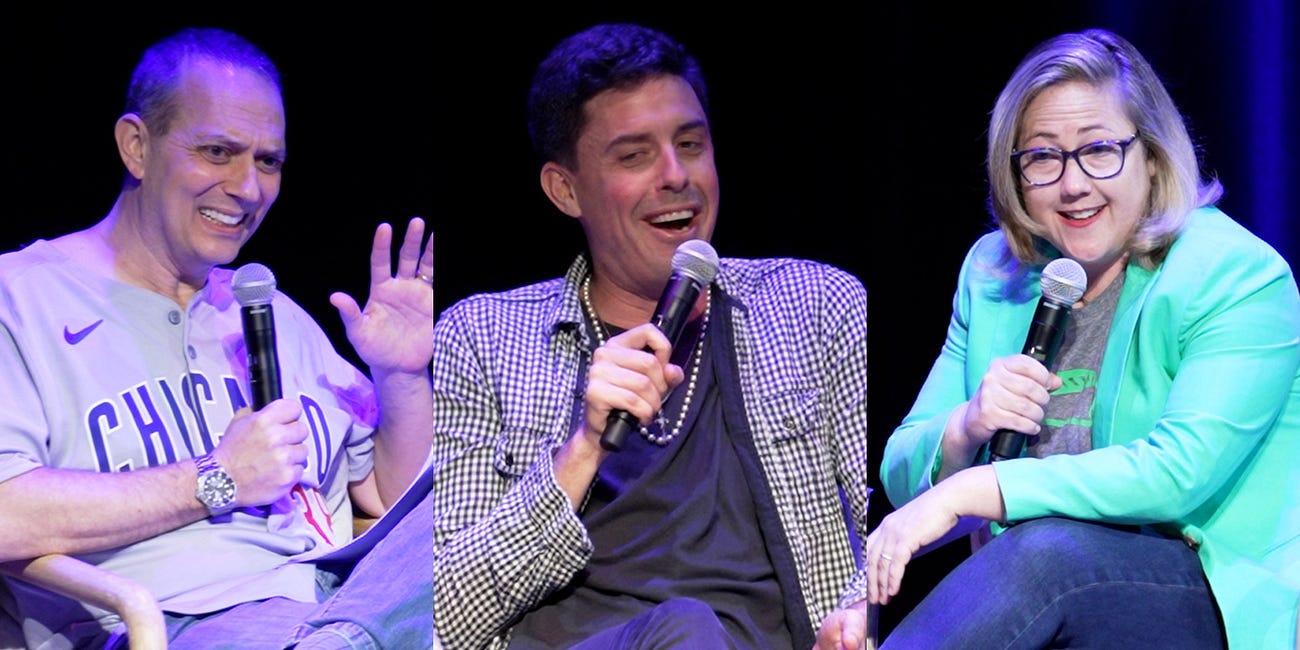
Adam Kinzinger joined Tim on stage in the Windy City Wednesday night to dis Chicken Trump, who’s made bitcoin bros, private prisons, his family and friends—and himself—the main winners in his ‘TACO’ trade economy. Meanwhile, Obama’s nuclear deal with Iran may be getting resurrected, and Trump finally seems to realize that Putin is a warmonger. Plus, Dems should put Qatar and El Salvador on notice that there will be a cost for their free gifts in the future, and we are the guys and girls on the white horse who will save this country.
Adam Kinzinger joins Tim Miller in Chicago.
Leave a comment
show notes
The Bulwark Podcast is available wherever you get your podcasts and on YouTube. Follow, leave us a review and wherever you tune in. Add the show to your player of choice, here.
As always: Watch, listen, and leave a comment.
Don’t care for video? Use the controls on the left-hand side of the player to toggle to the audio edition.
Ad-free editions of The Bulwark Podcast are available exclusively for Bulwark+ members.
Great Job Tim Miller & the Team @ The Bulwark Source link for sharing this story.
For years, we’ve been hearing that the combination of childish governance and chronic budget deficits would eventually catch up with the United States, but the US always outran the worrywarts. That era, one in which the Treasury could borrow limitlessly and at low cost, may be ending.
“For the first time in my professional life, we’re seeing a shift, with investors looking askance at Treasury debt,” John Velis, a money manager at BNY Mellon told Politico. The spark looks to have been Moody’s downgrade of the Treasury’s credit rating, but there was no new information in the rating agency’s decision. It did, however, as Velis noted, “focus minds.”
Moody’s is one of three big ratings agencies. Their main business is assessing the risk of default — that the debtor, whether a company or a government, may miss an interest payment or repayment of principal on their loan — and their major way of communicating that risk is a letter rating, looking much like a grade. Each has a different system, but they range from AAA down to C or D (as in default). Some institutional investors are, under government regulation or internal policy, required to buy only high-rated debt. Moody, using its own idiosyncratic system, cut the United States from Aaa, the highest, to Aa1, second highest.
In its downgrade, Moody’s pointed to interest and debt burdens that are “significantly higher” than the US’s rich-country peers, while noting that the country still has exceptional strengths, like the size and dynamism of its economy. But those strengths “no longer fully counterbalance the decline in fiscal metrics.” They’re discreetly confident in the face of the political challenges of the Trump era: “Institutions and governance will not materially weaken, even if they are tested at times.”
S&P Global Ratings (formerly Standard & Poor’s) was the first of the big three ratings agencies to cut their rating on US Treasuries, back in August 2011. Curiously, über-investor Warren Buffett and former Federal Reserve chair Alan Greenspan both dismissed the move, saying the United States could never default because we borrow in dollars — many other countries don’t have the privilege of borrowing in their own currency — and we can just print them as needed.
That’s true. It would be inflationary and panic-inducing, but it still wouldn’t be a default. S&P’s reasoning for the cut fourteen years ago was much like Moody’s in mid-May: “The effectiveness, stability, and predictability of American policymaking and political challenges have weakened at a time of ongoing fiscal and economic challenges,” meaning chronic deficits and rising debt. The world of 2025 seems rather less stable and predictable than that of 2011.
Fitch, the smallest of the big three, announced its downgrade in August 2023, offering reasons very similar to S&P’s: rising debt and “a steady deterioration in standards of governance.” Countering that, Fitch noted high US scores on indexes of Political Stability and Rights, the Rule of Law, Institutional and Regulatory Quality, and Control of Corruption (caps in original). That looks quaint at a time when US tariffs on imports from China can go from 31 percent to 135 percent and back to 51 percent in just a few months on the whim of just one man, a man who happily disregards the law and who’s made a bundle on his own meme coin while using his office promoting crypto.
Fitch added that factors that could lead to another downgrade include “a marked increase in general government debt” and “a decline in the coherence and credibility of policymaking that undermines the reserve currency status of the U.S. dollar, thus diminishing the government’s financing flexibility.” We are very much there, but no critical comments yet from Fitch.
Fitch’s comment about the reserve currency status refers to the dollar’s role as the global currency, the one major commodities like oil are priced in, and the one in which countries keep their foreign reserves. (Foreign reserves are holdings that countries keep of currencies other than their own that serve as cushions in case of a foreign payments crisis. As of last year, 58 percent of those worldwide were denominated in US dollars.)
That reserve status has depended in part on the enormous size of the US economy and its financial markets; no market in the world matches the US Treasury market’s capacity to absorb billions in inflows and outflows with only the slightest ripple. But it also depends on the United States’ role as the foundation of capitalist power globally and its ultimate guarantor in a crisis.
During the 2008 financial crisis, the Fed and Treasury led a globally coordinated bailout. It’s not clear that Trump’s government would have the competence or stature to do the same today. Trump has deliberately frayed the ties among the principal capitalist states, and the US today is a source of systemic disorder, not stabilization.
Evidence of the “shift” that Velis cited can be found in the unprecedented ways in which markets panicked on Liberation Day, April 2, when Trump announced his big, not-so-beautiful tariffs. Normally in times of political or economic stress, investors from around the world plow into US assets, notably Treasury bonds. Since you need dollars to buy Treasuries, such flights to quality, as they’re called usually, push up the value of the dollar.
That didn’t happen after Liberation Day: the dollar fell, a sign that investors were dumping US assets rather than buying them. George Saravelos, a Deutsche Bank currency analyst (funny, since Deutsche was one of the few major banks to lend to Trump over the years, on often questionably generous terms), diagnosed a “dramatic regime change in markets” and an increasingly likely “confidence crisis” in the dollar. That panic has ebbed, but it does feel like something has changed.
In its downgrade note, Moody’s said, “US institutions and governance will not materially weaken, even if they are tested at times.” Hope dies last.
Republicans now thoroughly control the federal budget, but math makes budget balancing very hard for them. They’re committed to big tax cuts. Tariffs will offset that some, but not by much, so increasing revenue is out.
The spending side isn’t so easy either, if you’ve ruled out cuts to the Pentagon. The budget is basically divided into three big parts: mandatory, discretionary, and interest payments. Mandatory spending is for programs that Congress doesn’t have to authorize afresh every fiscal year — they’re on autopilot from year to year unless Congress overhauls them.
The bulk of mandatory spending is accounted for by “entitlement programs,” notably Social Security and Medicare, and Medicaid. The term, which has acquired an unfortunate aura of moral disapproval, reflects the fact that if you qualify for the benefits, they’re yours — you’re “entitled” to them, without having to jump through hoops (though Medicaid, since it’s mostly for poor people, has some hoops and will get more).
Discretionary spending, by contrast, has to be authorized at a level set by Congress every year; this includes everything from education and the military (which accounts for almost half of it) to the environment (which accounts for very little of it).
Serious cuts to Social Security and Medicare are, for now, politically impossible, so that leaves little more than Medicaid and civilian discretionary spending to chop. You could cut both categories to zero and the budget still wouldn’t balance.
To the Right, the problem is out-of-control spending. Measured as a share of GDP, spending has risen, mostly because of Medicare and Medicaid, thanks to an aging population and an insane health care financing system, along with some help from interest payments. Social Security’s share is up only mildly.
Surprisingly, the military spending share of GDP has fallen by more than two-thirds since 1962 and half since 1986, the peak of the Reagan-era buildup. It’s still way too high, and if Trump has his way, which he usually does, it will climb. DOGE-style cuts to the Weather Service and scientific research are immensely damaging but save only trivial amounts of money.
One could narrow, or even close, the budget gap with an approach that’s forbidden in mainstream discourse: raising taxes. As a share of GDP, federal revenues in 2024, 17.1 percent, were almost exactly what they were in 1962 even as the spending share has risen from 18.2 percent to 23.4 percent. Restoring corporate tax rates, which are at near-record lows, to the levels of the early 1960s and restoring the income tax structure of the Clinton years — hardly radical moves — would reduce the deficit by nearly a third. Cut the military budget in half, admittedly a more radical move, and you’d reduce it by well over half.
Some on the Left argue that debt and deficits are nothing to worry about, or are even healthy stimuli, and only spoilsport “austerians” think they matter. On the second point, looking at eighteen major countries, on average, high-debt and -deficit countries are more unequal and have higher poverty rates than low-debt/low-deficit countries. The Nordic social democracies have small public debts and deficits, countering the belief that deficit spending is somehow egalitarian.
On the worry point, yes, the US Treasury has enjoyed tremendous freedom to borrow, but that seems a privilege not worth testing. Markets can turn on a dime, and manias can become panics almost overnight. There’s always the option of just printing the money, an idea modern monetary theorists say they are unfairly accused of. Trump himself has endorsed the printing approach several times, first in 2016 and again in his first presidency. Since we just went through a disastrous inflation, money printing, which can be seriously inflationary, doesn’t seem like a live option.
More extreme would be some kind of default. The idea of the Treasury not keeping up on its debt seems too extreme for Trump, but he does have a casual attitude toward default and bankruptcy. As he said in 2016 of his debt-driven business strategy, when you run into trouble, just negotiate.
And what does he mean by negotiate? “Hey, guess what? The economy just crashed. I’m gonna give you back half.” Trump’s advisors have talked about forcing foreign holders of Treasury bonds to exchange them for one-hundred-year bonds at low-interest rates or pay “taxes” on their interest payments, either of which would be a default — though this sort of thing is now supposedly off the table, which is good, because it would blow up the world’s financial markets, and not to the benefit of the global working class.
Aside from worrying about a market panic about the US suddenly being unable to borrow, or being forced to pay very high interest rates, the share of the budget going to service the Treasury’s debt has been rising and will only rise further. Last year, an eighth of federal spending went to interest payments, the highest in twenty-five years. That’s 43 percent more than we spent on Medicaid and 238 percent what we spent on income security. We’d rather borrow money from rich people and pay them interest than tax them.
Of course, Trump’s One Big Beautiful Bill Act (OBBA) will swell the deficit. Spending cuts in the bill, around 80 percent of them from Medicaid and food stamps (now known as the Supplemental Nutrition Assistance Program, or SNAP), will be damaging to their beneficiaries — 10–14 million people could lose Medicaid, and 11 million could see cuts to food benefits — but only very partially offset the tax cuts. Overall, the Penn Wharton budget model estimates that the poorest 20 percent of Americans will take a 15 percent hit to income in 2026, while the top 0.1 percent would gain 3 percent, based on the version of the OBBBA passed by the House. Penn Wharton adds a cheerful note: the act could increase GDP growth and capital accumulation because “cuts to Medicaid and SNAP” will force people to “work longer hours and increase precautionary savings.”
Sadly, loss of medical and food benefits isn’t the sort of thing that upsets bond traders or ratings agencies. But chaotic governance and endless borrowing can, and we’ve got plenty of that. Trump, who bragged in that 2016 interview that “nobody knows debt better than me. I’ve made a fortune by using debt,” may find that running the US government is more challenging than running some casinos into the ground and making off with the loot.
Trump promised in 2016 that “we’re gonna win so much, you may even get tired of winning.” It’s hard to see the winning in ratings downgrades, deep budget cuts, and potential fiscal crises.
Great Job Doug Henwood & the Team @ Jacobin Source link for sharing this story.
The first time we tried getting Bulwark members together we did it at a baseball game in Washington. It was kind of a DIY mess: The Nationals reserved a section for us, people sent money to me via PayPal. I bought the ticket for them and then forwarded it. I think maybe 100 people came that night and we just hung out and watched a ballgame together.
It was great.
Last night a thousand people from this community came together in Chicago at a theater down the street from Wrigley. When we booked this place I thought the venue was too big for us; that we’d never fill it. We sold it out in 72 hours. Truth is, we could have gone bigger. If you want to watch the show, it’s here.
The Next Level
Live in Chicago! Pardons, Authoritarianism, and Xanax
Live from Chicago, Tim Miller, Sarah Longwell, and JVL break down the latest wave of Trump pardons, the rising authoritarian behavior from GOP leaders, and the Democratic Party’s identity crisis. Also, who is the worst (and best?) cabinet member so far, and what comes next?
I want to talk about two things.
First: Thank you. To all of you. Everyone who came out last night. Everyone who reads this newsletter. Everyone who convenes with us over podcasts or on YouTube. Everyone who talks in the comments or emails back and forth with me. From the bottom of my heart.
Second: This is how we fight back.
Over the weekend Carl Safina published a profound essay about resisting authoritarianism that drew on his work studying animal behavior.
One late afternoon long ago at the Ngorongoro Crater in Tanzania, I was with a group of birders when we located a pride of sleeping lions. As evening approached, they yawned big-fanged yawns and slowly roused. About 10 in total, scarred veterans and prime young hunters.
It was time for them to hunt. But first they licked one another, pressed bodies and indulged in much face rubbing. They reaffirmed, “Yes, we are together, we remain as one.” Only then did they set off.
Their tawny bodies flowed up into the tall golden grass along the ridge of a low hill. One sat; the others kept walking. Ten yards on, another sat while the others walked. And so on until the ridge was lined with a hidden picket fence of hungry lions all attentively gazing onto a plain where a herd of unsuspecting zebras grazed. Then one, who’d remained standing, poured herself downhill. Her job was to flank and then spook the zebras into running uphill, directly into her veteran sisters and their spry younger hunters.
Rubbing noses does not catch a zebra. But only after the lions rubbed noses and reaffirmed a shared identity were the zebras in any danger. Those lions showed me that a sense of community is prerequisite for coordinated strategy.
And here’s his big point:
As individuals we cannot always formulate the full fix. But we can be a part of a movement to forge one. . . . [C]ommunity comes before strategy.
Yes. YES.
Say it again. Tattoo it on your eyelids. Put it on a pillow.
Community comes before strategy.
Leave a comment
A couple weeks ago on the Secret pod I was having kind of a dark week of the soul and Sarah asked me, If people are so terrible and everything is lost, then what are we even doing here?
I didn’t have an answer then. But I do now. We’re building the community. And as we build that power, we’ll figure it out.
That’s my ask. Come join us. If you can’t afford the membership, that’s fine. We never leave anyone out. Just hit reply to this email—it goes directly to me—and we’ll take care of you.
If you can afford it, come and stand with us. Build with us. Grow with us. Because when we’re united we’re powerful.
TACO has the potential to hurt Trump.
(1) It’s simple. Trump Always Chickens Out. You can put that phrase anywhere, apply it to anything, and everyone knows what it means.
(2) It’s meme-able. You have the slogan. You have the word mark. And you have an universally recognizable image. Hell, there’s even a pre-built emoji for it. You can put this thing anywhere and it will be a symbol of the democracy movement.
(3) It’s universal. You can apply it to any situation. Trump pulls back on tariffs? TACO. Trump gives in to Putin? TACO. Trump increases the national debt? TACO.
(4) It’s organic. No Democratic strategist came up with TACO. It’s an observation that emerged from the finance world—from the very same bros who voted for Trump in the first place. You can feel the disdain of his own supporters dripping off of it.
(5) It hits at something deep inside Trump. It’s about his soul. It’s about his weakness.
(6) It’s a provocation. Real talk: It’s usually good that Trump chickens out. It’s good that he didn’t try to use the military to remain in office in January of 2021. It’s good that he pulled the 150 percent tariffs back to 45 percent, or 30 percent, or whatever they’re at this morning.
But in the current dynamic, that’s how Trump wins. He says he’s going to do some insane thing, his supporters give him credit for doing it—but then he pulls back in order to avoid the worst real-world consequences.
By hitting him with TACO over and over, you (a) reveal his pull-backs as weakness and (b) dare him to go through with the stuff that will screw up the real world—and, in theory, create pain for his movement.
Maybe it’s just the high from all the face rubbing last night, but I think TACO has the potential to be a real weapon. I want to put it on red hats in the MAGA font, put it on stickers, see it plastered all over the public sphere, guerrilla-style.
And from there, we see what happens.
Leave a comment
A Wired piece on AI and music.
Smith and Hay finished their album and called it Jazz. That fall, they released it on all the usual places—Spotify, Apple Music, Tidal—and as a physical album. Alas, it failed to take off. Smith and Hay weren’t total nobodies; a few songs they had coproduced for other artists years earlier had gotten some buzz. So the two men decided to retool Jazz and release an updated version, adding new songs.
Jazz (Deluxe) came out in January 2018. Right away, it shot up the Billboard chart and hit No. 1. Hay was elated. At last, real, measurable success had arrived.
Then, just as suddenly, the album disappeared from the ranking. “Nobody drops off the next week to zero,” says Hay, remembering his confusion. He called other artists to ask if they’d ever seen this before. They hadn’t. Questions piled up. If so many people had listened, why did they suddenly stop? He scanned the internet for chatter. Even a single freaking tweet would have been nice. Nada. Where were the fans? “No one’s talking about the music,” Hay realized.Pulling up Spotify’s dashboard for artists, Hay scrutinized the analytics for the pair’s work. Listeners appeared concentrated in far-flung places like Vietnam. Things only got stranger from there. Here’s how Hay remembers it: He started receiving notices from distributors, the companies that handle the licensing of indie artists’ music. The distributors were flagging Smith and Hay’s music, from Jazz and from other projects, for streaming fraud and pulling it down. Smith told Hay it was a mistake and that Hay had messed up securing the proper rights for samples. Hay frantically tried to correct the issue, but the flagging persisted.
Hay, panicking, badgered Smith to help him figure out what was happening. Finally, Hay says, Smith offered some answers: Smith had instructed his staff at the medical clinics to stream their songs. It didn’t sound like the full story.
Then, last September, Smith turned up at the heart of another music streaming incident, this one rather epic. The FBI arrested him and charged him in the first AI streaming fraud case in the United States. The government claims that between 2017 and 2024, Smith made over $10 million in royalties by using bot armies to continuously play AI-generated tracks on streaming platforms.
Read the whole thing.
Great Job Jonathan V. Last & the Team @ The Bulwark Source link for sharing this story.
There was a time when about 1 percent of the entire population of Greenland lived in a single building, before it was gradually evacuated in the early 2010s.
Built in the 1960s, Blok P in Nuuk, Greenland’s capital, was a symbol of Danish colonial ignorance. Its narrow doorways and small rooms were incompatible with the bulky clothing and outdoor livelihoods of residents. The absence of any specialized facilities for fishermen meant they had to fillet their catches in bathtubs.
Greenland has long been ignored or caricatured. It seems to have taken a deliberate misunderstanding by a US president for Denmark to engage with the territory on something approaching equal terms. In recent months, the Danish king and prime minister have both visited, Denmark has announced a large increase in military investment for Greenland, and Greenland has assumed the role of chair of the Arctic Council on behalf of the Kingdom of Denmark.
The year 2025 has brought unprecedented attention to the sparsely populated northern island, with continued pressure from the Trump administration uniting the Greenlandic and Danish governments against the president’s claim that Greenland’s citizens “want to be with us.” Following protracted negotiations involving all parties, elections on March 11 returned a broad coalition, with only the most pro-independence major party, Naleraq, excluded from government.
The coalition discussions led by the center-right, free-market Demokraatit party aimed from the start at forming a unity government to withstand unwelcome attention from Greenland’s Arctic neighbor. The coalition agreement emphasized the need to “tread carefully” in discussions of independence, with no mention of any particular time frame for breaking with Copenhagen, while encouraging the development of mineral extraction and relaxation of business regulations.
This was a document designed to show consensus among the Greenlandic parties, and to gain the world’s respect as an equal. Yet this effort was being undermined even before the deal had been signed.
In the midst of the coalition negotiations, at a time when there was no official representative to speak on behalf of the Greenlandic government, US vice president J. D. Vance announced he would be joining his wife on what had been billed as a cultural trip to Greenland. Usha Vance was due to attend Avannaata Qimussersua, Greenland’s annual dog sled race, in the process highlighting funding it had received from the US consulate in Nuuk.
The planned visit, and the announcement that Trump’s then national security advisor Mike Waltz would be making a separate trip to the island, provoked an understandably negative reaction in both Nuuk and Copenhagen. The addition of the vice president to the trip schedule transformed it into a brief stopover at the United States’ Pituffik space base in northern Greenland. This avoided the potential spectacle of a silent protest against Mrs Vance’s arrival, where local residents had planned to turn their backs on the Second Lady.
For an administration so preoccupied with optics, that would have been a difficult photo to spin. Denmark’s foreign minister, Lars Løkke Rasmussen, recognized this, calling the decision to visit only the US-operated Pituffik “very positive,” and one made to “look like they’re escalating when they’re actually de-escalating.”
While the visit itself may have been a de-escalation in comparison with potential alternatives, it nonetheless marked a continuation of the Trump administration’s combination of aggressive statements toward Denmark with vague platitudes about Greenlanders and requirements of unconditional loyalty from its own underlings.
In the aftermath of Vance’s visit to the far north, during which he criticized Denmark for “not [having] done a good job by the people of Greenland,” the commander of the base was removed for clarifying in an email that “the concerns of the US administration discussed by vice-president Vance on Friday are not reflective of Pituffik space base.”
According to a 2024 survey by the Swedish research organization Novus, just 4.5 percent of the Danish population would have voted for Donald Trump if they were able to. This was the lowest percentage out of all the forty-five countries polled.
A defense agreement originally signed in 2023 between the Danish government and the Biden administration, which grants the US army sweeping powers over the areas surrounding its Danish bases, has now come under significant scrutiny in the buildup toward its likely ratification. In a reflection of just how much things have changed in the last two years, Foreign Minister Rasmussen was forced to clarify that Denmark would be able to pull out of the deal in the event of a US invasion of Greenland.
Such an invasion remains unlikely, but a period of relative calm in recent weeks has not given Greenlanders any sense of security. Jeppe Strandsbjerg, an associate professor at the University of Greenland and the Royal Danish Defence College, says that the US interest has “been taking up so much space, and there’s been so much focus on it, that it would be strange if it just disappeared from the agenda.” Instead, he says, “there’s a wait and see, let’s see what happens attitude.”
Just because the media storm has quietened, Greenland can’t suddenly take things easy. In early May, the Wall Street Journal reported that officials at various US intelligence agencies had been asked to ramp up their espionage efforts in Greenland and find people on the ground who might be sympathetic to deepening ties with the United States. While Trump’s focus is elsewhere, and with his statements having done little to help relations, the United States is attempting to gradually shift Greenlandic opinion in its favor.
Strandsbjerg says this is unlikely to be a new development and likely represents “a different variation or degree of what they were also doing before in terms of gathering information, getting to know Greenland better, you know, figuring out what is the perception or the status of the US in Greenland, in case Greenland becomes independent. That has probably been an agenda all along.”
Days after the Wall Street Journal report, CNN revealed that the Pentagon was considering moving American responsibility for Greenlandic security issues from the US European Command to US Northern Command, the section of the Department of Defense responsible for North America. This would be a change with limited practical relevance for Greenlanders, but a further attempt to isolate the island from Europe and tie it into the United States’ direct sphere of influence.
For the time being, though, this approach isn’t working. Strandsbjerg says this is evident in Facebook discussions on the US consulate in Nuuk, which “used to be quite positive.” Even before the latest disturbances, he says,
the view on the US presence had already changed in terms of being skeptical, maybe being a bit cautious about what was the agenda. . . . The general perception among some has changed, but you also still find voices that say, “Let’s just get as much out of it as we can, or make the best deal for us, because the Americans are here anyway.”
Even among those with more positive attitudes toward the United States, perspectives seem to be based on a pragmatic standpoint more than any ideological desire to be part of a large North American family.
That vague idea seems further away than ever, as in recent weeks, the new Greenlandic government has stressed its relationship with the EU as a reliable partner, offering a mining permit to a Danish-French group, while demanding better terms from the deal that allows the United States to use Greenland for military purposes regardless of the views of residents. With any concrete proposals from the United States over a future relationship yet to emerge, Greenland must focus on its own priorities.
The much-heralded redevelopment of the airport in Nuuk was meant to smooth the path of international business and tourism. In the first four months of 2025, however, thirty-two transatlantic flights to Greenland were canceled or diverted, mostly due to bad weather on the west coast. The figure for the same period last year, when flights were headed inland to the calmer skies of Kangerlussuaq, was one.
On the coast, Greenland’s nationalized ferry service, Arctic Umiaq Line, saw far lower passenger figures in 2024 than a year before, as a result of a failed gamble on higher-paying tourist trips. Although there are more cars on Greenland’s roads than ever, the territory’s very first road between two settlements remains far from completion. Development on the coasts of the far north is complicated and, with the ground melting below the feet of tourists and the heavy machinery of mineral extractors, ever-vulnerable to the changing climate.
Aaja Chemnitz, one of two Greenlandic representatives in the Danish Parliament, recently put out a call on Facebook for input on why people choose to leave Greenland. The answers highlighted a few common themes: housing, schooling, health care, and the cost of living. These are long-term problems, none of which Trump has meaningfully addressed in his headline statements on “security” and “freedom.”
Having formed a unity government primarily in order to head off the US advances, members of the governing coalition are divided on exactly how to address these issues. Both of the previous governing parties are now in government with elements of the former opposition, which makes finding consensus on policies such as Greenland’s controversial fisheries legislation difficult.
The largest party, Demokraatit, may have won its vote share in part because of its opposition to the plan that, among other things, reduced catch quotas for large companies. Yet its leaders must now work with Inuit Ataqatigiit and Siumut, architects of the legislation.
In practice, discussions over a US takeover are immaterial without an idea of how it would change the lives of Greenlanders. Having been forced to focus on events outside of its control, and choosing to integrate more closely with Denmark, the coalition government can now use the world’s attention to stake out Greenland’s position in the international system.
Great Job Huw Paige & the Team @ Jacobin Source link for sharing this story.
Live from Chicago, Tim Miller, Sarah Longwell, and JVL break down the latest wave of Trump pardons, the rising authoritarian behavior from GOP leaders, and the Democratic Party’s identity crisis. Also, who is the worst (and best?) cabinet member so far, and what comes next.
Leave a comment
Watch, listen, and leave a comment. Use the controls on the the left side of the player to toggle to the free audio-only edition or find the show wherever you get your podcasts and on YouTube.
This ad-free video version of The Next Levelis exclusively for Bulwark+ members.
You can add The Next Level to your podcast player of choice, here.
Great Job Tim Miller & the Team @ The Bulwark Source link for sharing this story.
MAGA protesters outside the D.C. Jail on January 20, 2025 anticipating the release of people behind bars because of actions they took in support of Donald Trump’s 2020 election lies. (Photo by Shedrick Pelt for The Washington Post via Getty Images)
Donald Trump is on a pardon spree.
From a labor union leader who failed to report hundreds of thousands of dollars in gifts to eccentric reality star and bank fraudster Todd Chrisley, anyone affiliated with Trump who’s in federal legal jeopardy stands a good chance of getting legal reprieve these days.
On Wednesday, Trump even mulled pardoning the Michigan men who plotted to kidnap Gov. Gretchen Whitmer. Even as I’m writing this newsletter, it’s being reported that he’s pardoning a former congressman from New York who served seven months for tax crimes, and commuting the sentence of Larry Hoover, the Chicago gang leader and convicted murderer currently serving multiple life sentences at the supermax prison in Florence, Colorado. After my first draft was sent in, there were even more. And then again, some more came in as I was adjudicating edits.
Flush with the power of his office, Trump is handing out pardons as eagerly as ex-sheriff Scott Jenkins handed out bogus deputy badges in exchange for $75,000. And Jenkins got a pardon too!
“No MAGA left behind,” Ed Martin, the Justice Department’s pardon adviser, tweeted after Jenkins’s pardon.
Except, there is one MAGA being left behind. And it’s driving some folks in that movement nuts.
Great Job Will Sommer & the Team @ The Bulwark Source link for sharing this story.
President Donald Trump is often perceived as an ideological paradox — at once populist and plutocratic, pro-working-class and anti-labor, pro-growth and anti-trade, maverick conservative and old-guard Republican. But for all of what looks like impulsive zigzagging, there is a consistent through line: He’s always focused on finding, spotlighting, and exacerbating the country’s most divisive cultural flash points.
So far, the strategy is working. Polls show Trump is historically unpopular, but still more popular than his Democratic opponents. Democrats have spent Trump’s first one hundred days following the advice of the Clinton clan’s political strategist James Carville, who instructed them to “embark on the most daring political maneuver in the history of our party: roll over and play dead.”
When Democrats have woken up, they’ve toggled between berating their enraged rank-and-file voters, purging critics from their party, eschewing blame for the 2024 campaign — and now invoking TED Talk buzzwords like “abundance” to repackage their tepid agenda that keeps losing elections.
As the economy burns, the opposition party still seems unable to formulate a response to the central question of this moment: How do they combat a GOP leader with a different political formula than past Republicans — a president who sees the culture war not as secondary skirmish to entertain a rabid conservative base but as the central unifying cause animating his government?
Can an opposition to MAGA fight and win a different kind of culture war?
The first step toward an answer is understanding what Trump represents. Sure, he embodies the rise of oligarchy, the end of civility, the spread of misinformation, the normalization of corruption, the electoral irrelevance of job experience, and the embrace of pathological dishonesty.
But at his core, he’s more than the sum of those parts. Above all else, this Roy Cohn mentee who cut his political teeth inflaming the Central Park Five brouhaha personifies the new supremacy of cultural conflict.
Consider Trump’s executive orders, which are the most unvarnished declarations of presidential priorities. Trump’s edicts are a smorgasbord of culture-war virtue signaling positioning him as the brave warrior defending America against the bogeymen haunting conservatives’ nightmares — what the White House depicts as biased media snobs, non-English speakers, anti-Christian apostates, trans athletes, radical environmentalists, academic elites, crime-ridden cities, uppity minorities, woke language police, and scary criminal aliens stealing America’s wealth.
Whatever archetype you see in Trump — a Bonfire of the Vanities villain? The Joker? Bulworth? — he clearly views cultural inflammation as a feature of his political program, not a bug.
The incendiary language in his orders betray their real mission: they tout “beautiful clean coal” (trolling the climate movement); deride the alleged “forced use of paper straws” (trolling enviros); lament “anti-Christian bias” (trolling secular liberals); and pledge to “prevent illegal aliens” from obtaining benefits and to “repel invasions” from the southern border (trolling immigrants). There’s even one for a “Loyalty and Law Day, USA” to insinuate that MAGA critics are this generation’s flag-burning, America-hating hippies.
Trump’s devotion to the culture war explains why he’s always weighing in on the zeitgeist conflict of the moment, even if it has nothing to do with his job (most recently, he stomped into Major League Baseball’s oldest controversy and reframed it as a fable of the Persecuted White Guy). It also explains why his cabinet is teeming with Fox News personalities rather than subject-matter experts. These carnival barkers weren’t hired to run government bureaucracies, but to use federal agencies as media platforms for the news cycle’s cultural skirmish (Trump’s Fox News host–turned–defense secretary literally installed a makeup studio in the Pentagon).
Those conflicts are mostly manufactured by Trump, who designs them to not only crush dissent, but also to caricature his opponents as defenders of right-wing bugaboos and to focus the discourse on conservative grievances.
His threat to strip Harvard’s tax status aims to bait Democrats into defending Ivy League universities.
His crusade against diversity, equity, and inclusion (DEI) initiatives aims to lure Democrats into caricaturing themselves as annoying HR consultants.
His arrest of protesters and his deportations seem designed to help conservative media cast the Left as overly focused on protecting allegedly undesirable (often nonwhite) dissenters rather than Middle America.
His blocking of most asylum-seekers while boosting an influx of allegedly persecuted white South Africans — it is yet another effort to stoke the mythology of white grievance and persecution.
Trump has so successfully stoked social conflict that he and his party are now creatively weaponizing the culture war for his donors’ class war. Indeed, Trump is right now defunding white-collar criminal prosecutions (from their already historically low levels) in the name of better funding his immigration crackdown, and congressional Republicans are using Medicaid cuts to fund special new tax goodies – including a tax break for purchases of gun silencers.
In all of his machinations, Trump presumes that if twenty-first-century politics is just a battle for attention, then an ever-more spectacular culture war can overwhelm Americans’ senses and distract us from the smell of our money burning up as GOP donors quietly feast on policy favors and the president enriches himself.
In prosperous economic times, Trump’s formula makes sense as a political gambit — when the vibes are good, betting on bread, circuses, and internet clicks is a decent wager in a social-media-addled society that forgets its entire world every fifteen minutes under a flood of text messages, emails, spam calls, and TikTok videos.
But as the macroeconomy now contracts and fears of a recession intensify, it’s a dicier gamble — a bet that a White House–led, cable-news-fueled filibuster of nonstop conversation about cultural conflagration will prevent anyone from noticing the potential economic calamities on the horizon.
It’s such a risky bet at this point that even some Republicans seem freaked out.
In recent weeks, GOP senators have tried to rescind Trump’s reckless tariffs, which threaten economy-wrecking shortages in the coming weeks — and which are projected to hit various red states particularly hard.
Now some Republican lawmakers are also sounding the alarm about Trump’s “big beautiful” budget bill, which Congress’s own budget office projects to be one of history’s largest upward transfers of wealth in American history. At a moment when survey data shows GOP voters want higher taxes on the wealthy, the legislation proposes to finance six-figure tax breaks for billionaires with Medicaid cuts that could eliminate health insurance for more than 7 million Americans — many of whom are in MAGA country.
“I don’t understand the argument that says, “Yes, congratulations working folks, you voted for Donald Trump, and now we’re going to take away your access to health insurance.” It seems insane to me,” said Sen. Josh Hawley (R-MO), who has called for his party to back off Medicaid cuts and to prioritize the child tax credit rather than high-income tax cuts. “We increasingly have an economy in this country that does not work for working-class people. And as Republicans, we need to do something about that. . . . We need to preserve social insurance programs that they rely on — and pay into.”
MAGA icons like Trump strategist Steve Bannon are making a similar case, creating GOP fissures for Democrats to exploit. But Democrats still haven’t capitalized because their dominant faction still wants nothing to fundamentally change. So far, their political strategy appears to be:
Shrieking the word “democracy,” while crushing it inside their own party; reelecting their congressional leadership; and trying to conjure a “liberal Joe Rogan” by throwing cash at TikTokers and YouTubers.
Voting for Trump’s nominees, courting Trump’s Silicon Valley cabal, and feigning ignorance about Joe Biden’s cognitive impairment.
Presenting Gotham supervillain (and Trump pal) Andrew Cuomo as a presidential contender; repackaging Chicago’s human personification of the swamp Rahm Emanuel as their party’s anti-corruption crusader; and trotting out former CIA analyst–turned–Bush White House official Elissa Slotkin to flip off Bernie Sanders and offer up some forced profanity and odes to patriotism — as if this is still the 2004 election with John Kerry reporting for duty.
Beyond circulating slide decks about the party’s message and holding lanyard conferences reviewing the party’s brand, this coterie of Democratic elites is now onto an allegedly new “Ezra Klein–pilled” policy agenda — one championing the billionaire-financed “abundance” movement amplified by the New York Times’ liberal whisperer.
That movement essentially argues that environmental, city planning, clean air, and tech regulations pushed by an allegedly all-powerful American left are the primary obstacle to prosperity. Recently this faction demonized the idea of requiring real estate moguls to guarantee breathable air in their rental properties and pushed Republican congressional legislation preempting state limits on artificial intelligence, even when it is being used to fleece renters and deny medical claims.
In absolving robber barons from blame for this new Gilded Age, the supply-side messaging is exquisitely crafted for Democratic politicians, operatives, think tankers, and influencers whose careers have relied on finding an ever-narrower path between the demands of their big donors and the rage of their party’s voters.
Through Abundance, they are attempting to sell their party’s increasingly affluent (and shrinking) voter base on the plutocrat-approved idea that — rather than being a generational catastrophe — conservatives’ deregulatory assault on the New Deal hasn’t gone far enough.
Of course, that’s Trump’s own economic ideology and message — a reminder that corporate Democrats still believes they can compete with Trump by merely offering a more polite, stable, and culturally refined version of the boorish president.
This repackaged version of deregulation is the same election-losing algorithm Democrats used in the 2024 campaign and that they’ve been amplifying for a generation: on economics, it’s incrementalism, technocratic neoliberalism, and corporatism that placates donors; on culture, it’s identitarianism, social libertarianism, and lawn-sign liberalism that generates plenty of internet memes for YouTubers and Instagram influencers — but so often alienates voters.
To be sure, refusing to adapt and playing dead could work for Democrats in the short term if things get bad enough. Maybe Trump will so decimate the economy that impoverished voters will briefly return Democrats to power out of total desperation.
But at that point, what’s left to govern?
Without a more direct and compelling challenge to Trumpism and its culture war, what will the next Democratic presidency be beyond another brief interregnum between MAGA governments?
This dark future isn’t preordained. Time doesn’t have to be a flat circle. There is another nascent faction inside the Democrats’ coalition — one that offers a different path in this political multiverse.
You can see it in the huge crowds flocking to rallies headlined by Bernie Sanders and Alexandria Ocasio-Cortez, in the growing antitrust movement infiltrating the party, and in periodic labor uprisings across the country. You can also see it in the crop of new-generation populist challengers running for office, in longtime incumbents suddenly feeling the need to echo antiestablishment themes, and in the more honest discussions about the downsides of Democrats constantly avoiding economic populism.
“You get to what we call identity politics (which is) you’re Black you’re wonderful, you’re tremendous, you’re gay you’re the greatest human being on Earth, rather than saying what do you stand for?” Sanders said recently. “You’re gay, that’s fine, who cares. . . . The issue is, what you stand for, which gets you back (to) class politics in the sense of which side are you on? Are you going to stand with working families?”
Though still inchoate and disorganized, this ragtag alliance is built around a critique of concentrated corporate power and oligarchy. There we find something that the donor-coddling Democratic political and media elite don’t want to admit: in an era that saw $79 trillion purloined from the bottom 90 percent of income earners over the last half century, the epochal problem isn’t a lack of abundance — it is that oligarchs are hoarding all of the abundance for themselves.
“You can’t make your rent because the guy that employs you is not paying you enough money,” said comedian Bill Burr recently in blunt language that most Democratic politicians still somehow can’t seem to muster. “There’s enough money, there’s enough food, there’s enough shelter for everybody — but these super rich [expletive] want too much for themselves, and they are heartless.”
This is a truism that most Americans face in their daily lives. They see it in their credit card bills funding higher bank earnings, their rents fueling bigger landlord windfalls, and their health care premiums financing insurers’ profit margins.
That frustration makes the anti-oligarchy message a far stronger counterargument to MAGA than Abundance Bros’ technocratic complaints about zoning regulations or #Resistance liberals’ paeans to democracy and identity. Moreover, unlike what Democratic leaders are offering, anti-oligarchy politics offers a direct contrast with Trump not just on economic matters — but on cultural terms.
Unlike the Big Tech–courting Abundance acolytes, anti-oligarchy is a challenge to the titans sitting in the front row of Trump’s inauguration. It’s a challenge that doesn’t just mock Trump-aligned moguls’ obscene wealth, but also makes a pro-family, anti-predator case against their business models that target kids, their surveillance pricing schemes that target your purchases, and their censorship crusades that target their critics.
Unlike Democrats’ Wall Street wing, this faction can indict Trump donors’ junk fees and price-gouging not just in inequality language for lefties, but also in culture-coded vernacular for normies. Anti-oligarchy Democrats can go to war with Trump’s private equity pals harming our elders, our hometown economies, and even our pets. They can attack the monopolies pricing us out of the hospitals we need, the communities we live in, the concerts we want to see, and the sporting events we want to attend (particularly critical for a party whose “bro” rhetoric tried to turn masculinity into a smear and now has a serious dude problem).
As important, anti-oligarchy offers a far clearer contrast for the electorate that sees Trump as merely a more honest — and more entertaining — version of both parties’ worst behavior.
To many disaffected independents, Trump doing favors for his Wall Street donors looks like Bill Clinton, George W. Bush and Barack Obama doing the same; his foreign crypto scheme looks like the Clintons gorging on foreign cash and paid speeches; and his library accepting a $400 million Qatari plane looks like the twenty-first-century version of the Clinton, Bush, and Obama library boondoggles. These voters no doubt see the Trump family grifting off the Washington swamp as merely a new reality TV episode whose previous seasons featured the Bidens and Pelosis.
Liberals are offended by Trump’s lack of manners in pulling off extreme versions of what their own party icons have done, but many Americans seem to cherish the Joker-like quality of Trump’s antics. They seem to appreciate that — unlike establishment Democrats — Trump at least doesn’t use a dog whistle to trick anyone. He uses a bullhorn to proudly broadcast and brag about his malfeasance — all while offering a captivating and distracting culture war along the way.
Swinging these disillusioned voters away from the authoritarian right is an imperative — not for saving the Democrats, but for saving the country. And yet right now, these voters are being offered only conservatives’ MAGA circus or liberals’ Davos cocktail party.
Something better is possible — particularly now as the economy teeters. But the working class will not be swayed by a Democratic Party more interested in creating a twenty-first-century version of Rockefeller Republicanism than in fighting the culture war.
It’s a war that Trump has spent his life fighting, but that can still be won — if a MAGA alternative channels the populist uprising in a different direction.
Great Job David Sirota & the Team @ Jacobin Source link for sharing this story.
Eliot returns from overseas travel and brings back the jackassery of the week segment with him. He and Eric discuss the President’s reliance on totally fraudulent evidence while ambushing the President of South Africa with a video alleging genocide against whites in his country, the President’s bizarre commencement address at the “Army Acadmey,” the disembowling of the national security council staff, and the continued sniping in the immediate office of the Secretary of Defense. Eliot also reports on the “strategic ghosts” haunting the chanceries of Europe and his visits to Edinburgh, London, Tallinn, Stockholm and Warsaw. They discuss the UK Strategic Defense Review and Britain’s post-imperial overstretch, Eliot’s attendance at the Lennert Meri Conference in Estonia and that country’s memories of absorption into the Soviet Union and its fears of Russian revanchism, Russian gray zone activity in the Baltic Sea, Russian troop movements in the north and the threat to the Nordics, Russian Foreign Minister Sergei Lavrov’s unpublished threatening letter to the Swedes in 2021, Sweden’s “armed neutrality” during the Cold War, the nuclear question that hangs over Poland as well as Polish resentments at past betrayals, Russia’s evolution into a perpetual warfare state, and European efforts to both rearm, assist Ukraine and influence Trump (and their chances of success on the latter front).
Shield of the Republic is a Bulwark podcast co-sponsored by the Miller Center of Public Affairs at the University of Virginia.
Leave a comment
Shield of the Republic is a Bulwark podcast cosponsored by the Miller Center of Public Affairs at the University of Virginia.
Great Job Eric S. Edelman & the Team @ The Bulwark Source link for sharing this story.
In mid-February, the United Nations Special Rapporteur Francesca Albanese was scheduled to give a talk together with Forensic Architecture founder Eyal Weizman at Berlin’s Free University. Yet, the school soon faced political pressure from Israeli ambassador Ron Prosor and Berlin’s conservative mayor Kai Wegner, who demanded that its leadership “cancel the event immediately and send a clear message against antisemitism.” The university then did call off the talk, vaguely citing “security concerns.” The left-wing newspaper Junge Welt eventually offered its editorial spaces as an alternative venue.
The event went ahead under huge police intimidation: two hundred armed and riot-clad officers surrounded the building, with an additional police presence in the newspaper’s offices to ensure that no thought-crime be committed. In the days before and after, German legacy media tried not to emphasize that government officials’ intervention in the university’s affairs might threaten academic freedom. The focus was all on not platforming antisemitism: implicitly accusing Albanese and Weizman of this very offense.
These open attacks on the Palestinian diaspora, their supporters, UN representatives, and NGOs are not unique to Germany. Both US and British media often cite the claims of civic bodies like the Anti-Defamation League, the Board of Deputies, the Community Security Trust, and other anti-antisemitism organizations. The German media landscape, especially public broadcasters, more often refer to antisemitism “experts” in the form of academic scholars or government-appointed antisemitism commissioners. They are habitually presented as independent witnesses standing outside political discourse or even academic debate. Instead, their assessments — or rather, their accusations of antisemitism — are presented as objective scientific fact, not to be challenged.
A prime example of this is an interview by the Berlin newspaper Tagesspiegel with linguist and antisemitism scholar Matthias J. Becker in the wake of the cancellation of Albanese’s talk at the Free University. In it, he accuses Albanese of comparing Israel’s policies in Palestine with that of the Nazi regime and alleges that she failed to condemn the October 7 attacks.
While the latter accusation is simply false (Albanese did denounce attacks on civilians) the former claim is stated without evidence. The shrillest accusation, however, is that Albanese is projecting the “blood libel” onto Israel. This refers to a medieval antisemitic canard that charged Jews with the ritual murder of Christian children. While this accusation is used against anyone pointing out the scores of children killed by the Israeli military, it is primarily deployed by Israel’s lobbyists and spokespeople, and rarely by serious academics.
Becker was consulted by the Tagesspiegel because of his affiliation with the Decoding Antisemitism project at the Center for Research on Antisemitism at the Technical University Berlin, which he led from 2019 until 2025. With the help of a large language computing model, the project aims to create “an [AI] algorithm that will automatically recognize antisemitic statements in web comments . . . so that antisemitic posts can be removed more efficiently and accurately” by online platforms. In a talk to the Institute of the Study of Global Antisemitism and Policy, Becker lays out the political focus of the project:
What we are interested in is not so much the antisemitism of the alt-right or white supremacy platforms but mainstream society, because . . . antisemitism on campuses, antisemitism coming from the left, among artists, it is actually the mainstream, the political moderate discourse that is a challenge in itself. . . . Because as soon as antisemitism is communicated . . . in implicit ways there is very often a lack of sanctioning in contrast for [sic] examples of antisemitic tropes uttered by a neo-Nazi.
While officially claiming to focus on “the mainstream,” the project primarily centers on Israel-related, or “new,” antisemitism. Of the roughly 103,000 individual online comments that have been collected to train the algorithm and made available as metadata on the project’s website, two-thirds relate to Palestine and Israel, while one-third concern other antisemitic incidents covered in the media. A subset comprising 21,000 comments collected immediately after the October 7 attacks found roughly 2,400 antisemitic incidents, or 11.7 percent. Almost half of these are categorized as “Attacks on Israel’s Legitimacy.”
The dataset is divided into labels of differing forms of supposed antisemitisms such as “analogies with Nazism,” fascism, apartheid, or colonialism; calling Israel a racist or terrorist state; accusing it of genocide; referencing the Boycott, Divestment and Sanctions movement (BDS); giving Israel the sole blame for the plight of the Palestinians; applying double standards; and denying Israel’s right to exist.
Albeit using publicly available data, the Decoding Antisemitism project has not itself released the full dataset. Hence, it is impossible to understand in detail which comments were categorized and archived as antisemitic and why. Further, it forecloses any holistic analysis or checks and balances of the data from outsiders (usually done via peer review in academia). However, last November the project published “A Guide to Identifying Antisemitism Online,” a five-hundred-page glossary that lays out each label in some detail. It gives examples of explicit and implicit antisemitic comments, followed by non-antisemitic comments as neutral points of reference.
Under the label “Nazi Analogy/Fascism Analogies,” a clear example of an antisemitic statement is given: “Jews are doing what Hitler did to them.” An example of implicit antisemitism reads “you stand against anti semitism and the holocaust but not against killings of innocent Palestinians. You are woman of double standards and a disgrace!” [all sic].
According to the glossary, this is antisemitic because “an implicit equation [is] being established” between Israel and Nazi Germany. This argument becomes puzzling considering the example provided of a non-antisemitic comment: “Studying the Holocaust should be a warning against all forms of oppression and injustice, whether in the Middle East or in other conflicts.” It is not clear where the substantial difference between the latter two examples lies, aside from politeness, civility, and a suspected orientation toward Zionism. Both demand consistency in the lessons learned from the past.
The most egregious instance of this approach can be found in the chapter called “Blood Libel/Child Murder.” The argument goes that accusing Israel of killing Palestinian children is akin to the antisemitic fantasy of accusing Jews of the ritualistic murder of Christian children. It is not explained how this vile trope is somehow equivalent to accusations against the Israeli military. As proof of this crude thesis, the chapter provides an example of explicit antisemitism, which reads “What you mean is, Israel bomb [sic] children. Let’s not mince words here,” whereas an example of implicit antisemitism reads “How many rockets has Israel fired on innocent children???” Perhaps, the commenters could believe in the blood libel trope. Yet clearly, neither of these comments is any kind of proof of that. How these comments are substantially different, and how a medieval antisemitic fantasy relates to a present-day genocide in real life, goes unexplained.
The possibility that someone who speaks ill of Israel and its actions could be an antisemite is turned into a must be simply because of how emotional the admonishment of Israel’s actions is perceived as being — or how political the outrage is. Unsurprisingly then, the non-antisemitic example provided of how to comment about the killing of Palestinian children is set in the passive voice: “Nine children died in Gaza last month as a result of air strikes.” According to the author, this is not antisemitic because “the statement does not suggest any deliberate action, focusing its attention on the tragic deaths” and “Choosing the verb ‘died’ instead of ‘were killed/murdered’ . . . additionally reduces the level of emotional intensity. . . .”
On the topic of Palestine and Israel, the glossary seems to operate within a logic that sees emotional responses to a live-streamed genocide not as a human reaction but as an indicator of antisemitic beliefs. The emotional, irrational, and racialized Palestinian Other is already a common theme in the criminalization of the Palestinian diaspora and Palestinian solidarity in Germany and beyond. This logic regarding the possible motivation behind innocuous or harsh comments reflects a worldview that suspects antisemitism everywhere, especially where it does not exist.
Becker makes this explicit in a seminar talk introducing the project, where he uses the analogy of the iceberg where the visible tip is the antisemitism that we can understand and identify today, but the vast majority of the antisemitism is apparently under the surface and can only be deciphered with the right methodological approach that has yet to be developed. The belief that most antisemitism is hiding under the surface, undetected and unseen, hints at a paranoid predisposition — a phenomenon all too common in German political culture but, more worryingly, also in its academic culture.
Arguably, this seemingly paranoid turn originated in German postwar antisemitism scholarship, or more precisely in the distortion and uncritical adulation of some of such scholarship. The most influential theory often used today to justify the criminalization of Palestine solidarity and to deem opposition to Israel as antisemitic is called Umwegkommunikation: detour communication. In a talk to the UCLA’s Shoah Foundation, Becker emphasizes that detour communication is part of the conceptual framework of the Decoding Antisemitism project.
Detour communication originated in 1986 when sociologists Werner Bergmann and Rainer Erb wondered — quite rightly — where all the antisemitism that had been so prevalent and institutionalized during the Nazi era had gone, once the Third Reich was dismantled. Antisemitism had been banished from the public sphere virtually overnight and what was once part of everyday political discourse had not only become a taboo but also a matter of criminal law.
Despite this, most scholarly work in Germany and the West focused on the historical emergence of an annihilationist antisemitism in early-twentieth-century Europe, which found its catastrophic conclusion in the Holocaust. These discussions were led most prominently by Theodor W. Adorno and Max Horkheimer and until Bergmann and Erb little scholarship was interested in postwar antisemitism. Surveys of postwar West-German society showed that antisemitic attitudes had not changed much but were simply not uttered publicly anymore. Hence, Bergman and Erb observed that antisemitism had morphed from an institutionalized phenomenon to a latent, hidden one that only reemerged under specific circumstances and conditions.
They theorized that antisemitism is not only a psycho-social and cultural phenomena but also a communicative one. Because antisemitism was a taboo in public discourse, other ways had to be found to utter antisemitic views without suffering the social consequences of this transgression. One way would be to ensure that the social environment of the speaker is aware and accepting of one’s antisemitic beliefs so that there is no taboo that needs breaking — primarily meaning, in private settings.
In public settings, the speaker is forced to use coded language, which ensures that the antisemitic intent of their speech is not identified as such because there is no certainty that the transgression of the taboo will be tolerated rather than sanctioned immediately. In this sense, the concept of coded language is not dissimilar to that of racist dog whistles. Yet, in the context of antisemitism, Bergmann and Erb suggest that one such code could be to speak about Israel when one cannot openly mention Jews. In this context, speaking negatively about Israel then is a strategic detour communication in lieu of openly targeting Jews.
What was set out by Bergmann and Erb as theoretical reflections on postwar antisemitism that needed to be rigorously tested was gradually taken on uncritically by other German scholars of antisemitism and over the last three decades or so morphed from a theoretical concept to a shibboleth and unproven scientific fact of Germany’s many antisemitism scholars, appointed antisemitism czars, Israel lobbyists, and other so-called experts, despite unsatisfactory empirical proof. It has become the go-to argument for why anti-Zionism is in fact antisemitism and radical critiques of Israel are a code hiding antisemitic beliefs.
Since 2019, Umwegkommunikation is listed in the entry on Israel-Related Antisemitism on the website of the Federal Agency for Civic Education and its regional counterparts, a state-funded civic education institution that provides education material for civic organizations and schools. The entry, authored by Professor Lars Rensmann, explains Umwegkommunikation in a distorted version of the original work, and goes further adding, “[V]erbal antisemitic detour communication is also suitable for legitimizing and unleashing direct violence against Jews” — something that Bergmann and Erb neither claimed nor investigated.
While scholarship on postwar antisemitism ought to be taken seriously, Bergmann and Erb’s discussions on Umwegkommunikation are overshadowed by their weaponization in attempts to claim that their work proved that anyone speaking ill of Israel or opposing its policies does so out of antisemitic motives. Additionally, the nearly forty-year-old concept has largely become obsolete in the fight against antisemitism at a time when public support for Israel has become a hallmark of the far right and of prominent corporate, political, and evangelical leaders who spread antisemitic conspiracy theories, materially support and embolden the far right while posing for photo-ops in Auschwitz and Israel, all in the name of “Never Again.”
Yet, this obvious fact is largely ignored so as not to hurt the concept’s political usefulness among German state-appointed experts, scholars, and law enforcement, who claim it as scientific fact and use it to demand ever more draconian sanctions and regulations against critics of Israel. Since the far right has recognized Israel as a blueprint for its own ethno-supremacist fantasies, using the concept of Umwegkommunikation to make sense of antisemitism has turned it from a tool to conceptualize and investigate antisemitism into one to fight the Left while ignoring or outright shielding the far right.
The Decoding Antisemitism project is the prime example of where this logic leads. It is, to date, the most authoritarian attempt to use antisemitism scholarship to erase from the public domain not only uncomfortable opposition to Israel but millions of Palestinian voices. For now, it is not entirely clear where the Decoding Antisemitism project will go next or who exactly will make use of the data it collected and the large language model it trained. My own request to access the raw dataset was denied because “the financial value of the annotated dataset has become a factor” in not publishing it — despite publication being good scientific practice.
In an interview with Israeli news outlet Mako, Becker suggests that social media providers are opening their doors and hearing concerns like his. This strongly suggests hopes to commercialize and implement its findings with online platforms. Five years after its inception, it appears that its conceptual framework and glossary have been overtaken by reality. We are today seeing, in real time, what Masha Gessen called the liquidation of a ghetto, and the deliberate killing of Palestinian children by the Israeli military, turning Gaza into a “‘Graveyard’ for children.” While this reality may shatter the scientific credibility of Decoding Antisemitism and its conceptual framework, the project may nonetheless be a formidable weapon for those who want to erase Palestinians’ and their supporters’ voices online and take legal proceedings against them offline.
Ultimately, the Decoding Antisemitism project is no aberration. It is the latest authoritarian adventure emblematic of an academic field that is often guided by a provincial hysteria and paranoia closely aligned with German foreign policy objectives and more concerned with protecting Israel’s reputation than fighting actual antisemitism. More importantly, however, this discipline has over the last four decades facilitated like no other the dehumanization of Palestinians. It has declared their lives, their suffering, and their subjugation, necessary to what is called the fight against antisemitism. In so doing, this scholarship has become part and parcel of a political culture complicit in genocide.
Great Job Daniel G. B. Weissmann & the Team @ Jacobin Source link for sharing this story.