During the NOPE campaign, when we were collecting thousands of petition signatures, people immediately understood what privatization meant in concrete terms: higher rates, less accountability, and the loss of public oversight over an essential service. There was nothing abstract about it. People recognized that if a community has an essential need, the most sensible approach is to pool our resources and provide that service ourselves, at cost.
Clarity is what made the campaign so successful, and it’s also what makes it a powerful starting point for broader conversations. People could see the same dynamic at work in the proposed sale of our sewer system to Aqua Pennsylvania. They see how we’re being ripped off more generally whenever essential needs are handed over to private corporations that prioritize shareholders over residents. Once that connection is made, it opens up real, grounded discussions about health care, childcare, housing, and public education, other areas where we’ve seen aggressive efforts to privatize public services or block public options altogether.
As I step into office, one of my earliest priorities is housing. Norristown is a majority-tenant community — about 60 percent of residents rent — and that shapes everything. Some steps can happen relatively quickly, like creating a publicly accessible landlord registry or strengthening basic tenant protections. Other efforts will take longer, like establishing a land bank, supporting the development of community land trusts, and pursuing other permanently affordable or social housing models.
While some of this work extends beyond the formal powers of municipal government, I also hope to help catalyze conversations that lead to the formation of a tenant union in Norristown. The lesson of NOPE is that when people understand how privatization and deregulation affect their daily lives — and when they organize collectively — they can win. I want to carry that approach forward, to start with concrete fights, build shared analysis, and use those victories to expand what people believe is possible and to develop real left-wing organization.
Great Job David McMahon & the Team @ Jacobin Source link for sharing this story.
That sun has provided him cheap power for 25 years, and this month he installed his fourth iteration of solar panels on his Vermont home. In an interview after he set up the new system, he said President Donald Trump’s stance against solar and other cheap green energy will hurt the GOP in this year’s elections as electricity bills rise.
Meanwhile, electricity prices are rising in the United States, and McKibben is counting on that to trigger political change.
“I think you’re starting to see that have a big political impact in the U.S. right now. My prediction would be that electric prices are going to be to the 2026 election what egg prices were to the 2024 election,” said McKibben, an author and founder of multiple environmental and activist groups. Everyday inflation hurt Democrats in the last presidential race, analysts said.
The Trump administration and a bipartisan group of governors on Friday tried to step up pressure on the operator of the nation’s largest electric grid to take urgent steps to boost power supplies in the mid-Atlantic and keep electricity bills from rising even higher.
“Ensuring the American people have reliable and affordable electricity is one of President Trump’s top priorities,” said White House spokesperson Taylor Rogers.
“We can’t economically compete in a world where China gets a lot of cheap energy and we have to pay for really expensive energy,” McKibben told The Associated Press, just after he installed a new type of solar panels that can hang on balconies with little fuss.
When Trump took office in January 2025, the national average electricity cost was 15.94 cents per kilowatt-hour. By September it was up to 18.07 cents and then down slightly to 17.98 cents in October, according to the U.S. Energy Information Administration.
That’s a 12.8% increase in 10 months. It rose more in 10 months than the previous two years. People in Maryland, New Jersey and Maine have seen electricity prices rise at a rate three times higher than the national average since October 2024.
At 900 kilowatt-hours per month, that means the average monthly electricity bill is about $18 more than in January 2025.
Democrats blame Trump for rising electric bills
This week, Democrats on Capitol Hill blamed rising electric bills on Trump and his dislike of renewable energy.
“From his first day in office, he’s made it his mission to limit American’s access to cheap energy, all in the name of increasing profits for his friends in the fossil fuel industry. As a result, energy bills across the country have skyrocketed,” Illinois Rep. Sean Casten said at a Wednesday news conference.
“Donald Trump is the first president to intentionally raise the price of something that we all need,” Hawaii Sen. Brian Schatz, also a Democrat, said Wednesday on the Senate floor. “Nobody should be enthused about paying more for electricity, and this national solar ban is making everybody pay more. Clean is cheap and cheap is clean.”
Solar panels on McKibben’s Vermont home
McKibben has been sending excess electricity from his solar panels to the Vermont grid for years. Now he’s sending more.
As his dog, Birke, stood watch, McKibben, who refers to his home nestled in the Green Mountains of Vermont as a “museum of solar technology” got his new panels up and running in about 10 minutes. This type of panel from the California-based firm Bright Saver is often referred to as plug-in solar. Though it’s not yet widely available in the U.S., McKibben pointed to the style’s popularity in Europe and Australia.
“Americans spend three or four times as much money as Australians or Europeans to put solar panels on the roof. We have an absurdly overcomplicated permitting system that’s unlike anything else on the rest of the planet,” McKibben said.
McKibben said Australians can obtain three hours of free electricity each day through a government program because the country has built so many solar panels.
“And I’m almost certain that that’s an argument that every single person in America would understand,” he said. “I don’t know anyone who wouldn’t say: ‘I’d like three free hours of electricity.’”
__
Swinhart reported from Vermont. Borenstein reported from Washington. Matthew Daly contributed to this report from Washington.
__
The Associated Press’ climate and environmental coverage receives financial support from multiple private foundations. AP is solely responsible for all content. Find AP’s standards for working with philanthropies, a list of supporters and funded coverage areas at AP.org.
Copyright 2026 The Associated Press. All rights reserved. This material may not be published, broadcast, rewritten or redistributed without permission.
Great Job Seth Borenstein And Amanda Swinhart, Associated Press & the Team @ KSAT San Antonio for sharing this story.
Welcome back to World Brief, where we’re looking at violent clashes following a crucial vote in Uganda, new trade commitments between Canada and China, and U.S. congressional support for Danish control of Greenland.
Uganda’s ‘Ominous’ Election
Incumbent Ugandan President Yoweri Museveni claimed a commanding lead on Friday in the country’s disputed presidential election held Thursday. According to the country’s Electoral Commission, Museveni has secured more than 75 percent of votes from nearly half of polling stations—sweeping main challenger Bobi Wine, who holds less than 20 percent of votes, as well as six other candidates. According to electoral chief Simon Byabakama, the final results will be announced by 5 p.m. local time on Saturday.
Welcome back to World Brief, where we’re looking at violent clashes following a crucial vote in Uganda, new trade commitments between Canada and China, and U.S. congressional support for Danish control of Greenland.
Sign up to receive World Brief in your inbox every weekday.
Uganda’s ‘Ominous’ Election
Incumbent Ugandan President Yoweri Museveni claimed a commanding lead on Friday in the country’s disputed presidential election held Thursday. According to the country’s Electoral Commission, Museveni has secured more than 75 percent of votes from nearly half of polling stations—sweeping main challenger Bobi Wine, who holds less than 20 percent of votes, as well as six other candidates. According to electoral chief Simon Byabakama, the final results will be announced by 5 p.m. local time on Saturday.
However, reports of widespread repression, voter intimidation, and violence against the opposition have marred Uganda’s election, eliciting fierce condemnation from the United Nations.
Thursday’s presidential election was seen as a test for Museveni, who at 81 years old hopes to extend his 40-year grip on power. Museveni has previously accused the opposition of voter fraud, and he has reorganized the country’s Electoral Commission so that all of its members are hand-chosen by the president. Ahead of the vote, government authorities also imposed an internet blackout to prevent “misinformation, disinformation, electoral fraud and related risks.” Some polling stations reported delayed openings due to the telecommunications shutdown.
Rights groups lambasted the blackout as a violation of democratic practices during a critical moment for Uganda. “It creates an information vacuum and a digital darkness that may provide cover for the perpetration of serious human rights violations,” said Tigere Chagutah, Amnesty International’s East and Southern Africa regional director. “The fact that no end date for the internet shutdown has been given is also ominous.”
Locals reported the arbitrary detention of hundreds of supporters of Wine in the lead-up to the vote, and according to the opposition National Unity Platform on Thursday, Wine’s home in Kampala was surrounded by security forces, “effectively placing him and his wife under house arrest.” Following Uganda’s 2021 presidential election, during which Wine secured 35 percent of the vote, state authorities also confined the opposition figure to his home for several days.
Wine has alleged mass fraud in Thursday’s election and has called on his supporters to protest the results. Since then, at least seven people have been killed and 25 others have been arrested during overnight clashes in the Ugandan town of Butambala. The U.S. Embassy in Uganda issued an alert on Friday following reports that security forces were “using teargas and firing into the air to disperse gatherings.”
On Friday, police spokesperson Lydia Tumushabe accused machete-wielding “goons” working for the opposition and organized by local parliamentarian Muwanga Kivumbi of attacking a police station and a vote-tallying center. She maintains that the deaths occurred outside during the clashes. However, Kivumbi told Reuters that 10 people were killed while waiting for the election results inside his home.
“They broke the front door and began shooting inside the garage,” Kivumbi said. “It was a massacre.”
Today’s Most Read
What We’re Following
Slashing duties. Canadian Prime Minister Mark Carney and Chinese President Xi Jinping struck an initial agreement in Beijing on Friday to lower tariffs on electric vehicles (EVs) and canola. The deal aims to bolster economic relations between Ottawa and Beijing, as Canada seeks to diversify its markets to counter U.S. President Donald Trump’s global trade war. This was the first visit to China by a Canadian prime minister since 2017.
Under the agreement, Canada will cut its 100 percent tariff on Chinese EV exports and will place an annual cap of 49,000 vehicles to Canada that will grow to around 70,000 over five years. In exchange, China will reduce its duties on Canadian canola from 84 percent to about 15 percent.
However, not everyone in Canada is pleased with the deal. Ontario Premier Doug Ford warned on Friday that “China now has a foothold in the Canadian market and will use it to their full advantage at the expense of Canadian workers,” adding that a flood of cheap Chinese EVs could lead to domestic job losses. Ontario is the country’s main auto-manufacturing province.
Support for Greenland. A bipartisan U.S. congressional delegation led by a ranking member of the Senate Foreign Relations Committee arrived in Copenhagen on Friday to express solidarity with the Danish government. The lawmakers’ visit flies in the face of Trump’s threats to acquire Greenland, which would defy a 1916 agreement with Denmark and violate NATO’s founding principles.
“At a time of increasing international instability, we need to draw closer to our allies, not drive them away,” U.S. Sen. Chris Coons, who co-led the delegation, said this week. During the two-day trip, the 11-member delegation is expected to meet with Danish Prime Minister Mette Frederiksen and Greenlandic Premier Jens-Frederik Nielsen, both of whom have rejected U.S. demands to take control of the resource-rich, strategically located territory.
Also on Friday, Danish and Greenlandic cabinet ministers convened to discuss the island’s military preparedness, just one day after six European nations deployed troops to Greenland to demonstrate that a U.S. takeover is unnecessary to safeguard the Arctic.
Trump maintains that ownership of Greenland is vital for U.S. national security, and he plans to send his new special envoy for Greenland, Jeff Landry, to the island in March to discuss potential acquisition. However, 75 percent of Americans oppose the White House’s efforts to control the Danish territory, according to a CNN poll published Thursday.
Behind bars. A South Korean court sentenced former President Yoon Suk-yeol on Friday to five years in prison for obstructing authorities’ attempts to arrest him following his short-lived martial law order in December 2024. He was also found guilty of fabricating official documents and failing to discuss his martial law order at a formal cabinet meeting before implementing it.
In January 2025, Yoon became the first sitting South Korean leader to be arrested. In the wake of the martial law declaration, Yoon ignored multiple summonses to appear for questioning, leading authorities to issue an arrest warrant. He then appeared to encourage his supporters to form a “human wall” to block investigating officers and police from entering the presidential compound; once they made it inside, they were further blocked by presidential security personnel.
Friday’s ruling—the first related to criminal charges against Yoon—follows South Korean prosecutors requesting earlier this week in a separate trial that the former president be given the death penalty if he is found guilty of orchestrating an attempted insurrection. Seoul has not carried out a death sentence in nearly 30 years.
What in the World?
What reason did the Israeli military give for striking Hezbollah targets in several areas of Lebanon on Thursday?
A. The group was violating the 2024 cease-fire agreement B. It was firing at Israeli citizens across the southern border C. It was fighting the Lebanese military to resist disarmament D. It threatened attacks on Israeli government officials
Odds and Ends
Scientists have discovered the naturally mummified remains of cheetahs in northern Saudi Arabia, according to a new study published on Thursday. Ranging from 130 years old to more than 1,800 years old, the well-preserved specimens gave researchers the ability to extract and sequence the ancient big cats’ genes for the first time. Their findings, published in the journal Communications Earth & Environment, provide useful insights for conservation and rewilding efforts.
And the Answer Is…
A. The group was violating the 2024 cease-fire agreement
Israel believes Hezbollah is replenishing its weapons stores; it may risk an invasion of Lebanon to disarm the militant group once and for all, FP’s Anchal Vohra writes.
To take the rest of FP’s weekly international news quiz, click here, or sign up to be alerted when a new one is published.
Great Job Alexandra Sharp & the Team @ World Brief – Foreign Policy Source link for sharing this story.
Let’s be honest — minding your own business sounds simple, but it’s one of the most overlooked habits in personal growth, when we spend time watching, discussing, or comparing ourselves to others, we lose focus on our own lives. And without focus, personal growth slows down. We live in a world where everyone’s life is on display, opinions move fast, and comparison feels normal. But the more time we spend watching others, the less energy we have to focus on ourselves, and ( read this sllooowwllyyy) that distraction quietly stalls our growth.
And soI have been thinking that this year is a good time to stop the habit of being in other people’s business, what do you think? Yes, I know, we’ve said that we would many times before now, and yes, it’s human nature but the decision has been made, it’s time and we’re choosing to mind our own business and focus on ourselves. This habit of being caught up in other people’s lives needs to be broken so you can fully focus on your own. Because depending on the business you’re minding, you may start comparing yourself — and how does that help you? It doesn’t!
So this year, let’s get selfish in the healthiest way possible. We want to achieve, we want to grow and we want to stay focused on our own lane, all of which comes with us focusing on our personal growth. The truth is, this is a song that has been sung too many times for its own good. Let’s break the cycle. Let’s stop repeating what sounds good and start doing what actually works for us.
How to break the cycle and mind your business — literally, then start focusing on personal growth.
1. Catch the urge, don’t entertain it The moment you feel curious about someone else’s life, pause. Ask yourself: Does this improve my life right now? If the answer is no, drop it.
2. Reduce unnecessary access If certain group chats, social media pages, or conversations pull you into drama or comparison — mute them, leave them, unfollow. Access fuels distraction.
3. Redirect your attention immediately Every time your mind drifts to someone else’s situation, redirect to one personal goal, task, or habit you’re building. No delay.
4. Stop comparing timelines Their chapter is not your chapter. Comparison steals focus, peace, and momentum. Stay in your lane — that’s where growth will happen.
5. Fill your life with your own work Busy people with purpose don’t have time for other people’s business. Build something. Learn something and improve something about you.
6. Check your conversations If most of your conversations revolve around people instead of purpose, it’s time to upgrade how and who you talk to.
7. Choose progress over opinions Other people’s choices are not your responsibility. Your growth is.
This isn’t about ignoring the world or pretending people don’t exist. It’s about choosing where your energy goes and what contributes to your personal growth. You don’t grow by watching others live. You grow by doing the work that requires your attention, your discipline, and your commitment. And the truth is, every season you spend distracted is a season delayed.
So let this be the moment you stop recycling advice and start practicing it.
The bottom line is this, personal growth comes through—minding your business, staying in your lane and building on yours! The life you say you want won’t be created by observation — it will be built by focus. Remember it’s not about perfection but more so about intention. We’ve heard the message before. We’ve sung the song. But now it’s time to live it. Break the cycle. Mind your business. Do the things that actually work for you.
Your growth depends on it, and that’s where your power is.
LISTEN TO OUR LATEST PODCAST CONVERSATION
In this deeply moving and transformative conversation, Jacqueline sits down with Rev. Marie Berbick Bailey — minister, coach, author, and 2025 U.S. Presidential Lifetime Achievement Awardee — to talk about what it really means to rise through heartbreak, betrayal, transition, and spiritual warfare. Known as The People’s Pastor, Rev. Marie opens up about her journey from corporate communications in Jamaica to answering God’s call in the United States, navigating public scrutiny, and walking boldly into divine restoration. This episode is packed with wisdom, truth, and practical tools for every woman walking through a hard season. If you’ve ever felt broken, misunderstood, or stuck in the valley, this conversation will remind you that your story is far from over.
Join the early-access list for She Who Knows Her Value— a short, transformational course created for Caribbean women who are ready to stop shrinking and start owning their brilliance. Be the first to access special bonuses, exclusive content, and the tools you need to show up with confidence, clarity, and quiet power. Your value is real. Your voice matters. Step into it. If you’re ready to stop downplaying your brilliance and start leveraging your strengths, I’d love for you to join me. This is your moment to step into the version of yourself you’ve been carrying all along.
A Border Patrol agent sprays pepper spray into the face of a protester in Minneapolis on Jan. 7, 2026. (Alex Kormann / The Minnesota Star Tribune via Getty Images)
For the people of Minneapolis (and more around the U.S.), it’s been a another week of startling violence. The Trump administration has continued to mobilize ICE officers into the city—leading to shuttered schools and closed businesses, abandoned cars and vendor carts. People are scared to leave their houses. But still, thousands come out on the streets to resist.
One such resister’s story came to us through our Ms. community: a video of a woman named Skye, a disabled U.S. Marine Corps veteran who for days has been participating as part of citizen observer efforts in Minneapolis to warn residents about ICE presence in their neighborhoods. “This is my duty,” she told Ms. “I took an oath to defend the United States of America against all enemies, foreign and domestic. … [ICE agents] are terrorizing our citizens.”
On Jan. 11, while following and peacefully observing ICE agents from their car, Skye and her friend Elizabeth were pulled over by ICE agents in an unmarked vehicle. A video shows three ICE agents violently pulling her and Elizabeth out of the car. They surrounded the vehicle, dragging Skye into the road and threatening to tase Elizabeth if she moved. During the encounter, Skye told agents she was a Marine Corps veteran. An agent replied: “I don’t care what you are.” Skye says agents repeatedly referred to her as “it,” mocking her appearance and deep voice. “They were laughing and saying, ’Is it a guy or a girl? I don’t know—we’re just going to stick with it.’”
This is what happens in ICE operations under an administration that is misogynistic to its core: An investigation by The Washington Post revealed ICE recruiting efforts target male-dominated spaces where use of violence is glorified, including gun shows, UFC fights and military bases. “It seems like every MAGA [pundit and politician] is hellbent on making this a cautionary tale: Women who respond to and resist the authority of a man with a gun will get exactly what they deserve,” writes Jennifer Weiss-Wolf, Ms. executive director of partnerships and strategy.
Here at Ms. our goal is always to uncover the systems behind the violence. It’s also to uplift those who are doing the difficult—but essential—work of resisting. Skye told Ms. that now is the time to show up for our neighbors: “If that means that you can donate, if that means that you can deliver groceries, if that means you can go on a walk through your neighborhood with a whistle and patrol. … If you can do any one of these things. This isn’t a sprint, it’s a marathon.”
If there’s a silver lining here, it’s that people aren’t staying silent. Massive protests have filled the streets in Minneapolis and in cities far beyond Minnesota’s borders. Across a number of polls, majorities of Americans disapprove of ICE’s actions, and a majority of Americans believes the agency has been “too aggressive” over the past year, according to Navigator. Fifty percent of women support abolishing ICE, according to YouGov. (That’s compared to just 41 percent of men.)
We know you’re here because you’re a part of this marathon, too. You want to stay informed—so you can fight back. Let this be your weekly encouragement: Keep going. Keep resisting.
For equality, Kathy Spillar, executive editor
P.S.
As we honor Martin Luther King Jr. Day on Monday, I’m reminded that the man who is so emblematic of the fight for racial justice in America—a fight that is playing out in the streets of Minneapolis as I write this—was an ardent supporter of reproductive justice and rights, including abortion. And Coretta Scott King, whose legacy is so often overlooked but who was just as crucial of an activist, was a staunch advocate for the Equal Rights Amendment. Their commitments remind us that all our fights for justice—racial justice, gender equality, abortion rights, an end to police brutality—are intertwined.
P.P.S.
That same truth extends beyond U.S. borders. For weeks, protests against the Islamic Republic have spread across Iran (and in other cities around the world, in solidarity). The Iranian regime has responded with internet shutdowns, mass arrests and lethal violence. Now, Iranian women and gender-justice advocates are asking feminists everywhere to stand with them, loudly and collectively. Please consider adding your name in solidarity.
Great Job Kathy Spillar & the Team @ Ms. Magazine Source link for sharing this story.
Anahita Laverack was set on becoming an aerospace engineer, but her career took a different turn after a realization at an autonomous robotics challenge inspired her to launch Oshen, a company that builds fleets of robots that collect ocean data.
In 2021, Laverack, a storied sailor, decided to build and enter a robot in the Microtransat Challenge, a competition where participants build and send autonomous sail-powered micro-robots across the Atlantic Ocean. She, like everyone else that has tried this challenge, was unsuccessful.
“I realized half the reason that all of these attempts were failing is, number one, obviously it’s hard to make micro-robots survive on the ocean,” Laverack told TechCrunch. “But number two, they don’t have enough data on the ocean to know what the weather is or even know what the ocean conditions are like.”
Laverack set out for different conferences, like Oceanology International, to find this missing ocean data. She quickly realized that no one had really figured out a good way to collect it yet. Instead, she found people asking if they could pay her to try to collect the data herself. She figured that if people were willing to pay her for this data, she could try to build a way to capture it.
Those conversations were the basis for Oshen, which Laverack founded alongside Ciaran Dowds, an electrical engineer, in April 2022.
The company now builds fleets of autonomous micro-robots, called C-Stars, that can survive in the ocean for 100 days straight and are deployed in swarms to collect ocean data.
But Oshen started small. Laverack said she and Dowds chose not to pursue venture capital right away when launching the company. Instead, they combined their savings to buy a 25-foot sailboat, lived at the cheapest marina in the United Kingdom, and used the vessel as their testing platform while getting the company off the ground.
Techcrunch event
San Francisco | October 13-15, 2026
For two years, Oshen would iterate on the bots on shore and immediately take them out on the water to test them.
“In the summer, that’s not too bad,” Laverack said. “The problem is you really need your boats to work in all seasons. When your robot breaks, [and] it’s a winter storm that’s raging, a 25-foot sailboat shouldn’t really be going out in those conditions. So, that led to some adventure, which I wouldn’t say any more about, but there were certainly some interesting events there.”
Getting the tech just right was difficult, Laverack said, because it’s not as easy as just taking an existing larger robot and shrinking it down. These bots needed to be mass deployable and cheap despite also needing to be technologically advanced enough to operate and collect data for long periods of time on their own.
Many other companies have successfully gotten two of the three correct, Laverack said. Oshen’s ability to get all three started to attract customers across defense and government organizations.
The company caught the attention of National Oceanic and Atmospheric Administration (NOAA) two years ago, but Laverack said that their tech just wasn’t ready to be deployed reliably yet. The organization reached back out two months before the 2025 hurricane season after Oshen had successfully deployed the robots into winter storms in the U.K. This time, Oshen jumped at the chance and quickly built and sent over 15 C-Stars.
Five of these C-Stars were thrown overboard and made their way into position by the U.S. Virgin Islands where NOAA predicted Hurricane Humberto was headed.
Laverack said they were expecting the bots to just collect data leading up to the storm, but instead, three of the bots were able to weather the entire storm — minus a few missing parts — and collected data the whole time, becoming, she says, the first ocean robot to collect data through a Category 5 hurricane.
Now, the company has moved to a hub for marine tech companies in Plymouth, England, and has started racking up contracts with customers, including the U.K. government, for both weather and defense operations.
Laverack said the company plans to raise venture capital soon to keep up with demand.
Great Job Rebecca Szkutak & the Team @ TechCrunch Source link for sharing this story.
The Planned Parenthood at 7th St. and Chicon in Austin on July 3, 2017. (Martin do Nascimento | KUT News)
A Texas appeals court has allowed three Texas Planned Parenthood affiliates to move forward with a lawsuit challenging the state’s “heartbeat” abortion law, rejecting an effort by Texas Right to Life to shut the case down.
The Third Court of Appeals on Friday said Planned Parenthood and other abortion providers have the right to sue over the Texas Heartbeat Act, the 2021 law that bans abortions after cardiac activity is detected and is enforced not by the state, but by private citizens through civil lawsuits.
Judges said the providers face a credible and ongoing threat of enforcement that has already chilled their work, even as they comply with the law. The court found the groups “established an imminent threat of injury traceable to the threatened conduct of Texas Right to Life,” pointing to its efforts to encourage private citizens to file lawsuits and submit tips about suspected violations.
“Stating ‘we won’t sue you as long as you obey the law’ is still a threat of litigation,” the Friday court filing read. Planned Parenthood didn’t respond to a request for comment.
Texas Right to Life could appeal to the Texas Supreme Court. The group didn’t immediately respond to a request for comment on Friday.
The lawsuit was filed shortly before the law took effect in September 2021. At the time, a judge granted a restraining order blocking Texas Right to Life from suing the clinics under the new statute. Providers argued the law’s private enforcement system exposed them and their supporters to unlimited lawsuits and effectively shut down reproductive care through fear of legal retaliation.
And in the years that followed, the state implemented a near-total abortion ban created by three overlapping laws, after the U.S. Supreme Court overturned Roe v. Wade in June 2022. The ban allows abortions only when a pregnant patient’s life is at risk, with no exceptions for rape or incest. Performing an illegal abortion is a second-degree felony, punishable by up to 20 years in prison, and the state Attorney General’s office can seek civil penalties of at least $100,000 per violation.
The restrictive laws have fueled years of legal battles, including a case involving a private citizen’s attempt to investigate whether the Lilith Fund helped someone obtain an abortion and the fund’s countersuit asking a court to declare the Texas Heartbeat Act unconstitutional. The Texas Supreme Court heard arguments in that case Wednesday. The decision could shape how future challenges move forward, though it wouldn’t directly rule on the law’s constitutionality.
Great Job & the Team @ Houston Public Media for sharing this story.
At a House Judiciary subcommittee hearing on what Republicans called “opportunistic” lawsuits filed against the energy-intensive engineered stone industry by injured workers, the differences between the concerns of America’s political parties could not have been clearer.
Over the past several years, hundreds of U.S. workers have developed silicosis, a debilitating, often fatal but preventable occupational disease caused by inhaling silica dust. There are no effective treatments or cures for silicosis, which leaves workers struggling to breathe, coughing uncontrollably, progressively disabled and choosing between million-dollar lung transplants or death.
Those who work in the artificial stone industry face the greatest risk of exposure to silica dust, particularly when they prepare engineered stone slabs, formed by combining petroleum-based resins with pigments and pulverized crystalline silica, for installation. Twenty-seven artificial stone workers have died of silicosis since 2019 in California alone.
Yet the real victim, in the eyes of industry representatives and their Republican allies, is an industry that views workers’ efforts to recoup lost wages and budget-busting medical costs as an unjust money grab designed to bankrupt companies they say have no responsibility for how their products are cut, shaped and finished before installation.
“Our hearing this morning examines the troubling rise of abusive litigation against the U.S. stone slab industry,” Rep. Darrell Issa, R-Calif., said at the Wednesday hearing.
Issa, who chairs the subcommittee and co-sponsored H.R. 5437, a bill that would shield artificial stone slab manufacturers from lawsuits, blamed “bad actor” firms that buy those products and skirt health and safety regulations as they prepare them for installation. He played a video showing how such “fabrication” shops could keep employees safe. The video was produced by the Cambria Co., the largest domestic manufacturer of artificial stone slabs.
Issa also credited the Occupational Safety and Health Administration, which another bill co-sponsor is trying to abolish, for providing expert advice to companies who could help their workers avoid exposure to silica dust by following OSHA standards.
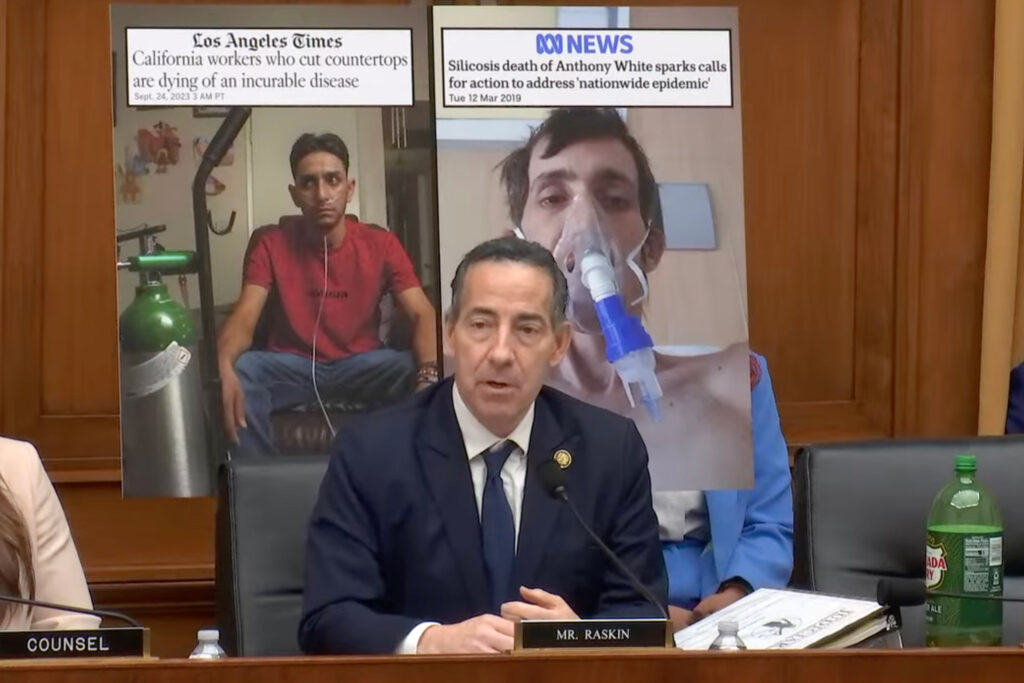
Rep. Jamie Raskin, D-Md., the ranking Democrat on the House Judiciary Committee, said when he learned that his Republican colleagues were “suddenly focused on a severe health crisis afflicting working-class craftsmen across America,” he assumed they were moved by the same headlines and articles he’d been reading about workers with silicosis dying of an incurable disease.
“Alas, I’d fallen victim to magical thinking,” said Raskin, who sat in front of posters of men who were dying or had already died of silicosis. “Our colleagues were getting involved in this rather esoteric matter, not to help the workers, but to help the industry they work in.”
Rep. Jamie Raskin (D-Md.) speaks during the House Judiciary subcommittee hearing on Wednesday. Credit: House Judiciary GOP
The Republican-controlled subcommittee invited three representatives of the $30-billion artificial stone industry to testify. All praised H.R. 5437, the Protection of Lawful Commerce in Stone Slab Products Act. The bill, sponsored by Rep. Tom McClintock, R-Calif., promised the luxury countertop industry the same immunity from civil lawsuits enjoyed by the gun industry.
At the hearing, Rebecca Shult, Cambria’s chief legal officer, described the legal threat facing the industry and her company, which she described as a family-owned business in a “small rural community.”
“Despite complying with all applicable law, including OSHA regulations, we are under attack from hundreds of lawsuits,” Shult said, acknowledging that workers who file the suits are succumbing to diseases caused by hazardous conditions on the job, but blaming bad actors for those exposures.
Cambria has no control over these third-party businesses that don’t follow OSHA laws, said Shult, who said that rogue fabricators are cutting corners and “putting profits over people.”
Instead of holding these bad actors accountable, she said, “lawsuits are being filed against dozens of innocent stone slab manufacturers.”
Republicans sympathized, agreeing it’s not manufacturers’ fault that workers are getting sick in the shops they sell to.
“Isn’t the only role of your company to sell a safe and legal product to a willing buyer?” McClintock asked Shult, who replied in the affirmative.
McClintock called it an injustice that Cambria and other manufacturers are being sued for the illegal practices of fabrication shops. “It appears that instead of enforcing the law against these illegal practices, the Democrats prefer to drive you out of business.”
Jim Hieb, CEO of the trade group Natural Stone Institute, thanked McClintock for introducing a bill that “brings fairness to the sellers of stone slabs,” while calling for more enforcement from OSHA.
It’s not fair that so many companies are wondering whether they’ll be in business next year, Hieb said.
“Sorry for what you’re going through,” Lance Gooden, R-Texas, told Hieb.
A Clear Chasm
As the minority party, the Democrats exercised their right to call a witness, and chose America’s longest-serving occupational health and safety chief, epidemiologist David Michaels, who ran OSHA from 2009 to 2017.
“There was this very clear chasm between the Republicans, who were primarily interested in protecting corporations, in particular, Cambria, and the Democrats, who
wanted to talk about how they ensure that workers who have silicosis get justice and how to address the silicosis epidemic,” Michaels, now a professor at George Washington University’s Milken Institute School of Public Health, told Inside Climate News.
Michaels, who has testified at dozens of congressional hearings, said he’s never been to one where Republicans heaped so much praise on OSHA and underscored its importance.
They kept saying if only fabricators followed OSHA rules, we wouldn’t have this problem, he said. But the OSHA silica standard is based on economic and technological feasibility as well as health effects, because the law doesn’t allow consideration of health protection alone, Michaels explained. “So just because you’re within the silica standard from OSHA, it doesn’t mean you’re safe.”
Plus, “it’s rich irony” for this Congress to call for stronger OSHA protections, he said, given that the House proposed significant cuts to OSHA’s budget and an H.R. 5437 co-sponsor wants to abolish the agency.
Democrats, in contrast to Republicans, expressed concern that silicosis is making American workers sick faster and younger from an irreversible but preventable disease.
“Doctors are seeing patients in their twenties and thirties,” said Rep. Henry Johnson, D-Georgia, ranking member of the subcommittee. “Men with families and young children so sick that they require double lung transplants, so sick that they can no longer work and no longer provide for their families, so sick that they slowly and painfully suffocate to death.”
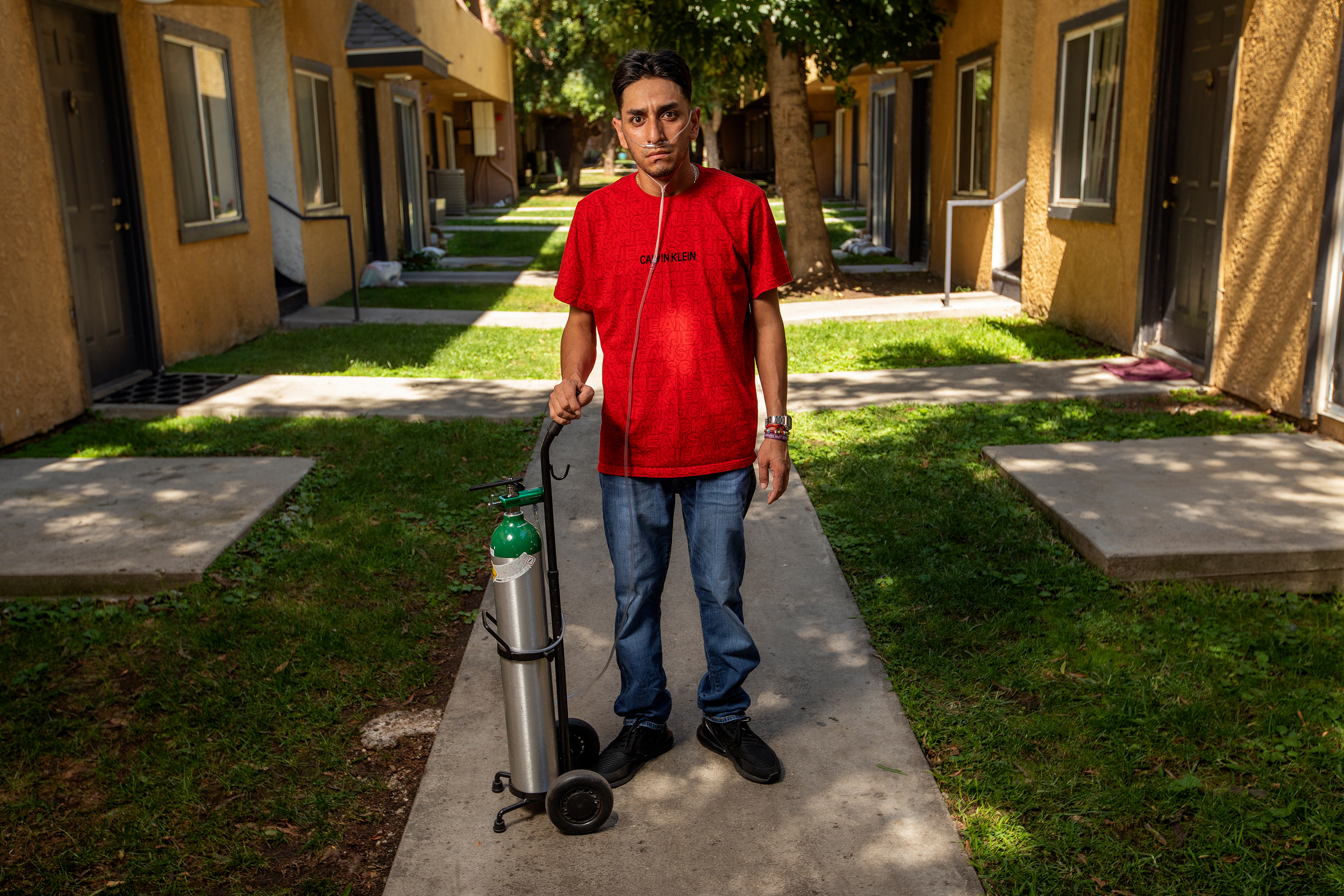
Leobardo Segura Meza, a 27-year-old suffering from silicosis, stands outside of his apartment in Pacoima, Calif., on Sept. 8, 2023. Credit: Mel Melcon/Los Angeles Times via Getty Images
Johnson entered into the record a letter from two physician-researchers from the University of California, San Francisco, Jane Fazio and Sheiphali Gandhi, who oppose H.R. 5437 because it rests on a fundamentally flawed premise: that artificial stone slabs are inherently safe and that worker harm arises primarily from noncompliant fabrication shops. That premise, they said, goes against clinical evidence, occupational health research and what they see in their medical practices.
“These products contain extremely high concentrations of crystalline silica—often exceeding 90 percent,” warned Fazio and Gandhi, who treat patients with silicosis. “Even with modern dust controls, cutting, grinding, and polishing artificial stone releases respirable silica at levels that overwhelm existing engineering and personal protective measures.”
“Surely we must be here to talk about how Congress can protect workers from artificial stone silicosis,” Johnson said, teeing up what he saw as the reason his Republican colleagues called the hearing.
“Apparently, it’s to give a handout to a millionaire friend of none other than Donald Trump,” he said, referring to Marty Davis, Cambria’s CEO. Davis has donated more than $800,000 to Republican politicians, including the president, federal filings show, and encouraged Trump to challenge the outcome of the 2020 election, according to The New York Times.
Micah Aberson, who acts as Cambria’s executive vice president for government affairs, declined to comment on Johnson’s conjecture, calling it “in no way germane” to safe workplaces and liability reform.
Widespread Risk
Republicans and the industry representatives cast the problem as one of a few bad actors operating mostly in California. But data from the state Department of Public Health shows that 54 percent of fabrication shops have silicosis cases, Michaels told the committee. California has a good screening system for workers, unlike much of the nation, he said.
“We haven’t seen that many cases around the country because no one’s looked for them,” Michaels told the committee. “We have, no doubt, thousands of cases if there are 500 cases in California.”
There’s every reason to think more cases will be identified, as long as exposure continues, Michaels told Inside Climate News.
This story is funded by readers like you.
Our nonprofit newsroom provides award-winning climate coverage free of charge and advertising. We rely on donations from readers like you to keep going. Please donate now to support our work.
Yet there are many changes manufacturers could institute to keep workers safe. One option is to stop manufacturing the product and switch to safer alternatives, which is the path Australia took after silicosis cases took off.
Alarmed by the rising incidence of silicosis among California stone fabrication workers, the Western Occupational and Environmental Medical Association has petitioned California’s Occupational Safety and Health Standards Board “to prohibit all fabrication and installation tasks on artificial stone that contain more than 1 percent crystalline silica.”
Cambria isn’t considering such changes, Aberson said.
“We don’t believe it solves the core problem, which are bad actor fabricator shops that are taking advantage of their workers and not providing a safe work environment,” he said.
Cambria is doing its part to address the problem through a learning-exchange center to train fabricators on safe processing techniques, Aberson said, though Shult told the committee the company does not require its buyers to complete the training.
As for overseeing its buyers’ operations, Aberson said with 10,ooo fabricators in the country, manufacturers aren’t in a position to monitor the entire industry. “This is specifically why we have OSHA, and we have regulations,” he said, adding that they won’t sell to shops they learn have unsafe conditions.
Many industries have programs that limit or prohibit sales to companies that endanger their workers, though it often takes litigation to trigger such actions.
When workers at microwave popcorn processing plants contracted a devastating respiratory illness after being exposed to diacetyl, a flavoring chemical, the firms did nothing to help their employees, even though manufacturers knew from lab tests that diacetyl could harm lungs, Michaels said in his written testimony.
Cases quickly led to more than $100 million awards or settlements to workers sick with “popcorn” lung, said Michaels, who’s written books on industry tactics to escape regulation. But rather than asking Congress for protection against more litigation, the industry acknowledged the problem and its trade group substituted a safer flavoring chemical.
Other industries have product stewardship programs where they work with companies that buy their product to make sure they’re used safely, he said.
And it’s not just a few bad actors that are making workers sick, Michaels said. The state figures showing that 54 percent of all the fabrication shops in California are reporting silicosis cases are a case in point, Michaels said. “This is across the industry, and this is who Cambria is selling to.”
Litigation is like regulation in that it drives technology, Michaels told the subcommittee. “Companies that don’t want to be involved in litigation find better products, safer products, and they substitute.”
If the industry receives immunity from liability, “all bets are off,” he said. “There’s no stopping the number of silicosis cases we’ll see around the country.”
Passing H.R. 5437, he told Inside Climate News, “would be a death sentence for workers exposed to silica.”
About This Story
Perhaps you noticed: This story, like all the news we publish, is free to read. That’s because Inside Climate News is a 501c3 nonprofit organization. We do not charge a subscription fee, lock our news behind a paywall, or clutter our website with ads. We make our news on climate and the environment freely available to you and anyone who wants it.
That’s not all. We also share our news for free with scores of other media organizations around the country. Many of them can’t afford to do environmental journalism of their own. We’ve built bureaus from coast to coast to report local stories, collaborate with local newsrooms and co-publish articles so that this vital work is shared as widely as possible.
Two of us launched ICN in 2007. Six years later we earned a Pulitzer Prize for National Reporting, and now we run the oldest and largest dedicated climate newsroom in the nation. We tell the story in all its complexity. We hold polluters accountable. We expose environmental injustice. We debunk misinformation. We scrutinize solutions and inspire action.
Donations from readers like you fund every aspect of what we do. If you don’t already, will you support our ongoing work, our reporting on the biggest crisis facing our planet, and help us reach even more readers in more places?
Please take a moment to make a tax-deductible donation. Every one of them makes a difference.
Liza Gross is a reporter for Inside Climate News based in Northern California. She is the author of The Science Writers’ Investigative Reporting Handbook and a contributor to The Science Writers’ Handbook, both funded by National Association of Science Writers’ Peggy Girshman Idea Grants. She has long covered science, conservation, agriculture, public and environmental health and justice with a focus on the misuse of science for private gain. Prior to joining ICN, she worked as a part-time magazine editor for the open-access journal PLOS Biology, a reporter for the Food & Environment Reporting Network and produced freelance stories for numerous national outlets, including The New York Times, The Washington Post, Discover and Mother Jones. Her work has won awards from the Association of Health Care Journalists, American Society of Journalists and Authors, Society of Professional Journalists NorCal and Association of Food Journalists.
Great Job By Liza Gross & the Team @ Inside Climate News Source link for sharing this story.
At this urgent and dangerous moment, Iranian feminists are calling on the global feminist community not to look away.
An anti-Iranian regime protester lights a cigarette with a lit paper depicting Ali Khamenei, Supreme Leader of Iran, outside the U.S. consulate in Milan, on Jan. 13, 2026. (Piero Cruciatti / AFP via Getty Images)
For weeks, protests against the Islamic Republic have spread across Iran (and in other cities around the world, in solidarity). The Iranian regime has responded with internet shutdowns, mass arrests and lethalviolence. Now, Iranian women and gender-justice advocates are asking feminists everywhere to stand with them, loudly and collectively.
At Ms. magazine, we believe feminism means refusing silence in the face of state violence, repression and misogyny; amplifying the voices of those on the frontlines, not substituting our own; and understanding that struggles for bodily autonomy, democracy and human rights are globally interconnected.
Below, we are sharing—in full and in their own words—a powerful call from a collective of Iranian feminists in the diaspora. (Ms. and our publisher, the Feminist Majority Foundation, have signed on.) They outline the scale of the repression now underway and reaffirm the principles of the Woman, Life, Freedom movement. They also urge feminists worldwide to take concrete action: Demand an end to the killings, press for restored internet access, and amplify the diverse voices of protesters, especially women and marginalized communities.
Call for Feminist Solidarity with the People of Iran Against Tyranny
We, a group of Iranian feminists, at a time when the Islamic Republic has cut off the internet and all channels of communication with the outside world while carrying out a brutal massacre of protesters, extend our hands to feminists around the world. We call on the global civil society and feminists to stand with the people of Iran and to use all available independent national and international mechanisms to stop the regime’s machinery of killing and repression.
In December 2025, the people of Iran took to the streets not only to protest the country’s devastating economic situation but also to reject the authoritarianism of the ruling system. The people of Iran have long declared that genuine change is impossible without a transformation of the country’s political structures. They have clearly and courageously demanded the overthrow of the Islamic Republic. Many of today’s protesters are the same people who took to the streets during the Woman, Life, Freedom uprising of 2022, as well as in earlier peaceful demonstrations in 2017 and 2019, during which they are carrying the same demands.
Despite the nationwide internet shutdown and the isolation of the country, reports from inside Iran speak of widespread killings and mass arrests of protesters in multiple cities. While the exact number of victims remains unknown, testimonies of heavy gunfire on protesters, bodies piled in the streets, and the overwhelmed state of hospitals and morgues reveal the scale of the ongoing massacre. According to civil society organizations and Iranian media, the number of people killed in the protests has reached into the thousands.
Security forces have stormed hospitals, abducted wounded protesters, and refused to hand over the bodies of those killed to their families, such acts that expose the naked violence of the Iranian government. Meanwhile, official threats by state authorities have raised fears of large-scale, extrajudicial executions of detainees.
As the violent crackdown continues, we are deeply concerned that the voices of the protesting people are being silenced. While international powers and certain opposition groups each act according to their own priorities and interpretations of “the interests of the Iranian people,” it is vital to reflect the diversity and multiplicity of voices within Iranian society. Amplifying these diverse perspectives is essential in the struggle to realise the people’s demands.
As feminists, we stand firmly against any organized, especially violent, attempt to impose a single vision on Iran’s present and future. We believe that the path toward a free society lies only through listening to and embracing our country’s plurality of voices.
We raise our voices to affirm that the movement born in 2022 under the progressive slogan Woman, Life, Freedom —a movement that united the marginalized and the silenced at the crossroads of oppression —remains alive.
As part of Iran’s civil society, we envision a future that is free, inclusive, prosperous, democratic, secular, and committed to justice, human rights, and gender equality. We hope for a space where all Iranians can freely express their demands and aspirations for the future of their country, and where a peaceful and democratic transition away from the repressive rule of the Islamic Republic can finally take place.
For this democratic transition to become a reality, we imagine you—all feminists across the world—joining hands with us in the widest field imaginable, a space large enough to embrace all humanity, so that we are not left alone in this struggle. We call on you to:
Exert sustained political and human rights pressure to immediately stop the killings and repression in Iran.
Urgently and seriously demand the restoration of unrestricted internet and phone access for people inside Iran.
Amplify the diverse voices of protesters, especially women and marginalized groups, in terms that are accurate.
If feminism means standing against violence, tyranny, and injustice, then today, Iran is one of its central frontlines.
A Collective of Iranian Feminists in the Diaspora January 13, 2026
Great Job Ms. Editors & the Team @ Ms. Magazine Source link for sharing this story.
RED FLAG WARNING: Near Critical Fire weather Saturday
FREEZE WARNING: A widespread hard freeze Sunday
MLK JR. DAY: Pleasant and cool
RAIN RETURNS: Tuesday and Wednesday
FORECAST
TODAY
San Antonio will see a windy and cool Saturday with wind gusts hitting 30 to 35 mph and very dry air in place. This combination means an elevated fire risk. A Red Flag Warning is in effect for all of South-Central Texas today from 10 a.m. to 8 p.m. Avoid any outdoor burning or activities that could spark a blaze, and keep an eye on rapidly changing weather conditions.
Critical Fire weather today (Copyright KSAT-12 2026 – All Rights Reserved)
SUNDAY MORNING
A hard freeze is expected across San Antonio Sunday morning. Temperatures are forecast to dip to the 20s near sunrise. Several hours of below freezing conditions are possible, especially outside the downtown area. A Freeze Warning is in effect Sunday morning as low temperatures fall into the mid 20s to around 32 degrees.
A hard freeze is possible Sunday morning for many (Copyright KSAT-12 2026 – All Rights Reserved)
These cold temperatures will hit in the early hours Sunday, and the freeze could last as long as five to six hours in some spots. Make sure to take steps ahead of time to protect the 4 P’s: People, pets, plants and pipes!
MLK JR. DAY
By Monday, the afternoon is expected to reach the mid-60s, but no further freezes are in sight. If you’re heading out for the march, pack layers for the morning chill, but expect a milder afternoon.
THIS WEEK
Cooler temperatures return for the weekend and continue into the middle of next week. The next big weather change arrives Tuesday and Wednesday as an upper-level disturbance and a front bring in moisture from the Gulf. Rain chances climb to 40 to 60 percent, particularly on Wednesday. Exact rainfall amounts are still uncertain, but keep your umbrella handy as some areas could see a soaking midweek.
7 Day Forecast (Copyright KSAT-12 2026 – All Rights Reserved)
Daily Forecast
KSAT meteorologists keep you on top of the ever-changing South Texas weather.
QUICK WEATHER LINKS
Copyright 2026 by KSAT – All rights reserved.
Great Job Shelby Ebertowski & the Team @ KSAT San Antonio for sharing this story.