Allegiant Travel Co. will acquire Sun Country Airlines Holdings Inc. in a cash-and-stock deal valued at $1.5 billion including Sun Country’s debt, the two carriers said in a joint statement on Sunday.
Sun Country’s shareholders will receive 0.1557 shares of Allegiant common stock and $4.10 in cash per Sun Country share, the companies said. The offer represents a premium of 19.8% over Sun Country’s closing share price on Friday, according to the statement.
The combined entity will provide more than 650 routes, including 18 international destinations in Mexico, Canada, the Caribbean and Central America, the companies said.
“Together, our complementary networks will expand our reach to more vacation destinations including international locations,” said Allegiant Chief Executive Officer Gregory C. Anderson in a statement.
Join us at the Fortune Workplace Innovation Summit May 19–20, 2026, in Atlanta. The next era of workplace innovation is here—and the old playbook is being rewritten. At this exclusive, high-energy event, the world’s most innovative leaders will convene to explore how AI, humanity, and strategy converge to redefine, again, the future of work. Register now.
Great Job Se Young Lee, Bloomberg & the Team @ Fortune | FORTUNE Source link for sharing this story.
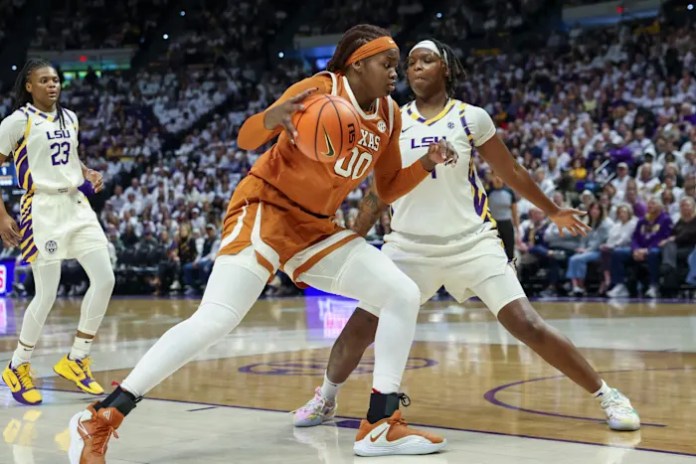
BATON ROUGE, La. – Mikaylah Williams scored 20 points, capped by her 3 as the shot clock expired with 1:20 to go in the game, and No. 12 LSU handed second-ranked Texas its first loss this season, 70-65 on Sunday.
After Williams’ late 3 made it 66-59, she jogged back toward the defensive end with both arms triumphantly held high as an announced sellout crowd in the Pete Maravich Assembly Center erupted. The Tigers (16-2, 2-2 SEC) never let Texas (18-1, 3-1) get closer than five points after that.
Madison Booker scored 24 points, 14 after committing her fourth foul just 11 seconds into the fourth quarter. Kyla Oldacre had 16 points, 16 rebounds and three blocks. Jordan Lee added 12 points for the Longhorns.
Flau’jae Johnson, Milaysia Fulwiley, ZaKiyah Johnson and Jada Richard each scored 10 points for LSU, which led the entire second half and by as many as 13. The Tigers have now won two straight since falling out of the top 10 in the AP Top 25 with consecutive losses to Kentucky and Vanderbilt to open SEC play.
Both teams scored far below their per game averages in a game defined by ramped-up and physical defensive play.
LSU came in averaging 101.8 points per game and Texas 91.9.
Texas committed 17 turnovers, with Booker losing the ball six times and Oldacre five.
Johnson, who’d scored 25 in a victory at Georgia on Thursday, didn’t hit the 10-point mark against Texas until her driving scoop in transition as she was fouled hard and knocked to the floor by Oldacre. She converted the 3-point play to give LSU a 55-47 lead.
Texas led briefly in the first half but never by more than four points.
LSU took its first double-digit lead when Grace Knox hit consecutive layups to make it 43-32 after half way through the third period. The lead was still 11 when ZaKiyah Johnson and Fulwiley each hit layups to make it 50-39 after three quarters.
Williams had 11 points and three steals during the first half. Her third steal, from Lee, sent Richard breaking the other way for a pull-up jumper at the halftime horn that made it 30-25.
Copyright 2026 The Associated Press. All rights reserved. This material may not be published, broadcast, rewritten or redistributed without permission.
Great Job Brett Martel, Associated Press & the Team @ KSAT San Antonio Source link for sharing this story.
The following contains use of force policies issued by the Department of Homeland Security, Customs and Border Patrol, and the Department of Justice. The list is provided in reverse chronological order to help show changes over time as well as the policies currently in effect. The list also contains other relevant documents such as an Inspector General report and independent review commissioned by CBP.
1. DHS LEOs should seek to employ tactics and techniques that effectively bring an incident under control while promoting the safety of LEOs and the public,and that minimize the risk of unintended injury or serious property damage. DHS LEOs should also avoid intentionally and unreasonably placing themselves in positions in which they have no alternative to using deadly force. …
VI. Deadly Force A. General Guidelines
1. …
a. DHS LEOs may use deadly force only when necessary, that is when the LEO has a reasonable belief that the subject of such force poses an imminent threat of death or serious bodily injury to the LEO or to another person. b. Fleeing Subjects: Deadly force shall not be used solely to prevent the escape of a fleeing subject. However, deadly force is authorized to prevent the escape of a fleeing subject where the LEO has a reasonable belief that the subject poses a significant threat of death or serious physical harm to the LEO or others and such force is necessary to prevent escape.
…
B. Discharge of Firearms … 2. Moving Vehicles, Vessels, Aircraft, or other Conveyances
a. DHS LEOs are prohibited from discharging firearms at the operator of a moving vehicle, vessel, aircraft, or other conveyance unless the use of deadly force against the operator is justified under the standards articulated elsewhere in this policy. Before using deadly force under these circumstances, the LEO must take into consideration the hazards that may be posed to law enforcement and innocent bystanders by an out-of-control conveyance.
3. Department of Justice Manual, Policy On Use Of Force, 1-16.00 – 1-17.000 (updated July 2022)
DEADLY FORCE
I. Law enforcement officers and correctional officers of the Department of Justice may use deadly force only when necessary, that is, when the officer has a reasonable belief that the subject of such force poses an imminent danger of death or serious physical injury to the officer or to another person.
A. Deadly force may not be used solely to prevent the escape of a fleeing suspect. B. Firearms may not be discharged solely to disable moving vehicles. Specifically, firearms may not be discharged at a moving vehicle unless: (1) a person in the vehicle is threatening the officer or another person with deadly force by means other than the vehicle; or (2) the vehicle is operated in a manner that threatens to cause death or serious physical injury to the officer or others, and no other objectively reasonable means of defense appear to exist, which includes moving out of the path of the vehicle. Firearms may not be discharged from a moving vehicle except in exigent circumstances. In these situations, an officer must have an articulable reason for this use of deadly force.
6. Customs and Border Patrol, Use of Force Policy (January 2021) [4500-002A]
Chapter 1: General Guidelines … C. Use of Safe Tactics … 2. Except where otherwise required by inspections or other operations, Authorized Officers/Agents should avoid standing directly in front of or behind a subject vehicle. Officers/agents should not place themselves in the path of a moving vehicle or use their body to block a vehicle’s path. 3. Authorized Officers/Agents should avoid intentionally and unreasonably placing themselves in positions in which they have no alternative to using deadly force.
DHS LEOs should seek to employ tactics and techniques that effectively bring an incident under control while promoting the safety of LEOs and the public, and that minimize the risk of unintended injury or serious property damage. DHS LEOs should also avoid intentionally and unreasonably placing themselves in positions in which they have no alternative to using deadly force. …
VI. Deadly Force
A. General Guidelines …
2. A DHS LEO may use deadly force only when the LEO has a reasonable belief that the subject of such force poses an imminent threat of death or serious bodily injury to the LEO or to another person.
a. Fleeing Subjects: Deadly force shall not be used solely to prevent the escape of a fleeing subject. However, deadly force is authorized to prevent the escape of a fleeing subject where the LEO has a reasonable belief that the subject poses a significant threat of death or serious physical harm to the LEO or others and such force is necessary to prevent escape.
B. Discharge of Firearms … 2. Moving Vehicles, Vessels, Aircraft, or other Conveyances
a. DHS LEOs are prohibited from discharging firearms at the operator of a moving vehicle, vessel, aircraft, or other conveyance unless the use of deadly force against the operator is justified under the standards articulated elsewhere in this policy. Before using deadly force under these circumstances, the LEO must take into consideration the hazards that may be posed to law enforcement and innocent bystanders by an out-of-control conveyance.
Directive
In order to lessen the likelihood of deadly force situations and reduce the risk of injury or death to agents and others, I am implementing the following directive effective immediately, which clarifies existing guidelines contained in the CBP Use of Force Policy:
(1) In accordance with CBP’s current Use of Force policy, agents shall not discharge their firearms at a moving vehicle unless the agent has a reasonable belief, based on the totality of the circumstances that deadly force is being used against an agent or another person present; such deadly force may include a moving vehicle aimed at agents or others present, but would not include a moving vehicle merely fleeing from agents. Further, agents should not place themselves in the path of a moving vehicle or use their body to block a vehicle’s path.
Note-1: Not publicly available is the CBP’s 23-page internal response, which the LA Times obtained. Note-2: See ACLU’s Freedom of Information Act Complaint (May 22, 2014) Note-3: For the importance of this report, see my analysis on Substack and YouTube.
Note: The Handbook states that “This Policy supersedes the U.S. Customs Firearms and Use of Force Handbook (CIS HB 4500-01A) dated March 2003; the U.S. Customs and Border Protection Interim Use of Force and Firearms Guidelines dated October 11, 2004; the INS Firearms Policy dated 19 February 2003; the U.S. Customs Firearms and Use of Force Training Policy (CD 4510-017A ) dated December 17, 2001; the 24 Hour Carry of Firearms by Office of Field Operations Personnel (ENF-3-FO RDJ) dated March 3, 2000; and the U.S. Immigration and Customs Enforcement Interim Firearms and Use of Force Policies dated July 7, 2004 (as they applied to CBP components transferred from U.S. Immigration and Customs Enforcement).”
Great Job Ryan Goodman & the Team @ Just Security Source link for sharing this story.
There has never been a question as to who the undisputed Queen of Hip-Hop Soul is. If we’re being honest, “hip-hop soul” as a term didn’t even truly exist before her. Sure, a handful of R&B musicians before her time incorporate some elements of rap culture in the rhythm of their blues, but none before or after her were able to fuse two of Black music’s most important genres together so seamlessly.
The ‘her’ in question is none other than the living legend herself, Mary J. Blige, and she just so happens to be turning a milestone 55 years old today!
A career that began three-and-a-half decades ago and hasn’t wavered in the slightest bit since — if anything, she’s only elevated with every passing year! — Mary’s trajectory in the game has been quite fitting of the “Queen” title. There’s no corner in the fused world of hip-hop and R&B that she hasn’t explored, from multiple classic collaborations with late hip-hop great The Notorious B.I.G. and one GRAMMY-winning hit in particular alongside Method Man (see: every version of “You’re All I Need”), to serenading linkups with equally talented vocalists like Lauryn Hill, Chaka Khan and, yes, even the late Queen Of Soul herself, Aretha Franklin. That’s not even considering her big pop collabs as well, like Bono from U2, the late George Michael and Brit-pop royalty, Sir Elton John.
Love Music? Get more! Join the Black America Web Newsletter
She’s simply the queen of this particular sub-genre; she has been for decades, probably will be for the foreseeable future and is literally loved by each and every one of her predecessors and successors alike. With four decades running at the top, we’re certain her reign won’t let up as she continues to tease us with surprises as in her birthday post via Instagram (seen above).
We know you know the hits — cheers to “Family Affair,” “I’m Going Down” and “Be Without You, for starters — but we just had to go that extra step by putting you all on, as per usual, to the deep cuts from our faves. Mary in specific has a very robust selection, so we definitely had to debate a few times on which ones from which era would make the cut. We think you’ll agree with our choices, but we’re always up for a debate if you think we missed a few. Sound off, fam!
Happy birthday, Mary J. Blige! Celebrate the undisputed Queen Of Hip-Hop Soul’s milestone birthday today by checking out her best deep cuts (in our humble opinion!) that we think you all definitely need to hear in this edition of “B-Side Bangers”:
1. “Changes I’ve Been Going Through” (1992) Album: What’s the 411?
2. “What’s the 411?” (Remix) [featuring K-Ci Hailey and The Notorious B.I.G.] (1993) Album: What’s the 411? Remix
3. “You Gotta Believe” (1994) Album: My Life
4. “Searching” (featuring Roy Ayers) [1997]Album: Share My World
5. “A Dream” (1997) Album: Money Talks: The Album (Official Soundtrack) by Various Artists
6. “Misty Blue” (live cover in dedication to her mother, Cora Blige) [1998]Album: The Tour
7. “Sincerity” (featuring Nas and DMX) [1999]Album: Mary (Limited Edition)
8. “Destiny” (2001) Album: No More Drama
9. “He Think I Don’t Know”* (2002) Album: No More Drama (Re-Release)
*Despite not being released as a single, and no known live performances, “He Think I Don’t Know” still managed to win the award for “Best Female R&B Vocal Performance” at the 2003 GRAMMYs.
10. “Willing & Waiting” (2003) Album: Love & Life
11. “Can’t Hide from Luv” (featuring JAY-Z) [2005]Album: The Breakthrough
A new year often marks the start of Dry January for many.
Texas-based Shiner Beer announced a new non-alcoholic version of its flagship Shiner Bock is hitting the shelves at retailers across the United States this month.
The brew contains less than .05% Alcohol by Volume (ABV) and will come in 12-ounce cans. The packaging will retain the signature yellow look as the original Shiner Bock, but will feature a distinct blue and silver “non-alcoholic” banner.
Shiner first rolled out a non-alcoholic beer series in 2023.
More businesses across the U.S. have launched non-alcoholic beer, wine and spirits over the last several years as more people try to limit their drinking. Some research indicates that Generation Z is drinking less alcohol than previous generations.
“We’re seeing a generational shift in how people enjoy beer,” said Nick Weiland, brand director of Shiner Beer in a press release. “Long-time fans and new drinkers alike can enjoy the ritual of an ice-cold Shiner, regardless of alcohol content.”
Beverage alcohol data tracker IWSR found non-alcoholic beverages displayed strong sales growth in 2024, with no-alcohol beer volume up around 9% that same year.
Great Job & the Team @ Houston Public Media for sharing this story.
Zohran Mamdani has energized the US Left and offered a potential road map to socialists seeking political power. But most candidates don’t have Mamdani’s unique superstar charisma and most American cities aren’t so favorable to the Left. Ultimately, to win power nationwide, we’ll need a diverse set of playbooks. The successful campaign of Seattle’s new mayor, Katie Wilson, therefore also deserves close study. Like Mamdani, Wilson ran against a well-funded, well-connected Democrat by centering the material interests of working people, but she did so with a different style and in a different register.
Seattle is home to arguably the most powerful corporation in human history and has a complex recent history of socialist electoral projects. Katie Wilson, a longtime leader of Seattle’s Transit Riders Union, had led campaigns to raise minimum wages, pass stronger renter protections, expand transit access, and levy taxes on large corporations. But before last February, she had no thought of running for political office. She was more comfortable in behind-the-scenes organizing meetings than in front of television cameras; in person, she was quiet, thoughtful, modest, even shy. Her campaign proved that smart socialist organizers, not only once-in-a-generation political talents, can also win the executive office of major American cities.
As her campaign manager and lead organizer, respectively, we wanted to share five observations we made on the campaign trail in the hopes that others can learn from what we did to bring working people and socialist candidates into city halls across the country.
First: authenticity was our strength. From the beginning, it was clear Wilson was a nontraditional candidate. She didn’t have a polished, campaign-ready political history, nor did her personality fit the extroverted politician profile. What some thought was a weakness, we realized early on was an asset.
The authentic Katie Wilson, who voters saw in videos and interviews, and at forums and in meetings, was remarkably intelligent, talented at communicating with specificity and clarity, and a seasoned organizer with hard-won instincts. She’d spent a decade and a half in the trenches, building a record of tangible wins for working people across the region. In some cases, she had been instructed by labor unions and other progressive organizations to stand down — advice that, in most cases, she ignored.
This independent, moral, and strategic streak is core to her character, an attribute that we embraced rather than tried to suppress. By encouraging Katie to stay true to Katie – despite numerous efforts from outside the campaign to have her dress differently, talk differently, and otherwise “professionalize” herself – we won over voters who were sick of consultant-speak and manipulation. In a historically antiestablishment time, she represented authentic change, not just in policy proposals but through her personality, aesthetic, and approach to campaigning.
Second, social media was critical to our success, not least because of the specific dynamics of our race.
In most Seattle elections, candidates have the support of either business groups or labor unions. However, Wilson’s opponent Bruce Harrell — the incumbent mayor who was strongly aligned with big business — had managed to break this binding “either-or” through tactical overtures to labor and progressives during his past four years in office. This meant that, before Wilson had even entered the race, the incumbent had stitched together a contradictory but coherent coalition that included big business (Amazon, Starbucks, Microsoft), large labor organizations (the Martin Luther King Labor Council, SEIU 775, and the building trades), the Democratic political establishment (Representative Pramila Jayapal, Governor Bob Ferguson, Attorney General Nick Brown), and the Seattle Times. Consequently, we needed to platform ourselves rather than rely on significant expenditures on our behalf. This was especially true during the primary.
Despite this unlikely but powerful coalition, we had identified one of our opponent’s biggest weaknesses: his lack of authentic and consistent communication. For the past four years, he had been operating with limited visibility, wheeling and dealing behind closed doors, with the expectation that he would coast to a second term. Meanwhile, homelessness was worse than ever, affordable housing was scarce, the cost of groceries was eye-watering, and small businesses were closing left and right. The city government was doing . . . what, exactly? No one seemed to know. In the early days of the campaign, voters often seemed resigned to voting for Harrell, despite not having positive views of him.
We set out to make a series of explainer videos. The first would link the high cost of a restaurant meal to the lack of affordable housing. Because the cost of living was so high, restaurant owners needed to pay their workers more, which caused them to raise prices; the lack of housing also meant fewer customers, which meant less profit, which meant businesses needed to make more per individual item sold. It was a vicious cycle: because everything was so expensive, people ate out less, exacerbating the problem. Wilson explained all of this while walking down the street with a cold piece of pizza, arguing that you deserve a living wage and to eat out at a restaurant from time to time. Seattle went nuts for it.
Over the next few months, we made more videos (one of our more popular featured Katie shopping for debate clothes at Goodwill), most of them shot and edited by volunteers. We learned that the highest traffic times were around 10 a.m. and 3 p.m., so we tried to post at those times every day. Photos of Katie out in the community, statements on current events, messages of solidarity with workers and immigrant groups — all of these went up onto the feed. We committed to posting one explainer video a week, no easy feat given that our entire video production team was composed of volunteers.
Our Instagram presence went from a few hundred followers at the start to over thirty-seven thousand now. And while we directed the messaging and approved posts, volunteers ran all of the accounts, monitored comments, and responded to direct messages. We posted to Facebook, Bluesky, Twitter, YouTube, TikTok, and LinkedIn. No one can tell you exactly how large an impact social media made on the election, but it’s clear to everyone that it was significant. The pizza video alone made Katie into something of a local celebrity.To be clear, we did not avoid the mainstream media. But new and social media were essential to our success. Voters, especially working-class and young voters, found us trustworthy because we were showing up in the places they got their news, and we were talking about the things that shaped their lives.
The third takeaway from our campaign is the value of our volunteer base. This was first demonstrated when we sought to qualify for “Democracy Vouchers,” a local program that allows voters in Seattle to award $100 of public money to candidates of their choice. To become eligible, mayoral candidates must receive six hundred ten-dollar donations and six hundred signatures. Within a few days, we had passed both thresholds, making our campaign the fastest to qualify in the ten-year history of the program. (If your city does not have a public financing system for elections, and you want to build a pathway for progressive and socialist candidates to get elected, we strongly suggest you fight to win a program like Democracy Vouchers.)
The enthusiastic volunteers who originally contributed — many of them members of the Transit Riders Union or affiliated organizations — then worked to collect vouchers from other voters. Over the next few months, hundreds of them staffed farmers’ markets, light-rail stops, music festivals, and political rallies, gathering the maximum amount of $450,000. The vouchers served three purposes. First, they allowed us to hire and pay staff, send out mailers, and purchase advertising. Second, they helped us to grow our lists of emails and phone numbers, which gave us another way to communicate with voters. Third, they allowed Katie to show up to house parties with working-class voters who were struggling to pay their rent and still walk away having raised hundreds or thousands of dollars, effectively democratizing her time and attention.
Volunteers coordinated by our field team collected $900,000 worth of democracy vouchers in total ($450,000 each in the primary and general) and knocked over fifty-five thousand doors (for context, about two hundred seventy thousand people voted in the general election). They also ran our social media accounts, designed our graphics, edited our videos, took our photographs, transported Katie (famously carless) to events, babysat her two-year-old daughter, organized house parties, phonebanked, textbanked, and more. They were the beating heart of our campaign, and the enthusiasm they generated frankly overmatched our competition. By the end of the campaign, Bruce Harrell was left fearmongering about Katie Wilson’s supposed lack of experience and saying things like “this is not the time for hope.”
The fourth observation is the significance of focusing on material issues rather than political labels. Katie Wilson is a socialist, she is a progressive, and she ran as a Democrat. We didn’t waste our time parsing the distinctions. Instead, we directed our messaging to other topics.
This was intentional. When we used to train organizers for local unions, we would tell the story of a worker who was trying to unionize his grocery store. The worker had all kinds of reasons for why he supported unions. “Unions are the reason why we have an eight-hour workday,” he said. “Unions are a source of political power for workers. Unions represent workplace democracy in action.” We agreed with everything he said. And yet, after months of trying to convince his coworkers, most of them decided not to join his effort. Why not? Because, we argued, for most people, abstract political ideology is less important than the reality of their material needs. Would unionizing the grocery store result in better hours for them? More money in their paycheck? Cheaper health insurance? Better (or worse) relationships with their coworkers? The question was not whether the workers supported having a union or not. The union was the answer to the question of how workers were going to improve their situation. But the workers needed to ask it.
We applied a similar logic to the campaign. Instead of leading with an argument for socialism, we addressed the issues that were top of voters’ minds: affordable housing, access to childcare, homelessness, and public safety. When Katie Wilson acknowledged to a reporter during the general election that, yes, she was a socialist, it barely registered. By that point, voters knew what she cared about. The label used to describe her belief system didn’t matter as much as what her values and priorities were.
Which brings us to our final observation.
In our perhaps most consequential decision, we chose to focus our messaging on universalist and local issues. That meant affordable housing, childcare, labor rights, food access, violence prevention, small business support, and homelessness response. It did not mean reviving a maximalist call to “defund the police,” or emphasizing the liberation of Palestine, or demonizing the tech industry (which, like it or not, is central to Seattle’s economy and voter base), or using the narrow, competitive, identity-based framing favored by elements of the Left in recent years.
We were criticized for these choices. While Katie Wilson condemned the genocide in Gaza when asked about it directly (and she had no qualms about using the word), she made the decision early that as a candidate for a position with little influence over conflicts in the Middle East, she was going to focus on local issues. She built relationships with local Muslim organizations and advocacy groups, making explicit commitments to their members and communities, and affirmed that, as mayor, she would oppose any city collaboration with the government of Israel. But she only talked about the genocide when others brought it up. When she had the opportunity to frame the conversation, she was driving it toward affordability and other issues that she could impact once elected.
Similarly, on the issue of police, instead of calling for “defunding,” which was no longer popular in Seattle and likely only to set off a semantic tug-of-war, we framed the need for community safety and police reform as a question of civilianizing roles that did not require armed officers, such as those who respond to nonviolent property crime and traffic incidents. Key to this argument was advocating for an expansion of the CARE team, which provides a non-police response to some kinds of 911 calls, and arguing for community policing, which would require officers to work in better partnership with the communities that they serve.
Finally, on issues of equity, Katie avoided identity-based arguments while also making clear that she believed racism, sexism, xenophobia, and other forms of bigotry intersected with capitalist economic oppression to form the material basis of lived experience. When anti-queer agitators held a rally in Seattle, we issued a public statement condemning the organizers’ actions, just as when Somali childcare providers were targeted by the Trump administration, we released a statement in solidarity. We made extensive efforts to build relationships with local black and African American communities, Asian American communities, Latino communities, queer communities, Muslim communities, immigrant communities, and so on. In conversations, we focused on issues that these communities held in common — crises of housing, homelessness, food access, targeted mistreatment, and childcare. We did this because we believe that durable wins come from a solidarity that recognizes particularity while also stitching us together. Our decision to take a more universalist approach challenged us to better articulate our vision for an administration that prioritized the interests of the diverse working class. Proving that universal programs are the best way to win long-term collective well-being will be essential, we believe, for the future of our movement.
There are good arguments on both sides of these approaches, and we expect socialist and progressive candidates to wrestle with the balance for months and years to come. But for us, in our city at this time, we felt that running this way would give us the best chance to win our election — which, in turn, would allow us to advance a popular left-wing agenda the likes of which the city had never seen. We now have that opportunity.
An authentic candidate. A strong social media presence. A dedicated and energetic volunteer base. A relentless focus on material issues rather than political labels. And an emphasis on locally relevant issues and cross-community solidarity. That’s what worked this past year in Seattle. What will work in your city?
Great Job Alex Gallo-Brown & the Team @ Jacobin Source link for sharing this story.
Following an investigation by the Guardian that found Google AI Overviews offering misleading information in response to certain health-related queries, the company appears to have removed the AI Overviews for some of those queries.
For example, the Guardian initially reported that when users asked “what is the normal range for liver blood tests,” they would be presented with numbers that did not account for factors such as nationality, sex, ethnicity, or age, potentially leading them to think their results were healthy when they were not.
Now, the Guardian says AI Overviews have been removed from the results for “what is the normal range for liver blood tests” and “what is the normal range for liver function tests.” However, it found that variations on those queries, such as “lft reference range” or “lft test reference range,” could still lead to AI-generated summaries.
When I tried those queries this morning — several hours after the Guardian published its story — none of them resulted in seeing AI Overviews, though Google still gave me the option to ask the same query in AI Mode. In several cases, the top result was actually the Guardian article about the removal.
A Google spokesperson told the Guardian that the company does not “comment on individual removals within Search,” but that it works to “make broad improvements.” The spokesperson also said that an internal team of clinicians reviewed the queries highlighted by the Guardian and found “in many instances, the information was not inaccurate and was also supported by high quality websites.”
Vanessa Hebditch, the director of communications and policy at the British Liver Trust, told the Guardian that the removal is “excellent news,” but added, “Our bigger concern with all this is that it is nit-picking a single search result and Google can just shut off the AI Overviews for that but it’s not tackling the bigger issue of AI Overviews for health.”
Techcrunch event
San Francisco | October 13-15, 2026
Great Job Anthony Ha & the Team @ TechCrunch Source link for sharing this story.
COPPERAS COVE, Texas – A Copperas Cove police officer was killed in the line of duty Saturday, sparking an investigation by the Texas Rangers that ended with the suspect taking his own life, officials said.
Fatal officer-involved shooting
What we know:
The Copperas Cove Police Department on Sunday identified the fallen officer as Elijah Garretson, badge number 118.
According to department officials, the incident began Jan. 10 during an officer-involved shooting near the intersection of Great Hills Drive and Lost Trail. Details regarding the initial confrontation have not yet been released.
Following the shooting, law enforcement tracked the unidentified suspect to a separate location. After what investigators described as a “lengthy negotiation attempt,” the suspect died from a self-inflicted gunshot wound.
What they’re saying:
“As we begin to navigate this incredibly difficult time, we ask for understanding and patience as our department, Officer Garretson’s family, and our law enforcement family grieve this tremendous loss,” the department said in a statement.
The Texas Rangers have taken the lead on the investigation at the request of local police, a standard procedure for shootings involving officers.
Copperas Cove officials said that out of respect for the family and the active nature of the investigation, no further details regarding the circumstances of the shooting are being released at this time.
What we don’t know:
The identity of the suspect has not been released.
Dig deeper:
Copperas Cove is located in Central Texas, approximately 75 miles north of Austin.
The Source: Information in this article is from the Copperas Cove police department.
7 Day Forecast (Copyright KSAT-12 2026 – All Rights Reserved)
FORECAST HIGHLIGHTS
TODAY: Warming up after a brisk morning
RAIN CHANCE: Minimal, but still possible
THIS WEEK: Cooler start, followed by a small warm-up
FORECAST
TODAY
Many spots woke up to a light freeze this morning. Clear skies and calm winds overnight let those temperatures drop. Luckily, under some partly sunny skies, our temperatures warm up to the mid 50s & 60s.
Warming up to the 50s & 60s today (Copyright KSAT-12 2026 – All Rights Reserved)
RAIN CHANCES
An upper-level disturbance is forecast to move through the area, bringing the potential for more rain early in the week. Spotty showers are expected on Monday, mainly to the west, with rain slowly expanding southeast through Tuesday.
A couple rain chances pop up next week (Copyright KSAT-12 2026 – All Rights Reserved)
THIS WEEK
Cool temperatures are anticipated early this week, followed by a warming trend mid to late week to the 70s. However, that doesn’t last long with the return to cooler conditions expected next weekend.
7 Day Forecast (Copyright KSAT-12 2026 – All Rights Reserved)
Daily Forecast
KSAT meteorologists keep you on top of the ever-changing South Texas weather.
Shelby Ebertowski joined KSAT 12 News in January 2025. She came to San Antonio from Fargo, North Dakota via the University of North Dakota, where she learned the ropes as a weekend forecaster over two years at KVLY. Her love of weather love began after experiencing Hurricane Harvey in 2017.
Great Job Shelby Ebertowski & the Team @ KSAT San Antonio for sharing this story.
TikTok content creator Brenay Kennard was ordered to pay her now-husband’s ex-wife $1.75 million after their affair led to the demise of the former couple’s marriage, and her latest reveal about the romance takes the cake.
Kennard’s husband, Tim Montague, was married to Akira Montague when he began his affair with the social media influencer, and Akira sued the TikToker for destroying her family in 2024. The case garnered national media attention for its subject matter and Kennard’s fame, but the latest chapter of the saga has revealed an admission from the influencer.
Brenay Kennard admits she made an inappropriate video with her now-husband while he was still married. (Photo: @lifeofbrenay/Instagram)
The TikTok star and her husband appeared on “Dr. Phil” on January 5, and Kennard admitted that while she was friends with Akira, she stayed at the couple’s house for a week.
During that time, she said she made a video that was “inappropriate” with her friend’s husband’s phone.
“I was there for a week,” she told Dr. Phil. “Tim and his wife, they allowed me to stay at their house.”
Kennard added that she wasn’t an alcoholic, but she does drink, and one evening while she was “under the influence,” she took Montague’s phone and made a video of herself talking “gibberish.”
“It was inappropriate. Absolutely.”
The TikTok star also said that she stated on the video she “couldn’t wait to be Mrs. Montague, which I am now.”
Dr. Phil brought the shade and asked, “About Akira’s husband? While you’re staying in her house?”
“Correct,” replied Kennard.
Kennard also said, “I’m not ashamed. It was inappropriate.”
The influencer also appeared on the “Tamron Hall Show” with Montague on Dec. 12, and she claimed her former friend was told by her then-husband that the marriage was over before the affair began. Kennard also claimed her husband is worth the expense of the lawsuit when asked if the romance was worth the money.
“Honestly, no — it’s not worth over a million. But he’s worth it, is what I can say,” she claimed. “He’s worth it….we know that the outside hates us, but we know that we love each other.”
Instagram users reacted to Kennard’s latest television appearance, and the comments are hilarious. One user wrote, “She thought he was gone be nice like Tamron Hall, Dr.Phil said, ‘AHT AHT!’”
Another also noted Dr. Phil’s shade during the interview. “Dr. Phil is funny as shiiiiii, he’s like ‘You don’t see why you wrong, huh??’”
One user provided some sage advice and replied, “This is exactly why you don’t trust nobody around your man or let people stay at your house.”
Montague and Kennard reportedly began their affair sometime in 2023, and by February of 2024, videos the duo shared online clearly revealed they were involved romantically. Akira filed her lawsuit in May and was awarded $1.75 million by the jury.
Great Job Niko Mann & the Team @ Atlanta Black Star Source link for sharing this story.