A few years ago, I visited my childhood home and heard a surprising sound: the bright and bouncy music of the Puerto Rican rapper Bad Bunny. My parents are white Baby Boomers who speak no Spanish and have never shown a taste for hip-hop, but they’d somehow gotten into Benito Antonio Martínez Ocasio, whose sex-and-rum-drenched lyrics they couldn’t begin to decipher. The vector of transmission appeared to be the streaming service hooked to their smart speakers. When in need of a pick-me-up, Mom would shout, “Alexa, play Bad Bunny,” and make her Southern California kitchen sound like a San Juan nightclub.
Explore the February 2026 Issue
Check out more from this issue and find your next story to read.
Stories like this help explain how Bad Bunny has reached across language barriers to dominate pop domestically and abroad. Since uploading his first single in 2016, he’s broken U.S. sales records and claimed the title of the most streamed artist on Spotify in four separate years. His popularity, high standing with critics, and duration of success make him a peer—and sometimes a better-selling one—of such contemporary titans as Taylor Swift, Beyoncé, and Kendrick Lamar. Like them, he’s figured out that 21st-century-pop success is achieved by assembling excitingly hybrid sounds around an iron core of identity. In his case, that means performing almost exclusively in Spanish.
Many Latin American singers have enjoyed cross-over fame before, but none has done it in the way Bad Bunny has, or at the same scale. Before streaming, they couldn’t: Major-market radio DJs, record-label execs, and the media still decided what constituted the American mainstream, and conventional wisdom said that audiences preferred music whose lyrics they could understand. Ricky Martin, Enrique Iglesias, and Shakira cracked U.S. markets only after they started singing in English. Rare exceptions, such as “Macarena,” by Los del Río, didn’t even confer name recognition upon their creators.
But the internet has revealed popular desires that last century’s gatekeepers didn’t know how to exploit. Bad Bunny arose from a transnational scene—widely called música urbana—whose primary audience is Spanish speakers, including the 44 million who live in the United States. Streaming has also helped English-only audiences connect with his music, just as it has for K-pop and Afrobeat. This month, Bad Bunny will occupy a cultural stage once reserved for America’s classic-rock gods and pop goddesses: the Super Bowl halftime show.
Bad Bunny has touted his game-day gig as a triumph for Latino—particularly Puerto Rican—representation. And in plain ways, his ascendance contradicts Donald Trump’s decree, made last March, that English is the sole national language. MAGA voices attacked the “crazy” decision by the “woke” NFL to book someone who’s not “a unifying entertainer.” They cited Bad Bunny’s political stances (he doesn’t want ICE outside his concerts) and gender-bending fashion (his biceps look great in a minidress). But they also tend to express the view that he, though an American citizen, is somehow un-American. The conservative activist group Turning Point USA is planning an alternative halftime show; in a poll sent to its supporters about what they’d like to see, the first option was “anything in English.”
The truth is that Bad Bunny’s rise is plenty American, and not simply because it reinforces the pluralistic ideals that Trump’s movement seeks to diminish. Bad Bunny’s music has reached all corners of the planet because it is a state-of-the-art product; he is a victor in the ever more crowded race for the freshest and most broadly appealing sound. Language barriers have turned out to be yet another bit of old friction that the internet has sanded down to create a cosmopolitan, commercialized middle ground. Does what’s lost in translation matter?
At the center of Bad Bunny’s sound is the rhythm that has ruled Latin American pop for decades: reggaeton, which marries dancehall and rap in crisp, minimalist fashion. Inspiring partying often with just a drum machine and a vocalist, reggaeton first flourished as the sound of working-class urban life in Puerto Rico. “This is where I was born, and so was reggaeton, just so you know,” Bad Bunny boasts in Spanish in one song.
He also grew up as a highly online Millennial at a time when American pop culture was ruled by Fall Out Boy’s pop punk, Lady Gaga’s synth pop, and Drake’s rap blues. All of those touchstones now inform his maximalist take on reggaeton. In any given Bad Bunny song, the melodies roll and sway between emo dejection and childlike glee, the electronic beats call to mind Nintendo games, and the low end churns as ominously as a lava pit. Bad Bunny’s vocal tone is unique: husky and flat, peppered with gasps and grunts, and shimmering with digital effects. He sounds like a ringmaster in a futuristic circus, and you don’t need to know Spanish to feel that a thrilling story is unfolding.
Indeed, Bad Bunny’s success with English-speaking audiences might seem to answer the perennial music-fan debate about how important lyrics really are. Any Rolling Stones listener oblivious to what Mick Jagger is yowling about knows that the art form’s pleasures don’t require intelligibility. And the ideals of enlightened music appreciation dictate that listening to music you don’t understand can be a mind-expanding exercise. As David Byrne once put it, “To restrict your listening to English-language pop is like deciding to eat the same meal for the rest of your life.”
Music, however, is also a form of communication. That’s especially the case in the tradition Bad Bunny builds on: hip-hop, in which narrative, persona, and wordplay are crucial. He raps with intoxicating fluidity, stringing syllables together in a steady murmur that encourages close listening. Translations get you only part of the way to comprehending this aspect of his appeal. His themes are largely the same as those of English-language pop rappers—success, partying, and girls. (Lots of girls: “Me gustan mucho las Gabriela, las Patricia, las Nicole, las Sofía,” goes his smash “Tití Me Preguntó,” a little black book in song form.) But as I read along, I can sense all the things I’m missing: puns, connotations, references.
Even some fluent Spanish speakers may feel similarly. He raps in a Caribbean dialect that is “full of so many skipped consonants, Spanglish, neologisms, and argot that it borders on Creole,” the Puerto Rican anthropology professor Yarimar Bonilla wrote in The New York Times. Bad Bunny’s success proves the cliché that music is a universal language, but it also highlights how universality can shear art from its social context—of which, in this artist’s case, there is a lot.
Bad Bunny has taken care to make his most important messages clear through not only lyrics but also videos, album art, and interviews. He’s more than a Puerto Rican Casanova with an ear for appealing musical pastiche. He’s also a protest artist, and part of what he’s protesting is the very process by which he has become so famous.
The title of his latest album, DeBÍ TiRAR MáS FOToS (or “I Should Have Taken More Photos”), expresses a sense of loss about the culture he grew up in. The cover image is of two empty chairs against a backdrop of banana trees. The songs long for friends and neighbors who have emigrated. A short film released with the album portrays an old man visiting a San Juan coffee shop only to find that it has been gentrified beyond recognition—filled with tourists and digital nomads scarfing overpriced vegan quesitos. (The video also features a talking toad belonging to an endangered local species.)
Bad Bunny is articulating the surreal and sad feeling of seeing his homeland transformed by internet-supercharged globalization. The U.S. territory’s economy has long relied on tourism, but in recent years, a wave of laptop-toting mainlanders lured by the balmy climate and notoriously loose tax laws has driven rent increases and threatened to wash out the local identity. Bad Bunny’s new album, Bonilla wrote, is a “lament for a Puerto Rico slipping through our fingers: betrayed by its leaders; its neighborhoods displaced for luxury developments; its land sold to outsiders, subdivided by Airbnb and crypto schemes and repackaged as paradise for others.”
Bad Bunny seeks not just to point out the problem of displacement, but also to do something about it. He’s portrayed his refusal to sing in English as a proactive maneuver against the pressures of Anglo-assimilation. On his latest tour, he skipped the continental U.S. entirely, citing fears that ICE agents would target his concerts. Instead, he hosted a 31-show residency in San Juan, the title of which, No me quiero ir de aquí, means “I Don’t Want to Leave Here.” He has campaigned for the island’s independence and against its potential statehood. One song on the new album spotlights Hawaii—a tourist playground whose natives have been utterly marginalized—as an example of the fate that could befall Puerto Rico if its residents do not resist the influence from their north.
Yet, inevitably, Bad Bunny’s worldwide fame is bound up in the same cycle he bemoans. Though many tickets for his concert residency were set aside for locals, the gambit of course attracted outsiders to the island. Some made a pilgrimage to the supermarket where he once worked in his hometown of Vega Baja. One was shot and killed in La Perla, a poor San Juan neighborhood that began to attract tourists only after being featured in the video for Luis Fonsi and Daddy Yankee’s 2017 reggaeton smash, “Despacito.”
In this context, Bad Bunny’s Super Bowl booking represents an uneasy trade. He gets to perform on America’s most watched stage—expressing his vision on a grand scale in ways that could energize his fans and expand his audience. The NFL not only gets a popular performer to juice ratings; it gets to advertise itself to the Spanish-speaking world at a time when professional football is eyeing the global market share of soccer and other sports, eager to carve out a niche. Some might say that the NFL is a mainland-American institution with colonial ambitions, and that Bad Bunny is now part of that effort.
Exports, imports, migration, melding—the costs of these historical engines of change and progress are now the preoccupation of popular art and politics. In a strange way, MAGA and Bad Bunny are each responding to versions of the same 21st-century phenomenon: the decoupling of culture and geography, which has left so many people—wherever they were born—feeling strangely placeless and adrift. But the cruel absurdities and dark historical parallels of Trump’s nationalist agenda reflect how perverse, and ultimately futile, strident identity protectionism is in 2026. American country music has been catching on abroad; American listeners have KPop Demon Hunters fever. And the Super Bowl will be headlined by an artist who seems sure he can create something meaningful out of interconnectivity—something that’s his own, no matter how much it’s shared.
This article appears in the February 2026 print edition with the headline “How Bad Bunny Did It.”
Great Job Spencer Kornhaber & the Team @ The Atlantic Source link for sharing this story.
The fashion world is taking a collective sigh of relief at the news of Anok Yai‘s road to medical recovery. Yai, a 28-year-old South Sudanese-American supermodel who was recently crowned Model of the Year at the 2025 Fashion Awards, is currently recovering from a scary medical emergency. After undergoing what was initially a successful robotic lung surgery in mid-December, Yai was reportedly rushed back to the hospital after developing sepsis, a life-threatening response to infection.
Source: John Nacion / Getty
The news comes as a shock to fans who have watched Yai dominate the industry, from opening Prada shows to gracing every major Vogue cover. Behind the high-fashion editorials, however, the model has been navigating a medical battle that the majority of the world was unaware of until she took to Instagram to share her journey.
According to Page Six, for much of her life, Yai was asymptomatic, but over the last year, her health began a steady decline that she initially tried to outrun. What she originally dismissed as a persistent cough evolved into chest pains, bouts of coughing up blood, and terrifying moments where she struggled to draw breath. After seeking specialist care, she was diagnosed with a congenital defect, a condition present from birth, that was overworking her heart and gradually destroying her lung tissue.
Love Celebrity? Get more! Join the Bossip Newsletter
Despite the severity of her symptoms, Yai admitted that she chose to work through the pain, trying to find a convenient time for a procedure in an industry that rarely stops for a break.
“I quickly realized there was never going to be a ‘right time’—my health would continue to worsen,” she shared with her followers.
Anok Yai Is On The Mend After A Postoperative Scare
The robotic thoracic surgery, performed by Dr. Robert Cerfolio at NYU Langone Health, was intended to remove the diseased tissue and provide the model with a fresh start. However, the subsequent development of sepsis turned a standard recovery into a “difficult, life-saving procedure” that required immediate intervention.
Page Six reported, sepsis is often referred to as a “silent killer” because it occurs when the body’s immune system overreacts to an infection, potentially causing organ failure. While it is a known postoperative risk, the urgency of Yai’s situation cannot be overstated. Fortunately, sources close to the model indicate that she is currently stable and expected to make a full recovery.
Yai has been vocal about her gratitude for the medical teams involved in her care, specifically shouting out Dr. Harmik Soukiasian and Beverly Hills Concierge Health for discovering the condition that others might have missed.
The outpouring of support from the fashion community has been immense. Icons like Naomi Campbell and designers across the globe have flooded her social media with well-wishes, acknowledging the resilience she has shown throughout this ordeal. Yai has always been a symbol of strength and grace on the catwalk, but this latest chapter has redefined her as a symbol of vulnerability and survival.
As she focuses on her healing at home, the industry is reminded that health is the ultimate luxury. Yai concluded her recent update with a message of hope for her fans: “For now I’m healing… but I’ll be back. See ya ”
Great Job Kerbi Lynn & the Team @ Bossip Source link for sharing this story.
On May 1, 2026, one of Margaret Thatcher’s key legacies will be rewritten. “Assured shorthold tenancies,” the default form of tenancy for renters in England, will be abolished as part of the Renters’ Rights Act.
This means that “no fault” evictions — where a landlord can end a tenancy for no reason other than the current tenancy period coming to an end — will also be abolished. Instead, all current and future tenancies will be open-ended, only terminating if the tenant hands in notice or the landlord has valid grounds to regain control of the property.
In addition, up-front payments of rent will be capped at one month, renters will have stronger rights to keep pets, and “rental bidding” will be banned. However, another critical legacy of Thatcherism, the end of rent controls, will remain in place.
Landlords will also still have grounds to evict a renter who has abided by their rental agreement — for example, if the landlord wishes to return to living in a property that used to be their home, if they have decided to sell up, or if the tenant is in rent arrears.
By replacing insecure tenancies with long-term tenancies and strengthening renters’ rights in a series of areas, the new piece of legislation will represent the biggest change for renters since the 1980s. As such, it represents a partial break with the way in which private rented housing has been organized under neoliberalism in Britain (due to devolution, Scotland has had comparable reforms since 2017, while more limited reforms were enacted in Wales in 2016).
It may even mark the beginning of the end of a period where the living standards of renters and homeowners have significantly diverged. After nearly a decade of campaigning from renters’ unions and groups, pressure has yielded a whole suite of reforms.
At the same time, the level of progress should not be overstated. The affordability of private rents, already close to being the worst in Europe, remains barely addressed. The Renters’ Rights Act, though more ambitious than the previous Conservative government’s attempt at reform, was watered down from the original “Renters’ Charter” that Labour proposed when still in opposition in 2022.
Calls to give courts more discretion to block evictions never really made it into the discussion. Nor can rental reforms do much to change the underlying dynamic of the private rented sector, where homes serve above all as a financial asset.
The new Renters’ Act represents the centerpiece of the government’s more progressive achievements on housing, but not its whole strategy for the housing system. Labour’s flagship goal has been to deliver 1.5 million new homes, the highest level of house building since 1973, and thereby boost the supply of housing.
Alongside this, the government has sought to expand England’s Affordable Homes Programme (now renamed the Social and Affordable Homes Programme) to increase social and low-cost housing and to reform the leasehold system, in which homes are bought and owned for only time-limited periods.
On house building, Labour has mainly relied so far on planning reforms in an effort to speed up local approvals for housing developments, and it has lagged behind targets. While new housing starts have risen modestly, planning applications have fallen. Official figures suggest the government will only build around two-thirds of the homes needed to hit the target — similar to the figure claimed by the Conservatives in their final term.
Developers are now calling for government action to stimulate house building by increasing demand subsidies. This is a strategy that critics have accused of inflating house prices and doubling the amount of profit per home in the 2010s.
The last time England successfully built as many homes as the current target, council homes comprised roughly half of all new homes. Levels of new private development only reached that level in the period before World War II. This model of public housing development at scale is the tried and tested route in the UK.
Elsewhere in Europe, where house building is typically higher than in Britain, countries rely more on public-sector development or social house building, in cases like France, Austria, and the Netherlands, or on private house building with a more diverse base of developers (Germany), or on a bigger role for the public sector in parceling together land for “assembly” as new housing.
While the Starmer government has increased funding for affordable housing, much of its strategy so far has relied on loosening planning rules and fiscal incentives for private developers to build more. So far, this strategy looks unlikely to yield serious results.
While government ministers have emphasized the need for supply and the growth benefits of construction, they have often been more circumspect on the possible impact on house prices. Housing Secretary Steve Reed recently argued that this would depend on building “the right kinds of homes in the right kind of places.”
There are good reasons for this. Previous attempts at economic modeling have suggested that large-scale building would have a sizable impact on house prices but not a massive one.
While housing supply does have an impact on prices, financial factors, including the supply of mortgage finance, play a bigger role. Solutions based on supply are therefore unlikely to be enough to defeat the affordability crisis. Addressing the dominance of finance in the housing market, or expanding nonmarket options such as public housing, is critical.
In addition to reform of the private rented sector, the Starmer government points to its Social and Affordable Homes Programme to argue that it is delivering positive social reform on this front. The new funding program for social and affordable housing, beginning in 2026, will consist of £39 billion of grants for social housing providers over a ten-year period.
The program will begin with modest, above-inflation increases in this parliamentary term, with larger increases from 2029–30 onward. However, it will not reach the levels of the previous Labour government in the late 2010s, when social housing investment was a critical part of Gordon Brown’s post-recession stimulus package, let alone match the scale of council housing investment before Thatcher.
While Labour presented the program as a transformative package, and it does represent a real increase, the Institute of Fiscal Studies sounded a more cautious note:
Upon closer inspection the promise of £39bn over 10 years is less generous than on first appearance. The small print suggests spending of about £3bn a year over the next three years, which is not a million miles away from what is currently spent.
The government expects the increased funding to deliver eighteen thousand new social rented homes a year. This should be compared to calls for ninety thousand a year from housing charities and for more than one hundred fifty thousand from renters’ groups.
The distribution of the funding matters, too. Like its predecessor, the new program is open to for-profit social housing providers, many of which are owned by asset management firms. The program is effectively ownership-blind, with neither housing associations (privately owned nonprofits), nor local councils, nor profit-making providers taking precedence.
This risks perpetuating a situation where local government is no better placed to win public grants for housing than a for-profit provider owned by an investment fund. It also leaves the country in a worse position for rebuilding the public housing stock, which has been cut by roughly four-fifths since the 1980s.
More recently, Keir Starmer’s government has announced its long-term strategy for tackling homelessness, with new funding and measures to enable better coordination across the public sector. With figures for rough sleeping rising from levels that were already extremely high, and more people languishing in temporary accommodation than other wealthy countries, action is urgently needed. However, the declared aim to halve long-term rough sleeping falls well short of cross-party pledges in the last parliamentary term to end rough sleeping altogether.
While the Renters’ Rights Act does represent a real step away from the way housing has operated since the Thatcher era, the act has its own limits and flaws. Reforms in other parts of the housing system could do much more to address the housing emergency, particularly in terms of affordability.
Increasing funding for the Affordable Homes Programme and spending more of the allocated funding in the next few years could go some way toward making housing more affordable. Giving local councils a duty to provide public housing would help ensure that more of this new housing is publicly owned.
Public investment in the planned “New Towns”’ program could be delivered at scale, making the program itself more feasible. The launch of public development corporations with substantial powers would make it possible for that process to be planned and properly coordinated. These first steps would begin to shift the housing system in a different direction.
While renters’ rights legislation will improve prospects for tenants, rent controls remain the missing link. In their absence, renters will remain vulnerable and continue paying out an average of 36 percent of their income to landlords (42 percent in London).
Of course, Britain’s housing system needs more than ameliorative changes. Deeper structural reforms are needed to ensure that everyone can access a good, secure, and truly affordable home. A publicly owned master developer capable of coordinating the process of delivering homes from top to bottom would be just one such change, reshaping how housing operates.
Ultimately, we need a vision of public housing luxury, where such housing is exceptional in terms of quality, truly affordable, and democratically run, turning homes into places to live and thrive rather than financial investments.
Great Job Adam Peggs & the Team @ Jacobin Source link for sharing this story.
Officials from Indonesia and Malaysia have said they are temporarily blocking access to xAI’s chatbot Grok.
These are the most aggressive moves so far from government officials responding to a flood of sexualized, AI-generated imagery — often depicting real women and minors, and sometimes depicting violence — posted by Grok in response to requests from users on the social network X. (X and xAI are part of the same company.)
In a statement shared Saturday with the Guardian and other publications, Indonesia’s communications and digital minister Meutya Hafid said, “The government views the practice of non-consensual sexual deepfakes as a serious violation of human rights, dignity, and the security of citizens in the digital space.”
The ministry has also reportedly summoned X officials to discuss the issue.
Varied governmental responses over the past week include an order from India’s IT ministry for xAI to take action to prevent Grok from generating obscene content, as well as an order from the European Commission for the company to retain all documents related to Grok, potentially setting the stage for an investigation.
In the United Kingdom, the communications regulator Ofcom has said that it will “undertake a swift assessment to determine whether there are potential compliance issues that warrant investigation.” Prime Minister Keir Starmer said in an interview Ofcom has his “full support to take action.”
xAI initially responded by posting a seemingly first-person apology to the Grok account, acknowledging that a post “violated ethical standards and potentially US laws” around child sexual abuse material. It later restricted the AI image-generation feature to paying subscribers on X, though that restriction did not appear to affect the Grok app itself, which still allowed anyone to generate images.
In response to a post wondering why the U.K. government wasn’t taking action against other AI image generation tools, Musk wrote, “They want any excuse for censorship.”
This post has been updated to reflect Malaysia’s ban on Grok.
Great Job Anthony Ha & the Team @ TechCrunch Source link for sharing this story.
The latter is drawing renewed scrutiny into this murky world of speculative, 24/7 transactions. Last week, an anonymous trader pocketed more than $400,000 after betting that Maduro would soon be out of office.
The bulk of the trader’s bids on the platform Polymarket were made mere hours before President Donald Trump announced the surprise nighttime raid that led to Maduro’s capture, fueling online suspicions of potential insider trading because of the timing of the wagers and the trader’s narrow activity on the platform. Others argued that the risk of getting caught was too big, and that previous speculation about Maduro’s future could have led to such transactions.
Polymarket did not respond to requests for comment.
The commercial use of prediction markets has skyrocketed in recent years, opening the door for people to wage their money on the likelihood of a growing list of future events. But despite some eye-catching windfalls, traders still lose money everyday. And in terms of government oversight in the U.S., the trades are categorized differently than traditional forms of gambling — raising questions about transparency and risk.
Here’s what we know:
How prediction markets work
The scope of topics involved in prediction markets can range immensely — from escalation in geopolitical conflicts, to pop culture moments and even the fate of conspiracy theories. Recently, there’s been a surge of wages on elections and sports games. But some users have also bet millions on things like a rumored — and ultimately unrealized — “secret finale” for the Netflix’s “Stranger Things,” whether the U.S. government will confirm the existence of extraterrestrial life and how much billionaire Elon Musk might post on social media this month.
In industry-speak, what someone buys or sells in a prediction market is called an “event contract.” They’re typically advertised as “yes” or “no” wagers. And the price of one fluctuates between $0 and $1, reflecting what traders are collectively willing to pay based on a 0% to 100% chance of whether they think an event will occur.
The more likely traders think an event will occur, the more expensive that contract will become. And as those odds change over time, users can cash out early to make incremental profits, or try to avoid higher losses on what they’ve already invested.
Proponents of prediction markets argue putting money on the line leads to better forecasts. Experts like Koleman Strumpf, an economics professor at Wake Forest University, think there’s value in monitoring these platforms for potential news — pointing to prediction markets’ past success with some election outcomes, including the 2024 presidential race.
Still, it’s never a “crystal ball,” he noted, and prediction markets can be wrong, too.
Who is behind all of the trading is also pretty murky. While the companies running the platforms collect personal information of their users in order to verify identities and payments, most people can trade under anonymous pseudonyms online — making it difficult for the public to know who is profiting off many event contracts. In theory, people investing their money may be closely following certain events, but others could just be randomly guessing.
Critics stress that the ease and speed of joining these 24/7 wagers leads to financial losses everyday, particularly harming users who may already struggle with gambling. The space also broadens possibilities for potential insider trading.
The major players
Polymarket is considered to be the largest prediction market in the world, where its users can fund event contracts through cryptocurrency, debit or credit cards and bank transfers. Its top competitor, Kalshi, operates similarly — and has laid the groundwork for event contracts on elections and sports nationwide after winning court approval just weeks before the 2024 election to let Americans put money on upcoming political races. Kalshi began to host sports trading about a year ago.
Restrictions vary by country but in the U.S., the reach of these markets has expanded rapidly over the last couple years, coinciding with shifting policies out of Washington. Former President Joe Biden was aggressive in cracking down on prediction markets. Following a 2022 settlement with the Commodity Futures Trading Commission, Polymarket was barred from operating in the country.
That changed under Trump late last year, when Polymarket announced it would be returning to the U.S. after receiving clearance from the commission. American-based users can now join a platform “waitlist.”
The space is now crowded with other big names. Sports betting giants DraftKings and FanDuel both launched prediction platforms last month. Online broker Robinhood is widening its own offerings. Trump’s social media site Truth Social has also promised to offer an in-platform prediction market through a partnership with Crypto.com — and one of the president’s sons, Donald Trump Jr., holds advisory roles at both Polymarket and Kalshi.
“The train has left the station on these event contracts, they’re not going away,” said Melinda Roth, a visiting associate professor at Washington and Lee University’s School of Law.
Loose regulation
Because they’re positioned as selling event contracts, prediction markets are regulated by the CFTC. That means they can avoid state-level restrictions or bans in place for traditional gambling and sports betting today.
“It’s a huge loophole,” said Karl Lockhart, an assistant professor of law at DePaul University who has studied this space. “You just have to comply with one set of regulations, rather than (rules from) each state around the country.”
Sports betting is taking center stage. There are a handful of big states — like California and Texas, for example — where sports betting is still illegal, but people can now wager on games, athlete trades and more through event contracts.
A growing number of states and tribes are suing to stop this. And lawyers expect litigation to eventually reach the U.S. Supreme Court, as added regulations from the Trump administration seem unlikely.
Federal law bars event contracts related to gaming as well as war, terrorism and assassinations, Roth said, which could put some prediction market trades on shaky ground, at least in the U.S. But users might still find ways to buy certain contracts while traveling abroad or connecting to different VPNs.
Whether the CFTC will take any of that on has yet to be seen. But the agency, which did not respond to request for comment, has already taken steps away from enforcement.
Despite overseeing trillions of dollars for the overall U.S. derivatives market, the CFTC is also much smaller than the Securities and Exchange Commission. And at the same time event contracts are growing rapidly on prediction market platforms, there have been additional cuts to the CFTC’s workforce and a wave of leadership departures under Trump’s second term. Only one of five commissioner slots operating the agency is currently filled.
Still, other lawmakers calling for a stronger crack down on potential insider trading in prediction markets — particularly following suspicion around last week’s Maduro trade on Polymarket. On Friday, Democratic Rep. Ritchie Torres introduced a bill aimed at curbing government employees involvement in politically-related event contracts.
Copyright 2026 The Associated Press. All rights reserved. This material may not be published, broadcast, rewritten or redistributed without permission.
Great Job Wyatte Grantham-Philips, Associated Press & the Team @ KSAT San Antonio for sharing this story.
ORLANDO, Fla. – The next U.S. census is four years away, but two lawsuits playing out this year could affect how it will be done and who will be counted.
The challenges align with parts of Trump’s agenda even as the Republican administration must defend the agency in court.
A Democratic law firm is representing efforts to intervene in both cases because of concerns over whether the U.S. Justice Department will defend the bureau vigorously. There have been no indications so far that government attorneys are doing otherwise, and department lawyers have asked that one of the cases be dismissed.
As the challenges work their way through the courts, the Census Bureau is pushing ahead with its planning for the 2030 count and intends to conduct practice runs in six locations this year.
The legal challenges
America First Legal, co-founded by Stephen Miller, Trump’s deputy chief of staff, is leading one of the lawsuits, filed in Florida. It contests methods the bureau has used to protect participants’ privacy and to ensure that people in group-living facilities such as dorms and nursing homes will be counted.
The lawsuit’s intent is to prevent those methods from being used in the 2030 census and to have 2020 figures revised.
“This case is about stopping illegal methods that undermine equal representation and ensuring the next census complies with the Constitution,” Gene Hamilton, president of America First Legal, said in a statement.
The other lawsuit was filed in federal court in Louisiana by four Republican state attorneys general and the Federation for American Immigration Reform, which opposes illegal immigration and supports reduced legal immigration. The lawsuit seeks to exclude people who are in the United States illegally from being counted in the numbers for redrawing congressional districts.
In both cases, outside groups represented by the Democratic-aligned Elias Law Group have sought to intervene over concerns that the Justice Department would reach friendly settlements with the challengers.
In the Florida case, a judge allowed a retirees’ association and two university students to join the defense as intervenors. Justice Department lawyers have asked that the case be dismissed.
In the Louisiana lawsuit, government lawyers said three League of Women Voters chapters and Santa Clara County in California had not shown any proof that department attorneys would do anything other than robustly defend the Census Bureau. A judge has yet to rule on their request to join the case.
A spokesman for the Elias Law Group, Blake McCarren, referred in an email to its motion to dismiss the Florida case, warning of “a needlessly chaotic and disruptive effect upon the electoral process” if the conservative legal group were to prevail and all 50 states had to redraw their political districts.
Aligning with Trump’s agenda
The goals of the lawsuits, particularly the Louisiana case, align with core parts of Trump’s agenda, although the 2030 census will be conducted under a different president because his second term will end in January 2029.
During his first term, for the 2020 census, Trump tried to prevent those who are in the U.S. illegally from being used in the apportionment numbers, which determine how many congressional representatives and Electoral College votes each state receives. He also sought to have citizenship data collected through administrative records.
A Republican redistricting expert had written that using only the citizen voting-age population, rather than the total population, for the purpose of redrawing congressional and state legislative districts could be advantageous to Republicans and non-Hispanic whites.
In August, Trump instructed the U.S. Commerce Department to change the way the Census Bureau collects data, seeking to exclude immigrants who are in the U.S. illegally. Neither officials at the White House nor the Commerce Department, which oversees the Census Bureau, explained what actions were being taken in response to the president’s social media post.
Congressional Republicans have introduced legislation to exclude noncitizens from the apportionment process. That could shrink the head count in both red and blue states because the states with the most people in the U.S. illegally include California, Texas, Florida and New York, according to the Pew Research Center.
The Constitution’s 14th Amendment says “the whole number of persons in each state” should be counted for the numbers used for apportionment. The numbers also guide the distribution of $2.8 trillion in federal dollars to the states for roads, health care and other programs.
Defending the Census Bureau
The Louisiana lawsuit was filed at the end of the Biden administration and put on hold in March at the request of the Commerce Department. Justice Department lawyers representing the Cabinet agency said they needed time to consider the position of the new leadership in the second Trump administration. The state attorneys general in December asked for that hold to be lifted.
So far, in the court record, there is nothing to suggest that those government attorneys have done anything to undermine the Census Bureau’s defense in both cases, despite the intervenors’ concerns.
In the Louisiana case, Justice Department lawyers argued against lifting the hold, saying the Census Bureau was in the middle of planning for the 2030 census: “At this stage of such preparations, lifting the stay is not appropriate.”
Copyright 2026 The Associated Press. All rights reserved. This material may not be published, broadcast, rewritten or redistributed without permission.
Great Job Mike Schneider, Associated Press & the Team @ KSAT San Antonio for sharing this story.
Forever War, Part 3: This story is the third in a series of stories about the PFAS crisis in North Carolina.
FORT FISHER, N.C.—On a sunny, brisk afternoon in mid-December, Kerri Allen peers from the deck of a ferry, crossing the Cape Fear River from Fort Fisher, on a coastal barrier island, to Southport, a small town on the mainland, near where the river meets the sea.
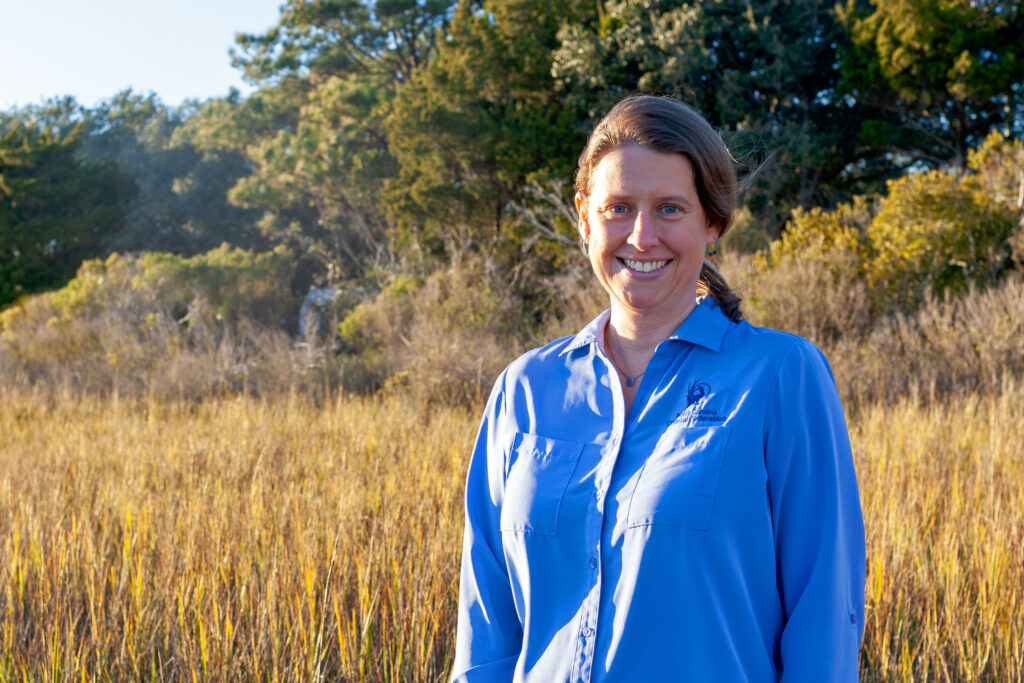
Allen has lived near the water all of her 30-plus years. She competes in outrigger canoe races and calls herself an “East Coast mermaid.” She knows how to read a river, and at times her life has depended on that skill. She has paddled this rugged stretch of the Cape Fear River when winds were wailing and whitecaps were walloping her boat. She now works as coastal management program director for the N.C. Coastal Federation.
On this day, from the port side of the ferry, the river looks as deep and dark as midnight. A light southwest wind pushes serrated waves against the hull.
“There is a lot going on under the water,” Allen says, as she scans the horizon. “Tidal currents, river currents, basin currents.”
Kerri Allen, with the N.C. Coastal Federation, is concerned about the lack of monitoring plans for the proposed dredging project. Credit: Lisa Sorg/Inside Climate News
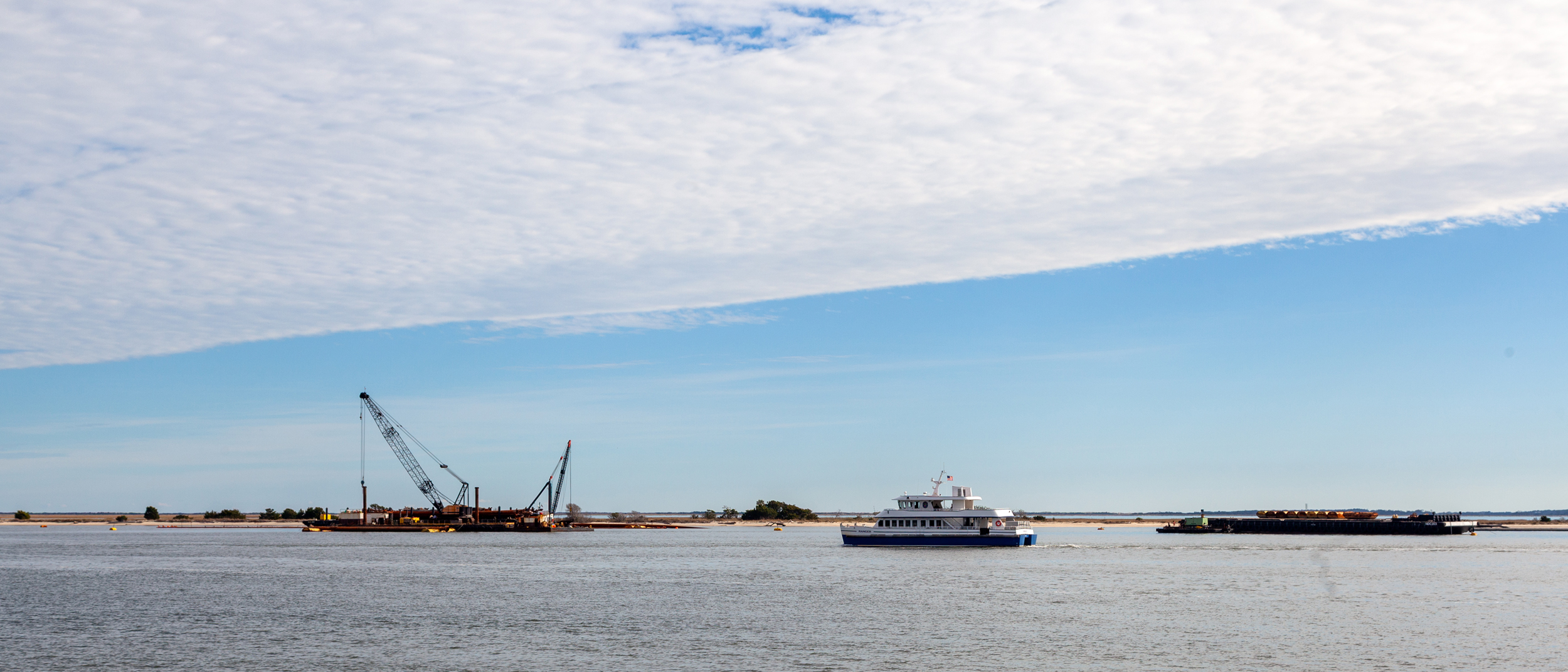
Allen is taking the 35-minute ride with her fellow environmental advocates: Lindsay Addison, a coastal biologist with the Audubon Society, and Kemp Burdette, the Cape Fear Riverkeeper. They’re showing me the potential impacts of a proposed federal dredging project: Shorelines and beach spits that are buffeted by wakes of enormous container ships, and vulnerable bird habitats on barrier islands that could be coated with PFAS-contaminated silt.
And, of course, the Cape Fear River itself. It’s a repository for industrial chemicals and fertilizers that have drained from farms and lawns, and microplastics that have invaded every aspect of human existence, even our brains.
The advocates have spent the last year fending off myriad environmental assaults under the Trump administration, including the loss of wetlands protections, the weakening of the Endangered Species Act and the rollback of PFAS regulations in drinking water.
These threats—and many others—are now weighing on the advocates’ minds as they fight a different battle, the billion-dollar, six-year dredging project proposed by the U.S. Army Corps of Engineers.
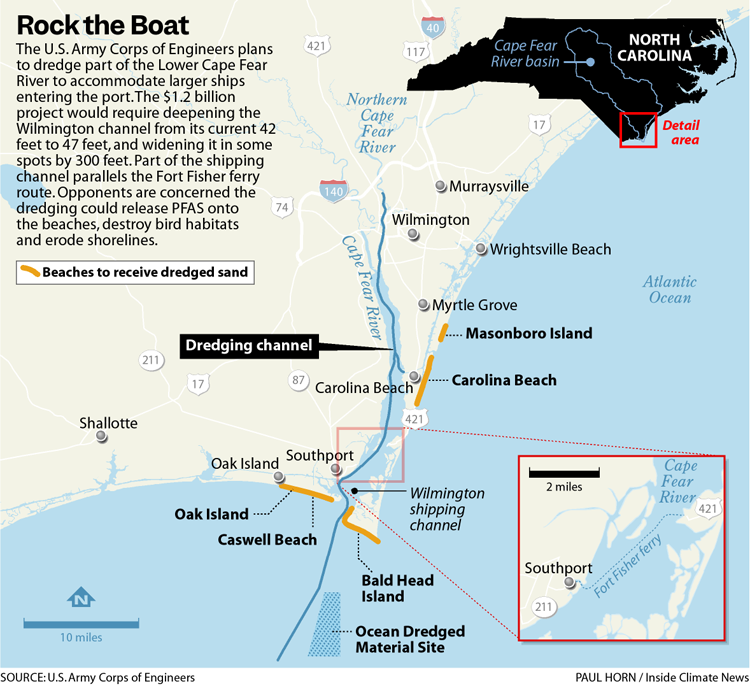
To accommodate larger ships heading up the Cape Fear River to the Port of Wilmington, the Corps would dredge 28 miles of the river up from its mouth near Bald Head Island, north along the Fort Fisher ferry route and upstream to the port. The dredging would deepen the shipping channel to 47 feet, from its current depth of 42 feet, federal records show, and widen some segments by as much as 500 feet—equivalent to one and a half football fields.
By the time the Corps is finished, 35 million cubic yards of silt and sand, plus the creatures that live in it, would be scraped and slurped from the riverbed.
The Corps would dispose of roughly half the material at a permitted ocean disposal site; the rest—sand and silt likely contaminated with PFAS—would be slathered on hundreds of acres of public beaches, bird-nesting islands and imperiled wetlands.
From the ferry deck, the Military Ocean Terminal Sunny Point comes into view across the vast river expanse. Operated by the U.S. Army, it is the world’s largest military terminal. It stores and ships explosives, artillery shells, Howitzers, grenades and other ammunition. If the United States is embroiled in a conflict—or assisting with one—the weapons likely ship from Sunny Point.
Parts of the terminal are contaminated with toxic PFAS found in firefighting foam, military testing has shown. Studies have also found contaminants from terminal seeping from the groundwater into tributaries of the Cape Fear.
University scientists and state environmental regulators have also found the forever chemicals in river water, fish, birds and alligators, as well as in sediment north of the port.
Despite the likelihood of contamination, the Corps doesn’t intend to test the dredging material for PFAS, according to a Draft Environmental Impact Statement released in September. In fact, the 260-page document doesn’t mention PFAS at all.
Even if the Corps did find PFAS in the dredging material, it’s unclear if they would be prohibited from disposing of it. There are currently no federal standards or regulations to guide decisions related to PFAS contamination in sediment, a Corps spokesman said.
Because sediment tests have a limited shelf life, the spokesman said, samples collected now would be outdated by the time the Corps would begin dredging the river in five to 10 years.
If the dredging project comes to fruition, the spokesman said, the Corps would test the sediment in the engineering and design phase “to meet all applicable requirements” and guide decisions about where to place the material.
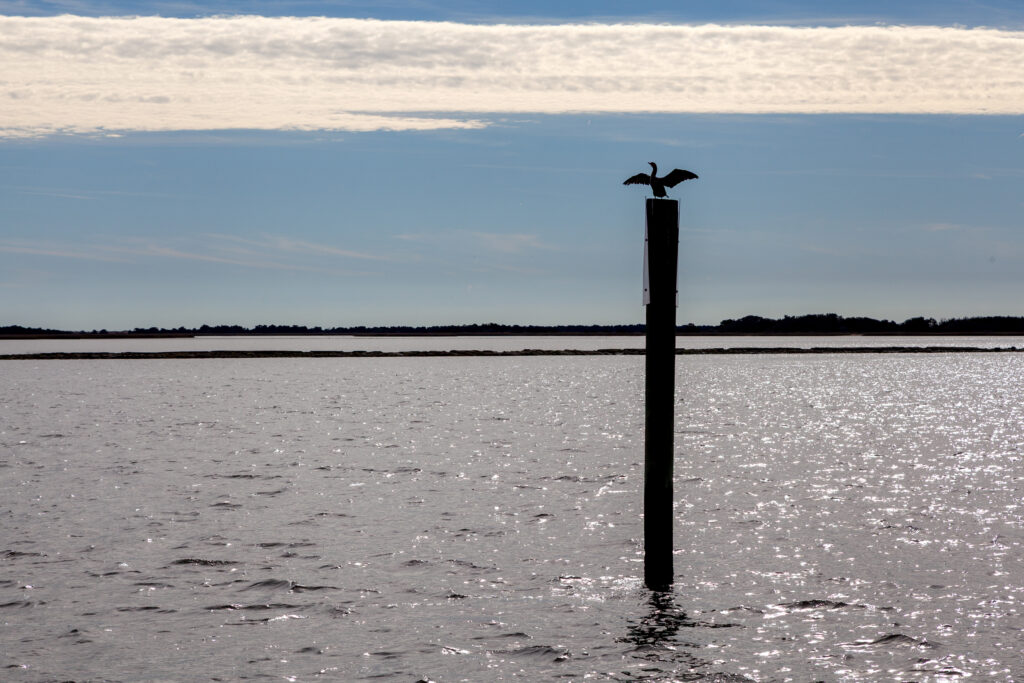
Gulls soar overhead. A cormorant perches on a channel marker and spreads its wings. As the ferry lumbers downriver, the issue takes on an urgency that’s tinged with exasperation.
A cormorant dries its wings atop a channel marker in the Cape Fear River. Credit: Lisa Sorg/Inside Climate News
Burdette has battled for PFAS regulations since the compounds were detected in the Cape Fear River in 2017. He’s from Wilmington and unknowingly drank contaminated water much of his life. His two children, now in their teens, drank it. His father drank it and died of kidney cancer, which research has linked to exposure to GenX, a PFAS compound.
Burdette has wrestled alligators so scientists could take their blood. His organization, Cape Fear River Watch, sued the state and Chemours, the chemical manufacturer responsible for discharging GenX and other forever chemicals into the Cape Fear. The state and Chemours agreed to a consent order that required the company to stop its contaminated discharges into the waterway.
Last fall, Burdette paddled an aluminum rowboat to Chemour Fayetteville Works on the river to test whether a PFAS compound called TFA was in water outfalls from the plant. He found disturbingly high levels of the ultra-short chain compounds.
Now Burdette is again fighting for the river he knows so well, and on behalf of the people who depend on it.
A Gritty, Loud, Noxious Port
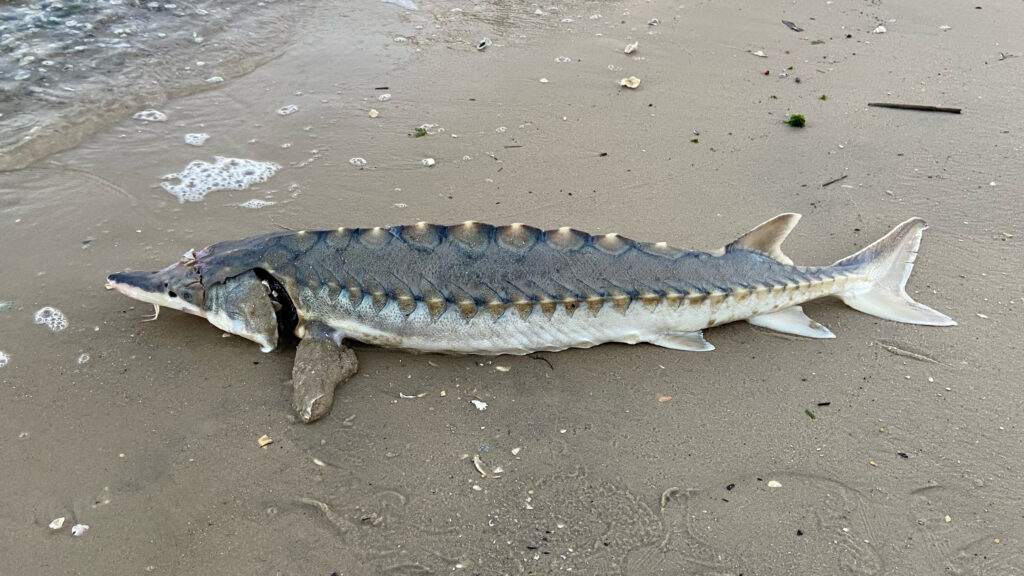
The ferry turns gently toward the west as the advocates aboard rattle off additional probable harms from the dredging: The increased wake and wave action from the enormous ships would erode shorelines and drown bird eggs and chicks in their nests. Roughly 1,000 acres of wetlands would be permanently lost. Endangered Atlantic Sturgeon, which live on the river bed, would be dismembered by the ships’ sharp keels.
Allen is concerned that there is no monitoring plan for the environmental impacts. The Cape Fear River is so impaired, she says, that crabbers describe the river as dead.
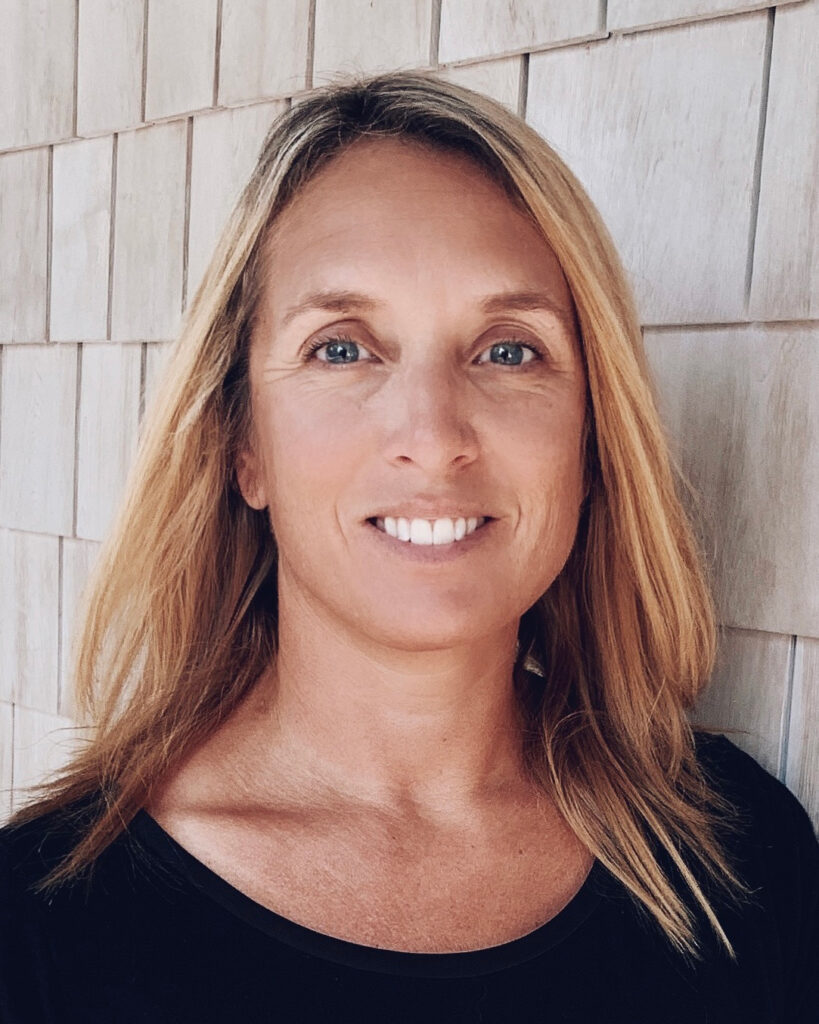
Allen, in her mid-30s, is blond and athletic with a wide smile. She was born in Raleigh, but moved to Wilmington as a teenager. She originally planned to become an artist, and her creative streak manifests in her Coastal Federation office at Wrightsville Beach.
Not only does she have a graceful array of seashells, but also a collection of sand: Black sand, white sand, sand from Hawaii, sand from San Francisco, sand from Costa Rica, sand with large grains, sand with small grains, even sea glass, all housed in 100 small antique bottles with cork stoppers.
Sand is placed on beaches as part of routine maintenance, but there is no legal requirement to test the material for PFAS, even in areas known to be contaminated. Credit: Lisa Sorg/ Inside Climate News
Had it not been for a high school oceanography class, Allen could be painting ocean scenes. But as part of the class, she visited a marsh where she retrieved the shell of a tulip mollusk, a type of large sea snail. She was hooked. Now she’s a coastal geologist.
Allen and her fellow advocates have scrutinized the economics of the proposal. Federal documents show the financial benefits of the $1.2 billion proposed project are few and barely meet the Corps’ benefit-cost threshold for reasonableness. The state legislature would have to appropriate $339 million to cover a quarter of the costs.
The total cargo volume flowing through the port is expected to remain steady with or without a harbor improvement project, according to the Corps’ analysis. Yet, the Corps, and before it, the State Ports Authority, justified deepening the shipping channel to accommodate larger vessels. Otherwise, ships would have to “light load”—carry less weight to the port, which could entail more river traffic.
In other words, fewer trips, but bigger ships.
The 284-acre Port of Wilmington lies just two miles south of downtown. Unlike the city’s waterfront promenade, restaurants and tourist shops, the port is gritty, loud and noxious.
Along Burnette Boulevard, Kinder Morgan, the Houston-based pipeline company, operates a chemical, petroleum and asphalt storage terminal. EcoLab injects shipping containers with the neurotoxin methyl bromide to fumigate logs. In the backyards of Sunset Park residents looms Enviva’s dome of wood pellets, sourced from North Carolina forests and bound for Europe to be burned as fuel.
The port is crucial to Wilmington’s economy, but receives just 1.3 percent of the nation’s marine shipping traffic. It handled about 7 million tons of cargo in 2022, most of it container shipments, according to State Port Authority figures.
In February 2020, the State Port Authority released a feasibility study about improving the shipping channel, which, unsurprisingly, found it would benefit the port.
The findings have since prompted accusations of self-dealing, especially in light of an eviscerating federal review. After the state submitted it to the assistant secretary of the Army for Civil Works, that office identified more than two dozen major weaknesses and unresolved issues.
The state Department of Transportation, which oversees the port, did not respond to emails from Inside Climate News seeking comment.
The Port Authority underestimated the project’s impact on river flooding associated with sea-level rise, failed to account for the effects of climate change, and claimed, without evidence, that unless the shipping channel was deepened and widened, the port would close.
“As written, the planning objectives are unclear and could potentially lead to the pre-selection of an alternative plan,” Corps documents read. “In many cases, the report uses qualifying words, such as may, potentially, and just, to lessen the description of project impacts.”
Nonetheless, Congress authorized more than $839 million for the project, but with a caveat: The study’s shortcomings had to be fixed before lawmakers would consider releasing the funding.
In 2022, the task fell to the Corps.
PFAS in the Fish
The ferry docks at the Southport terminal after crossing the river in about 35 minutes, and the trio of environmental advocates heads for the fishing pier. It’s nearly empty in December, but during high season, the pier is jammed with anglers eager to catch a red drum or Atlantic croaker for dinner.
Those fish are among seven saltwater species that contained PFAS in their tissues, according to sampling conducted by the state Department of Environmental Quality.
In 2023 and 2024, DEQ tested 77 fish caught between Wilmington and Southport—the same stretch of the river that the Corps would deepen and widen—for the compounds. DEQ presented preliminary data to the state Secretaries’ Science Advisory Board last October that showed PFAS were present in all seven saltwater species sampled, as well as in river water.
The agency found 13 types of PFAS disbursed among the fish. PFOS, which the chemical industry phased out in 2002, was detected in all of the samples.
Two compounds found in several fish, PFMOAA and PFO5DA, can be traced back to Chemours, 100 miles upstream.
The saltwater fish findings build on previous DEQ sampling that detected high levels of PFOS in eight species of freshwater fish commonly caught in the river segment upstream of Wilmington, between Chemours and the Bluffs on the Cape Fear.
The results compelled state health officials in 2023 to issue a fish consumption advisory for those species, recommending that pregnant women eat none and that others limit their intake to no more than seven meals in a year.
The state health department is evaluating options for future fish advisories, including consideration of guidelines proposed last September by the Great Lakes Consortium for Fish Advisories.
Research on PFAS and Birds
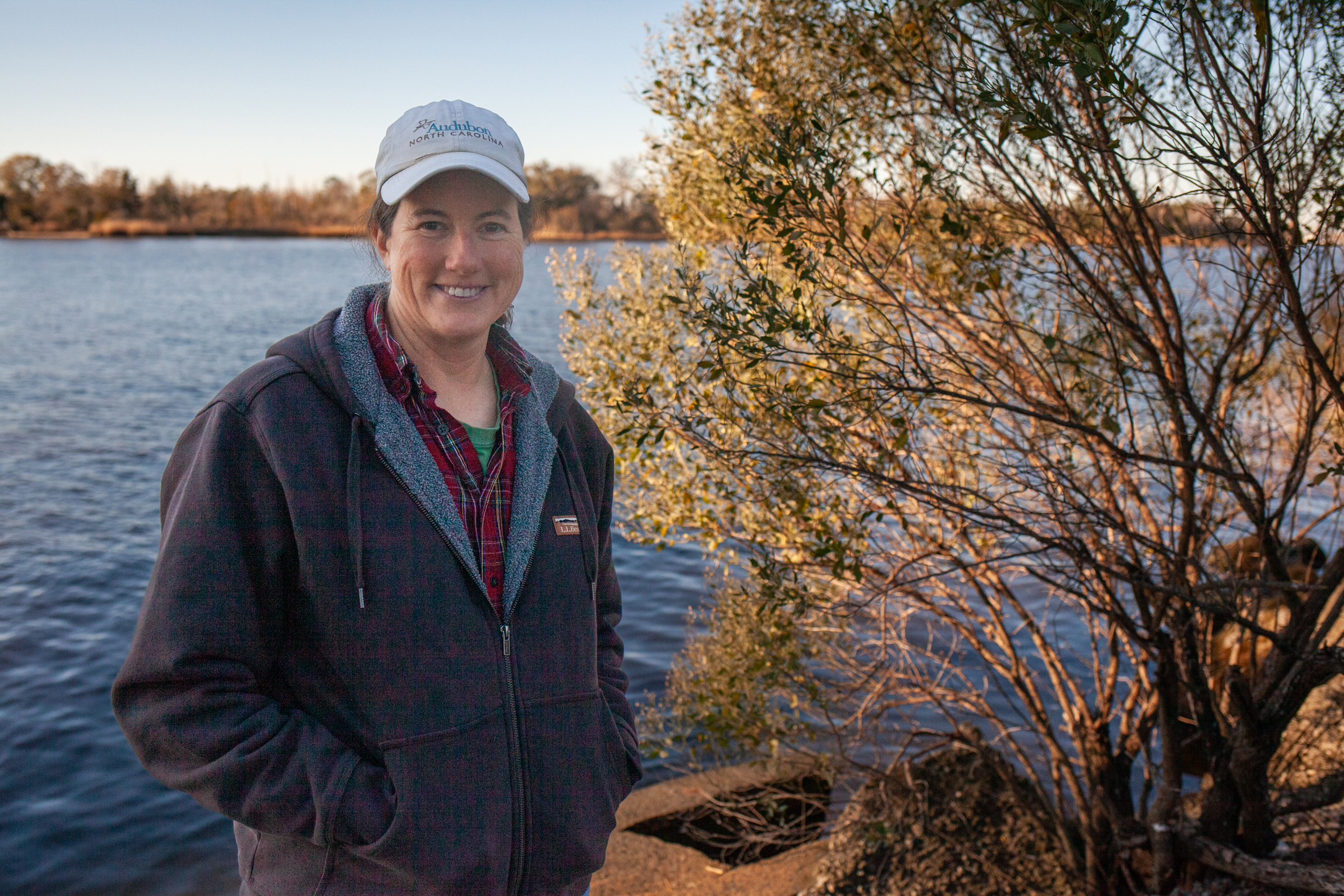
Addison is in her 40s and, in the winter, wears flannel and a knit toboggan to protect against the wind. She has been a coastal biologist with the Audubon Society in Wilmington for 15 years and grew up in Florida, surrounded by nature and books. Her father was a biologist, and she spent her childhood playing outside, roaming the woods behind her elementary school while she waited for her mother, a teacher, to finish working.
“Outside, you might go to the same place over and over,” she says, “but you don’t know what you’re going to see or what’s going to happen. It’s never the same.”
Even her hobbies dovetail with her professional life. Like the protagonists in the British mysteries she reads, Addison observes the natural world, what belongs and what seems out of place.
“Birds are a thing everyone can get behind,” says Lindsay Addison, a coastal biologist with the Audubon Society. Credit: Lisa Sorg/Inside Climate News
Addison loves birds. She has a figurine of a killdeer in her office—but if she had to name a favorite shorebird, it would be the American oystercatcher. (The Carolina wren, a yardbird, is second, Addison says. “They’re pert.”)
“Birds are a thing that everyone can get behind,” she says. “They are a great uniter.”
American oystercatchers live on coastal salt marshes, mudflats, and islands. They are sociable introverts who are loyal to their mates and will return to the same spot to nest every year. If an island were a parking lot, Addison says, an American oystercatcher would return not just to the same lot, but “to the same parking space.”
American oystercatchers, as their name suggests, eat oysters. And scientists have found oysters contaminated with the compounds along the Southeast Atlantic Coast..
Some birds living along the Cape Fear River have also been contaminated with PFAS. In 2017, Addison, EPA scientists and University of Rhode Island researchers tested chicks that had died of natural causes from three locations: Massachusetts Bay, Narragansett Bay in Rhode Island, and the Cape Fear River Estuary in North Carolina.
They found 16 types of PFAS in the livers of royal terns, sandwich terns, laughing gulls and brown pelicans from the Cape Fear River Estuary. These included PFOS and two compounds associated with Chemours.
Chicks from the Cape Fear Estuary contained significantly greater concentrations and numbers of PFAS than juveniles from Massachusetts Bay or Narragansett Bay, researchers found. A royal tern chick from the estuary had the highest total of PFAS of all the birds tested: 390 parts per trillion.
Over the past two years, Addison, along with the U.S. Geological Survey and the University of North Carolina, Wilmington, conducted a second study. They took blood samples from living brown pelican chicks to see if their immune systems have been affected by exposure to PFAS. The results are pending.
If the Corps places contaminated dredge material on the bird nesting islands, that could further expose them to compounds. The “likely presence of PFAS is a major concern” for DEQ, according to an agency spokesperson.
“We need to find out before we do it,” Addison says. “You can’t un-ring the bell.”
Back Before the House
Emily Donovan, co-founder of the environmental group Clean Cape Fear, couldn’t make the ferry trip. Instead, she prepared to testify before the U.S. House Environment Subcommittee.
Donovan routinely speaks in public; sometimes it seems like she’s on tour. Seven years ago, she first appeared before the House Environment Subcommittee, where she pleaded with federal lawmakers to authorize and fund a comprehensive, nationwide PFAS Human Exposure Study and to regulate all of the compounds, not piecemeal, but as a class.
Last May, she addressed 100 people from the pulpit of Ocean View United Methodist Church in Oak Island, North Carolina, to unveil findings about PFAS in sea foam along the state’s beaches. Coincidentally, that was the day EPA Administrator Lee Zeldin announced he would roll back drinking water regulations for GenX and four other PFAS chemicals—regulations Donovan and other North Carolina environmentalists had fought for more than a decade.
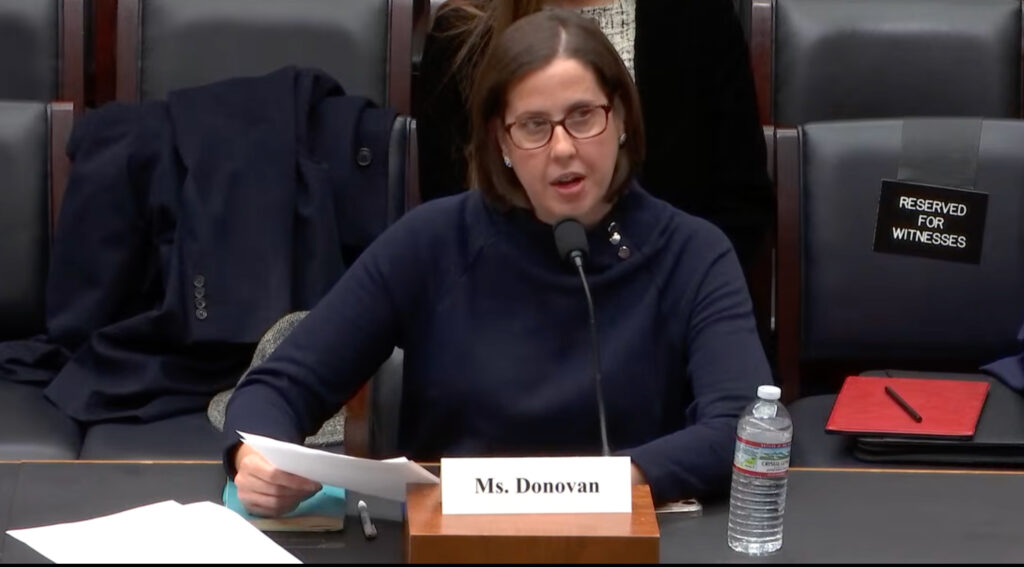
Emily Donovan, co-founder of Clean Cape Fear, testified before the U.S. House Environment Subcommittee in mid-December about PFAS and hazardous waste law. Source: Screenshot from subcommittee livestream
This time, though, Donovan felt nervous. She had little time to finesse her remarks. House Democrats had contacted her on short notice to appear before the committee about proposed PFAS exemptions under the Superfund law, which governs hundreds of sites nationwide that are contaminated by hazardous waste.
The hearing at the Rayburn Building in Washington, D.C., was on the 18th of December: A week before Christmas, in the middle of Hanukkah and on the final day of Congress in 2025. She wondered if anyone was listening or even cared.
Clad in a black turtleneck sweater, Donovan sat at a hearing table with three other witnesses, all of whom represented industries that favored the Superfund exemption.
The Trump administration had kept the hazardous materials designation for PFOA and PFOS, enacted under President Biden. That classification places those compounds under the purview of the Superfund program, which allows the EPA to force polluters to pay for cleanups, rather than taxpayers.
Now, Congress was weighing a legal exemption for “passive receivers,” entities that didn’t produce the compounds but had unknowingly accepted contaminated material: farmers, wastewater treatment plants, even seaside beach towns.
Initially, the proponents’ arguments seemed reasonable. But as the hearing wore on, observers learned the EPA already absolves passive receivers from governmental liability. However, proponents say that without the exemption, they are still vulnerable to third-party lawsuits.
Those claims are disingenuous, Donovan told the committee, whose Democratic members agreed. The passive receiver exemption could shield polluters from accountability, she said. For example, in North Carolina, the state regulates water and wastewater utilities. In turn, the utilities often end up processing discharges of toxic chemicals from industries like plastics manufacturers and textile companies,
This gives polluting industries cover: the utility is on the hook to DEQ, not them, Donovan said.
“Our beaches are coated in an atrocious amount of PFAS in sea foam.”
— Emily Donovan, Clean Cape Fear
“Yet here we are debating whether to weaken accountability for two types of PFAs that haven’t been in commercial use for over a decade,” she said.
Donovan was part of a research team that found PFAS-contaminated sea foam along several Brunswick County beaches in southern North Carolina. Of the 12 sea foam samples, Caswell Beach and nearby Oak Island had some of the highest levels. These are the same places where the Corps could soon place 2 million cubic yards of dredge material from the Cape Fear River.
“Our beaches are coated in an atrocious amount of PFAS in sea foam, the highest ever recorded in literature to date,” she told the committee. “The discovery of these toxic levels of PFAS contaminating our local beaches is yet another public health threat lawmakers and regulators have no idea how to address.”
Seaside Towns Divided on Dredging
Sand is existential for coastal communities. Without a steady replenishment, the sand is carried to sea by storms—some of them supercharged by climate change—and the constant barrage of wakes and waves. Without sand, there are no tourists. And without tourists, the coastal economy folds like a beach chair.
Beach renourishment can cost seaside towns tens of millions of dollars. This is why the prospect of the Corps delivering free sand from the dredging project is nearly irresistible.
The Corps is required under federal law to evaluate whether to test dredge material for contaminants of concern, such as pesticides, metals and PCBs. If the material is in an area with a history of spills or known contamination, the Corps is required to test it for a list of chemicals before disposing of it either inland or at a designated ocean site. PFAS are not on that list.
In the Draft Environmental Impact Statement, the Corps bases its conclusions that sediment contains “acceptable concentrations” of toxic contaminants on tests conducted from 2013 to 2016. Those tests did not include PFAS; not until 2017 did the public know PFAS had contaminated the Cape Fear River.
Scientists have already shown that PFAS can settle in sediment in rivers and lakes worldwide, from Michigan to China. Ralph Mead, a scientist at UNC Wilmington, found the compounds in sediment samples in the Cape Fear River at the dam 39 miles north of Wilmington. Eleven PFAS were found in estuarine sediments in Charleston, S.C.
Erin Carey is the deputy director and director of coastal programs for the North Carolina chapter of the Sierra Club. She lives in Wilmington with her husband and stepson, and grew up in rural Vermont, where, as a child, she became an environmental advocate.
In third grade, she started a petition to bring a rock, about the size of a loaf of bread, into the classroom where she could store it at her desk. All of her classmates signed the petition, which did not sway the teacher. “Not only did it not work,” she says. “But I didn’t get the rock and I had to stay in for recess.”
Erin Carey, deputy director of the North Carolina chapter of the Sierra Club. Credit: Sierra Club
In sixth grade, she started a boycott to advocate for dolphin-safe tuna. Carey wanted to “save the world” and become a marine biologist. She moved to Wilmington, where she earned two degrees in environmental science.
But “there weren’t a lot of ‘save the world jobs’ out there,” Carey says, so she took whatever science job she could.
She worked at the microbiology lab at Wilmington’s Sweeney water treatment plant years before scientists discovered PFAS entering and leaving the facility. In Carteret County, she inspected small wastewater treatment plants, where her job entailed peering into vats of raw sewage. At DEQ’s shellfish sanitation program, she pureed oysters to test them for E. coli bacteria.
Finally, one day when she was surfing in Costa Rica, she got the call that she’d been hired at the Sierra Club in North Carolina. Since then, she’s seen some environmental victories—state rules on emissions of methyl bromide, a neurotoxin—and losses. Under Trump, millions of acres of wetlands, including thousands in North Carolina, are losing protection. “The wetlands fight will be, [and] is, the most daunting and most terrifying change we’ve seen come out of the Trump administration.”
Polling shows that the environment falls below the economy in importance, she says. “It may, but I don’t think that that’s a full picture of how emotionally connected people are to the environment. Despite the body blows that we take, the energy from the public, love for the environment and for nature, the need to protect it, that seems intrinsic to being human. That makes it worth it.”
Carey says environmental groups have spoken with the Corps about their PFAS concerns, but “they’re taking the stance that it’s not regulated and we don’t have to do anything about it.”
“No, you don’t have to,” Carey says of the Corps, “but you could do your job and protect people.”
“Despite the body blows that we take, the energy from the public, love for the environment and for nature, the need to protect it, that seems intrinsic to being human.”
— Erin Carey, Sierra Club
Caswell Beach Mayor George Kassler said he is unaware “that anyone is concerned with PFAS from material placed on the beach.” He said the town is relying on the “Corps’ assurance” that chemical testing of the material would occur as outlined in the Draft Environmental Impact Statement.
In Oak Island, elected officials haven’t taken a public stand on whether it would accept sand from the dredging project. The Town Council “has not yet had the chance to discuss this topic in an open meeting,” a town spokesman said.
Other municipalities, though, have either opposed the project or asked for concessions similar to those made when the Georgia Ports Authority expanded the Savannah Harbor.
The Southport Board of Alderman passed a resolution earlier this month that urged state and federal policymakers to require a “comprehensive, long-term, and fully-funded environmental mitigation and adaptive management plan.”
This would require the State Port Authority to deposit $500 million in an escrow account to fund future mitigation projects to address as-yet-unknown environmental harms caused by the dredging.
Kure Beach officials passed a similar resolution. They also urged the relevant agencies to protect Battery Island and the surrounding Cape Fear River islands “as irreplaceable ecological assets,” ensuring that mitigation measures “fully safeguard the habitats supporting nearly a third of North Carolina’s coastal shorebird population.”
Across the Cape Fear River and the Southport pier lies Battery Island, North Carolina’s largest colony for herons, ibis and egrets. Credit: Lisa Sorg/Inside Climate News
The Village of Bald Head Island, a wealthy enclave in and near a maritime forest four miles from the mainland, would receive 1.6 million cubic yards of dredged sand. But that offer isn’t enticing enough to counter the potential environmental and property damages; in mid-December, village officials voted unanimously to oppose the project.
Bill Cary, an attorney with the powerful law firm Brooks Pierce, which is representing Bald Head Island, wrote to the Corps that the village is still recovering 25 years after the previous dredging project. It has spent more than $2.8 million a year addressing the damages, including shoreline erosion.
Brooks Pierce also hired ports and shipping expert Asaf Ashar, a University of New Orleans research professor emeritus, who, in 40 pages of analysis, concluded that the Corps’ economic projections are incorrectly calculated and unsupported.
“Considering the size of the projected expenditures, the environmental impacts, the prior criticisms and the time and expense of the new analysis,” Cary wrote, “one would expect the 2025 economic considerations to be thorough, well-documented, supported by available data, and based on sound, consistent analytical principles. It is none of those things.”
What’s Next
A motorboat passes by the Southport pier. Its wake travels beneath the pilings and thwacks the stone rip-rap that protects the waterfront from flooding. Multiply the power of that wake by 1,000, even 10,000, from ships traveling the river, and the force of the water can annihilate a shoreline.
Addison points out Battery Island, which lies about a half mile across the river from the Southport pier. At 100 acres, it is one of the largest wading-bird areas in the state, as well as a sanctuary for chicks because no mammals, other than the occasional unfortunate deer, can swim there.
Many of the birds “read” the island for the high tide line and build their nests above it, she says. But sometimes the incoming water, whether from gusty winds or big boats, tops the line and drowns birds in their nests.
When ferries and ships pass the island, they create a tsunami effect: Water is sucked from the shore, but then slams back and gradually sloughs off the shoreline. The birds are running out of higher ground. Thirty-year-old cedars are falling into the sea.
“It’s one of the islands we’re most concerned about,” Addison says. “There’s a pretty wicked current. It’s striking how far a boat wake can travel.”
The state Wildlife Resources Commission owns two islands near the river, which the Audubon Society manages. The commission is also concerned about the damage wakes could inflict on birding islands from large ships, especially on Battery Island.
“There was no information on wave heights and how far wakes would progress onshore,” the WRC wrote in its public comments to the Corps. “A single overwash causes a nest to be lost. This permanent loss of nesting and roosting habitats along with potential site abandonment by birds should be considered and mitigated appropriately.”
The project would alter 1,000 acres of wetlands from freshwater to saltwater, which supports entirely different ecosystems. The Corps would be required to mitigate those impacts at other locations within the river subbasin, but the harm—including inundation of some wetlands and wake erosion of others—would be extensive and permanent.
“This project will increase salinity up the river,” said Carey of the Sierra Club. “It will change the nature of ecosystems and forests. The idea of killing off wetlands and then just assuming that they will become just a different kind of wetland—eventually—there’s no analysis behind that. It’s just an assumption.”
Carey likens the project to a scene in the film Jurassic Park: “Jeff Goldblum says, ‘your scientists were so focused on whether they could do something, they didn’t think about whether they should.’”
An Uncertain Fate
On the pier, Burdette scrolls on his phone, searching for photos of Atlantic sturgeon. They are endangered in North Carolina and, because they live on the river bottom, can be mowed down by the sharp keels of ships.
He points to the shoreline where the boat’s wake just dissipated. “This one I found right over there,” he says, having found the photo of a sturgeon on his phone. “And this one—is missing part of himself.”
Cars and trucks line up to load onto the ferry back to Fort Fisher. It is mid-afternoon but already the sun is nodding toward the horizon. Burdette glances at his watch, 30 minutes until high tide. The ferry heads up and then back across the river to Fort Fisher. Even though the advocates know the area by heart, there is always something beautiful to see.
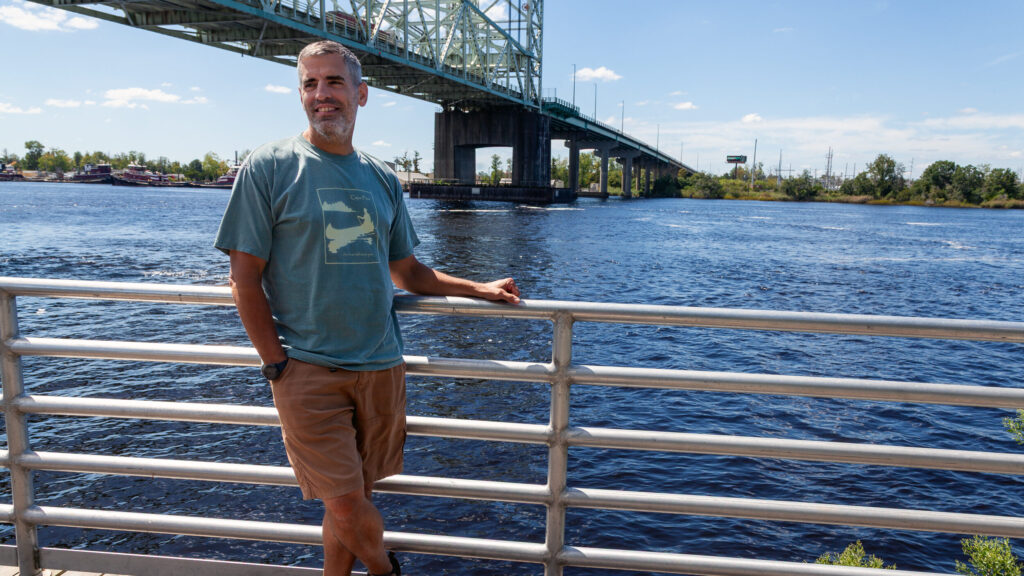
Cape Fear Riverkeeper Kemp Burdette. Credit: Lisa Sorg/Inside Climate News
Atlantic sturgeon are common in the Cape Fear River. They are an endangered species whose existence is threatened by dredging of spawning areas, vessel strikes and more. Credit: Kemp Burdette
“Wow, look at that boat,” Allen says, pointing ahead.
The long fingers of the sun have bathed the vessel in hues of butter.
The conversation turns to what could happen next. Under state law, DEQ must conduct a consistency review for federal projects that could affect the coastal zone. The agency’s Division of Coastal Management analyzes the project to evaluate whether it complies with the state’s approved coastal management program, including the dredge and fill law.
Coastal Management officials are expected to complete the review by Jan. 20.
The division has three choices: It could issue a letter of “concurrence,” which allows the project to continue. A letter of “conditional concurrence,” requires changes to the project for it to proceed. An “objection” cancels the project unless the Corps appeals to the U.S. Department of Commerce or enters into mediation with the state.
The Corps could issue its Final Environmental Impact Statement as early as next spring. Even if the project clears the regulatory hurdles, it’s unclear if Congress and the state legislature will appropriate the funds—and when.
The ferry heads north and east. From the starboard side, Burdette points to a dredging barge, slouched in the water, laden with dirt. The barge is headed south, and likely out to sea, to dump it.
Out here on the water, I feel small, humble, inconsequential. “Ecosystems, the ocean, the tides, hurricanes, these are not things you can negotiate with,” Addison says. “We can, we can observe them and appreciate their beauty, but we do not control them. The forces are big and impersonal, and that, to me, is comforting instead of intimidating.”
Ten minutes after sunset at Kure Beach, just north of Fort Fisher, the skies have turned from indigo to lilac. The sand is damp and cold. A half dozen hardy tourists take selfies against the backdrop of ocean waves breaking on the shore.
Those forces require beaches to be routinely smoothed and mended. Behind the orange snow fence, slumps a backhoe and a heap of sand.
A view of Kure Beach at sunset in mid-December. Town officials passed a resolution urging the U.S. Army Corps of Engineers to protect the area’s “irreplaceable ecological assets.” Credit: Lisa Sorg/Inside Climate News
About This Story
Perhaps you noticed: This story, like all the news we publish, is free to read. That’s because Inside Climate News is a 501c3 nonprofit organization. We do not charge a subscription fee, lock our news behind a paywall, or clutter our website with ads. We make our news on climate and the environment freely available to you and anyone who wants it.
That’s not all. We also share our news for free with scores of other media organizations around the country. Many of them can’t afford to do environmental journalism of their own. We’ve built bureaus from coast to coast to report local stories, collaborate with local newsrooms and co-publish articles so that this vital work is shared as widely as possible.
Two of us launched ICN in 2007. Six years later we earned a Pulitzer Prize for National Reporting, and now we run the oldest and largest dedicated climate newsroom in the nation. We tell the story in all its complexity. We hold polluters accountable. We expose environmental injustice. We debunk misinformation. We scrutinize solutions and inspire action.
Donations from readers like you fund every aspect of what we do. If you don’t already, will you support our ongoing work, our reporting on the biggest crisis facing our planet, and help us reach even more readers in more places?
Please take a moment to make a tax-deductible donation. Every one of them makes a difference.
Lisa Sorg is the North Carolina reporter for Inside Climate News. A journalist for 30 years, Sorg covers energy, climate environment and agriculture, as well as the social justice impacts of pollution and corporate malfeasance. She has won dozens of awards for her news, public service and investigative reporting. In 2022, she received the Stokes Award from the National Press Foundation for her two-part story about the environmental damage from a former missile plant on a Black and Latinx neighborhood in Burlington. Sorg was previously an environmental investigative reporter at NC Newsline, a nonprofit media outlet based in Raleigh. She has also worked at alt-weeklies, dailies and magazines. Originally from rural Indiana, she lives in Durham, N.C.
Great Job By Lisa Sorg & the Team @ Inside Climate News Source link for sharing this story.
The second big upgrade is in ISO. I am one of those people who will shoot up to 25,000 ISO if I need to to maintain my shutter speed and aperture where I want them. Maybe this is an old-guy film-shooter thing, but changing ISO still seems like a miracle to me, and it’s my favorite thing about digital photography—when it works. With the A7V, I was completely comfortable pushing ISO as high as 32,000. With the noise-reduction algorithms in postproduction software these days, the images still look great even at these insane ISOs. And yes, I try to keep ISO down when I can, but it’s nice to know that I can go that high if I need to to get the shot.
The third upgrade is not so much an upgrade as a change for the better. Sony’s color science has improved dramatically, especially with skin tones, which are much truer to life across the range of skin tones in this world. Auto white balance is also significantly better, though I am still a fan of shooting in good old sunlight white balance 95 percent of the time.
Finally, a bonus thing I loved. I’ve always wanted to get better at bird photography, but that generally requires expensive lenses and extensive time in the field. It still requires both of those things, but with 33 MP to crop into, and the pre-burst capture, and 33 images-per-second RAW capture … even someone like me, with next to no wildlife photography skills and only a 200mm lens, can get some pretty decent images, which was fun to experiment with.
Photograph: Scott Gilbertson
The one thing that still sucks about the A7V and has sucked about every Sony camera I’ve ever used, and it’s only getting worse: the menu system. They are disorganized, confusing, and difficult to navigate. The only thing that saves you here is the number of programmable hardware buttons, which allow you to control things the way you want to without having to dive into the menus. Sony, seriously, hire a UX designer and fix this. Even better, steal Leica’s menu designer.
Is the A7V worth the upgrade? Yes, if you’re coming from a camera that’s below the A7IV. If you already have the A7IV, it’s less compelling. The new features are impressive on a specs table, but whether you need them depends on what you shoot.
If you’re a wildlife or sports photographer, it’s worth the upgrade to get the pre-capture and higher burst rates. If what you shoot doesn’t benefit from those features—say you mostly shoot travel images, landscape, street—the A7V is a less-compelling prospect. It’s incredibly nice for all those scenarios, but if you already have the A7IV, it might not be worth the money to upgrade for a bunch of new features you won’t use.
Great Job Scott Gilbertson & the Team @ WIRED Source link for sharing this story.
by Bob Francis, Fort Worth Report January 11, 2026
The new year is only a few days old, but the Fort Worth office market already feels different to Todd Burnette, executive managing director at JLL.
“We are definitely coming out of the downturn in the office market,” he said. “It feels different than in 2025, so we’re encouraged. I feel good about what we’ll see in 2026.”
That optimism is despite a new report on the Fort Worth office market for the fourth quarter of last year, which saw more space vacated than leased.
The office market had been beset with a variety of issues creating economic uncertainty —– from COVID-related shifts in office attendance to global conflicts to higher interest rates to tariffs —– that led many companies to delay decisions on office space and needs, Burnette said.
“But that seems behind us to a large extent,” he said.
The report finds the city’s downtown showing strength even as trophy class offerings attract tenants to new projects along West 7th and southwest Fort Worth, Burnette said.
The JLL report notes that Fort Worth downtown has the second-lowestClass-B vacancy rate of any central business district in the nation.
Burnette said he expects to see more activity return to Sundance Square soon.
“That’s been a question mark for a few years, but we’re seeing indications that is changing,” he said, noting that the area recently hosted a New Year’s Eve event that attracted a reported 100,000 attendees.
“That shows how strong of a draw downtown Fort Worth is,” he said. “And it’s not just the north part of downtown. With the convention center upgrades, Texas A&M’s first building coming on line and I think the Omni Hotel expansion will happen soon, we’re going to see more growth on the south end of downtown.”
If downtown has one question mark, it is the lack of space for a big project, said Burnette.
“If we had a big project that wanted space downtown, we don’t really have it,” he said.
Some projects are attracting some tenants away from downtown, however.
Overall, office leasing activity will continue to be concentrated in Class A and trophy class properties in the downtown, south Fort Worth and Westlake/Southlake submarkets, he said.
The trophy class projects underway include:
Goldenrod Companies’ mixed-use Van Zandt project along West 7th that will include 100,000 square feet of office space.
The first phase of Keystone Group and Larkspur Capital’s 37-acre mixed-use Westside Village project that will include about 880,000 square feet of office space.
The Crescent Offices second building that will add 171,500 square feet of office space. JPMorganChase will move many of its downtown Fort Worth operations to the building.
The Office at Clearfork will have 75,800 square feet of space with Wells Fargo taking two floors of the building, shifting operations from downtown.
All that means the market could see 1.2 million square feet of trophy class space by 2035, up from nearly none a decade ago, he said.
“That flight-to-quality transition will continue to occur,” Burnette said.
Last year also saw the largest office lease of the decade in the city, Burnette added, with Lockheed Martin renewing a 455,000-square-foot office lease at 5555 N. Beach St. in the Fossil Creek Business Park. The nNorth Fort Worth lease secured space for 1,800 employees involved in supply chain and engineering.
Burnette said his optimism is bolstered by the fact that rents continue to increase. Class A space was leasing for $31.45 per square foot at the end of 2025, up from $30.68 at the end of the second quarter last year.
“I think those rates are going to go up,” he said. “We’ve got a very strong market.”
Bob Francis is business editor for the Fort Worth Report. Contact him at bob.francis@fortworthreport.org. At the Fort Worth Report, news decisions are made independently of our board members and financial supporters. Read more about our editorial independence policy here.
This <a target=”_blank” href=”https://fortworthreport.org/2026/01/11/office-market-full-of-optimism-as-fort-worth-starts-new-year-strong/”>article</a> first appeared on <a target=”_blank” href=”https://fortworthreport.org”>Fort Worth Report</a> and is republished here under a <a target=”_blank” href=”https://creativecommons.org/licenses/by-nd/4.0/”>Creative Commons Attribution-NoDerivatives 4.0 International License</a>.<img src=”https://i0.wp.com/fortworthreport.org/wp-content/uploads/2021/04/cropped-favicon.png?resize=150%2C150&quality=80&ssl=1″ style=”width:1em;height:1em;margin-left:10px;”>
Desmond Scott is finally breaking his silence after Kristy Sarah made infidelity claims in a divorce petition. He released a statement, apologizing to Sarah and explaining the allegation and the state of their marriage in recent times.
On Saturday (Jan. 10), Desmond Scott issued a social media statement referring to Kristy Sarah’s divorce filing. Posting on Instagram Stories, Scott admitted to engaging in “choices” he’s not proud of during a separation period in his marriage. He apologized to Kristy and spoke of remaining an active dad to their sons, Vance and Westin.
“I want to begin by apologizing to Kristy, our family, and everyone who has been impacted by the public attention surrounding this situation. I know this news has been disappointing for many, and I’m truly sorry for the hurt it has caused,” Desmond Scott wrote. “Kristy is the mother of my children, and that will always come first. I remain fully committed to being an active, present, and loving parent to our boys, as I have always been.”
Scott said he and Kristy had “faced challenges” and sincerely tried to work through them. However, near the end of last year, Desmond said he wanted to separate, told his wife that, and during that time made those choices. He said they decided to divorce after discussing what happened. He thanked their supporters for their love over the years and shared his hopes that they’ll continue to stick by him.
“I ask for privacy and compassion as we navigate this difficult chapter of our lives. Thank you to everyone who has supported us over the years. I’m grateful for that support and will continue sharing my love for cooking and the things that inspire me. I hope you’ll continue that journey with me.”
No More Couple Goals? Kristy Sarah Files For Divorce
During the last month of 2025, fans peeped that Kristy hadn’t been including Desmond Scott in her social media posts. They built a brand he’s expanded into social media chefin’ and after weeks of nothing came the divorce petition. They wed in 2014 and had been dating since their teen years together. She filed to end the Scotts on December 30, citing infidelity.
The Fans Have Questions!
Fans have been spamming Kristy’s comment section with questions that she’s yet to respond to. The couple had not previously revealed marital issues. No word yet on what will happen to the newly built family home the family debuted on social media—another big question in the comment sections. Kristy’s last Instagram post, as of Saturday night, dropped on Jan. 6. Disbelief was the common feeling under that post.
Also, under Desmond Scott’s latest IG post from two days ago, fans have questions, prayers and a lil’ spicy word or two. In the clip, he’s making his sons a coke float.
“All of a sudden he look different to me,” @llloverocksss commented.
“I just wanna know with who… cause Kristy the whole package I’m just curious. It happens tho so no hate,” @j.michellepaz wrote.
“We all pray you didn’t fumble the bag,” @producertonyawilder added.
@brown_ranger even peeped an alleged bio change on Desmond’s profile, writing, “His bio used to be “My wife’s chef” or something like that and now it’s Father & Chef .”
@toxicology2024 added, “We understand this can happen to anyone you guys are human. Been friends since 14 that’s a long time prayers up to you both ”
Meanwhile, @anarcotics got a lil’ aggressive, commenting: “I got everything BUT compassion for you! don’t let me catch you.”
But @karlaturner.of took a softer approach, writing, “I hope you can recover from each of what you are going through.”
And @emeraldwarrior had the same energy, commenting: “Mr and Mrs Scott. Please fight to restore your marriage and family. DON’T LET THE DEVIL WIN”