Home News Page 111

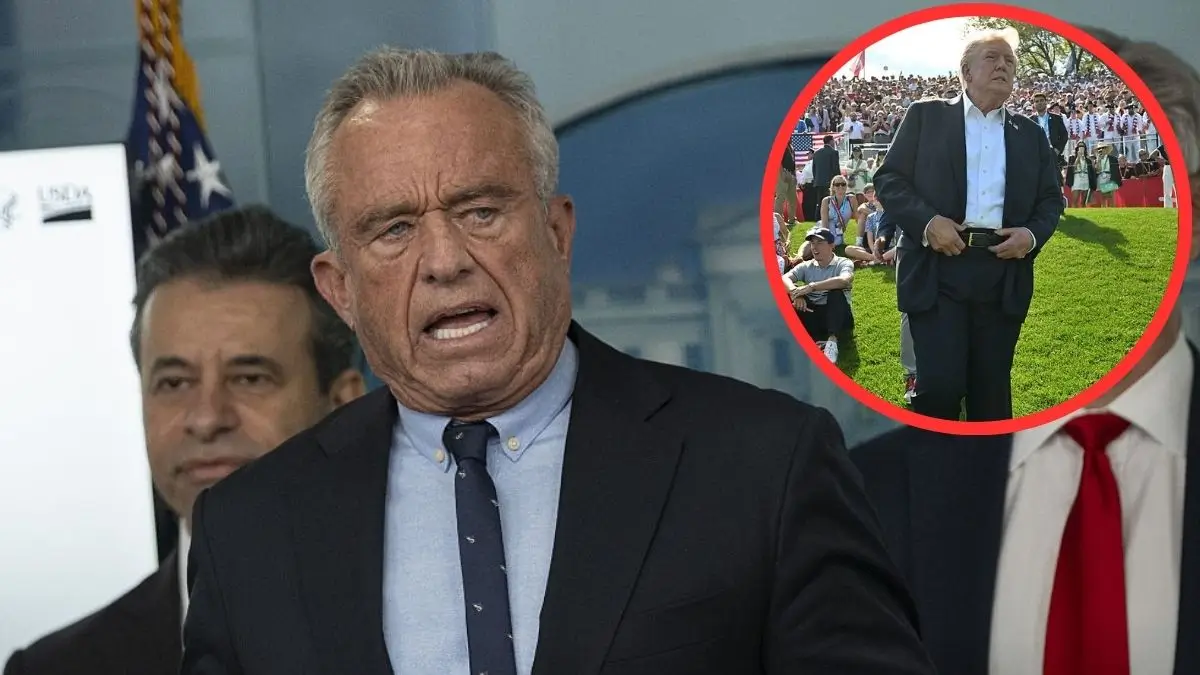
‘Trump Has Been Obese for Decades Himself’: Trump Takes a Hit After RFK Jr.’s Obesity Chat as Critics Pull Brutal Photos of His Larger Than Life Frame

‘Trump Has Been Obese for Decades Himself’: Trump Takes a Hit After RFK Jr.’s Obesity Chat as Critics Pull Brutal Photos of His Larger Than Life Frame

Irony hung over yesterday’s health briefing as President Donald Trump’s weight became part of the broader discussion, arriving just as Robert F. Kennedy Jr. laid out an aggressive push against obesity.

The United States Secretary of Health and Human Services held a press conference at the White House, where the administration unveiled new dietary guidelines.

Kennedy praised Trump for ending the negative stigma attached to saturated fats in his “Make America Healthy Again.”

‘Trump Has Been Obese for Decades Himself’: Trump Takes a Hit After RFK Jr.’s Obesity Chat as Critics Pull Brutal Photos of His Larger Than Life Frame
(Photos by Celal Gunes/Anadolu via Getty Images; Mandel Ngan-Pool/Getty Images)

‘This Is a Joke’: Donald Trump’s Doctor Declares He’s in ‘Excellent’ Shape as Fans Point to Recent Photos That Tell a Very Different Story

The disconnect wasn’t lost on critics, who pointed to the awkward overlap in the administration’s health messaging, while Trump’s well-documented fondness for double-fisting Big Macs and Quarter Pounders from McDonald’s continues to fuel jokes.

Kennedy explained that fruits, vegetables, red meat, and cheese at the top of the new food pyramid, while whole grains have now shifted to the bottom of the pyramid. “Protein and healthy fats are essential and were wrongly discouraged in prior dietary guidelines,” he said after noting that “President Trump has ordered it to end.”

“As Secretary of Health and Human Services, my message is clear — eat real food,” he continued. The new guidelines also limit sugar and processed foods, and Kennedy claimed the guidelines are the country’s “most significant reset of federal nutrition policy in history.”

Video clips of his remarks at the press conference went viral after many noted the audacity of with viewers zeroing in on the audacity of linking Trump to healthy eating. The internet’s disbelief quickly turned into jokes, as critics pointed to years of anecdotes about Trump’s obsession with fast food and eating in bed.

One user wrote, “Trump has been obese for decades himself.”

“Trump the Obese has ordered obesity to end,” joked another. “This message sponsored by the McDonald’s double cheeseburger deluxe, now with more cheese than ever.”

One user shared a picture of Trump, Kennedy, Elon Musk, and Donald Trump Jr., eating McDonald’s aboard Air Force One with the caption, “This you bro?”

“Even being generous about what his height and weight are (he’s not over 6 feet and he’s at least 275 lbs): that’s a BMI of 38.4. Not morbidly obese but certainly not a healthy weight.

Another user summed things up by writing, “Horrifyingly laughable every f’ing day. The outrageous irony & stunning projection has been normalized to the point of numbness.”

Trump has previously listed his height at 6 feet 3 inches and his weight at around 215 pounds in official medical disclosures, figures that would place him just above the normal BMI range for his height.

Those numbers resurfaced as a point of contrast during a White House health briefing where Robert F. Kennedy Jr. outlined a forceful campaign against obesity and promoted new dietary guidelines.

Kennedy’s remarks, which framed obesity as a national crisis that needed to be confronted head-on, drew attention back to Trump’s own reported measurements and physical condition, placing the president’s health profile squarely alongside the administration’s broader messaging on nutrition and weight.

Great Job Niko Mann & the Team @ Atlanta Black Star Source link for sharing this story.

Former ICE director warns ‘wartime recruitment’ tactics like influencer campaigns and $50,000 bonuses could attract the wrong kind of agents | Fortune

Former ICE director warns ‘wartime recruitment’ tactics like influencer campaigns and ,000 bonuses could attract the wrong kind of agents | Fortune

The Department of Homeland Security’s deployment of more than 2,000 Immigration and Customs Enforcement officers and agents—the largest such enforcement action in U.S. history—turned fatal on Wednesday when an ICE officer shot and killed a 37-year-old woman in Minneapolis. 

The shooting was just one of several fatal incidents since ICE ramped up its mass deportation effort last year and raises questions about how officers are trained, especially as DHS has dodged questions about this process while more than doubling its number of agents since 2024. Recruitment efforts have been juiced by massive funding from the One Big Beautiful Bill Act, as taxpayers have found themselves funding an unprecedented swelling of immigration enforcement hiring.

Federal officers have also killed at least three other people, according to The Marshall Project, and have shot at least nine people since September, according to The New York Times

While ICE has ballooned to more than 22,000 agents—more than double from early 2025—the “wartime recruitment” tactics it has employed could be attracting combat-hungry or inexperienced people to the job, experts warn.

Recruitment tactics led to over 200,000 applications

DHS announced last summer its plans to hire 10,000 deportation officers, using what they internally called a “wartime recruitment,” according to an internal document reviewed by The Washington Post

ICE officials planned to spend $100 million over a one-year period to recruit gun rights and military support through influencers and geo-targeted advertising campaigns, according to The Post. The funding is part of the $1.7 billion allocated for border and interior enforcement, including $75 billion for ICE, to be spent over four years. 

The department’s strategy dedicated $8 million to influencers, including “former agents, veterans and pro-ICE creators,” with Gen Z and millennial audiences, according to internal documents reviewed by The Post. DHS planned to work with creators across traditional social media platforms like Facebook, Instagram, and X as well as platforms with more conservative users such as Rumble. DHS anticipated that their influencer would bring more than 5,000 applications. 

In addition to a salary ranging from $49,739 to $89,528 a year, DHS offers up to a $50,000 signing bonus split over three years, up to $60,000 in student loan repayment and forgiveness options, and retirement benefits. 

ICE also uses a marketing strategy called “geofencing” to send ads to the phone web browsers and social media feeds of anyone located near military bases, NASCAR races, college campuses, or gun and trade shows, according to The Post.

“The recruitment initiative utilized data-driven outreach efforts to recruit qualified patriotic Americans from across the country. As a result, ICE was able to exceed its hiring surge target while maintaining rigorous standards for training and readiness,” the agency wrote in the Jan. 3 statement. 

ICE did not respond to a request for comment.

Sarah Saldaña, former director of ICE, recently told The Post she was concerned that the speed of recruitment and the framing of jobs as a war effort in marketing campaigns increased the risk of attracting people seeking combat experience. 

The department received over 220,000 applications and hired 12,000 new officers in four months. Despite reaching their personnel goal, DHS is still recruiting more officers.  

“We continue to call on American patriots to serve the homeland because we know that there’s still more work to do — and we will not stop until every community in this nation is safe,”” said ICE Deputy Director Madison D. Sheahan in a statement.

Officer training questioned 

Renee Nicole Macklin Good was shot in her car as ICE agents approached her vehicle and demanded she open the door, according to video filmed by bystanders. An ICE officer shot her at close range and was briefly hospitalized after the vehicle hit him. 

Homeland Security Secretary Kristi Noem defended the officer who killed Macklin Good, saying that the officer “followed his training.” President Donald Trump doubled down on Wednesday, calling the video of the shooting “horrible to watch,” but said Macklin Good had “behaved horribly” and ran the agent over, even though video evidence disputes that claim. 

All new ICE agents are required to undergo the 8-week Basic Immigration Law Enforcement Training Program, during which they train 6 days a week at a facility in Georgia and learn to find, arrest, and deport people. In the past, ICE officials underwent a five-week Spanish-language training program and 16 weeks of basic training, according to the ICE website

The shooting comes after months of allegations of unprofessionalism and misconduct from advocacy groups. Even after a federal judge ordered ICE officers to wear individual badges, officers were seen without badges, according to the Chicago Sun-Times. Some new recruits showed up to training without full vetting, having failed drug tests, physical, or academic standards, and without disclosing criminal backgrounds. 

A senior DHS official told NBC News on Wednesday that ICE officers are trained to never approach a vehicle from the front and not to shoot at a moving vehicle because it will not stop it from moving towards the officer.

Representative Robin Kelly (D-IL) filed articles of impeachment against Noem on Wednesday. 

“Secretary Noem wreaked havoc in the Chicagoland area, and now, her rogue ICE agents have unleashed that same destruction in Minneapolis, fatally shooting Renee Nicole Good,” Kelly wrote in a statement announcing the move. “ It’s one thing to be incompetent and dangerous, but it’s impeachable to break the rule of law.”

Great Job Jacqueline Munis & the Team @ Fortune | FORTUNE Source link for sharing this story.

2-time Olympic champion Chloe Kim injures shoulder, ‘trying to stay optimistic’ for Italy

2-time Olympic champion Chloe Kim injures shoulder, ‘trying to stay optimistic’ for Italy

LAAX – American snowboarding star Chloe Kim said Thursday that she took “the silliest fall” in training and dislocated her shoulder, threatening her chance to win a third straight gold medal at nex month’s Winter Olympics in Italy.

Kim posted video of the accident in Laax, Switzerland, earlier this week week as she practiced for a key Olympic tune-up there next weekend. She tumbled to the snow and went skittering across the halfpipe.

She did not say which shoulder she hurt and that she was ““trying to stay optimistic” about competing at the Olympics but “I don’t have much clarity now.” The 25-year-old said she has an MRI scheduled for Friday that will reveal the extent of the damage.

“The positive thing is, I have range, I’m not in that much pain, I just don’t want it to keep popping out, which has happened,” she said. “I’m just trying to stay really optimistic. I feel really good about where my snowboarding is at right now, so I know the minute I get cleared and I’m good to go, I should be fine.”

Kim’s absence would deprive the Winter Games of one of its biggest names and one of its best storylines.

She is trying to become the first action-sports athelte to win three straight gold medals. Shaun White took three halfpipe golds, but they were spread out over five games.

Kim was the breakout star of the 2018 Olympics, a bubbly teenager taking gold in her parents’ home country of South Korea. Four years ago in China, she won again, with that victory puncutated by her messages about the ups and downs of success and fame.

Through it all, nobody has come close to beating her.

Two years ago at the Winter X Games, Kim became the first woman to pull off a 1260-degree spin in competition. Before that, she was the first woman to land a double-cork 1080 — two flips and one spin — and the first to land back-to-back 1080s.

She was working on adding to that repertoire for the Milan Cortina Games and, if healthy, would be the heavy favorite to win again. This injury throws all that in question. The Olympic qualifying round in women’s halfpipe is Feb. 11.

The Laax Open is scheduled for next weekend, and even if Kim were to get a clean bill of health, there is a chance she would head into the Olympics without having competed in the final of a contest this season.

Kim qualified for the U.S. team by winning a contest last year and has kept a light schedule in ’25-26. She fell during warmups for the final in Copper Mountain, Colorado, last month and pulled out after hurting her shoulder then, as well. That injury was not believed serious.

Regarding her latest shoulder injury, she said: “It should be fine. I’m just hoping that it doesn’t take too long, but I’m going to be chilling for the next little while.”

___

AP Winter Olympics: https://apnews.com/hub/milan-cortina-2026-winter-olympics

Copyright 2026 The Associated Press. All rights reserved. This material may not be published, broadcast, rewritten or redistributed without permission.

Great Job Associated Press & the Team @ KSAT San Antonio Source link for sharing this story.

DOJ’s Dangerous Silence in the Face of Federal Immigration Agents’ Violent Tactics

DOJ’s Dangerous Silence in the Face of Federal Immigration Agents’ Violent Tactics

On Wednesday morning in Minneapolis, an Immigration and Customs Enforcement (ICE) agent shot and killed a woman in her car during a federal immigration enforcement operation. Department of Homeland Security (DHS) officials characterized the shooting as a response to “an act of domestic terrorism,” stating the woman “weaponized her vehicle” and attempted to “run over” officers. Minneapolis Mayor Jacob Frey has disputed that account, describing the incident as “an agent recklessly using power that resulted in somebody dying.” Governor Tim Walz described it as “totally avoidable.” The FBI and Minnesota Bureau of Criminal Apprehension initially announced they were jointly investigating the matter. Within hours, the U.S. Attorney’s Office reversed course, stripping the state agency of access to case materials and asserting unilateral control over the investigation.

The fatal Minneapolis shooting is among the most serious in a series of incidents over recent months involving federal immigration agents’ use of force. Videos have documented agents firing pepper balls at clergy, shooting rubber bullets at journalists, and deploying tear gas against protesters. Many of these incidents raise questions about whether agents used excessive force in violation of the Fourth Amendment and federal criminal law. Yet, the Minnesota incident is only the first where the FBI has indicated it is investigating, and so far, DOJ has announced no criminal charges related to any such incident. While the current investigation is an important step, it is far from sufficient.

Private plaintiffs are challenging the legality of many DHS tactics in court. The Department of Justice (DOJ), for its part, has remained conspicuously silent through months of these tactics. This silence is a dangerous abdication of DOJ’s authority and responsibility. Under 18 U.S.C. § 242, which makes it a crime for any government official to willfully deprive someone of their constitutional rights, DOJ can and should investigate and, where appropriate, charge federal agents who use excessive force.

A Pattern of Force Raising Constitutional Questions

Reports of aggressive, violent, and potentially unlawful tactics by some federal agents have followed each surge of officers arriving in a new city to conduct the administration’s immigration enforcement operations. These have included a military-style, nighttime raid on sleeping families at an apartment complex, the firing of tear gas canisters, rubber bullets, and pepper balls at non-violent protestors, and widespread racial profiling followed by stops and detentions without reasonable suspicion or warrants. State and local officials have decried the unreasonable uses of force in court and in public statements, and at least two Senators have publicly called on DOJ to investigate. Nevertheless, the President and Department of Homeland Security leadership have repeatedly defended their tactics.

Traditionally, the DOJ—in any administration—would seek accountability for unlawful, excessively violent tactics by law enforcement officers, by charging them with violating people’s constitutional rights. However, the DOJ has not announced any charges relating to federal immigration enforcement actions, nor (before Wednesday) had it indicated it had even taken notice.

This is not surprising. By now, it is clear to those paying attention that the DOJ is acting as the administration’s enforcer, prioritizing politicized prosecutions against Trump’s perceived enemies, rather than exercising its independent judgment. And while public attention, understandably, has focused on those high-profile questionable prosecutions, DOJ’s omissions—the cases it is choosing not to pursue—also deserve scrutiny. The agency’s silence about violent tactics by federal agents suggests an apparent abandonment of its criminal civil rights enforcement authority, a silence that is destructive to the rule of law itself.

DOJ’s failure to act signals a troubling abdication of its authority to enforce the constitutional limits of federal agents’ coercive power. The federal statute that is most clearly implicated by aggressive ICE and CBP tactics, 18 U.S.C. § 242, is a Reconstruction-era law that makes it a criminal offense for federal, state, or local government officials to willfully deprive a person of their constitutional rights. Congress passed the statute as part of a series of laws intended to protect the rights of Black Americans following the Civil War. The statute was among those aimed at enforcing the protections of the newly enacted Thirteenth, Fourteenth, and Fifteenth Amendments.

Investigations and prosecutions under Section 242, while not numerous, are often significant. Career prosecutors under both Republican and Democratic administrations have, for decades, relied on the statute to investigate the conduct of law enforcement officers when needed. DOJ used Section 242 to prosecute the men, including law enforcement officials, responsible for the 1964 murder of three young civil rights activists in Mississippi. In 1993, under the leadership of Attorney General Bill Barr, DOJ obtained indictments against four Los Angeles Police Department officers involved in the 1991 beating of Rodney King, two of whom were later convicted at trial. Nearly three decades later, the first Trump Administration’s DOJ, again under Attorney General Bill Barr’s leadership, opened an investigation into the death of George Floyd. The DOJ later charged four Minneapolis Police Department officers with violating Section 242, ultimately convicting them for violating Mr. Floyd’s constitutional rights.

DOJ’s failure to address apparent uses of excessive force by federal immigration agents, coupled with DHS doubling down on the appropriateness of its violent and constitutionally questionable tactics, makes the situation more dangerous. In prior administrations, agents credibly accused of violating the Constitution by using unreasonable force would commonly be placed on leave, or on desk duty, while the agency (in this case, ICE or CBP) conducted an internal administrative investigation or referred the incident to DOJ. DOJ could then conduct a criminal investigation when warranted and, if no charges resulted, the agency could determine whether it needed to take administrative action or return the officer to enforcement duties. Currently, however, DHS has permitted agents to continue to serve, with few known exceptions—and even lauded their conduct. Meanwhile DOJ’s silence emboldens further aggressive uses of force.

Select Incidents Meriting Investigation

Over the past seven months, many incidents involving federal immigration agents’ force have been documented on video. While each incident requires thorough investigation to determine whether agents violated federal law, the publicly available evidence in many cases appears to implicate Section 242 and merit a full investigation. Indeed, at least one federal court has already concluded that individual and organizational plaintiffs made a “strong showing” that the government’s tactics constituted unreasonable force in violation of the Fourth Amendment.

September 19, 2025 – Broadview, Illinois

To take one widely-reported example, on September 19, 2025, at least one federal agent stationed on the roof of an ICE processing and detention facility in Broadview, Illinois, fired pepper balls at Reverend David Black as he prayed outside the building with a group of protestors holding signs, shouting, and dancing. A video shows Reverend Black, dressed in clerical garb and standing with his arms extended, palms open and empty, in a parking space outside the building, when an agent drew and repeatedly fired a pepper ball launcher at Black, striking him in the head, arms, and torso, and causing him to fall to his knees. Black later stated in a court declaration that the officers had issued no warnings or orders to disperse before firing, and none can be heard in the video. Neither Black nor the other protestors visible in the video appeared to pose any threat to the officers.

While a full investigation would be required, the publicly available evidence indicates that one or more officers may have committed a felony civil rights violation in firing pepper balls at Reverend Black. To establish a violation of Section 242, a defendant must have been (1) acting under color of law when he (2) willfully (3) deprived a person of a constitutional or federal right. Officers act “under color of law” when they act in their official capacity. The agent who fired at Reverend Black was acting under color of law, and in firing pepper balls at Reverend Black and other protesters, the officer may have violated both Black’s First and Fourth Amendment rights.

Focusing on Black’s Fourth Amendment right to be free from the use of unreasonable force by a law enforcement officer, it is not apparent there was a need for any force—the protestors did not pose a discernable threat to the safety of the officers or anyone else, and the video indicates no urgent need for the protestors to move. Firing pepper balls with no warning at a pastor’s head while he was praying under these circumstances is objectively unreasonable. And the very obvious unreasonableness of those actions indicates that the officer knew firing on Black would be unlawful. Knowing this—and choosing to fire anyway—is the definition of willfulness. Finally, Reverend Black’s reaction—clasping his hand to his eyes and collapsing on his knees—shows that he suffered bodily injury. Proving this element makes the crime a felony. In any previous administration, an incident like this, caught on video, would have prompted an immediate DOJ investigation.

October 23, 2025 – Oakland, California

In Oakland, on October 23, 2025, the Reverend Jorge Bautista attended an early morning vigil to protest an expected immigration enforcement surge in the Bay Area. As trucks carrying CBP agents drove past protestors toward a bridge connecting Oakland with the agents’ destination, a Coast Guard base, agents exited the trucks and approached the protestors, including Reverend Bautista. One agent trained a pepper ball launcher on Bautista from about five feet away. As Bautista said, “we’re here in peace,” the agent fired a pepper ball into Bautista’s face, leaving him coated in powder and bleeding from his chin. While video and photographs that capture the incident do not show all the circumstances that would be relevant to determining whether this use of force was reasonable, firing at such close range at the head of a pastor who, by his words and actions showed that he did not pose a threat, appears unreasonable; these facts would support an investigation.

June 7, 2025 – Paramount, California

On June 7, 2025, journalist Ryanne Mena was interviewing protestors near a Home Depot in Paramount, California, wearing press credentials, when federal agents exiting a nearby warehouse began firing rubber bullets at her and the protestors. They did so without first issuing a warning. Mena said relatively few protestors were present, and she did not see anyone threatening or antagonizing the agents. As she and a second journalist ran for cover, a rubber bullet struck her in the head; the other journalist was hit in the forehead with a tear gas canister. This incident, too, would be an appropriate subject for a Section 242 investigation.

Proving Section 242 violations beyond a reasonable doubt can be challenging in part because the law permits officers to use force—even lethal force—in certain circumstances. When officers willfully exceed the bounds of the law, however, the DOJ is authorized to prosecute. The DOJ’s prosecution of federal officers who have violated Section 242 involves, at its core, the enforcement of not just a criminal statute but the rule of law itself—as it ensures the officers entrusted to execute the law themselves act within its bounds.

Bringing civil rights prosecutions against law enforcement officers is never easy. Juries tend to be wary of harshly judging those who choose a job protecting the public at risk to their own safety. But DOJ has traditionally recognized the importance of holding the agents and officers who wear badges and carry guns responsible when they willfully violate the rights of those whom they serve. This practice underscores the idea that no one is above the law.

The video evidence and other evidence already in the public domain about these and other incidents provides ample cause to open civil rights investigations. Yet we have heard resounding silence from this DOJ.

Other Avenues for Relief are Challenging

Action from DOJ in response to excessive force by federal immigrant agents is vital also because alternative paths for pursuing accountability are challenging. Local prosecutors face significant legal hurdles in bringing charges against federal officials for violating state law: where federal agents’ actions are authorized by federal law and “necessary and proper” for fulfilling their federal duties, they may be immune from prosecution under the Supremacy Clause. Private litigants also face significant doctrinal challenges when suing federal officers, as the Supreme Court has both limited the availability of injunctive relief for ongoing violations and narrowed the circumstances under which suits for monetary damages may be brought against federal officials. Where litigants can sue, the robust protections provided by qualified immunity often mean the suit is dismissed before discovery—even if a court agrees that the federal officials violated the Constitution.

States, therefore, are pursuing creative methods to document perceived abuses, as Governor Pritzker has done in creating the Illinois Accountability Commission. This Commission aims to gather evidence of potentially unlawful conduct by federal agents, to support referrals to investigative agencies and recommendations for changes to existing laws to better protect state residents. Other states and cities have created online portals that residents can use to report misconduct by federal agents. Still others have announced they are investigating possible violations of state law by federal agents or that they stand ready to do so. Meanwhile, many state and local law enforcement leaders remain focused on improving both public safety and community trust, which go hand-in-hand. Their approaches include better engagement with communities, an emphasis on deescalation, and new guidelines for policing protest events. Where federal officers are not immune from state prosecution (because, for instance, their actions violate federal law) states can select the appropriate charge from an array of state statutes, including ones that, unlike Section 242, permit prosecution for criminal negligence and other lesser levels of intent than Section 242 requires.

***

DOJ has the authority, resources, and responsibility to hold federal agents accountable for willful constitutional violations. It has the tools and power to deter further unlawful acts. Unfortunately, DOJ’s current abdication of responsibility puts communities at needless risk and undermines the rule of law itself.

FEATURED IMAGE: Protestors clash with federal agents outside the Bishop Henry Whipple Federal Building in Saint Paul, Minnesota, on January 8, 2026. A US Immigration and Customs Enforcement (ICE) agent shot and killed an American woman on the streets of Minneapolis January 7, leading to huge protests and outrage from local leaders who rejected White House claims she was a domestic terrorist. The woman, identified in local media as 37-year-old Renee Nicole Good, was hit at point blank range as she apparently tried to drive away from agents who were crowding around her car, which they said was blocking their way. (Photo by Octavio JONES / AFP via Getty Images)

Great Job Samantha Trepel & the Team @ Just Security Source link for sharing this story.

Trending on the Timeline: NFL, College Football & Trae Young

Trending on the Timeline: NFL, College Football & Trae Young

Source: ione nicole thomas / IONE, VIA NICOLE THOMAS

We are keeping our ear to the streets and bringing you the hottest updates shaking up the sports world. From major coaching shake-ups to playoff drama, here is everything you need to know to stay ahead of the game.

Here’s a closer look at the stories that had everyone talking about:

The Ravens Flock Fly Solo

Baltimore is buzzing with some major news. After an amazing 18-season run, John Harbaugh and the Baltimore Ravens are parting ways. This isn’t just a ripple—it’s a tidal wave for the franchise. Harbaugh has long been a staple in the league, but after losing the division, the team felt it was time for a change. Don’t expect him to be sitting out for long, though. Six teams with vacant head coaching spots have already reached out, so it’ll be interesting to see where he makes his next move.

Bowl season is here, and the College Football Playoff semifinals are about to light up the weekend. Thursday night features the University of Miami facing off against Ole Miss, with the Canes hoping to put their stamp back on the national stage. Then, on Friday, the undefeated Indiana Hoosiers look to keep their streak alive when they take on the Oregon Ducks. These are matchups you can’t miss, so gather the crew and get ready for some drama on the field.

The Transfer Portal Chaos

College football has never seen anything like this—the transfer portal is overflowing, with up to 25% of current FBS players exploring new opportunities. The shake-up is real for programs, even those in the playoff hunt. Lane Kiffin’s move from Ole Miss to LSU has recruits scrambling, with some eyeing a switch to Baton Rouge or Miami. Even scholarship athletes, like Maguire Richmond from Kansas State, are entering the portal. These moves prove that loyalty in college sports is evolving as athletes make choices that fit their futures.aking of college ball, the transfer portal is absolutely wild right now. DJ Misses broke it down: up to 25% of current FBS players are in the portal. It’s shifting the landscape even for teams still in the playoff hunt! With Lane Kiffin moving from Ole Miss to LSU, recruits are scrambling, looking to jump ship to Baton Rouge or Miami. It’s a free-for-all out there. Even scholarship players like Maguire Richmond from Kansas State are being released. The loyalty game is changing, and athletes are making moves that best suit their futures.

Trae Young’s D.C. Dreams?

Shifting gears to the hardwood, Atlanta Hawks star Trae Young is generating buzz with rumors of a potential trade. Reports say he has named the Washington Wizards as his preferred destination, with both sides apparently working together to make a deal happen. The idea of going from one play-in team to another may raise eyebrows, but a move like this could shake up the energy in D.C. and give Wizards fans something new to cheer about.

Follow your girl on the ‘Gram (@djmisses) and check out Posted On The Corner for more updates.

Stay plugged in, keep the discussion going, and make sure your voice is part of the movement shaping what’s next.

Great Job Nia Noelle & the Team @ Black America Web Source link for sharing this story.

A Supreme Court ruling could bring historic drop in Black representation in Congress

A Supreme Court ruling could bring historic drop in Black representation in Congress

The United States could be headed toward the largest-ever decline in representation by Black members of Congress, depending on how the Supreme Court rules in a closely watched redistricting case about the Voting Rights Act.

For decades, the landmark law that came out of the Civil Rights Movement has protected the collective voting power of racial minorities when political maps are redrawn. Its provisions have also boosted the number of seats in the House of Representatives filled by Black lawmakers.

That’s largely because in many Southern states — where voting is often polarized between a Republican-supporting white majority and a Democratic-supporting Black minority — political mapmakers have drawn a certain kind of district to get in line with the Voting Rights Act’s Section 2 provisions. In these districts, racial-minority voters make up a population large enough to have a realistic opportunity of electing their preferred candidates.

But at an October hearing last year for the redistricting case about Louisiana’s congressional map, the Supreme Court’s conservative majority appeared inclined to issue this year another in a series of decisions that have weakened the Voting Rights Act — this time its Section 2 protections in redistricting.

That kind of ruling could put at risk at least 15 House districts currently represented by a Black member of Congress, an NPR analysis has found. Each of those districts has a sizable racial-minority population, is in a state where Republican lawmakers control redistricting and, for now at least, is likely protected by Section 2. Factoring in newly redrawn districts in Missouri and Texas, which were not included in NPR’s analysis, could raise the tally of at-risk districts higher.

Loading…

If Republican-led states no longer have to follow current redistricting provisions under Section 2, it’s unclear how many Democratic-represented districts could be eliminated, because GOP-led legislatures may see a partisan advantage in preserving some of those districts. The timing of such moves is also unclear, as state lawmakers await the Supreme Court ruling.

Still, the loss of even a handful of those at-risk districts could fuel a record drop in the number of Black representatives. The current record drop was set by the 45th Congress, which began in 1877 and had four fewer House districts represented by Black lawmakers than the previous session.

How Black representation in Congress has grown after the Civil War

The post-Civil War Reconstruction era brought the start of Black representation on Capitol Hill in 1870, around the time when Black men gained the right to vote. The rise of racist poll taxes, literacy tests and threats of violence, however, whittled away the rights of Black voters until the passing of the Voting Rights Act of 1965.

For a century after the Civil War, the number of Black-represented House districts in each Congress stayed in the single digits or at zero. That continued until 1969, when the number began gradually increasing through today to 63 districts, or about 14% of the current House.

Loading…

What the Supreme Court decides in the Louisiana case will set the stage for where that trend line goes.

At the center of the case is one of the state’s two majority-Black congressional districts. Louisiana’s Republican-controlled legislature drew it after a related Section 2 lawsuit led by Press Robinson, a Black voter and civil rights activist in Baton Rouge.

Robinson says he fears that without Section 2’s protections, Black representation in Congress and at other levels of government will be diminished to “a very minor scale.”

“And that is not where we should be in 2026,” adds Robinson, who became the first Black elected member of the East Baton Rouge Parish School Board in 1980 after filing a federal lawsuit over the board’s use of an election system that he argued diluted the power of Black voters.

Press Robinson, a civil rights activist, sits at his desk in his home in Baton Rouge, La., on Aug. 24, 2022. Louisiana’s Republican-controlled legislature drew a second majority-Black congressional district after Robinson and other Black voters in the state sued.

Robinson’s concerns about Section 2’s future have been echoed by current members of Congress.

“For so many of us here today, Section 2 is why we stand before you as members of the Congressional Black Caucus,” said Democratic Rep. Terri Sewell of Alabama at a press conference, after the Supreme Court’s October hearing for the Louisiana case. “If this court strikes down these critical provisions, it would not only reverse decades of precedent, but it would also take us back to a dark time in our nation’s history, a time when discrimination against minority voters went unchecked.”

Opponents of those Section 2 provisions claim, however, that they violate the Constitution.

In the Supreme Court case, Louisiana’s Republican state officials say race should play no role “in any form” when redrawing voting maps. A group of self-described “non-African American” voters from the state argue that the court should put an end to race-based redistricting under Section 2 now that it has ruled against race-based affirmative action at colleges and universities. Similarly, the Justice Department under the Trump administration has criticized the use of Section 2 provisions in redistricting as “a form of electoral race-based affirmative action to undo a State’s constitutional pursuit of political ends.”

A weakening of Section 2 could also reduce Latino representation

Additional restrictions on how race can be factored into redistricting could give political mapmakers more leeway to neutralize the collective power of minority voters and lead to fewer representatives of color getting elected, says Katherine Tate, a professor of political science at Brown University.

“Minority members of Congress are more likely to sponsor bills that talk about minority interests, even controlling for political party. So diversity really is important in terms of fair representation, equal representation of American voters,” explains Tate, who has written books about Black representation in Congress.

Any weakening of Section 2’s current redistricting provisions also puts at risk representation by other racial and ethnic minorities and at lower levels of government.

As much as 11% of the Congressional Hispanic Caucus could be lost, and close to 200 Democratic-held state legislative seats, mostly representing majority-Black districts in the South, could be eliminated, according to estimates by the voting rights advocacy groups Fair Fight Action and Black Voters Matter Fund.

Those changes may play out over years, says Lauren Groh-Wargo, Fair Fight Action’s CEO.

“We could see a very rapid, effective dismantling of Black representation at the congressional level and possibly at the state legislative level in a couple of states. I think other states may hold off and wait to do their gerrymandering” until the current wave of mid-decade congressional redistricting is over, Groh-Wargo adds.

It’s “always a fight”

Tate, the political scientist at Brown University, sees the Louisiana redistricting case returning the Supreme Court to a role from more than 150 years ago.

Tate recalls the series of court decisions beginning in the 1870s that eroded the civil rights gains of the Reconstruction era for Black citizens, including millions of formerly enslaved people. Now, the court is weighing the fate of a key remaining section of the Voting Rights Act — a legacy of the Civil Rights Movement that historians consider a second Reconstruction.

“It’ll be like the first Reconstruction, why that failed — because of the Supreme Court rulings,” Tate says. “The end of the second Reconstruction will be because of the Supreme Court.”

For Robinson of Baton Rouge, it’s all a reminder that the struggle for fair representation never ends.

“When it comes to voting rights and other rights for people of color, it’s always a fight,” Robinson says. “There’s never a time that we get what we deserve and that we should have without having to fight for it.”

Edited by Benjamin Swasey

Copyright 2026 NPR

Great Job Hansi Lo Wang & the Team @ Texas Public Radio for sharing this story.

My brush with dengue was excruciating. What’s even scarier is how fast it’s spreading. » Yale Climate Connections

My brush with dengue was excruciating. What’s even scarier is how fast it’s spreading. » Yale Climate Connections

When the chills, body shivers, and pounding headache first hijacked my system, I was 30,000 feet above the Pacific Ocean, midway through a 14-hour flight to Manila in the Philippines. My home in Baja California Sur, Mexico, was some 5,000 miles behind me. And I had no clue which pathogen had stowed itself away in my bloodstream before my departure.

Four days later – following many visits to pharmacies and a small island clinic – a volley of blood tests finally revealed what was wrecking my body: dengue fever, also known as breakbone fever.

Fittingly for the disease’s common name, it was the sharp and nearly-paralyzing body aches in my ankles, calves, and even between my fingers that prompted my Filipino medical team to test for dengue.

The virus has a long history in the Philippines and Mexico alike. But dengue had hardly crossed my mind while I was living the past year in the arid, subtropical desert of Baja California Sur, Mexico. Still, just before my infection in September 2025, a series of tropical storms had soaked the landscape, turning it green and ripe for mosquito propagation.

On day seven after my symptoms began, I was hospitalized as my blood platelet count dropped dangerously low.

The fingerprints of climate change

Dengue fever now ranks as the world’s fastest-growing and one of the most common mosquito-borne diseases. Case counts have accelerated in parts of Mexico, Latin America, and Southeast Asia in recent years – fueled by globalization and climate change, according to multiple recent studies.

Climate research now forecasts a significant rise in dengue exposure and transmissions by midcentury as global temperatures increase, plaguing places where it already circulates as well as cooler regions where significant outbreaks have been less common historically.

“Climate change allows mosquitoes to move to places where they previously could not survive,” said Jose Ramos-Castañeda, a dengue expert with Mexico’s Center for Research on Infectious Diseases in Cuernavaca, Mexico, in Spanish.

The mosquitoes spreading dengue

The culprits behind the spread of the virus are the common Aedes aegypti mosquito and, in some places, the Aedes albopictus mosquito.

Both species transmit it to humans via discrete bites to the skin. Although a dengue patient can’t directly infect someone else, mosquitoes spread dengue when they bite one infected person and then move on to another victim.

Both species prefer urban settings and bite during daylight hours. They also transmit yellow fever, Zika, and chikungunya viruses.

The females feed on human and animal blood for protein to sustain egg production (males don’t bite). They lay their eggs in still water, often preferring small containers like tires or debris. And one individual mosquito can live up to eight weeks, feeding on many humans in that life span.

Globally, mosquitoes cause more than 700,000 deaths per year, making them the world’s deadliest animals. And our planet, in some ways, is becoming more hospitable to them.

How warming is fostering dengue

The shift toward a world with more dengue is already well underway.

In 2024, the approximately 14 million recorded cases of dengue fever set a global record, more than double the record of around seven million set the previous year, according to a 2025 study in the International Journal of Infectious Diseases.

Many cases go unreported, so experts estimate that the true number ranges between 100 million and 400 million annually.

A fall 2025 analysis published in Proceedings of the National Academy of Sciences presented the most comprehensive estimate yet of how temperature shifts affect dengue’s spread.

The research shows that higher temperatures from climate change contributed to an average 18% of dengue cases across 21 countries in Asia and the Americas from 1995 to 2014. This translates to millions of new infections each year.

Paired with future climate models, their work also showed that dengue cases are likely to climb between 49% and 76% globally over the next 35 years, depending on how much heat-trapping pollution we add to the atmosphere.

For Mexico, a median climate change scenario would result in a 147% surge of dengue in the state of Jalisco, home to Mexico’s second-most populous city, Guadalajara. Similar spikes are predicted for the states of Chihuahua and Baja California, while the state of Mexico in the center of the country would see a 267% jump.

One important pattern that emerged across multiple countries and continents: Higher-elevation and farther-from-the-equator regions where dengue cases already occur occasionally will start to see a significant uptick in transmission.

“Places on the cooler end really popped out,” said Kelsey Lyberger, a quantitative ecologist at Arizona State University and the co-author of the study.

Stacking climate variables and transmission

In Mexico’s northwestern state of Baja California Sur, a dengue outbreak in 2013-2014 caused a 650% spike in recorded infections for the region.

With more than 8,000 reported cases, it was a stunning epidemic for the driest state in Mexico, where historic rainfall averages less than seven inches (176 millimeters) per year.

Although scientific data is lacking and conflicting on the exact relationship between rainfall and dengue trends, local health advisories and community warnings in Mexico and other countries often follow hurricanes and tropical storms that bring seasonal rainfall.

Annual outbreaks in Baja California Sur also occurred in 2023 and 2024, particularly affecting the population centers of Los Cabos and La Paz, where I spent most of my time just before my infection.

Experts say they know that shifting rainfall patterns, tropical storms, hurricanes, and flooding influence mosquito activity and dengue transmission. But for those factors, it’s difficult to pin down the exact role of the changing climate.

Lyberger points to examples of the complex ways that storms can influence dengue transmission: More frequent and more damaging hurricanes can destroy window screens, enabling mosquitoes to slip inside. Storms can also destroy homes, leaving displaced people vulnerable to bites.

In addition to climate variables, the exponential growth of global trade and travel in recent decades is also transporting mosquito eggs and dengue-infected people across borders at a higher rate than ever.

Tires, for example, make prime habitat for Aedes aegypti eggs, which can lie dormant for months during shipment and transport. Similarly, I became a possible international dengue vector when I traveled from Mexico to the Philippines and got bitten by local mosquitoes.

This global transit matters because there are four subtypes of the dengue virus (dengue-1, dengue-2, dengue-3, and dengue-4).

Although a person typically gains lifelong immunity to a dengue subtype after first infection, they remain vulnerable to the other three strains. And second or third dengue infections for an individual can be more dangerous than the first, increasing the chances of life-threatening hemorrhagic dengue, characterized by plasma leakage and bleeding. Globalization seems to be exposing people to additional subtypes more frequently.

“There are probably some places still with a single serotype, but this is becoming much more rare with globalization, transport, and people traveling,” Lyberger says.

Today, all four serotypes are present in Mexico.

The bacteria that fight dengue inside a mosquito’s body

One community defense for dengue fever that is growing globally sounds counterintuitive: the release of millions of new mosquitoes into a region where dengue is spreading. But these aren’t just any mosquitoes.

The released mosquitoes are males infected with a naturally occurring insect bacterium called Wolbachia. When these introduced mosquitoes breed with wild Aedes aegypti females, they pass on Wolbachia, which reduces dengue transmission to humans by making it more difficult for the virus to reproduce inside the mosquito, according to the World Mosquito Program that launched the Wolbachia method in 2011.

This year alone, Mexico has released tens of millions of Wolbachia mosquitoes into targeted areas where dengue outbreaks have occurred.

Many of these communities also fumigate city streets, filling the air with a fog of insecticide targeted to kill adult mosquitoes. Health agencies also encourage the public to apply bug spray liberally.

Lyberger says the “tip and toss” standing water method is effective for anyone trying to rid dangerous mosquitoes or eggs from their home or property. It involves identifying and removing standing water from containers, surfaces, and other potential spawning spots for Aedes aegypti.

Medical treatment of the virus

On the medical side, no particular medication is approved for dengue. Multiple antiviral meds are in trial phases and showing promising results for treating the infection.

Vaccines have also surfaced, including Dengvaxia, which was approved in Mexico and some other countries in 2015. But medical risks and limited accessibility hampered the distribution and effectiveness, prompting the manufacturer of Dengvaxia to cease production last year.

Ramos-Castañeda said a more viable pharmaceutical strategy could be a game changer in the years ahead.

“I don’t think [dengue] will be a catastrophic issue long term,” he said. “I believe that the vaccine will be a determining factor in the control of dengue in the future.”

A long recovery

At the hospital where I was treated for dengue, round-the-clock IV fluids and some improved blood numbers after two nights earned me a discharge with a regimen of basic meds, supplements, and a strict diet.

My full recovery took more than six weeks – particularly my liver function, as my enzyme levels shot 2,000% above the normal range. Doctors recommended vitamins, hydration, rest, and dietary restrictions like avoiding alcohol.

By the time my final blood test came back normal, I was back home in Baja California Sur and fielding weekly texts from one friend after the next who told me they had come down with dengue.

For one friend, it was the third infection since her youth. She did not know the second or third infection might pose more danger than the first.

Another friend who was pregnant was infected, presenting particular risks to her fetus.

The best I could offer was a healthy meal drop-off, a hug, and a roundup of doctor’s advice I gleaned from my immersive experience: avoid aspirin, which can thin the blood and worsen dengue symptoms; seek multiple complete blood count tests to know what’s happening in your system (especially blood platelet levels); and test liver function, which can nosedive more than a week or two after symptoms begin.

Spreading this general knowledge might be a key, practical step to weathering our likely future with heightened dengue exposure.


My brush with dengue was excruciating. What’s even scarier is how fast it’s spreading. » Yale Climate Connections

Republish our articles for free, online or in print, under a Creative Commons license.

Great Job Tree Meinch & the Team @ Yale Climate Connections Source link for sharing this story.

Ben Shapiro says it’s “bad policy” to stop corporations from buying single-family homes

Ben Shapiro says it’s “bad policy” to stop corporations from buying single-family homes

BEN SHAPIRO (HOST): Meanwhile, the Trump administration is trying to find some policy win with regard to affordability.

According to Politico, the White House is now drafting an executive order broadly targeted at addressing Americans’ frustration with the cost of living, including a push to allow people to dip into their retirement and college savings account to afford down payments on homes. The document, according to two people familiar with the drafting, is expected to include an action previewed by President Trump on Wednesday that would move toward banning large investors from acquiring single-family homes.

Well, Senate minority leader Chuck Schumer said Senate Democrats tried to do this last year and Republicans blocked it. Well, I mean, that’s true. It also happens not to be particularly good policy. 

The attempt to stop corporations, major corporations, from buying up single-family homes, it sounds fun and it sounds good, and it will have literally zero impact on the cost of housing.

How do we know this? Well, because we actually have evidence as to how many single-family homes are owned by gigantic corporations. Some of it is rental stock, by the way. So, you know, when you’re asking, you know, a corporation buys a house and then flips it and then sells it again, that’s a different question from a corporation buys a home and then rents it.

If a corporation buys a home or creates a home and then rents it, that actually lowers the rents because it’s increasing the supply of rental units. As far as corporations buying houses and then reselling those same houses, typically, this is done in areas with low regulation, and it’s typically done in areas where the price is already going up. And it actually lowers the price because they then build new inventory.

So, this is just bad policy. The reality is that large institutional investors own about 2% of all single-family rental stock. That’s rental stock. And, again, when a giant corporation buys up a block of houses and converts them to rents, that just opened up a bunch of rental units, which lowers the price because you increase the supply.

Great Job Media Matters for America & the Team @ Media Matters for America Source link for sharing this story.

See How Kennedy’s Inverted Food Pyramid Stacks Up

See How Kennedy’s Inverted Food Pyramid Stacks Up

The Trump administration released new dietary guidelines on Wednesday and with them, an inverted food pyramid that has steak, cheese and full-fat milk near the top and whole grains at the bottom.

The new pyramid is a nod to an older version, introduced in 1992, which was right side up and had grains as the largest section. It has served as a potent symbol for health secretary Robert F. Kennedy Jr. and his allies, who have criticized previous federal nutrition advice as a cause of Americans’ poor health and have promised to create a better version.

Great Job Alice Callahan & the Team @ NYT > Well Source link for sharing this story.

GTMfund has rewritten the distribution playbook for the AI era | TechCrunch

GTMfund has rewritten the distribution playbook for the AI era | TechCrunch

Building software products has never been easier, so why are so many well-funded startups failing to take off no matter how good their product is? In this season finale episode of Build Mode, our guest has an answer: Startups have focused too much on product development and not enough on distribution excellence. Paul Irving is partner and […]

Great Job Maggie Nye, Isabelle Johannessen & the Team @ TechCrunch Source link for sharing this story.

Secret Link