MEMPHIS, Tenn. – Cam Spencer scored 21 points, including five in the final 1:26, and the Memphis Grizzlies beat San Antonio 106-105 on Tuesday night, offsetting 30 points by the Spurs’ Victor Wembanyama in his return after a two-game absence.
Spencer’s 10-foot baseline jumper with 36.5 seconds left were the final points. San Antonio’s De’Aaron Fox took a 15 footer with 5 second left but was blocked by Memphis’ Santi Aldama, and the Grizzlies snapped a four-game losing streak.
Jaren Jackson Jr. also had 21 points for Memphis, and Jock Landale finished with 19 points. Spencer had eight rebounds and eight assists.
Wembanyama’s 30 points led the Spurs while Julian Champagnie finished with 23. Stephon Castle had 15 points before fouling out with 3:13 left. Wembanyama, who played 21 minutes, was 10 of 20 from the floor, including 3 of 6 from outside the arc.
Memphis led 101-100 with 2:44 left when Fox, who started 1 of 13 from the field, was in the midst of six straight points, taking the San Antonio lead to 104-101 with 1:39 to play. But Spencer’s late burst gave Memphis the victory.
After a poor first half, Memphis opened the third on a 20-7 run to erase San Antonio’s 11-point lead. Wembanyama had 12 in the period and Memphis held an 82-81 advantage into the final quarter.
The first half was rather sloppy with both teams making less than a third of their shots until late in the second frame. Memphis had 13 turnovers as the Grizzlies struggled to generate any offense.
Up next
Spurs: Return home to face the Lakers on Wednesday night.
Grizzlies: Continue a four-game homestand against Phoenix on Wednesday night.
Copyright 2026 The Associated Press. All rights reserved. This material may not be published, broadcast, rewritten or redistributed without permission.
Great Job Clay Bailey, Associated Press & the Team @ KSAT San Antonio Source link for sharing this story.
Nearly a year ago, Health Secretary Robert F. Kennedy Jr. pledged during his confirmation hearing to support the CDC’s childhood-vaccine schedule. Yesterday, he broke that promise. The Department of Health and Human Services has announced that the CDC will drop several vaccines from its recommendation list. With that move, Kennedy has shown that he can change the vaccine schedule by fiat.
Kennedy appears to have a clear road if he wants to do more. The acting CDC director, Jim O’Neill, who signed off on the plan, took over the position when the previous director was fired after defying Kennedy. The new recommendations were written by two Kennedy allies at HHS; the agency’s vaccine advisory board, which Kennedy remade in his own image last year, appears to have been cut out of the process entirely. Following this map, Kennedy could dispense with any recommendation he dislikes, issue whatever advice strikes him and those he’s hired as wise, and thereby remake public-health policy in the United States in accordance with the anti-vaccine arguments he’s been advancing for 20 years.
The move didn’t come as a surprise. Kennedy spent much of 2025 undermining confidence in vaccines and sidelining public-health officials who disagreed with him. The overhaul of the pediatric schedule followed a request last month by President Donald Trump to bring the United States in line with a set of other developed countries and had been hinted at for weeks, as well. The vaccines no longer universally recommended for children include those for hepatitis A, rotavirus, and the flu. Although these diseases can be serious—the CDC estimates that, before the vaccine, rotavirus killed dozens of children each year and sent hundreds of thousands to the hospital—they don’t represent the same level of threat as polio or the measles, each of which killed thousands of children in the 1950s and each of which, at least for now, remain on the vaccine schedule. An HHS spokesperson, Andrew Nixon, told me that the new list “maintains strong protection against diseases that cause serious harm or provide clear community benefit, while aligning U.S. guidance with international norms.” Whatever the pros and cons of any particular vaccine, this move is still the strongest evidence yet that the health secretary intends to unilaterally impose his will on an agency he has repeatedly assailed as corrupt.
Public-health experts are generally aghast at the new policy. Although Mehmet Oz, the chief of Medicare and Medicaid, said yesterday that insurers will still cover the vaccines that are no longer recommended, the onus will now be on doctors and professional associations such as the American Academy of Pediatrics to make the case for the demoted immunizations to parents. Daniel Jernigan, the former director of the CDC’s National Center for Emerging and Zoonotic Infectious Diseases, told me that revoking the recommendations for some immunizations “sends a message that those vaccines are of uncertain value.” That could prove dangerous: Vaccination rates have already fallen in many states in recent years, and Jernigan fears that the schedule change might lead parents to forgo certain shots, or perhaps not immunize their children at all.
Nixon said that the new schedule “returns decision-making to families,” and Kennedy has said that it is intended to rebuild trust in public health. (In a survey last fall, just over half of Americans said they considered the vaccine schedule safe.) But it seems guaranteed to contribute to greater confusion. In the short term, if the schedule change leads to fewer vaccinations, children in America will suffer through more diarrhea from rotavirus, nausea from hepatitis A, and fevers from the flu. In the long term, it could lead to an increased burden on American hospitals.
The schedule overhaul was hailed as a “victory for American children” by the Informed Consent Action Network, which has paid millions of dollars to attorneys challenging vaccine mandates. Del Bigtree, who was the communications director for Kennedy’s presidential campaign and is the CEO of ICAN, told me that the change is “setting our children on the same path to health that Denmark enjoys,” because the new recommendations mostly mirror that country’s. (The comparison is fraught: Denmark is far smaller and less diverse than the United States, and it has universal health care.)
Yet Bigtree and other Kennedy allies see the announcement as merely a first step toward eliminating all of the government’s vaccine recommendations. Aaron Siri, a lawyer who has sued states over vaccine mandates and has been a close adviser to Kennedy, told me that he is especially keen on removing the polio vaccine from the recommended list, along with DTaP, which protects against diphtheria, tetanus, and whooping cough. Bigtree wants an end to vaccine mandates, which he sees as a violation of the Nuremberg Code, he said. (The CDC’s recommendations are not mandates but are frequently used to justify states’ school-admission requirements.) Mark Gorton—who is best known as the creator of the file-sharing service LimeWire and has since become an anti-vaccine activist and a co-president of the MAHA Institute, a pro-Kennedy think tank—told me he would like to go much further. He favors pulling all vaccines from the market until they’ve undergone additional testing. (Decades of evidence have shown that the vaccines on the U.S. pediatric schedule are safe.) “Politically, we’re not there yet,” he told me. But if Gorton has anything to do with it, that’s where the U.S. is heading. (Nixon declined to comment on whether Kennedy and HHS are actively considering any of these moves.)
If more American parents opt out of the inoculations that the federal government no longer recommends, harm will inevitably come to pass. The high fevers, hospitalizations, and dehydration that these illnesses cause can be painful and disruptive—and, with vaccines, avoidable. This year’s brutal flu season is a reminder of just how devastating even routine infections can be. But the illnesses that the U.S. is now officially less concerned about preventing are not usually deadly or permanently debilitating. The World Health Organization does not recommend universal vaccination against any of them, with the exception of Hepatitis B. (As of last month, the U.S. recommends that vaccine only to children who are born to a mother who is positive for the virus or whose status is unknown.)
The same cannot be said of the immunizations the CDC still does recommend. If they were to be taken off the market or if more parents were to opt out of them, Americans could see diseases that most of us have never encountered—such as polio and diphtheria—return with a vengeance. The nation is getting a taste of that already with the resurgence of measles, which killed three people last year, and whooping cough, which claimed the lives of more than a dozen. Without the protection that widespread vaccination provides, the United States could become a nation that’s not only far sicker but also much less safe for children.
Great Job Tom Bartlett & the Team @ The Atlantic Source link for sharing this story.
Millennials, rejoice! This morning, Coca-Cola’s Sips & Sounds Music Festival announced that Grammy award–winning artists Christina Aguilera and Calvin Harris will headline its 2026 fest, which returns to the capital city March 13-14.
Christina Aguilera. Photo by Chris Haston/WBTV via Getty Images.
Calvin Harris. Photo by Anthony Devlin/Getty Images for Bauer.
Located at Auditorium Shores, the popular springtime festival will feature 16 artists over two days, including performances by Major Lazer, Foster the People, Ravyn Lenae, GROUPLOVE, and Stephen Sanchez. Although Sips & Sounds Music Festival is unaffiliated with SXSW, it happens during the same timeframe (the latter will run March 12 through 18 this year).
Diplo of Major Lazer. Photo by Julia Beverly/Getty Images.
Mark Foster of Foster the People. Photo by Joshua Applegate/WireImage.
The full lineup is listed below. Two-day and one-day general admission and GA+ tickets are now on sale here.
Great Job Madeline Hollern & the Team @ Austin Monthly Magazine Source link for sharing this story.
The federal government is reducing the number of vaccines it formally recommends to all children in the United States, which public health experts say is an abrupt, potentially dangerous change that will sow confusion among families.
Federal officials claim the altered vaccine schedule will not impact vaccine access for the general public. But medical groups say they’re still determining how it might impact long-term vaccine supply, access and insurance coverage. And they worry how families with small children — many of whom are vaccinated against multiple diseases within the first two years — are interpreting the changes.
“We recognize parents are hearing a lot of information right now, and a lot of it is really confusing and really misleading,” said Dr. Sean T. O’Leary, chair of the Committee on Infectious Diseases for the American Academy of Pediatrics during a media briefing Monday. “Our role as pediatricians is to cut through all that noise and understand what the science actually shows so that parents can make informed decisions with confidence alongside with their pediatrician.”
Here’s what we know about the changes so far and what they mean for families with young kids.
What are the changes?
The childhood vaccine schedule is a series of recommended shots, historically set by the medical community and the federal government, for children as they age. Vaccines are not mandated in the United States, but the CDC’s recommendations impact the cost and availability for everyday people, since insurance companies turn to agency guidance to determine what they will cover. Individual states also require immunizations against several diseases in settings where infections can spread quickly, including at schools and day cares.
The CDC now recommends vaccines to all children against 11 diseases:
Federal officials are recommending children who are part of “certain high-risk groups or populations” get vaccinated against six diseases:
Respiratory syncytial virus (RSV)
Hepatitis A
Hepatitis B
Dengue (the vaccine for this disease was already recommended only to children with a history of dengue infection or in an area where the disease is common)
Meningococcal ACWY
Meningococcal B
Officials will also recommend immunizations based on “shared clinical decision-making” for several vaccines that were once suggested for all:
The change was celebrated by Health and Human Services Secretary Robert F. Kennedy Jr., who has repeatedly dismissed the effectiveness of routine childhood vaccines.
“This decision protects children, respects families, and rebuilds trust in public health,” he said in a statement.
Who is considered part of a high-risk group or population?
Vaccination against six diseases is now recommended only for children part of “certain high-risk groups or populations.”
HHS said in accompanying documentation that for people in this category, “risk factors can include unusual exposure to the disease, underlying comorbidities, or the risk of disease transmission to others.”
The updated CDC site lists some of these new parameters:
RSV: Children should get one dose if their birthing parent did not get a shot during pregnancy. Children should get a second dose at 8 to 19 months if they have a medical condition like chronic lung disease.
Hepatitis A: Children should get vaccinated against the disease if they’re planning international travel to areas with high or intermediate cases of hepatitis A.
Hepatitis B: Children whose birthing parent tests positive for the disease or whose status is unknown should vaccinate their newborn and continue the multi-dose series. This follows a CDC advisory panel’s recent recommendation to end a universal newborn shot.
Dengue: Vaccination is recommended if a child is living in areas with endemic dengue or have a confirmed lab test of a previous infection.
Meningococcal ACWY: Vaccination is recommended for children with anatomic or functional asplenia or HIV infection, and those traveling to countries with hyperendemic or epidemic meningococcal disease, and first-year college students living in residential housing.
Meningococcal B: Vaccination is recommended for children with anatomic or functional asplenia and during outbreaks.
Dr. Paul Offit, director of the Vaccine Education Center at the Children’s Hospital of Philadelphia and a co-inventor of the rotavirus vaccine, said some of these new definitions lack critical context. He noted people can get hepatitis A through food contamination.
“So basically you’re in a high-risk group for hepatitis A assuming you eat food,” he said. “Are they going to make that clear?”
Dr. Lori Handy, an associate director at the same center as Offit, said the new recommendations do not have the typical level of detail that accompanies the immunization schedule.
Handy added that the RSV monoclonal antibodies were previously recommended for all newborns, with a second dose during the next RSV season recommended for high-risk children.
HHS says shared clinical decision-making is between a health care provider and the patient, or the parent or guardian: “It is not always possible or pragmatic for public health officials to clearly define who will benefit from a vaccine, who has the relevant risk factors, or who are at risk for exposure. Parents and physicians, who know the child, may be better placed to make that judgment.”
On a CDC website dated January 2025, shared clinical decision-making is defined as “individually based and informed by a decision process between the health care provider and the patient or parent/guardian that may be informed by factors like an individual’s “characteristics, values, and preferences” and a health care provider’s clinical discretion as well as the “characteristics of the vaccine being considered.”
O’Leary said “shared clinical decision-making” is a confusing phrase for parents and health care providers.
“The fact is, pediatricians already do this all day every day. They routinely have long, detailed conversations with families about vaccines,” he said. “Changing a recommendation to shared clinical decision-making doesn’t change that. It just makes things more confusing for parents and clinicians.”
Survey data released last year by the Annenberg Public Policy Center (APPC) on the general public’s understanding of new COVID-19 guidelines found there was confusion over what such decision-making means.
“Expecting parents to engage in shared decision-making with health care providers about routine, thoroughly studied childhood vaccinations suggests that the public health community has doubts about the safety and efficacy of these vaccines when it does not,” said Patrick E. Jamieson, director of APPC’s Annenberg Health and Risk Communication Institute, in a statement. “These vaccines have been part of the recommended childhood schedule because the benefits of taking them substantially outweigh the risks.”
HHS officials claim that anyone who wants a vaccine as previously recommended will be able to access it without additional cost, adding that all vaccines will still be covered by insurance companies.
“While non-consensus immunizations are not routinely recommended for all children, all these vaccines will continue to be available for anyone who wants them and will be covered by Medicaid, CHIP, the Vaccines for Children Program, and private health insurance,” according to HHS.
O’Leary said that claim doesn’t take into account some potential downstream consequences. He worries that some clinicians, who already face logistical costs with ordering and storing certain vaccines, may decide to stop stocking vaccines that are now under shared clinical decision-making because there could be a drop in demand. He also worries that pharmacists in certain pockets of the country may be unable to administer vaccines that are not universally recommended because of local laws and rules over who gives shots and under what circumstances. Others have noted that some combination shots are for diseases that now fall under different CDC categories.
If I want my child to receive vaccinations against diseases listed beyond the reduced 11 universal recommendations, will that be possible?
Given HHS’s claim that this altered schedule will not impact access for anyone, that technically means a parent who wants a vaccine that isn’t part of the non-consensus category — whether as a high-risk group or population or under shared clinical decision-making — should be able to access it.
“Parents can still choose to give their children all of the Vaccinations, if they wish, and they will still be covered by insurance,” Trump wrote on this Truth Social account on Monday. His post included a reference to “MAHA Moms” who he seemed to credit for the change, alongside Kennedy and other federal officials.
A spokesperson for HHS did not immediately respond to a request for clarification about access changes, but several officials emphasized on Monday that all vaccines listed on the schedule under any category would be available at no-cost. A major insurance group said last year that they would cover vaccines recommended through September 2025 into the end of 2026.
Why are Kennedy and his HHS staff making these changes?
Trump and Kennedy have both claimed without evidence that childhood vaccines are unsafe and that the country is an outlier compared to other nations — though the number of vaccines available in the United States is similar to countries like Australia and Germany. It follows years of anti-vaccine activism by Kennedy, who previously helped run an anti-vaccine group.
With Monday’s announcement, federal officials including Kennedy claimed the change would restore trust in vaccines — an assertion that medical groups said ignored the impact of vaccine messaging by Kennedy himself. Those groups have criticized Kennedy’s handling of a measles outbreak that began last year and continues to spread.
Dr. Ronald G. Nahass, president of the Infectious Diseases Society of America, called it “irresponsible” for the federal government “to haphazardly change vaccine recommendations without a solid scientific basis and transparent process.” He worried it would further decrease vaccination rates and increase disease.
The Big Cities Health Coalition, whose members represent local health departments with roughly 61 million residents, said the announcement makes those local officials’ jobs harder amid confusion.
“We will continue to do everything in our power to ensure that those who live in our jurisdictions continue to have access to vaccines that protect their health and save lives,” said the group in a statement.
Where can I get more information about vaccines?
O’Leary noted that AAP continues to publish its own vaccination schedule. Several states, particularly those run by Democrats, have announced regional health alliances — both in the west and east — aimed at ensuring access to vaccines recommended by groups like AAP.
“It remains the trusted gold standard for keeping children healthy,” he said. “Following our schedule on time remains the best way to ensure children receive the strongest possible protection.”
Offit said parents with young children should turn to their pediatrician or family doctor, many of whom already seek guidance from groups like AAP, if they have questions about the changes and future availability.
“I do think that on the ground, I’ll be curious to see how much things change,” he said. “We’ll see.”
O’Leary added that AAP will be working with its partners across medicine and public health to ensure that parents have “credible science-backed vaccine recommendations they can trust.”
“Tragically, our federal government can no longer be trusted in this role,” he said.
Great Job Barbara Rodriguez & the Team @ The 19th Source link for sharing this story.
Breathlessness (also known as dyspnea) and anxiety are common symptoms experienced by individuals with idiopathic pulmonary fibrosis (IPF).e60dc2a1-f33c-4a05-9b50-8e3e8e5976290476c8cf-327e-4420-94a4-9dcf9a1a4800 They are also linked together in a “dyspnea-anxiety cycle.” Feeling short of breath can trigger anxiety, which can worsen your breathing and make you feel even more breathless. In turn, anxiety can both cause and exacerbate dyspnea. Anxiety and breathlessness fuel each other in this cycle; each worsens the other. “Shortness of breath is one of the most challenging symptoms of IPF and can cause significant anxiety,” says Jamie Garfield, MD , a medical spokesperson for the American Lung Association and a professor of thoracic medicine and surgery at the Temple Lung Center at Temple University Hospital in Philadelphia. “Anxiety is highly prevalent among patients with idiopathic pulmonary fibrosis, affecting up to 40 percent of individuals, but multiple nonpharmacologic approaches can help improve breathing and reduce anxiety.”
Breathing Techniques Breathing Techniques Breathing exercises can help you control your breathing and strengthen your lungs if you begin to feel breathless. Some of these techniques can ease both anxiety and breathlessness and help you feel more in control and comfortable.e60dc2a1-f33c-4a05-9b50-8e3e8e59762963ee24b3-98c2-4b38-83bd-004bb6c120e1e60dc2a1-f33c-4a05-9b50-8e3e8e5976290dabe7c7-7f12-4313-9f47-ccc6c3b89232 Pursed Lip Breathing Pursed lip breathing can slow your breathing rate and keep your airways open longer.e60dc2a1-f33c-4a05-9b50-8e3e8e5976290dabe7c7-7f12-4313-9f47-ccc6c3b89232 It also moves oxygen into your lungs and then allows you to exhale more efficiently. Pursed lip breathing can also be used during exercise and as a relaxation technique. Here are the steps for pursed lip breathing.e60dc2a1-f33c-4a05-9b50-8e3e8e5976290dabe7c7-7f12-4313-9f47-ccc6c3b89232 Inhale slowly through your nose with your mouth closed for about two seconds. It doesn’t have to be a deep breath. Next, pucker or purse your lips together and as if you’re going to whistle or kiss. Then exhale very slowly through your mouth, keeping your lips pursed. Take four or more seconds (twice as long as you inhaled) — it sometimes helps to count the seconds. Diaphragmatic or Belly Breathing The diaphragm is a muscle located beneath your two lowest two ribs that plays an important role in breathing.e60dc2a1-f33c-4a05-9b50-8e3e8e59762963ee24b3-98c2-4b38-83bd-004bb6c120e1 This technique is very beneficial as it helps strengthen the diaphragm, slows your breathing rate, reduces oxygen demand, and requires less effort and energy to breathe. Importantly, it helps relieve stress and anxiety. “Diaphragmatic breathing is often very helpful for people with IPF,” says Anna Gersten, MD , the director of the Breathlessness Clinic at Johns Hopkins Medicine in Baltimore. “This means focusing on the diaphragm as a very large breathing muscle and ignoring all the other muscles. Patients imagine the diaphragm going down as they breathe in and rising as they breathe out.” How to belly breathe:e60dc2a1-f33c-4a05-9b50-8e3e8e597629ff988379-8897-4294-836e-b424e2e6cbb7 Sit or lie down in a comfortable place. Place one hand on your upper chest and a hand on your stomach, just below your rib cage. Breathe in slowly through your nose for about 4 seconds. You should feel your stomach expand and your hand move outward. Conversely, the hand on your chest should remain still. Now hold your breath for 2 seconds. Next, breathe out very slowly through your mouth. Box Breathing or 4-4-4 Breathing Box breathing is a form of deep breathing that is used to calm anxiety and stress.e60dc2a1-f33c-4a05-9b50-8e3e8e597629993cdd44-9028-4f32-a964-ba9ea3bf79e7 It is so effective that even the United States Navy SEALs practice it to manage their stress and improve overall wellness. Its name comes from the fact that while breathing, you count to four a total of four times — similar to the four sides of a box. How to practice box breathing:e60dc2a1-f33c-4a05-9b50-8e3e8e597629993cdd44-9028-4f32-a964-ba9ea3bf79e7 Inhale slowly through your nose for 4 seconds. Hold your breath for 4 seconds. Breathe out slowly through your mouth for 4 seconds. Hold your breath after exhaling (lungs empty) for 4 seconds. 4-7-8 Breathing 4-7-8 breathing originated in ancient yoga practices, and is similar to box breathing.e60dc2a1-f33c-4a05-9b50-8e3e8e59762969c46c68-08a8-4604-a56b-bb940312cd7e This technique follows the 4-7-8 pattern:e60dc2a1-f33c-4a05-9b50-8e3e8e59762969c46c68-08a8-4604-a56b-bb940312cd7e Inhale while slowly counting to 4. Hold your breath for a count of 7. Exhale while you count to 8.
Relaxation Techniques Relaxation Techniques With breathlessness, the goal is to break the anxiety spiral. When you start to feel anxious, your body tenses up, which can make it even harder to breathe. One way to interrupt this cycle is to calm the nervous system.e60dc2a1-f33c-4a05-9b50-8e3e8e5976299b07c5c5-a62b-40c4-b986-d97bcb9d3ad4 Gentle mindfulness exercises, repeating a simple mantra, saying a prayer, or using any grounding practice that is comfortable can help you relax and ease your breathing. It is helpful to first review exercises with your provider, so you feel confident practicing them on your own. “Anxiety often makes breathlessness worse, creating a cycle that’s hard to break,” says Garfield. “Relaxation techniques can help, but there is no one activity that works for all. Patients may consider meditation, cognitive behavioral therapy, music, yoga, and many other activities.” Meditation This is a mind-body practice where you focus or clear your mind to achieve a clear, emotionally calm, and stable state. There are many ways of meditating and they use a variety of mental and physical techniques. Research shows that people who meditated for 3 or more years had lower resting respiratory rates and were able to hold their breath longer.e60dc2a1-f33c-4a05-9b50-8e3e8e597629b739e709-95d0-4c22-a399-c42682916e2a Mindfulness This is a simple type of meditation where you pay attention to the current moment. This is done without reacting to it or judging it. Mindfulness has been found to decrease anxiety and depression in people with chronic lung disease. It may also be combined with other modalities, such as cognitive behavioral therapy and breathing exercises.e60dc2a1-f33c-4a05-9b50-8e3e8e597629f20f83a4-2966-4bbc-b161-16d65616feede60dc2a1-f33c-4a05-9b50-8e3e8e597629bdee4a42-923d-402a-9411-c97c54916c68 Yoga It is a practice that combines physical exercises, breathing techniques, and meditation. Yoga can help improve the health and happiness of those who practice it regularly. Regular practice has been shown to reduce stress, improve health, and improve breathing control.e60dc2a1-f33c-4a05-9b50-8e3e8e5976297da98cb8-0ebd-47f4-a71c-4f7f5ec87abd Visualization Studies have shown that imagery or visualization can help the mind and body relax, and help with anxiety, stress, and pain.e60dc2a1-f33c-4a05-9b50-8e3e8e597629e9825623-1b84-49a7-b87b-b327d0d35003 Visualization can be done by thoughts alone or being guided through it by another person. Dr. Gersten finds visualization to be very useful for patients who are anxious. “My favorite is a guided visualization because it lets you engage all five senses and fully immerse the person,” she says. As an example, Gersten describes a recent experience with a patient in respiratory distress who had just returned from a very enjoyable beach vacation. She asked him to close his eyes and “return to the beach,” and walked him through seeing and smelling the ocean, listening to the sounds, and so on. “Using each of the senses in a positive way can help someone step out of a very difficult moment and find their footing again,” says Gersten. “As we went through this exercise, I watched his heart rate come down, his oxygen level go up, and his body relax. I encourage people to pick their own ‘place’ so they can practice this on their own.” Grounding Exercises These are simple techniques designed to help both your mind and body relax.e60dc2a1-f33c-4a05-9b50-8e3e8e5976293f1c2bc5-96d5-40af-9ef2-ccaae5b0852d They are also helpful in reducing anxiety, stress, and depression. Gersten uses a simple grounding exercise called “see the rainbow.” Patients are given a rainbow card and then are asked to look at each color, one at a time, and find something in the room that matches it. “The goal is to focus only on that task until they have gone through each color of the rainbow,” she says. “These [exercises] help calm the nervous system, reduce panic, and bring people back to the present moment so they can breathe more easily and make clearer decisions about what needs to happen next.” Distraction Sometimes relaxation can be as simple as adjusting your attention, says Giuliana Cerro Chiang, MD , an assistant professor in the department of pulmonary, critical care, and sleep medicine at Yale School of Medicine in New Haven, Connecticut. “Start counting, recite phone numbers — anything to distract your mind,” she says. “Focus on something else, even like doing a puzzle or watching television — basically anything that distracts you.”
Energy Conservation Energy Conservation Getting regular exercise is important, as it can strengthen your muscles and make them more resistant to fatigue. That said, it is also important to balance rest with activity, and to take things at a slower pace to avoid fatigue and getting short of breath.e60dc2a1-f33c-4a05-9b50-8e3e8e59762925c38439-1649-4305-bdef-3005e0f81d77 “Patients with IPF need to think about saving energy for activities that matter most,” says Garfield. “Some strategies include planning ahead, pacing yourself, organizing your space, using assistive devices, and asking for help.” By simplifying your tasks and doing them more efficiently, less energy is used to complete them.e60dc2a1-f33c-4a05-9b50-8e3e8e59762925c38439-1649-4305-bdef-3005e0f81d77 This will leave you with more energy over the course of the day for other tasks and activities. Setting realistic goals for yourself is also important, in keeping pace with your energy levels. “If you always walk two miles, it’s okay to walk one mile if you’re feeling tired,” says Dr. Cerro Chiang. “Don’t neglect the signs your body is telling you.” Practicing the “Ps” can help you conserve energy and achieve your daily goals:e60dc2a1-f33c-4a05-9b50-8e3e8e5976297af5220e-9fbf-47a0-93de-918b62425cd5e60dc2a1-f33c-4a05-9b50-8e3e8e59762910de4063-cab8-4746-84c7-65e7db8e22c0 Planning Decide your goals and activities for the day and plan break times. Importantly, consider what part of the day you are most energetic, and try to plan activities around that time window. Pacing Slow down your pace, as this will take less energy. Take time each day to relax, and break down large tasks into smaller ones. Prioritizing Decide which activities are the most important and do those first. Concentrate on your highest priority tasks and then go down your list. Positioning Your body’s position can affect your breathing and energy. Bending or reaching excessively can lead to shortness of breath and fatigue. Try to avoid standing in one position for any length of time as this can be tiring. Permission Give yourself permission to do things differently. Be patient with yourself.
Pulmonary Rehabilitation Pulmonary Rehabilitation Pulmonary rehabilitation is a supervised medical program that helps people manage chronic lung disease.e60dc2a1-f33c-4a05-9b50-8e3e8e597629862eb35f-b29d-414d-a03b-41e6261c4975 It includes many different components, such as exercise; breathing exercises; management of anxiety, stress, and depression; and education about IPF. “Pulmonary rehabilitation has been shown to meaningfully increase exercise capacity, reduce breathlessness, and improve quality of life in IPF patients,” says Garfield. “It is one of the most effective treatments for improving exercise capacity and quality of life in people with IPF.” She explains that it is a comprehensive program that includes “exercise training tailored to your abilities to improve strength and stamina, education about your disease and how to manage symptoms, breathing techniques taught by respiratory [specialists], nutritional counseling to maintain healthy weight and energy, and emotional support to help cope with the challenges of living with IPF.” While not a formal part of pulmonary rehab, Garfield also suggests non-pharmacologic therapies. “Breathlessness and anxiety in IPF can be mitigated by patient support groups, as connecting with others who have IPF can reduce feelings of isolation,” she says. “Also helpful are palliative care services, focusing on symptom relief and quality of life, which is appropriate at any stage of disease, and mental health support to manage anxiety and depression that often accompany chronic lung disease.”
Oxygen Therapy Oxygen Therapy At some point, most people with IPF will need oxygen therapy.e60dc2a1-f33c-4a05-9b50-8e3e8e597629b62a9632-c64f-49ee-b851-97e745ea2907 You may only need it at certain times, like during exercise or when you sleep, or you may need it all the time. Oxygen levels are measured with a small device called a pulse oximeter, which measures blood saturation. The goal is generally to have the oxygen saturation level above 90 percent. When it drops and stays down, you may need to turn up the oxygen. Anxiety or breathlessness can initially be caused by low oxygen. “If you can check your oxygen level, that is the first thing to do if you feel anxious,” says Cerro Chiang. “Sometimes patients are in denial, that they may be getting worse and so minimize the symptoms. You may be getting anxious because your body is trying to tell you something is wrong. If your oxygen saturation is below 90 percent, call your doctor.” Also important is checking your equipment. “The proper amount of oxygen may not be reaching you if there is an equipment failure,” she says. “Check the tank, make sure the battery is on, that you have power, and so on.” Cerro Chiang also emphasizes that you should notify your doctor if there is a big change in your saturation level, even if it is above 90 percent. “For example, if you are always at 98 percent and now suddenly you are staying at 92 percent, your doctor needs to know this,” she says. Gersten notes that she generally only recommends increasing oxygen if a patient is truly hypoxic, which is when there is low oxygen in the body tissues, and that is driving the breathlessness. “I encourage patients to keep a pulse oximeter, and I prefer that a caregiver put it on and help assess the patient,” she says. “Asking someone who is already distressed to interpret their oxygen numbers and adjust their oxygen can create even more stress at a time when the goal is to help them feel calmer and more in control.”
The Takeaway Breathlessness and anxiety are linked together in a “dyspnea-anxiety cycle,” where each can fuel or worsen the other. There are many nonpharmacological interventions that can be used to reduce both anxiety and breathlessness. Interventions can be as simple as slowing down and pacing yourself or using breathing techniques. Pulmonary rehabilitation is recommended for people with IPF as it can improve physical function, breathlessness, mood, and quality of life. Oxygen therapy may also be needed at certain times, such as during exercise.
Resources We Trust Cleveland Clinic: Dyspnea American Lung Association: Coping With Stress and Emotions From Pulmonary Fibrosis Pulmonary Fibrosis Foundation: Symptom Management Action for Pulmonary Fibrosis: Breathlessness American Thoracic Society: Cognitive Behavioral Therapy to Manage Anxiety in Chronic Respiratory Disease
Great Job Roxanne Nelson, RN & the Team @ google-discover Source link for sharing this story.
If there is one point of consensus among the CES 2026 keynote speakers, it is that AI is reshaping technology with a speed and scale unlike any previous technological revolution.
In a live taping on Tuesday of the All-In podcast, co-host Jason Calacanis interviewed Bob Sternfels, Global Managing Partner of McKinsey & Company, and Hemant Taneja, CEO of General Catalyst. Their discussion focused on how AI is transforming investment strategies and the workforce.
“The world has completely changed,” Taneja said about the unprecedented growth of AI companies. He noted that while it took Stripe about 12 years to reach a $100 billion valuation, Anthropic, another General Catalyst portfolio company, soared from a $60 billion valuation last year to a “couple hundred billion dollars” this year.
Taneja believes we are on the verge of seeing a new wave of trillion-dollar companies. “That’s not a pie-in-the-sky idea with Anthropic, OpenAI, and a couple of others,” he said.
Calacanis pressed them on what’s driving this explosive growth. According to McKinsey’s Sternfels, while many companies are testing AI products, non-tech enterprises remain on the fence about full adoption. Sternfels says the question that McKinsey consultants often hear from CEOs is: “Do I listen to my CFO or my CIO right now?”
CFOs, seeing little return on investment, argue for delaying implementation. Meanwhile, CIOs claim it’s “crazy” not to adopt AI because “we’ll be disrupted,” Sternfels said.
Another key concern is how AI is reshaping the labor force. “Some people are looking at AI and they’re scared,” Calacanis said, noting concerns that AI could replace entry-level jobs traditionally filled by recent graduates. He asked Sternfels and Taneja for advice on what young people should do in this new landscape.
Techcrunch event
San Francisco | October 13-15, 2026
Sternfels said that while AI models can handle many tasks, sound judgment and creativity remain the essential skills humans must bring to succeed in an AI-infused world.
Meanwhile, Taneja argued that people must recognize that “skilling and re-skilling” will be a lifelong endeavor. “This idea that we spend 22 years learning and then 40 years working is broken,” he said.
Calacanis agreed that in a world where it may take less time to build an AI agent than to train a new worker, people must find ways to stay relevant. “To stand out, you’re going to have to show chutzpah, drive, passion,” he said.
Sternfels provided a glimpse into that future. While he expects McKinsey to have as many “personalized” AI agents as employees by the end of 2026, he noted that headcount will not necessarily decrease. Instead, the firm is shifting its composition; it’s increasing employees who work directly with clients by 25% while reducing back-office roles by the same percentage.
Great Job Marina Temkin & the Team @ TechCrunch Source link for sharing this story.
WASHINGTON – CIA turncoat Aldrich Ames, who betrayed Western intelligence assets to the Soviet Union and Russia in one of the most damaging intelligence breaches in U.S. history, has died in a Maryland prison. He was 84.
A spokesperson for the Bureau of Prisons confirmed Ames died Monday.
Ames, a 31-year CIA veteran, admitted being paid $2.5 million by Moscow for U.S. secrets from 1985 until his arrest in 1994. His disclosures included the identities of 10 Russian officials and one Eastern European who were spying for the United States or Great Britain, along with spy satellite operations, eavesdropping and general spy procedures. His betrayals are blamed for the executions of Western agents working behind the Iron Curtain and were a major setback to the CIA during the Cold War.
He pleaded guilty without a trial to espionage and tax evasion and was sentenced to life in prison without parole. Prosecutors said he deprived the United States of valuable intelligence material for years.
He professed “profound shame and guilt” for “this betrayal of trust, done for the basest motives,” money to pay debts. But he downplayed the damage he caused, telling the court he did not believe he had “noticeably damaged” the United States or “noticeably aided” Moscow.
“These spy wars are a sideshow which have had no real impact on our significant security interests over the years,” he told the court, questioning the value that leaders of any country derived from vast networks of human spies around the globe.
In a jailhouse interview with The Washington Post the day before he was sentenced, Ames said he was motivated to spy by “financial troubles, immediate and continuing.”
Ames was working in the Soviet/Eastern European division at the CIA’s headquarters in Langley, Virginia, when he first approached the KGB, according to an FBI history of the case. He continued passing secrets to the Soviets while stationed in Rome for the CIA and after returning to Washington. Meanwhile, the U.S. intelligence community was frantically trying to figure out why so many agents were getting discovered by Moscow.
Ames’s spying coincided with that of FBI agent Robert Hanssen, who was caught in 2001 and charged with taking $1.4 million in cash and diamonds to sell secrets to Moscow. He died in prison in 2023.
Ames’s wife, Rosario, pleaded guilty to lesser espionage charges of assisting his spying and was sentenced to 63 months in prison.
Copyright 2026 The Associated Press. All rights reserved. This material may not be published, broadcast, rewritten or redistributed without permission.
Great Job Associated Press & the Team @ KSAT San Antonio for sharing this story.
MIAMI – In 2017, as political outsider Donald Trump headed to Washington, Delcy Rodríguez spotted an opening.
Then Venezuela’s foreign minister, Rodríguez directed Citgo — a subsidiary of the state oil company — to make a $500,000 donation to the president’s inauguration. With the socialist administration of Nicolas Maduro struggling to feed Venezuela, Rodríguez gambled on a deal that would have opened the door to American investment. Around the same time, she saw that Trump’s ex-campaign manager was hired as a lobbyist for Citgo, courted Republicans in Congress and tried to secure a meeting with the head of Exxon.
The charm offensive flopped. Within weeks of taking office, Trump, urged by then-Sen. Marco Rubio, made restoring Venezuela’s democracy his driving focus in response to Maduro’s crackdown on opponents. But the outreach did bear fruit for Rodríguez, making her a prominent face in U.S. business and political circles and paving the way for her own rise.
“She’s an ideologue, but a practical one,” said Lee McClenny, a retired foreign service officer who was the top U.S. diplomat in Caracas during the period of Rodríguez’s outreach. “She knew that Venezuela needed to find a way to resuscitate a moribund oil economy and seemed willing to work with the Trump administration to do that.”
Nearly a decade later, as Venezuela’s interim president, Rodríguez’s message — that Venezuela is open for business — seems to have persuaded Trump. In the days since Maduro’s stunning capture Saturday, he’s alternately praised Rodríguez as a “gracious” American partner while threatening a similar fate as her former boss if she doesn’t keep the ruling party in check and provide the U.S. with “total access” to the country’s vast oil reserves. One thing neither has mentioned is elections, something the constitution mandates must take place within 30 days of the presidency being permanently vacated.
This account of Rodríguez’s political rise is drawn from interviews with 10 former U.S. and Venezuelan officials as well as businessmen from both countries who’ve had extensive dealings with Rodríguez and in some cases have known her since childhood. Most spoke on the condition of anonymity for fear of retaliation from someone who they almost universally described as bookishly smart, sometimes charming but above all a cutthroat operator who doesn’t tolerate dissent. Rodríguez didn’t respond to AP requests for an interview.
Father’s murder hardens leftist outlook
Rodríguez entered the leftist movement started by Hugo Chávez late — and on the coattails of her older brother, Jorge Rodríguez, who as head of the National Assembly swore her in as interim president Monday.
Tragedy during their childhood fed a hardened leftist outlook that would stick with the siblings throughout their lives. In 1976 — when, amid the Cold War, U.S. oil companies, American political spin doctors and Pentagon advisers exerted great influence in Venezuela — a little-known urban guerrilla group kidnapped a Midwestern businessman. Rodriguez’s father, a socialist leader, was picked up for questioning and died in custody.
McClenny remembers Rodríguez bringing up the murder in their meetings and bitterly blaming the U.S. for being left fatherless at the age of 7. The crime would radicalize another leftist of the era: Maduro.
Years later, while Jorge Rodríguez was a top electoral official under Chávez, he secured for his sister a position in the president’s office.
But she advanced slowly at first and clashed with colleagues who viewed her as a haughty know-it-all.
In 2006, on a whirlwind international tour, Chávez booted her from the presidential plane and ordered her to fly home from Moscow on her own, according to two former officials who were on the trip. Chávez was upset because the delegation’s schedule of meetings had fallen apart and that triggered a feud with Rodriguez, who was responsible for the agenda.
“It was painful to watch how Chávez talked about her,” said one of the former officials. “He would never say a bad thing about women but the whole flight home he kept saying she was conceited, arrogant, incompetent.”
Days later, she was fired and never occupied another high-profile role with Chávez.
Political revival and soaring power under Maduro
Years later, in 2013, Maduro revived Rodríguez’s career after Chávez died of cancer and he took over.
A lawyer educated in Britain and France, Rodríguez speaks English and spent large amounts of time in the United States. That gave her an edge in the internal power struggles among Chavismo — the movement started by Chávez, whose many factions include democratic socialists, military hardliners who Chávez led in a 1992 coup attempt and corrupt actors, some with ties to drug trafficking.
Her more worldly outlook, and refined tastes, also made Rodríguez a favorite of the so-called “boligarchs” — a new elite that made fortunes during Chávez’s Bolivarian revolution. One of those insiders, media tycoon Raul Gorrín, worked hand-in-glove with Rodríguez’s back-channel efforts to mend relations with the first Trump administration and helped organize a secret visit by Rep. Pete Sessions, a Texas Republican, to Caracas in April 2018 for a meeting with Maduro. A few months later, U.S. federal prosecutors unsealed the first of two money laundering indictments against Gorrin.
After Maduro promoted Rodríguez to vice president in 2018, she gained control over large swaths of Venezuela’s oil economy. To help manage the petro-state, she brought in foreign advisers with experience in global markets. Among them were two former finance ministers in Ecuador who helped run a dollarized, export-driven economy under fellow leftist Rafael Correa. Another key associate is French lawyer David Syed, who for years has been trying to renegotiate Venezuela’s foreign debt in the face of crippling U.S. sanctions that make it impossible for Wall Street investors to get repaid.
“She sacrificed her personal life for her political career,” said one former friend.
As she amassed more power, she crushed internal rivals. Among them: once powerful Oil Minister Tareck El Aissami, who was jailed in 2024 as part of an anti-corruption crackdown spearheaded by Rodríguez.
In her de-facto role as Venezuela’s chief operating officer, Rodríguez proved a more flexible, trustworthy partner than Maduro. Some have likened her to a sort of Venezuelan Deng Xiaoping — the architect of modern China.
Hans Humes, chief executive of Greylock Capital Management, said that experience will serve her well as she tries to jump-start the economy, unite Chavismo and shield Venezuela from stricter terms dictated by Trump. Imposing an opposition-led government right now, he said, could trigger bloodshed of the sort that ripped apart Iraq after U.S. forces toppled Saddam Hussein and formed a provisional government including many leaders who had been exiled for years.
“We’ve seen how expats who have been outside of the country for too long think things should be the way it was before they left,” said Humes, who has met with Maduro as well as Rodríguez on several occasions. “You need people who know how to work with how things are not how they were.”
Democracy deferred?
Where Rodríguez’s more pragmatic leadership style leaves Venezuela’s democracy is uncertain.
Trump, in remarks after Maduro’s capture, said Nobel Peace Prize winner Maria Corina Machado lacks the “respect” to govern Venezuela despite her handpicked candidate winning what the U.S. and other governments consider a landslide victory in 2024 presidential elections stolen by Maduro.
Elliott Abrams, who served as special envoy to Venezuela during the first Trump administration, said it is impossible for the president to fulfill his goal of banishing criminal gangs, drug traffickers and Middle Eastern terrorists from the Western Hemisphere with the various factions of Chavismo sharing power.
“Nothing that Trump has said suggests his administration is contemplating a quick transition away from Delcy. No one is talking about elections,” said Abrams. “If they think Delcy is running things, they are completely wrong.”
Copyright 2026 The Associated Press. All rights reserved. This material may not be published, broadcast, rewritten or redistributed without permission.
Great Job Joshua Goodman, Associated Press & the Team @ KSAT San Antonio for sharing this story.
While people look to start fresh in the new year, many residents in California’s Los Angeles County are still living in the burn scars of the past. A year ago this week, a series of deadly wildfires tore through the region, their spread pushed by winds topping 80 miles per hour and parched vegetation that burned rapidly the moment a spark ignited it.
They contributed to at least 440 deaths from Jan. 5 to Feb. 1 in LA County, an August study suggests. The two largest, the Palisades Fire in Pacific Palisades and the Eaton Fire in Altadena, burned more than 50,000 acres and destroyed nearly 16,000 homes and other buildings before they were fully contained. Climate change set up these fire-ripe conditions, making the wildfires about 35 percent more likely to occur, researchers estimate.
Many residents from these hardest-hit neighborhoods are still displaced, either due to permitting and construction delays or concerns over lingering toxic contamination in their homes. Debates have raged for months over the best approach to recovery and how to prevent future blazes, but a few moments of hope have emerged alongside the wreckage.
An Ongoing Disaster: Last January, the 12 destructive wildfires that burned simultaneously through LA County threw much of the country’s second-most populous city into disarray. Confusing evacuation orders and tough-to-navigate neighborhoods created gridlock on the roads as thousands of people tried to flee at the same time. Some stayed behind to try to protect their homes. More than 30 people perished directly in the flames—the additional deaths came later due to fire-related factors, such as lung or heart harm from increased air pollution.
Although firefighters eventually contained the infernos, cascading disasters followed. As I covered at the time, displaced people struggled to find temporary or new housing as landlords hiked rent prices, a mostly illegal—but common—practice in the wake of extreme weather. Meanwhile, homeowners have battled for months to secure payouts from insurers for their losses as the industry reckons with the growing financial impacts of climate change.
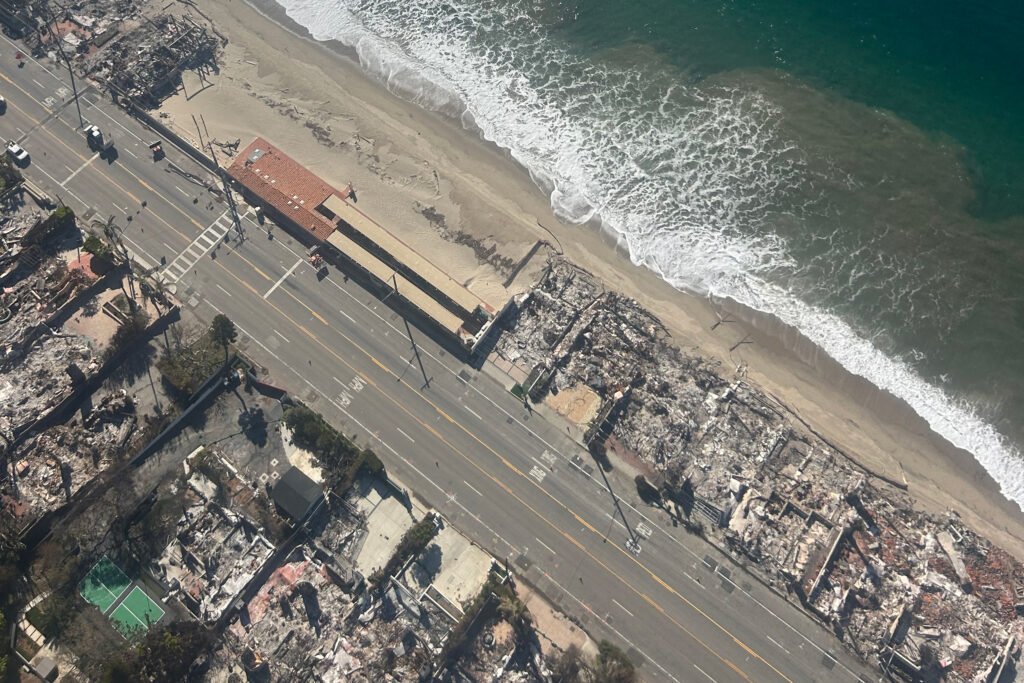
Two months after the fires started, I visited Southern California to report on the aftermath. The damage was harrowing. On a helicopter flyover of the scorched area, firefighters from the Orange County Fire Authority recounted the grueling experience of going up against the flames, and pointed out the remains of homes in Altadena and the Pacific Palisades. It resembled a post-apocalyptic scene from a sci-fi movie: entire structures leveled, once-pristine swimming pools blackened by a soup of ash and soot, scorched hillsides devoid of almost all vegetation.
What also struck me were the homes that didn’t burn. Strong gusts made the LA fires unpredictable, with the flames skipping some areas altogether or even sparing just one home on a block.
However, the homes that weren’t destroyed didn’t necessarily escape damage. For an Inside Climate News series called “After the Fires,” Nina Dietz has spent months reporting on health risks following the LA infernos. Dietz followed scientists and homeowners’ efforts to uncover how lead and other toxic substances from the smoke and ash affected the buildings that remained. In some cases, insurance companies have resisted paying for testing and decontamination, which could leave homeowners at risk of serious health problems such as cancer, experts say.
These types of challenges are becoming increasingly common as climate change worsens urban conflagrations, where materials like plastics and tires leave behind harmful chemicals when burned.
Many homes in Malibu, California, were also destroyed by the fires that swept through LA last January. Credit: Kiley Price/Inside Climate News
Slow Recovery: Rising construction costs, environmental hazard assessments and permitting red tape have made rebuilding a slowgoing process.
To fast-track recovery, the state has suspended certain permitting and review requirements, including those required under the California Environmental Quality Act and the California Coastal Act. But rebuilds are lagging, with just two homes fully rebuilt in and around the Pacific Palisades, according to a new analysis by online real estate marketplace Realtor.com. In Altadena, just four single-family homes, one multifamily property and three accessory dwelling units have been fully rebuilt, the analysis found.
“The rebuilding process has been slower than anyone hoped,” real estate agent Brock Harris, with the firm Brock & Lori, told Realtor.com. “While debris removal moved quickly, the permitting and construction bottlenecks are real. Many families are still in temporary housing a year later, which is heartbreaking.”
As recovery lags, policymakers, fire experts and local residents argue over how to implement new rules to reduce the amount of vegetation that could ignite in the area directly around a home dubbed “Zone Zero.” More broadly, experts are urging governments and the public to reconsider humanity’s relationship with fires as climate change intensifies.
Though fire has always been a natural fixture in the American West, the “Los Angeles fires mark a new phase, and seem to affirm a new consensus among a certain cohort of fire experts, that we have fundamentally misunderstood the nature of the problem and mismanaged fire risk as a result,” journalist David Wallace-Wells wrote in an op-ed for The New York Times.
This “new phase” extends beyond California, with states across the U.S. reckoning with growing fire risks—even in the Northeast, where large blazes may become more common with rising temperatures. The Trump administration is charging forward with a new plan to reorganize federal firefighters, but cuts to climate research and initiatives could inhibit their ability to understand risks associated with global warming, as I reported in December.
However, there have been a few bright spots amid the devastating tragedy of the LA fires. Neighbors leaned on each other to preserve the identity of their communities, salvaging tiles from historic fireplaces in Altadena or starting support groups to coordinate resources and help work through the grieving process of losing homes. One Altadena resident, Missi Dowd-Figueroa, planted sunflowers on her scorched property, turning the spot that once held her four-bedroom home into a garden of hope while she waited to rebuild, The Associated Press reports.
Though most of the flowers are now gone, a new beacon is emerging in their wake: Construction on Dowd-Figueroa’s home is expected to be completed by mid-June.
More Top Climate News
Over the weekend, the United States performed a “large-scale strike” against Venezuela, capturing the country’s president and taking him to New York to face criminal charges. President Donald Trump is now seeking to expand U.S. oil operations in the South American country, stating at a press conference after the capture that the U.S. is going to have its “very large United States oil companies, the biggest anywhere in the world, go in, spend billions of dollars, fix the badly broken infrastructure, the oil infrastructure, and start making money for the country,” Jake Bittle reports for Grist. Venezuela has the largest reported reserves of oil in the world, and most U.S. oil companies were forced out of the country over the last century. Experts are skeptical that U.S. oil operations in Venezuela will scale up at the size and scale Trump has promised any time soon, given the political instability and costs associated with propping up the industry in this area.
According to documents obtained by The Washington Post, the Department of Homeland Security has drafted a plan to slash the Federal Emergency Management Agency workforce in 2026. The agency has been a target of President Donald Trump’s ire—he flirted with eliminating it early in his second term but has since walked that back. Instead, the Post reports, the documents show that the administration may drastically reduce the number of disaster workers under FEMA. An agency spokesperson told the news outlet that “materials referenced from the leaked documentation stem from a routine, pre-decisional workforce planning exercise” and the “email outlining that exercise did not direct staffing cuts or establish reduction targets.”
A new study stresses that microplastics are undermining the ocean’s ability to absorb carbon, which could fuel faster climate change, Liam Gilliver reports for Euronews. After reviewing nearly 90 studies on the links between microplastic and marine health, the authors found that these tiny contaminants can release emissions when they degrade and hurt marine life crucial to carbon sequestration. The researchers assert that tackling the microplastic pollution issue and climate crisis together is key to solving both.
Postcard from … New York
After a brief holiday break, I am so excited to be back with you readers. One of my favorite additions to 2025 for the newsletter was the “Postcards From” series. Kicking off 2026, one of our readers sent in a snowy squirrel shot he took in his backyard in Rochester “during our very cold December.”
I can’t wait to see more of your nature photos this year; please send them to [email protected] to be featured in upcoming newsletters.
About This Story
Perhaps you noticed: This story, like all the news we publish, is free to read. That’s because Inside Climate News is a 501c3 nonprofit organization. We do not charge a subscription fee, lock our news behind a paywall, or clutter our website with ads. We make our news on climate and the environment freely available to you and anyone who wants it.
That’s not all. We also share our news for free with scores of other media organizations around the country. Many of them can’t afford to do environmental journalism of their own. We’ve built bureaus from coast to coast to report local stories, collaborate with local newsrooms and co-publish articles so that this vital work is shared as widely as possible.
Two of us launched ICN in 2007. Six years later we earned a Pulitzer Prize for National Reporting, and now we run the oldest and largest dedicated climate newsroom in the nation. We tell the story in all its complexity. We hold polluters accountable. We expose environmental injustice. We debunk misinformation. We scrutinize solutions and inspire action.
Donations from readers like you fund every aspect of what we do. If you don’t already, will you support our ongoing work, our reporting on the biggest crisis facing our planet, and help us reach even more readers in more places?
Please take a moment to make a tax-deductible donation. Every one of them makes a difference.
Kiley Price is a reporter at Inside Climate News, with a particular interest in wildlife, ocean health, food systems and climate change. She writes ICN’s “Today’s Climate” newsletter, which covers the most pressing environmental news each week.
She earned her master’s degree in science journalism at New York University, and her bachelor’s degree in biology at Wake Forest University. Her work has appeared in National Geographic, Time, Scientific American and more. She is a former Pulitzer Reporting Fellow, during which she spent a month in Thailand covering the intersection between Buddhism and the country’s environmental movement.
Great Job By Kiley Price & the Team @ Inside Climate News Source link for sharing this story.
GREG GUTFELD (CO-HOST): When he says, we’re taking the oil, we can go, wow, that’s kind of brash. Yeah, but, you know, it’s honest. And is that good for America? Well, yeah, it was our oil. I mean, he not only staunched the flow of drugs, he also is getting our oil back. That’s what — I coined this phrase this morning, killing two birds with one stone.
Great Job Media Matters for America & the Team @ Media Matters for America Source link for sharing this story.