Home News Page 133

Narwal adds AI to its vacuum cleaners to monitor pets and find jewelry | TechCrunch

Narwal adds AI to its vacuum cleaners to monitor pets and find jewelry | TechCrunch

Robot vacuum maker Narwal unveiled its new set of smart vacuum cleaners at the Consumer Electronics Show (CES) with AI-powered features such as monitoring pets, finding valuable objects, and notifying users about misplaced toys.

The company said that its new flagship Flow 2 robot vacuum has a rounded design and easy-lift tanks for better cleaning. The device uses two 1080p RGB cameras with a 136-degree field of view to map out the area and recognize different kinds of objects using AI models.

Narwal said that through this tech stack, the vacuum cleaner has the ability to identify an unlimited number of objects. The device first tries to identify an object locally, but in case there are no matches, it sends the data to the cloud for further processing.

Image Credits: Narwal

The Flow 2 has three key modes called pet care mode, baby care mode, and AI floor tag mode. With pet care mode, you can define zones where pets usually rest or hang out to clean them. Plus, it can monitor pets and also check in on your pets via two-way audio (there is no guarantee that they would listen to you, though). In the baby care mode, the vacuum switches to quiet mode near the crib and notifies you of misplaced toys. In the AI floor tag mode, the vacuum recognizes valuable items like jewelry, avoids them, and alerts you.

Narwal said that its newest vacuum cleaner has four cleaning modes that can identify different types of dirt. The device can also return to its base to wash the mop and then re-mop a certain area if it is dirty. The company noted that the Flow 2’s design allows for a higher hot water washing temperature for better cleaning.

Narwal adds AI to its vacuum cleaners to monitor pets and find jewelry | TechCrunch
Image Credits: Narwal

Along with the Flow 2, the company also showed off a handheld vacuum called the U50 that weighs 1.41kg (3.1 lbs) and has UV-C sterilization along with heat treatment for allergen removal. The company also demoed an unnamed cordless vacuum with a slim design, 360-degree swivel, and up to 50 minutes of run time. The cordless vacuum also has an auto-empty station that can support up to 60 days of dust disposal.

Great Job Ivan Mehta & the Team @ TechCrunch Source link for sharing this story.

Israel Strikes Southern, Eastern Lebanon Targets.

Israel Strikes Southern, Eastern Lebanon Targets.

BEIRUT (AP) — Israel’s air force struck areas in southern and eastern Lebanon on Monday, saying they are home to infrastructure for the militant groups Hezbollah and Hamas.

The strikes came a few days before Lebanon’s army commander is scheduled to brief the government on its mission of disarming Hezbollah in areas along the border with Israel.

The strikes took place nearly two hours after Israel’s military Arabic language spokesman Avichay Adraee posted warnings on X that the military would strike targets for Hezbollah and the Palestinian Hamas groups in two villages in the eastern Bekaa Valley and two others in southern Lebanon.

Lebanon’s state-run National News Agency said a home struck in the village of Manara in the Bekaa Valley belonged to Sharhabil al-Sayed, a Hamas military commander who was killed in an Israeli drone strike in May 2024.

The Lebanese army last year began the disarmament process of Palestinian groups while the government has said that by the end of 2025 all the areas close to the border with Israel — known as the south Litani area — will be clear of Hezbollah’s armed presence.

The Lebanese government is scheduled to discuss Hezbollah’s disarmament during a meeting Thursday that will be attended by army commander Gen. Rudolph Haikal.

Monday’s airstrikes were in villages north of the Litani river and far from the border with Israel.

The disarmament of Hezbollah and other Palestinian groups by the Lebanese government came after a 14-month war between Israel and Hezbollah in which much of the political and military leadership of the Iran-backed group was killed.

The latest Israel-Hezbollah war began Oct. 8, 2023, a day after Hamas attacked southern Israel, when Hezbollah fired rockets into Israel in solidarity with Hamas. Israel launched a widespread bombardment of Lebanon in September 2024 that severely weakened Hezbollah, followed by a ground invasion.

The war ended in November 2024 with a ceasefire brokered by the U.S.

Israel has carried out almost daily airstrikes since then, mainly targeting Hezbollah members but also killing 127 civilians, according to the office of the U.N. High Commissioner for Human Rights.

Lebanon’s Health Ministry said a drone strike on a car in the southern village of Braikeh earlier Monday wounded two people. The Israeli military said the strike targeted two Hezbollah members.

(Copyright, All Rights Reserved, WBAP/KLIF 2026)

Great Job & the Team @ News Talk WBAP-AM for sharing this story.

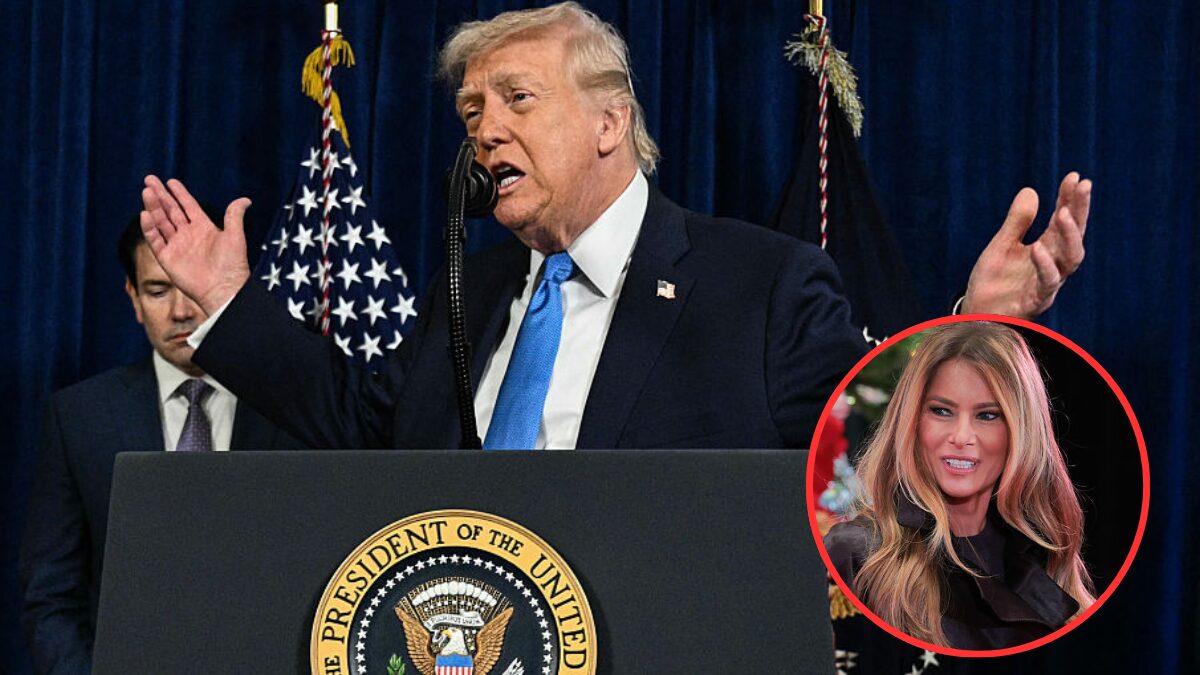
‘Hahaha…That Fake Smile’: Melania Loses Control When Trump Opens His Mouth, She Notices the Cameras Too Late, and Fans Can’t Stop Laughing

‘Hahaha…That Fake Smile’: Melania Loses Control When Trump Opens His Mouth, She Notices the Cameras Too Late, and Fans Can’t Stop Laughing

Melania Trump may know her husband better than almost anyone, but Donald Trump still manages to catch her off guard. The first lady couldn’t hide her surprise after he gave an interesting answer to a reporter’s question.

The couple, who will celebrate their 21st wedding anniversary on Jan. 22, were walking into a Mar-a-Lago party when a reporter asked Trump, “Mr. President, do you have a New Year’s resolution?”

‘Hahaha…That Fake Smile’: Melania Loses Control When Trump Opens His Mouth, She Notices the Cameras Too Late, and Fans Can’t Stop Laughing
Trump and Melania. (Photo by Jim WATSON / AFP via Getty Images)

‘Trump Was 35 When Melania Was 10’: Trump Draws Gasps as Critics Examine His Marriage and a Melania Family Detail Stops Them Cold

The suited businessman responded, “l have — peace, peace on earth. Peace on earth.” What exactly “peace on earth” looks like, only Trump knows. Three days later, on Jan. 3, Trump announced the capture of Venezuelan leader Nicolás Maduro, inciting concerns about the next chapter of the U.S. military adventures abroad.  

Melania, dressed in a fitted silver-sequined gown, wore a frozen smile plastered across her face as photographers captured their every move. When Trump uttered his pageant response, she looked at him and grimaced for a split second before resuming her performance as his doting plus-one.  

The public caught the very moment the former model let her mask slip, exposing “the shock on her face.” On Instagram, a user simply laughed, “hahaha.” While another person mentioned that it was “absolutely crazy how fast she put that fake smile back on.” Several onlookers read into the shift in her facial expression, suggesting her true feelings about the president were revealed. 

 A second user commented, “She always looks so pained when she’s next to him.” A third person quipped, “She caught his lie then had to catch her own reaction to that lie.” A fourth noted, “One thing about Melania, is she can’t hide her disgust for him.”

A grim reaction alluded to the senior citizen’s eventual demise being a bright spot in Melania’s life when they wrote, “She’s counting the days. You think Erika Kirk is a happy widow? Just wait.”

Trump and his Cabinet herald themselves as being America’s most transparent administration ever, though critics rightfully doubt that is true.

Regarding matters of the president’s health, he has revealed that he has undergone multiple visits to the doctor and advanced imaging, as well as at least three cognitive tests — all of which he claims he passed with flying colors, since he took office in January 2025.

Yet, hardly anyone has overlooked the chronic bruising of Trump’s hands — which White House Press Secretary Karoline Leavitt initially claimed was a result of excessive handshaking — his inability to stay awake during meetings, or the cadence of his speech. Even on New Year’s Eve, folks were puzzled by his lack of clear diction. 

A commenter wrote, “His speech is definitely slurred.” Another individual remarked, “Melania heard him slurring his words. She looked concerned for a split second.”

One user proposed, that he was “either drunk or stroking out… you pick!” However, the Republican figure has long boasted that he does not consume alcohol, leaving folks to assume he was “stroking out.”

Trump has denied having suffered a stroke for years. In a new Wall Street Journal interview, he admitted to taking a 325 mg dose of aspirin every day. “They say aspirin is good for thinning out the blood, and I don’t want thick blood pouring through my heart,” he said.

That same article exposed his frat boy diet that consists of McDonald’s Big Macs, Quarter Pounders, Filet-O-Fish sandwiches, fries, and Diet Coke.  

Great Job Angelina & the Team @ Atlanta Black Star Source link for sharing this story.

Trump’s strike on Venezuela gives the U.S. 30% of the world’s oil reserves on paper and a $100 billion rebuilding job in reality | Fortune

Trump’s strike on Venezuela gives the U.S. 30% of the world’s oil reserves on paper and a 0 billion rebuilding job in reality | Fortune

President Donald Trump’s plans to restore Venezuela’s beleaguered oil industry faces a series of challenges that will cost U.S. oil companies many billions of dollars to overcome.

Over the weekend, U.S. forces arrested Venezuelan President Nicolas Maduro on drug trafficking charges, with Trump claiming the U.S. would “run” the country and take over the country’s nationalized oil reserves.

“American dominance in the western hemisphere will never be questioned again. Won’t happen,” Trump said on Saturday, while explicitly endorsing the “Donroe doctrine,” a social media meme/portmanteau that describes the retro-nostalgic version of imperial authority increasingly on display in his second term. The Monroe Doctrine meets the Donald.

The move follows a series of deadly strikes on Venezuelan boats supposedly carrying drugs, attacks widely considered to be illegal. The United Nations Secretary General António Guterres, the body’s top official, called Trump’s ousting of Maduro a violation of the UN’s charter. 

Home to the world’s largest oil reserves, Venezuela reached its output peak in the 1970s, producing more than 3.5 million barrels of oil daily, though production has significantly tapered off to about 1 million barrels daily. Analysts have high hopes that oil companies entering Venezuela can tap back into the country’s black gold. JPMorgan predicted that with control of Venezuela’s oil, the U.S. could hold 30% of the world’s oil reserves. Other analysts said the country could double or triple its current output, returning it to its highs from 50 years ago, quite quickly.

But experts warn that the path to dominance, at least as far as oil is concerned, will be an uphill battle following decades of mismanagement and sanctions. State-owned oil giant Petróleos de Venezuela S.A. (PDVSA) collapsed in the mid-2010s following the loss of  foreign financial support, as well as skilled workers to maintain pipelines. In 2017, the first Trump administration escalated oil sanctions on Venezuela, restricting the country’s access to U.S. markets.

Small war, big questions

According to Helima Croft, head of global commodity strategy at RBC Capital Markets, oil companies’ efforts to grow production, such as rebuilding infrastructure, would take about a decade. She wrote in a note to investors on Saturday that according to oil executives, these efforts will cost $10 billion annually, bringing total investments over the next 10 years to about $100 billion.

Part of those steep rebuilding costs are also a result of the need to extract and refine heavy crude oil, which makes up about 75% of Venezuela’s reserve, most of which is in the Orinoco Belt. Venezuela’s oil boom of yesteryear was also a result of light crude oil found in the oilfields of western Venezuela, which was easy to access and therefore were depleted quickly. While heavy crude oil is what is predominantly being drilled for today, its viscous consistency and high levels of metals and sulfur mean extracting and refining this product is significantly more costly than its light crude counterpart.

The mass undertaking to restore the Venezuelan oil industry to its peak means oil prices are unlikely to budge anytime soon, said Miguel Tinker Salas, a professor emeritus of history at Paloma College and author of The Enduring Legacy: Oil, Culture, and Society in Venezuela. It’s a hit to Trump’s “drill baby, drill” vision and, according to the historian, the president’s hope of gaining momentum ahead of the midterm elections.

“The notion that Venezuela has the largest reserves of oil in the world—303 billion barrels of oil [in reserve]—may be a stimulant in trying to get the price of oil to drop for potentially his own electoral purposes,” Tinker Salas told Fortune. “Although [Trump] is grossly mistaken if he thinks that Venezuelan oil comes online tomorrow and will affect prices of oil before the election.”

Several other analysts see more than a little bit of midterm maneuvering behind the U.S. strike on Venezuela, given the offyear rout that Republicans suffered in 2025 and Trump’s dismal poll ratings. Macquarie’s global analysts Viktor Shvets and Kyle Liu noted that their 2026 outlook included “start a small war” as one policy the Republicans could pursue to avoid a “meltdown” in the midterms. Maduro’s capture is about oil and the Monroe Doctrine, they added, but it also strengthens the Republican Party’s “tough on crime and drugs” image. 

Elsewhere, UBS chief economist Paul Donovan argued in a Monday podcast that perceptions of “affordability” seem to have shaped U.S. administration policy over the past few weeks. He noted two tariff decisions in particular: a delay on a furniture levy, and a cut on planned fees for tariffs on Italian pasta. 

“The weekend’s action in Venezuela also raises fiscal questions,” he wrote. “It is not clear how, if at all, the US intends to ‘run’ Venezuela but military adventures carry a fiscal cost. Despite the noise of social media warriors, geopolitical considerations are likely to concern investors less.”

Risks of political instability

The factors influencing U.S. oil companies go beyond just the infrastructure challenges plaguing the industry in Venezuela. According to RBC Capital Markets’ Croft, increasing oil production will hinge on companies feeling confident about the safety of setting up shop in Venezuela. That begins with who will be leading the country moving forward.

That individual will likely not be Nobel Peace Prize winner and opposition leader María Corina Machado, whom Trump said lacked support to fill the role; nor will it be Edmundo González, who ran against Maduro in the 2024 election, which was considered to be the fair winner of the election. González is in a self-imposed exile in Spain. Delcy Rodriguez, Maduro’s vice president, was sworn in as Venezuela’s interim president on Monday.

“We don’t really know who’s in charge, who is going to be running Venezuela,” Croft told CNBC on Monday. 

The U.S. will also have to learn from its past efforts to build up authority in the oil-rich countries of Iraq and Libya. Both endeavors included attempts to depose the countries’ respective leaders that led to political collapse and civil unrest.

“We thought Libya was going to be an easy turnaround, post-[former Libyan Prime Minister Muammar] Gaddafi,” Croft said. “So the question is, What’s our template for a rapid recovery of an oil sector that has suffered decades of decline and mismanagement?”

Tinker Salas argued that other factors, including an improvement in technology to extract low crude oil, could expedite production, but until there’s evidence that companies can thrive in Venezuela, there will likely be few efforts to escalate drilling.

“I don’t think any large U.S. major company is going to want to invest without a series of guarantees, because you’re talking about billions of dollars of investment,” Tinker Salas said. “This is an investment for the long term, not for the short term.”

Macquarie’s Shvets and Liu added an ominous warning for the long term of U.S. foreign policy, writing, that this is “another nail in the coffin of [the] global rules-based order,” marginalizing the UN “similar to the League of Nations circa 1930s.” The League of Nations was the forerunner to the UN and is famous among historians for its formation after the wreckage of World War I and its almost immediate failure to prevent the rise of authoritarianism in the 1930s that gave way to World War II.

This could also signal that the Church Committee rules may be “obsolete,” the Macquarie analysts wrote, referring to the regulations in place since 1975 to address abuses intelligence revealed during the Vietnam era. The CIA reportedly played a critical role in ensuring the success of this military action in Venezuela, after all.

A strong Republican midterm showing would reinforce the “unitary system of governance,” on the one hand, but Macquarie argued that it would likely further erode the “few remaining semi-independent agencies (principally the Fed).” Right on cue, a new Federal Reserve chairman is expected to be selected in the coming days.

Great Job Sasha Rogelberg, Nick Lichtenberg & the Team @ Fortune | FORTUNE Source link for sharing this story.

Clock and scoreboard malfunction delays Rockets vs. Suns game

Clock and scoreboard malfunction delays Rockets vs. Suns game

Copyright 2026 The Associated Press. All rights reserved.

Play continues with the shot clock not working during the first half of an NBA basketball game between the Phoenix Suns and Houston Rockets Monday, Jan. 5, 2026, in Houston. (AP Photo/David J. Phillip)

HOUSTON – Monday’s game between the Houston Rockets and Phoenix Suns was briefly delayed because of a malfunction of the clocks and scoreboard before play resumed without either working.

The problems began early in the second quarter when the game clock, shot clock and scoreboard stopped working. The clock and shot clocks went blank and the scoreboard was frozen with the score at the end of the first quarter.

After play resumed, the public address announcer periodically announced the time remaining on the clock, gave the time left on the shot clock early in the count and counted down when the shot clock got under 10. He also announced the score of the game every couple of minutes.

During the delay, some Phoenix players jogged in place or skipped on the court to stay loose. Houston’s Tari Eason took a different path, sitting in an empty courtside seat and chatting with a fan for a bit before returning to the court.

The clock and scoreboard began working with about four minutes left in the first half, and the shot clocks were restored for the start of the third quarter.

___

AP NBA: https://apnews.com/hub/NBA


Great Job Kristie Rieken, Associated Press & the Team @ KSAT San Antonio Source link for sharing this story.

After Venezuela, Who’s Next?

After Venezuela, Who’s Next?

Welcome back to World Brief, the first edition of 2026! Today, we’re looking at threats of U.S. intervention around the world, South Korea’s budding friendship with China, and a series of cyberbullying convictions in France.


The Donroe Doctrine

In 2025, U.S. President Donald Trump often touted his “no new wars” mantra as evidence for why he deserved the Nobel Peace Prize. Within days of the start of 2026, though, Trump took a hard right turn: capturing Venezuelan President Nicolás Maduro, threatening military action against Colombia, warning of the fall of Cuba, suggesting U.S. intervention in Iran, cautioning the administration in Mexico, and vowing to annex Greenland.

Pursuing what has been coined the “Donroe Doctrine,” after the 1823 Monroe Doctrine, Trump kicked off the new year with an eye on U.S. intervention in resource-rich nations—a policy that he has prioritized in his National Security Strategy.

Here’s what you need to know about Trump’s current (and potentially future) targets:

Venezuela

Maduro appeared in a New York court on Monday for the first time since his dramatic seizure by U.S. forces early Saturday morning. He has pleaded not guilty to federal drug-trafficking charges and demanded that he be returned to Caracas, where he maintains that he is the rightful leader. (Independent vote monitors say opposition figure Edmundo González rightfully won Venezuela’s disputed presidential election in 2024.)

Trump has since said that the United States will “run the country,” with some suggesting that either Secretary of State Marco Rubio or presidential advisor Stephen Miller will oversee post-Maduro operations. It is unclear what U.S. involvement will look like, though the White House has said that it aims to take control of Venezuela’s oil reserves.

Experts suggest that the United States’ monthslong pressure campaign against alleged narcoterrorists in Latin America was a thinly veiled smoke screen for its regime-change ambitions. While the White House maintains that its actions against Maduro were legal, United Nations chief António Guterres warned on Saturday that they set a “dangerous precedent,” and several members of the U.N. Security Council argued in an emergency session on Monday that the U.S. operation in Venezuela violated international law.

Colombia

Trump threatened Colombian President Gustavo Petro on Sunday with U.S. military action, saying: “Colombia is very sick too, run by a sick man who likes making cocaine and selling it to the United States. And he’s not going to be doing it very long, let me tell you.” Asked if the United States would launch an operation against Bogotá, Trump replied with, “It sounds good to me.”

The U.S. president has not provided specifics as to what such an operation might look like. But Petro has warned of armed resistance if U.S. forces turn their attention on Colombia. “Do not threaten our sovereignty, because you will awaken the Jaguar,” Petro posted on X last month. “Attacking our sovereignty is declaring war, do not damage two centuries of diplomatic relations.”

Cuba

Following Maduro’s capture, Trump suggested that Cuba’s regime could similarly collapse in the near future. “I think Cuba is going to be something we’ll end up talking about because Cuba is a failing nation right now,” Trump said on Saturday, with Rubio adding, “If I lived in Havana, and I was in the government, I’d be concerned—at least a little bit.”

However, Trump has since walked back some of these comments, telling reporters aboard Air Force One on Sunday that “I think it’s just going to fall. I don’t think we need any action.”

Iran

A day before the U.S. operation in Venezuela, Trump appeared to consider U.S. intervention in Iran in support of anti-regime protesters. “If Iran shots and violently kills peaceful protesters, which is their custom, the United States of America will come to their rescue,” he posted on Truth Social. In response, Iranian Parliament Speaker Mohammad Bagher Ghalibaf warned that “all American centers and forces across the entire region will be legitimate targets for us in response to any potential adventurism.”

U.S. forces struck three Iranian nuclear sites in a brazen operation last June during the 12-day Israel-Iran conflict, and Trump has previously threatened Ayatollah Ali Khamenei and the Iranian regime under President Masoud Pezeshkian.

Mexico

When it comes to tackling drug cartels, Mexico is one of Trump’s top targets. “Mexico has to get their act together, because they’re [drugs are] pouring through Mexico, and we’re going to have to do something,” Trump said aboard Air Force One on Sunday after sharing a similar sentiment on Fox & Friends.

Mexican President Claudia Sheinbaum condemned Trump’s most recent threats on Monday. “We categorically reject intervention in the internal affairs of other countries,” she said. “The history of Latin America is clear and compelling: Intervention has never brought democracy, never generated well-being, nor lasting stability.”

Greenland

Throughout 2025, the Trump administration expressed interest in acquiring Greenland, a resource-rich, strategically located territory of Denmark. Despite Copenhagen being a NATO ally, Trump has not ruled out using military force or economic coercion to achieve this goal. “We do need Greenland, absolutely,” Trump told the Atlantic on Sunday. “We need it for defense.”

Danish Prime Minister Mette Frederiksen urged European powers on Monday to take Trump’s threats seriously, adding that “if the United States attacks another NATO country, everything stops.”


Today’s Most Read


The World This Week

Tuesday, Jan. 6: The Organization of American States’ Permanent Council meets to discuss the situation in Venezuela.

Wednesday, Jan. 7: Pope Leo begins an extraordinary two-day consistory of cardinals.

Thursday, Jan. 8: Amman hosts the European Union-Jordan summit.

Sunday, Jan. 11: Benin holds parliamentary elections.

Myanmar holds the second phase of its general election.

Monday, Jan. 12: Hong Kong’s High Court holds a presentencing hearing for pro-democracy activist Jimmy Lai.

The International Court of Justice holds hearings on genocide allegations against Myanmar.

Polish President Karol Nawrocki begins a two-day visit to the United Kingdom.


What We’re Following

A burgeoning friendship. South Korean President Lee Jae-myung signaled a “new phase” in Seoul’s relationship with Beijing on Monday during a four-day state visit to China, adding that 2026 will be the first year of a “full-scale restoration of Korea-China relations.” The summit, during which Lee met with Chinese President Xi Jinping, signals both countries’ efforts to bolster their alliances in the face of regional adversaries.

For Beijing, that opposition comes from Tokyo. Since the inauguration of Japanese Prime Minister Sanae Takaichi in October 2025, differences in policy over Taiwan have sparked a major diplomatic blowout between China and Japan as well as threats of military action. Xi has since emphasized China’s shared history with South Korea during World War II, when both countries fought Japan, to curry favor with Seoul.

As for South Korea, one of the summit’s priorities is to counter Pyongyang. Just hours before Lee arrived in China, North Korea launched several ballistic missiles, including what it claimed to be hypersonic missiles, into the sea. This was its first such launch since November. South Korea’s Defense Ministry called the tests a violation of U.N. Security Council resolutions and urged Pyongyang to respond to its push to restart peace talks.

Guilty of cyberbullying. A Paris court convicted 10 people on Monday for cyberbullying French first lady Brigitte Macron. The defendants, eight men and two women whose ages range from 41 to 65, were found guilty of spreading false online claims about Macron’s gender, including that she was transgender, and equating the 24-year age gap between her and her husband, President Emmanuel Macron, to pedophilia.

These comments were “particularly degrading, insulting, and malicious,” the court ruled, pointing to the “cumulative harmful effects” that they had on the first lady. The 10 defendants were sentenced to jointly pay a fine of $11,675 for moral damage and are required to attend cyberbullying awareness training. Other sentences were determined based on the severity of each individual’s online posts, with the harshest receiving a six-month jail term.

Critical infrastructure attacks. Overnight Russian strikes on Ukraine’s Kyiv region early Monday marked what appears to be the war’s first fatalities of 2026. At least two people were killed, and several homes and critical infrastructure were damaged, including a working medical facility in Kyiv’s Obolonskyi district. According to Kyiv Oblast Gov. Mykola Kalashnyk, pockets of the region were left without power.

Over the course of Russia’s nearly four-year war against Ukraine, Moscow has routinely targeted the country’s energy sector in an effort to freeze Ukraine into submission. That includes attacks on its communications grid and oil refineries during the most recent brutal winter. The West has previously responded by imposing sanctions on Russia’s two largest oil companies, Rosneft and Lukoil—to devastating effect. But such pressure has so far failed to force Russian President Vladimir Putin to the negotiating table.

Kyiv’s Western allies will convene in Paris on Tuesday for a session of the “coalition of the willing,” a group of more than 30 nations committed to Ukraine’s defense, during which they plan on discussing postwar security guarantees for Kyiv.


Odds and Ends

Get ready for some expensive sushi. The operator of popular Japanese restaurant chain Sushi Zanmai bid $3.24 million on Monday for a single bluefin tuna. Weighing 535 pounds, the cost of the prized catch was the highest-ever price paid at Tokyo’s Toyosu fish market’s annual start-of-year auction—superseding the previous record of $2.1 million paid in 2019. “I haven’t sampled it yet, but it’s got to be delicious,” the company’s owner, Kiyoshi Kimura, said. “But when I see a good-looking tuna, I cannot resist.”


Great Job Alexandra Sharp & the Team @ World Brief – Foreign Policy Source link for sharing this story.

Maduro and wife plead not guilty to narco-terrorism charges

Maduro and wife plead not guilty to narco-terrorism charges

Updated January 5, 2026 at 3:00 PM CST

Venezuela’s Nicolás Maduro and his wife, politician and attorney Cilia Flores, made their first court appearance at a federal court in New York City Monday afternoon, when they both pleaded not guilty to all charges.

Maduro is facing charges of narco-terrorism conspiracy, cocaine-importation conspiracy and weapons charges. Flores and other senior Venezuelan officials, including Maduro’s son, are also facing charges.

U.S. District Judge Alvin K. Hellerstein is overseeing the proceedings. Monday’s hearing lasted less than an hour, with both Maduro and Flores submitting their pleas.

It’s one of the first times the now-former head of the Venezuelan state has been seen publicly since the U.S. attacked Caracas, captured Maduro and his wife, and brought them to the U.S. over the weekend to face charges.

Maduro greeted people in the courtroom with “Happy New Year” as he entered.

During the proceedings, he introduced himself as the president of Venezuela as well as a prisoner of war. Flores introduced herself as first lady of Venezuela. Her right eye appeared swollen and her forehead was bandaged in what may be injuries sustained during the U.S. military operation.

Alfredo Lasry R / Getty Images

/

Getty Images

Venezuela’s Nicolás Maduro seen on Aug. 17, 2024, in Caracas, Venezuela. He and his wife pleaded not guilty to the narco-terrorism charges they are facing.

Maduro’s defense requested X-rays and medical attention for what they said may be a broken or bruised rib, which they say was sustained during the military operation.

A heckler stood up in court to say, “You will pay in the name of the Venezuelan people.” Maduro turned to face him and responded, “I am a man of God.” The next court date is March 17.

Outside the courtroom, crowds gathered and emotions were high. Protesters played drums and sang the Venezuelan national anthem. Some who opposed the Trump administration’s actions demanded the U.S. release Maduro. Others decried harsh conditions for Venezuelans under Maduro.

Counterprotesters display signs supporting ousted Venezuelan leader Nicolás Maduro and fly the Venezuelan flag outside the Daniel Patrick Moynihan United States Courthouse in New York City.

José A. Alvarado Jr. for NPR /

Counterprotesters display signs supporting ousted Venezuelan leader Nicolás Maduro and fly the Venezuelan flag outside the Daniel Patrick Moynihan United States Courthouse in New York City.

Maduro and Flores were captured in their Caracas compound in a surprise U.S. military operation Saturday.

The same day, the U.S. Justice Department released a 25-page indictment that accuses Maduro and his allies of importing thousands of tons of cocaine into the U.S. with protection from Venezuelan law enforcement. It alleges Maduro provided drug traffickers with diplomatic passports and partnered with drug cartels to send cocaine to the U.S. via points in the Caribbean and Central America. The indictment claims Maduro began drug trafficking into the U.S. as early as 1999.

In a post on X this past weekend, Attorney General Pam Bondi wrote that Maduro and his wife “will soon face the full wrath of American justice on American soil in American courts.”

If convicted, Maduro and his wife could face life in prison.

Maduro is being represented by Barry J. Pollack, a leading trial attorney in the U.S. whose high-profile clients include Julian Assange and Enron executives. Pollack didn’t immediately respond to a request for comment.

Flores is being defended by Mark Donnelly, a Houston-based attorney that specializes in white collar criminal defense.

In a statement sent to NPR Donnelly said, “Our client is in good spirits. We look forward to reviewing and challenging the evidence the government has. While we would love to present our side now, we will wait to do so in court at the appropriate time. The first lady is aware that there is a long road ahead and is prepared.”

Copyright 2026 NPR

Great Job Jaclyn Diaz, Jasmine Garsd & the Team @ Texas Public Radio for sharing this story.

Trending on the Timeline: The Power of Black Love and TikTok

Trending on the Timeline: The Power of Black Love and TikTok

Source: ione nicole thomas / IONE, VIA NICOLE THOMAS

From the rise of Black-owned tech startups to the latest TikTok dance challenge, she’s got her finger on the pulse of what’s trending. She also takes a moment to celebrate Black love in Hollywood and shines a spotlight on young activists making waves in their communities. Here’s a closer look at the stories that had everyone talking about:

The Rise of Black-Owned Tech Startups
The segment kicked off by spotlighting the surge of Black entrepreneurs making waves in the tech industry. From innovative apps to groundbreaking AI solutions, these trailblazers are not only redefining the tech landscape but also creating opportunities for the next generation. “It’s about time we see more representation in Silicon Valley,” the host shared, encouraging listeners to support these ventures.

Viral Dance Challenges Taking Over TikTok
Next up was the latest TikTok dance craze that’s sweeping the nation. Created by a young choreographer from Atlanta, the #BounceBackChallenge has become a cultural phenomenon, with celebrities and influencers joining in. “This is more than just a dance—it’s a celebration of resilience and joy,” the host shared, urging fans to show off their moves.

The Power of Black Love in Hollywood
In a heartwarming turn, the segment highlighted the recent engagement of two beloved Black actors, whose love story has inspired fans worldwide. Their journey, filled with mutual respect and admiration, serves as a reminder of the beauty and strength of Black love. “We need more stories like this,” the host said, “because representation matters in every form.”

Community Activism and Change
Closing out the segment, the spotlight turned to grassroots movements tackling issues like voter suppression and education inequality. Young activists were praised for their relentless efforts to create a better future. “This is what it’s all about—using our voices to make a difference,” the host emphasized, encouraging listeners to get involved.

Follow your girl on the ‘Gram (@djmisses) and check out Posted On The Corner for more updates.

Great Job Nia Noelle & the Team @ Black America Web Source link for sharing this story.

EPA Funding Salvaged in US Congress Spending Bill – Inside Climate News

EPA Funding Salvaged in US Congress Spending Bill – Inside Climate News

In a step toward heading off a government shutdown when a temporary funding agreement expires at the end of January, appropriators in both the Senate and House of Representatives released a bipartisan spending package Monday morning that kept the budget of the Environmental Protection Agency largely intact. 

The spending package would fund several federal agencies and scientific bodies, including the EPA, departments of Interior and Energy and the National Science Foundation through Sept. 30, the end of the fiscal year.

The “minibus” bills, which will likely move to the House floor for a vote this week, allocated more than $38 billion to Interior, Environment and related agencies, or $9.5 billion more than the Trump administration’s budget request.

“This legislation is a forceful rejection of draconian cuts to public services proposed by the Trump administration and Republicans in Congress,” said Rep. Rosa DeLauro, D-Conn., the ranking member of the House Appropriations Committee, in a statement.

“The bill prioritizes unleashing American energy, ensuring access to public lands, promoting the reversal of harmful Biden-era rulemakings that have hamstrung farmers and industries and rightsizing agency funding levels, including a $320 million reduction to the Environmental Protection Agency,” said Rep. Tom Cole, R-Okla., chair of the House Appropriations Committee, in a statement outlining key provisions of the package.

The package allocated $8.8 billion for the EPA, roughly 4 percent less than last year’s $9 billion budget for the agency, a far less drastic reduction than environmental advocates had feared.

Both DeLauro and Cole noted the lack of “poison pills” in the package, referring to policy provisions added by opponents of a bill designed to sabotage its passage.

“This bill blocks the worst cuts and policy riders to EPA and shows Congress getting back to its job by passing bipartisan bills rather than relying on short-term stopgaps,” said Marc Boom, senior director of public affairs for the nonprofit Environmental Protection Network (EPN), in a statement. The group is made up of more than 700 former EPA employees.

Before Congress adjourned for the holiday recess in December, former EPA staffers led by EPN urged legislators to adopt the Senate’s bipartisan approach to funding the nation’s environmental regulators to halt what they called the dismantling of protections for Americans’ health. 

The bipartisan Senate bill had negotiated a 5 percent budget reduction. The House, by contrast, had originally proposed a 23 percent cut, which was less severe than the Trump administration’s proposed 55 percent reduction but deep enough to hobble the agency’s core enforcement and research duties, warned experts with EPN. 

Democratic members of the Senate Appropriations Committee said the package of funding bills rejects “draconian” cuts and policies pushed by President Trump and House Republicans, and reasserts congressional control over key funding decisions, in a statement Monday.

The bill is a notable step in the right direction, said Boom, “but it doesn’t yet undo the damage to EPA’s capacity to protect public health or prevent further destructive actions by Administrator [Lee] Zeldin.”  

In July, the EPA announced staff cuts and “organizational improvements” affecting the Office of Research and Development (ORD) it said would save $748.8 million. The agency had already cut more than 3,700 EPA employees in the first seven months of Trump’s second term.

“Science is really foundational to EPA in its ability to achieve its mission, and now it’s at risk,” said Jennifer Orme-Zavaleta, a former principal deputy assistant administrator with ORD, at an EPN briefing last month. “Dismantling EPA’s Office of Research and Development would devastate the agency’s ability to protect us from legacy pollution and emerging threats,” said Orme-Zavaleta, who spent 40 years at the agency.

The administration already dismantled the Board of Scientific Counselors for ORD, Orme-Zavaleta told Inside Climate News, referring to the independent federal advisory committee established in 1996 to support the office’s research. 

ORD once had more than 1,5o0 employees but now just 140 are left, she said. “There remains a lot of uncertainty about whether the agency is going to take the final step and dismantle the whole thing, or are they waiting to see how the budget plays out?”

It’s also unclear whether Colorado’s Democratic senators will support the package, after the Trump administration threatened to close the National Center for Atmospheric Research, a global leader in climate and earth science based in Boulder, and then vetoed a bill to fund a drinking water pipeline in the state.

Boom credits the “sustained advocacy” of the many environmental experts at EPN who urged Congress to adopt the bipartisan Senate approach and halt the relentless assault on the EPA. But the EPA’s budget remains historically low when adjusted for inflation, continuing a decade-long erosion of the agency’s capacity as its responsibilities have grown, he said. 

“EPN volunteers will continue to press Congress to finish the job of ensuring EPA is fully resourced, accountable and able to carry out its proper mission of protecting the American people,” Boom said. 

About This Story

Perhaps you noticed: This story, like all the news we publish, is free to read. That’s because Inside Climate News is a 501c3 nonprofit organization. We do not charge a subscription fee, lock our news behind a paywall, or clutter our website with ads. We make our news on climate and the environment freely available to you and anyone who wants it.

That’s not all. We also share our news for free with scores of other media organizations around the country. Many of them can’t afford to do environmental journalism of their own. We’ve built bureaus from coast to coast to report local stories, collaborate with local newsrooms and co-publish articles so that this vital work is shared as widely as possible.

Two of us launched ICN in 2007. Six years later we earned a Pulitzer Prize for National Reporting, and now we run the oldest and largest dedicated climate newsroom in the nation. We tell the story in all its complexity. We hold polluters accountable. We expose environmental injustice. We debunk misinformation. We scrutinize solutions and inspire action.

Donations from readers like you fund every aspect of what we do. If you don’t already, will you support our ongoing work, our reporting on the biggest crisis facing our planet, and help us reach even more readers in more places?

Please take a moment to make a tax-deductible donation. Every one of them makes a difference.

Thank you,

Great Job By Liza Gross & the Team @ Inside Climate News Source link for sharing this story.

Zohran Mamdani Is Right About the Warmth of Collectivism

Zohran Mamdani Is Right About the Warmth of Collectivism

Zohran Mamdani became the 112th mayor of New York City on New Year’s Day. He followed custom by being legally sworn in at midnight and holding a big public ceremony in the afternoon.

Anyone who expected the mayor to back off his previous commitment to socialism was sorely disappointed. Mamdani was sworn in by Senator Bernie Sanders, whom he praised in his inaugural address as “the man whose leadership I seek most to emulate.” He said, “I was elected as a democratic socialist, and I will govern as a democratic socialist.” And in the line that most infuriated the American right, he rejected “rugged individualism” in favor of “collectivism.”

In the lead-up to that line, Mamdani talked about the “voters from Hillside Avenue or Fordham Road who supported President Trump a year before they voted for me, tired of being failed by their party’s establishment.” He said:

Many of these people have been betrayed by the established order. But in our administration, their needs will be met. Their hopes and dreams and interests will be reflected transparently in government. They will shape our future.

And if for too long these communities have existed as distinct from one another, we will draw this city closer together. We will replace the frigidity of rugged individualism with the warmth of collectivism.

In response, journalist Matt Taibbi compared New York’s new mayor to Joseph Stalin, describing “collectivism” as “an infamous Stalinist term.” Wealthy tech CEO David Sacks joined Taibbi in fretting about the allegedly innate bloodthirstiness of “collectivist political experiments.” The official X account of the House Republicans posted that rugged individualism is what “made America great” and declared that “communism has to be defeated before there’s nothing left to save.”

Even Sohrab Ahmari, one of the most thoughtful writers on the contemporary Right, rejected Mamdani’s statement on the basis that “collectivism” supposedly means “destroying individuality.” He counterposed both collectivism and individualism to a Catholic-inflected notion of “the common good.”

Many right-wing outlets simply posted the clip without commentary, apparently taking it for granted that everyone would share in their horror. Former Fox News personality Megyn Kelly made the assumption explicit, posting, “No, actually, we are Americans and we don’t believe in that sh-t.”

Judging by the double-digit defeat Mamdani handed Andrew Cuomo on election day, not to mention the fact that Bernie Sanders consistently polls as one of the most popular politicians in the country, it seems that quite a few Americans do, in fact, believe in that sh-t.

More importantly, though, Mamdani is correct on the merits of the issue. The phrasing was provocative — likely deliberately so — but it’s a fight that makes sense to provoke, on terrain where the Left can and should prevail. Socialists often emphasize democracy and equality, but community is also an essential socialist value, and one that the mayor is right to highlight.

The term “collectivism” has had many uses and connotations over the centuries. Its original use comes from nineteenth-century anarchists, for whom it meant a stateless egalitarian order based on shared ownership of the means of production. When referencing the Soviet Union, “collectivization” connotes Stalin horrifically forcing Russian peasants to live on so-called collective farms — quite the opposite of anything an anarchist would endorse. Later in the twentieth century, Ayn Rand used “collectivist” as an all-purpose catchall for socialists, communists, nationalists, religious people, and anyone else who questioned her right to be maximally selfish, again a totally different definition.

In truth, most Americans are not historians of the nineteenth century left, nor students of Stalinist state policy, nor devotees of Ayn Rand. For them, “collectivism” likely means something like “pursuing left-wing economic policies” (such as collective ownership of resources or collective efforts to meet people’s needs).

Even some left-wing commentators expressed concern that, in contrasting collectivism with individualism, Mamdani was conceding important ideological territory to the anti-socialist Right. But the key word this critique misses is “rugged.” Given Mamdani’s past fondness for invoking the democratic socialism of Martin Luther King Jr, it’s likely that part of his intention here was to reference King’s classic observation that in America we “all too often have socialism for the rich and rugged free enterprise capitalism for the poor.”

If “individualism” connotes individual rights like freedom of speech or freedom of religion, or the ability of individuals to live their own lives in whatever way seems best to them within reasonable limits set by everyone else being given the same freedom of action, then democratic socialists are ardent individualists. (Indeed, Oscar Wilde argued precisely that in his famous essay “The Soul of Man Under Socialism.”)

But individual striving playing out over “rugged” terrain means leaving everyone to their own devices. In this conception, obstacles to flourishing are always your problem alone, and you should pull yourself up by your own individual bootstraps instead of expecting help from the rest of society. That’s the type of individualism Mamdani is rightly contrasting with what he calls the warmth of collectivism.

On the talk show Breaking Points, producer Griffin Davis joked that Mamdani sounded like an “Ayn Rand villain.” He’s not wrong. The villains in Ayn Rand’s novels tend to talk about society coming together to collectively care for one another. And this, in turn, gives us a clue about what the mayor may have been up to.

While we can’t know his intentions for certain, someone as rhetorically savvy as Mamdani probably wouldn’t have included a line this likely to reduce conservatives and libertarians to spasms of fury without knowing exactly what he was doing. In contrasting collectivism with rugged individualism, he ensured that his remark would be the subject of intense scrutiny.

That would make a lot of sense if his calculation was that most normal, persuadable working-class Americans find the morality of Ayn Rand novels repulsive. They believe that we should live in a society that cares for all its members, and hearing right-wingers respond to that suggestion by ranting about Stalin will only make the Right look unpleasant and unhinged.

In the society we live in right now, some city dwellers learn not to make eye contact with homeless people in order to psychologically function around the results of extreme inequality. People who don’t have health insurance and those who’ve exhausted what their insurance will pay for are often left to beg for donations on GoFundMe. The escalating spiral of social cruelty has reached the point where Republicans in Congress voted last year to impose work requirements for Medicaid at the national level.

In other words, the rotten fruit of “rugged” individualism is hanging all around us. Don’t be surprised if more and more Americans like the sound of collectivism by contrast.

Great Job Ben Burgis & the Team @ Jacobin Source link for sharing this story.

Secret Link