Home News Page 139

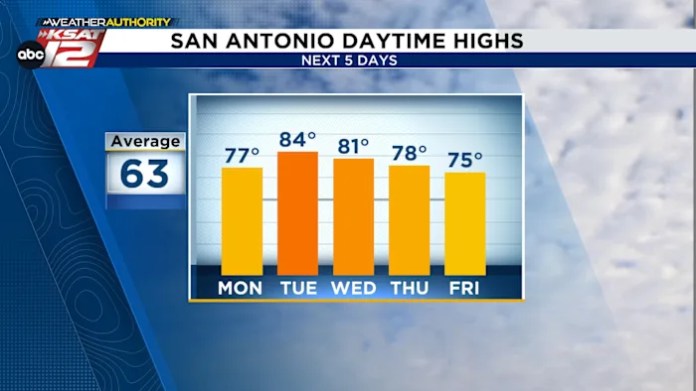
More warmth this week and possibly another record high

More warmth this week and possibly another record high

Any cool down holds off until late in the week

Daytime highs this week (Copyright KSAT-12 2025 – All Rights Reserved)

FORECAST HIGHLIGHTS

  • PATCHY FOG: Fog will be possible for a few hours this morning

  • WARM AFTERNOON: After a cloudy start, temps will reach the upper-70s

  • RECORD TUESDAY?: We’ll be in record territory Tuesday with highs in the mid-80s

  • COLDER WEEKEND: A cold front will bring down temperatures by Saturday

FORECAST

TODAY’S FORECAST

It’s back to work and back to school (for some) and we pick up right where we left off before Christmas break. Patchy fog is possible for a few hours this morning. Clouds stick around for a while longer, before breaking midday. We’ll make the upper-70s with afternoon sunshine.

Today’s Forecast (Copyright KSAT-12 2025 – All Rights Reserved)

RECORD TUESDAY?

We could set yet another record high Tuesday afternoon. The forecast calls for a high in San Antonio of 84°. The previous record is 84°, set in 1989. Tuesday will be our warmest day in the extended forecast.

Near-record highs on Tuesday (Copyright KSAT-12 2025 – All Rights Reserved)

COOL DOWN THIS WEEKEND

The work week will be warm. Cool air will stall just to our north, but finally pushes through on Friday evening. This will give us a cooler weekend. One thing to watch will be morning lows on Monday, with a few spots nearing freezing.

Extended Forecast (Copyright KSAT-12 2025 – All Rights Reserved)

QUICK WEATHER LINKS


Great Job Justin Horne & the Team @ KSAT San Antonio for sharing this story.

10 big energy stories Canary Media is tracking in 2026

10 big energy stories Canary Media is tracking in 2026

In 2026, I want to see if politicians and regulators will recognize that electrification can in fact boost affordability, especially in newly built homes. — Alison F. Takemura, staff writer

The geothermal breakthrough on the horizon

Geothermal energy startups have raised huge sums of money in recent months and years to develop next-generation technologies for harnessing Earth’s heat. But so far, the companies have delivered relatively little carbon-free electricity to the grid.

That will change this year, when Fervo Energy flips the switch on its Cape Station facility in Utah. The startup is building an enhanced geothermal system” that uses fracking techniques to create geothermal reservoirs in hard, impermeable rocks. The first 100 megawatts (of an eventual 500 MW) are slated to go online in October, which would make Cape Station the biggest project of its kind to connect to the grid worldwide.

The development will send a powerful signal that next-generation geothermal is moving from promise to commercial reality,” said Jeremy O’Brien of geoscience software company Seequent. We expect this milestone to accelerate both investor interest and government support globally.”

Fervo isn’t alone in its ambitions. The company Eavor will start working this spring to expand its first-of-a-kind geothermal project in Germany, and firms like Sage Geosystems, Quaise, XGS, and Zanskar are accelerating efforts to satisfy demand for clean, around-the-clock power. I’ll be watching closely to see whether 2026 proves to be the pivotal year the industry is hoping for. — Maria Gallucci, senior reporter

The tug-of-war over clean energy in Ohio

Ohio, where I report from, has for years been a hotbed for dark money and a testing ground for national efforts to hinder action on climate change. State lawmakers and regulators continue to throw up obstacles to renewable energy development, while giving preference to new fossil-fueled power plants. One pending bill, for example, calls for energy permitting decisions to make sure facilities employ affordable, reliable, and clean energy sources,” with reliable” meaning energy that’s available at all times and clean” defined to include natural gas. I’ll keep investigating those efforts in 2026 to hold the people in power accountable as the public struggles with rising energy costs and worsening climate change impacts.

But it’s not all bad news in the Buckeye State, as some communities rally in support of clean energy. One story I’m particularly excited to cover is a May referendum that will give voters the chance to overturn a local solar and wind ban covering most of their county — an approach that could take off elsewhere in Ohio and in other states that allow local restrictions on renewable power. — Kathiann M. Kowalski, contributing reporter based in Ohio

The AI boom’s battery awakening

2026 will be the year we start seeing batteries bridge the gap between data centers’ sky-high power demand and what the U.S. grid can actually deliver.

A well-placed battery system can secure electricity for AI computing hubs in the relatively few hours each year when the grid can’t supply them. That can allow data centers to get built far sooner than if they waited for pricey and time-consuming power network upgrades.

Storage developers are reporting a frenzy of interest in such projects, but these typically are shrouded in secrecy. I recently reported on the first publicly confirmed project of this kind, which entered construction in Oregon for Aligned Data Centers and should start operating in 2026. Utility Portland General Electric will own that one and use it to guarantee power a few years earlier than it could have with conventional grid upgrades.

What I found most intriguing is that the data center developer is paying for this smart grid upgrade. This arrangement lays out a rare positive vision for the nation’s energy future: The companies that stand to make boatloads of money on data centers could fund grid upgrades that benefit everyone, as opposed to the general public subsidizing those upgrades to pad the profits of AI ventures. In the year ahead, I’ll be tracking the proliferation of batteries for data centers, and what they mean for consumers’ energy bills. — Julian Spector, senior reporter

The fate of coal in the Midwest

Over the past decade, scores of Midwestern coal plants have closed, as environmental regulations kicked in and coal-fired generation became more expensive than natural gas or renewables.

Now, the tables could be turning again.

Utilities are pushing back retirement dates for coal plants as electricity-demand forecasts increase exponentially due to proposed data centers — many of which may never get built. The Trump administration is ordering plants on the brink of closure to stay open and easing up on rules around pollution from coal power. Indiana’s Republican Gov. Mike Braun issued an executive order last spring calling for coal plant life extensions,” and Illinois experts are researching controversial clean coal technologies,” including at a demonstration carbon-capture plant that went online in 2024.

Coal is embedded in the culture in these states, and it’s highly political, as I’ve heard many times from elected officials, grassroots activists, and coal miners. In 2026, I’ll be closely tracking how this campaign to revive coal progresses and what it means on the ground in Midwest communities where it is burned and mined. After all, coal isn’t just an increasingly expensive way to generate electricity; it’s also incredibly polluting. — Kari Lydersen, contributing reporter based in Illinois

The big push for offshore wind in Canada

The future of America’s offshore wind sector may well be in Canada — a country prepping its first projects and willing to share power generated from its frigid ocean breezes with U.S. states just across the border.

Thanks to President Trump’s ire, it’s likely that no new offshore wind farms will be completed in the U.S. until 2035, save for the five projects already being built, BloombergNEF predicted in early December. Even those projects aren’t guaranteed, a fact underscored by the 90-day pause on wind farm construction issued Dec. 22 by the Interior Department.

In 2026, I’ll be keeping a close eye on whether these deals materialize — and what they mean for North America’s offshore wind workforce and supply chain, which grew under the Biden administration and could otherwise wither away under Trump 2.0. — Clare Fieseler, reporter

{
if ($event.target.classList.contains(‘hs-richtext’)) {
if ($event.target.textContent === ‘+ more options’) {
$event.target.remove();
open = true;
}
}
}”
>

Great Job Canary Staff & the Team @ Canary Media Source link for sharing this story.

The making of a MAGA martyr

The making of a MAGA martyr

In the wake of the insurrection at the Capitol on January 6, 2021, President Donald Trump quickly took up the cause of a 35-year-old veteran named Ashli Babbitt.

“Who killed Ashli Babbitt?” he asked in a one-sentence statement on July 1, 2021. 

“An innocent, wonderful, incredible woman, a military woman,” Trump said during a Fox News interview a few weeks later. 

To Trump and his Make America Great Again movement, Babbitt was not an insurrectionist shot while trying to get close to the members of Congress who were certifying the election results, the sole rioter killed by police that day. She was a martyr, someone who died for her beliefs. She was a woman who had died for lack of protection. 

Trump’s framing of Babbitt’s death in the months after he left office served as one of the guiding principles of his second term: the necessity of “protecting women” and an insistence on identifying and eradicating those he sees as posing a threat to them.

Who was Ashli Babbitt?

She was an Air Force veteran who had done tours in Afghanistan and Iraq. She was married and divorced and then married again. She faced criminal charges after an altercation with an ex-girlfriend of her second husband. She voted for Barack Obama. She bought a pool care business with her husband. She discovered the far-right conspiracy theory QAnon, which asserted that Trump was trying to save the country from a cabal of Satan-worshipping child molesters installed within the United States government.

Over time, Babbitt became increasingly steeped in QAnon and was primed to believe the robustly disproved conspiracy that the 2020 election had been stolen from Trump. So when Trump encouraged his followers to go to Washington to support him on January 6, 2021, she did. While the election results were being officially certified by Congress, Trump addressed a crowd that included Babbitt. And when he encouraged them to go to the Capitol, many did — Babbitt among them. 

Not everyone who went to the Capitol broke into the building, but she did. With a Trump flag draped over her shoulders like a superhero’s cape, Babbitt was part of the group who tried to gain access to the Speaker’s Lobby, just outside the House chamber. Another rioter smashed glass. As Babbitt tried to crawl through, a Capitol Police officer shot her from inside the lobby.

Video footage from the day shows Babbitt falling backward into the crowd as blood pours out of her mouth. After the shooting, many rioters began to flee the Capitol grounds. Babbitt was transported to Washington Hospital Center. She was declared dead upon arrival.

The officer who killed Babbitt was cleared of wrongdoing; Lt. Michael Byrd potentially saved lives by stopping the mob, lawmakers and police said. 

But her death gave Trump’s Make America Great Again movement something it needed: a martyr. 

Religiosity moves in

The making of a MAGA martyr
On Jan. 6, 2021, a political rally turned into an insurrection as Trump supporters stormed the Capitol in an attempt to stop the certification of electoral votes.
(John Minchillo/AP Photo)

A religious frame has been present in Trump’s politics since his rallies in the leadup to the 2016 election. 

Jeffrey Sharlet, a veteran journalist and professor at Dartmouth College who was an early chronicler of the rise of Trumpism and its ties to religiosity, said these rallies were shaped by the prosperity gospel, a branch of Protestantism rooted in the supposition that, effectively, God wants you to be rich. 

In 2020, the religious tenor was still there — but it had shifted to a more conspiratorial approach. Trump stopped merely “winking at QAnon” and began “invoking that level of conspiratorial thinking that has been absorbed into the DNA of the movement,” Sharlet said.

Before Babbitt’s death, Sharlet said, Trump had already been working to incorporate martyrs into his rhetoric, invoking a list of names, usually people who had been killed by immigrants in the country without legal status. They would typically fall into two categories, he said: “blonde White women and promising young Black men” — think Jamiel Shaw Jr., a rising football star in the midst of college applications who was shot and killed by a gang member who was in the country illegally, orSarah Root, who was killed by an undocumented drunk driver the day after her graduation from college.

Sharlet calls Babbitt “a perfect storm”: a White woman killed on camera in footage seen by millions, a Black man —  the Capitol police officer — responsible for her death. 

“That changed everything,” Sharlet said. “The first real martyr who really takes hold of Trumpism is a woman, and it gives the movement a real religiosity.” 

And it set the stage for Trump to ascend into a kind of religious figure himself after a would-be assassin shot him in Butler, Pennsylvania, in July 2024. 

“Every martyr disappears into the cult of personality,” Sharlet said. “She was a placeholder. She keeps the cross warm until Trump gets up there and he’s the martyr. Now, he’s the martyr for us all — but it started with a certain appeal to women.” 

Martyrs can’t speak

Babbitt was an active participant in the insurrection — but that didn’t mean she couldn’t be reassigned the role of someone who needed protecting. 

Sharlet recalled watching videos of Trump supporters talking about Babbitt in the wake of her death: “They’re aging her backward, they’re lowering her weight, they’re lowering her height, they’re turning her into a little girl.” 

It was a blueprint for what was to come, he said of Babbitt: “The blondeness is important, the smallness is important, but so is the camouflage of being a veteran.”

Her race, too, was important, Sharlet said. 

“It’s about the Whiteness of things. It’s not enough for them that a woman be murdered,” he said. “She has to be a little girl. She has to be White.”

Meghan Tschanz, a former missionary who has emerged as a critic of patriarchal systems in evangelical Christianity, drew a connection between Babbitt and Laken Riley, a college student whose murder by an immigrant who was in the country illegally was highlighted by Trump. Both women’s deaths became part of a larger narrative — one designed to accomplish a political goal, not mourn the victims. 

Tschanz, who lives in Athens, Georgia — where Riley was killed — stressed that criticizing the politicization of Riley’s death is in no way a dismissal of the reality and severity of her killing. Rather, she said, politicization can dilute the pain of the loss in service to a larger narrative.

“Again and again, we see women die and the response isn’t, ‘Let’s make it so women don’t die.’ It’s, ‘Let’s make it so that I can use this to further my narrative that immigrants are evil,’” she said. 

Riley’s father, Jason Riley — a Trump supporter — told NBC News about the pain of watching his daughter become a political tagline after Rep. Marjorie Taylor Greene of Georgia, at the time a strong Trump ally, heckled President Joe Biden during his State of the Union speech in 2024, urging him to say Riley’s name.  

“I think it’s being used politically to get those votes. It makes me angry. I feel like, you know, they’re just using my daughter’s name for that. And she was much better than that, and she should be raised up for the person that she is,” Jason Riley said. “She was an angel.” 

It’s a dynamic also echoed in Babbitt’s death. Though Babbitt’s mother, Michelle Witthoeft, emerged as a leading advocate for the release of those who were arrested for their actions on January 6, she also has publicly grappled with the way in which her daughter’s death became something other than an acute family tragedy. 

Witthoeft told The Washington Post in 2021, “Half the country loves her and half the country hates her,” she said. “It’s weird to have your child belong to the world.” 

For Trump, Riley’s and Babbitt’s  deaths helped reinforce the message that women’s lives are in danger and that they need to be saved — something he emphasized in his campaigns as he painted immigrants and his political opponents as threats. 

“It all plays into the fears and vulnerabilities that women have to navigate, which is that women are more vulnerable to sexual and gender-based violence and women are tasked culturally with caring for the home and for their children,” said Hilary Matfess, an assistant professor at the University of Denver and the co-author of an analysis done by the Program on Extremism at George Washington University on gender and the January 6 insurrection. “So this message of scary immigrants are going to come in and destroy your communities with drugs and rape your women and children is intended to strike fear into a very specific demographic — namely, suburban White women.”

Matfess pointed to how the role of martyr cemented a view of Babbitt for Trump’s followers. She became someone who needed protecting, a figure whose memory is in need of constant, everlasting protection. 

“Being put on a pedestal means you can’t move around too much,” Matfess said. 

The ‘protection racket’

Witthoeft frowns with arms crossed in front of large American flags, surrounded by other women.
Michelle Witthoeft, Ashli Babbitt’s mother, participates in a demonstration in support of insurrectionists who were arrested and charged following the January 6, 2021 attack on the U.S. Capitol.
(Tasos Katopodis/Getty Images)

Matfess said there is a long-standing academic notion of the “protection racket,” in which a government offers protection from an imagined threat to deflect from the threat posed by the government itself. It’s something that can be used to keep women in subservient roles — and thus effectively in need of some form of protection from others. 

“The Trump administration is not saying, ‘Wow, we should really expand access to prenatal health care’ or ‘We need more resources for women that are victims of domestic violence,’ because it is not about protecting women,” she said. “It’s about protecting certain men’s ability to wield power and influence under the banner of protection.”

Babbitt’s death in some ways challenged the narrative, too — she was part of the group trying to stop the certification of the election, not sitting by.

Matfess noted the ways that the Proud Boys — the far-right, all-men neo-fascist group that have become rigorous defenders of Trump and his agenda — insist on the fact that there are in fact no Proud Girls, often suggesting that the best way women can support the politics they espouse is by staying home and reproducing.

Matfess points to early rumors from within the far right that Babbitt was part of a false flag mission — evidence that the movement had to grapple with a woman who was attacking, not asking for protection. 

“There’s a lot of utility to narratives that talk of attacks against women and children, and so it becomes that once they decided it wasn’t a false flag, that she was there of her own political beliefs, it becomes a compelling narrative of a woman sacrificing herself for this movement. Whether or not the movement would have been kind to her had she lived is besides the point,” Matfess said. 

“The memorialization takes away the kind of difficult questions of how this movement would deal with women who are taking on more transgressive gender roles. Once someone’s a hero, you can leave it at that.”

Great Job Jennifer Gerson & the Team @ The 19th Source link for sharing this story.

To Knock Down Health-System Hurdles Between You and HIV Prevention, Try These 6 Things – KFF Health News

To Knock Down Health-System Hurdles Between You and HIV Prevention, Try These 6 Things – KFF Health News


When Matthew Hurley was looking to take PrEP to prevent HIV, the doctor hadn’t heard of the medicine, and when he finally did prescribe PrEP, the bills sent to Hurley were expensive … and wrong. “I decided to write in because the process was really super frustrating.” At one point, Hurley asked, “Am I just going to stop this medication to stop having to deal with these coding issues and these scary bills?”

— Matthew Hurley, 30, from Berkeley, California

A couple of years ago, Matthew Hurley got the kind of text people fear.

It said: “When was the last time you were STD tested?”

Someone Hurley had recently had unprotected sex with had just tested positive for HIV.

Hurley went to a clinic and got tested. “Luckily, I had not caught HIV, but it was a wake-up call,” they said.

That experience moved Hurley to seek out PrEP, shorthand for preexposure prophylaxis. The antiretroviral medication greatly reduces the chance of getting HIV, the virus that causes AIDS. The therapy is 99% effective at protecting people against sexual transmission when taken as prescribed.

Hurley started PrEP and all was well for the first nine months — until their health insurance changed and they started seeing a new doctor: “When I brought PrEP up to him, he said, ‘What’s that?’ And I was like, oh boy.”

Hurley, who is a librarian, went into teaching mode. They explained that the PrEP regimen they’d been on required daily pills and lab work every three months to look out for breakthrough infections or other health issues.

Hurley was surprised they knew more about PrEP than the physician. The FDA approved the first drug, Truvada, back in 2012, and Hurley lives in the San Francisco Bay Area, a place with one of the highest concentrations of LGBTQ+ people in the nation and a deep history of HIV and health care activism. Hurley said older friends and acquaintances who survived the AIDS epidemic shared the horror of living through a time when there was no effective treatment or drugs for prevention. Deciding to take PrEP felt like an empowering way to protect their health and their community.

So Hurley pushed the doctor, and after the physician did his own research, he agreed to prescribe PrEP.

Hurley got the care they needed, but they had to be the expert in the exam room.

“That’s a big burden,” said Beth Oller, a family medicine physician and board member of GLMA, a national organization of LGBTQ+ and allied health care professionals focused on health equity. “You really want someone you can just go in and talk [to] about your health concerns without feeling like you are having to educate and advocate for yourself at every turn.”

Oller said many queer people have had negative experiences during health care visits.

“I have a lot of patients who had not done preventive care for years because of the medical stigma,” she said.

Billing Headaches

Clearing the access hurdles to HIV prevention medicine was just the beginning. Hurley started receiving a string of bills for PrEP-related care. Blood test: $271.80. Office visit: $263.

Again, Hurley was surprised. They knew — even if the billing office didn’t — that under the Affordable Care Act most private insurance plans and Medicaid expansion programs are required to cover PrEP and ancillary services, like lab tests, as preventive with no cost sharing.

The bills for doctor visits and blood draws piled up.

Hurley would appeal the bill and get a denial almost every time. Then, they would appeal again.

Hurley shared a series of appeal letters for one service, in which the billing office acknowledged that blood work had been initially incorrectly coded as diagnostic. Once that was corrected, Hurley said, the insurer paid for the service.

That might sound quick or easy to resolve, but Hurley said it took “forever to get through the process.” They dealt with at least six incorrect bills over several months. Hurley estimated they spent more than 60 hours contesting the bills.

During that time, Hurley said, the billing department “is continuing to send me emails and bills that are saying, You’re overdue. You’re overdue. You’re overdue.

Fed up with the hassles, Hurley decided to find a health provider (and billing office) better informed about PrEP. They settled on the AIDS Healthcare Foundation. The care team there was able to discuss the pros and cons of different PrEP regimens and knew how to navigate the formulary for Hurley’s insurance.

Hurley hasn’t gotten an unexpected bill since.

But siloing sexual health care and PrEP off from primary care hasn’t been ideal.

“I have multiple organizations that I have to deal with to get my holistic health dealt with,” Hurley said.

A provider doesn’t need to be an HIV specialist, an infectious disease expert, or a physician to prescribe PrEP. The Centers for Disease Control and Prevention encourages primary care providers to treat PrEP like other preventive medications.

To avoid some of the headaches Hurley faced, try these tips:

1. Find Out if PrEP Is Right for You

The CDC estimates 2.2 million Americans could benefit from HIV prevention drugs, but just over a quarter of that group have been prescribed them.

“Not enough people know about PrEP, and there are a number of people who know about PrEP but do not realize it’s for them,” said Jeremiah Johnson, executive director of PrEP4All, an organization dedicated to universal access to HIV prevention and medication.

According to the CDC’s clinical guidelines, PrEP can be prescribed as part of a preventive health plan to anyone who’s sexually active. It’s especially recommended for people who don’t use condoms consistently, intravenous drug users who share needles, men who have sex with men, and people in relationships with partners living with HIV or whose HIV status is unclear.

The vast majority of PrEP users are men. There are big race, gender, and geographical disparities in the distribution of HIV and the populations taking the prevention medicine. For example, based on the patterns of new infection in the U.S., a group that would benefit from PrEP is cisgender Black women, whose gender identity aligns with their sex assigned at birth.

2. Don’t Assume Your Provider Knows About PrEP

If your doctors aren’t well informed, start by educating yourself. There are also clinical guidelines and information you can share with your provider. Check your state or local health department for a how-to guide for prescribing PrEP. For example, the New York State Department of Health AIDS Institute has information for providers.

The CDC also has PrEP guidelines, but many of the agency’s websites dealing with LGBTQ+ health are in flux. Under the Trump administration, some HIV/AIDS resources have been taken down from federal websites. Others now have headers saying: “This page does not reflect biological reality and therefore the Administration and this Department rejects it.”

3. Get Lab Work In-Network

Johnson said Hurley’s experience with billing mistakes is common. “The lab expenses in particular end up being very tricky,” Johnson said.

For example, a doctor’s office may mistakenly code the lab work required for PrEP as a diagnostic test instead of preventive care. Patients like Hurley can end up with a bill they shouldn’t have to pay. If your doctor’s office is making mistakes, share the PrEP billing and coding guide from NASTAD, an association of public health officials who administer HIV and hepatitis programs.

Try to get your lab work done in-network. If the lab is out-of-network, Johnson said, it can be difficult to appeal.

If the bills keep coming, appeal them. And if you can’t resolve the dispute, Johnson said, file a complaint with the agency that regulates your insurance plan.

4. Look for Ways To Save

There are different kinds of PrEP. There are lower-cost, generic versions of Truvada, for example, sold as emtricitabine/tenofovir disoproxil fumarate, often shortened to FTC/TDF. Newer PrEP drugs Apretude and Yeztugo have list prices in the thousands of dollars. Check your insurance formulary and ask your doctor to prescribe medicine your plan will cover.

With many health care premiums dramatically increasing and millions at risk of losing Medicaid coverage, many people may go without health insurance this year. Drug manufacturers such as Gilead and ViiV have assistance programs for qualifying patients. If you have to pay out-of-pocket, prescription price comparison websites, like GoodRx, can help you find the pharmacies with the cheapest price.

5. Consider Telehealth

Telehealth is an increasingly popular option if you don’t live near an affirming provider or are looking for a more private way to get PrEP. In 2024, roughly 1 in 5 people on PrEP used telemedicine. Online pharmacies like Mistr and Q Care Plus offer PrEP without an in-person appointment, and lab work can be done at home. Some telehealth options have ways to lower the cost if you’re uninsured.

Telehealth can also broaden the number of doctors who are ready to prescribe PrEP. And some patients say speaking with a remote provider feels like a safer setting to talk about sexual health. “They’re in the comfort of their own bedroom or living room but can interface virtually with a provider. It can open up a lot of doors for honesty and trust,” said Alex Sheldon, executive director of GLMA.

6. Seek Out Affirming Care

GLMA created the LGBTQ+ Healthcare Directory, a searchable database of health care providers across the nation who identify as queer-friendly. As Hurley discovered, living in a major metro area is no guarantee your doctor is up to date on LGBTQ+ health care.

Ask locals you trust for recommendations. You might be surprised to find good options nearby.

Health Care Helpline helps you navigate the health system hurdles between you and good care. Send us your tricky question and we may tap a policy sleuth to puzzle it out. Share your story. The crowdsourced project is a joint production of NPR and KFF Health News.

Great Job Zach Dyer and Oona Zenda & the Team @ Public Health Archives – KFF Health News Source link for sharing this story.


Kodiak taps Bosch to scale its self-driving truck tech | TechCrunch

Kodiak taps Bosch to scale its self-driving truck tech | TechCrunch

Self-driving trucks company Kodiak AI announced on Monday it is working with global automotive supplier Bosch to develop a system of hardware and software that can give standard big rigs autonomous driving capabilities.

The collaboration was announced at the 2026 Consumer Electronics Show in Las Vegas, and it could help Kodiak bring its self-driving tech to more trucks, faster.

Kodiak, which is developing self-driving trucks for highway, industrial, and defense uses, has already developed and designed a self-driving system with redundant systems for braking, steering, sensors, and computers. In January 2025, Kodiak’s self-driving trucks began making driverless deliveries for Atlas Energy Solutions in the oil-rich Permian Basin of West Texas and eastern New Mexico.

Kodiak has since delivered at least eight self-driving trucks to Atlas Energy as part of an initial 100-truck order under an agreement between the two companies. Kodiak has been working with Roush Industries, which was the upfitter for its driverless trucks delivered to Atlas.

Now, the company, which went public via a merger with special-purpose acquisition company Ares Acquisition Corporation II in September 2025, wants to scale its tech for the truck masses.

Bosch and Kodiak will work together on redundant platforms designed to turn semi trucks — regardless of manufacturer — into driverless ones. Bosch will supply Kodiak with a variety of hardware components, including sensors and vehicle actuation components such as steering technologies. Notably, these systems can be added within the vehicle production line or by a third-party upfitter at a later date, according to Kodiak founder and CEO Don Burnette.

“We believe collaborating with Bosch will allow us to scale autonomous driving hardware with the modularity, serviceability, and system-level integration needed for commercial success for both upfit and factory-line integration,” Burnette said in a statement.

Techcrunch event

San Francisco
|
October 13-15, 2026

Paul Thomas, who is president of Bosch in North America and the company’s Bosch Mobility Americas division, appears to see this as opportunity for growth in the sector.

“By supplying production-grade hardware, we are enabling the next generation of autonomous trucking alongside Kodiak,” said Thomas in a statement. “Kodiak has already deployed trucks with no humans on board in commercial operation and this cooperation gives us a valuable opportunity to deepen our understanding of real-world autonomous vehicle requirements and to further enhance our offerings for the broader autonomous mobility ecosystem.”

While Kodiak’s plan is to scale and Bosch is keen to increase its market share in the sector, it’s unclear exactly when this will happen. Neither company provided a timeline for when these new systems might go into production or become available.

Great Job Kirsten Korosec & the Team @ TechCrunch Source link for sharing this story.

What’s Fire?! Mariah The Scientist Seemingly Checks Hazel E After She Drops Emojis Under Clip Of Young Thug (PHOTO + VIDEO)

What’s Fire?! Mariah The Scientist Seemingly Checks Hazel E After She Drops Emojis Under Clip Of Young Thug (PHOTO + VIDEO)

Whew, Roomies! Mariah The Scientist is making it clear that she’s stepping and standing ten toes down behind her fiancé Young Thug. That’s the energy she had when she peeped Hazel E leaving a random comment under a video of her man.

RELATED: Congrats! Young Thug Proposes To Mariah The Scientist During ATL Show & Fans Are Loving Here Pink Diamond Ring (WATCH)

Mariah The Scientist Clocks Hazel E’s Comment Under Video Of Young Thug

Chileeee, Mariah The Scientist wasn’t having it after Hazel E dropped a comment under a video of Young Thug. The clip, posted by @shotbymoneymeech on Instagram, shows Thug flexing in a fresh fit while walking amongst a fleet of luxury whips. Hazel peeped the post and dropped three fire emojis, but Mariah slid in quick asking, “Which part is fire?” Hazel E came through with her own clap back though basically saying its not that deep and nobody’s checking for Thugga, writing, “he shot me too and I commented on the photographers page about the aesthetic of his work. lil girls be showing they insecurities girl nobody want this man but her.” 

Social Media Erupts After Mariah Puts Hazel E On Blast

The Shade Room comment section was split! Some fans said they don’t play just like Mariah, while others sided with Hazel, saying when it comes to Young Thug he’s all for Mariah. Peep some of the reactions below.

Instagram user @alexandriaslife_ wrote,That ring got Mariah acting different ” 

Instagram user @thenotoriousjaz wrote, Now Mariah, hunny……” 

While Instagram user @sam.colon wrote,Can’t put nothing past her, she gave Bluetooth a shot ” 

Then Instagram user @olivirahhhhh wrote, Oh Mariah it’s really not that deep.” 

Another Instagram user @brokeasxfemale wrote, Mariah is me cuz be specific before I get mad.” 

Instagram user @meechsmommy wrote, “So no one can ever comment emojis on young thugs posts again? Tf lol.” 

While another Instagram user @72shawtyysweets wrote, Now Mariah ” 

Then another Instagram user @glamstar14 wrote, Mariah…please…the year just started….you really gotta bffr…” 

Finally, Instagram user @prettyface.laiii wrote, “LMAOOOOOO no shade mariah is meee” 

Heavy On Don’t Play About Him! Mariah Spills Tea On Her REAL Reaction To Thugga’s Proposal

When it comes to not playing about her man, fans get it — especially after Young Thug went all out and proposed to Mariah during his “Hometown Hero” concert in Atlanta in December. Thug popped the question right after Mariah hit high notes and then slid a big pink diamond ring on her finger. Mariah said in an interview that she kind of had a feeling he was going to propose. “If you know me, you know that I have powers, actually. I actually predicted it earlier in the day.” And when asked if a lil’ mini-me Thug and Mariah would be coming soon, she made it crystal clear that a baby would definitely be “a post-wedding vibe, not before.


RELATED: Oop! Hazel E Fires Back After Blueface Ends Relationship By Questioning Her Maturity At 45 (VIDEO) 

What Do You Think Roomies?

Great Job Ashley Rushford & the Team @ The Shade Room Source link for sharing this story.

Why a CFO’s top skill isn’t capital allocation—it’s influence | Fortune

Why a CFO’s top skill isn’t capital allocation—it’s influence | Fortune

Good morning. Happy New Year! Today’s CFOs are expected not only to own the numbers, but also to act as core strategists, digital leaders, and enterprise change agents.

I recently talked about this topic with Robinhood CFO Jason Warnick and his successor, Shiv Verma, SVP of finance and strategy and treasurer. At Robinhood, the Menlo Park, Calif.–based fintech and asset trading platform, Verma is stepping into the top finance job. Warnick is retiring and moving into an advisory role this quarter, remaining with the company until Sept. 1.

Earlier in his career, Warnick—who joined Robinhood in late 2018 after two decades at Amazon—said he was once asked by a mentor, “What do you think is the most important aspect of a CFO’s job?” Warnick answered, “capital allocation.”

“That’s important; that’s what drives future returns for the company,” he recalls his mentor telling him. “But you don’t get to allocate the capital yourself.” The most important skill a CFO has, Warnick said, is influencing the ultimate decision-maker—the CEO. “So our job is to bring data and finance into the discussion and influence the outcome,” he said.

Verma has spent a lot of time with Robinhood CEO Vlad Tenev, the board, and cross-functional leaders in engineering, legal, compliance, and risk, focusing on the decisions that matter most for Robinhood’s long-term trajectory, he said.

While both roles are critical on their own, the quality of the CEO–CFO partnership often matters more than what either leader can achieve individually. CEOs are leaning on their CFOs as strategic thought partners as businesses confront rapid technological change and evolving stakeholder expectations. In that context, finance chiefs provide enterprise-wide visibility and help turn ambiguity into concrete scenarios, trade-offs, and decisions.

Verma, now Tenev’s strategic partner, describes Robinhood’s past seven years as a compressed Silicon Valley life cycle: early build-out, pandemic-era hypergrowth, the GameStop frenzy, and an IPO, followed by a sharp selloff. In 2022, Robinhood cut roughly 30% of its workforce and shifted to a general manager model intended to cut excessive management layers and give managers broader responsibility for their businesses. “We’ve come a long way,” Verma said, “to a very skilled public company.” In 2024, the company earned $2.95 billion in total net revenue and annual net income of $1.41 billion. In September, it joined the S&P 500.

Robinhood has also managed to create a model of corporate governance and succession planning. To find out how the company handled the CFO transition, you can read more here.

Sheryl Estrada
sheryl.estrada@fortune.com

Leaderboard

Jason Chung was promoted to CFO of Riot Platforms, Inc. (Nasdaq: RIOT), effective March 1, 2026. Chung succeeds Colin Yee, who has served as the company’s CFO since 2022. Chung currently serves as Riot’s EVP and head of corporate development and strategy, and brings two decades of experience in investment banking and corporate finance to the CFO role. He will assume leadership of Riot’s finance organization while continuing to oversee corporate development and investor relations. 

Dan Moorhead was appointed CFO of Beyond Air, Inc. (Nasdaq: XAIR), a commercial stage medical device and biopharmaceutical company, effective Jan. 5. Duke Dewrell, the company’s controller, who served as interim CFO, will resume his prior role as of that date. Moorhead brings more than 20 years of finance leadership experience. He previously served as CFO of Zynex, Inc. Before that, Moorhead spent 10 years at Evolving Systems, Inc. (acquired by PartnerOne, Inc.), serving as CFO following earlier roles as VP of finance and administration and corporate controller.

Big Deal

Elon Musk’s electric vehicle company Tesla (No. 43 on the Fortune 500) released its fourth-quarter 2025 production, deliveries, and deployments report on Friday. 

In Q4, Tesla produced over 434,000 vehicles, delivered over 418,000 vehicles, and deployed 14.2 GWh of energy storage products, which is a record for deployments, according to the company. Tesla sales totaled 418,227 vehicles in Q4, short of analysts’ expectations of around 440,000 vehicles, including a FactSet consensus of roughly 440,000. Sales were impacted in part by the expiration of a $7,500 tax credit for EV purchases that was ended by the Trump administration at the end of September. 

For the full year 2025, the company delivered 1.64 million vehicles, down about 9% from 1.79 million in 2024. In comparison, Chinese competitor BYD sold about 2.26 million electric vehicles in 2025, now making it the world’s biggest EV maker.

Going deeper

“5 takeaways on Venezuela in the aftermath of Maduro: A memo to CEOs” is a new Fortune opinion piece by Jeffrey Sonnenfeld, the Lester Crown Professor of Leadership Practice at the Yale School of Management and founder of the Yale Chief Executive Leadership Institute.

Three of the key themes Sonnenfeld argues every CEO should think about are:

—”Consider an immediate, temporary moratorium on executive travel between the U.S. and Latin America, and take care in Lower Manhattan.”

— “Hold off on public statements of support or condemnation until the justice process in the U.S. unfolds, Venezuelan streets and government processes are stable, succession is clear, and public statements emerge from Latin American nations.”

—”Prepare for prospective Latin American backlash against U.S. enterprises with major market engagement and trade relations.”

You can read his complete opinion piece here.

Overheard

“You make investments in safety or investments in people, and they don’t necessarily show up on the bottom line—at least not immediately.”

—Waste Management CEO Jim Fish told Fortune in an interview. “Safety tends to show up in longer terms, and if you do have a safe organization, that will eventually show up on your income statement—but it takes a while,” Fish said.

Great Job Sheryl Estrada & the Team @ Fortune | FORTUNE Source link for sharing this story.

Gauff clarifies comments on American tennis fans, loses to Bouzas Maneiro

Gauff clarifies comments on American tennis fans, loses to Bouzas Maneiro

PERTH – Coco Gauff dropped a post on social media just before she started her United Cup singles match Monday, hoping to add context to her recent comments about American tennis fans.

The issue was clearly a distraction and the match didn’t go well for the No. 4-ranked Guaff, who lost the first five games and struggled in a 6-1, 6-7 (3), 6-0 loss to No. 42 Jessica Bouzas Maneiro in Perth.

It gave Spain a 1-0 lead over the defending champion U.S. team in the Group A contest ahead of the men’s singles and mixed doubles.

“I‘m going to clarify because people are dragging this out of context,” Gauff said in pre-match post, referring to the “worst” comments she made earlier at the tournament comparing support for players from smaller countries with the kind of support American players receive on foreign soil.

Gauff said she wasn’t expecting fans to travel to tournaments specifically to support their compatriots, but instead was talking broadly about the audible and visible support at events — other than the U.S. Open — that attracted American tennis fans.

“Those from smaller countries come with their colors and flags and it is clear on who they are supporting.” Gauff said in her post. “I was just speaking from my perspective. I understand the financial aspect of things and know tennis is not accessible for everyone, it was more of a comment for those who are already attending and how I wish they were as passionate as those from other countries.”

The 21-year-old Gauff, a two-time major winner, said her initial comments were in response to a question at a news conference.

“I was asked and it was simply an observation I noticed about other countries vs. mine that is all,” she said. “Nevertheless I am grateful for any support no matter how big or small it is.”

In a clip of the news conference posted on X, Gauff said: “I feel like we’re definitely in the tennis department the worst when it comes to that.”

She added that at previous team events she’d noticed that players from other countries get more animated support from their fans than the American tennis players do, but attributed that to the U.S. sports fans having so many successful teams and athletes to support.

Guaff said there was always good support for the Americans from fans who travel to the Australian Open in Melbourne, “but I would like to see some more Americans if we make it to Sydney (United Cup finals) in Sydney than there were last year.”

After Monday’s match, Bouzas Maneiro acknowledged the crowd support she received in Perth.

“Thank you for the atmosphere. It was amazing,” she said in an on court TV interview. “I just felt the support. I saw flags, Spain, Spanish flags there. Thankyou so much.”

In her first match of the United Cup on Saturday, Gauff had a 6-1, 6-1 win over Solana Sierra to help the U.S. team open with a victory over Argentina.

___

AP tennis: https://apnews.com/hub/tennis

Copyright 2026 The Associated Press. All rights reserved. This material may not be published, broadcast, rewritten or redistributed without permission.

Great Job Associated Press & the Team @ KSAT San Antonio Source link for sharing this story.

Arizona Judges Launch Effort Seeking Quicker Resolutions to Death Penalty Cases

Arizona Judges Launch Effort Seeking Quicker Resolutions to Death Penalty Cases

What happened: Judge Jennifer Green, who oversees the Maricopa Superior Court’s criminal department, has quietly rolled out a program to facilitate quicker resolutions to death penalty cases in Arizona’s most-populous county.

The court has begun issuing orders for the prosecution and defense to participate in settlement conferences two years after a notice to seek the death penalty is filed, according to a statement from the court. The orders are meant to “encourage” settlement talks in capital cases, which often drag on for many years only to end with prosecutors reducing the charges.

Court officials said current and retired judges will conduct the hearings. 

Why it’s happening: An investigation by ProPublica and ABC15 Arizona in June found that prosecutors in the Maricopa County Attorney’s Office have frequently pursued the death penalty but rarely secured death sentences.

In nearly 350 such cases over 20 years, just 13% ended in a death sentence. The outcomes raised questions about the office’s judgment in pursuing the death penalty, said former Maricopa County Attorney Rick Romley, who called for a review of capital charging decisions after the news organizations shared their findings with him.

“Once you allege death, the whole game changes,” Romley told ProPublica and ABC15 at the time. “So many more resources go into that particular case.” 

Capital cases can be litigated across the terms of multiple county attorneys and cost more than a million dollars each to prosecute. In the hundreds of Maricopa County death penalty cases pursued since 2007, the cost of furnishing the accused with an adequate defense alone has totaled $289 million. That figure did not include the costs of the prosecution, which the county attorney’s office said are not recorded in a way that can be tracked separately.

Romley applauded the court for implementing the settlement conferences. “The courts have recognized this isn’t the right way to be doing this,” he said, adding that the orders could speed up other aspects of the cases, such as discovery. Victims could also benefit from quicker resolution, he said. “If I was county attorney, I would be embracing it,” he said.

Arizona resumed executions in 2025 after a two-year pause. Gov. Katie Hobbs, a Democrat, in 2022 ordered a review of the state’s lethal injection process, but she dismissed the retired federal magistrate judge she had appointed to conduct the analysis after he determined that lethal injection is not humane, he said.

There are 107 people on Arizona’s death row

What people are saying: Rosemarie Peña-Lynch, director of public defense services for Maricopa County, said in a statement that public defenders are committed to a process that “offers an opportunity to explore potential case resolutions while safeguarding the constitutional rights of our clients.”

Maricopa County Attorney Rachel Mitchell, a Republican, said at a news conference in November that she is “for anything that would speed up this process.” But, she added, prosecutors seek death in cases “where we think the death penalty is warranted.”

Asked about holding settlement conferences two years into such cases, she said: “It’s not typically a situation where the death penalty is dropped … on a whim of a plea agreement. It’s dropped because maybe evidence changes, or, for example, witnesses die, or something like that. Whether it will help or not, I don’t know, but if it does that’s great.”

What’s next: Last month, Green issued an order in a death penalty case to schedule a settlement hearing within two years. Green’s order, in a case against two men accused of murdering a Tempe woman, cites a criminal procedure rule mandating capital cases be resolved within 24 months of the state’s notice to seek death.

On Dec. 3, Mitchell announced that her office would seek the death penalty against 

Cudjoe Young and Sencere Hayes, who were previously charged with the April 17, 2023, murder of 22-year-old Mercedes Vega. Young and Hayes have pleaded not guilty. 

An autopsy report showed Vega, who was still alive when she was left in a burning Chevrolet Malibu, died of blunt force injuries and had been shot in the arm. A medical examiner also found bleach in her throat, according to ABC15.

“We will continue to pursue justice for Mercedes Vega and her family,” Mitchell said in a statement.

Great Job Nicole Santa Cruz & the Team @ ProPublica Source link for sharing this story.

Bakana Boutique Opens a Cross-Cultural Luxury Lifestyle Space in San Francisco – Our Culture

Bakana Boutique Opens a Cross-Cultural Luxury Lifestyle Space in San Francisco – Our Culture

Bakana Boutique opens in San Francisco as a new cultural space based on global and upcoming brands. Bakana is a selected store, beyond a traditional retail space, and is based on the experience of the founder, Mariana Bakana, in the fields of fashion, creative direction, and entrepreneurship. The notion is a response to a rising local demand for selective and design-conscious setups in the changing luxury scene of the city.

A Platform Shaped by Global Creative Exchange

The boutique started as a career in international fashion networks under the auspices of Mariana Bakana. Her style is more collaborative than distributive, providing independent designers and artisans with a critical audience. The space combines labels from Europe and the United States, whose niche is in Paris, Italy, and the South of France. Every participant is brought in based on a selective process that focuses on craftsmanship, storyline, and cultural relatability.

This is compared to the overall changes in the luxury industry. According to Bain and Company, over 60 percent of luxury purchases made across the world are influenced by experiential retail, as people want to have context and meaning in addition to products. In response to this trend, Bakana Boutique responds by placing each collection within a broader cultural discourse, rather than merchandising at the level of single items.

Curated Collections Across Lifestyle Categories

To establish a cohesive lifestyle outlook, the store offers limited-edition collections in fashion, cosmetics, gourmet goods, and wellness. This interdisciplinary curation reflects shifting consumer behavior. Nearly half of North American luxury customers now base purchasing decisions on lifestyle convergence, as shown in a 2023 McKinsey report.

Two internal lines serve as the space’s anchors within this framework. Bakana Gold, an extra virgin olive oil derived from Puglian millenary trees, supports traceable production and agricultural heritage. Bakana Beauty incorporates local customs with contemporary skincare methods, drawing inspiration from Mediterranean practices. These lines set quality and sourcing criteria for visiting brands and guarantee continuity.

A Launchpad Rather Than a Storefront

Bakana Boutique operates as a launch environment for international labels entering the San Francisco market. Pop-ups, trunk shows, and private presentations create flexible formats that adapt to each brand’s identity. Press previews and cultural programming further extend visibility beyond the physical space.

This model reflects a growing preference for temporary and event-based retail. Pop-up retail revenue in the United States exceeded 10 billion dollars in 2022, driven by brands seeking lower risk and stronger audience engagement, as reported by Statista. Bakana integrates this logic while emphasizing community connection over transactional volume.

Supporting Independent and Women-Led Initiatives

The project’s framework continues to emphasize community interaction. Collaborations, seasonal markets, and fashion shows promote women-owned enterprises and independent creators. These programs promote dialogue among designers, customers, and cultural players in the city.

San Francisco’s creative economy lends support to this strategy. Creative sectors generate more than 15 billion dollars in revenue for the local economy each year, as reported by the San Francisco Office of Economic and Workforce Development. Bakana Boutique exists inside this environment, providing a physical meeting place for global and local influences.

Bakana Boutique’s debut marks the introduction of a hybrid place where retail, culture, and creative exchange converge. The idea connects San Francisco to European design centers while responding to changes in luxury consumerism and community-driven shopping. Bakana, rather than redefining luxury, reframes its circulation through context, collaboration, and cultural continuity.

Great Job Our Culture Mag & Partners & the Team @ Our Culture Source link for sharing this story.

Secret Link