


Home News Page 138

Experienced software developers assumed AI would save them a chunk of time. But in one experiment, their tasks took 20% longer | Fortune

Experienced software developers assumed AI would save them a chunk of time. But in one experiment, their tasks took 20% longer | Fortune

It’s like a new telling of the “Tortoise and the Hare”: A group of experienced software engineers entered into an experiment where they were tasked with completing some of their work with the help of AI tools. Thinking like the speedy hare, the developers expected AI to expedite their work and increase productivity. Instead, the technology slowed them down more. The AI-free tortoise approach, in the context of the experiment, would have been faster. 

The results of this experiment, part of a recent study, came as a surprise to the software developers tasked with using AI—and to the study’s authors, Joel Becker and Nate Rush, technical staff members of nonprofit technology research organization Model Evaluation and Threat Research (METR).

The researchers enlisted 16 software developers, who had an average of five years of experience, to conduct 246 tasks, each one a part of projects on which they were already working. For half the tasks, the developers were allowed to use AI tools—most of them selected code editor Cursor Pro or Claude 3.5/3.7 Sonnet—and for the other half, the developers conducted the tasks on their own.

Believing the AI tools would make them more productive, the software developers predicted the technology would reduce their task completion time by an average of 24%. Instead, AI resulted in their task time ballooning to 19% greater than when they weren’t using the technology.

“While I like to believe that my productivity didn’t suffer while using AI for my tasks, it’s not unlikely that it might not have helped me as much as I anticipated or maybe even hampered my efforts,” Philipp Burckhardt, a participant in the study, wrote in a blog post about his experience.

Why AI is slowing some workers down

So where did the hares veer off the path? The experienced developers, in the midst of their own projects, likely approached their work with plenty of additional context their AI assistants did not have, meaning they had to retrofit their own agenda and problem-solving strategies into the AI’s outputs, which they also spent ample time debugging, according to the study. 

“The majority of developers who participated in the study noted that even when they get AI outputs that are generally useful to them—and speak to the fact that AI generally can often do bits of very impressive work, or sort of very impressive work—these developers have to spend a lot of time cleaning up the resulting code to make it actually fit for the project,” study author Rush told Fortune.

Other developers lost time writing prompts for the chatbots or waiting around for the AI to generate results.

The results of the study contradict lofty promises about AI’s ability to transform the economy and workforce, including a 15% boost to U.S. GDP by 2035 and eventually a 25% increase in productivity.  In fact, many companies have yet to see a return on AI investments. An MIT report published in August found out of 300 AI deployments, only 5% achieved rapid revenue acceleration.  Only 6% of companies fully trust AI to run core business practices, according to a Harvard Business Review Analytic Services research report published last month.

But Rush and Becker have shied away from making sweeping claims about what the results of their study mean for the future of AI.

For one, the study’s sample was small and non-generalizable, including only a specialized group of people to whom these AI tools were brand new. The study also measures technology at a specific moment in time, the authors said, not ruling out the possibility that AI tools could be developed in the future that would indeed help developers enhance their workflow.

The purpose of the study was, broadly speaking, to pump the brakes on the torrid implementation of AI in the workplace and elsewhere, acknowledging more data about AI’s actual effects need to be made known and accessible before more decisions are made about its applications.

“Some of the decisions we’re making right now around development and deployment of these systems are potentially very high consequence,” Rush said. “If we’re going to do that, let’s not just take the obvious answer. Let’s make high-quality measurements.”

AI’s broader impact on productivity

Economists have already asserted that METR’s research aligns with broader narratives on AI and productivity. While AI is beginning to chip away at entry-level positions, according to LinkedIn chief economic opportunity officer Aneesh Raman, it may offer diminishing returns for skilled workers such as experienced software developers.

“For those people who have already had 20 years, or in this specific example, five years of experience, maybe it’s not their main task that we should look for and force them to start using these tools if they’re already well functioning in the job with their existing work methods,” Anders Humlum, an assistant professor of economics at the University of Chicago’s Booth School of Business, told Fortune.

Humlum has similarly conducted research on AI’s impact on productivity. He found in a working study from May that among 25,000 workers in 7,000 workplaces in Denmark—a country with similar AI uptake as the U.S.—productivity improved a modest 3% among employees using the tools. 

Humlum’s research supports MIT economist and Nobel laureate Daron Acemoglu’s assertion that markets have overestimated productivity gains from AI. Acemoglu argues only 4.6% of tasks within the U.S. economy will be made more efficient with AI.

“In a rush to automate everything, even the processes that shouldn’t be automated, businesses will waste time and energy and will not get any of the productivity benefits that are promised,” Acemoglu previously wrote for Fortune. “The hard truth is that getting productivity gains from any technology requires organizational adjustment, a range of complementary investments, and improvements in worker skills, via training and on-the-job learning.”

The case of the software developers’ hampered productivity points to this need for critical thought on when AI tools are implemented, Humlum said. While previous research on AI productivity has looked at self-reported data or specific and contained tasks, data on challenges from skilled workers using the technology complicate the picture.

“In the real world, many tasks are not as easy as just typing into ChatGPT,” Humlum said. “Many experts have a lot of experience [they’ve] accumulated that is highly beneficial, and we should not just ignore that and give up on that valuable expertise that has been accumulated.”

“I would just take this as a good reminder to be very cautious about when to use these tools,” he added.

A version of this story originally published on Fortune.com on July 20, 2025.

More on AI adoption in the workplace:

Join us at the Fortune Workplace Innovation Summit May 19–20, 2026, in Atlanta. The next era of workplace innovation is here—and the old playbook is being rewritten. At this exclusive, high-energy event, the world’s most innovative leaders will convene to explore how AI, humanity, and strategy converge to redefine, again, the future of work. Register now.

Great Job Sasha Rogelberg & the Team @ Fortune | FORTUNE Source link for sharing this story.

Phillies hire Don Mattingly as bench coach, reuniting him with GM son Preston

Phillies hire Don Mattingly as bench coach, reuniting him with GM son Preston

PHILADELPHIA – The Philadelphia Phillies hired former Dodgers and Marlins manager Don Mattingly as a bench coach on Rob Thomson’s staff.

Mattingly is reuniting in Philadelphia with his son, Preston, who is Philadelphia’s general manager.

Mattingly will be spending his 23rd straight season as a major league manager and coach, including the last three coaching for the Toronto Blue Jays, who lost World Series Game 7 to the Dodgers.

Mattingly left his role as Toronto’s bench coach under manager John Schneider after the World Series.

“Having known Don for years and having worked closely with him in New York, I know that his knowledge of the game and his character make him a great addition to our tremendous coaching staff,” Thomson said in a statement.

The 64-year-old Mattingly played 14 seasons as a first baseman in the major leagues, all for the Yankees, from 1982-95. He was a six-time American League All-Star and the 1985 AL Most Valuable Player before retiring.

Mattingly managed the Dodgers from 2011-15 and the Marlins from 2016-22. He was the 2020 NL Manager of the Year after he led the Marlins to their first playoff appearance since 2003.

Mattingly replaced Mike Calitri, who became the Phillies’ major league field coordinator.

Philadelphia won the NL East for the second straight season and were eliminated by the Dodgers in the NL Division Series.

___

AP MLB: https://apnews.com/hub/mlb

Copyright 2026 The Associated Press. All rights reserved. This material may not be published, broadcast, rewritten or redistributed without permission.

Great Job Associated Press & the Team @ KSAT San Antonio Source link for sharing this story.

The Epstein Files and the Seven Member Rule

The Epstein Files and the Seven Member Rule

With passage of the Epstein Files Transparency Act in November, the American public received a crash course on an archaic congressional mechanism known as the discharge petition. The discharge petition has existed in its present form since 1931. When signed by a majority of the House membership – at least 218 members – a discharge petition can force consideration of legislation on the House floor whether the House Speaker likes it or not. Because losing control of the House floor is a humiliation to the Speaker, the discharge petition has always been a thorn in the side of the House majority leadership whether they are Republican or Democrat.

Nevertheless, the discharge petition has survived regardless of which party has controlled the House for more than 90 years. Part of its survival may have to do with the fact that discharge petitions are rarely successful in getting the necessary signatures to trigger a vote – let alone enacting bills into law. But it is enjoying a rare period of success right now and it is not limited to having forced the high-profile passage of the Epstein Files Transparency Act, which required the Trump administration to release all of the investigative files relating to convicted sex offender Jeffrey Epstein by Dec. 19. In recent years, the discharge petition also brought two other measures into law (the Federal Disaster Tax Relief Act of 2023 and the Social Security Fairness Act of 2023). A fourth discharge petition to nullify a Trump executive order that would strip federal workers of collective bargaining rights successfully brought the measure to the House floor earlier this month. And a fifth discharge petition to allow for consideration of an extension of subsidies for the Affordable Care Act just reached the 218 signature threshold, setting up a vote in the new year.

Shortly after the House passed the Epstein Files Transparency Act by a nearly unanimous vote, Speaker Mike Johnson told reporters that he is considering changing the House Rules to make it harder to use discharge petitions. Perhaps this shouldn’t be surprising. The current congressional leadership is limiting the rights of the minority in historic and unprecedented ways.

For example, it is also taking aim at the “Seven Member Rule,” another tool that the Democrats in Congress have used in an attempt to overcome opposition from the majority to releasing the Epstein files. This rule allows members of the principal oversight committee of either chamber of Congress to obtain information from a resistant executive branch. Seven members of the House Committee on Oversight and Government Reform or five members of the Senate Committee on Homeland Security and Governmental Affairs is required for its use. In July, Senate Minority Leader Chuck Schumer invoked the Seven Member Rule in an attempt to force disclosure of the Epstein files. The effort was shortly eclipsed by the bipartisan approval of a subpoena in the House Oversight Committee and subsequent legislation to force release of the documents, so it is doubtful that there is any need to push that request to an ultimate outcome. Regardless, the Epstein-related examples show just how important it is to have congressional tools that enable the minority in Congress to voice their concerns.

The Power of the Seven Member Rule

Like the discharge petition, the Seven Member Rule has a long history in Congress. In 1927, the Supreme Court found that Congress “cannot legislate wisely or effectively in the absence of information,” and therefore the “constitutional provisions which commit the legislative function to the two houses are intended to include” the power to compel information from the executive branch. The following year, in 1928, Congress established a statutory mechanism for congressional committees to obtain information from the executive branch. Congress amended the provision to its modern form in 1966, and has periodically updated the names of the relevant congressional committees as they have changed over time. The provision is found at 5 U.S.C. § 2954 and provides that, when requested, an executive agency, shall submit “any” information requested of it relating to any matter within the jurisdiction of the respective oversight committee.

On its face, the provision is powerful. It is nondiscretionary; an executive agency “shall submit” the requested information. It is broad; an agency must provide “any information requested.” And the jurisdiction requirement is hardly limiting; congressional oversight committees have extremely wide-ranging jurisdiction. Moreover, unlike the discharge petition, the statute does not require any members of the majority congressional caucus to support or join in the request for the request to be effective. With 21 minority members on the House Committee on Oversight and Government Reform and seven minority members on the Senate Committee on Homeland Security and Governmental Affairs, this provision may be used without the support of any member of the majority party.

It is likely this feature that has led the House majority leadership to change the rules of the House to thwart its use. When the Republicans took over the House in 2023, they adopted a separate order along with the House Rules that addressed the Seven Member Rule. A separate order is a freestanding provision that has the force of the House rules without actually amending the House rules. This separate order provides that the chair of the House oversight committee shall be included as one of the seven members in any request for information invoking the Seven Member Rule. This separate order was again adopted in 2025 at the beginning of the current session. The goal is obvious: converting a statutory authority that can be exercised by members of any political affiliation into an authority that cannot be exercised without the agreement and participation of the House majority.

As a legal matter, it is difficult to see how the House can thwart the federal agency duty that flows from the statutory requirement in 5 U.S.C. § 2954. The House’s separate order does not amend the statute (which was passed by both the House and the Senate and signed by President Calvin Coolidge), and the statute is what should govern an agency’s legal analysis. Undoubtedly though, the separate order is having a chilling effect on the actions of House members by making it a violation of the House Rules for a member to use the Seven Member Rule unless the chair of the Committee on Oversight and Government Reform joins in the effort. The Constitution grants the House the ability to “punish its Members for disorderly Behaviour.” Rule XXIII of the House Rules requires members to “adhere to the spirit and the letter of the Rules of the House.” While censure and reprimand are historically reserved for more serious offenses, the separate order technically makes members of Congress vulnerable to disciplinary action in the House for merely using a tool that members have been authorized to use since 1928.

Over the years, House members have invoked the Seven Member Rule repeatedly. In some cases, requests have been routinely complied with. For example, in January 2017, members obtained information from the General Services Administration about the leasing of the Old Post Office building in Washington, D.C., pursuant the Seven Member Rule. The Seven Member Rule was also used to compel the State Department to produce unredacted emails between former Secretary of State Colin Powell and former Secretary of State Hillary Clinton in September 2017.

In other cases, the executive branch has vigorously fought the Seven Member Rule requests. For example, when the executive branch has refused to provide requested information relating to the census and additional information relating to the Old Post Office building, members of the House have taken the executive branch to court in efforts to force compliance with the Seven Member Rule. These cases have had a mixed record in the courts so far. Two district court rulings have found that the Seven Member Rule can only be enforced by Congress as an institution, not the members who signed the letter. (One case concerned the Medicare Modernization Act, and the other was in regard to additional information sought on the Old Post Office building.) A Court of Appeals decision upheld members’ enforcement authority, but the Supreme Court granted certiorari on the case raising questions about the durability of that decision.

Ultimately, however, the Supreme Court never reached the merits. The Court of Appeals decision was vacated as moot after a political change in the executive branch resulted in the executive branch producing nearly all the requested records. Additionally, the executive branch has argued that legislative history indicates that the Seven Member Rule should be interpreted as less encompassing than specified by the plain language of the statutory provision. For watchers of today’s Supreme Court, it may seem highly unlikely that legislative history could negate statutory text, but that issue has not been resolved by a court.

Attempts to Thwart the Seven Member Rule

The House majority’s separate order can be traced to actions taken during the first Trump administration when the Acting Administrator of the General Services Administration testified before the House Appropriations Committee that the administration “instituted a new policy that matters of oversight need to be requested by the committee chair.” That general policy of distinguishing between requests from committee chairs and individual members of Congress was not novel in context of the Freedom of Information Act. However, applying that general policy to the Seven Member Rule was new. A 2019 opinion by the Department of Justice’s Office of Legal Counsel later enshrined the distinction between requests from committee chairs and individual members without acknowledging or factoring in the Seven Member Rule.

The House’s approach is an apparent effort to put a stop to uncomfortable questions being asked of the executive branch. But should a House majority be able to make its members subject to disciplinary action just for exercising their rights as members of Congress? Certainly, the House rules should not be able to prohibit members from introducing certain legislation, speaking out in opposition to other legislation, or even signing a discharge petition. These are all tools, options, and opportunities that we expect members to exercise and are necessary in a democracy. Why would requesting information from the executive branch be considered any differently? Can the House Rules prohibit members of Congress from filing Freedom of Information Act requests or showing up at a federal facility without approval of the majority? Answers to these questions are not readily available, but they point to silly and unproductive policies. Instead of obscuring government operations, congressional leadership could better serve the nation by promoting transparency.

Certainly, all information in the possession of the executive branch is not equally disclosable. Government leases, census data, advice from the Department of Justice to its federal agency clients, and communications between the president and his closest advisers, all have different legal status. But questions of privilege don’t need to be answered to allow for a more systematic implementation of the Seven Member Rule. The executive branch should provide information where it can and raise objections where it must. Congress need not be in the business of preventing a question from ever being asked.

The Seven Member Rule is not a panacea for the ailments of congressional oversight. And the discharge petition is not a solution for congressional leadership that refuses to address pressing issues in the country. But these tools, along with other established policies and practices in Congress, are essential in ensuring that Congress is knowledgeable and responsive to the nation’s challenges. They are a critical part of the checks and balances that help democracy function.

In this time of political polarization, the discharge petition and the Seven Member Rule are two longstanding features of the country’s legislative institutions that allow the minority to have a meaningful, although limited, role in advancing their agenda. Hearing the concerns of the minority party has value and rather than squelching these voices, the U.S. Congress should work to better hear and respond to them.

FEATURED IMAGE: This photo illustration taken in Washington, DC, on December 23, 2025 shows a new batch of files released on Tuesday by the US government in relation to the notorious late sex offender Jeffrey Epstein. A first batch was made public December 19, 2025 amid fierce criticism that the US Justice Department was deliberately slow-walking the release and excluding any references to US President Donald Trump. The latest slew of documents contains 8,000 files, including hundreds of videos or audio recordings. This includes surveillance footage from August 2019, the month Epstein was found dead in his jail cell — and declared to have committed suicide. (Photo by AFP via Getty Images)

Great Job Greg Dotson & the Team @ Just Security Source link for sharing this story.

Hollywood Nupes: Members of Kappa Alpha Psi In TV and Film

Hollywood Nupes: Members of Kappa Alpha Psi In TV and Film

Source: Jackson State University / Getty

On this day in 1911 (Jan. 5), Kappa Alpha Psi Fraternity, Inc. was founded on the campus of Indiana University, the second historically Black intercollegiate fraternity in the United States. With their motto, “Achievement in Every Field of Human Endeavor,” the men of Kappa Alpha Psi (also commonly referred to as “The Nupes”) have a long history of outstanding service, scholarship, and brotherhood.

The Kappas are also known for being very dapper and always finding a way to be camera-ready. That could explain why so many Nupes have taken over Hollywood for decades. From TV to film, in front of the camera and behind it, the men of Kappa Alpha Psi have seen great entertainment achievements.

In celebration of their Founders’ Day, we take a look at some of our favorite Kappa men on stage and screen!

RELATED: Famous Members Of Kappa Alpha Psi

1. Cedric The Entertainer

Comedian and actor; credits include The Steve Harvey ShowThe Original Kings of Comedy, Johnson Family Vacation, and The Neighborhood

Initiating Chapter: Mu Zeta (Southeast Missouri State University)

2. Max Julien

Actor, sculptor and clothing designer; best known for his role as “Goldie” in the Blaxploitation film The Mack.

Initiating Chapter: Xi (Howard University)

3. Lance Gross

Actor; credits include House of Payne, Temptation: Confessions of a Marriage Counselor, Dutch, and Call Her King

Initiating Chapter: San Fernando-Santa Clarita (CA) Alumni 

4. John Singleton

Director, screenwriter, and producer; credits include Boyz n the Hood, Rosewood, Higher Learning, and Snowfall

Initiating Chapter: Beta Omega (University of Southern California)

5. Finesse Mitchell

Comedian, actor, writer, and MC; credits include Saturday Night Live, ComicView, Showtime at The Apollo, and Comedy Central Presents

Initiating Chapter: Iota Chi (University of Miami)

6. Terayle Hill

Actor; credits include Step Up: High Water, Cobra Kai, and Judas and The Black Messiah

Initiating Chapter: San Fernando-Santa Clarita (CA) Alumni

7. Whitman Mayo

Actor; best known for playing “Grady” on Sanford and Son

Initiating Chapter: Upsilon (University of California, Los Angeles)

8. Ernest Lee Thomas

Actor; best known as “Raj” on What’s Happening!! and What’s Happening Now!!, also played “Mr. Omar” on Everybody Hates Chris

Initiating Chapter: Alpha Zeta (Indiana State University)

9. Lee Thompson Young

Actor; best known for starring in The Famous Jett Jackson and Rizzoli & Isles

Initiating Chapter: Beta Omega (University of Southern California)

10. Y’lan Noel

Actor; best known for playing “Daniel” on Insecure

Initiating Chapter: Omicron (Columbia University)

11. Stan Lathan

Director and TV/Film producer; credits include Def Comedy Jam, Sanford & Son, and Def Poetry Jam

Initiating Chapter: Delta Theta (Pennsylvania State University)

12. Joe Clair

Comedian, actor, and media personality; best known for hosting BET’s Rap City

Initiating Chapter: Alpha Iota (Morgan State University)

13. Aaron D. Spears

Actor; credits include Bold and The Beautiful, Greenleaf, and Being Mary Jane

Initiating Chapter: Mu Phi (Pennsylvania Western University, Clarion)

14. Palmer Williams Jr.

Actor; best known for playing “Floyd” on Tyler Perry’s House of Payne and Love Thy Neighbor

Initiating Chapter: Beta Phi (Knoxville College)

Great Job paige.boyd & the Team @ Black America Web Source link for sharing this story.

Austin Police homicide detectives investigating incident in South Austin

Austin Police homicide detectives investigating incident in South Austin

The Austin Police Department says its homicide detectives are investigating an incident in South Austin.

What we know:

APD says the investigation is going on in the 60 block of East Avenue.

What we don’t know:

Details of the investigation have not been released.

A news conference is expected but a time has yet to be determined.

The Source: Information from Austin Police Department.

South AustinCrime and Public Safety

Great Job & the Team @ Latest & Breaking News | FOX 7 Austin for sharing this story.

A congressman’s climate pilgrimage » Yale Climate Connections

A congressman’s climate pilgrimage » Yale Climate Connections

Transcript:

For nearly a decade, U.S. Rep. Mike Quigley of Illinois has taken annual trips to national parks – not for vacation, but to raise awareness about how the parks are being harmed by climate change.

Quigley: “They’re so beloved. They’re the quintessential national natural treasure. And if they’re endangered, nothing is safe.”

Quigley’s climate change tours have taken him to Florida, where rising seas threaten the vulnerable wetlands of the Everglades, and to Maine, where warming temperatures are accelerating the spread of invasive species in Acadia.

He’s gone to California, where wildfires threaten giant sequoias in Yosemite, and to Alaska, where melting permafrost is increasing the risk of landslides in Denali.

On each visit, Quigley talks to researchers and park rangers about the changes they’re seeing.

He brings other members of Congress with him to help them understand these impacts, too. And he shares what he learns on social media.

Quigley: “We want to show everybody that it affects all corners of the country.”

And Congressman Quigley encourages people to get involved and push for climate action.

Quigley: “We have to continue to act. We owe it to future generations.”

Reporting credit: Sarah Kennedy / ChavoBart Digital Media

Great Job YCC Team & the Team @ Yale Climate Connections Source link for sharing this story.
Fox host Brian Kilmeade: “I have news for you, the Republicans don’t have a healthcare program. They can’t have a crisis”

Fox host Brian Kilmeade: “I have news for you, the Republicans don’t have a healthcare program. They can’t have a crisis”

BRIAN KILMEADE (CO-HOST): Chuck Schumer went on to say if his policy was so great, Juan Guaidó, who was the person that we looked at as the real leader of the country at the time, wouldn’t be in the balcony at the State of the Union address; he would be in power. Well, now Maduro is in a prison cell, and now he says, well how dare you do that, the economy [unintelligible], Hakeem Jeffries, you’re not addressing the Republican health care crisis. Hey, I have news for you. The Republicans don’t have a health care program. They can’t have a crisis. It’s your program that’s in crisis and you can, as a president, have a foreign policy and a domestic policy. In fact, some would say you need both. You — one functions without the other. The others don’t go home when you are doing foreign policy.

Great Job Media Matters for America & the Team @ Media Matters for America Source link for sharing this story.

Amazon’s AI assistant comes to the web with Alexa.com | TechCrunch

Amazon’s AI assistant comes to the web with Alexa.com | TechCrunch

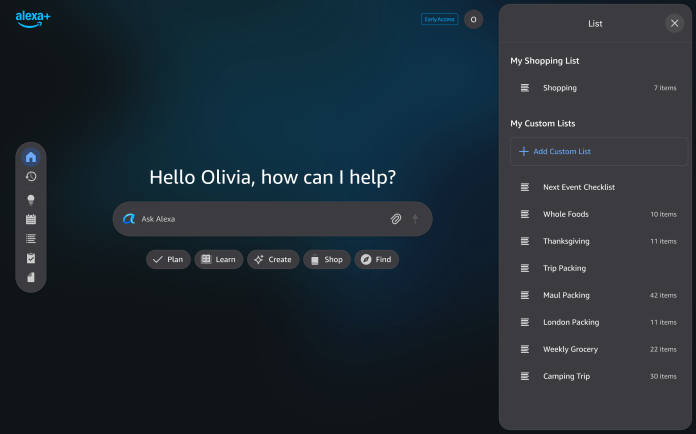
Amazon’s AI-powered overhaul of its digital assistant, now known as Alexa+, is coming to the web. On Monday, at the start of the Consumer Electronics Show in Las Vegas, the company announced the official launch of a new website, Alexa.com, which is now rolling out to all Alexa+ Early Access customers. The site will allow customers to use Alexa+ online, much as you can do today with other AI chatbots such as ChatGPT or Google’s Gemini.

While Alexa-powered devices, including Amazon’s own Echo smart speakers and screens, have a well-established footprint with over 600 million devices sold worldwide, Amazon believes that for its AI assistant to be competitive, it will need to be everywhere — not just in the home, but also on the phone and on the web.

Plus, the expansion could later give anyone a way to interact with Alexa+, even if they don’t have a device in their home.

Related to this expansion, Amazon is updating its Alexa mobile app, which will now offer a more “agent-forward” experience. Or, in other words, it’s putting a chatbot-style interface on the app’s homepage, making it seem more like a typical AI chatbot. (While you could chat with Alexa before in the app, the focus is now on the chatting — while the other features take a backseat.)

Image Credits:Screenshot of the new Alexa app

On the Alexa.com website, customers can use Alexa+ for common tasks, for instance exploring complex topics, creating content, and making trip itineraries. However, Amazon aims to differentiate its assistant from others by focusing on families and their needs in the home. That includes controlling smart devices, as you already could with the original Alexa, but it also means doing things like updating the family’s calendar or to-do list, making dinner reservations, adding grocery items you need to your Amazon Fresh or Whole Foods cart, finding recipes and saving them to a library, or even planning the family movie night with personalized recommendations.

More recently, Amazon has been integrating more services with Alexa+, including the addition of Angi, Expedia, Square, and Yelp, which will join existing apps like Fodor’s, OpenTable, Suno, Ticketmaster, Thumbtack, and Uber.

The Alexa.com website features a navigation sidebar for quicker access to your most-used Alexa features, so you can pick up where you left off on tasks like setting the thermostat, checking your calendar for appointments, reviewing shopping lists, and more.

Techcrunch event

San Francisco
|
October 13-15, 2026

Amazon’s AI assistant comes to the web with Alexa.com | TechCrunch
Image Credits:Amazon

In addition, Amazon aims to convince customers to share their personal documents, emails, and calendar access with Alexa+, so its AI can become a sort of hub to manage the goings-on at home, from kids’ school holidays and soccer schedules to doctor’s appointments and other things families need to remember — like when the dog got its last rabies shot, or what day the neighbor’s backyard BBQ is taking place.

This is an area where Amazon will need to stretch, as it doesn’t have its own productivity suite or the wealth of personal data that rivals like Google already have for their own customers. Instead, Amazon has been relying on tools to forward and upload files to Alexa+ for its AI to keep track of. That, too, will now be a feature available on Alexa.com, and the information you share can be displayed on the Echo Show’s screen, where it can also be managed.

This ability to manage a family’s personal data could be Alexa’s biggest selling point, if it gets it right.

“Seventy-six percent of what customers are using Alexa+ for no other AI can do,” says Daniel Rausch, VP of Alexa and Echo at Amazon, in an interview with TechCrunch. “And I think that’s a really interesting statistic about Alexa+ for two reasons.

He continues, “One, because customers count on Alexa to do unique things. You know, you can send a photograph of an old family recipe to Alexa and then talk through the recipe as you’re cooking it in your kitchen, substitute ingredients for what you have around the home, and get the job all the way done.”

But he notes, another 24% are using Alexa to do things other AIs can do — that could indicate they’re shifting more of their AI usage to Alexa+.

Image Credits:Amazon

Alexa.com will initially only be available to Early Access customers who sign in with their Amazon account. Amazon has been steadily rolling out Early Access since its debut of Alexa+ early last year.

Rausch tells us that over 10 million consumers now have access to Alexa+, and they’re having two to three times more conversations with Alexa+ than they did with the original Alexa assistant. Specifically, they’re shopping three times more with Alexa+ and are using recipes five times more than before, he says. Heavy smart home customers also use Alexa+ 50% more for smart home control, compared with the original Alexa.

However, across social media and online forums, there are complaints about Alexa+’s misfires and mistakes. But Rausch believes the complaints are over-represented online. He says that the number of people opting out of the Alexa+ experience after trying it is in the low single digits, on average, or “effectively … almost none.”

“Ninety-seven percent of Alexa devices support Alexa+, and we see now in adoption from customers that they’re using Alexa across all those many years and many generations of devices,” Rausch adds. “We support all of Alexa’s original capabilities, the tens of thousands of services and devices that Alexa was integrated with already are carried forward to the Alexa+ experience.”

Great Job Sarah Perez & the Team @ TechCrunch Source link for sharing this story.

From ‘Landman’ to data centers, here are the top Fort Worth projects to watch in 2026

From ‘Landman’ to data centers, here are the top Fort Worth projects to watch in 2026

by Ismael M. Belkoura, Bob Francis, Eric E. Garcia, Nicole Lopez, Scott Nishimura and McKinnon Rice, Fort Worth Report
January 4, 2026

From taking a star turn in Taylor Sheridan’s “Landman” to riding the data center bandwagon to expanding colleges and hospitals, Cowtown saw a growth spurt last year that befitted a city of 1 million residents

Our business team had their boots and heels on the ground in 2025 covering the major projects shaping the city’s future. 

Here are the top business news stories of the past year along with a little crystal-ball gazing on what’s next for 2026 and beyond.

Strongest year in a decade

Fort Worth had a banner fiscal year in economic development in 2025 with $6.7 billion in new capital investment and more than 6,900 in new and retained jobs, the city’s strongest year in more than a decade.

Those economic projects include a mix of the old — a new Bell plant that’ll add 520 full-time jobs — and the new — the Taiwan-based Wistron manufacturer will spend $761 million on AI supercomputer plants that will create more than 800 jobs.  

Others noticed the city’s new economic development prowess as well.

The Fort Worth Economic Development Partnership, at only 2 years old, was earlier chosen by Site Selection Magazine as the recipient of the 2025 Mac Conway Award for Excellence in Economic Development, considered the most prestigious award given to such groups.

That’s quite a change from 2017, when a report dinged the city for its unfocused efforts at attracting new businesses and expanding legacy companies.

And 2026 is teed up for more business growth.

A recent city report noted Fort Worth has 98 projects in the development pipeline, with 44 of those company expansions and 54 focused on companies new to the area. 

Bedrock Fort Worth companies such as Lockheed Martin Aeronautics Co. are proving to remain relevant into the future as well. The company recently unveiled its first F-35A fighter jet for Finland and was on track to delivering a total of nearly 200 combined to its customers, providing about $20 billion in local impact. More than 300 will be needed by the United States over the next decade.

Fort Worth Mayor Mattie Parker speaks during the State of the City on Oct. 16, 2025, where she highlighted the city’s growing film industry. (Maria Crane | Fort Worth Report/CatchLight Local/Report for America)

Mixed-use projects taking shape in the new year include the eight-story Van Zandt project at the northwest corner of West 7th and Foch streets and the nearby $1.7 billion Westside Village off University Drive. 

And, of course, there was “Landman,” the Paramount+ series that brought eyeballs to Fort Worth with filming at businesses across the city. But it’s more than just window dressing, as Sheridan’s studios built two large studio complexes at Hillwood’s AllianceTexas with plans for more. 

Expanding health access

JPS Health Network completed several phases of its multibillion expansion plan. The county hospital opened a Las Vegas Trail health center alongside Cook Children’s Health Care System in July and a psychiatric emergency facility in September. 

As we go into the new year, don’t expect a pause in expansion.

The next phase of JPS’s master plan — a new parking garage — will be unveiled in the spring. Further details of future phases will likely become public early next year, with plans for a new $1 billion hospital building filed with the state in November. 

Meanwhile, Medical City Healthcare completed an expansion at its Arlington hospital, constructed a mental health center in north Fort Worth and revamped their Fort Worth hospital

Cook Children’s announced plans to move its pediatric office in Arlington to a new location. The hospital is set to break ground on a new parking garage that will serve its new West Tower.

UT Southwestern broke ground on a cancer center in Near Southside. Texas Health Resources announced plans for a new patient tower in its southwest Fort Worth campus.

College growth 

Local colleges and universities built themselves up last year, literally and figuratively.

The University of Texas at Arlington, Texas Christian University, Texas Wesleyan University and Tarleton State University Fort Worth each enrolled their largest-ever freshman classes. 

UTA broke ground on its new UTA West campus along the western edge of Fort Worth in April, making progress toward the expected fall 2028 open date. University officials expect system regent approval for drawings of the campus’s first building in February and to begin construction in March.

From ‘Landman’ to data centers, here are the top Fort Worth projects to watch in 2026
Texas A&M University’s Law & Education Building is under construction in downtown Fort Worth. (Scott Nishimura | Fort Worth Report)

Texas A&M Fort Worth continued progress on its downtown campus Law & Education Building, which is expected to open next year. The university is planning for five buildings that will serve as an “innovation district,” hosting academic programs and public-private collaborations in areas such as engineering and health. 

UNT Health Fort Worth launched a master’s in clinical nutrition to train professionals for a field growing in recognition. The program’s first class will begin in fall 2026. 

Tarrant County College increased enrollment for the fourth consecutive year. The school collaborated with Autobahn for a new internship and scholarship program that serves as a pipeline for technicians. 

Burnett School of Medicine at TCU, along with the UT Southwestern Medical Center, took the lead on the North Texas Maternal Health Accelerator launched in November that forms collaborations between organizations in Fort Worth and Dallas. 

Data centers’ growing footprint

Texas is a national leader in new data centers, which often require significant water sources for cooling and enough energy to supply power to a midsized city. 

A 2024 state report noted Texas was home to about 300 data centers with 141 of them located in North Texas

Now Fort Worth is contributing to the state’s growing data center and technology industry with new facilities, such as AllianceTexas’ $2 billion Meta facility that draws energy from wind. 

More recently, Black Mountain Power gained a green light for a data center in south Fort Worth after city leaders approved zoning changes on 430 acres. In 2026, developers expect to ask for more land to be rezoned in the area, according to the Fort Worth Star-Telegram.

Trains, buses and bikes

Fort Worth-area transit ridership grew to about 8 million trips in 2025 — Trinity Metro’s highest numbers since 2017.

TEXRail, a passenger rail line from downtown to Dallas Fort Worth International Airport, saw big ridership gains — reaching more than 877,000 trips in 2025, nearly 100,000 more trips than the previous year, data shows. That line now connects with the new Silver Line route operated by Dallas Area Rapid Transit that started on Oct. 25.

Trinity Metro launched its free downtown Blue Line that’s seeing ridership exceed that of the old Molly the Trolley route, officials said.

The Western-themed Orange Line, which takes riders from downtown to the Fort Worth Stockyards and Northside, also saw big gains. The route, which launched in 2024, consistently drew between 3,500 to over 4,000 riders each month, officials said.

Trinity Metro’s revamped bike share program started in 2025 as part of a $2.3 million partnership with Lyft Urban Solutions. The 400-bike fleet, which includes 340 electric models, saw ridership gains in the latter part of the year with more than 2,700 riders in September — more than double the amount of riders recorded during the same period in 2024, data shows.

Getting in line for H Mart 

What will be one the region’s most followed stories of 2026? 

We already know the openings of H Mart — the popular Asian-themed grocery store — and a lineup of restaurants, stores and salons at North Beach Street and Loop 820 in Haltom City will be one of them.

Haltom City is projecting a spring opening for H Mart. McDonald’s beat everyone to the punch with its October opening, becoming the first operating tenant. Some are pushing ahead and may open ahead of H Mart. Most, however, are expected to open around the same time as the grocery store.

The shopping center, which will house more than 40 tenants, is 100% leased, city officials said in the fall.

The center’s restaurants will serve Korean barbecue, sushi, Vietnamese, Thai, Mexican and American food. A spot for Japanese cheesecake is also expected.

H Mart helped spawn more development around it. A number of tracts in and around the 820-North Beach-Haltom Road corridor are under construction. 

“This whole corridor is going to be a place where people come to live, come to visit, come to work,” Rex Phelps, Haltom City city manager, said in the fall. “All cities want regional-type draws that bring people to your city.”

Bob Francis is business editor for the Fort Worth Report. Contact him at bob.francis@fortworthreport.org

Eric E. Garcia is senior business reporter at the Fort Worth Report. Contact him at eric.garcia@fortworthreport.org

McKinnon Rice is the higher education reporter for the Fort Worth Report. Contact her at mckinnon.rice@fortworthreport.org.

Scott Nishimura is a senior editor at the Fort Worth Report. Contact him at scott.nishimura@fortworthreport.org.

Ismael M. Belkoura is the health reporter for the Fort Worth Report. Contact him at ismael.belkoura@fortworthreport.org

Nicole Lopez is the environment reporter for the Fort Worth Report. Contact her at nicole.lopez@fortworthreport.org.

At the Fort Worth Report, news decisions are made independently of our board members and financial supporters. Read more about our editorial independence policy here.

This <a target=”_blank” href=”https://fortworthreport.org/2026/01/04/from-landman-to-data-centers-here-are-the-top-fort-worth-projects-to-watch-in-2026/”>article</a> first appeared on <a target=”_blank” href=”https://fortworthreport.org”>Fort Worth Report</a> and is republished here under a <a target=”_blank” href=”https://creativecommons.org/licenses/by-nd/4.0/”>Creative Commons Attribution-NoDerivatives 4.0 International License</a>.<img src=”https://i0.wp.com/fortworthreport.org/wp-content/uploads/2021/04/cropped-favicon.png?resize=150%2C150&amp;quality=80&amp;ssl=1″ style=”width:1em;height:1em;margin-left:10px;”>

<img id=”republication-tracker-tool-source” src=”https://fortworthreport.org/?republication-pixel=true&post=335445&amp;ga4=2820184429″ style=”width:1px;height:1px;”><script> PARSELY = { autotrack: false, onload: function() { PARSELY.beacon.trackPageView({ url: “https://fortworthreport.org/2026/01/04/from-landman-to-data-centers-here-are-the-top-fort-worth-projects-to-watch-in-2026/”, urlref: window.location.href }); } } </script> <script id=”parsely-cfg” src=”//cdn.parsely.com/keys/fortworthreport.org/p.js”></script>

Great Job Ismael M. Belkoura, Bob Francis, Eric E. Garcia, Nicole Lopez, Scott Nishimura and McKinnon Rice & the Team @ Fort Worth Report for sharing this story.

More warmth this week and possibly another record high

More warmth this week and possibly another record high

Any cool down holds off until late in the week

Daytime highs this week (Copyright KSAT-12 2025 – All Rights Reserved)

FORECAST HIGHLIGHTS

  • PATCHY FOG: Fog will be possible for a few hours this morning

  • WARM AFTERNOON: After a cloudy start, temps will reach the upper-70s

  • RECORD TUESDAY?: We’ll be in record territory Tuesday with highs in the mid-80s

  • COLDER WEEKEND: A cold front will bring down temperatures by Saturday

FORECAST

TODAY’S FORECAST

It’s back to work and back to school (for some) and we pick up right where we left off before Christmas break. Patchy fog is possible for a few hours this morning. Clouds stick around for a while longer, before breaking midday. We’ll make the upper-70s with afternoon sunshine.

Today’s Forecast (Copyright KSAT-12 2025 – All Rights Reserved)

RECORD TUESDAY?

We could set yet another record high Tuesday afternoon. The forecast calls for a high in San Antonio of 84°. The previous record is 84°, set in 1989. Tuesday will be our warmest day in the extended forecast.

Near-record highs on Tuesday (Copyright KSAT-12 2025 – All Rights Reserved)

COOL DOWN THIS WEEKEND

The work week will be warm. Cool air will stall just to our north, but finally pushes through on Friday evening. This will give us a cooler weekend. One thing to watch will be morning lows on Monday, with a few spots nearing freezing.

Extended Forecast (Copyright KSAT-12 2025 – All Rights Reserved)

QUICK WEATHER LINKS


Great Job Justin Horne & the Team @ KSAT San Antonio for sharing this story.

Secret Link