

Home News Page 157

Even as global crop prices fall, India’s Arya.ag is attracting investors — and staying profitable | TechCrunch

Even as global crop prices fall, India’s Arya.ag is attracting investors — and staying profitable | TechCrunch

Arya.ag, an Indian agritech company offering storage facilities near farms and offering lending services to hundreds of thousands of farmers, has drawn investor interest and remained profitable even as global crop prices continue to fall in a volatile commodities market.

The investor interest has taken shape in the latest all-equity Series D round from GEF Capital Partners, totaling $81 million, of which more than 70% was primary capital and the rest secondary share sales, according to the company.

Globally, agricultural commodity prices are falling. Risks from extreme weather, input costs, trade disruptions, and biofuel policy shifts continue to weigh on agricultural markets, the World Bank has warned. This leaves businesses exposed to price swings and inventory losses. Nonetheless, Arya.ag says it is navigating the worst of that strain by steering clear of direct commodity bets and using a model that it says helps absorb shocks from downward pricing shifts.

Founded in 2013 by former ICICI Bank executives Prasanna Rao, Anand Chandra, and Chattanathan Devarajan, Arya.ag is built around a simple idea: giving farmers more control over when and to whom they sell their crops. The Noida-based startup offers storage close to farms while allowing farmers to borrow against warehoused grain to meet immediate cash needs and connecting them with a wider pool of buyers — from agri-corporations to processors and millers — helping them avoid the pressure to sell just after harvest, when prices are often weakest.

The company operates at scale, which sets Arya.ag apart from traditional lenders, banks, and other agribusiness platforms. The startup says it aggregates and stores about $3 billion worth of grain each year — roughly 3% of national output — and facilitates around $1.5 billion in loans annually, while keeping its rate of bad loans (known as gross non-performing assets, or NPAs) below 0.5% despite the recent drop in prices.

Arya.ag lends only a portion of the value of stored grain and tracks prices closely, triggering margin calls when required rather than taking losses itself, Rao said. Borrowers can respond by repaying part of the loan or adding more grain as collateral.

“You’re not immune to risks,” Rao told TechCrunch. “But because your lending is completely secured against commodities, it will never happen that the prices will fall by 90%. You already have a margin of 30%, and with your mark to market, you’ve been able to control your NPAs and defaults.”

Techcrunch event

San Francisco
|
October 13-15, 2026

In the year ended March 2025, Arya.ag generated net revenue of ₹4.5 billion (around $50 million), with first-half revenue in the current financial year rising about 30% from a year earlier to ₹3 billion ($33.3 million). Profit after tax stood at ₹340 million (about $3.78 million) last year, and has risen a further 39% so far this year, Rao said.

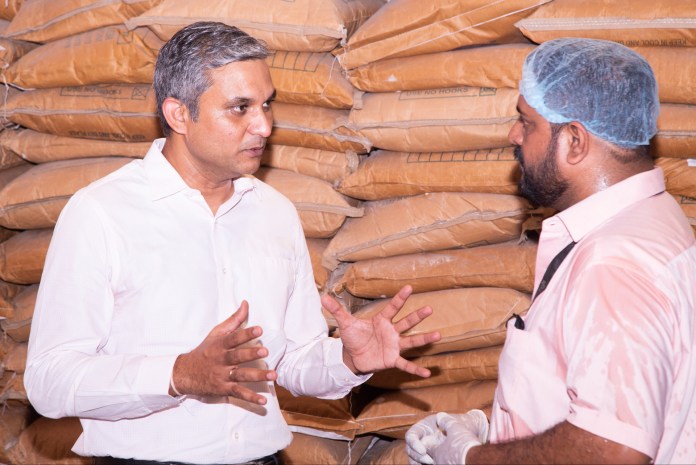
Arya.ag Co-founder and CEO Prasanna RaoImage Credits:Arya.ag

Arya.ag says it now reaches between 850,000 and 900,000 farmers across 60% of India’s districts, operating through a network of about 12,000 agricultural warehouses, all leased from third parties. The startup generates revenue from farmers for storage, from banks for originating loans against stored grain, and from buyers for facilitating crop sales through its platform.

Storage remains the largest contributor, accounting for about 50–55% of total revenue, while finance contributes 25–30% and the rest comes from commerce, Rao said.

Arya.ag disburses more than ₹110 billion (about $1.2 billion) in loans to farmers each year through its platform. Between ₹25 billion and ₹30 billion (roughly $278 million–$333 million) of that comes from its own balance sheet via its non-banking finance arm, Rao said, with the rest originated for partner banks.

Arya.ag’s loans carry interest rates of about 12.5% to 12.8%, well below the 24% to 36% typically charged by commission agents, Rao said, though higher than bank lending rates of around 11% to 12%. He added that banks generally do not lend in the small, local markets close to farming areas that Arya serves, where loan sizes are a fraction of typical bank tickets and borrowers are often located far from formal branches.

The startup approves loans in under five minutes with disbursements handled almost entirely digitally, Rao said.

Technology plays a central role in how Arya.ag manages risk and scale. The startup uses AI to assess grain quality for lending decisions, satellite data to track crop stress before harvest, and airtight, sensor-enabled storage bags that allow farmers to store grain for extended periods even in villages without formal warehouses.

Arya.ag plans to use the fresh capital to scale its tech deployments further, including expanding smart farm centers and deploying more digital tools closer to farms. Part of the investment, Rao said, will also go toward strengthening the startup’s blockchain-based system that digitally tracks stored grain, allowing crops used as collateral or sold through the platform to be monitored across lending and trade transactions, alongside continued investment in storage and credit infrastructure.

With the latest capital infusion and improving profitability, Arya.ag is aiming to be IPO-ready in the next 18 to 20 months, Rao said.

Beyond India, Arya.ag plans to expand selectively through a software-led model, with some of its technology already deployed in parts of Southeast Asia and Africa. The startup has a headcount of over 1,200 full-time employees.

Avendus advised Arya.ag for the new financial round.

Great Job Jagmeet Singh & the Team @ TechCrunch Source link for sharing this story.

Prayers Up! Legendary Gospel Singer Richard Smallwood Passes Away At 77

Prayers Up! Legendary Gospel Singer Richard Smallwood Passes Away At 77

Richard Smallwood, a gospel singer and recording artist nominated eight times for Grammy Awards, has died. He was 77. Smallwood’s songs were performed and recorded over the years by artists such as Whitney Houston, Stevie Wonder, Destiny’s Child and Boyz II Men.

RELATED: Prayers Up! Anthony Joshua “Stable” After Car Crash In Nigeria That Killed Two Of His Friends (WATCH)

Richard Smallwood’s Cause Of Death Revealed

Richard Smallwood died Tuesday (Dec. 30) of complications of kidney failure at a rehabilitation and nursing center in Sandy Spring, Maryland, his representative Bill Carpenter announced. Smallwood had health issues for many years, and music gave him the strength to endure, Carpenter said in an interview.

“Richard was so dedicated to music, and that was the thing that kept him alive all these years,” he said. “Making music that made people feel something is what made him want to keep breathing and keep moving and keep living.”

In recent years, mild dementia and other health issues prevented Smallwood from recording music, and members of his Vision choir helped care for him.

A Gospel Legend Gone But Not Forgotten

As mentioned, Whitney Houston brought his music to film by performing ‘I Love the Lord’ in the 1996 movie ‘The Preacher’s Wife,’ according to Smallwood’s biography at the Gospel Music Hall of Fame.

Richard Smallwood was born Nov. 30, 1948, in Atlanta and began to play piano by ear by the age of 5, per Associated Press.  By age 7, he was taking formal lessons. He had formed his own gospel group by the time he was 11.

Later, Smallwood became a music pioneer in multiple ways at Howard University in Washington, where he graduated cum laude with a music degree. He was a member of Howard’s first gospel group, the Celestials. He was also a founding member of the university’s gospel choir, according to an obituary from his rep Carpenter.

After college, Smallwood taught music at the University of Maryland and went on to form the Richard Smallwood Singers in 1977. He brought a contemporary sound to traditional gospel music.

He later formed Vision, a large choir that fueled some of his biggest gospel hits, including ‘Total Praise.’ The song became a modern-day hymn that touched people from all types of backgrounds and walks of life, Carpenter said by phone Wednesday.

“You can go into any kind of church — a Black church, a white church, a nondenominational church — and you might hear that song,” he said. “Somehow it found its footing throughout the whole Christian world. If he never wrote anything else, that would have put him in the modern hymn book.”

Stevie Wonder performed ‘Total Praise’ at the funeral of Martin Luther King Jr.’s son Dexter Scott King at Ebenezer Baptist Church in Atlanta on Feb. 10, 2024.

Chaka Khan Reacts To Richard’s Death

Richard Smallwood “opened up my whole world of gospel music,” singer and songwriter Chaka Khan wrote on Facebook after his death.

“His music didn’t just inspire me, it transformed me,” she said. “He is my favorite pianist, and his brilliance, spirit, and devotion to the music have shaped generations, including my own journey.”

His legacy will live on “through every note and every soul he touched,” Khan said. “I am truly looking forward to singing with you in heaven,” she said.

RELATED: Prayers Up! Young Mother Fatally Struck By Two Cars While Crossing The Street The Day After Christmas

Associated Press Jeff Martin contributed to this report via AP Newsroom.

What Do You Think Roomies?

Great Job Cassandra S & the Team @ The Shade Room Source link for sharing this story.

AI chip designer Biren’s shares surge 76% on debut in Hong Kong | Fortune

AI chip designer Biren’s shares surge 76% on debut in Hong Kong | Fortune

Shares of Shanghai Biren Technology Co. jumped almost 76% in their trading debut on Friday, marking the best first-day performance since early 2021 among Hong Kong listings that raised at least $700 million.

The artificial intelligence chip designer’s stock finished at 34.46 Hong Kong dollars after an initial public offering that was priced at 19.60 Hong Kong dollars, the top of an indicative range. Strong investor demand helped the company raise $717 million through the IPO, with its retail portion subscribed more than 2,300 times.

The developer of graphics processing units used to train and run AI models made its debut amid a wave of blockbuster Chinese listings in the sector, which has emerged as one of hottest themes in global equity markets. Apart from the surging investor interest in all things AI, China’s push to support homegrown technology has also boosted sentiment.

Shanghai Biren’s strong start will likely augur well for two other AI-related stocks—MiniMax Group Inc. and Knowledge Atlas Technology JSC Ltd., better known as Zhipu—that are set to list in the Asian financial hub next week. Separately, Baidu Inc.’s AI chip unit confidentially filed for a Hong Kong IPO on Friday.

As the first GPU-focused stock to list in Hong Kong, Shanghai Biren “enjoys scarcity value and high market attention,” according to Kenny Ng, a strategist at China Everbright Securities International Co. “The industry is in a flourishing stage, with many firms striving for breakthroughs and significant growth potential.”

Shanghai Biren’s stock soared nearly 119% intraday before paring gains. Even so, the first-day performance at close was the best since Kuaishou Technology’s shares surged 161% in their trading debut in early 2021. That’s taking into account Hong Kong listings that raised $700 million or more.

Broadly, listings of this size in the financial hub between 2020 to 2025 generated a weighted-average gain of nearly 23% on their first day, according to data compiled by Bloomberg.

Meanwhile, debuts by Chinese chipmakers this year on the mainland have been far more impressive.

Last month in Shanghai, MetaX Integrated Circuits Shanghai Co. soared 693% on its first day of trading, tracking Moore Threads Technology Co.’s stellar debut earlier. The firms, including Shanghai Biren, are part of China’s “Four Little Dragons” in the GPU space—seen as contenders to pick up market share left by Nvidia Corp.’s retreat.

Founded in 2019 by Zhang Wen, former president of SenseTime Group Inc., Shanghai Biren has been gaining traction among major Chinese firms. In 2022, it claimed “setting a new record in global computing power” with its first general-purpose GPU.

A major setback came just a year later when the firm was added to a U.S. trade restriction list requiring exporters obtain a government license before shipping to Biren. Washington argued its chip curbs are necessary to keep advanced technology out of China’s military hands.

In its prospectus, Shanghai Biren said that proceeds from the offering will be used toward research and development of its computing solutions. The company posted a 1.6 billion yuan ($228.9 million) net loss in the first six months of the year.

China’s ambitions to grow its at-home chips sector have accelerated this year in a bid to reduce its reliance on foreign players given increasing trade tensions. Officials are now considering a package of incentives worth as much as $70 billion to bankroll the sector.

DeepSeek, a Hangzhou-based startup that stunned the industry with its R1 reasoning model a year ago, this week published a paper outlining a more efficient approach to developing AI, illustrating Chinese efforts to compete with the likes of OpenAI despite a lack of free access to Nvidia chips. Such publications from DeepSeek have foreshadowed the release of major models in the past.

This story was originally featured on Fortune.com

Great Job Sangmi Cha, Chongjing Li, Bloomberg & the Team @ Fortune | FORTUNE Source link for sharing this story.

4 Takeaways From Ole Miss' Dramatic Sugar Bowl Win vs. Georgia in CFP Quarterfinals

4 Takeaways From Ole Miss' Dramatic Sugar Bowl Win vs. Georgia in CFP Quarterfinals

The College Football Playoff semifinal field is set, and for the first time in history the Ole Miss Rebels will feature in it. 

With their Sugar Bowl win against the No. 3 Georgia Bulldogs on New Year’s Day, the No. 6 Rebels earned the right to face the No. 10 Miami Hurricanes in the Fiesta Bowl and are two wins away from their first national championship in 64 years.

[2025 College Football Playoff Odds: Lines, Spreads for Each CFP Semifinal Game]

That means Ole Miss and Rebels coach Pete Golding have twice as many CFP victories as Oklahoma — with four fewer appearances. It means former Ole Miss head coach Lane Kiffin will earn $500,000 in bonuses from LSU for work he didn’t perform in the postseason.

And those aren’t even my top four takeaways from this CFP quarterfinal thriller between Ole Miss and Georgia, but these are:

1. Trinidad Chambliss steps up again on a big stage

(Photo by Sean Gardner/Getty Images)

No one expected Ole Miss quarterback Trinidad Chambliss to be this good, but he needed an otherworldly effort to bring Mississippi back.

And he delivered.

Facing a double-digit deficit to Georgia, Chambliss put the Rebels on his back and lifted them to a 39-34 Sugar Bowl victory — plus their first berth in the College Football Playoff semifinals — at Caesars Superdome in New Orleans. 

Chambliss is the man who marred Georgia coach Kirby Smart’s 4-0 record in rematches against opponents faced earlier in the year with a loss.

He entered the Sugar Bowl with 3,406 total yards in the regular season — fourth most as a starter in FBS, and he did not start a game until the Rebels’ third game this season. 

He also is the latest in a tradition of dual-threat quarterbacks at Ole Miss to throw for at least 300 yards and rush for 100 yards in the same game, following his 307 passing yards and 112 rushing yards against Tulane in the Rebels’ first-round CFP appearance and first win in the playoff. Only Archie Manning (1969), Chad Kelly (2015) and Jordan Ta’amu (2018) have thrown for 300 and rushed for 100 in the same game for Mississippi.

Chambliss proved once again to be an elite passer with his eighth 300-yard passing outing this season and his second-straight in the CFP. And he’s done it with a devastating group of receivers.

Ole Miss is the only program in the SEC with five receivers each averaging at least 40 yards receiving per game in 2025.

The move by Golding and offensive coordinator Charlie Weis Jr. to put the game squarely back into the hands of their quarterback in the second half led to the emergence of Ole Miss receiver Trey Wallace as a star in a game that was rolling out of reach. With his ninth reception, he eclipsed 156 receiving yards, and his touchdown catch was the 13th consecutive completion thrown by Chambliss to a Mississippi receiver. 

Chambliss’ stat line reads: 30 of 46 for 362 passing yards with two touchdowns. But those numbers belie his brilliance as a magician in the pocket, extending plays that should’ve resulted in Georgia sacks or worse. In the second half, those 13 consecutive passes make him the first player to complete 12 or more consecutive passes against an AP top-5 opponent since Georgia quarterback Gunner Stockton did the same against Ole Miss when the two met in October. 

[MORE CFP: 4 Takeaways From Miami’s Cotton Bowl Win Over Ohio State in CFP Quarterfinals]

2. The legend of Gunner Stockton will continue to grow — just not now

(Photo by Chris Graythen/Getty Images)

Very few folks expected the Georgia passer to be this good. This is especially true against ranked opponents. With Stockton at quarterback, the Bulldogs walked into the Caesars Superdome with a 5-1 record against ranked opponents this season. In the fourth quarter against those ranked opponents — AKA “Winning Time” — Stockton had completed 29 of 32 passes for 319 yards with six touchdowns and zero interceptions through 13 games.

Importantly, against Ole Miss earlier this season, Stockton led a comeback win with a perfect passing display in the third and fourth quarters: 12 of 12 for 135 yards with three touchdowns. That performance helped Georgia overcome the 35-26 deficit it faced in the second half and made Stockton the first quarterback to go 12 for 12 in a single half against an AP Top 5 opponent since Aaron Rodgers did the same at Cal against No. 1 USC in 2004.

His experience starting in last year’s Sugar Bowl, a 23-10 win against No. 5 Notre Dame, showed itself early against the Rebels. He rushed for each of Georgia’s first two touchdowns. 

He also stood in the face of Rebels defender Chris Graves Jr. closing like a freight train powered by 1.21 gigawatts of electricity, on third-and-12 with 4:40 left to go in the second quarter, got cracked by Graves, and completed a pass that finished 26 yards downfield. That play set up the second touchdown of the night for the Bulldogs.

However, that was as good as it would get for Stockton and the Georgia offense against Ole Miss this time around. He finished with 15 of 31 completions for 219 yards with a touchdown.

[MORE CFP: 4 Takeaways From Oregon’s Shutout Win vs. Texas Tech in the CFP Quarterfinals]

3. Coaching blunders on each sideline were gut-wrenching

(Photo by Chris Graythen/Getty Images)

First, there was the fumble by Ole Miss running back Kewan Lacy that led to a defensive score for the Bulldogs. Next, Ole Miss mismanaged the clock late in the first half, robbing itself of the chance to close the arrears to a single scoring act. How? The Rebels missed the opportunity to run the place-kicking unit onto the field because Ole Miss receiver Dae’Quan Wright simply forgot to step out of bounds after his 8-yard gain had moved the ball to the Georgia 35-yard line as time wound down.

The Bulldogs defense scored as many touchdowns in the first half as the Rebels offense after Georgia defensive back Daylen Everette picked up a bouncing ball that popped out of Lacy’s hands and returned it to the end zone for six. With the extra point — and a failed two-point conversion attempt by Ole Miss — the defensive score allowed Georgia to take a 21-12 lead with 2:34 left to play in the first half.

A point thrown away on a failed two-point conversion. A 12-point swing on Everette’s scoop-and-score. A missed chance to take three points late. That’s 16 points Ole Miss gave away in the first half alone.

Mississippi players jogged into the locker room lacking the ability to stop the clock.

Then, on Ole Miss’ first possession of the second half, Golding chose to go for it on fourth-and-1 and let the offensive coordinator take the ball out of Chambliss’ hands, only to watch Lacy get stuffed behind the line of scrimmage on a direct-snap dive.

Those two plays alone are enough to ruin most teams’ chances to defeat a Kirby Smart-coached Georgia team.

[MORE CFP: 4 Takeaways From Indiana’s Rose Bowl Demolition of Alabama in CFP Quarterfinal]

And in the fourth quarter — the same quarter the Bulldogs shut out Ole Miss in the teams’ first meeting — Chambliss got the ball in his hands. 

First, he closed the distance between his team and Georgia’s with a 36-yard strike to set up a touchdown. Just inside the fourth quarter, he escaped three sacks that looked like certain death for the Bulldogs on a drive that gave Ole Miss the lead 27-24 with a two-point conversion that actually worked. And the comeback was on.

Down by just three, Smart’s decision to make a hockey-line change from his punt unit to his offensive one on fourth-and-2 with 9:40 left to play from the Georgia 33-yard line did not catch Golding’s punt or defensive unit off-guard. But Stockton’s snap-count seemed to surprise his own team. When the ball was snapped, the left side of the Georgia offensive line did not move, and Ole Miss edge rusher Suntarine Perkins sacked Stockton to not only create the turnover-on-downs but also a short field for the hottest quarterback in the playoff.

Ole Miss needed just three plays to take a double-digit lead with 9:02 left. Ultimately, it took Lucas Carneiro’s 47-yard field goal with nine seconds left to play to seal the win. But Smart’s decision to go for it on fourth-down late — after using his trick play card earlier with a fake punt conversion — made Ole Miss’ lead insurmountable.

4. Three teams can win the national title for the first time in the modern era

(Photo by Sean Gardner/Getty Images)

The CFP semifinals feature three teams that have not won a national title in the modern era: Ole Miss, No. 5 Oregon and No. 1 Indiana. The Ducks and Hoosiers will be looking to win their first-ever, and Mississippi is two wins away from its first since 1962.

Miami has won a national title in the 21st century, but just barely. 2001 is the last time the Hurricanes stood atop the rest of college football.

No matter who wins the CFP national championship this year, the story will be the same, though. There has never been a semifinal round quite like this one with so many “new” players so close to clutching glory.

RJ Young is a national college football writer and analyst for FOX Sports. Follow him @RJ_Young.

Want great stories delivered right to your inbox? Create or log in to your FOX Sports account, follow leagues, teams and players to receive a personalized newsletter daily!

FOLLOW Follow your favorites to personalize your FOX Sports experience

Great Job & the Team @ FOX Sports Digital Source link for sharing this story.

Daily Show for January 01, 2026

Daily Show for January 01, 2026

Democracy Now! 2026-01-01 Thursday

  • "Empire of AI": Karen Hao on How AI Is Threatening Democracy & Creating a New Colonial World

Download this show

Great Job Democracy Now! & the Team @ Democracy Now! Audio Source link for sharing this story.

The 7-Point Outfit Rule – Our Culture

The 7-Point Outfit Rule – Our Culture

What we call “effortless” is a recipe more often than we’d like to admit. One fresh basic, one good shoe, one unnecessary accessory, one idea too many. Somewhere between trying too hard and denying it entirely, there’s a number. And that’s seven. Maybe even eight. Overthinkers, sit down.

Back to the TikTok’s styling guide obsession, every outfit has a target, 7-8 points. Less than that? Maybe reconsider stepping outside. More than that? Guess what! Still reconsider stepping outside. Basics score 1, statement pieces, think colorful, textured, design-forward, score 2. Yes, we are now counting our sweaters like calculus problems, nothing wrong with that. Nothing says style like basic addition (I can almost hear my high-school teacher crying).

Suppose we’re risking public exposure for caffeine, baggy sweatpants (1), plain long-sleeve (1), boxy bomber (1), and my dependable “not trying too hard” sneakers (also 1), 3-4 points shy. Overstimulating stacked jewelry (2), a pair of sunglasses (1) and my everyday bag (1). I’ve never been good at math but counting isn’t that cruel. 8 points later a boring outfit can even become worthy of photos. Work it in reverse too, fix that outfit that seems too much, edit it down. No brain cells harmed, no talent required, just ruthless scoring and balance.

Okay, this whole “score your outfit” nonsense can be helpful, especially for people who overthink everything from what cereal to eat to whether their socks match their mood. It also feeds that delicious need for external confirmation, not from people, mind you, but from some arbitrary set of rules someone posted on TikTok, the algorithmic kind, the sort that tells you you did it “right”.

It’s not genius, it’s not revolutionary, and it surely isn’t life-changing. And let’s be honest, to make it work you need a vague sense of taste, otherwise your “statement” piece will look like something dug out of a prop closet at a horror shoot. Would I stick to this blindly? Absolutely not. Fashion doesn’t need those rules. But for anyone who wants to stay safely inside the tidy little box of socially digestible style, it’s… a tool. Like training wheels for your ego, sold as guidance. I could name ten influencers off the top of my head who worship it like it’s the second coming.

Great Job Vera Adamidou & the Team @ Our Culture Source link for sharing this story.

Opening of Center for Health Empowerment on San Antonio’s Southwest Side expected this spring

Opening of Center for Health Empowerment on San Antonio’s Southwest Side expected this spring

Sign up for TPR Today, Texas Public Radio’s newsletter that brings our top stories to your inbox each morning.

San Antonio nonprofit Center for Health Empowerment in South Texas, also known as CHEST, is getting its first headquarters in 2026 with a goal of providing easier access to medical services for residents on San Antonio’s Southwest Side.

CHEST was created to bridge gaps in access to healthcare. The center would provide support services, such as transportation arrangements, health navigation agencies, and access to educational programming.

Former District 4 Councilwoman Adriana Rocha Garcia, who represented much of the Southwest Side, is the new president and CEO of CHEST. The building being leased is a former education center in South San ISD with 12 classrooms. The goal is to provide the space to other nonprofits to provide their services.

“We will be able to bring together, essentially convene, a group of nonprofit organizations to do some work that’s focused on the non-medical drivers of health in the South Side of San Antonio,” said Rocha Garcia.

The headquarters will be located at 419 Lovett Street behind the recently closed Athens Elementary School in South San. The board of managers for South San Antonio ISD approved a lease agreement in November.

During preliminary discussions a month earlier, board members praised the use of the building and potential revenue for the district. The lease is about $2,500 a month for three years with a two-year renewal option.

The building itself was originally an annex of the school but later became the district’s CareZone in 2019. It makes grief counseling, child psychiatry, addiction support and family therapy accessible to the South Side community and eliminates the need for long bus rides to appointments on the other side of town. CareZone is now located next door at Dwight Middle School.

The CareZone name is still visible on one side of the building. CHEST will begin moving in over the coming weeks. Rocha Garcia said the building still needs some work.

“We are right now in the process of cleaning the building a little bit, of course, buffing the floors, cleaning the restrooms, bringing things up to code,” Rocha Garcia said. “It had just been renovated a few years ago, but we want to make sure that everything is ready to go for the partners that we bring in.”

A pre-pandemic study in 2019 showed that residents on the South Side of San Antonio had a 20-year life expectancy gap compared to those on the north side of the city. Much of that disparity can be attributed to the lack of healthcare services and facilities on the South Side.

A map of hospitals within the City of San Antonio shows a gap of facilities on the Southwest side.

“If you technically divide south of (Highway) 90, you’re going to be waiting for a hospital bed a lot longer than north of 90,” Rocha Garcia said, adding that in some zip codes in this area there are 0.7 hospital beds for every one person.

A map showing hospital locations within the city of San Antonio shows a gap in the Southwest Side and only one hospital on the Southeast Side.

Rocha Garcia said one of the goals is to help create health empowerment zones where people will have better access to the resources they need.

“What do we have? What can we bring together? Bringing ownership. That’s why we’re empowerment, right? We’re trying to make sure that people take care of their own health. We empower them. We bring them the chest, essentially, so that they can come and have access, right? It’s data informed,” she said.

CHEST is in conversations with multiple other nonprofits to be housed in the center.

One such organization is Ride Connect, which provides rides for seniors to doctors’ appointments, and others like Community First, Fuerza Unida, and United Way.

The partners would be housed in the center’s classrooms at a cost that is much less than the market rate for the area with the help of a grant CHEST is receiving.

“We’d rather they use the money that they would have allocated for rent in the area into the programs that will be going back to serve our community,” Rocha Garcia said.

A ribbon cutting is expected in February or March.

Editors note: This story has been updated to reflect the cost nonprofit partners would pay to be housed at the center.

Great Job Joey Palacios & the Team @ Texas Public Radio for sharing this story.

Maduro open to US talks on drug trafficking, but silent on CIA strike

Maduro open to US talks on drug trafficking, but silent on CIA strike

CARACAS – Venezuela is open to negotiating an agreement with the United States to combat drug trafficking, the South American country’s President Nicolás Maduro said in a pretaped interview aired Thursday on state television, but he declined to comment on a CIA-led strike last week at a Venezuelan docking area that the Trump administration believed was used by cartels.

Maduro, in an interview with Spanish journalist Ignacio Ramonet, reiterated that the U.S. wants to force a government change in Venezuela and gain access to its vast oil reserves through the monthslong pressure campaign that began with a massive military deployment to the Caribbean Sea in August.

“What are they seeking? It is clear that they seek to impose themselves through threats, intimidation and force,” Maduro said, later adding that it is time for both nations to “start talking seriously, with data in hand.”

“The U.S. government knows, because we’ve told many of their spokespeople, that if they want to seriously discuss an agreement to combat drug trafficking, we’re ready,” he said. “If they want oil, Venezuela is ready for U.S. investment, like with Chevron, whenever they want it, wherever they want it and however they want it.”

Chevron Corp. is the only major oil company exporting Venezuelan crude to the U.S. Venezuela has the world’s largest proven oil reserves.

The interview was taped on New Year’s Eve, the same day the U.S. military announced strikes against five alleged drug-smuggling boats. The latest attacks bring the total number of known boat strikes to 35 and the number of people killed to at least 115, according to numbers announced by the Trump administration. Venezuelans are among the victims.

President Donald Trump has justified the attacks as a necessary escalation to stem the flow of drugs into the United States and asserted that the U.S. is engaged in an “armed conflict” with drug cartels. The strikes began off Venezuela’s Caribbean coast and later expanded to the eastern Pacific Ocean.

Meanwhile, the CIA was behind a drone strike last week at a docking area believed to have been used by Venezuelan drug cartels, according to two people familiar with details of the operation who requested anonymity to discuss the classified matter. It was the first known direct operation on Venezuelan soil since the boat strikes began, a significant escalation in the administration’s pressure campaign on Maduro, who has been charged with narco-terrorism in the U.S.

Asked about the operation on Venezuelan soil, Maduro said he could “talk about it in a few days.”

___

Associated Press writer Aamer Madhani contributed to this report from Washington.

Copyright 2026 The Associated Press. All rights reserved. This material may not be published, broadcast, rewritten or redistributed without permission.

Great Job Regina Garcia Cano, Associated Press & the Team @ KSAT San Antonio for sharing this story.

Elon Musk Says Neuralink Will Automate Brain Surgery in 2026

Elon Musk Says Neuralink Will Automate Brain Surgery in 2026

Elon Musk has announced that Neuralink plans to begin high-volume production of its brain-computer interface devices in 2026, alongside a shift to fully automated surgical procedures. He added that the implants will be inserted through the dura without requiring its removal, a move aimed at making the process less invasive and more scalable.

Musk wrote on X, “Neuralink will start high-volume production of brain-computer interface devices and move to a streamlined, almost entirely automated surgical procedure in 2026. Device threads will go through the dura, without the need to remove it. This is a big deal.”

ALSO SEE: Apple Teases Major Fitness+ Update in 2026: What’s Coming

The Neuralink brain implant is roughly the size of a coin and allows users to control on-screen cursors and digital devices using simple mental commands. The technology is designed to help people interact with computers and smart devices without physical movement.

So far, Neuralink has implanted the chip in 12 people, according to a company update shared in November. The first recipient, Noland Arbaugh, received the implant in 2024 and has publicly spoken about how the device has improved his quality of life.

Arbaugh has explained that the brain-computer interface enables him to control his computer, play games like Mario Kart, operate his television, and manage home devices such as an air purifier without moving other parts of his body. Other participants have reported similar experiences, including playing video games, controlling smart devices, and browsing social media.

Elon Musk has said Neuralink’s goal is to give people with quadriplegia or severe loss of brain-body connection a communication data rate that exceeds normal human capabilities. He has also claimed the company could achieve over 1,000 implants by 2026, supported by $650 million in funding raised in June to expand patient access and advance future devices.

ALSO SEE: January 2026 Phone Launches in India: Redmi Note 15, Realme 16 Pro and More

Great Job Priya Singh & the Team @ Mashable India tech Source link for sharing this story.

About 40 People Dead and 115 Injured in Fire at Swiss Alpine Bar During New Year’s Celebration

About 40 People Dead and 115 Injured in Fire at Swiss Alpine Bar During New Year’s Celebration

Posted on January 1, 2026

Journalists gather in front of the street where a fire ripped through a crowded bar during New Year’s Eve celebrations in the Alpine ski resort town of Crans-Montana on January 1, 2026. Several dozen people are presumed dead and around 100 injured after a fire ripped through a crowded bar in the luxury Swiss ski resort of Crans-Montana, Swiss police said on January 1, 2026. Police, firefighters and rescuers rushed to the popular resort, which is set to host the Ski World Cup from January 30, after the fire broke out in the early hours of New Year’s Day. (Photo by MAXIME SCHMID / AFP via Getty Images)

CRANS-MONTANA, Switzerland (AP) — About 40 people were killed and another 115 injured, most of them seriously, during a New Year’s celebration in a Swiss Alpine bar, police said. The fire happened in the Alpine ski resort municipality of Crans-Montana, Switzerland. Attorney general of Valais Canton Beatrice Pilloud says it is too early to determine the cause of the fire. Experts have not yet been able to go inside the wreckage. Police say the fire started around 1:30 a.m. Thursday in Le Constellation. Investigators are working to determine the cause. A reception center and helpline has been established for impacted families. The community is in the heart of the Swiss Alps, just 40 kilometers north of the Matterhorn.

(Copyright 2026 The Associated Press. All Rights Reserved.)

Great Job & the Team @ News Talk WBAP-AM for sharing this story.

Secret Link