“No, I don’t do calls,” said the former Shark Tank star and Dallas Mavericks owner in a TikTok video posted by Masterclass. “You know, I’ll engage with you via email, and trust me, I do this all the time. I’m really good at it.”
But Cuban’s logic for his proclivity toward email over the phone is very different from younger generations. He said conversing over email gives him more time to craft a thoughtful response.
“I’ll give you more comprehensive responses than if it was via phone,” said Cuban, who’s worth an estimated $6 billion. “And if we do it by phone, I’m going to forget half the stuff that we talked about because I’ve got so much going on.”
While Cuban is no longer starring on Shark Tank and sold off his majority stake in the Mavericks, he’s still plenty occupied running Mark Cuban Cost Plus Drugs Company and serving as an investor and advisor to the dozens of companies he invested in during his time on the show.
Meanwhile, Gen Zers prefer email or text because they are anxious about talking on the phone. A 2024 study shows nearly a quarter of the generation is so hesitant about talking on the phone that they never answer calls. A college in the U.K. last year even launched a class aimed at helping Gen Z overcome its fear.
While it’s always easy to poke fun at younger generations for their professional-life quirks, the hesitancy for some is actually a deeply rooted fear called “telephobia.” This form of phone anxiety can lead to increased heart rate, nausea, shaking, and trouble concentrating, according to Verywell Mind.
“It speaks to a broader fatigue with immediacy and urgency, where people have grown tired of the hassle culture and obsession with efficiency,” Zoia Tarasova, an anthropologist with consumer insight agency Canvas8, previously told Fortune. “People are quietly rebelling against this immediacy by taking their time to respond to those calls.”
Other business leaders even told Fortune that this telephobia trend has hurt their bottom line. Casey Halloran, CEO and cofounder of online travel agency Namu Travel, said in the 25 years he’s been in business, management has “never seen anything quite like the generational divide” between older and younger travel agents in how they make phone calls. He also said combating telephobia has been a “frequent, uncomfortable topic” at his company, as management has recognized that his younger travel agents register fewer than 50% of the calls compared to older employees.
“As to solutions, we have been doing extensive training, incentives, call observing with our veteran reps, and even hired a business psychologist,” Halloran previously told Fortune. “After more than two years of this struggle, we’re nearly to the point of throwing up hands and embracing SMS and WebChat versus continuing to fight an uphill battle.”
Still, for his own business purposes, Cuban says he prefers emails over phone calls because he can go back and reference what he’s said.
“If we do it via email, I can search for it, always,” he added.
What research tells us about communication styles at work
Just like most business approaches, emailing instead of talking on the phone has its pros and cons.
Research by recruiting firm Robert Walters shows more than half of younger-generation professionals find instant messaging or email, instead of calls or meetings, is the best way to “get things done,” showing how they believe talking over the phone can be inefficient. That’s the “it could have been an email” mentality.
“Younger generations are less inclined to spend hours in a restaurant or cafe when they can have a quick discussion online,” Emilie Vignon, associate director of Robert Walters California, wrote in the 2024 study. To be sure, Vignon also said there are also “downsides” to only conversing via email or text.
“Face-to-face interactions allow for meaningful connections and provide an opportunity for non-verbal communication cues, building trust and rapport with clients and colleagues,” Vignon added. “The subtleties of body language, facial expressions, and tone of voice contribute to a deeper understanding and connection that often cannot be fully conveyed through text or even video chats.”
To be sure, other research from the University of Texas at Austin (UT) and the University of Chicago, as well as studies by McKinsey & Co., show calls can help resolve issues more quickly than an email, especially as workers spend nearly one-third of their time on email. A 2022 study from DePaul University researcher David J. Bouvier also shows that email enables easy information sharing and can reduce stress.
Great Job Sydney Lake & the Team @ Fortune | FORTUNE Source link for sharing this story.
LAGOS – British boxer Anthony Joshua is initially staying in Nigeria as he recuperates from injuries sustained after a deadly crash.
A vehicle carrying the former heavyweight champion and two of his associates crashed into a stationary truck on Monday on a major thoroughfare, the Lagos-Ibadan Expressway, which links Ogun state to Lagos. The two associates, Sina Ghami and Latif “Latz” Ayodele, were killed.
Joshua was released from a Lagos hospital on Wednesday afternoon, and he paid his respects to his deceased friends at the morgue.
His promoter, Matchroom Boxing, told The Associated Press on Thursday: “As reported, Anthony was released from hospital last night and will remain in Nigeria over the coming days.”
Joshua has family roots in Nigeria and he briefly attended boarding school there as a child. He also holds Nigerian nationality.
The Lagos state commissioner for information, Gbenga Omotoso, said Wednesday that Joshua had been discharged after being deemed clinically fit to recuperate from “home.”
Ghami was Joshua’s strength and conditioning coach while Ayodele was a trainer. Just hours before the crash, Joshua and Ayodele posted clips on social media playing table tennis together.
___
AP Sports Writer Steve Douglas in Manchester, England, contributed to this report.
Copyright 2026 The Associated Press. All rights reserved. This material may not be published, broadcast, rewritten or redistributed without permission.
Great Job Ope Adetayo, Associated Press & the Team @ KSAT San Antonio Source link for sharing this story.
A wave of protests started by shopkeepers swept through Tehran in December. Iranians have had such a terrible year—facing such a decline in living standards and such a sense of political impasse—that no one was terribly surprised when demonstrations filled the streets.
I asked one Iranian student why she had taken part in the street protests. “Yeah, why should we protest?” she replied sarcastically. “After all, we have it so good!”
The immediate spark for the protests was a sharp decline in the value of the Iranian currency. At one point last week, a U.S. dollar traded for almost 1.5 million rials, having lost more than half its value in a year. As recently as 2021, a dollar cost around 250,000 rials and, only a decade ago, around 30,000. This continuous decline has slashed savings, destroyed the Iranian middle class, and inflicted real suffering on the working classes. The protests began on Sunday with merchants who rely on importing electrical goods and find that very few can now afford them. But they’ve quickly mushroomed—as did previous rounds did in 2017, 2019, and 2022—spreading to cities in provinces such as Hamedan, Isfahan, and Lorestan, and drawing in students, pensioners, and members of Gen Z.
Like previous waves of demonstrations, the protests have quickly acquired a political character. Protesters have chanted, “Death to the dictator,” targeting the octogenarian Supreme Leader Ayatollah Ali Khamenei, who has held the top post since 1989 with little accountability. As a statement read out by students at Tehran’s Beheshti University put it: “This criminal system has taken our future hostage for 47 years. It won’t be changed with reform or with false promises.”
Iran’s President Masoud Pezeshkian, elected with promises of good governance last year, has overseen electricity and water cuts while failing to realize signature promises such as lifting restrictions of the internet. Wanting to show he is cut from a different cloth than his hard-line predecessor, Pezeshkian quickly promised to meet with representatives of protesters. His spokesperson affirmed “the constitutional right of peaceful protest” for Iranians.
But Pezeshkian doesn’t control the security forces, so these pronouncements ring hollow. Dozens of protesters have already been arrested, including Sarira Karimi, head of a student union chapter at the University of Tehran. (Karimi was released on Wednesday.) In the small cities of Kuhdasht and Fasa, security forces shot at protesters. According to local officials, a member of the security forces was killed in Kuhdasht. Protesters also clashed with police in Hamedan and Najafabad.
On Tuesday, Pezeshkian met with representatives of some guilds and merchant unions and promised to improve the economy. After almost 18 months in office, he finally dismissed Mohammadreza Farzin, the unpopular central-bank governor appointed by his hard-line predecessor. Farzin’s successor, Abdolnasser Hemmati, a pro-reform economist and Pezeshkian’s former finance minister, has promised economic stability.
But Hemmati faces a tall order. He is likely to slash interest rates (the official rate currently stands at 40 percent) and to pursue banking and currency-exchange reform. But these are hardly panaceas for Iran’s deeply beleaguered economy, which suffers from international isolation, Western-imposed sanctions, and domestic mismanagement by a regime that has long failed to prioritize its people’s welfare.
Iran’s current monthly minimum wage, of around 104 million rials, barely buys a gram of 18-karat gold (often used as a measure of real value). Nurses and teachers earn around 150 to 250 million rials a month while a semi-decent apartment in Tehran rents for around 200 million. Many professionals supplement their income by moonlighting as ride-share drivers or taking other odd jobs. Thousands have emigrated to seek a better life elsewhere.
To make things worse, Iranians live in the fear of another round of military strikes by Israel or the United States. “You can’t plan even for two weeks in this country,” a young man who took part in the protests told me. “Without stability, there is no prospect for growth or welfare. We live day by day.”
To change that, the regime would need to come to an agreement with the Trump administration that lifts the sanctions or at least keeps Iran safe from war. But Khamenei’s harsh ideological stance against Israel and the U.S. makes that hard to achieve. On Tuesday, protesters in Tehran used a classic protest chant: “Neither Gaza, nor Lebanon, I give my life for Iran.” The slogan, popular since 2009, reflects opposition to Iran’s backing for militias such as Hamas and Hezbollah. The protesters believe that military adventurism has drained Iranian resources and helped put the country at odds with both the West and its Arab neighbors. In other words, Iranians link their economic malaise to their regime’s foreign policy.
Can the protesters prevail against the Islamic Republic?
Every time Iranians come out to the streets, many around the world express this wish. Prominent American and Israeli politicians have already done so in the past few days. But rattled as the regime might be, it has seen mass protests off repeatedly in recent years.
Opponents of the Islamic Republic remain hopelessly disorganized and disunited. Some protesters have chanted slogans in favor of Reza Pahlavi, Iran’s exiled crown prince. But Pahlavi remains a divisive figure among anti-regime Iranians. Many reject his claim to leadership. Pahlavi’s supporters and top advisers routinely criticize popular domestic dissidents including the Nobel Peace laureate Narges Mohammadi, actress Taraneh Alidoosti, and rapper Toumaj Salehi. Earlier this month, Mohammadi was physically attacked by pro-Pahlavi protesters in the northeastern city of Mashhad.
Regardless of their politics, all opposition factions have failed to build powerful organizations or lasting networks that could direct the protests. Without such direction, the current protests are likely to lose momentum and fizzle out, just like previous rounds. Even if they were to last, it is far likelier that figures from inside the regime’s ranks would take the initiative and wrest power from Khamenei, than that the protesters would succeed in bringing about a change to the regime’s basic structures.
“I am happy from the bottom of my heart to see others in the streets,” a young woman who took part in protests on Wednesday told me. “But I also know that we are economically fucked and things won’t get better anytime soon. We also have no easy way of winning against these bastards. It is hard to be hopeful.”
Even as Iranians show incredible bravery by coming out against their thuggish regime, a winning strategy continues to be elusive.
Great Job Arash Azizi & the Team @ The Atlantic Source link for sharing this story.
The end of the year invites reflection whether we ask for it or not. It slows us down just enough to take stock of what we have lived through, what we are carrying, and what we are quietly hoping for next.
This season has not been easy for many. Life can look bleak from certain angles. The world feels heavy. Personal stories feel layered and unfinished. And still, there is a truth that remains steady beneath it all. No one has the power to take what is innate within you. Your capacity, your wisdom, your resilience are not dependent on circumstances. You already hold what you need to live a meaningful and expansive life.
I have been hearing stories filled with loss, uncertainty, and transition. I am carrying a few of my own. What I know is that none of us are walking alone, even when it feels that way. There is support that shows up when we are open to it. There is guidance that arrives when we stop resisting change. Often what looks like a challenge is actually an invitation. A moment of awakening. A chance to understand more deeply the life we have created and the life that is now asking to be shaped.
This time of year offers space to reimagine. To build new bridges. To form new relationships. And perhaps most importantly, to return to ourselves with honesty and care.
As conversations turn toward resolutions and reinvention, I want to pause that narrative for a moment. Instead of declaring New Year, New Me, what if we honored the woman you already are?
She has brought you this far. She navigated seasons without a guidebook. She made decisions in real time, under pressure, with limited information. She carried disappointment, adjusted expectations, and kept going anyway. Life may not be perfect, but perfection was never the point. The beauty lives in the cracks. The lessons live there too.
Your relationships may feel misaligned. Work may drain more than it gives. You may look back and wish you had done some things differently as a mother, a partner, or simply as a woman trying to figure things out. But the truth deserves to be spoken clearly. You did the best you could with what you had. And for many, that effort has been extraordinary.
So as the year turns, celebrate yourself. Celebrate the ways you stayed gracious when it was not returned. The ways you chose generosity even when it would have been easier to withhold. The ways you loved fully, even when love was not guaranteed. That is strength. That is emotional intelligence. That is mastery.
Here is the most important truth to carry forward. If your life is not bringing you joy, it is not a life sentence. Change begins with a single decision. The decision to do the inner work. The decision to become the woman you have been imagining quietly, patiently, and persistently.
You are allowed to move from obligation to adventure. From performance to presence. From surviving to building something aligned with who you are now. We grew up in a time when choices were limited. Today, your lived experience gives you options. You can release what no longer fits and design a life that reflects your values, your curiosity, and your growth.
This journey is yours. It requires your consent and your courage. And while it belongs to you, it does not require isolation. Ask for help. Seek guidance. Find community. Do not stay attached to who you were if it means shrinking who you are becoming. This is not about age. It is about energy.
So allow yourself to be expansive. Visible. Bold in your own way. Trust that you were meant to live fully and freely.
As you step into this new year, remember that you are already enough. You already carry what you need to become her. Name her. Envision her. Begin showing up as her, one intentional step at a time.
This next season is not about doing more. It is about being aligned with what your heart has been asking for. Take it slowly. Breathe. Stay present. Trust the process. The seeds you planted were not wasted.
Like a rose in spring, this is your season of unfolding.
If you feel called, share your biggest wish for the year ahead. Some intentions are meant to be spoken aloud.
With care, Monica Wisdom
Please Join our email community and receive our beautiful gift, The Passion and Purpose Workbook. Perfect to begin your new year. Join HERE
Great Job monicaamplified@gmail.com & the Team @ Black Women Amplified | Top Podcast for Black Women Source link for sharing this story.
Alaska’s Salmon River was once known for its clean, sparkling water.
But recently the river has turned a sickly shade of orange, and scientists say climate change is to blame.
As temperatures rise, nearby permafrost – or long-frozen ground – is thawing.
That’s letting water and oxygen seep underground and mix with sulfide minerals, creating sulfuric acid.
That acid eats away at rocks and releases metals like aluminum, cadmium, and iron. This contaminates the river and makes it cloudy and discolored.
Sullivan: “It’s pretty upsetting to see that these areas that we have cherished and tried to protect are being severely degraded by anthropogenic climate change.”
At many points along the Salmon River, Patrick Sullivan of the University of Alaska Anchorage and his colleagues found enough of these metals to be toxic to aquatic life.
Aluminum and iron can clog fish gills, while cadmium can cause calcium deficiencies.
Sullivan says dozens of other streams in Alaska and Canada show the same signs of contamination.
So climate change and melting permafrost are polluting the once-pristine rivers of the far north.
Reporting credit: Ethan Freedman / ChavoBart Digital Media
Great Job YCC Team & the Team @ Yale Climate Connections Source link for sharing this story.
by McKinnon Rice, Fort Worth Report December 31, 2025
When 24-year-old Larry Story began teaching at what was Tarrant County Junior College in 1967, the sidewalks were not yet finished.
Almost six decades later, the community college has undergone a name change, expanded to five more campuses and enrolled more than a million students. Now at 83, Story is the last remaining founding faculty member. After 59 years of service, he is hanging up his hat.
“Everybody said, ‘You’ll know when it’s time to retire,’ and they’re right,” he said.
This spring semester will be the first time Story will not be in school in some capacity since he entered the first grade. He earned a bachelor’s degree from the University of Texas at Arlington and a master’s from East Texas State University, now East Texas A&M, before immediately taking a teaching position at what is now Tarrant County College.
Story did not set out to teach this long, he said. He promised his wife, Judy, he would retire after his 50th year of teaching, planning for the two of them to spend more time together. But after she passed away during his 50th year, he continued.
“After that, I just thought, well, I’ve got nothing else to do, and so I just kept going,” he said.
A photo of Story appears in the Dec. 4, 1996, edition of The Collegian, Tarrant County College’s student newspaper. (Hermilo Escareno/The Collegian | The Portal to Texas History)
The history professor has lived through a significant amount of history himself.
He recalls tension in classes where Vietnam War veterans and protestors learned side by side.
“That could get pretty volatile because the protesters had something to say, and the veterans, they didn’t want to hear it. They’d been through a lot,” he said.
He also taught during the Civil Rights Movement and remembers 1968, the year Martin Luther King Jr. and Robert F. Kennedy were assassinated, as a particularly tough year.
Around this time, he taught alongside civil rights icon Reby Cary, who was a professor at the college before going on to serve as Fort Worth’s first Black school board member and as a Texas House member.
One particularly memorable moment came during a trip to Austin with colleagues for a Texas Junior College Teachers Association conference. The group made a stop at a diner.
When the waiters brought out the professors’ breakfasts, Cary’s toast was charred.
“They had burnt that toast to a charcoal patty, and we said, ‘We’re sending that back,’” Story said. “(Cary) said, ‘No.’ He said, ‘That won’t help.’ He said, ‘I’ve gotten used to it.’ So, we ate our toast and went on.”
Like many Americans, Story also remembers where he was on Sept. 11, 2001. He was in his faculty office when he heard about the terrorist attacks.
He did what he had done for the last 34 years — he went to class.
Story sits next to his sister, Linda, at TCC South’s 50th anniversary Masquerade Ball on April 7, 2018, in Fort Worth. (Courtesy image | Tarrant County College)
Story taught sections of Western civilization and United States history his entire career, but he never got bored teaching the same classes, he said.
He saw each of his more than 100 semesters as “its own little world.”
“Each class is different,” Story said. “It’s not the same job every semester because they’re new students, and my perspective on events changes, so I teach differently each semester.”
He taught at the college for so long that a student of one of his students became a faculty member alongside him, creating a lineage that can be traced similar to generations of family.
During the college’s first year, Story taught now-retired professor David Clinkscale, who later taught professor Armando Villarreal III.
“David told me, ‘This is the man that taught me. I taught you, so you are his academic grandson,” Villareal said.
Story does not have concrete retirement plans yet, but he has some ideas of how he will fill his time.
He is active in his church and can volunteer there. He enjoys visiting museums and presidential libraries. He may use his newfound freedom to travel.
“I have children and grandchildren scattered around the country, so I can go mooch off them, for a change,” he said with a laugh.
There was once a time when Story did not look forward to the break from the classroom that weekends brought.
But now, as he walks toward the world outside the sidewalks of the South Campus, he is excited to see where life will take him.
“There’s still things to do. There’s still things that I want to do,” he said.
The Fort Worth Report partners with Open Campus on higher education coverage.
At the Fort Worth Report, news decisions are made independently of our board members and financial supporters. Read more about our editorial independence policy here.
This <a target=”_blank” href=”https://fortworthreport.org/2025/12/31/after-59-years-tccs-longest-serving-professor-hangs-up-his-hat/”>article</a> first appeared on <a target=”_blank” href=”https://fortworthreport.org”>Fort Worth Report</a> and is republished here under a <a target=”_blank” href=”https://creativecommons.org/licenses/by-nd/4.0/”>Creative Commons Attribution-NoDerivatives 4.0 International License</a>.<img src=”https://i0.wp.com/fortworthreport.org/wp-content/uploads/2021/04/cropped-favicon.png?resize=150%2C150&quality=80&ssl=1″ style=”width:1em;height:1em;margin-left:10px;”>
The first nationwide randomized study of children enrolled in public Montessori preschools found that students showed stronger learning outcomes by the time they reached kindergarten. Compared with children who attended non-Montessori programs, Montessori students performed better in reading, memory, and executive function. The results also carry clear implications for education policy, since the Montessori programs produced these gains while operating at significantly lower cost. The study followed 588 children across two dozen programs in different parts of the country, underscoring the importance of tracking these outcomes through later grades and into adulthood.
Stronger Outcomes at Lower Cost
Researchers from the University of Virginia, the University of Pennsylvania, and the American Institutes for Research led the new national analysis. Their findings show that public Montessori preschool programs serving children ages 3 to 6 deliver stronger early learning outcomes than traditional preschool options, while also reducing costs for school districts and taxpayers. The research represents the first randomized controlled trial of public Montessori education and was published in the Proceedings of the National Academy of Sciences. Nearly 600 children were followed across 24 public Montessori programs nationwide.
By the end of kindergarten, children who were randomly selected through a lottery to attend Montessori preschools outperformed their peers in reading, executive function, short-term memory, and social understanding. At the same time, Montessori programs cost about $13,000 less per child than conventional preschool programs. This figure does not include additional savings that may come from higher teacher satisfaction and lower turnover, trends supported by other research. These results stand in contrast to earlier preschool studies, which often found short-term benefits that faded by kindergarten.
Researchers Highlight Enduring Benefits
“These findings affirm what Maria Montessori believed over a century ago — that when we trust children to learn with purpose and curiosity, they thrive,” said Angeline Lillard, Commonwealth Professor of Psychology at the University of Virginia. “Public Montessori programs are not only effective but cost-efficient.”
Karen Manship, coauthor and Managing Director at the American Institutes for Research, noted that Montessori programs are already widespread in public education. “Montessori preschool programs are already being used in hundreds of U.S. public schools, and our research shows that they are having a positive impact in key areas of early learning,” she said. “These findings provide valuable evidence to policymakers and educational leaders who are seeking to deliver better outcomes with increasingly limited resources.”
David Loeb of the University of Pennsylvania emphasized the historical roots of the approach. “Montessori began in the low-income housing of early 20th century Rome,” he said. “This research shows it still delivers on that promise for America’s children today.”
Key Findings From the National Trial
Stronger early learning: By the end of kindergarten, children in Montessori programs scored higher in reading, memory, executive function, and the ability to understand others’ perspectives.
Sustained benefits: Unlike many preschool programs where early gains fade, Montessori students continued to improve relative to their peers over time.
Cost savings: Compared with traditional public preschool, Public Montessori programs cost $13,000 less per child across the three years from ages 3-6. Savings were driven largely by efficient classroom structures, including the benefits of mixed-age learning.
Teacher morale and retention: Actual savings may be even greater, since prior evidence shows Montessori teachers tend to report higher job satisfaction and lower turnover.
Benefits for all children: While the strongest effects were seen among children from lower-income families, children from all backgrounds experienced positive outcomes. This aligns with Montessori’s original goal of serving underserved communities.
A Century-Old Model With Modern Impact
Dr. Maria Montessori opened her first classroom in 1907 in the working-class neighborhoods of Rome, introducing an educational approach built around children’s natural motivation to learn. Today, more than 600 public schools in the United States offer Montessori education. This national study reinforces the idea that Montessori’s century-old model remains a powerful tool for early education, producing lasting benefits for children and communities.
The findings are especially relevant for policymakers, since they show that public Montessori programs can deliver stronger outcomes while lowering costs. Additional research also points to improved teacher morale and retention in Montessori settings.
The paper’s coauthors include researchers from the American Institutes for Research (Juliette Berg, Maya Escueta, Alison Hauser) and University of Virginia graduate student Emily Daggett.
Great Job & the Team @ Public Health News — ScienceDaily Source link for sharing this story.
Fizz is betting that Gen Z is tired of performing their lives on Instagram and TikTok.
What started as a pandemic-era group chat frustration has turned into the dominant social platform on college campuses across the US, focused on the 99% of life that doesn’t make it into a highlight reel. Capturing the attention of a demographic typically glued to Instagram and TikTok, the app’s hybrid anonymous model and hyperlocal focus has made it what Solomon calls “the biggest college social app since Facebook.”
NEW YORK – Zohran Mamdani became mayor of New York City just after midnight Thursday, taking the oath of office at an historic, decommissioned subway station in Manhattan.
Mamdani, a Democrat, was sworn in as the first Muslim leader of America’s biggest city, placing his hand on a Quran as he took his oath.
“This is truly the honor and the privilege of a lifetime,” Mamdani said in a brief speech.
The private ceremony, administered by New York Attorney General Letitia James, a political ally, took place at the old City Hall station, one of the city’s original subway stops that is known for its stunning arched ceilings.
In Mamdani’s first remarks as mayor, he said the old subway station was a “testament to the importance of public transit to the vitality, the health and the legacy of our city” as he announced the appointment of his new Department of Transportation commissioner, Mike Flynn.
The new mayor then closed: “Thank you all so much, now I will see you later,” he said with a smile before heading up a flight of stairs.
Mamdani will be sworn in again, in grander style, in a public ceremony at City Hall at 1 p.m. by U.S. Sen. Bernie Sanders, one of the mayor’s political heroes. That will be followed by what his office is billing as a public block party on a stretch of Broadway known as the “Canyon of Heroes,” famous for its ticker-tape parades.
In addition to being the city’s first Muslim mayor, Mamdani is also its first of South Asian descent and the first to be born in Africa. At 34, Mamdani is also the city’s youngest mayor in generations.
In a campaign that helped make “affordability” a buzzword across the political spectrum, the democratic socialist promised to bring transformative change with policies intended to lower the cost of living in one of the world’s most expensive cities. His platform included free child care, free buses, a rent freeze for about 1 million households, and a pilot of city-run grocery stores.
But he will also have to face other responsibilities: handling trash and snow and rats, while getting blamed for subway delays and potholes.
Mamdani was born in Kampala, Uganda, the son of filmmaker Mira Nair and Mahmood Mamdani, an academic and author. His family moved to New York City when he was 7, with Mamdani growing up in a post-9/11 city where Muslims didn’t always feel welcome. He became an American citizen in 2018.
He worked on political campaigns for Democratic candidates in the city before he sought public office himself, winning a state Assembly seat in 2020 to represent a section of Queens.
Mamdani inherits a city on the upswing, after years of slow recovery from the COVID-19 pandemic. Violent crime has dropped to pre-pandemic lows. Tourists are back. Unemployment, which soared during the pandemic years, is also back to pre-COVID levels.
Yet deep concerns remain about high prices and rising rents in the city.
He’ll also have to deal with Republican President Donald Trump.
During the mayoral race, Trump threatened to withhold federal funding from the city if Mamdani won and mused about sending National Guard troops to the city.
But Trump surprised supporters and foes alike by inviting the Democrat to the White House for what ended up being a cordial meeting in November.
“I want him to do a great job and will help him do a great job,” Trump said.
Still, tensions between the two leaders are almost certain to resurface, given their deep policy disagreements, particularly over immigration.
Mamdani also faces skepticism and opposition from some members of the city’s Jewish community over his criticisms of Israel’s government.
The new mayor and his team have spent the weeks since his election victory preparing for the transition, surrounding Mamdani with seasoned hands who have worked inside or alongside city government.
That included persuading the city’s police commissioner, Jessica Tisch, to remain in her position — a move that helped calm fears in the business community that the administration might be planning radical changes in policing strategy.
Copyright 2026 The Associated Press. All rights reserved. This material may not be published, broadcast, rewritten or redistributed without permission.
Great Job Anthony Izaguirre, Associated Press & the Team @ KSAT San Antonio for sharing this story.
There is a place in the world, one that is among the most vulnerable as the global climate warms, where an extraordinary gesture of hope has endured for a quarter century.
The scope of the effort is almost incomprehensible, both for its sheer size and persistence on a low-lying peninsula, where the delineation between land and sea has always been somewhat unclear and is becoming less so. Here, sea level rise is accelerating at some of the most extreme rates on Earth, while hurricanes increasingly are swirling ashore with an unprecedented ferociousness.
The focal point for all this hope—and work—is the Florida Everglades, where a $27 billion restoration effort is among the most ambitious of its kind in human history. More is at stake than preserving the singular beauty of the sawgrass prairies of Everglades National Park or cypress swamps of the Big Cypress National Preserve. Or the many other protected lands here, including the Everglades Headwaters National Wildlife Refuge, Arthur R. Marshall Loxahatchee National Wildlife Refuge or Fakahatchee Strand Preserve State Park. Or the more than 70 endangered and threatened species that reside within the watershed.
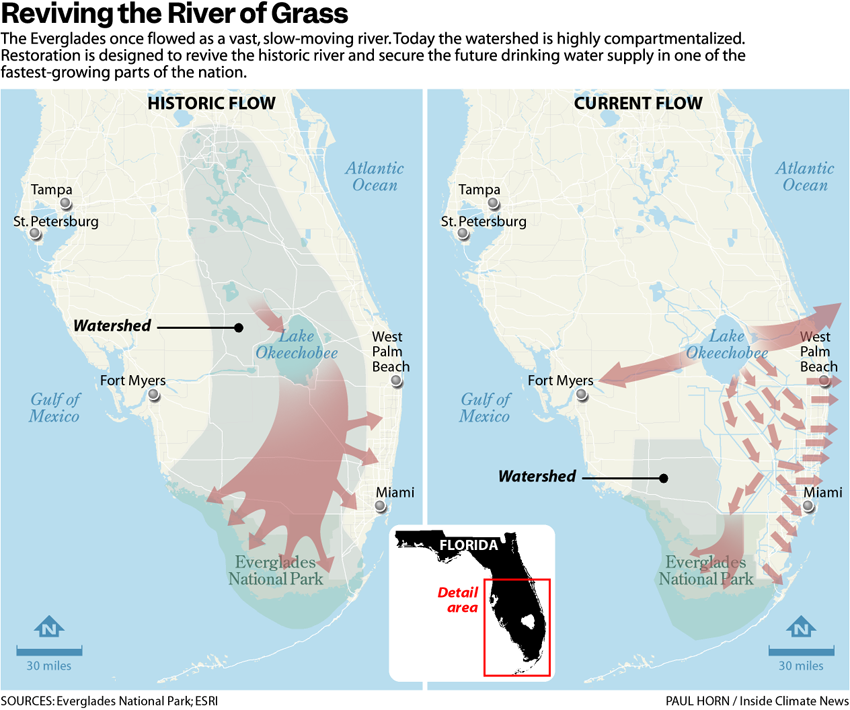
At the heart of the vast effort is the Everglades’ lifeblood water. In a state bounded on three sides by seawater, where water courses through underground aquifers and some 50 inches of rain falls annually, a series of historic efforts to drain the Everglades have made modern Florida possible. They have also pushed the state’s most important freshwater resource to the brink.
Every day, some 1.7 billion gallons of freshwater that once spilled over the southern shore of Lake Okeechobee and eventually flowed into the sawgrass marshes of the river of grass instead are carried through a series of canals and out to sea. That amount exceeds what is consumed in South Florida daily, and during times of high water the state’s flood control procedures require that even more freshwater be discharged to the coasts. The waste of so much freshwater would be problem enough. But the discharges also can overwhelm the delicate estuaries east and west of the state’s largest lake and, during the warm summer months, spread blooms of toxic algae, an issue that has become more persistent in recent years.
Everglades restoration is designed to recapture this freshwater and revive the watershed where it once flowed, with the overarching goal of securing the future drinking water supply in one of the fastest-growing parts of the nation. In this sense, the effort represents a remarkable investment in the future in a place where the future can feel less certain because of climate change.
“You can’t have a failure of imagination when you’re trying to address these issues. You’ve got to be operating at an appropriate scale,” said Shannon Estenoz, chief policy officer at the Everglades Foundation, an advocacy group.
“Don’t look at infrastructure as permanent,” she said. “The worst failure is you can’t imagine a landscape re-engineered. Or you can’t imagine an engineered landscape re-engineered.”
When former President Bill Clinton signed the Comprehensive Everglades Restoration Plan (CERP) into law in December 2000, the culmination of many years of scientific study and at times acrimonious political advocacy, nothing like it had ever been attempted anywhere.
Over the intervening 25 years, the landscape across an 18,000-square-mile expanse, larger than the state of Maryland, has undergone an extensive reshaping. Hundreds of miles of canals have been backfilled, enormous new reservoirs excavated and water control structures blown up, all to restore a more natural flow of water where for more than a half century some of the most complex water management infrastructure in the world has allowed for the urban jungles of South Florida to flourish alongside the wild Everglades.
The effort consists of dozens of massive infrastructure projects. The largest and most expensive is a $3.5 billion reservoir to be situated among sprawling sugarcane fields south of Lake Okeechobee, in a 1,100-square-mile region called the Everglades Agricultural Area (EAA). Once complete, the reservoir, designed to help reconnect the lake with the sawgrass marshes to its south, will be the largest of its kind that the U.S. Army Corps of Engineers has constructed anywhere in the country.
The Everglades Agricultural Area is situated south of Lake Okeechobee, where the river of grass once flowed. The region now raises vegetables, rice and sugarcane. Credit: Jose Iglesias/Miami HeraldThe construction site of the Everglades Agricultural Area reservoir, to the right, lies alongside a flow equalization basin, designed to store stormwater. Credit: Jose Iglesias/Miami Herald
Even partially built, the 16-square-mile reservoir is so big that it is impossible to see from one end to the other. The project also includes a 10-square-mile engineered wetland, or stormwater treatment area in the bureaucratic parlance of Everglades restoration, composed of lush vegetation that will serve as a natural water filter, with plant tissues absorbing nutrient pollution flowing from nearby farms.
Farther south, more stormwater treatment areas, 97 square miles of them in all, are scattered between the sugarcane and vegetable fields that make the EAA among the most bountiful regions in the nation and the fragile Everglades. Resembling nature but hardly natural, the wetlands are designed to replicate the filtering ability of the river of grass. The project, mandated under the Everglades Forever Act, which the state legislature approved in 1994, falls outside the scope of CERP, comprehensive as it is. Nowhere else on Earth have human-engineered wetlands like these ever been implemented at this scale.
Now the region faces another mounting threat. Temperatures and sea levels are rising and storm events are becoming more severe. The effort to rescue the river of grass has assumed an added responsibility: to save South Florida from the worst repercussions of climate change.
“If we don’t move on Everglades restoration, we’re not going to be able to address the issues and risks facing the built environment,” said Tom Van Lent, senior scientist at Friends of the Everglades, an advocacy group. “It’s more than just hope. It’s a necessity.”
A Pinball Machine of a River
The Everglades were formed from sea level rise. Over thousands of years, the tides built up the soil until it formed a gentle delineation between land and sea. The shallow freshwater coursed lazily among the sawgrass, the water stretching from the Atlantic Coastal Ridge to the east to the highlands of what is now part of the Big Cypress National Preserve to the west.
“The very mechanisms of sea level rise created the Everglades,” Van Lent said. “So we have to accelerate the efforts to get those back, because that’s what built the Everglades … but it’s not going to happen naturally. It’s probably too slow for that. But we have some tools, the very same tools you need to fight climate change or sea level rise.”
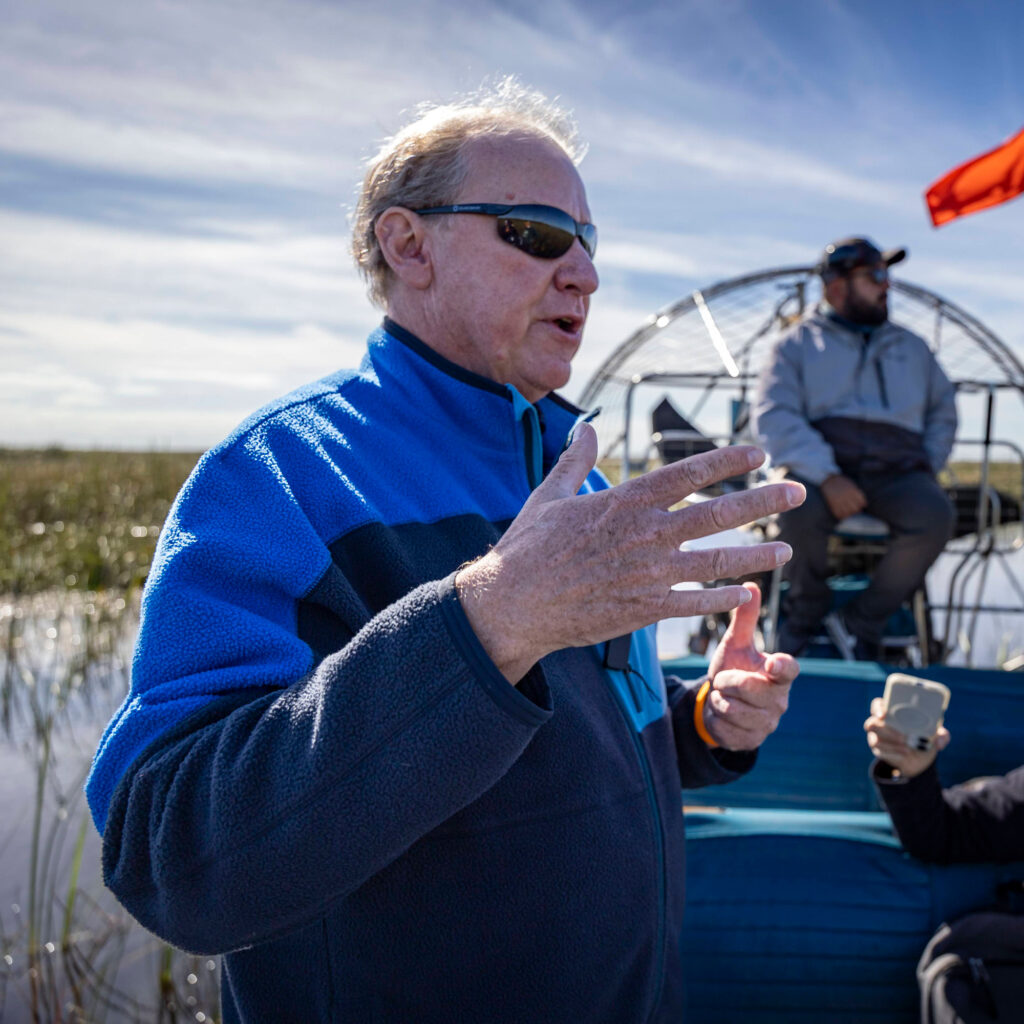
Tom Van Lent, senior scientist at Friends of the Everglades, says the river of grass remains highly compartmentalized and that more water storage is needed to revive the river of grass. Credit: Jose Iglesias/Miami Herald
Today, one could characterize the river of grass as a series of lakes, or reservoirs if you want to acknowledge the entirely artificial aspect of the reservoirs’ existence. The Everglades have been divvied up into a series of components: the Kissimmee River to the north, whose bends have been straightened and restored to their natural condition; Lake Okeechobee, which has been fully contained by the Herbert Hoover Dike; stormwater treatment areas, which cleanse the water; and water conservation areas, which were constructed for flood control, water supply and recreation.
Like a ball passing through the barriers of a pinball machine, the water flows among the components as directed by 2,200 miles of canals, 2,100 miles of levees and berms, 84 pump stations and 778 water control structures. The infrastructure, its efficacy a marvel on such flat terrain, began with a desire to drain or “reclaim” the Everglades, converting backwater Florida into a sunny paradise of agriculture, growth and development. Later attention turned to flood control after a hurricane in the 1920s caused Lake Okeechobee to overflow, killing thousands.
The situation is not all that different from that along the Mississippi, Missouri or Tennessee rivers, where a series of dams controls water flow. Everglades restoration involves removing as many of these dams as possible without risking flood control, while adding more reservoirs for water storage, all to revive a river of grass that flows once more.
One of these water conservation areas, 164-square-mile Water Conservation Area 2A west of Fort Lauderdale, resembles what one might imagine the Everglades to be. The sunshine sparkles upon the ripples of the gently moving water, which is clear and colored like tea by natural plant tannins. Patches of sawgrass and cattails are interspersed among the shrubby bayhead willows. A shiny black anhinga dives for a fish. But signs of trouble abound.
In the past, water levels were managed at depths that were too high, which obliterated tree islands that served as important habitat for wildlife such as alligators and deer. To address the problem, water managers many years ago lowered the levels, but the tree islands never recovered, leaving ghosts of islands that lack the elevation to support the majestic hardwoods found in other parts of the Everglades, such as cypress, pond apple and pop ash trees.
“This is an example of one of our first disasters in the Everglades,” Van Lent said. He was pointing from an idle airboat on a particularly mild November morning toward a cluster of bayhead willows, a marker of one of the tree island ghosts.
Cattails in Water Conservation Area 2A west of Fort Lauderdale signal trouble in the Everglades. They are a sign of nutrient pollution from the sugarcane fields to the north. Credit: Iglesias/Miami Herald
Cattails are native to Florida, but in the Everglades they have been characterized as another tombstone, a sign that nutrient pollution from sugarcane farms to the north has transformed the ecosystem into something else. Fish populations have thinned; alligators have become scrawny.
“It looks beautiful, and the quiet is wonderful, but it’s not a very productive area,” Van Lent said. “The landscape you see here is a direct consequence of converting the Everglades, river of grass, into a lake.”
Everglades restoration is designed to solve these problems by lowering water levels in places like the water conservation area where levels have been too high and delivering water to locations where levels have been too low, such as Everglades National Park.
A lack of funding during the first five to seven years after CERP was signed into law slowed progress, but record federal and state funding in recent years has propelled the effort forward at an unprecedented pace. Projects are complete or under construction in nearly every region of the Everglades, according to a 2024 report from the National Academies of Sciences, Engineering, and Medicine, the most recent available. The National Academies, a private nonprofit organization, has issued biennial reports on the effort’s progress since 2004, under a congressional mandate.
One project and two major project components are complete, another is essentially finished and six are under construction, according to the report. Already, the river of grass is showing signs of improvement. The National Academies characterized increased flows into northeast Shark River Slough, part of Everglades National Park, as the “largest step yet toward restoring the hydrology and ecology of the central Everglades.” Investments in controlling invasive species have led to a 75 percent reduction in the area overtaken by melaleuca, a particularly thirsty tree species introduced in the river of grass near the turn of the 20th century to help drain it.
Reservoirs are located east and west of Lake Okeechobee and are intended to help protect the fragile estuaries from nutrient pollution and toxic algae. An area of wetlands the size of the District of Columbia, called the Picayune Strand, has been rehydrated. But CERP is only one notable restoration effort underway in the Everglades. A substantial restoration of the Kissimmee River is complete. Refurbishment of the dike around the lake is finished, and a revision of the lake management rules went into effect in 2024. Sections of the Tamiami Trail, a scenic highway that crosses the Everglades, have been elevated to allow water to flow.
“We’re really in a heyday of Everglades restoration,” said Paul Gray, science coordinator for Audubon Florida’s Everglades restoration program.
The work is not done. The river of grass remains highly compartmentalized, and more water storage is needed before additional dams can be removed without risking flood-control problems, Van Lent said.
“We’ve scaled back every opportunity to create storage,” he said.
A New Water Standard
Crucial to Everglades restoration is clean freshwater. Historically, the water’s purity was singular, giving life to a watershed that flourished because of a unique paucity of nutrients, a situation that hindered the pursuit of any single species that would dominate the rest.
This changed with the draining and containing of the Everglades and explosive growth and development that followed. The extensive waterworks also made way for sprawling sugarcane fields in the Everglades Agricultural Area, where farmers tended their crops with nutrient-rich fertilizers. The fertilizers engorged the Everglades on nutrients, especially phosphorus, leading to the widespread proliferation of cattails. By the late 1980s, the river of grass was at risk of becoming a river of cattails.
“We’ve always held the importance of water quality as paramount to any other issue,” said Curtis Osceola, senior policy advisor for the Miccosukee Tribe of Indians of Florida, longtime environmental stewards for whom the Everglades are sacred. “For us it’s always been about keeping the water as pure as possible.”
Water Conservation Area 2A west of Fort Lauderdale looks natural, but problems abound. Everglades restoration is designed to address some of these problems. Credit: Jose Iglesias/Miami Herald
Several years of bitter litigation between the federal and state governments over the farmers’ pollution led to the Everglades Forever Act, a historic plan to clean up the water based largely on the construction of the stormwater treatment areas. The farmers also pitched in with efforts of their own, including adjusting fertilizer methods, controlling soil erosion and increasing on-site water retention. The plan for the most part has been successful. Pollution has declined at more than twice the rate mandated by state law. Today, at least 90 percent of the water meets the state standard. The Everglades Forever Act focuses on water quality, while CERP, which came later, encompasses water quality, storage and flow.
Although Everglades restoration is now moving greater volumes of water south into fragile areas such as Everglades National Park, there are fresh concerns about the potential spread of phosphorus pollution.
This year, a new standard will take effect. Called the Water Quality-Based Effluent Limitation (WQBEL), the standard is designed to shift scrutiny from protected areas of the Everglades to the stormwater treatment areas. The standard also is poised to affect CERP projects, particularly the mammoth reservoir under construction in the Everglades Agricultural Area, a project Gov. Ron DeSantis has described as “the crown jewel of Everglades restoration.”
After its scheduled completion in 2029, the reservoir is projected to provide approximately 370,000 acre-feet of “new” freshwater, diverted from the network of canals that would carry the water out to sea. That amount is enough to flood 578 square miles with a foot of water. DeSantis, a Republican, has prioritized Everglades restoration and pushed to expedite the reservoir’s construction during his two terms in office. But under an agreement between the Army Corps and the South Florida Water Management District, the federal and state agencies overseeing Everglades restoration, water managers will not be able to operate the reservoir at full capacity until all stormwater treatment areas have demonstrated compliance with the WQBEL for at least five years.
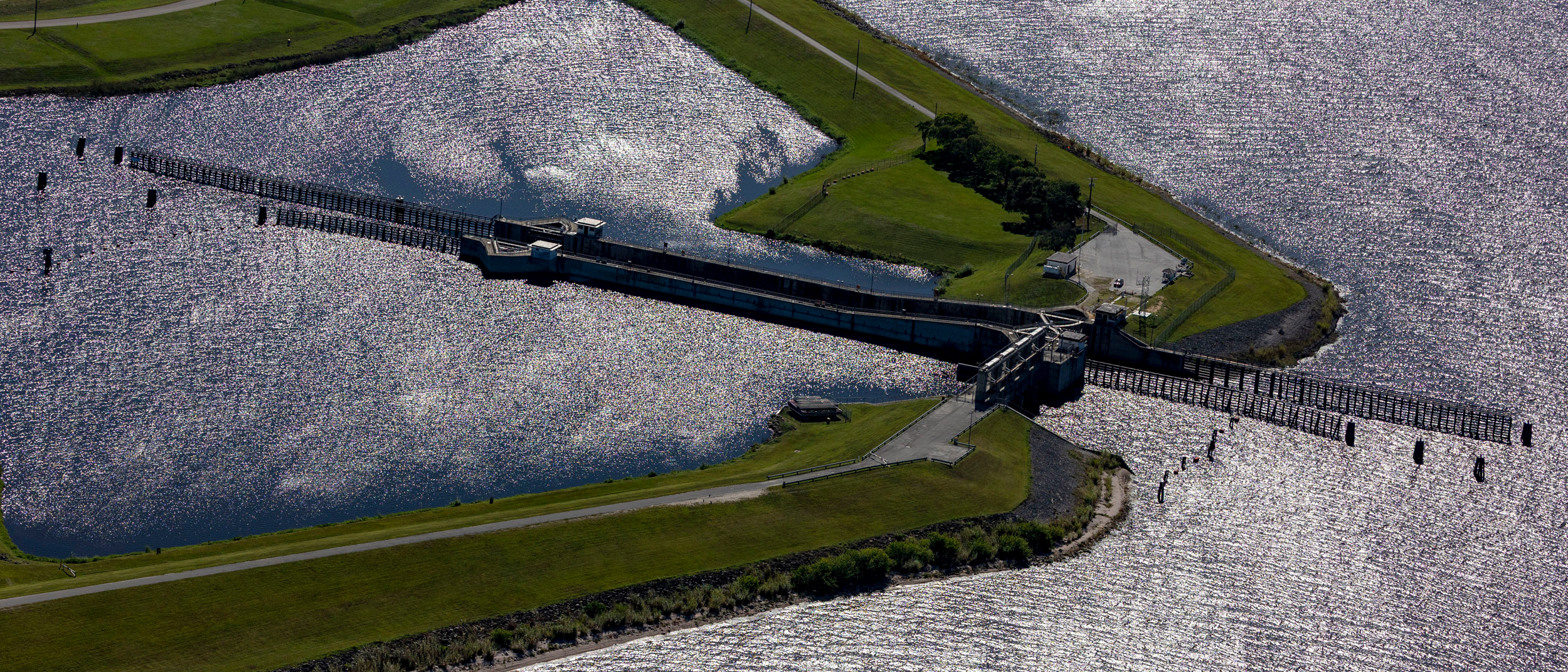
A lock and dam on Lake Okeechobee feeds the C-44 reservoir, an Everglades restoration project designed to spare the delicate estuary to the east of the lake of harmful nutrient pollution and toxic algae. Credit: Jose Iglesias/Miami Herald
As recently as 2024 only one stormwater treatment area met the standard, according to the National Academies. In 2022, the scientists said meeting the WQBEL by 2027 would be a “significant challenge,” although they noted phosphorus levels in the stormwater treatment areas were trending in the right direction. Noncompliance with the new standard would affect how much water could flow south into the reservoir, following the river of grass’ historic path, rather than east and west, threatening the estuaries that have been hammered by toxic algae, an issue that was central to DeSantis’ 2018 gubernatorial campaign.
“Fundamentally there is no Everglades restoration unless the water is clean,” said Eve Samples, executive director of Friends of the Everglades. She said if the reservoir “can’t effectively hold and flow as much water as was promised to the public then that raises very serious questions about whether the public has been served by the project.”
Friends of the Everglades and other groups, such as the Sierra Club in Florida, have raised concerns about the reservoir’s design, which they say does not meet restoration requirements. The organizations have voiced reservations about water quality and whether the reservoir will deliver enough water south. The groups also say the project’s designers failed to factor in the consequences of climate change. Friends of the Everglades is pushing for 160 square miles of additional conservation land in the Everglades Agricultural Area, to create space for 1 million more acre-feet of water storage.
“All of the other projects in most cases are, for me, mitigation,” said Cris Costello, senior organizing manager at the Sierra Club in Florida. “ I don’t think anybody, any of us, the organizations and the people in the state of Florida who embarked on this road 25 years ago, thought that CERP would become mitigation projects rather than actual restoration.”
Estenoz, a former assistant secretary for fish and wildlife and parks in the Biden administration before joining the Everglades Foundation, said operating the reservoir at less than its full capacity would not be an option, but she believes water quality standards, including the WQBEL, would be met.
“They have to be met. That’s the commitment,” she said. “It’s not an acceptable outcome that, ‘We’re done. We don’t meet the water quality standards therefore hydrology projects can’t be operated.’ That’s not the way the program is set up.”
This story is funded by readers like you.
Our nonprofit newsroom provides award-winning climate coverage free of charge and advertising. We rely on donations from readers like you to keep going. Please donate now to support our work.
Everglades restoration has always enjoyed remarkable bipartisan support, but like other environmental programs under the second Trump administration the effort has faced new challenges. One such development was the hastily assembled Everglades detention site called Alligator Alcatraz, where the Trump administration incarcerated thousands of undocumented migrants.
The facility’s existence alongside protected lands perpetually leased to the Miccosukee Tribe and are part of the Big Cypress National Preserve tested federal policies, including the National Environmental Policy Act (NEPA). Environmental groups and the tribe are pursuing litigation against the federal and state governments over the site, which the groups say was rushed to completion without any opportunity for public comment or environmental review as required by NEPA. The government agencies say the site does not threaten the environment.
“Alligator Alcatraz is perhaps the most stark example of the administration’s disregard for this fabric of environmental protections that were woven together a half-century ago, but it certainly doesn’t stand alone,” said Samples of Friends of the Everglades, one of the groups involved in the litigation. “If we continue to see an attack on NEPA it could affect things like Everglades restoration projects themselves, which have to comply with the NEPA process.”
What Comes After
Already there are spots where the Everglades are slipping away into the rising seas. The soil is collapsing, leaving something resembling large puddles among the freshwater marshes.
“It’s like Swiss cheese, round-type holes in the landscape that are filled with water,” said Steve Davis, chief science officer at the Everglades Foundation. “The rate of loss is very rapid. It’s on the order of a decade or two that these wetlands can be lost.”
The river of grass is vulnerable to climate change in various ways. Rising temperatures increase evaporation, further stressing a watershed already under pressure from growth and development. The hotter temperatures are sparking changes in precipitation—rainier rains and drier droughts. The watershed also is situated on relatively flat, low-lying and porous terrain, enabling higher tides to penetrate deeper into the freshwater marshes through the vast network of canals that holds the watershed together.
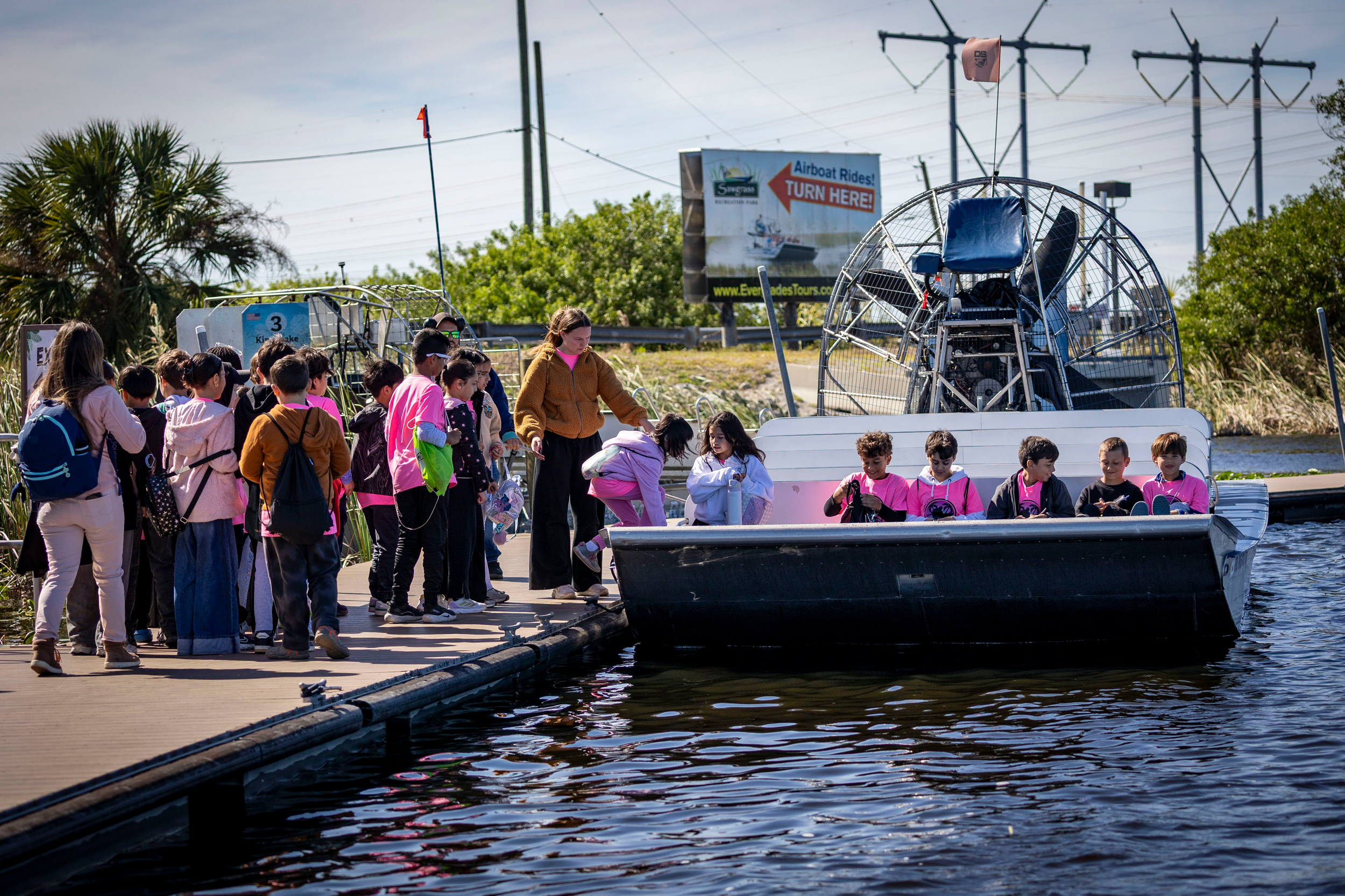
The Everglades are an important draw for tourists and recreationists, such as these children at Sawgrass Recreation Park in Weston, Fla. Credit: Jose Iglesias/Miami Herald
The National Academies, in its 2024 report, called for a strategy to understand how climate change may affect the massive effort to restore the Everglades. The report suggested developing a series of projected scenarios, based on variables such as hotter temperatures and rising seas, to layer with the models used to plan projects. The scenarios would help planners identify vulnerabilities that could affect the wildlife and habitats the projects are meant to preserve. Davis said it was too soon to cede South Florida to the rising seas.
“That notion of just throwing in the towel and giving up on Florida is really kind of reckless, because there is so much and so many that depend and will continue to depend on this system for decades to come,” Davis said.
Everglades restoration can help fortify the region as the climate warms by carving out space for more freshwater to remain on the landscape. That would encourage new peat accumulation and carbon sequestration.
But for all the billions of dollars spent, all the bipartisan support and dirt bulldozed, the grand gesture of hope may not be enough to fully address South Florida’s complex predicament, which begins with population growth that continues to stress the natural resources vital to sustaining that development, at a time when climate change is poised to further complicate the region’s plight. As profound as the hopeful gesture has been, Van Lent said another will likely be necessary once this one is deemed complete.
“The question becomes, what comes after CERP? What do we have to do so that we can really address the actual problems that South Florida faces?” he asked.
“How do we supply enough water to everybody? How do we maintain and improve the ecological function of the Everglades? All those things are important to our future, and CERP was never designed to cover them all,” he said. “It was never designed to really handle large-scale problems like ecosystem restoration or climate change. It’s designed to boil it down into very small, discrete doable project elements, and that’s not going to get us where we need to be.”
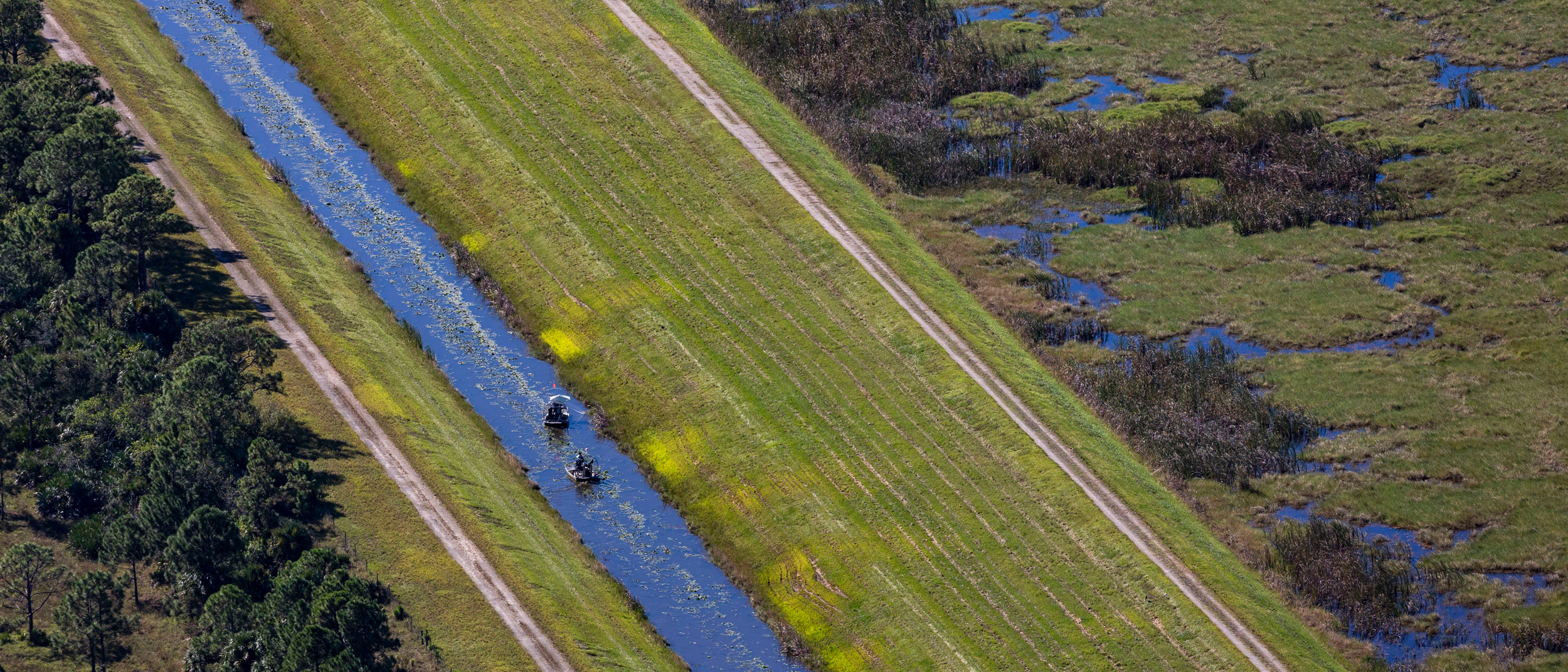
Two airboats traverse a canal in the Everglades. Credit: Jose Iglesias/Miami Herald
About This Story
Perhaps you noticed: This story, like all the news we publish, is free to read. That’s because Inside Climate News is a 501c3 nonprofit organization. We do not charge a subscription fee, lock our news behind a paywall, or clutter our website with ads. We make our news on climate and the environment freely available to you and anyone who wants it.
That’s not all. We also share our news for free with scores of other media organizations around the country. Many of them can’t afford to do environmental journalism of their own. We’ve built bureaus from coast to coast to report local stories, collaborate with local newsrooms and co-publish articles so that this vital work is shared as widely as possible.
Two of us launched ICN in 2007. Six years later we earned a Pulitzer Prize for National Reporting, and now we run the oldest and largest dedicated climate newsroom in the nation. We tell the story in all its complexity. We hold polluters accountable. We expose environmental injustice. We debunk misinformation. We scrutinize solutions and inspire action.
Donations from readers like you fund every aspect of what we do. If you don’t already, will you support our ongoing work, our reporting on the biggest crisis facing our planet, and help us reach even more readers in more places?
Please take a moment to make a tax-deductible donation. Every one of them makes a difference.
Amy Green covers the environment and climate change from Orlando, Florida. She is a mid-career journalist and author whose extensive reporting on the Everglades is featured in the book MOVING WATER, published by Johns Hopkins University Press, and podcast DRAINED, available wherever you get your podcasts. Amy’s work has been recognized with many awards, including a prestigious Edward R. Murrow Award and Public Media Journalists Association award.
Great Job By Amy Green & the Team @ Inside Climate News Source link for sharing this story.